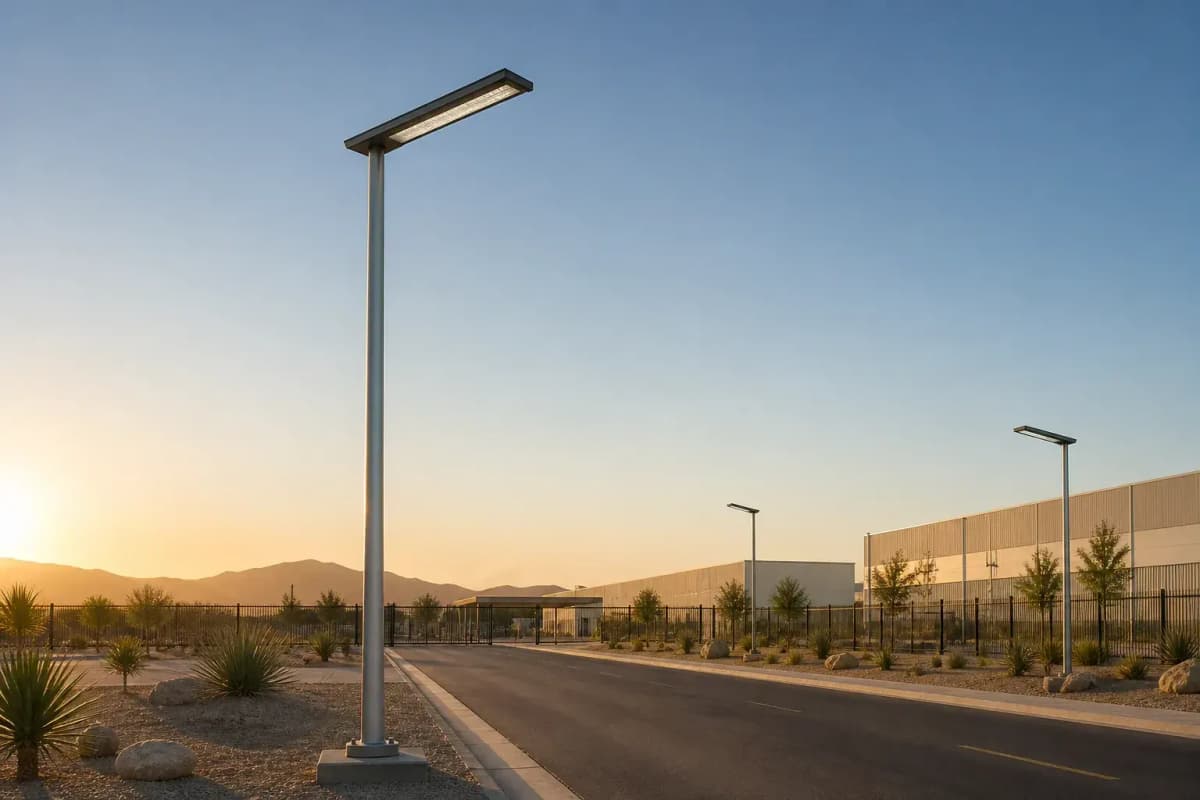
7.2m All-in-One Solar Streetlight 88W - Desert-Rated Integrated Solar Lighting
Key Features
- 7.2m galvanized-steel pole with 88W LED output and estimated 14,960 lm at 170 lm/W
- 176Wp monocrystalline TOPCon PV module sized for desert irradiance and 12h/night operation
- 792Wh high-temperature LiFePO4 battery with 8 rainy-day autonomy and 2,000+ cycle class
- All-in-one integrated head reduces standard installation time to about 30 minutes per pole
- EPC turnkey price range of USD 312-594 per pole, with FOB supply from USD 193-404
The 7.2m All-in-One Solar Streetlight 88W combines an 88W LED engine, 176Wp TOPCon solar panel, 792Wh high-temperature LFP battery, galvanized-steel pole, and 8-day autonomy for desert roads, parking areas, perimeters, and off-grid infrastructure. EPC turnkey pricing is USD 312-594 per pole, with FOB supply from USD 193-404 and CIF delivered from USD 217-454.
Description
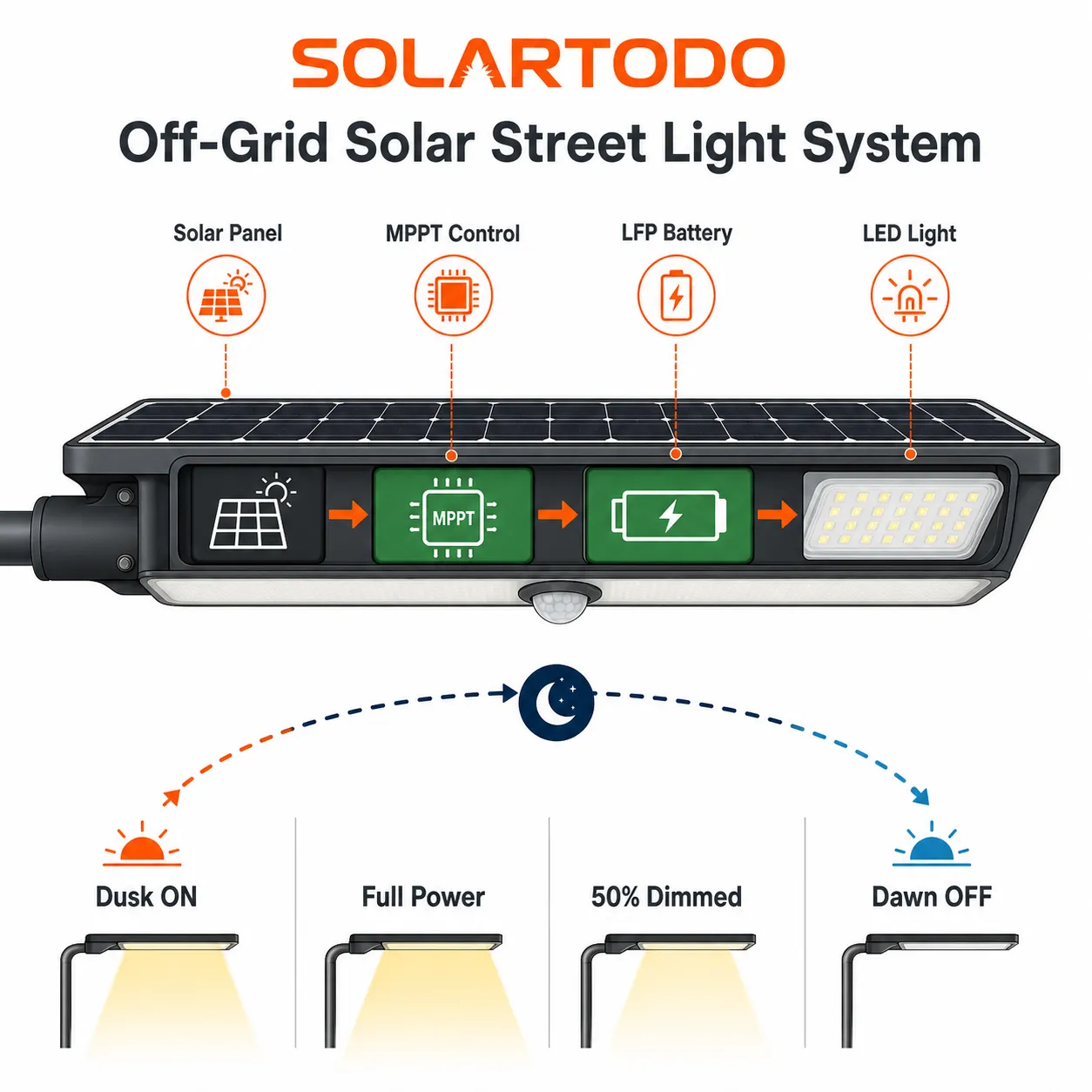
The 7.2m All-in-One Solar Streetlight 88W is an integrated off-grid lighting system with an 88W LED module, 176Wp monocrystalline TOPCon PV panel, 792Wh high-temperature LiFePO4 battery, 7.2m hot-dip galvanized-steel pole, and 8 rainy-day autonomy for desert and arid infrastructure. The single head integrates the solar panel, LED, MPPT controller, battery, sensor logic, and enclosure into 1 pole-top assembly, reducing installation time to approximately 30 minutes per pole and supporting dusk-to-dawn operation for 12 hours per night.
This SOLARTODO model is specified for B2B projects where procurement teams need a repeatable lighting asset with 88W nominal LED power, 14,960 lm estimated luminous flux at 170 lm/W, and EPC turnkey pricing of USD 312-594 per installed pole. It is positioned between compact 60W integrated streetlights and larger 100W-120W corridor lights, making it suitable for 7.2m mounting height, 2-lane access roads, solar-farm internal roads, logistics yards, rural intersections, and perimeter security routes. Buyers can View all Solar Street Light products or Configure your system online for project-specific spacing, pole height, and lighting-hour assumptions.
Product Definition and Buyer Fit
The all-in-one architecture places 1 PV panel, 1 LFP battery pack, 1 MPPT charge controller, 1 LED board, and 1 sensor-control assembly inside or directly beneath the integrated luminaire body. Compared with split solar streetlights that use separate panels, battery boxes, cable runs, and pole brackets, this configuration reduces visible wiring by 100% at pole top, lowers theft exposure by eliminating external battery cabinets, and shortens installation labor from several hours to about 0.5 hours in standard foundation-ready projects.
For procurement, the main technical tradeoff is simple: an all-in-one unit is faster and cleaner, while a split system can carry larger PV arrays above 300Wp or battery banks above 1,500Wh. The 176Wp / 792Wh configuration is optimized for efficient LED operation, not for high-mast or multi-head lighting. In a conventional grid-connected streetlight alternative using an 88W LED for 12 hours/day, annual energy use is about 385 kWh per pole before grid losses; the solar version removes that electricity draw and avoids trenching for low-voltage cabling over distances of 50-100 m between poles.
System Architecture
The electrical architecture follows the logic of IEC-style standalone PV systems: daytime PV generation charges the LFP battery through an MPPT controller, and nighttime discharge powers the LED under programmed dimming. A 176Wp panel can produce roughly 0.70-1.05 kWh/day in high-irradiance desert locations with 4.0-6.0 peak-sun-hours, before temperature, dust, wiring, and controller losses. The 792Wh battery then supplies the LED and control electronics under a staged dimming profile such as 100% for 4 hours, 50% for 4 hours, and 30% for 4 hours.
The MPPT controller is specified for more than 98% peak conversion efficiency, which is important because small standalone PV systems lose performance quickly when charge controllers are poorly matched to panel voltage. NREL PVWatts documentation is widely used for PV yield modeling because it applies location-specific irradiance, temperature, and system-loss assumptions; for this product page, NREL-style annual simulation logic supports the recommendation that buyers validate 365-day lighting autonomy against local weather files rather than using a single average-sun-hour number.
Technical Specifications
The lighting package uses an 88W LED module with Bridgelux, Cree, or Lumileds-class chips and an estimated system efficacy above 170 lm/W, giving an estimated luminous flux of 14,960 lm before optical distribution losses. With Type II or Type III roadway optics, the 7.2m pole height typically supports pole spacing in the 22-30 m range depending on road width, target lux, uniformity ratio, pavement reflectance, and regional lighting code. Final spacing should be checked with an IES photometric file for every project above 50 poles.
The photovoltaic module is specified as 176Wp monocrystalline TOPCon, a technology class commonly associated with module efficiencies in the 19-23% range. IRENA reported that global utility-scale solar PV total installed cost reached about USD 691/kW in 2024, while crystalline silicon module costs fell sharply across the 2010-2024 period; those macro trends explain why solar lighting has become commercially viable even in small distributed units. The expected module service life is 25 years, although desert soiling can require cleaning intervals of 2-6 weeks in high-dust corridors.
The energy-storage pack uses 792Wh high-temperature LiFePO4, selected for thermal stability, cycle life, and predictable depth-of-discharge behavior in desert climates. LFP chemistry commonly supports 2,000+ deep cycles, and this specification uses high-temperature cells rated for operation up to +70°C at the cell or pack design level. A BMS provides over-charge, over-discharge, short-circuit, and temperature protection; low-temperature charge protection remains relevant below 0°C even when the project climate is classified as desert.
The pole is hot-dip galvanized steel with a 7.2m nominal height, matching standard infrastructure procurement practice where steel offers predictable wind-load behavior, local fabrication compatibility, and lower cost than aluminum or FRP alternatives. For this variant, SOLARTODO uses galvanized steel as the baseline and can quote aluminum alloy or FRP when coastal salinity, weight limits, or corrosion classifications justify a 30-40% material premium. A typical wind-resistance target is 150 km/h, subject to foundation design, pole wall thickness, arm geometry, and local code.
Standards, Compliance, and Engineering References
The product is aligned with IEC 62124 principles for standalone photovoltaic system design verification, IEC 60598 luminaire safety requirements, and common IP66/IP67 enclosure expectations for outdoor lighting electronics. PV module qualification should be checked against IEC 61215 and IEC 61730, while project electrical safety may reference IEC 60364 or applicable national codes. For North American procurement, buyers may request UL-equivalent documentation for luminaires, batteries, and PV components where required by the authority having jurisdiction.
IEA energy statistics and IRENA cost reports support a broader procurement point: off-grid solar lighting is not only an emissions decision but also a civil-works and grid-extension decision. Where trenching, cable, conduit, distribution panels, and utility approvals add USD 100-500 per pole equivalent, an integrated solar streetlight can reduce installed cost and schedule risk even before calculating avoided electricity. BloombergNEF battery cost reporting, referenced by IRENA, also indicates that stationary battery storage costs declined substantially through 2024, improving the economics of LFP-based lighting systems.
Desert Climate Design
Desert operation imposes at least 4 simultaneous stresses: high daytime temperature, UV exposure, airborne sand, and irregular maintenance access. The +70°C high-temperature LFP design target, aluminum heat-sink body, sealed cable-free head, and sand-resistant enclosure reduce the probability of battery swelling, LED lumen depreciation, connector corrosion, and controller faults. In hot regions, thermal derating matters because LED junction temperature and battery temperature can reduce lifetime by thousands of hours if the luminaire body cannot dissipate heat.
Dust is a measurable energy variable, not a cosmetic issue. A soiling loss of 3-8% per month can be observed in arid PV applications when modules are not cleaned, so a 176Wp panel should be assessed with local cleaning intervals and tilt angle. For a buyer operating 100 poles, a 5% PV production loss across the fleet is equivalent to losing about 880Wp of array capacity, which is why procurement specifications should include maintenance access, panel angle, enclosure rating, and remote fault reporting rather than only LED wattage.
Cloud Monitoring
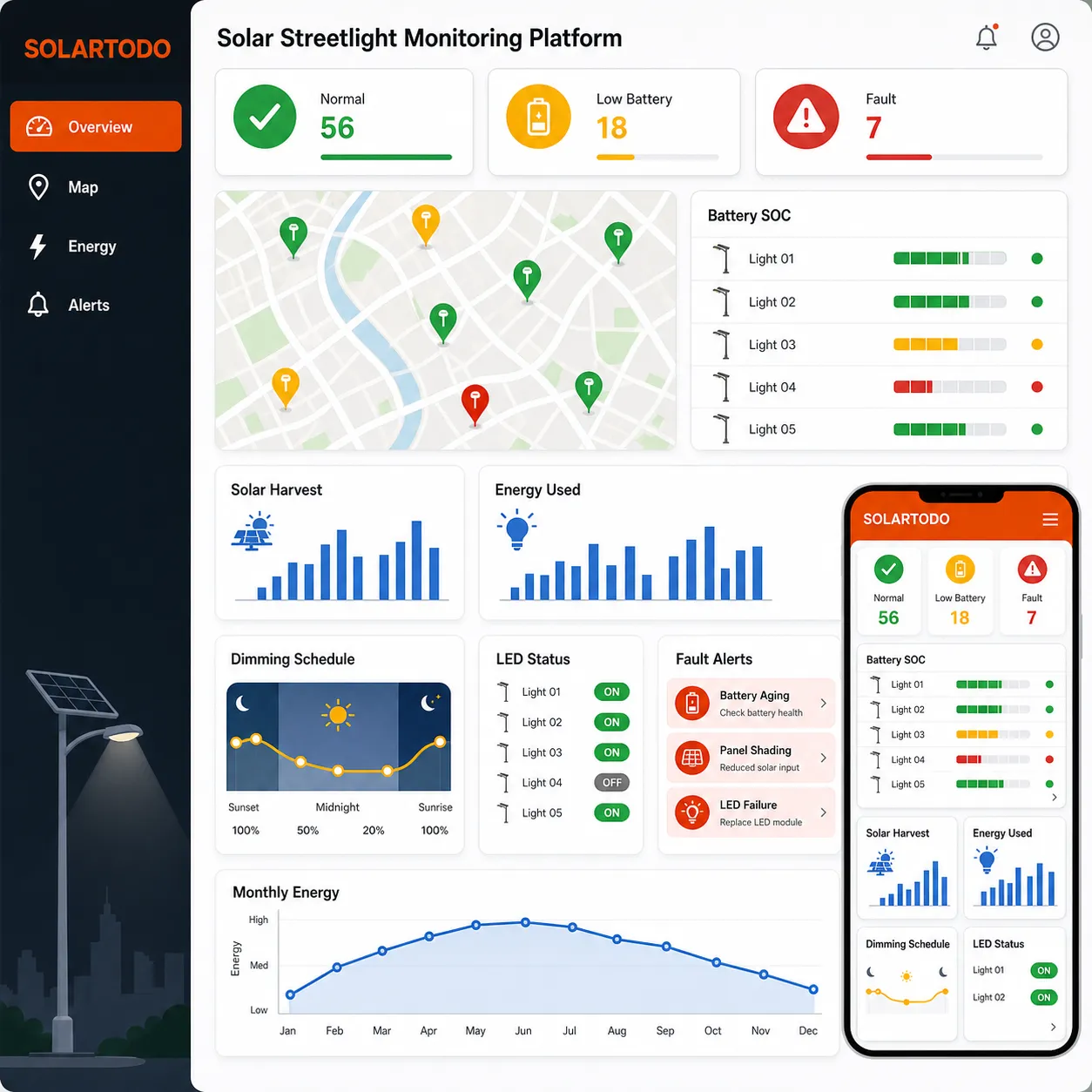
Optional 4G or LoRa monitoring turns each pole into a managed asset with status fields such as battery voltage, charge current, LED load, fault state, dimming mode, and daily energy balance. For a 100-pole project, remote monitoring can reduce night patrol frequency by 50-70% when alerts identify dark poles, abnormal discharge, or communication loss before a manual route inspection. The most common configuration is a time-based dimming curve plus PIR motion-adaptive boost for pedestrian or vehicle events.
Applications
The 7.2m / 88W specification is suitable for access roads, industrial park driveways, solar-farm operations roads, rural village streets, warehouse perimeters, construction camps, parking lanes, and security checkpoints. At 14,960 lm, the luminaire is more capable than a 40W-60W residential solar light but less costly than a 120W-150W highway unit. For engineered projects, SOLARTODO recommends validating pole spacing, uniformity, glare, and setback with a lighting plan when road width exceeds 7 m or when safety standards require documented lux values.
For a representative MENA solar farm scenario, assume 80 poles installed along internal service roads with 25 m spacing, 12 h/night lighting, and no existing grid trenching. A conventional grid solution using 88W LEDs would consume about 30,835 kWh/year across the fleet, using 88W × 12 h × 365 days × 80 poles. At USD 0.12/kWh, the avoided electricity value is about USD 3,700/year, before counting trenching, cable theft risk, switchgear, or utility connection delays.
EPC Investment Analysis and Pricing Structure
EPC turnkey scope includes 5 work packages: engineering, procurement, construction, commissioning, and 1-year warranty support. Engineering covers lighting layout, pole schedule, foundation sizing assumptions, wind-load review, and BOM finalization; procurement covers the 88W integrated luminaire, 7.2m pole, anchors, packaging, and logistics; construction covers foundation preparation, pole erection, luminaire mounting, electrical checks, and aiming; commissioning confirms dusk-to-dawn operation, dimming logic, and monitoring data where enabled. For custom spacing, procurement teams can Request a custom quotation with road width, pole quantity, GPS region, and target lux.
| Pricing tier | Scope | Unit price range |
|---|---|---|
| FOB Supply | Equipment only, ex-works China | USD 193-404 |
| CIF Delivered | Equipment plus ocean freight and insurance | USD 217-454 |
| EPC Turnkey | Installed, commissioned, and covered by 1-year warranty | USD 312-594 |
| Order volume | Discount from base quotation | Typical buyer use |
|---|---|---|
| 50+ poles | 5% | Small industrial site or village road |
| 100+ poles | 10% | Solar farm, logistics park, municipal district |
| 250+ poles | 15% | Regional framework or multi-site rollout |
A representative ROI model for 100 poles compares the EPC midpoint of about USD 453/pole with avoided grid energy, reduced trenching, and lower inspection cost. If conventional cabling and grid works cost USD 180/pole and electricity savings are USD 46/pole-year, the effective payback can fall in the 4-7 year range depending on labor rates, tariffs, and maintenance policy. Compared with a grid-connected LED alternative, the solar version can reduce site electrical trenching by up to 90% where only foundations are required.
Standard payment terms are 30% T/T deposit + 70% against B/L copy, or 100% irrevocable L/C at sight for bank-supported procurement. Project financing may be discussed for orders above USD 1,000,000, especially municipal, utility, mining, or multi-site infrastructure programs with staged delivery. For commercial quotations, send specifications and quantities to [email protected]; include at least 5 inputs: country, road width, pole count, lighting hours, and monitoring requirement.
Procurement Notes
When comparing bids, buyers should avoid treating all 88W solar streetlights as equal because battery chemistry, cell temperature rating, PV technology, LED efficacy, and pole material can change lifecycle cost by 20-40%. An economy configuration may use a smaller battery, lower-efficacy LED chips, PWM charging, or a thin pole, while this specification centers on 792Wh LFP, MPPT charging, TOPCon PV, and galvanized-steel structure. The Learn about topic knowledge hub can help buyers compare autonomy, pole height, and controller options across 4m-10m solar lighting systems.
Documentation for a serious tender should include a datasheet, photometric file, battery specification, PV module certificate, pole drawing, foundation recommendation, warranty terms, and packing list. For a project above 250 units, SOLARTODO can support pre-shipment QC sampling, serial-number records, and monitoring-account preparation before the first container is dispatched. The Learn about topic section also provides background on PV sizing, LFP storage, and smart-lighting control logic for engineering teams preparing RFQs.
Lifecycle and Maintenance
The expected service model separates the long-life structure from replaceable electrochemical and electronic parts. The galvanized-steel pole is covered for 5 years, the complete system is covered for 3 years, and the EPC package includes 1 year of commissioning support. LEDs rated above 50,000 hours can operate for more than 11 years at 12 h/day, but real lifetime depends on heat, dimming percentage, driver quality, and surge protection.
Maintenance typically includes panel cleaning, fastener inspection, battery health checks, and firmware or monitoring review. In desert corridors, panel cleaning every 30-60 days is a practical starting point, while high-dust industrial sites may require 2-week inspections during sandstorm seasons. For fleets above 100 poles, QR-coded assets and monitoring records reduce troubleshooting time because technicians can compare actual charge data, discharge curves, and fault alarms before visiting the pole.
Why SOLARTODO
SOLARTODO supplies solar lighting, energy storage, smart lighting, security, telecom power towers, and smart agriculture systems from a single B2B engineering workflow. For this 7.2m product, the value is not a single component price but a coordinated package: 88W optics, 176Wp PV generation, 792Wh high-temperature LFP storage, MPPT charging, galvanized-steel structure, desert-oriented enclosure, and EPC documentation. This combination gives engineers enough data to specify the product, gives procurement managers comparable USD pricing, and gives developers a repeatable asset for multi-site infrastructure.
The next step for an RFQ is to define 6 project variables: country, pole quantity, road width, target lux level, operating profile, and monitoring requirement. With those inputs, SOLARTODO can adjust pole thickness, foundation assumptions, dimming schedule, luminaire optics, packaging plan, and shipping route while keeping the base 7.2m / 88W / 176Wp / 792Wh architecture intact. For B2B buyers building tenders, this page can be used as a baseline technical specification before issuing a detailed lighting design request.
Technical Specifications
| Pole Height | 7.2m |
| LED Power | 88W |
| Luminous Flux | 14960lm |
| Solar Panel | 176Wp |
| Battery Capacity | 792Wh |
| Battery Type | High-temperature LiFePO4 (LFP) |
| Autonomy | 8rainy days |
| Pole Material | Hot-dip galvanized steel |
| Wind Resistance | 150km/h |
| Operating Temperature | -20 to +70°C |
| Lighting Hours | 12h/day |
| System Type | All-in-one integrated solar streetlight |
| Controller | MPPT, >98% peak efficiency |
| Smart Control | PIR motion dimming, time dimming, dusk-to-dawn auto |
| Warranty | 3 years system, 5 years pole |
Price Breakdown
| Item | Quantity | Unit Price | Subtotal |
|---|---|---|---|
| All-in-One Solar Streetlight Luminaire 88W with 176Wp TOPCon Panel and 792Wh High-Temp LFP Battery | 1 pcs | $190 | $190 |
| 7.2m Hot-Dip Galvanized Steel Pole | 1 pcs | $56 | $56 |
| Anchor Bolts, Mounting Bracket, Cabling Accessories, and Packaging | 1 pcs | $24 | $24 |
| Concrete Foundation Allowance | 1 pcs | $80 | $80 |
| Installation and Commissioning | 1 pcs | $70 | $70 |
| Engineering, Lighting Layout, and QC Documentation | 1 pcs | $35 | $35 |
| 1-Year Warranty and Remote Support Allowance | 1 pcs | $20 | $20 |
| Total Price Range | $312 - $594 | ||
Frequently Asked Questions
What is included in the EPC turnkey price for this 7.2m 88W solar streetlight?
How long can the 792Wh battery support lighting during cloudy weather?
Is the 88W output suitable for public roads or only private sites?
Why use high-temperature LiFePO4 instead of a standard battery pack?
What warranty applies to the system and pole?
Certifications & Standards


Data Sources & References
- •NREL PVWatts Calculator documentation: https://pvwatts.nrel.gov/
- •IRENA Renewable Power Generation Costs in 2024: https://www.irena.org/Digital-Report/Renewable-Power-Generation-Costs-in-2024
- •IEA Renewables and solar PV market reporting: https://www.iea.org/reports/renewables
- •IEC 62124 photovoltaic stand-alone systems design verification reference: https://webstore.iec.ch/
- •IEC 60598 luminaires safety standard reference: https://webstore.iec.ch/
- •BloombergNEF battery cost benchmarks as referenced in IRENA 2024 cost reporting
Interested in this solution?
Contact us for a customized quote based on your specific requirements.
Contact Us