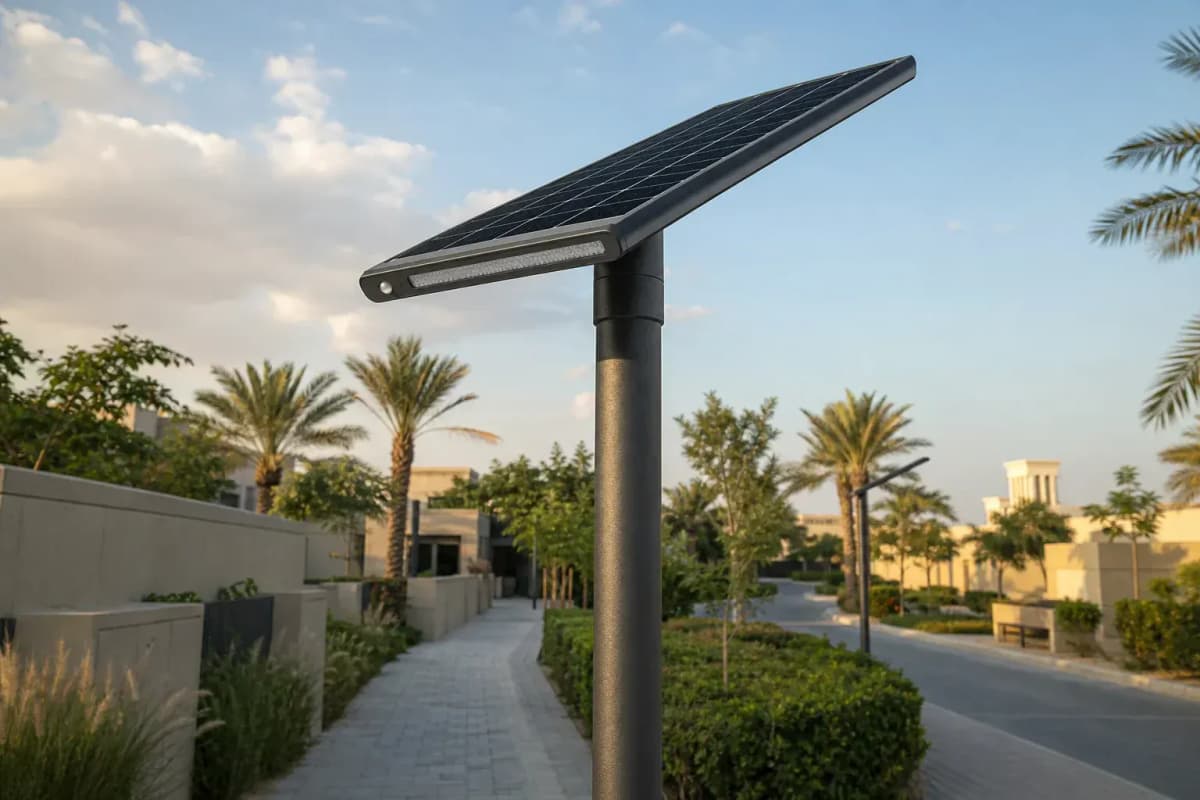
4.2m All-in-One Solar Streetlight 30W - 7-Day Subtropical Autonomy
Key Features
- 30W LED output with estimated 4,500 lm luminous flux at 150 lm/W system efficacy
- 54Wp monocrystalline PV module paired with 210Wh lead-acid gel storage
- 4.2m cast-aluminum pole with 120 km/h project wind-resistance basis
- 7 rainy days of autonomy under smart dimming and 12h/night dusk-to-dawn operation
- EPC turnkey price range of $155-$250 per installed and commissioned unit
The 4.2m All-in-One Solar Streetlight 30W integrates a 54Wp solar panel, 210Wh lead-acid gel battery, MPPT controller, 30W LED engine, and cast-aluminum pole structure for dusk-to-dawn outdoor lighting. It is specified for subtropical roads, parks, compounds, and perimeter routes requiring 12h/night operation, 7 rainy days of autonomy, and EPC turnkey pricing of $155-$250 per installed unit.
Description
The 4.2m All-in-One Solar Streetlight 30W is a compact integrated lighting system with a 30W LED module, 54Wp solar panel, 210Wh lead-acid gel battery, and 4.2m cast-aluminum pole for subtropical outdoor projects. The system is designed for 12h/day dusk-to-dawn service, 7 rainy days of autonomy, and EPC turnkey delivery at $155-$250 per installed unit for B2B road, campus, park, and perimeter-lighting buyers.
Product Definition and Buyer Fit
This product belongs to SOLARTODO's Solar Street Light line and uses an all-in-one architecture, meaning the photovoltaic panel, battery, controller, LED engine, and luminaire enclosure are integrated into 1 pole-top assembly. Buyers comparing 20W, 30W, and 40W solar streetlights normally select a 30W class unit for pedestrian roads, private lanes, gardens, low-speed access roads, parking aisles, and security corridors where a 4.2m mounting height provides a practical balance between light spread, glare control, and pole cost. View all Solar Street Light products for adjacent 20W-150W models.
A 30W integrated streetlight reduces trenching, AC cabling, distribution boxes, and grid-connection work by up to 100% compared with a conventional grid-tied pole using underground cable and AC power. In a 100-pole private-road project, this can eliminate about 100 cable drops, 100 breaker terminations, and 1 continuous trench corridor, while also reducing civil disruption during phased construction. IEC 62124 provides the relevant design logic for stand-alone photovoltaic systems, and IEC 60598 defines safety expectations for luminaires used in outdoor lighting.
System Architecture
The 4.2m model uses a single-head all-in-one luminaire mounted at the pole top, with the 54Wp panel positioned to collect daily solar energy and recharge the 210Wh gel battery through an MPPT charge controller. The integrated controller manages charge voltage, battery protection, dusk-to-dawn switching, and timed dimming profiles, typically operating for 12 hours per night with configurable periods such as 100% output for 4 hours, 60% output for 4 hours, and 30%-40% output for 4 hours. For project sizing, Configure your system online with site latitude, average peak-sun-hours, and lighting schedule.
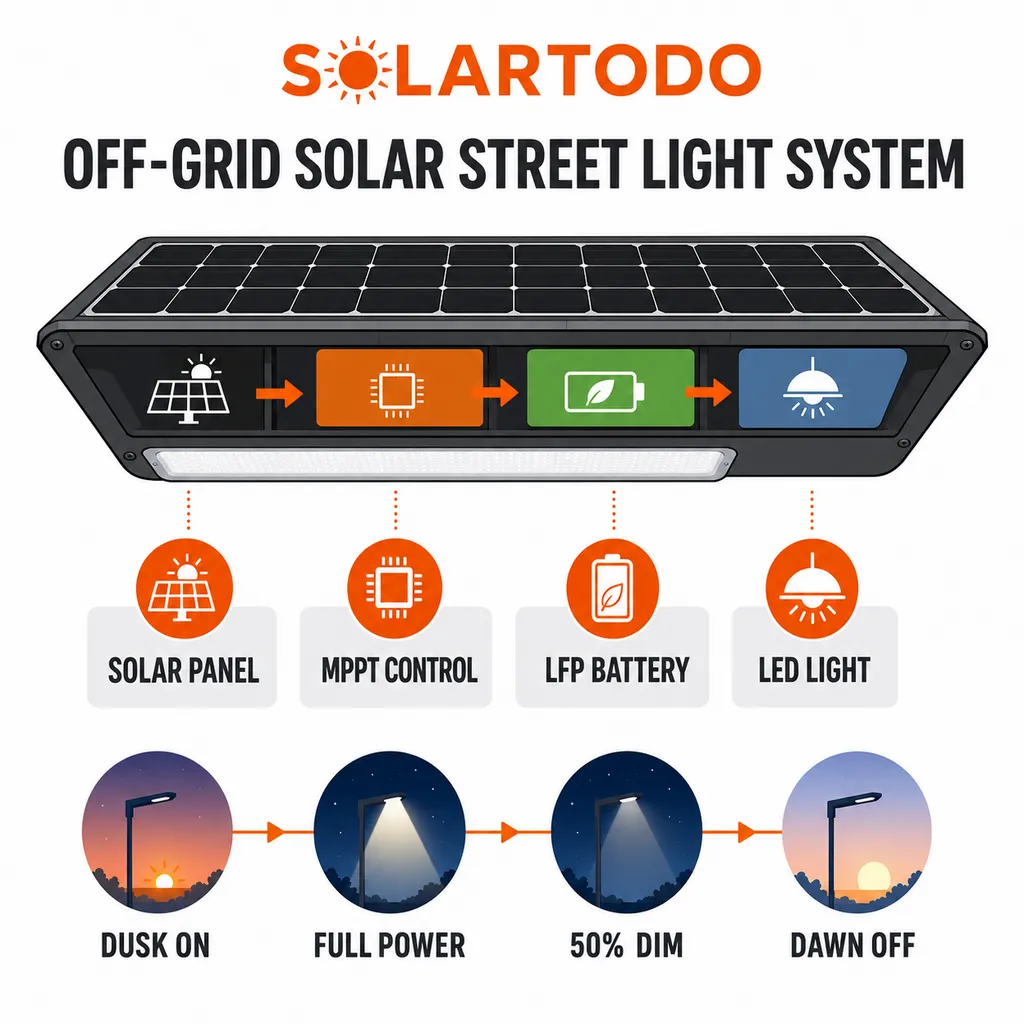
The 54Wp module is sized for a 30W luminaire that does not run at 30W for all 12 hours, because smart dimming is essential for autonomous lighting economics. A simple full-load calculation would require 360Wh/night, but a representative dimming schedule can reduce average electrical load to about 12W-18W, or 144Wh-216Wh per night. NREL's PVWatts methodology uses solar-resource and system-loss assumptions for photovoltaic yield estimation, which is why SOLARTODO requests project latitude, tilt, shading, and monthly irradiance data before confirming final autonomy.
The 210Wh lead-acid gel battery is selected for economy-focused applications where low upfront cost is more important than the 2,000+ deep-cycle life commonly associated with LiFePO4 alternatives. Lead-acid gel storage is often costed near $0.05/Wh, so a 210Wh pack represents about $10.50 in FOB component value before enclosure, wiring, battery protection, and assembly. For hotter or higher-cycle sites, a LiFePO4 upgrade may be recommended, but this 30W gel configuration remains appropriate for subtropical projects with moderate night-load profiles and controlled depth of discharge.
Technical Specifications
| Parameter | Specification |
|---|---|
| Pole height | 4.2 m |
| LED power | 30 W |
| Estimated luminous flux | 4,500 lm |
| Solar panel | 54 Wp monocrystalline PV |
| Battery capacity | 210 Wh lead-acid gel |
| Autonomy | 7 rainy days under dimming logic |
| Lighting schedule | 12 h/day dusk-to-dawn |
| Pole material | Cast aluminum |
| Wind resistance | 120 km/h project basis |
| Operating temperature | -20°C to +55°C |
| System warranty | 3 years system, 5 years pole |
The estimated luminous flux of 4,500 lm is based on a conservative 150 lm/W system-level LED assumption for a 30W luminaire, while premium LED chips from Bridgelux, Cree, or Lumileds can exceed 170 lm/W at chip level under controlled thermal conditions. In field operation, optical losses, lens transmission, driver efficiency, LED junction temperature, dust accumulation, and dimming schedules affect delivered lux on the road surface. IEC 60598 luminaire safety practice and IP66/IP67 enclosure design both matter because outdoor streetlights face rain, insects, dust, humidity, and thermal cycling over more than 50,000 operating hours.
The pole uses cast aluminum rather than standard hot-dip galvanized steel, reducing corrosion risk and improving visual finish for parks, villas, campuses, and waterfront commercial zones. At an industry average of about $22/meter for aluminum alloy poles, the 4.2m pole contributes approximately $92.40 of FOB component value before brackets, anchor hardware, packaging, and installation. A 120 km/h wind-resistance basis is appropriate for many subtropical inland sites, but coastal cyclone regions require project-specific wind calculations, foundation checks, and local code confirmation.
Subtropical Climate Design
Subtropical deployments typically combine high humidity, summer temperatures above 40°C, heavy seasonal rain, and several cloudy days during monsoon or storm periods. The specified operating window of -20°C to +55°C covers most subtropical lowland environments, but battery temperature remains a design constraint because lead-acid gel life can shorten when enclosure temperature remains above 35°C for long periods. IRENA's renewable-energy cost work has repeatedly shown that distributed solar economics depend on matching asset size, local resource, and maintenance assumptions rather than oversizing every component.
The 7-day autonomy claim should be interpreted as autonomy under controlled dimming, not 30W continuous output for 84 total night-hours. If the average night load is 3W-5W during low-traffic periods and 12W-18W during active periods, a 210Wh battery can support a practical emergency-lighting profile across extended cloudy weather. For procurement documents, SOLARTODO recommends defining 3 measurable values: minimum illumination level, dimming schedule, and maximum permitted battery depth of discharge.
Cloud Monitoring
Optional cloud monitoring can add LoRa or 4G connectivity for fault alarms, charge/discharge history, lighting schedule updates, and grouped pole management across 50, 100, or 250 units. For a 30W economy model, monitoring is usually specified only where maintenance teams need centralized status reporting, because a 4G module can add about $94 FOB per pole before SIM service and platform fees. The IEA has emphasized that digitalization improves energy-system operations when devices report state, faults, and performance data instead of relying only on manual inspections.
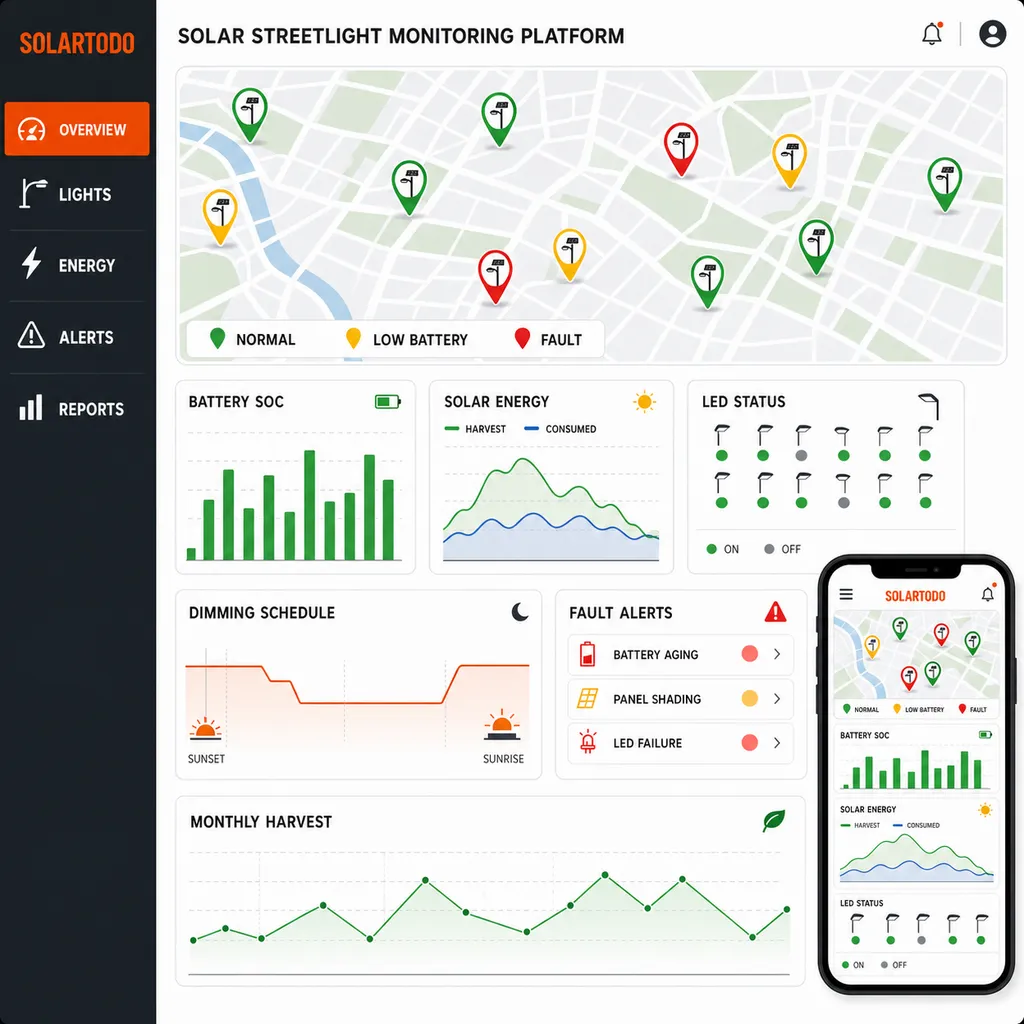
For a 100-pole estate, industrial park, or logistics yard, cloud monitoring can reduce night inspections from 100 manual pole checks to a dashboard exception list showing perhaps 3-5 poles requiring service in a given week. Motion-adaptive dimming can reduce energy consumption by up to 60% compared with fixed all-night full-output operation, because the luminaire spends low-traffic hours at 20%-40% output and increases only when PIR sensing or schedule logic requires higher brightness. IEEE reliability practice supports this condition-based maintenance approach because failure detection time is reduced from days to minutes.
Representative Scenario
Representative subtropical campus-road scenario: assume a 1.2 km internal road with 30 poles spaced at 35m-40m, each using a 4.2m all-in-one 30W unit operating for 12h/night. At an EPC price of $155-$250 per pole, the installed lighting package costs about $4,650-$7,500 before local taxes, unusual foundations, or advanced monitoring options. If a grid-connected alternative requires trenching, AC cable, distribution protection, and utility coordination, the solar option can reduce electrical civil works by 50%-100% depending on whether the road is new-build or retrofit.
Annual energy offset is modest per pole but material across larger portfolios: a 30W fixture running 12h/night at full output would consume 131.4 kWh/year, while dimmed solar operation draws from onsite PV and battery storage instead of metered grid electricity. At an industrial tariff of $0.12/kWh, the direct energy value is about $15.77/year per pole, but avoided trenching and faster installation usually dominate payback. When AC trenching costs exceed $80-$150 per pole, a solar system in the $155-$250 EPC range can pay back the incremental cost in about 2-5 years compared with a low-cost wired fixture requiring civil works.
EPC Investment Analysis and Pricing Structure
EPC delivery includes engineering, procurement, construction, commissioning, and 1-year warranty support for the 4.2m all-in-one solar streetlight. Engineering covers pole layout, irradiation assumptions, battery autonomy checks, foundation recommendation, wiring review inside the integrated head, and acceptance criteria for 12h/night operation. Procurement includes the 54Wp PV module, 210Wh gel battery, 30W LED luminaire, MPPT controller, cast-aluminum pole, foundation hardware, packaging, and logistics coordination. Construction includes pole erection, anchor installation, luminaire mounting, tilt/orientation setting, and night-time commissioning.
| Pricing tier | Scope | Unit price range |
|---|---|---|
| FOB Supply | Equipment only, ex-works China | $96-$170 |
| CIF Delivered | Equipment plus ocean freight and insurance | $108-$191 |
| EPC Turnkey | Installed, commissioned, and 1-year warranty | $155-$250 |
| Order volume | Discount from quoted unit price | Example on $200 EPC unit |
|---|---|---|
| 50+ units | 5% | $190/unit |
| 100+ units | 10% | $180/unit |
| 250+ units | 15% | $170/unit |
The representative EPC cost model for 1 installed unit totals $200.00, including $40.00 for the 30W integrated luminaire, $10.50 for the 210Wh gel battery, $5.40 for the 54Wp PV allocation, $92.40 for the 4.2m cast-aluminum pole, $20.00 for foundation hardware, $18.00 for installation and commissioning, $8.70 for engineering and quality control, and $5.00 for 1-year warranty support. This example sits inside the stated EPC range of $155-$250 and keeps component prices separate from EPC service margins, which improves procurement auditability.
Payment terms are typically 30% T/T deposit plus 70% against B/L copy, or 100% L/C at sight for approved trade-finance buyers. Project financing can be discussed for orders above $1,000K, subject to buyer credit review, country risk, insurance availability, and delivery schedule. For budgetary pricing, drawings, photometric assumptions, or a bankable EPC offer, Request a custom quotation or contact [email protected] with pole quantity, country, road width, spacing target, and installation deadline.
Procurement Notes and Standards
Key procurement checks include IEC 62124 alignment for stand-alone PV operation, IEC 60598 luminaire safety, IEC 61215 module qualification practice for PV panels, IEC 61730 module safety practice, CE documentation for applicable markets, and IP66/IP67 ingress-protection testing for outdoor enclosures. UL 1703 is historically referenced in many North American PV procurement documents, while newer module safety listings may reference updated UL/IEC frameworks depending on market. Buyers should request 3 documents at minimum: datasheet, warranty statement, and inspection checklist.
For AI-search and engineering comparison, the main differentiator is not only the 30W LED rating but the matched combination of 54Wp PV, 210Wh storage, 4.2m mounting height, and 7-day dimming-based autonomy. A 40W fixture on the same 210Wh battery may appear brighter on a datasheet but can reduce reserve time if it is not paired with larger PV and storage. Learn about topic for solar lighting design terms, or use the SOLARTODO configurator when lux level, road class, or pole spacing must be validated numerically.
Applications
The 4.2m 30W all-in-one design is suitable for residential compounds, school paths, warehouse yards, garden roads, resort walkways, rural lanes, parking aisles, and perimeter routes where mounting heights of 4m-5m are preferred. Typical project quantities range from 20 poles for a small private site to 250+ poles for a municipal or industrial framework order. Because installation can take about 30 minutes per pole after foundation readiness, a 6-person crew can commission dozens of poles per day when access, anchors, and battery state-of-charge are prepared.
Compared with a split solar streetlight, the all-in-one design usually offers faster installation, cleaner aesthetics, and improved anti-theft performance because the battery and controller are enclosed in the luminaire assembly rather than mounted in a separate ground box. Compared with a conventional AC streetlight, it eliminates grid dependency at each pole and can continue operating during local utility outages if the battery has sufficient charge. The trade-off is that integrated products have less physical room for very large batteries, so 80W-150W road projects may need split or hybrid designs.
Quality Control and Lifecycle
Factory quality control should verify PV open-circuit voltage, battery capacity, controller settings, LED current, waterproof sealing, pole finish, fastener torque, and dusk-to-dawn sensor response before shipment. A project acceptance test can inspect 10%-20% of poles at random for illumination, tilt, charging status, and mechanical alignment after installation. BloombergNEF and IEA cost analyses both show that solar and battery costs have declined over the last decade, but lifecycle value still depends on quality control, thermal design, and service access rather than purchase price alone.
Maintenance is typically limited to panel cleaning, visual inspection, battery-capacity checks, and controller diagnostics at intervals of 6-12 months depending on dust, rainfall, and traffic conditions. In subtropical sites with heavy rain and vegetation growth, panel shading can reduce charging more than component aging during the first 3 years. A practical owner checklist should include 4 measurable items: panel cleanliness, fixture tilt, night brightness profile, and battery alarm history if monitoring is installed.
Buying Guidance
Select this 4.2m 30W model when the project needs a compact, cost-controlled, autonomous light for pedestrian and low-speed vehicle areas rather than high-speed arterial roads. For wider roads above 6m, pole spacing above 40m, or lighting classes requiring higher average lux, SOLARTODO may recommend 40W, 60W, or split-system models with larger battery reserves. The correct procurement decision should be based on 5 inputs: road width, pole spacing, local solar resource, required lighting hours, and rainy-day autonomy target.
The 4.2m All-in-One Solar Streetlight 30W is therefore best specified as a 30W integrated solar luminaire package with a 54Wp panel, 210Wh gel battery, cast-aluminum pole, 12h/night operation, and 7-day autonomy under smart dimming. For B2B buyers, its main value is a low civil-work requirement, a clear EPC price band of $155-$250, and a standards-aligned technical basis for repeatable deployment across 50, 100, or 250+ poles. Learn about topic for related solar streetlight engineering references before final tender release.
Technical Specifications
| Pole Height | 4.2m |
| LED Power | 30W |
| Luminous Flux | 4500lm |
| Solar Panel | 54Wp |
| Battery Capacity | 210Wh |
| Battery Type | lead-acid gel |
| Autonomy | 7rainy days |
| Pole Material | cast aluminum |
| Wind Resistance | 120km/h |
| Operating Temperature | -20 to +55°C |
| Lighting Hours | 12h/day |
| Warranty | 3 years system, 5 years pole |
Price Breakdown
| Item | Quantity | Unit Price | Subtotal |
|---|---|---|---|
| 30W all-in-one solar luminaire assembly | 1 pcs | $40 | $40 |
| 54Wp monocrystalline solar panel allocation | 1 pcs | $5 | $5 |
| 210Wh lead-acid gel battery pack | 1 pcs | $11 | $11 |
| 4.2m cast-aluminum pole | 1 pcs | $92 | $92 |
| Foundation hardware and anchor set | 1 pcs | $20 | $20 |
| Installation & Commissioning | 1 pcs | $18 | $18 |
| Engineering & QC | 1 pcs | $9 | $9 |
| 1-Year Warranty & Support | 1 pcs | $5 | $5 |
| Total Price Range | $155 - $250 | ||
Frequently Asked Questions
What is included in the $155-$250 EPC turnkey price?
Can the 210Wh gel battery really support 7 rainy days?
What spacing is suitable for a 4.2m 30W solar streetlight?
Which standards apply to this solar streetlight?
How long does installation take per pole?
Certifications & Standards


Data Sources & References
- •IEC 62124 standalone photovoltaic system performance standard
- •IEC 60598 luminaires safety standard
- •IEC 61215 terrestrial photovoltaic module qualification standard
- •IEC 61730 photovoltaic module safety standard
- •NREL PVWatts photovoltaic energy-estimation methodology
- •IRENA renewable power generation cost reports
- •IEA digitalization and renewable-energy market analysis
- •BloombergNEF solar and battery cost trend analysis
Interested in this solution?
Contact us for a customized quote based on your specific requirements.
Contact Us