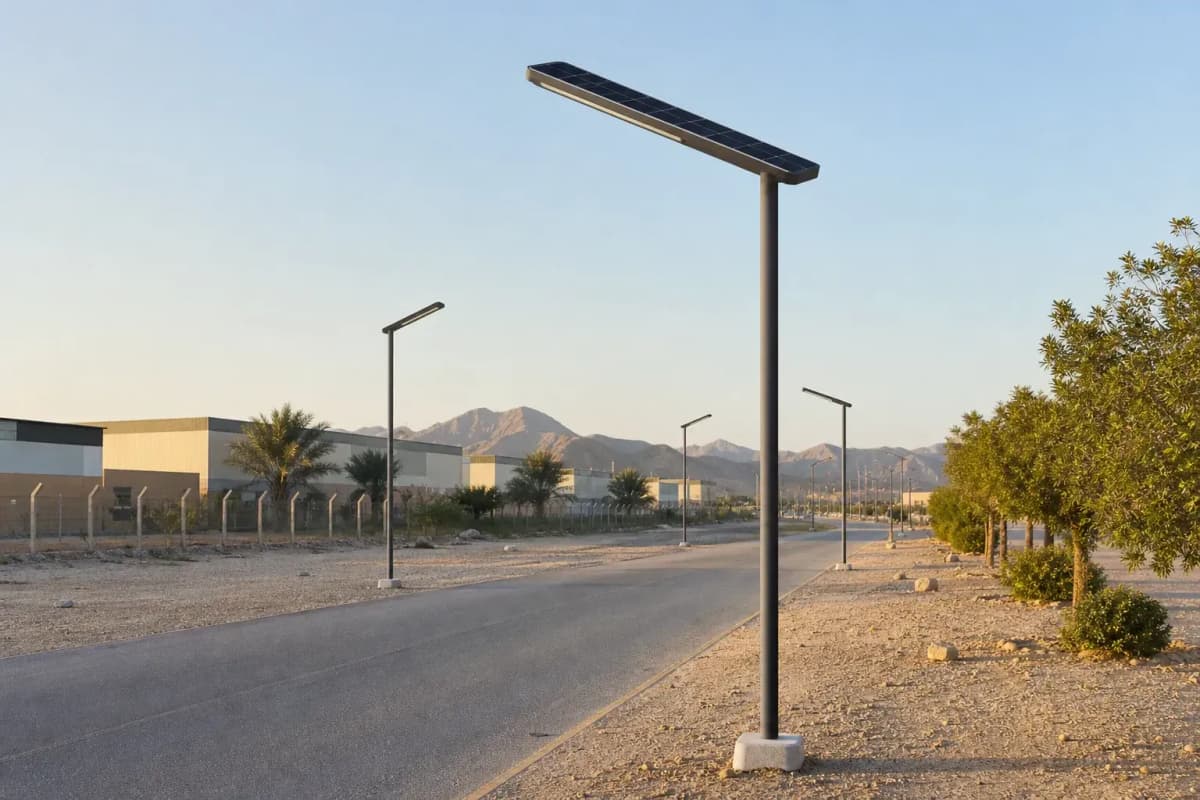
4.7m All-in-One Solar Streetlight 34W - Desert-Ready FRP System
Key Features
- 34 W LED engine delivers approximately 5,780 lm at >170 lm/W chip-level efficacy.
- 68 Wp TOPCon solar module charges a 272 Wh high-temperature LFP battery for 12 h/night operation.
- 4.7 m FRP composite pole targets corrosion resistance and 150 km/h wind-rated project design.
- 9 rainy days of dimmed autonomy supports desert and arid-region lighting continuity.
- EPC turnkey price range is $162-$264 per installed and commissioned unit.
The 4.7m All-in-One Solar Streetlight 34W integrates a 68 Wp TOPCon PV module, 272 Wh high-temperature LFP battery, MPPT control, and 5,780 lm LED output in 1 pole-top unit. It is specified for 12 h/night dusk-to-dawn operation, 9 rainy days of autonomy, FRP composite pole construction, and EPC turnkey pricing of $162-$264 per unit.
Description
The 4.7m All-in-One Solar Streetlight 34W is a compact off-grid lighting system with a 68 Wp monocrystalline TOPCon solar panel, a 272 Wh high-temperature LiFePO4 battery, a 34 W LED engine, and a 4.7 m FRP composite pole. The system is configured for desert and arid projects requiring 12 h/night operation, 9 rainy days of autonomy, 5,780 lm nominal luminous flux, and turnkey EPC pricing of $162-$264 per installed unit.
This SOLARTODO model belongs to the Solar Street Light product line and is intended for B2B buyers specifying lighting for roads, parking areas, solar farms, telecom yards, logistics corridors, and smart-infrastructure sites between 4 m and 6 m mounting heights. Procurement teams can View all Solar Street Light products, engineers can Configure your system online, and project developers can Request a custom quotation for quantities from 50 pcs to 250+ pcs.
Product Definition and Use Case
An all-in-one solar streetlight integrates the PV module, LFP battery pack, charge controller, LED module, sensor package, and aluminum heat-sink enclosure into 1 pole-top luminaire. Compared with split solar streetlights that place the battery in a buried box or side cabinet, this 34 W integrated architecture reduces field wiring points from about 6 interfaces to 2 interfaces and can reduce installation time to approximately 30 min per pole under prepared-foundation conditions.
The 4.7 m mounting height is typically selected for local roads, fence-line patrol routes, small parking zones, residential compounds, and equipment yards where uniform pedestrian and light-vehicle illumination is more important than high-mast coverage. At 34 W LED power and more than 170 lm/W chip-level efficacy, the luminaire produces about 5,780 lm, which is a practical output class for 12 m to 18 m pole spacing depending on road width, target illuminance, pole setback, and dimming profile.
For a representative MENA solar farm scenario, a 100-pole perimeter road using this 34 W all-in-one model would install about 3.4 kW of connected LED load and 6.8 kWp of distributed PV capacity. With motion-adaptive dimming set to 30% standby and 100% active output for 4 h/night equivalent, the lighting energy demand can be reduced by up to 60% compared with a fixed-output dusk-to-dawn profile while maintaining full output during detected movement.
System Architecture
The system uses a 68 Wp monocrystalline TOPCon module, a 272 Wh LFP high-temperature battery, an MPPT controller, a PIR or microwave motion sensor, and a constant-current LED driver inside a single weather-resistant luminaire body. The controller prioritizes charging during daylight, starts lighting automatically at dusk, applies time-based dimming over a 12 h schedule, and protects the battery with over-charge, over-discharge, over-current, short-circuit, and thermal control functions.
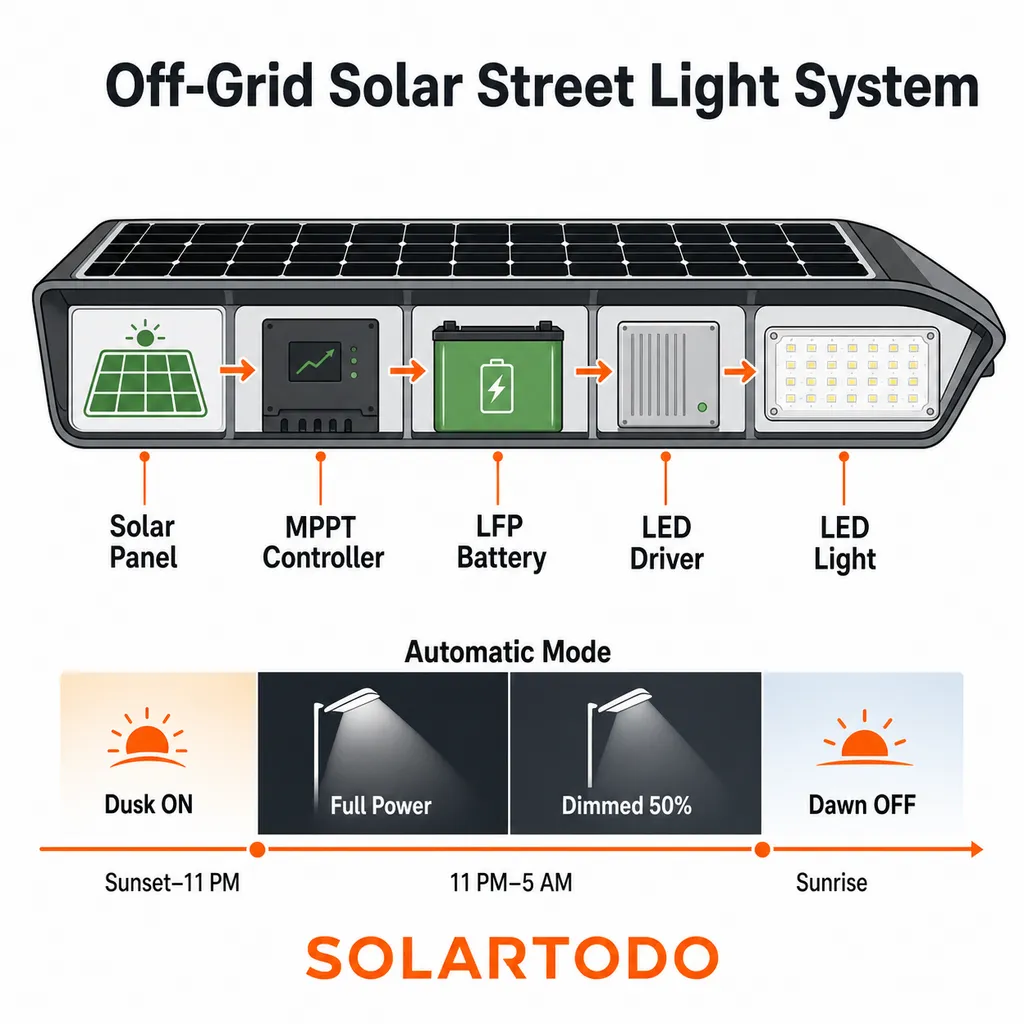
The 272 Wh LFP battery stores enough nominal energy for roughly 8.0 h at full 34 W output, but the operating profile is normally dimmed to extend nightly operation to 12 h. A common profile is 100% output for 4 h, 40% output for 6 h, and 70% output for 2 h before dawn, yielding an equivalent load of about 20.4 W and an overnight consumption of about 245 Wh before controller and thermal losses.
The MPPT controller is specified at more than 98% conversion efficiency and is suitable for low-voltage standalone PV systems aligned with the design-verification intent of IEC 62124 for PV stand-alone systems (IEC Webstore: https://webstore.iec.ch). For solar-resource modeling, engineering teams commonly benchmark irradiance and loss assumptions against NREL PVWatts, which uses long-term weather records and documented PV performance inputs (https://pvwatts.nrel.gov/).
Technical Specifications
The luminaire is designed around a 34 W LED engine, 68 Wp PV input, 272 Wh LFP battery storage, 9 days autonomy target under dimmed emergency operation, and a 4.7 m FRP composite pole. The enclosure target is IP66 or IP67 depending on project specification, while the luminaire safety framework should be mapped against IEC 60598 and ingress protection should be mapped against IEC 60529.
| Parameter | Value |
|---|---|
| Pole height | 4.7 m |
| LED power | 34 W |
| Nominal luminous flux | 5,780 lm |
| Solar panel | 68 Wp TOPCon mono |
| Battery capacity | 272 Wh high-temperature LFP |
| Autonomy | 9 rainy days under dimmed profile |
| Operating temperature | -20°C to +70°C |
| Wind resistance target | 150 km/h |
| Lighting schedule | 12 h/day dusk-to-dawn |
| Warranty basis | 3 years system, 5 years pole |
The TOPCon PV module uses monocrystalline silicon technology in the 19%-23% efficiency range and is selected for better high-temperature behavior than older low-efficiency crystalline modules. For module qualification language, project documentation can reference IEC 61215 for design qualification and IEC 61730 for PV module safety, while actual factory certification files should be checked at order stage for the exact bill of materials and country of import.
The LED package can use Bridgelux, Cree, Lumileds, or equivalent chips with a nominal efficacy above 170 lm/W and a rated LED lifetime above 50,000 h under controlled junction temperature. Photometric testing should be specified using IES LM-79 methods for lumen output, electrical power, and chromaticity, because a 34 W streetlight must be evaluated by delivered lumens and beam distribution rather than wattage alone.
Desert and High-Temperature Engineering
This variant is configured for desert climates where daytime ambient temperatures can exceed 45°C, pole-top enclosure temperatures can approach 70°C, and wind-driven dust can reduce PV yield if glass surfaces are not cleaned on a regular schedule. The LFP high-temperature cell chemistry is preferred over lead-acid gel because LFP typically supports more than 2,000 deep cycles, lower maintenance, and better voltage stability under repeated 12 h/night cycling.
The FRP composite pole is selected for corrosion resistance, low mass, electrical insulation, and coastal or chemical-exposure suitability, even though desert projects often use galvanized steel or aluminum alloy poles. At 4.7 m, FRP helps reduce handling weight during installation and avoids red-rust corrosion risk, while wind calculations should still verify foundation size, pole wall thickness, terrain category, and gust rating for the target 150 km/h design condition.
Sand resistance depends on gasket compression, cable gland quality, breather design, and the smoothness of the PV glass surface, not only on an IP rating. For arid sites with dust storms, SOLARTODO recommends a cleaning interval of 30-60 days, plus a 2% to 8% soiling allowance in energy simulations depending on local rainfall, traffic dust, and available O&M labor.
Lighting Performance and Control Logic
The 34 W LED output is suitable for low-traffic roads, internal industrial roads, park paths, solar-farm service roads, and security corridors requiring localized illumination rather than highway-class lighting. A representative layout using 15 m spacing and 4.7 m mounting height should be checked in lighting software for average illuminance, minimum illuminance, uniformity ratio, glare rating, and the selected correlated color temperature, typically 3000 K, 4000 K, or 5000 K.
The controller supports dusk-to-dawn operation, timed dimming, motion-adaptive dimming, and optional 4G or LoRa remote monitoring. Compared with a conventional 70 W grid-connected sodium or LED streetlight running 12 h/night, a 34 W solar unit with 60% dimming savings can reduce grid electricity consumption by about 306 kWh per pole per year, using the formula 70 W x 12 h x 365 days.
For B2B buyers comparing lighting alternatives, the main difference is that the solar unit shifts cost from trenching, cable, grid meter connection, and monthly electricity to a distributed PV-and-battery asset. A grid-connected installation can require 20 m to 60 m of trenching per pole in large sites, while this all-in-one unit normally requires a foundation, pole erection, luminaire fastening, and commissioning checks at 1 location.
Cloud Monitoring
Optional cloud monitoring connects the controller through 4G or LoRa for battery voltage, PV charge current, LED load current, fault alerts, and operating schedule changes. For projects above 100 pcs, remote status reporting can reduce night patrol inspection time because operators can identify low-battery, LED-driver, or communication faults before dispatching a maintenance crew.
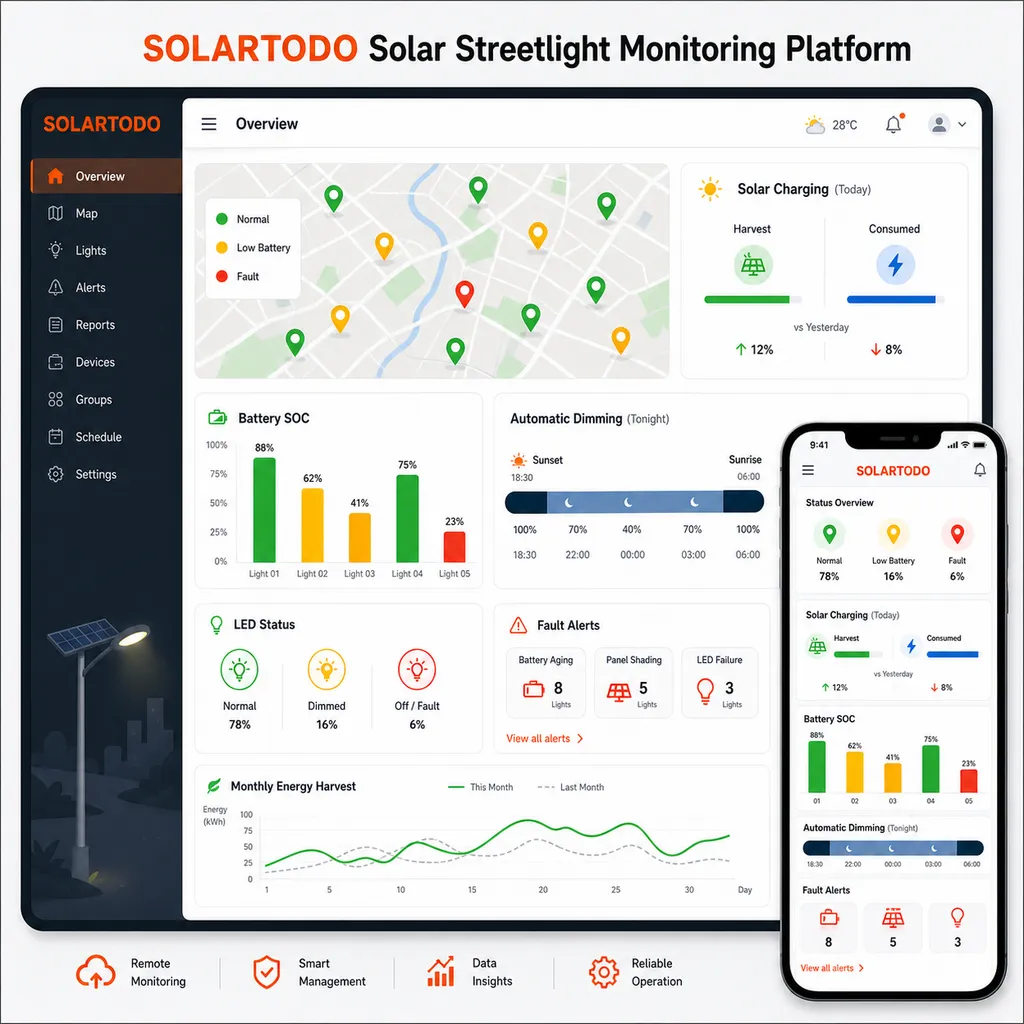
A typical monitoring data set includes 15 min or 60 min intervals for charge current, discharge current, battery voltage, load percentage, and alarm state. For smart-city or industrial security networks, the same platform can be coordinated with CCTV poles, telecom power towers, and perimeter sensors, but this 34 W model should be treated as a lighting node first and a data node second because the battery budget is 272 Wh.
Applications
The 4.7m All-in-One Solar Streetlight 34W is suitable for rural roads, off-grid compounds, logistics yards, solar farm access roads, agricultural processing zones, telecom shelters, parking areas, and temporary construction routes where pole heights of 4 m to 6 m are required. Buyers evaluating larger roads can compare higher-output models through View all Solar Street Light products and then Configure your system online with project-specific spacing.
For procurement specifications, the product can be written as: 4.7 m FRP composite pole, 34 W LED luminaire, 68 Wp TOPCon PV module, 272 Wh high-temperature LFP battery, IP66/IP67 enclosure, MPPT controller, 12 h dusk-to-dawn operation, and 9-day dimmed autonomy. For background reading on off-grid lighting and PV storage sizing, buyers can Learn about topic before issuing a bill of quantities.
EPC Investment Analysis and Pricing Structure
EPC turnkey scope includes engineering, procurement, construction, commissioning, and a 1-year service warranty for each installed pole. Engineering covers layout review, solar-resource assumption checks, foundation guidance, lighting schedule selection, and QC documentation; procurement covers the luminaire, FRP pole, anchor set, battery, controller, PV module, and packing; construction covers foundation coordination, pole erection, luminaire mounting, commissioning, and handover records.
| Pricing tier | Scope | Unit price range |
|---|---|---|
| FOB Supply | Equipment only, ex-works China | $100-$180 |
| CIF Delivered | Equipment plus ocean freight and insurance | $112-$202 |
| EPC Turnkey | Installed, commissioned, 1-year warranty | $162-$264 |
| Volume | Discount from quoted unit price |
|---|---|
| 50+ pcs | 5% |
| 100+ pcs | 10% |
| 250+ pcs | 15% |
A representative 100-pole EPC package at the midpoint price of $213/unit would have a gross installed budget of about $21,300 before taxes, local civil variations, and project-specific freight. With a 10% volume discount for 100+ pcs, the indicative discounted equipment-and-EPC budget becomes about $19,170, subject to final foundation design, destination port, inspection requirements, and installation labor rates.
ROI depends strongly on avoided trenching and avoided grid power. If a conventional grid streetlight costs $120 for the fixture, $80 for pole and foundation, $150 for trenching and cable, and $31/year for electricity at $0.10/kWh using 306 kWh/year, the installed grid alternative can exceed $350/pole before maintenance, while this solar EPC range is $162-$264/pole and avoids recurring electricity cost.
The simple payback can be immediate where trenching is required, because the solar EPC upper price of $264 is lower than the example grid-installed cost of $350. Where grid wiring already exists, payback is more commonly 3-6 years, based on avoided electricity, reduced cabling, and lower battery-maintenance cost compared with lead-acid systems that may need replacement after about 2-3 years in hot climates.
Standard payment terms are 30% T/T deposit + 70% against bill of lading, or 100% L/C at sight for qualified trade orders. Project financing can be discussed for orders above $1,000K, and commercial requests should be sent to [email protected] with quantity, destination country, road width, pole spacing target, and required lighting standard.
Standards, Sources, and Procurement Notes
The engineering basis references IEC 62124 for stand-alone PV design verification, IEC 60598 for luminaire safety, IEC 60529 for IP protection, IEC 61215 and IEC 61730 for PV module qualification, and IES LM-79 for LED photometric testing. Market context is consistent with IEA Renewables 2025, which forecasts renewable deployment through 2030 (https://www.iea.org/reports/renewables-2025), and IRENA Renewable Power Generation Costs in 2024, which tracks the cost competitiveness of renewable power (https://www.irena.org/).
Because SOLARTODO supplies solar, energy storage, smart lighting, security, telecom power towers, and smart agriculture systems, this 34 W streetlight can be bundled with broader site infrastructure in 1 procurement package. Buyers should Request a custom quotation when projects require 4G monitoring, custom color temperature, anti-theft bolts, hot-dip galvanized alternatives, camera integration, wind-zone calculations, or country-specific certification files.
Technical Specifications
| Pole Height | 4.7m |
| LED Power | 34W |
| Luminous Flux | 5780lm |
| Solar Panel | 68Wp |
| Battery Capacity | 272Wh |
| Battery Type | High-temperature LiFePO4 (LFP) |
| Autonomy | 9rainy days |
| Pole Material | FRP composite |
| Wind Resistance | 150km/h |
| Operating Temperature | -20 to +70°C |
| Lighting Hours | 12h/day |
| Warranty | 3 years system, 5 years pole |
Price Breakdown
| Item | Quantity | Unit Price | Subtotal |
|---|---|---|---|
| 34W all-in-one solar luminaire with 68W panel and 272Wh LFP battery | 1 pcs | $70 | $70 |
| 4.7m FRP composite pole with mounting hardware | 1 pcs | $113 | $113 |
| Concrete foundation and anchor set allowance | 1 pcs | $32 | $32 |
| Installation and commissioning | 1 pcs | $20 | $20 |
| Engineering, QC, and documentation | 1 pcs | $12 | $12 |
| 1-Year warranty and support allowance | 1 pcs | $8 | $8 |
| Total Price Range | $162 - $264 | ||
Frequently Asked Questions
What does the EPC turnkey price include for this 34 W solar streetlight?
How long can the 272 Wh LFP battery operate the 34 W LED load?
Why use an FRP composite pole instead of galvanized steel?
Which standards are relevant for specification and inspection?
What spacing is typical for a 4.7 m, 34 W solar streetlight?
Certifications & Standards



Data Sources & References
- •NREL PVWatts Calculator 2026 - https://pvwatts.nrel.gov/
- •IEA Renewables 2025 - https://www.iea.org/reports/renewables-2025
- •IRENA Renewable Power Generation Costs in 2024 - https://www.irena.org/
- •IEC Webstore standards catalogue - https://webstore.iec.ch/
- •IES LM-79 solid-state lighting photometric test method
- •SOLARTODO solar streetlight configuration data supplied in task brief
Interested in this solution?
Contact us for a customized quote based on your specific requirements.
Contact Us