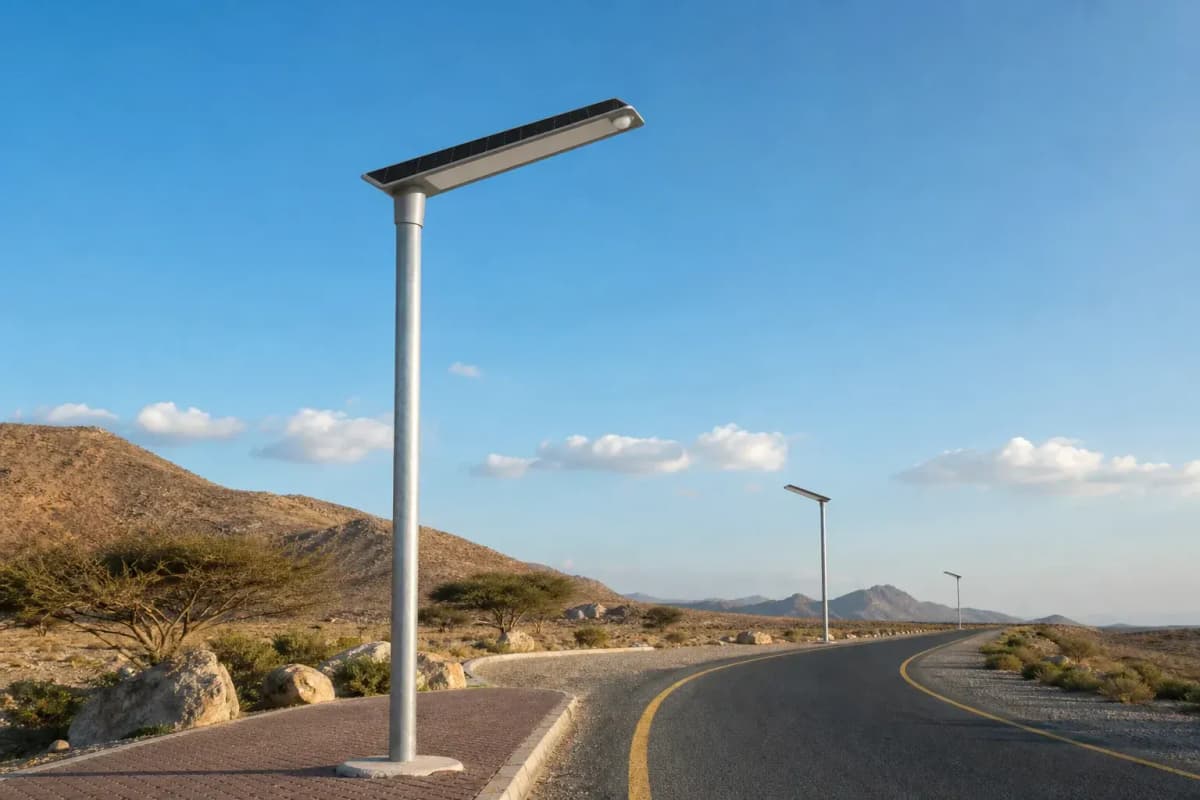
7m All-in-One Security Streetlight 47W - Desert Solar Security Lighting
Key Features
- 7 m galvanized steel pole with 47 W LED output for security roads and perimeter lighting
- 103 Wp TOPCon monocrystalline panel with 19-23% module efficiency range
- 329 Wh high-temperature LiFePO4 battery pack rated on a +70 C cell basis
- 9 rainy days of autonomy using PIR and time-based dimming profiles
- EPC turnkey price range of USD 204-341 per installed and commissioned pole
The 7m All-in-One Security Streetlight 47W combines a 103 Wp TOPCon panel, 329 Wh high-temperature LFP battery, and 7 m galvanized steel pole for 12 h dusk-to-dawn lighting with 9-day autonomy. EPC turnkey pricing is USD 204-341 per pole for roads, perimeters, logistics yards, and smart-infrastructure sites.
Description
The 7m All-in-One Security Streetlight 47W is a desert-ready solar street lighting system with a 7 m hot-dip galvanized steel pole, 47 W LED engine, 103 Wp monocrystalline TOPCon PV module, and 329 Wh high-temperature LiFePO4 battery pack. It is specified for 12 h dusk-to-dawn operation, up to 9 rainy days of autonomy, and an EPC turnkey budget of USD 204-341 per pole for B2B road, perimeter, industrial, and smart-infrastructure projects.
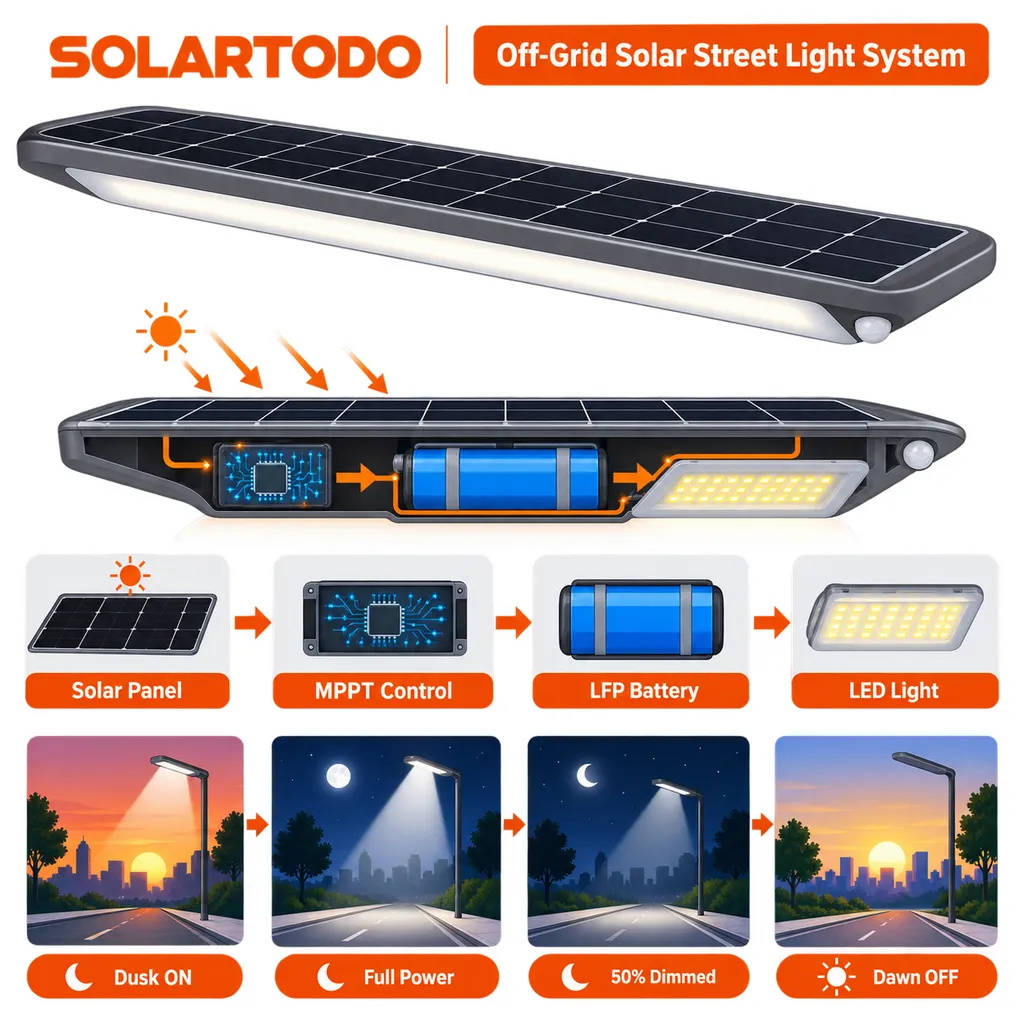
SOLARTODO positions this model in the solar-streetlight product line for buyers that need one integrated luminaire, one pole, and one foundation instead of a cabinet-based split system with 3 or more outdoor electrical enclosures. The all-in-one-plus format places the PV panel, battery, MPPT controller, LED array, PIR sensor, and communication module in a single pole-top assembly, reducing field wiring points by roughly 60% compared with a conventional split solar streetlight with separate panel brackets, battery boxes, and external controllers.
Product Overview
This 7 m, 47 W configuration is sized for access roads, solar farm fence lines, parking lanes, logistics yards, village roads, and campus security corridors where a 6-8 m mounting height is commonly used. At an LED efficacy basis of 170 lm/W, the luminaire delivers approximately 7,990 lm before optical, thermal, and dirt depreciation factors are applied in the lighting design.
The system uses a 103 Wp TOPCon monocrystalline PV module to recharge a 329 Wh high-temperature LFP battery, creating a storage-to-load ratio of about 7.0 Wh per LED watt. This ratio is selected for desert and arid regions where high irradiance can be paired with dust events, 45-55 C ambient peaks, and extended cloudy intervals during seasonal storms.
Buyers comparing multiple mounting heights can start from the product family page at View all Solar Street Light products, where 4-10 m pole options and 20-150 W LED ranges can be evaluated side by side. Engineering teams can also Configure your system online with road width, pole spacing, battery reserve, and dimming schedule inputs before requesting a bill of materials.
System Architecture
The electrical architecture has 5 major subsystems: the 103 Wp PV module, 329 Wh LFP battery, MPPT charge controller, 47 W LED optical module, and smart sensing or communications layer. IEC 62124 describes design verification for stand-alone PV systems, including functionality, autonomy, and recovery after low battery state of charge, which is directly relevant to a solar streetlight with no grid input (IEC 62124 summary).
The pole-top assembly reduces installation labor because the installer lifts one integrated luminaire instead of aligning 2 separate brackets and pulling 3 or more cable runs through the pole. In a typical 2-person crew workflow, the luminaire can be mounted, tilted, wired internally, and commissioned in about 30 minutes per pole after the foundation and anchor bolts are ready.
Technical Specifications
| Parameter | 7m All-in-One Security Streetlight 47W value |
|---|---|
| Pole height | 7 m |
| LED power | 47 W |
| Estimated luminous flux | 7,990 lm at 170 lm/W |
| Solar panel | 103 Wp TOPCon monocrystalline |
| Battery capacity | 329 Wh high-temperature LiFePO4 |
| Autonomy | 9 rainy days under dimming profile |
| Pole material | Hot-dip galvanized steel |
| Operating temperature | -20 C to +70 C battery-cell rating basis |
| Wind resistance basis | 150 km/h project design check |
| Lighting schedule | 12 h/night dusk-to-dawn |
IEC 60598-1:2024 covers general luminaire safety requirements for equipment operating up to 1,000 V, while IEC 60598-2-3 covers road and street lighting luminaires with a minimum column-integrated height of 2.5 m (IEC 60598-1, IEC 60598-2-3). For procurement documentation, SOLARTODO maps the luminaire enclosure to IP66 or IP67 project requirements, surge protection, insulation class, grounding, and photobiological safety data sheets.
The LED package may use Bridgelux, Cree, Lumileds, or equivalent high-efficacy chips, with a nominal service life above 50,000 h when the case temperature is controlled by the aluminum heat sink. A 47 W LED running 12 h/night operates about 4,380 h/year, so the LED life basis corresponds to approximately 11.4 years before lumen-maintenance thresholds are reached.
Solar Module and Battery Design
The 103 Wp panel uses monocrystalline TOPCon technology with a practical module efficiency band of 19-23%, matching current B2B expectations for compact pole-top PV area. NREL PVWatts V8 documentation notes that modern production estimates use NSRDB weather data and updated photovoltaic module, inverter, bifacial, albedo, and thermal models, so project teams should verify site yield with current irradiance data rather than a generic 5 peak-sun-hour assumption (NREL PVWatts).
The 329 Wh LFP battery is specified with a high-temperature cell chemistry rated to a +70 C basis because desert enclosures can exceed ambient air temperature by 10-20 C under direct solar exposure. LFP chemistry is preferred over lead-acid gel in this application because it supports 2,000+ deep cycles, lower maintenance, integrated BMS protection, and higher usable depth of discharge for the same nominal watt-hour rating.
For a representative MENA solar farm scenario, assume 9.0 h/night at reduced output and 3.0 h/night at security-brightness output during patrol, vehicle, or PIR events. With motion-adaptive dimming, the effective nightly LED energy can be reduced by about 60% versus fixed 47 W operation, allowing the 329 Wh battery to support multi-night autonomy while maintaining a visible security response near gates and inverter stations.
Lighting Performance and Controls
The controller uses MPPT charging with a conversion efficiency target above 98%, time-based profiles, and PIR-triggered brightness changes. A typical profile can run 30% output for 8 h, 60% output for 3 h, and 100% output for 1 h when movement is detected, although final settings should be matched to ANSI/IES RP-8-25 roadway or parking criteria for the road class and conflict area (IES RP-8-25).
Compared with a conventional 47 W grid-connected LED streetlight operating 12 h/night, this solar unit avoids approximately 206 kWh/year of grid electricity before charge and dimming effects are considered. At an electricity tariff of USD 0.15/kWh, the direct electricity saving is about USD 31/year per pole, and trenching, cable, meter, and distribution-panel costs can be reduced by hundreds of USD per pole on remote roads.
The optical design should be validated with IES LM-63 photometry, road width, pole setback, tilt angle, and spacing assumptions rather than lumens alone. For a 7 m pole, common concept spacing falls in the 20-30 m range for private roads, but the maintained illuminance target, uniformity ratio, glare constraint, and pavement reflectance can shift the exact spacing by 25% or more.
Desert and Arid Climate Engineering
The desert package combines a sand-resistant enclosure, corrosion-protected galvanized steel pole, sealed battery compartment, and high-temperature LFP cells. The 7 m pole should be checked against local wind speed, exposure category, terrain roughness, and foundation soil bearing because a 150 km/h design basis can require different anchor bolt and rebar schedules in open desert than in an urban lane.
IRENA reported that utility-scale battery storage costs declined by 93% from 2010 to 2024, supporting wider adoption of PV-plus-storage systems even in small autonomous loads such as lighting (IRENA 2024 costs). IEA Renewables 2025 analysis also projects nearly 4,600 GW of renewable power additions over 2025-2030, with solar PV representing almost 80% of renewable capacity expansion, which supports supply-chain depth for PV-based infrastructure (IEA Renewables 2025).
Maintenance in dusty climates should include panel cleaning every 30-90 days, torque checks at the first 90 days, and annual inspection of gaskets, fasteners, grounding, and battery diagnostics. Where airborne salinity, fertilizer dust, or coastal corrosion is present, SOLARTODO can substitute FRP or aluminum poles, but this galvanized steel variant remains the cost-controlled standard for most inland desert projects.
Cloud Monitoring
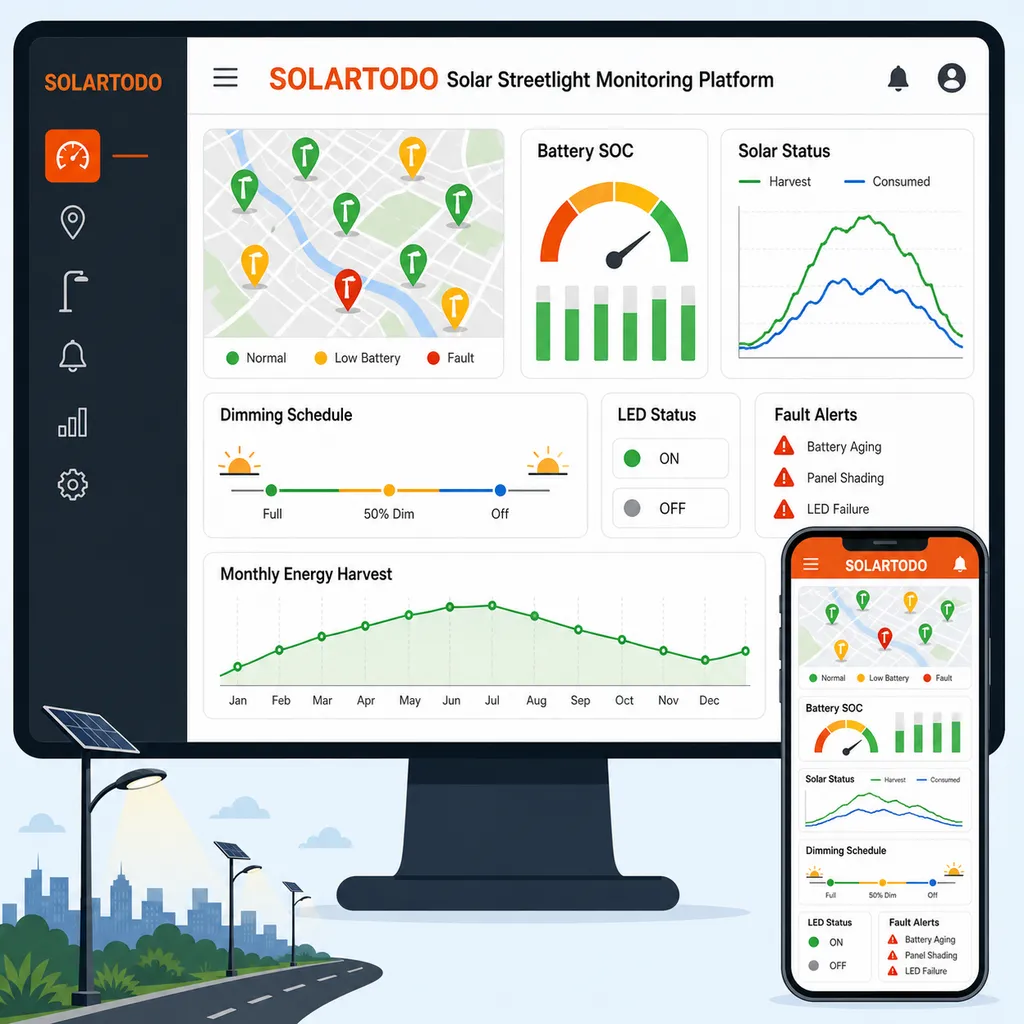
The all-in-one-plus platform can be supplied with 4G or LoRa monitoring for battery voltage, PV charge status, LED current, fault alerts, dimming schedules, and operating hours. A monitored fleet of 100 poles can surface low-charge or luminaire faults in minutes instead of waiting for monthly night patrols, which materially reduces outage duration on remote industrial and municipal sites.
Cloud monitoring also supports procurement governance because each pole can be registered with a serial number, GPS coordinate, commissioning date, and warranty status. For a 250-pole EPC package, this creates 250 digital asset records that can be exported to an owner's O&M system, allowing engineers to compare measured charging data against PVWatts or local irradiance expectations.
Applications
This 7 m, 47 W system is most suitable for perimeter roads, solar PV plant access routes, logistics yards, rural connector roads, parking lanes, campus security zones, and telecom or power-tower compounds. The 9-day autonomy target is useful where maintenance teams may need 3-7 days to reach a remote asset after a weather event or where grid extension would require trenching across more than 100 m of road or fence line.
Project developers can use Learn about solar street lighting design to compare mounting height, light distribution, battery sizing, and controller schedules across 4 technical variables. Procurement managers can use Learn about autonomous solar infrastructure to align solar lighting with CCTV, telecom, EV charging, and distributed storage roadmaps before issuing a multi-lot tender.
EPC Investment Analysis and Pricing Structure
SOLARTODO's EPC scope for this product includes 5 work packages: engineering, procurement, construction, commissioning, and 1-year warranty support. Engineering covers lighting layout, pole foundation checks, bill of materials, and site-specific autonomy validation; procurement covers the luminaire, 103 Wp PV module, 329 Wh LFP battery, galvanized pole, anchors, foundation materials, logistics, and quality control; construction covers foundation, erection, aiming, and electrical checks; commissioning confirms dusk-to-dawn operation, dimming, and monitoring data.
| Pricing tier | Scope | Unit price range |
|---|---|---|
| FOB Supply | Equipment only, ex-works China | USD 126-232/pole |
| CIF Delivered | Equipment plus ocean freight and insurance | USD 142-261/pole |
| EPC Turnkey | Installed, commissioned, and supported for 1 year | USD 204-341/pole |
| Volume band | Discount from list EPC | Example 300 USD baseline |
|---|---|---|
| 50+ poles | 5% | USD 285/pole |
| 100+ poles | 10% | USD 270/pole |
| 250+ poles | 15% | USD 255/pole |
ROI depends on trenching distance, local labor, grid tariff, and night lighting schedule, but a practical benchmark compares the 7 m solar unit with a grid-connected LED pole requiring cable, conduit, distribution protection, and energy billing. If avoided grid works are USD 150-500 per pole and avoided electricity is USD 31/year, the simple payback against a conventional connected alternative can fall below 3-6 years on remote roads, while projects with no grid trenching requirement may justify the solar option primarily through resilience and installation speed.
Payment terms are normally 30% T/T deposit plus 70% against bill of lading, or 100% irrevocable L/C at sight for approved buyers. Project financing can be discussed for contracts above USD 1,000,000, and buyers can Request a custom quotation or contact [email protected] with road drawings, GPS coordinates, pole count, target lux level, and delivery port.
Procurement Notes
A complete tender package should specify at least 12 data points: pole height, LED wattage, lumen output, CCT, CRI, optical distribution, PV wattage, battery chemistry, battery watt-hours, autonomy days, IP rating, wind load, and warranty. SOLARTODO recommends including IEC 62124 design-verification language, IEC 60598 luminaire safety language, ANSI/IES RP-8 photometric criteria where applicable, and IP66 or IP67 enclosure targets in the same technical schedule.
Before order release, buyers should confirm the quantity, foundation design, shipping Incoterm, monitoring requirement, camera or sensor options, and whether the project needs Arabic, French, Spanish, or English documentation. A batch of 100 poles can be staged by lot number and serial number so factory acceptance, container loading, site receipt, and commissioning records remain traceable from purchase order to O&M handover.
Technical Specifications
| Pole Height | 7m |
| LED Power | 47W |
| Luminous Flux | 7990lm |
| Solar Panel | 103Wp |
| Battery Capacity | 329Wh |
| Battery Type | High-temperature LiFePO4 (LFP) |
| Autonomy | 9rainy days |
| Pole Material | Hot-dip galvanized steel |
| Wind Resistance | 150km/h |
| Operating Temperature | -20 to +70C |
| Lighting Hours | 12h/day |
| Warranty | 3 years system, 5 years pole |
Price Breakdown
| Item | Quantity | Unit Price | Subtotal |
|---|---|---|---|
| 103 Wp TOPCon solar panel | 1 pcs | $10 | $10 |
| 329 Wh high-temperature LFP battery pack | 1 pcs | $43 | $43 |
| 47 W LED module and optics | 1 pcs | $21 | $21 |
| MPPT controller and PIR dimming controls | 1 pcs | $31 | $31 |
| Integrated aluminum luminaire housing and hardware | 1 pcs | $18 | $18 |
| 7 m hot-dip galvanized steel pole | 1 pcs | $55 | $55 |
| Concrete foundation and anchor bolt set | 1 pcs | $80 | $80 |
| Installation and commissioning | 1 pcs | $35 | $35 |
| Engineering, QC, and documentation | 1 pcs | $20 | $20 |
| 1-year warranty and support | 1 pcs | $12 | $12 |
| Total Price Range | $204 - $341 | ||
Frequently Asked Questions
What is included in the EPC turnkey price for this 7m 47W streetlight?
How long can the 329 Wh battery support the 47 W LED load?
Is the 7 m pole suitable for public road lighting?
Why use high-temperature LFP instead of lead-acid gel batteries?
Can this model connect to cloud monitoring or smart-city systems?
Certifications & Standards



Data Sources & References
- •NREL PVWatts V8 and NSRDB solar resource documentation, https://pvwatts.nrel.gov/
- •IEA Renewables 2025 renewable electricity forecast, https://www.iea.org/reports/renewables-2025/renewable-electricity
- •IRENA Renewable Power Generation Costs in 2024, https://www.irena.org/Digital-Report/Renewable-Power-Generation-Costs-in-2024
- •IEC 62124:2004 PV stand-alone systems design verification, https://www.vde-verlag.de/iec-standards/search/?publication-number=62124
- •IEC 60598-1:2024 luminaires general requirements, https://webstore.iec.ch/en/publication/66620
- •ANSI/IES RP-8-25 roadway and parking lighting practice, https://store.ies.org/product/recommended-practice-lighting-roadway-and-parking-facilities/?v=eb65bcceaa5f
Interested in this solution?
Contact us for a customized quote based on your specific requirements.
Contact Us