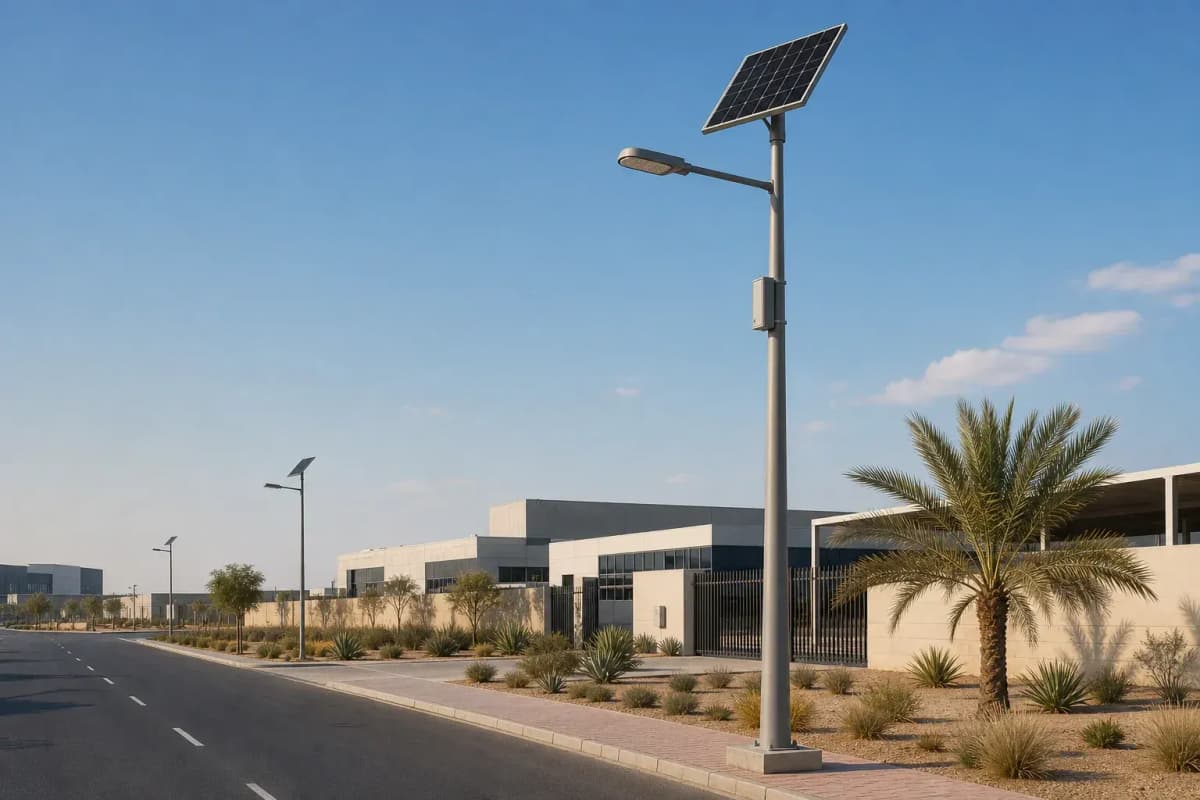
7.8m Split Solar Streetlight 98W - Desert LFP EPC System
Key Features
- 7.8m cast-aluminum split pole with 98W LED output and about 16,660 lm at 170 lm/W
- 196Wp monocrystalline TOPCon panel sized at 2.0x LED wattage for desert charging margin
- 686Wh high-temperature LiFePO4 battery engineered for up to +70°C desert operation
- 6-day autonomy with MPPT control above 98% efficiency and dusk-to-dawn 12h scheduling
- EPC turnkey price range of $565-$1,062 per installed and commissioned pole
The 7.8m Split Solar Streetlight 98W combines a 196Wp TOPCon PV module, 686Wh high-temperature LiFePO4 battery, MPPT control, and 6-day autonomy for desert roads, perimeter lanes, solar farms, and smart-infrastructure sites.
Description
The 7.8m Split Solar Streetlight 98W is a desert-rated solar street lighting system with a 196Wp monocrystalline TOPCon panel, 686Wh high-temperature LFP battery, 98W LED engine, and 6-day autonomy. The split architecture separates the PV module, luminaire, battery, and controller into serviceable modules, giving engineers better tilt control, easier battery access, and EPC pricing from $565 to $1,062 per installed pole.
SOLARTODO specifies this model for B2B projects where a 7.8m mounting height, 12h dusk-to-dawn operation, and approximately 16,660 lm of LED output are required without trenching grid cable over 100m, 1km, or 10km corridors. The configuration is aligned with standalone PV design principles referenced by IEC 62124 standalone photovoltaic system verification and outdoor luminaire safety requirements in IEC 60598-1:2024, while the PV module class follows IEC 61215-1:2021 design-qualification logic for long-term open-air climates.
Product Positioning
This 98W split solar streetlight sits between common 80W rural-road packages and heavier 120W highway packages, making it suitable for 2-lane access roads, industrial yards, logistics parks, perimeter fences, and MENA desert projects requiring 6 nights of reserve energy. Compared with all-in-one fixtures, the split system allows the 196Wp panel to be oriented at a project-specific tilt angle, which can improve daily yield by 10% to 25% in fixed-array designs when compared with a flat or poorly oriented integrated fixture under the same irradiance.
The system uses a 686Wh high-temperature LiFePO4 battery rather than lead-acid gel because desert cabinets can exceed 55°C during summer afternoons and standard cells lose cycle life rapidly above 45°C. A battery bank sized at 686Wh supports adaptive dimming profiles such as 100% output for 4h, 60% output for 6h, and 30% security mode for 2h, giving approximately 706Wh of nominal LED demand before dimming losses and allowing the MPPT controller to manage charge recovery over multiple days.
System Architecture
The architecture consists of 6 primary elements: a 196Wp TOPCon PV panel, a 98W LED luminaire, a 686Wh LFP battery pack, an MPPT charge controller, a cast-aluminum 7.8m pole assembly, and IP66 or IP67 electrical enclosures. The split layout places the PV module on a top or side arm, the LED head on a road-facing bracket, and the battery in a pole-base box or separate cabinet where a technician can replace 1 pack without removing the luminaire.
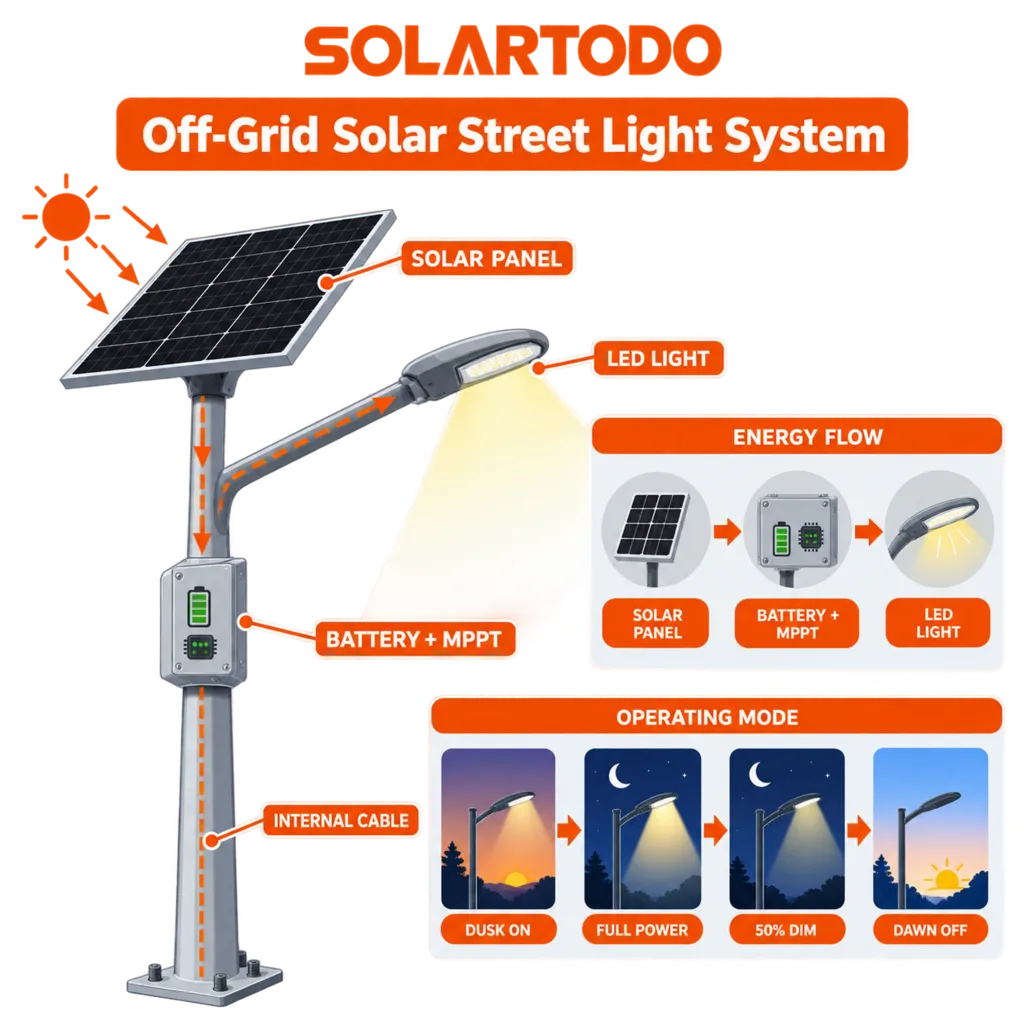
The 196Wp panel rating is deliberately 2.0 times the 98W LED power rating, which is a practical ratio for regions with 4.5 to 6.5 peak-sun-hours and seasonal dust soiling. NREL PVWatts Version 8.5.2 uses updated NSRDB PSM V3 weather datasets and monthly soiling inputs, so SOLARTODO engineering normally models desert yield with at least 12 monthly loss values instead of 1 annual assumption.
The MPPT controller is specified at greater than 98% tracking efficiency and sized against the 196Wp PV input rather than only the 98W lighting load. In a 24V nominal design, a 196Wp panel can deliver roughly 8A at peak operating current, and the controller must handle cold-morning voltage rise, reverse-polarity protection, low-voltage disconnect, over-temperature derating, and a 6-day autonomy algorithm without manual reset.
Technical Specifications
| Parameter | Value |
|---|---|
| Pole height | 7.8 m |
| LED power | 98 W |
| Estimated luminous flux | 16,660 lm at 170 lm/W |
| Solar panel | 196 Wp monocrystalline TOPCon |
| Battery capacity | 686 Wh high-temperature LiFePO4 |
| Autonomy | 6 rainy or low-sun days |
| Pole material | Cast aluminum alloy |
| Wind resistance | 150 km/h project basis |
| Operating temperature | -20°C to +70°C |
| Lighting schedule | 12 h/day dusk-to-dawn |
| Warranty | 3 years system, 5 years pole |
The LED package uses Bridgelux, Cree, or Lumileds-class chips at more than 170 lm/W, producing about 16,660 lm before optical and thermal losses. Optics are selected by road geometry, typically Type II for narrow lanes, Type III for wider access roads, and asymmetric perimeter optics for fence lines where a 7.8m pole can illuminate a 22m to 32m longitudinal spacing interval.
The cast-aluminum pole reduces mass compared with galvanized steel and improves corrosion resistance in arid zones where alkaline dust, UV exposure, and thermal cycling stress coatings for 3,000h to 5,000h equivalent exposure windows. For projects with 50 poles or more, SOLARTODO can provide foundation calculations based on wind zone, soil bearing capacity, bracket sail area, and a design reference of 150 km/h unless local civil code requires a higher value.
Desert Climate Engineering
Desert deployment requires thermal margin, dust control, and battery chemistry selection rather than simply increasing panel wattage by 20W or 40W. The high-temperature LFP pack is rated for operation up to +70°C, the enclosure uses sand-resistant sealing, and the controller can reduce LED current if internal temperature exceeds programmed thresholds during 1, 2, or 3 consecutive hot nights.
The enclosure target is IP66 for dust-tight and strong-water-jet resistance, with IP67 available for flood-prone wadis or low-lying industrial zones. Cable glands, MC4 connectors, and pole-base terminals are selected to reduce ingress risk during seasonal sandstorms where fine particles below 150 microns can penetrate weak gasket designs after hundreds of thermal cycles.
Representative MENA Solar Farm Scenario
For a representative MENA solar farm scenario with 5.5 peak-sun-hours, 8% soiling loss, and 12h nightly operation, a 100-pole perimeter road would use 19.6kWp of distributed PV and 68.6kWh of total LFP storage. At an EPC midpoint of $814 per pole, the installed lighting budget is approximately $81,400 before optional cameras, trenching upgrades, or SCADA integration.
In this scenario, the split solar streetlight avoids roughly 1,500m to 3,000m of AC trenching, armored cable, distribution panels, and transformer tap work, depending on whether poles are spaced at 25m or 30m. Compared with a conventional 100W grid LED pole running 12h/day at $0.16/kWh, one pole consumes about 438kWh/year and costs about $70/year in electricity alone, so 100 poles can avoid about $7,000/year in grid energy charges before demand charges and trench maintenance.
The comparison is strongest where trenching costs exceed $25/m and grid extension delays exceed 30 days. A conventional grid-fed LED alternative may have a lower luminaire-only price, but it adds buried cable, switchgear, permits, grid outage exposure, and civil reinstatement; on isolated industrial roads, the split solar design can reduce electrical-civil scope by 40% to 70% compared with trench-fed lighting corridors.
Cloud Monitoring
The controller can be supplied with 4G or LoRa remote monitoring for project owners who need fault alerts, battery state-of-charge trends, lamp runtime, PV charging current, and dimming profile verification across 50, 100, or 250 poles. Motion-adaptive dimming can reduce energy demand by up to 60% on low-traffic roads by moving from 100% output to 30% standby after a configurable 30s to 300s period.
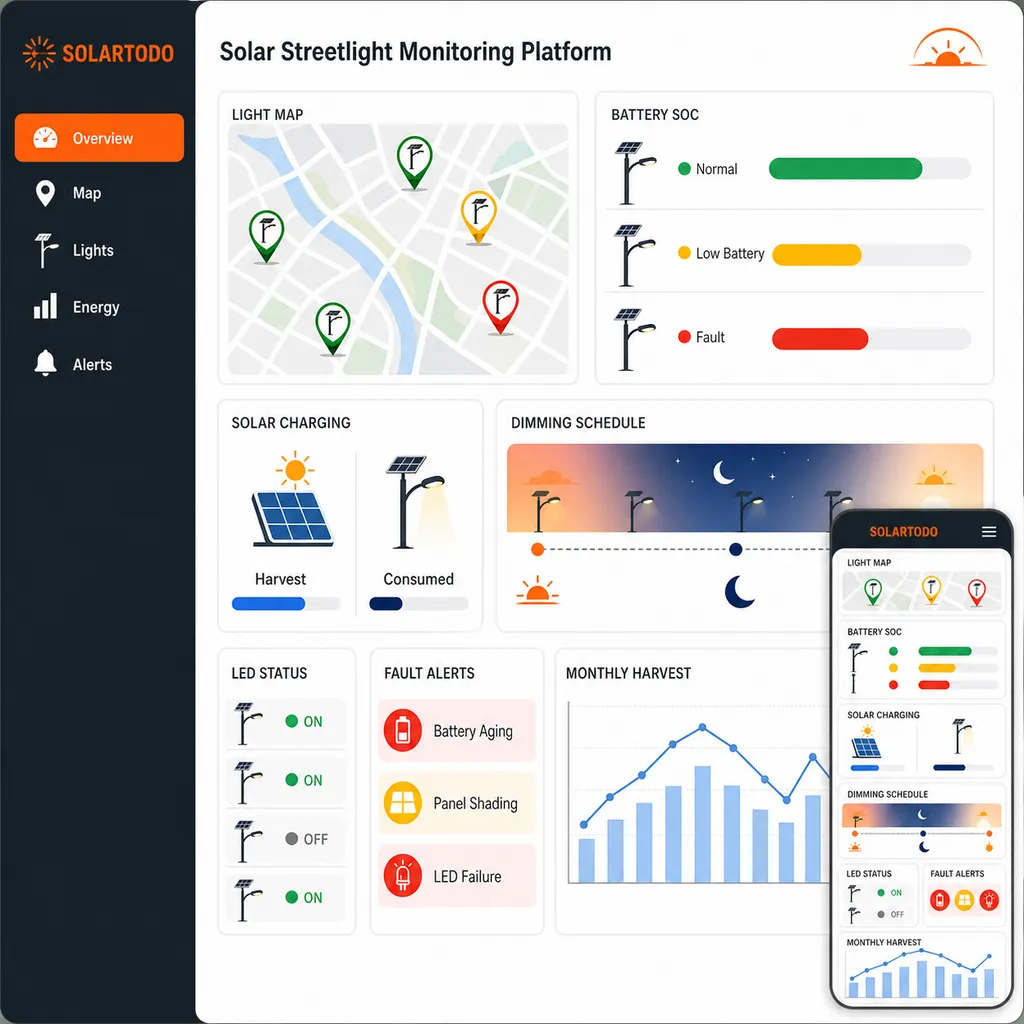
Cloud telemetry is especially useful for EPC warranty management because faults can be separated into PV undercharge, battery degradation, LED driver failure, communication loss, or shading by new structures. SOLARTODO typically recommends monitoring for projects above 50 units because a 2% annual fault discovery gap across 250 poles can create 5 dark points before manual night patrols identify the issue.
Applications
Typical applications include solar farm perimeter roads, oil-and-gas access roads, logistics yards, mining camps, border facilities, rural feeder roads, industrial parks, and temporary infrastructure where 6-day autonomy lowers service visits. Buyers can View all Solar Street Light products for 30W to 200W variants or Configure your system online to compare 6m, 8m, 10m, and 12m pole layouts.
For procurement teams, this 7.8m 98W model is often the correct middle specification when 6m poles create insufficient spacing and 10m poles create higher foundation and wind-load cost. Engineers can also review SOLARTODO technical notes at Learn about topic for PV sizing, autonomy selection, and lighting-class assumptions before submitting a bill of quantities.
EPC Investment Analysis and Pricing Structure
EPC supply includes 5 work packages: engineering design, procurement, construction, commissioning, and a 1-year turnkey warranty on the installed system. The EPC scope normally covers lighting layout, PV sizing, pole foundation design input, factory QC, packing, inland logistics, ocean freight coordination, installation supervision, controller programming, night commissioning, and handover documentation for 1 site or multi-site rollouts.
| Pricing tier | Scope | Price per pole |
|---|---|---|
| FOB Supply | Equipment only, ex-works China | $350 - $722 |
| CIF Delivered | Equipment plus ocean freight and insurance | $393 - $811 |
| EPC Turnkey | Fully installed, commissioned, and covered by 1-year warranty | $565 - $1,062 |
| Order volume | Discount from base EPC price | Typical procurement use |
|---|---|---|
| 50+ units | 5% | Pilot roads and small industrial parks |
| 100+ units | 10% | Solar farms and logistics yards |
| 250+ units | 15% | Municipal corridors and multi-site EPC programs |
ROI depends on grid tariff, trenching distance, soil condition, and pole spacing, but the reference 100W grid alternative consumes approximately 438kWh per year per pole at 12h/day. At $0.16/kWh, annual avoided energy is about $70 per pole; if avoided trenching and cable works are valued at $300 to $700 per pole, the simple payback against a grid-fed new-build alternative can fall in the 3.0 to 6.5 year range.
The payment structure is normally 30% T/T deposit plus 70% against bill of lading, or 100% L/C at sight for bankable procurement contracts. Project financing can be reviewed for EPC programs above $1,000K, especially when the buyer provides site quantity, pole spacing, civil drawings, target illumination class, and import documentation; procurement teams can Request a custom quotation or contact [email protected].
Standards, Compliance, and Data Sources
The solar module specification follows IEC 61215 design qualification and IEC 61730 safety concepts, while the luminaire follows IEC 60598-1:2024 general safety requirements for lighting products up to 1,000V. Standalone PV verification is benchmarked against IEC 62124, and remote monitoring projects can map data points to IEEE-style reliability logs for event timestamps, fault classifications, and 1-year warranty evidence.
Industry cost and energy assumptions are checked against public data rather than marketing claims. IRENA Renewable Power Generation Costs in 2024 reports utility-scale solar PV at about $0.043/kWh globally in 2024 and battery storage costs around $192/kWh, while IEA Renewables 2025 tracks the continuing expansion of solar PV in power systems; these sources help EPC buyers compare solar lighting with grid extension, diesel lighting, and conventional AC LED alternatives.
Procurement Notes
A complete RFQ should include 8 items: site country, road width, pole spacing target, required illumination class, wind speed, soil/foundation condition, monitoring preference, and quantity. For a 7.8m 98W split solar streetlight, SOLARTODO can quote FOB, CIF, or EPC turnkey pricing in USD and can align packaging for 20ft or 40ft container loading when the order reaches 50, 100, or 250 poles.
The recommended buyer-side acceptance process includes factory inspection, 1 sample pole assembly, controller profile confirmation, PV flash-test document review, battery capacity check, and a night-time commissioning record for at least 10% of installed units. This evidence-based workflow reduces ambiguity for engineers and procurement managers because it connects the 196Wp panel, 686Wh battery, 98W LED load, and 6-day autonomy claim to measurable acceptance data.
Technical Specifications
| Pole Height | 7.8m |
| LED Power | 98W |
| Luminous Flux | 16660lm |
| Solar Panel | 196Wp |
| Battery Capacity | 686Wh |
| Battery Type | High-temperature LiFePO4 (LFP) |
| Autonomy | 6days |
| Pole Material | Cast aluminum |
| Wind Resistance | 150km/h |
| Operating Temperature | -20 to +70°C |
| Lighting Hours | 12h/day |
| Warranty | 3 years system, 5 years pole |
Price Breakdown
| Item | Quantity | Unit Price | Subtotal |
|---|---|---|---|
| 196Wp TOPCon solar panel | 1 pcs | $20 | $20 |
| 98W split LED cobra-head luminaire | 1 pcs | $44 | $44 |
| 686Wh high-temperature LFP battery pack | 1 pcs | $89 | $89 |
| 196W MPPT charge controller | 1 pcs | $59 | $59 |
| 7.8m cast-aluminum pole assembly | 1 pcs | $172 | $172 |
| Concrete foundation and anchor kit | 1 pcs | $80 | $80 |
| IP66 enclosure, cables, brackets, connectors | 1 pcs | $35 | $35 |
| Remote monitoring communication module | 1 pcs | $55 | $55 |
| CIF freight and insurance allowance | 1 pcs | $43 | $43 |
| Engineering, lighting layout, and QC documentation | 1 pcs | $70 | $70 |
| Installation and commissioning | 1 pcs | $150 | $150 |
| 1-year warranty and support reserve | 1 pcs | $55 | $55 |
| Total Price Range | $565 - $1,062 | ||
Frequently Asked Questions
What is included in the EPC turnkey price for the 7.8m Split Solar Streetlight 98W?
How long can the 686Wh LFP battery support the 98W LED light?
Why use a split solar streetlight instead of an all-in-one fixture?
Is the 7.8m pole suitable for high-wind desert sites?
Which standards are relevant to this solar streetlight system?
Certifications & Standards



Data Sources & References
- •NREL PVWatts Version 8.5.2, https://pvwatts.nrel.gov/version_8.php
- •IEC 60598-1:2024, https://webstore.iec.ch/en/publication/66620
- •IEC 61215-1:2021, https://webstore.iec.ch/en/publication/61345
- •IRENA Renewable Power Generation Costs in 2024, https://www.irena.org/Digital-Report/Renewable-Power-Generation-Costs-in-2024
- •IEA Renewables 2025, https://www.iea.org/reports/renewables-2025
- •SOLARTODO technical configuration data, https://solartodo.com
Interested in this solution?
Contact us for a customized quote based on your specific requirements.
Contact Us