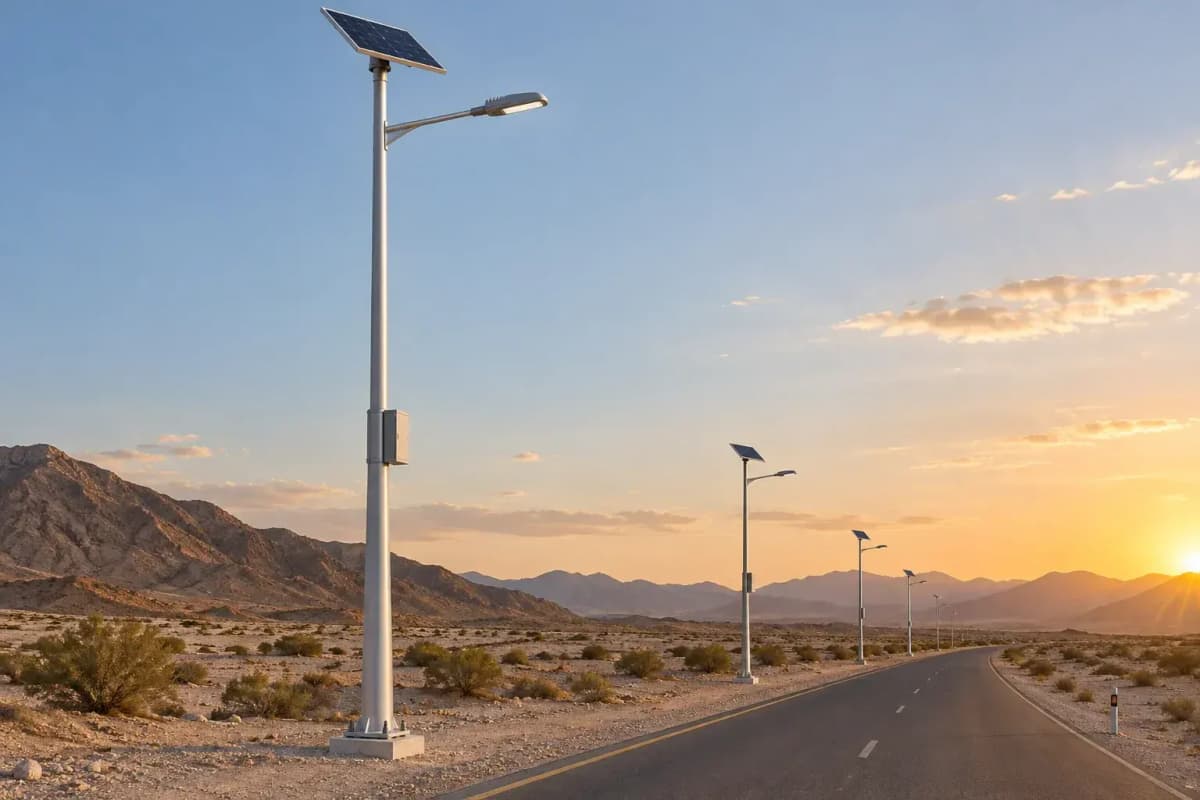
13.3m Split Solar Streetlight 156W - Desert EPC Solar Lighting
Key Features
- 13.3 m aluminum-alloy split pole engineered for desert road and industrial perimeter lighting
- 156 W LED engine delivers an estimated 26,520 lm at more than 170 lm/W chip efficacy
- 312 Wp monocrystalline TOPCon PV module sized at 2.0 W solar per 1 W LED load
- 1,404 Wh high-temperature LFP battery supports 8-day autonomy with smart dimming profiles
- EPC turnkey budget range is USD 950-1,672 per installed and commissioned unit
The 13.3m Split Solar Streetlight 156W combines a 312Wp TOPCon panel, 1,404Wh high-temperature LFP battery, 26,520lm LED output, and 8-day autonomy for desert road and industrial perimeter lighting.
Description
The 13.3m Split Solar Streetlight 156W is a desert-duty, off-grid lighting system combining a 156 W high-efficacy LED head, a 312 Wp monocrystalline TOPCon photovoltaic module, and a 1,404 Wh high-temperature LiFePO4 battery for 8 rainy days of autonomy. Designed for 13.3 m aluminum-alloy poles, 12 h/night dusk-to-dawn service, and +70°C cell-rated battery operation, this split architecture separates the PV module, luminaire, controller, and battery enclosure so engineers can optimize tilt angle, heat rejection, and maintenance access in arid corridors.
This page specifies the SOLARTODO 156 W split solar streetlight for B2B procurement teams comparing 50, 100, or 250+ pole programs in highways, logistics parks, solar farms, industrial estates, and desert access roads. For the broader category, see View all Solar Street Light products, or model a site-specific bill of materials in 3 steps at Configure your system online.
System Architecture for a 13.3 m Split Streetlight
A split solar streetlight uses 4 main field-replaceable assemblies: a TOPCon panel on an adjustable arm, a cobra-head LED luminaire, a BMS-protected LFP battery in the pole base or service box, and an MPPT charge controller rated above 98% conversion efficiency. Compared with an all-in-one 120 W light, the separated 312 Wp panel can be tilted toward the site latitude, while the 1,404 Wh battery can be mounted lower for a safer 1-person service procedure at ground level.
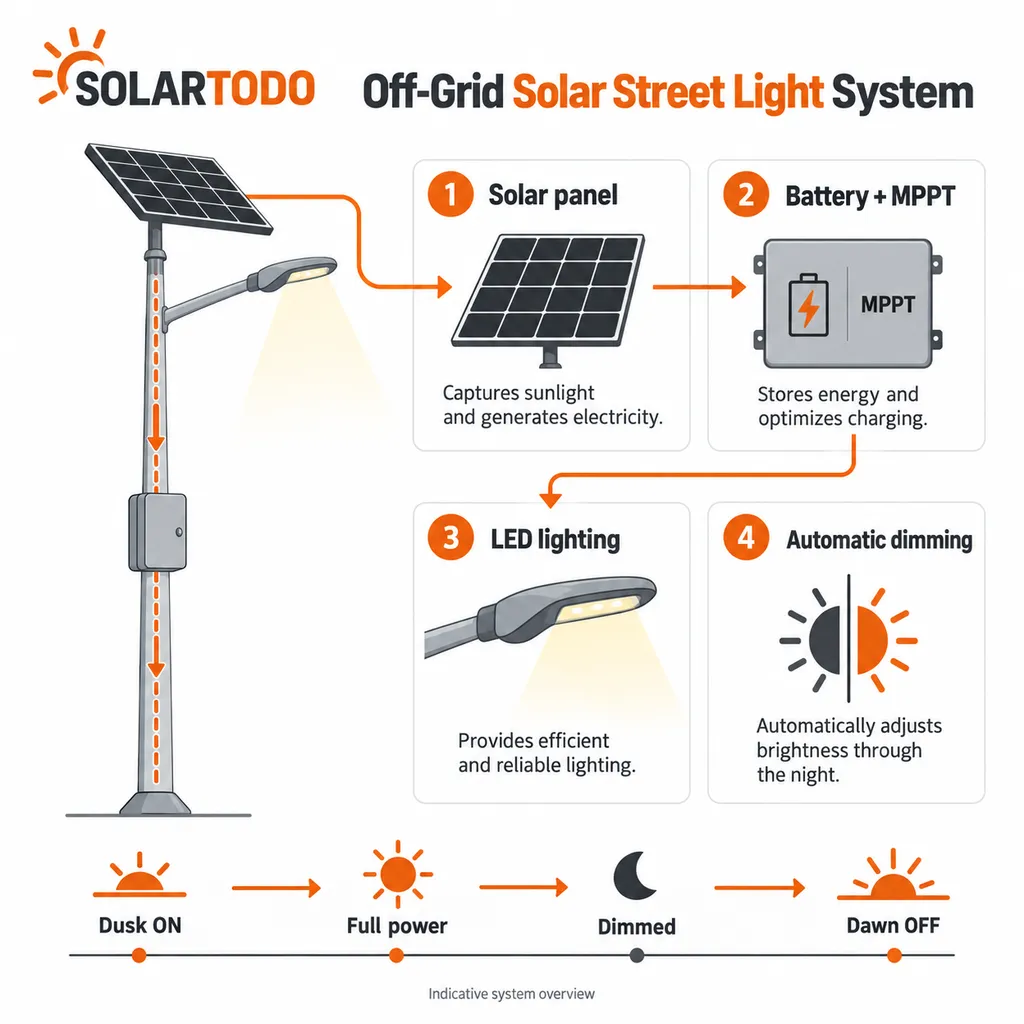
The electrical chain starts with the 312 Wp PV module, moves through a weather-sealed DC combiner and MPPT controller, charges the 1,404 Wh high-temperature LFP battery, and powers a 156 W LED engine using programmable night profiles such as 100% for 4 h, 60% for 4 h, and 30% for 4 h. NREL states that PVWatts V8 uses 2020 TMY weather data from the National Solar Radiation Database for covered locations, which is why SOLARTODO sizes desert projects with monthly irradiance loss factors rather than a single annual average NREL PVWatts V8.
Mechanically, the 13.3 m aluminum-alloy pole reduces mass versus galvanized steel by roughly 25% to 35% while retaining high corrosion resistance for dry, dusty, and coastal-desert sites. The reference wind configuration is 150 km/h, the LED housing targets IP66 ingress protection, and cable glands, breather valves, and powder-coated brackets are specified to limit sand intrusion during 8 h wind events and seasonal dust storms.
Technical Specifications for 156 W Operation
The luminaire uses Bridgelux, Cree, or Lumileds-class LED packages at more than 170 lm/W, producing an estimated 26,520 lm from 156 W before optical losses. IEC 60598-1:2020 covers luminaire safety requirements for light sources operating up to 1,000 V, including classification, marking, mechanical construction, electrical construction, and photobiological safety; this specification aligns the LED head and driver enclosure with that framework IEC 60598-1.
The 312 Wp monocrystalline TOPCon panel is sized at 2.0 W of PV per 1 W of LED load, a useful ratio for hot regions where module temperature can reduce midday output by 8% to 15%. TOPCon modules typically fall in the 19% to 23% efficiency band, and the procurement-grade design assumption is a 25-year panel life with power degradation modeled separately from the 3-year system warranty.
The 1,404 Wh high-temperature LFP battery supports 8 autonomy days only when the dimming schedule is commissioned for seasonal energy balance rather than 156 W continuous output for 12 h every night. At full power, the luminaire consumes 1.872 kWh/night; with a representative smart profile averaging 55% output over 12 h, consumption falls to about 1.030 kWh/night, extending backup duration and reducing deep-cycle stress by roughly 45%.
The MPPT controller should be configured with 3 programmable limits: PV input voltage, LFP charge voltage, and low-voltage disconnect. IEC 62124 was written for design verification and performance of stand-alone PV systems, and although the 2004 edition is now marked withdrawn by IEC, its test logic remains a useful procurement reference for off-grid PV lighting acceptance checks IEC 62124.
For LED electronics, UL 8750 is relevant when the project requires North American safety documentation for LED drivers, LED arrays, and LED packages used in lighting products. UL lists UL 8750 as active, with LED equipment intended for visible-spectrum operation from 400 nm to 700 nm, so SOLARTODO can map the 156 W driver stack to UL-recognized component requirements when a buyer requests that compliance path UL 8750.
Desert Climate Design and 12-Month Maintenance
The desert configuration uses high-temperature LFP cells rated to +70°C, an aluminum-alloy pole, sand-resistant enclosures, UV-stable cables, and 8 days of modeled autonomy for sites with periodic haze or dust accumulation. In arid regions, the highest reliability gains often come from 2 simple maintenance actions: cleaning PV glass every 30 to 60 days in dusty seasons and checking torque on bracket bolts every 12 months after thermal cycling.
Battery placement is a major serviceability difference between split and all-in-one designs: at 13.3 m, a top-mounted battery can require a lift truck for every diagnostic call, while a pole-base battery box can reduce typical inspection height from 13.3 m to less than 1.5 m. For a 100-pole project, that difference can remove 100 lift operations from a yearly battery audit and shorten night-work exposure for maintenance crews.
Compared with a conventional grid-tied 150 W LED streetlight, the solar split system avoids trenching, AC cabling, distribution cabinets, and meter points across each isolated pole line. In remote roads where trenching costs can exceed USD 25 to USD 80 per meter, a 100-pole route with 30 m spacing can avoid roughly 3,000 m of cable corridor work, although final savings depend on soil class, permitting, and transformer distance.
Representative MENA Solar Farm Scenario with 100 Poles
For a representative MENA solar farm scenario with 100 poles, 30 m spacing, 5.5 peak-sun-hours/day, and 12 h/night operation, the 312 Wp panel can produce about 1.72 kWh/day before thermal, soiling, wiring, and controller losses. After a conservative 25% system loss allowance, the usable harvest is about 1.29 kWh/day, which supports a 156 W luminaire running a 55% average dimming profile and preserves reserve capacity for 8 cloudy or dusty days.
In this scenario, a 100-unit EPC package at the midpoint price of USD 1,311 per pole equals USD 131,100 before volume discounts. A 10% discount for 100+ units reduces the indicative project supply-and-install cost by about USD 13,110, while the avoided grid extension can be larger than USD 75,000 when trenching, conductors, switchgear, and civil reinstatement are included at conservative corridor rates.
Cloud Monitoring and 4G Smart Controls
Remote monitoring can be configured over 4G or LoRa, with 15-minute to 60-minute reporting intervals for battery voltage, charge current, LED load, fault alerts, dimming profile, and panel status. A networked controller also supports PIR or radar motion-adaptive dimming, which can reduce delivered energy by up to 60% on low-traffic roads while keeping 100% output available during detected activity windows.
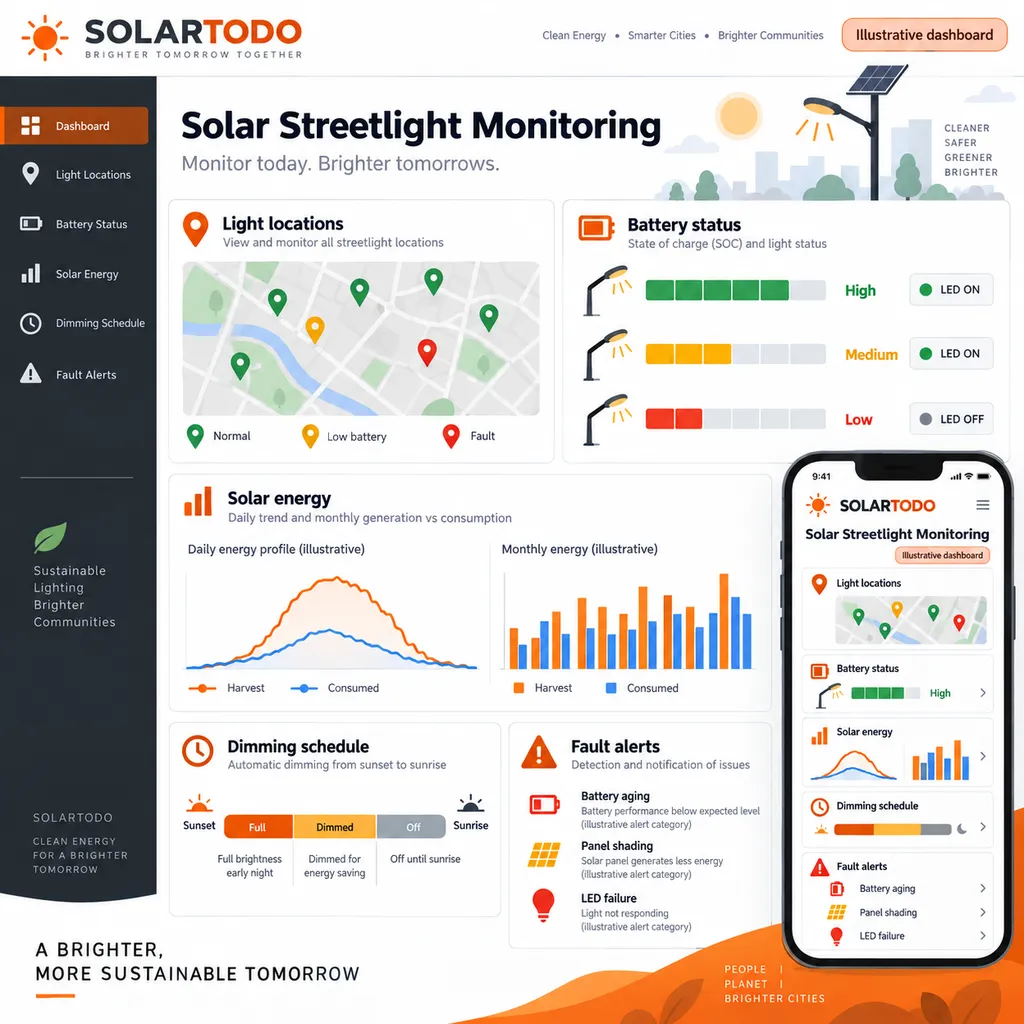
For cybersecurity-conscious owners, SOLARTODO separates 2 operating layers: local dusk-to-dawn autonomy remains available even if the cloud link is offline, while cloud dashboards provide fleet analytics, fault triage, and work-order prioritization. A 100-pole project reporting every 30 minutes generates about 4,800 telemetry records per day, which is enough for battery trend analysis without turning a streetlight into a high-bandwidth network device.
The broader market context supports this design direction because IEA Renewables 2025 projects almost 4,600 GW of renewable capacity additions between 2025 and 2030, with solar PV representing nearly 80% of that expansion. That macro trend matters for procurement because PV module, controller, and battery supply chains are scaling toward standard, replaceable components rather than isolated custom parts IEA Renewables 2025.
IRENA reports that utility-scale battery storage installed costs fell 93% from 2010 to 2024, reaching USD 192/kWh in 2024, which helps explain why 1,404 Wh LFP batteries are now feasible in mid- to high-pole lighting systems. For streetlighting, the engineering implication is not simply lower price; it is the ability to specify deeper autonomy, stronger BMS protection, and more conservative cycling for hot climates IRENA Renewable Costs 2024.
Applications and Buyer Fit for 50+ Units
The 13.3 m, 156 W configuration is best suited to wide roadways, perimeter roads, port yards, industrial parks, mine access roads, solar-farm internal roads, and high-security compounds requiring pole heights above 12 m. It is usually over-specified for small residential lanes below 6 m, where a 30 W to 60 W integrated unit may be sufficient and lower in first cost.
Procurement teams can compare this SKU with neighboring variants by reviewing Learn about topic for solar lighting design fundamentals and Learn about topic for off-grid PV battery sizing. For formal tender responses, SOLARTODO can prepare 3 documents per project: a datasheet, a lighting layout input sheet, and a commercial quotation based on quantities, incoterms, and installation scope.
EPC Investment Analysis and Pricing Structure for 3 Buying Models
EPC turnkey pricing for this product includes 5 cost centers: engineering, procurement, construction, commissioning, and 1-year field warranty support. The quoted EPC range of USD 950 to USD 1,672 per unit covers installed hardware, civil foundation work, pole erection, electrical commissioning, lighting profile setup, and handover documentation; it excludes unusual road closures, armed security, customs penalties, or grid interconnection work outside the 24 V or 48 V DC streetlight package.
| Tier | Scope | Unit price, USD | Buyer use case |
|---|---|---|---|
| FOB Supply | Equipment only, ex-works China | 589-1,137 | Distributors, EPCs, and importers buying 50+ kits |
| CIF Delivered | Equipment plus ocean freight and insurance | 662-1,277 | Buyers needing delivered-port budgeting for 100+ units |
| EPC Turnkey | Installed, commissioned, and warranted for 1 year | 950-1,672 | Developers needing a complete 13.3 m lighting package |
| Quantity | Discount | Indicative effect on USD 1,311 midpoint EPC price |
|---|---|---|
| 50+ units | 5% | USD 65.55 reduction per pole |
| 100+ units | 10% | USD 131.10 reduction per pole |
| 250+ units | 15% | USD 196.65 reduction per pole |
ROI depends on the avoided grid work and diesel-generator displacement, so SOLARTODO presents payback as a site model rather than a universal claim. In a 100-pole remote-road project, if grid trenching and AC distribution are avoided at USD 75,000 and annual electricity plus maintenance savings reach USD 12,000, the simple payback against a conventional grid lighting alternative can fall in the 4.5-year to 7.5-year band, before carbon or downtime values are counted.
Payment terms are 30% T/T deposit plus 70% against bill of lading, or 100% irrevocable L/C at sight for bank-approved buyers. Project financing can be discussed for programs above USD 1,000K, and engineering teams can Request a custom quotation or email [email protected] with 6 inputs: country, road length, pole spacing, target illuminance, mounting height, and warranty requirement.
Procurement Notes and 10-File Compliance Documentation
A complete bid package normally includes 10 files: datasheet, IES file, pole drawing, foundation drawing, PV module certificate, battery MSDS or UN38.3 file, controller manual, warranty statement, packing list, and test report summary. The buyer should confirm 3 project-specific variables before purchase: wind speed, soil bearing capacity, and lighting-class target, because a 13.3 m pole has higher overturning moments than an 8 m or 10 m streetlight.
SOLARTODO positions this 156 W model as an engineered B2B system, not a commodity lamp, because the economics depend on correct PV yield, battery cycling, dimming logic, and civil installation. When buyers standardize the 312 Wp panel, 1,404 Wh LFP battery, MPPT controller, IP66 LED luminaire, and aluminum-alloy pole across 50 to 250+ units, spare-part planning becomes simpler and commissioning data becomes comparable across every road segment.
Technical Specifications
| Pole Height | 13.3m |
| LED Power | 156W |
| Luminous Flux | 26520lm |
| Solar Panel | 312Wp |
| Battery Capacity | 1404Wh |
| Battery Type | High-temperature LiFePO4 (LFP) |
| Autonomy | 8rainy days |
| Pole Material | Aluminum alloy |
| Wind Resistance | 150km/h |
| Operating Temperature | -20 to +70°C |
| Lighting Hours | 12h/day |
| Control Mode | MPPT with PIR/time-based dimming and 4G/LoRa option |
| Ingress Protection | IP66/IP67 option |
| Warranty | 3 years system, 5 years pole |
Price Breakdown
| Item | Quantity | Unit Price | Subtotal |
|---|---|---|---|
| 312Wp mono TOPCon solar panel | 1 pcs | $31 | $31 |
| 1,404Wh high-temperature LFP battery pack | 1 pcs | $183 | $183 |
| 156W split LED cobra-head luminaire | 1 pcs | $70 | $70 |
| 312W MPPT solar charge controller | 1 pcs | $94 | $94 |
| 13.3m aluminum alloy pole | 1 pcs | $293 | $293 |
| Battery enclosure, brackets, and DC cabling | 1 pcs | $55 | $55 |
| 4G/LoRa remote monitoring module | 1 pcs | $94 | $94 |
| Concrete foundation materials | 1 pcs | $80 | $80 |
| Inland logistics and packing allowance | 1 pcs | $45 | $45 |
| Installation & commissioning | 1 pcs | $210 | $210 |
| Engineering, lighting profile setup, and QC | 1 pcs | $80 | $80 |
| 1-year warranty and field support allowance | 1 pcs | $65 | $65 |
| Total Price Range | $950 - $1,672 | ||
Frequently Asked Questions
What is included in the EPC turnkey price for the 13.3m Split Solar Streetlight 156W?
How can the system claim 8 days of autonomy with a 1,404Wh battery?
Why use a split solar streetlight instead of an all-in-one fixture?
Which standards are relevant for this product specification?
What project information is needed for a firm quotation?
Certifications & Standards



Data Sources & References
- •NREL PVWatts V8 and NSRDB 2020 TMY data, https://developer.nlr.gov/docs/solar/pvwatts/
- •IEC 60598-1:2020 Luminaires - General requirements and tests, https://webstore.iec.ch/en/publication/61414
- •IEC 62124 PV stand-alone systems design verification, https://webstore.iec.ch/en/publication/6483
- •UL 8750 LED Equipment for Use in Lighting Products, https://www.shopulstandards.com/ProductDetail.aspx?productId=UL8750
- •IEA Renewables 2025 renewable electricity analysis, https://www.iea.org/reports/renewables-2025/renewable-electricity
- •IRENA Renewable Power Generation Costs in 2024, https://www.irena.org/Digital-Report/Renewable-Power-Generation-Costs-in-2024
Interested in this solution?
Contact us for a customized quote based on your specific requirements.
Contact Us