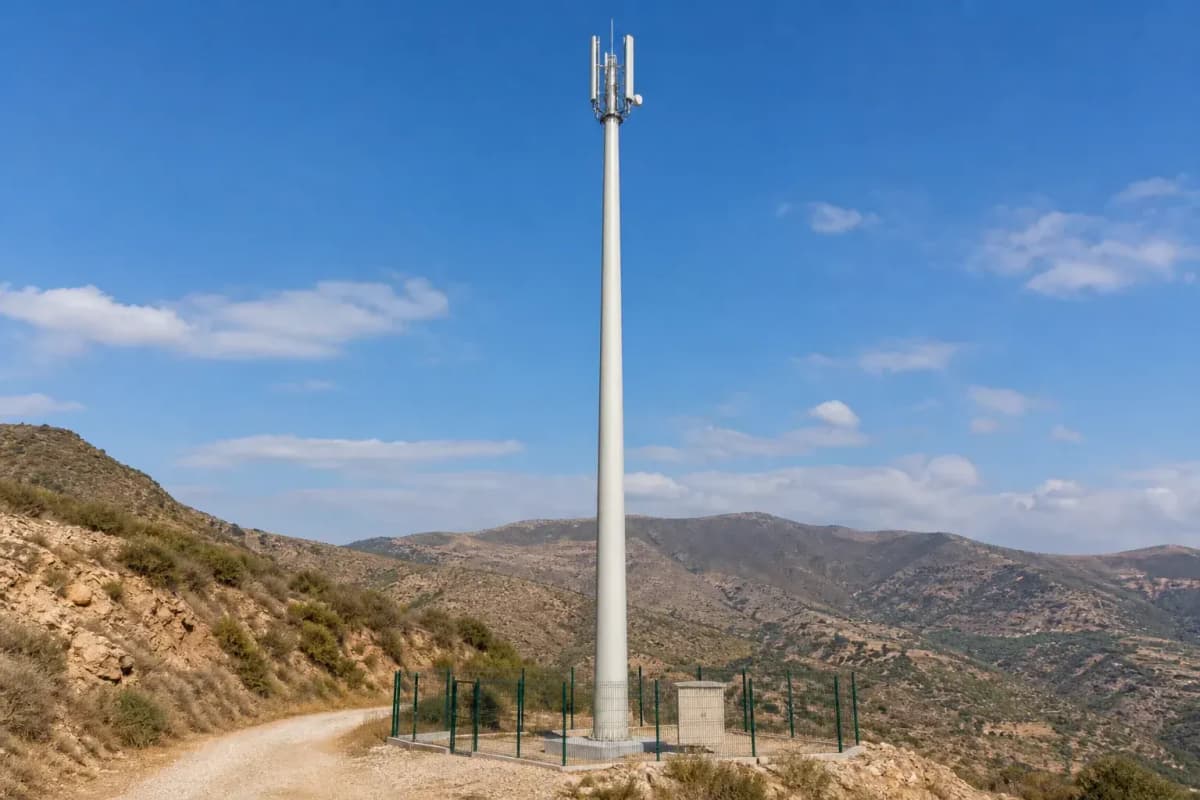
26m FRP Pole Rural Flanged - 41 m/s Rural Telecom Support
Key Features
- 26 m heavy-duty FRP composite monopole with flanged base connection for rural telecom sites
- Designed for 41 m/s wind speed with 1 antenna platform and 3 antenna mounting positions
- Estimated 350 kg total tip load subject to final antenna, cable, and wind-zone verification
- FRP shaft is typically 60-70% lighter than comparable galvanized steel monopoles
- EPC turnkey price range is USD 29,187-44,712 with 1-year warranty support
The 26m FRP Pole Rural Flanged is a fiber reinforced polymer telecom support pole for rural 4G/5G sites, designed for 41 m/s wind, 1 antenna platform, and 3 antenna positions. EPC turnkey pricing is USD 29,187-44,712 with ASTM D4923, TIA-222-H, IEC 61109, and IEEE grounding practices referenced for specification.
Description
The 26m FRP Pole Rural Flanged is a 26 m fiber reinforced polymer telecom pole for rural 4G/5G coverage, microwave backhaul, GPS timing, and aviation lighting where low maintenance and RF transparency are required. The configuration supports 1 antenna platform, 3 antenna positions, and a 41 m/s design wind speed, with EPC turnkey pricing from USD 29,187 to USD 44,712.
This product belongs to SOLARTODO's Telecom Tower line and is specified for operators, EPC contractors, rural broadband developers, and public infrastructure buyers planning 1-site, 10-site, or 250-site rollouts. Buyers can View all Telecom Tower products, Configure your system online, or Request a custom quotation with site coordinates, soil data, and antenna loading.
Product Definition
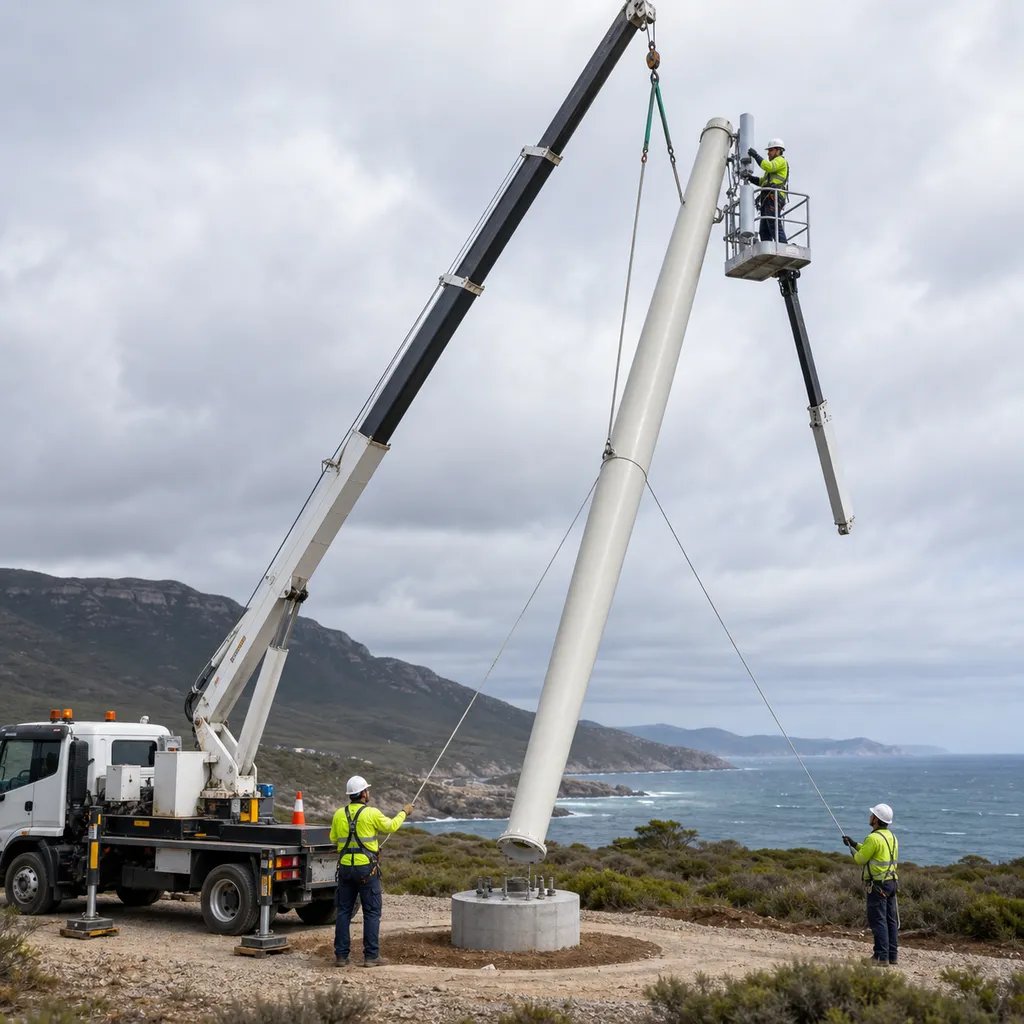
The pole is manufactured from glass fiber reinforced polymer with polyester or vinyl ester resin, using filament winding or equivalent composite forming for a tapered 26 m monopole body. Compared with a conventional galvanized steel monopole of similar height, the FRP structure is typically 60-70% lighter, reducing freight weight, crane size, and installation handling risk across rural sites with 1 narrow access road or limited lifting equipment.
FRP is selected for sites where corrosion, electrical conductivity, and RF obstruction create lifecycle penalties over 30-50 years. The UV-stabilized gel coat protects the outer laminate, while the non-metallic shaft allows internal antenna concealment for stealth designs and can reduce external visual clutter from 3 exposed panels to 0 exposed panels when the antenna package is designed for internal mounting.
Standards and Compliance Basis
Structural design should be checked against ANSI/TIA-222-H, which TIA identifies as the structural standard for antenna supporting structures, appurtenance mounting systems, foundations, and wind loading alignment with ASCE 7 criteria: TIA-222-H publication notice. For FRP material procurement, ASTM D4923 covers reinforced thermosetting plastic poles and requires purchaser-supplier agreement on design parameters and service conditions: ASTM D4923.
Composite electrical insulation practice is informed by IEC 61109:2025, a 108-page IEC standard for composite insulators using fiber cores in resin matrices, polymer housings, and acceptance criteria for overhead-line service: IEC 61109:2025. Ground testing methodology should reference IEEE 81-2025, published in 2026, for earth resistivity, ground impedance, step voltage, touch voltage, and grounding-system measurement practice: IEEE 81-2025.
Technical Specifications
| Parameter | Specification |
|---|---|
| Tower height | 26 m |
| Tower type | FRP composite monopole |
| Material | Heavy-duty glass fiber + polyester/vinyl ester resin |
| Connection type | Flanged base connection |
| Application | Rural telecom site |
| Antenna platforms | 1 level |
| Antenna capacity | 3 antennas |
| Design wind speed | 41 m/s |
| Estimated total tip load | 350 kg |
| Foundation type | Reinforced concrete pad/pier, site-designed |
| Lightning target resistance | Less than 4 ohm |
| Design life | 50+ years for FRP body with inspections |
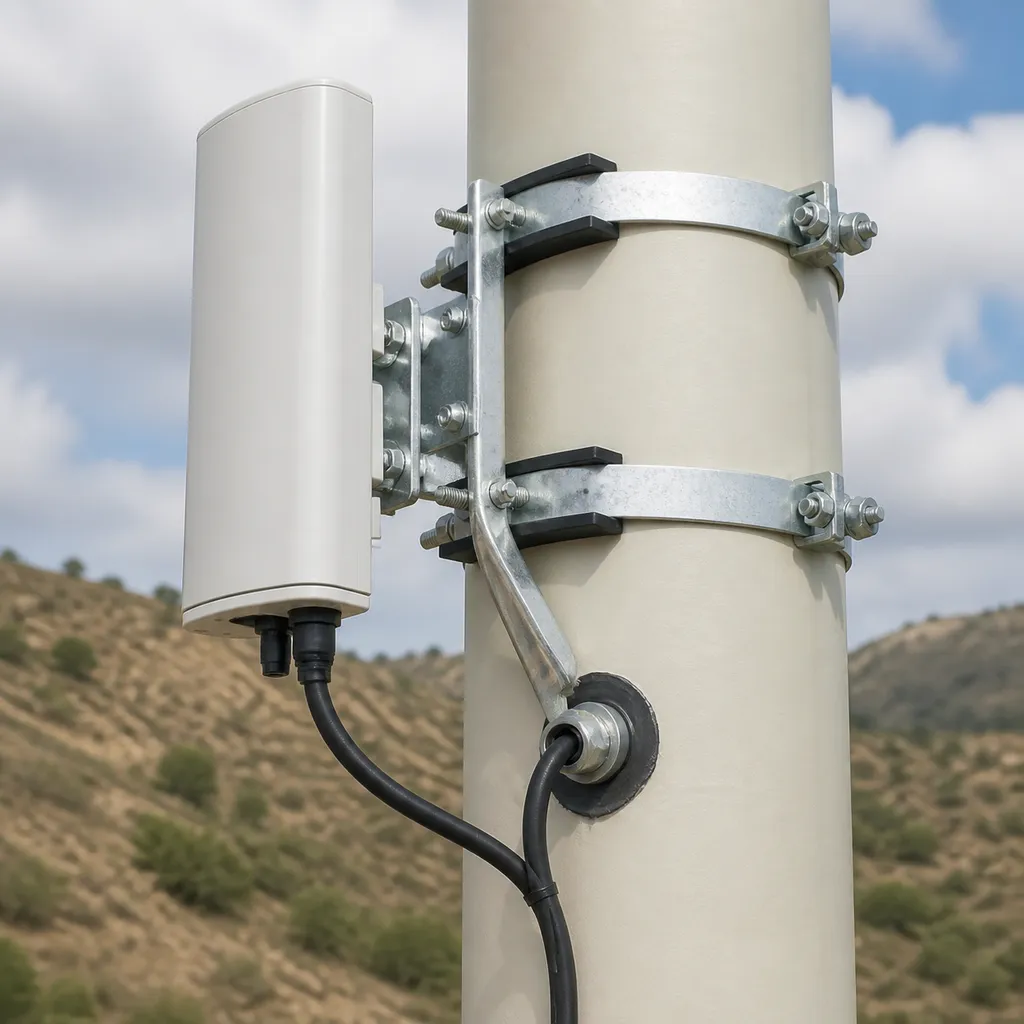
The representative 350 kg tip load should be verified against the final antenna schedule, cable weight, bracket geometry, and wind exposure category before procurement. A typical rural payload may include 3 sector antennas at 20-25 kg each, 1 microwave dish at 35-60 kg when required, 1 GPS antenna under 5 kg, 1 aviation light set near 3-6 kg, and cable runs distributed along 26 m of internal or external tray.
System Architecture
The flanged base transfers overturning moment and shear from the 26 m FRP shaft into an anchor-bolt cage and reinforced concrete foundation. For bidding, SOLARTODO uses a representative 18 m³ concrete allowance, but final dimensions should be based on 1 geotechnical report, 1 wind map, 1 antenna loading table, and the governing national annex or local telecom authority requirement.
The standard system package includes 1 FRP pole body, 1 flanged base assembly, 1 antenna platform level, 3 antenna mounting interfaces, 26 m of internal ladder or access provision, 26 m of cable tray route, 1 lightning air terminal, 1 down conductor, 1 grounding grid, 1 aviation warning light set, and 1 site-specific foundation design package.
RF transparency is the main engineering differentiator. Steel poles and lattice towers can reflect or shadow RF energy at multiple frequencies, while an FRP shaft can allow concealed antennas when the radio design confirms acceptable loss through the laminate at the required 4G, 5G, or microwave band. This is especially useful for 1 rural community site near scenic, municipal, or agricultural areas where visual acceptance matters.
Materials and Manufacturing
The heavy FRP material system uses continuous glass fiber reinforcement with a resin-rich outer layer and UV-stabilized gel coat. In a 26 m pole, wall thickness is selected by section bending demand, deflection criteria, and 41 m/s wind load rather than by height alone, so procurement drawings should define base diameter, tip diameter, laminate schedule, bolt circle, flange thickness, and allowable top deflection.
FRP corrosion resistance reduces maintenance exposure in coastal, chemical, and high-humidity sites where galvanized steel often requires inspection, rust treatment, or repainting during a 30-year service horizon. A conservative rural O&M model assumes 1 visual inspection per year and no repainting cycle for FRP, compared with a steel repaint or touch-up event every 7-10 years depending on zinc loss, salt deposition, and site access.
Rural Applications
The 26 m height is suitable for rural macro infill, village broadband, road coverage, farm operations, rail-adjacent telemetry, solar-farm communications, and perimeter security backhaul across 1-5 km local service areas depending on terrain, antenna gain, frequency band, and allowed transmit power. For remote energy sites, the pole can share civil works with solar, battery, CCTV, or smart lighting infrastructure when foundation loads are checked together.
Rural access constraints are often more important than factory cost. Because the FRP pole is approximately 60-70% lighter than equivalent steel, many projects can reduce truck payload class, lifting duration, and temporary road preparation. For 50 sites, even a USD 1,200 logistics saving per site equals USD 60,000 before considering reduced corrosion work over the first 10 years.
Cloud Monitoring
The pole itself is passive infrastructure, but it can support 1 cloud-connected telecom cabinet, 1 smart meter, 1 weather station, 1 tilt sensor, and 1 aviation-light alarm output when the buyer specifies a monitored site package. A common rural configuration reports grid status, battery voltage, cabinet temperature, door status, and lightning-event counters at 5-minute or 15-minute intervals through an LTE or fiber backhaul link.
Monitoring should not replace scheduled structural inspection, because TIA-222-H class checks, bolt torque verification, and foundation condition reviews remain physical tasks. However, adding 4-6 digital points can reduce unnecessary truck rolls by identifying whether a fault is caused by AC power, DC power, cabinet heat, radio outage, or aviation-light failure before dispatching a 2-person crew.
Representative MENA Rural Solar Farm Scenario
For a representative MENA solar farm scenario, assume 1 off-grid telecom point at a 100 MW photovoltaic plant, 3 sector antennas, 1 microwave backhaul dish, 1 security camera network, 41 m/s regional wind design, and a 26 m flanged FRP pole located near the operations building. The pole supports telecom coverage for maintenance teams while avoiding conductive tower members near medium-voltage routes and reducing corrosion risk in desert dust and coastal humidity.
If the alternative is a 26 m galvanized steel monopole, FRP may reduce installed lifting weight by about 60-70% and remove 2-4 painting or corrosion-repair events over a 30-year planning period. With avoided repainting at USD 2,200 per cycle, lower annual corrosion inspection at USD 450 per year, and one-time logistics saving of USD 1,800, the lifecycle saving can exceed USD 17,000 per site over 30 years before discounting.
EPC Investment Analysis and Pricing Structure
SOLARTODO's EPC turnkey scope includes 5 work blocks: engineering, procurement, construction, commissioning, and 1-year warranty support. Engineering covers structural calculations, foundation drawings, antenna interface review, and lightning/grounding layout; procurement covers the FRP pole, flange, platform, cable route, lighting, and foundation materials; construction covers excavation, rebar, concrete, erection, torque checks, grounding, and site restoration.
| Pricing tier | Scope | Price range |
|---|---|---|
| FOB Supply | Equipment only, ex-works China | USD 18,096-30,404 |
| CIF Delivered | Equipment + ocean freight + insurance | USD 23,142-38,881 |
| EPC Turnkey | Installed, commissioned, and 1-year warranty | USD 29,187-44,712 |
| Volume band | Discount | Commercial note |
|---|---|---|
| 50+ poles | 5% | Batch production, shared engineering templates, consolidated freight |
| 100+ poles | 10% | Repeated flange, laminate, and foundation assumptions across regions |
| 250+ poles | 15% | Framework procurement with staged shipment and site-by-site call-off |
ROI is evaluated against 3 cost groups: initial installed cost, logistics and installation cost, and 30-year maintenance cost. If a steel alternative costs USD 34,000 installed and the FRP EPC package is USD 39,430 in a representative budget, the initial premium is USD 5,430; with USD 1,800 logistics saving and USD 900 annualized avoided maintenance from corrosion and coating work, simple payback is about 4.0 years.
Payment terms are 30% T/T + 70% against B/L copy, or 100% irrevocable L/C at sight for qualifying buyers. Project financing can be discussed for packages above USD 1,000,000, equal to about 23-34 EPC poles at the listed price range, and technical-commercial requests should be sent to [email protected] with 1 site list, 1 antenna schedule, and 1 target delivery window.
Energy and Infrastructure Context
The need for rural telecom infrastructure is linked to the same electrification and grid-edge trend that drives solar, storage, and smart monitoring. The IEA projects renewable electricity capacity additions of about 4,600 GW from 2025 to 2030, with solar PV contributing nearly 80% of the increase: IEA Renewables 2025. Telecom towers at solar farms, substations, and smart-agriculture sites are part of that distributed infrastructure layer.
IRENA reported that solar PV remained at about USD 44/MWh in 2025, while onshore wind reached about USD 33/MWh, reinforcing the economics of power-backed communications in remote locations: IRENA Renewable Power Generation Costs in 2025. For site energy modeling, NREL's PVWatts V8 uses NSRDB weather data and can estimate PV production for hybrid telecom power systems: NREL PVWatts V8.
Procurement Notes
A complete RFQ should include at least 10 data points: site country, GPS coordinates, terrain category, design wind speed, antenna sizes, antenna elevations, cable count, preferred access method, soil bearing capacity, and grounding target. Without those 10 inputs, any quotation should be treated as preliminary because foundation cost, anchor bolt diameter, section thickness, and freight packaging can change materially.
Procurement teams should also define 6 acceptance documents before factory release: laminate material certificate, dimensional inspection report, flange bolt-hole report, gel-coat visual inspection, packing list, and structural calculation summary. For 100+ pole programs, SOLARTODO can align serial numbering, shipment batches, and drawing revisions so that each 26 m pole is traceable from factory QC to site commissioning.
Related SOLARTODO Knowledge
Engineers comparing tower types can Learn about topic for broader telecom, energy storage, and smart infrastructure notes, including site power, grounding, and monitoring concepts. For procurement teams that need product families, View all Telecom Tower products provides the broader tower category, while the telecom configurator supports 20-45 m preliminary configuration ranges.
Specification Summary
The 26m FRP Pole Rural Flanged is best suited to rural projects requiring 1 compact foundation, 1 flanged erection interface, 3 antenna positions, 41 m/s wind resistance, and a long-life non-corroding shaft. It is not a universal substitute for every steel lattice tower, but for corrosive, scenic, power-sensitive, or low-maintenance sites, its 50+ year FRP service profile can lower lifecycle risk across 10, 50, or 250-site programs.
Technical Specifications
| Tower Height | 26m |
| Tower Type | FRP composite pole |
| Material | Heavy glass fiber reinforced polymer with polyester or vinyl ester resin |
| Application | Rural telecom coverage and smart infrastructure |
| Connection Type | Flanged base connection |
| Antenna Platforms | 1levels |
| Antenna Capacity | 3antennas |
| Design Wind Speed | 41m/s |
| Total Tip Load | 350kg |
| Foundation Type | Reinforced concrete pad or pier, site-designed |
| Corrosion Protection | UV-stabilized gel coat, corrosion-proof FRP body |
| Lightning Grounding Target | <4ohm |
| Design Life | 50+years |
| Standards | ASTM D4923 / ANSI TIA-222-H / IEC 61109 / IEEE 81 |
Price Breakdown
| Item | Quantity | Unit Price | Subtotal |
|---|---|---|---|
| 26m heavy FRP composite pole body | 1 pcs | $15,200 | $15,200 |
| Flanged base plate and anchor interface | 1 pcs | $2,600 | $2,600 |
| Antenna platform, installed allowance | 1 pcs | $800 | $800 |
| Antenna mounting brackets | 3 pcs | $350 | $1,050 |
| Internal ladder for FRP pole | 26 pcs | $20 | $520 |
| Cable tray system | 26 pcs | $10 | $260 |
| Lightning protection system | 1 pcs | $500 | $500 |
| Aircraft warning light set | 1 pcs | $300 | $300 |
| Reinforced concrete foundation allowance | 18 pcs | $300 | $5,400 |
| CIF freight and insurance allowance | 1 pcs | $2,300 | $2,300 |
| Installation and commissioning | 1 pcs | $5,200 | $5,200 |
| Engineering, drawings, and QC documentation | 1 pcs | $3,100 | $3,100 |
| 1-year warranty and support | 1 pcs | $1,500 | $1,500 |
| Site survey and permit coordination allowance | 1 pcs | $1,200 | $1,200 |
| Total Price Range | $29,187 - $44,712 | ||
Frequently Asked Questions
What is included in the EPC turnkey price for the 26m FRP Pole Rural Flanged?
Why use FRP instead of a galvanized steel telecom monopole?
Can antennas be installed inside the FRP pole?
What standards are used for structural and electrical checks?
What site data is needed before final manufacturing?
Certifications & Standards


Data Sources & References
- •TIA: ANSI/TIA-222-H publication notice, 2017
- •ASTM D4923-92 Standard Specification for Reinforced Thermosetting Plastic Poles
- •IEC 61109:2025 composite insulator standard, publication date 2025-02-26
- •IEEE 81-2025 grounding measurement standard, published 2026-07-15
- •IEA Renewables 2025 renewable electricity analysis
- •IRENA Renewable Power Generation Costs in 2025, July 2026
- •NREL/NLR PVWatts V8 API documentation and NSRDB reference
Interested in this solution?
Contact us for a customized quote based on your specific requirements.
Contact Us