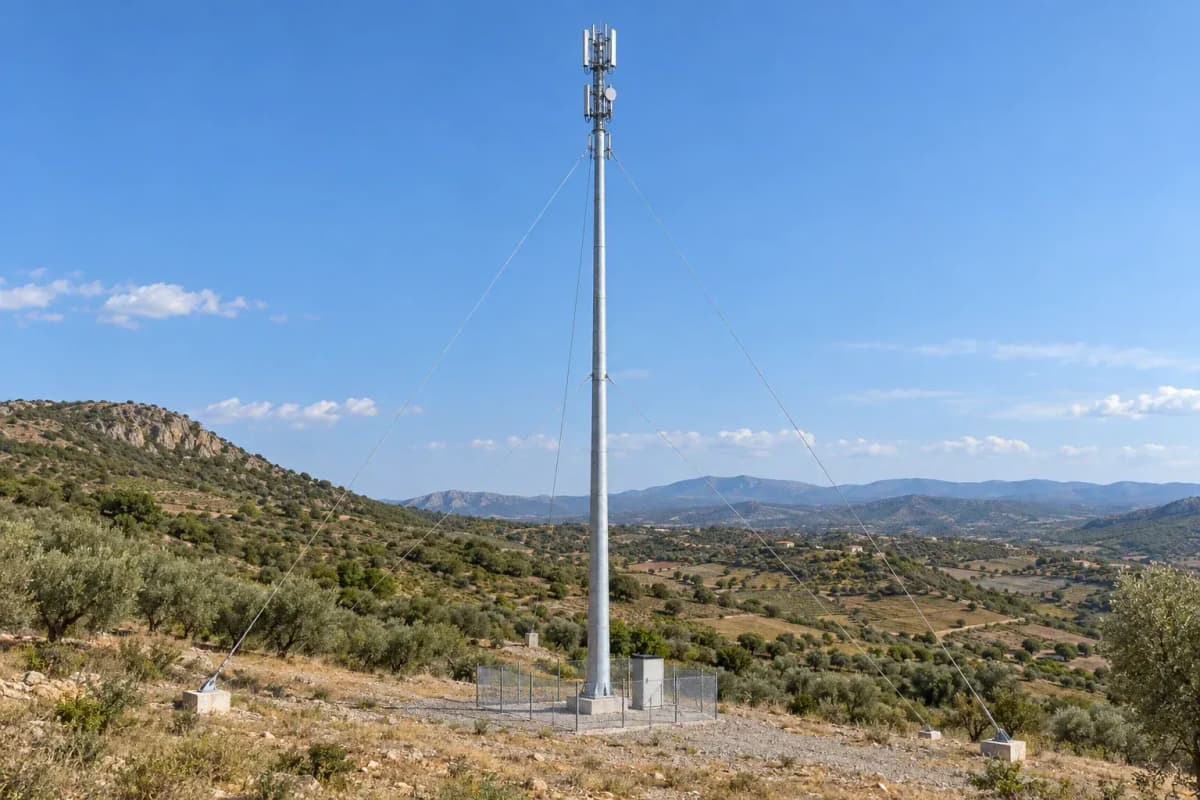
60m Guyed Tower Rural Wide Coverage Slip-Joint
Key Features
- 60 m Q355 galvanized steel-tube guyed mast for rural wide coverage
- 47 m/s design wind speed, equal to approximately 169 km/h basic wind input
- 3 antenna platform levels with 12 antenna positions and 650 kg representative tip load
- 18-30 m typical guy radius, equal to 30-50% of tower height
- $63,070-$86,020 EPC turnkey range with 1-year warranty support
The 60m Guyed Tower Rural Wide Coverage Slip-Joint is a 60 m Q355 galvanized steel-tube telecom mast for 3 antenna platforms, 12 antennas, and 47 m/s wind design. EPC turnkey pricing is $63,070-$86,020 for engineering, procurement, construction, commissioning, and 1-year warranty support.
Description
The 60m Guyed Tower Rural Wide Coverage Slip-Joint is a 60 m steel-tube telecom mast engineered for open-land rural macro coverage, 3 antenna platform levels, 12 total antennas, and a 47 m/s design wind speed. The slip-joint mast architecture reduces bolted flange count by multiple section interfaces while the guyed support system keeps the installed EPC budget at $63,070-$86,020 for 1 complete commissioned site.
Product Overview
This SOLARTODO telecom tower is specified for rural wide-area 4G, 5G, microwave backhaul, emergency communications, and energy-site SCADA where 1 elevated structure must carry up to 12 antenna positions across 3 working elevations. A 60 m guyed mast is normally more cost-efficient than a 60 m self-supporting lattice tower because the primary vertical steel member is stabilized by 3 or 4 radial guy directions rather than by a wide free-standing steel base, which can reduce structural steel mass by about 25-40% when adequate land is available.
The tower uses galvanized Q355 steel tube sections with slip-joint overlaps, a central reinforced-concrete base, and 3 anchor blocks positioned at a guy radius typically equal to 30-50% of tower height, or approximately 18-30 m from the mast centerline. This land requirement is the main engineering trade-off: the system saves steel and crane time, but it needs a clear circular easement of about 2,000-3,000 m2 for safe guy-wire geometry, anchor access, and maintenance clearance.
SOLARTODO positions this configuration inside the View all Telecom Tower products portfolio for rural base stations, solar farms, border roads, mining roads, agricultural monitoring networks, and low-density municipal service zones. Buyers comparing 40 m, 60 m, and 80 m structures can use the Configure your system online workflow to adjust antenna loading, wind zone, foundation volume, cable tray length, and optional aviation lighting before requesting a formal bill of quantities.
System Architecture
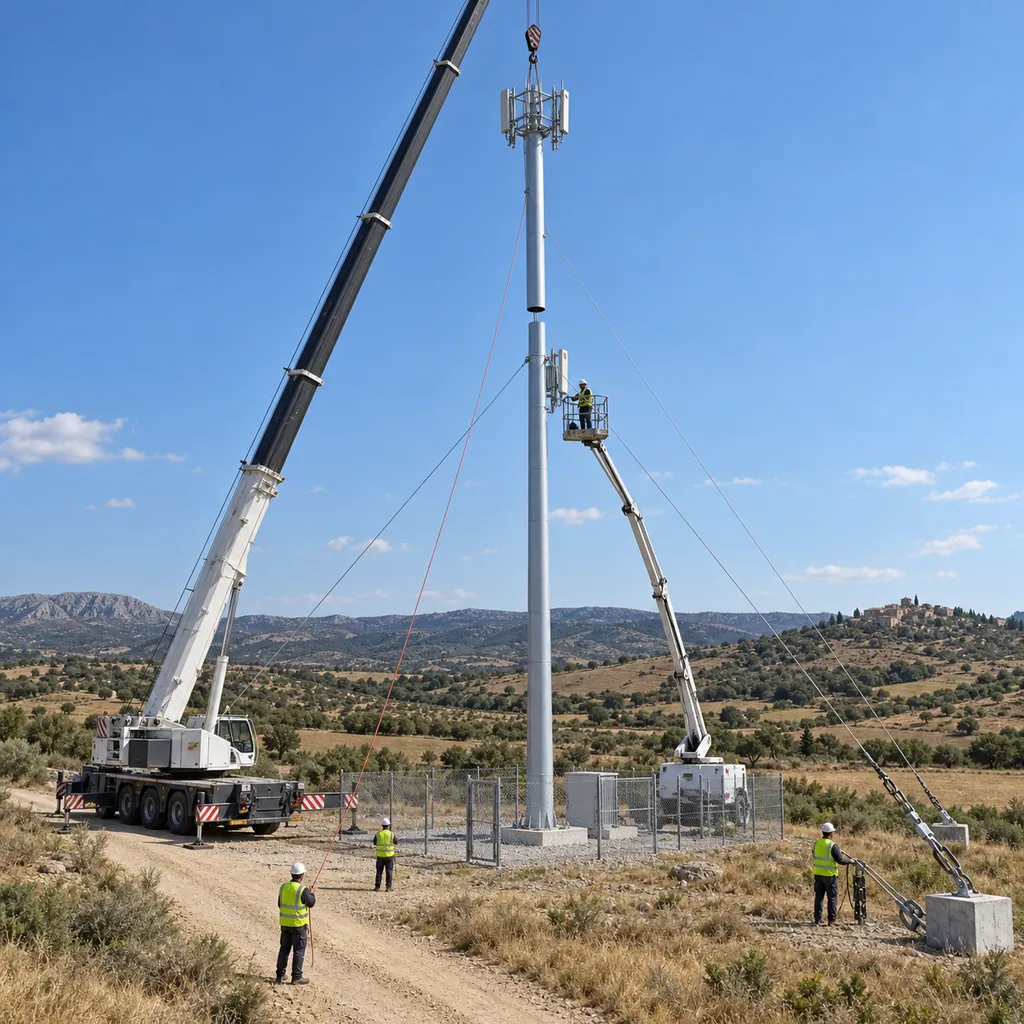
The 60 m structure is divided into tapered steel-tube mast sections that are stacked by slip-joint insertion length rather than relying only on heavy bolted flanges at every elevation. In a typical 6-section mast, each slip joint is factory-marked with overlap depth, lifting orientation, and galvanizing batch reference, allowing site crews to control vertical alignment and rotation before the first 3 guy levels are tensioned.
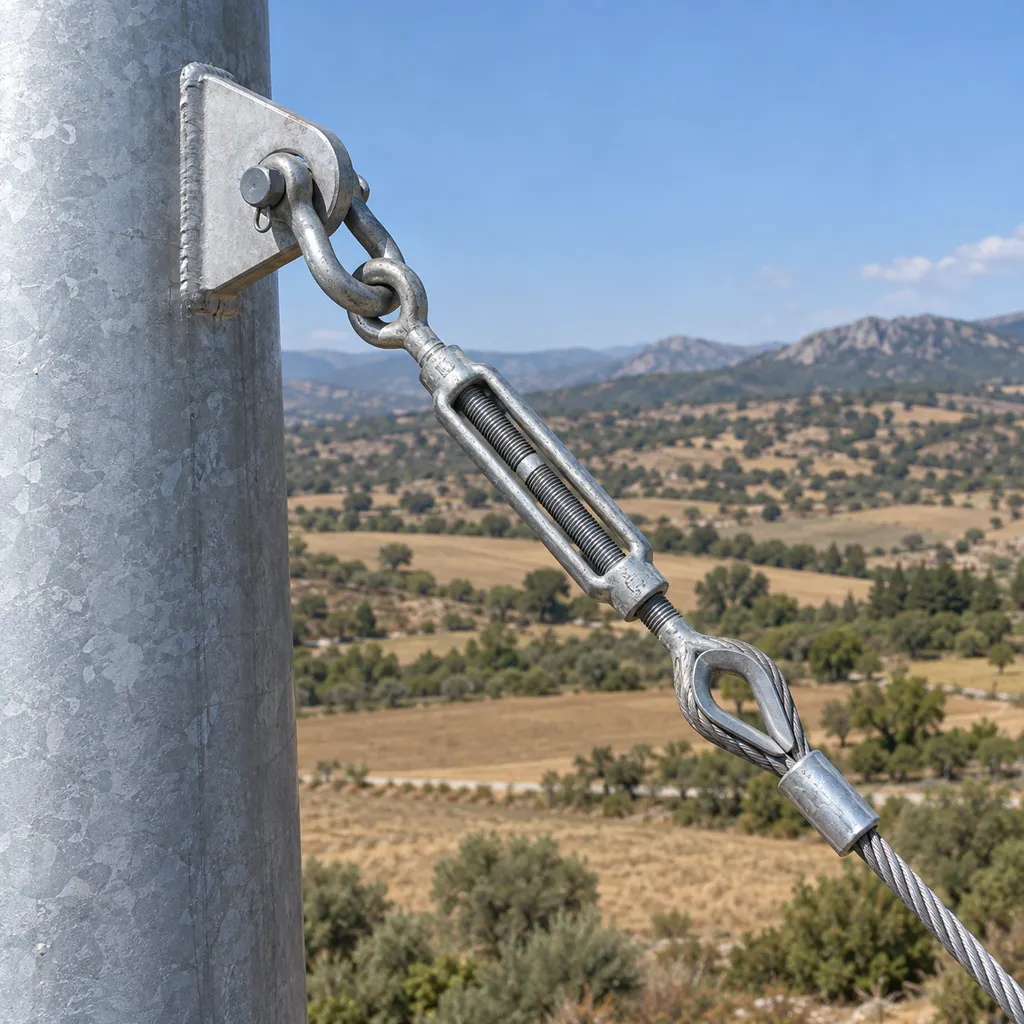
The guy system normally uses 3 radial directions spaced at 120 degrees or 4 directions spaced at 90 degrees, with 3-4 guy-wire elevations selected after final antenna loading and local wind exposure are confirmed. Each anchor block resists uplift, lateral load, and cyclic tension, while the central base mainly transfers compression, shear, and overturning stabilization from the mast shaft into reinforced concrete.
Cable routing is designed as a vertical tray or ladder path from the equipment shelter to all 3 antenna platforms, with RF feeder, fiber, grounding, and DC power segregation applied where the radio design requires it. A standard 60 m cable tray allowance is included in the price model, and additional cable ladders can be added when microwave dishes, remote radio heads, GPS antennas, or 2 aviation lights require separated routes.
Technical Specifications
The base technical specification is 60 m height, guyed tower type, steel_tube material, slip_joint connection, 3 antenna platforms, 12 antenna capacity, and 47 m/s design wind speed. The representative tip load is specified at 650 kg, which covers a rural macro arrangement of 9 panel antennas, 2 microwave dishes, 1 GPS antenna package, mount steel, feeder clamps, and service allowances subject to final structural analysis.
| Parameter | Baseline Value | Engineering Note |
|---|---|---|
| Tower height | 60 m | Rural macro coverage and microwave line-of-sight |
| Tower type | Guyed mast | 3-4 guy elevations depending on soil and wind |
| Material | Q355 galvanized steel tube | Typical FOB material basis: about $1,500/t |
| Connection | Slip joint | Factory-marked overlap and alignment control |
| Antenna platforms | 3 levels | Nominally 20 m, 40 m, and 58 m service elevations |
| Antenna capacity | 12 antennas | Final wind area must be checked before fabrication |
| Design wind speed | 47 m/s | About 169 km/h basic wind design input |
| Grounding target | <4 ohm | Tested before energizing radio equipment |
Structural design should be checked against ANSI/TIA-222-H, which TIA published in 2017 for antenna supporting structures, antennas, appurtenance mounts, foundations, and guy assemblies (https://standards.tiaonline.org/news-media/press-releases/tia-announces-publication-tia-222-h-standard-antennas-and-supporting). For European procurement, steel design alignment can reference EN 1993-3-1, and for Chinese projects the governing civil basis may include GB 50135, with local wind maps and soil reports controlling the final anchor-block geometry.
The slip-joint architecture is practical for rural delivery because 6 nested mast sections can be shipped in fewer open-top or flat-rack positions than equivalent long welded sections. Compared with a conventional bolted-flange steel tube tower of similar 60 m height, the slip-joint option can reduce flange plates, bolt packs, and site torque checks by roughly 15-25%, although it requires stricter control of insertion depth, ovality, and erection sequencing.
Standards, Safety, and Quality Control
Lightning protection is configured around an air terminal, bonded down conductor, surge protection interfaces, and a grounding network designed to achieve less than 4 ohm resistance after installation. IEC 62305-1:2024 defines general principles for lightning protection of structures and persons, while IEC 62305-3 and IEC 62305-4 govern physical damage and internal system protection measures for installations with telecom electronics (https://webstore.iec.ch/en/publication/27136).
Grounding verification can reference IEEE 81-2025, which covers methods for measuring earth resistivity, ground impedance, and surface potentials of grounding systems, including test conditions that may distort measurements (https://standards.ieee.org/ieee/81/11218/). For a 60 m tower, SOLARTODO normally documents at least 3 test points around the grounding ring and records dry-season or wet-season assumptions because a 1 ohm seasonal difference can alter surge performance.
Access safety uses an external steel climbing ladder, safety rail or vertical lifeline, rest platforms where specified, and an anti-climbing barrier at about 3 m above finished ground level. OSHA 29 CFR 1910.140 establishes performance, care, and use criteria for personal fall-protection systems in U.S. workplaces, so procurement documents should define compatible harness, traveler, anchorage, inspection, and rescue provisions before the first climb (https://www.osha.gov/laws-regs/regulations/standardnumber/1910/1910.140).
Factory quality control includes mill certificates for Q355 steel, zinc coating records for hot-dip galvanizing, weld visual inspection, trial-fit checks for slip-joint geometry, and packing lists by section number. For an 18 t representative steel scope, SOLARTODO recommends at least 1 dimensional inspection record per mast section, 1 galvanizing thickness log per batch, and 1 marked erection drawing set per shipment.
Applications
The 60 m guyed tower is suited to rural macro sites where coverage radius, microwave horizon, and low cost per meter matter more than a compact urban footprint. Typical applications include 1 mobile-network operator site, 1 rural broadband relay, 1 utility SCADA hub, 1 solar farm communications node, 1 smart-agriculture gateway, or 1 emergency-radio mast serving roads, pumps, substations, and field sensors.
For renewable-energy infrastructure, telecom elevation often becomes a reliability component rather than a standalone communications asset. The IEA reported in 2026 that grid connection queues had reached record levels worldwide and that faster grid integration increasingly depends on digital technologies and operational visibility (https://www.iea.org/reports/electricity-2026/grids); a 60 m tower can support 4G/5G backhaul, SCADA data, and perimeter security feeds for remote solar or storage sites.
For a representative MENA solar farm scenario, assume a 100 MWac photovoltaic plant located 18 km from the nearest fiber point, with 2 microwave links, 6 LTE/5G sector antennas, 2 CCTV backhaul radios, 1 GPS timing antenna, and 1 spare antenna position. In that scenario, a 60 m guyed mast can consolidate 12 antenna positions into 1 structure instead of using 2 shorter 30 m poles, reducing duplicated foundations, grounding systems, aviation lights, and maintenance climbs by about 30-45%.
EPC Investment Analysis and Pricing Structure
SOLARTODO EPC scope includes 5 work packages: engineering, procurement, construction, commissioning, and 1-year warranty support. Engineering covers structural calculation, foundation drawings, tower loading schedule, and method statement; procurement covers galvanized steel, guy wires, platforms, ladders, cable tray, lightning kit, and warning lights; construction covers concrete works, mast erection, guy tensioning, grounding, and punch-list closure.
| Pricing tier | Scope definition | Price range (USD) |
|---|---|---|
| FOB Supply | Equipment only, ex-works China | $39,103-$58,494 |
| CIF Delivered | Equipment plus ocean freight and insurance | $50,006-$74,804 |
| EPC Turnkey | Installed, commissioned, and covered by 1-year warranty | $63,070-$86,020 |
| Order volume | Discount from listed supply basis | Procurement note |
|---|---|---|
| 50+ towers | 5% | Best for regional rural batches with 50 similar wind zones |
| 100+ towers | 10% | Best for national rollouts with 100 standardized tower files |
| 250+ towers | 15% | Best for framework contracts with 250 repeat anchor designs |
A representative EPC budget of $76,580 sits within the published $63,070-$86,020 range and includes about $27,000 of Q355 steel-tube material, $10,800 of anchor-block concrete, $7,200 of central-foundation concrete, and $3,600 of steel installation labor. Payment terms are 30% T/T + 70% against B/L, or 100% L/C at sight, with project financing review available for qualified portfolios above $1,000K; commercial inquiries can be sent to [email protected] or through Request a custom quotation.
ROI for a telecom structure is usually measured through avoided duplicate sites, shorter outage response, lower rental exposure, and faster rural coverage activation rather than direct energy yield. If a 60 m guyed mast replaces 2 separate 30 m pole locations, the avoided second foundation, grounding system, aviation light set, site fence, and monthly lease can create estimated capital savings of $18,000-$35,000 and annual operating savings of $4,000-$9,000, implying a simple payback of about 4-8 years depending on land cost and maintenance schedule.
The main conventional alternative is a 60 m self-supporting lattice tower, which can fit a smaller lease parcel but normally requires heavier base steel, larger concentrated footing, and more crane time. Where a 24-30 m guy radius is available, the 60 m guyed slip-joint design can reduce total installed cost by about 20-35% compared with a self-supporting lattice alternative of equal height and antenna load, while accepting a larger land envelope and periodic guy-tension inspections.
Procurement Notes
Buyers should provide 7 inputs before final quotation: site coordinates, reference wind speed, terrain category, soil bearing report, antenna schedule, microwave dish diameter, and utility or solar-site grounding requirements. If any 1 input is unavailable, SOLARTODO can issue a budgetary offer, but fabrication drawings should wait until the wind, soil, and antenna wind-area values are confirmed.
The International Renewable Energy Agency notes that renewable-capacity and generation statistics are updated annually and directly support investment planning across national markets (https://www.irena.org/data). For hybrid solar, storage, and telecom infrastructure, this matters because rural tower placement is often tied to 1 grid-connection corridor, 1 substation, or 1 O&M route rather than only to mobile subscriber density.
The IEA 2025 transmission supply-chain report highlights that modern infrastructure programs face pressure on steel-intensive components, manufacturing slots, and long-term procurement coordination (https://www.iea.org/reports/building-the-future-transmission-grid). For telecom-tower buyers, framework procurement of 50-250 repeat 60 m structures can stabilize zinc, steel, fastener, and shipping exposure better than isolated 1-site purchasing.
Integration with SOLARTODO Systems
The tower can be paired with SOLARTODO solar power, lithium energy storage, smart lighting, CCTV, perimeter radar, and agricultural IoT gateways for 24/7 off-grid or weak-grid locations. A typical hybrid telecom package may include 1 tower, 1 solar array, 1 battery cabinet, 1 rectifier, 1 equipment shelter, 1 grounding network, and remote alarms for door status, battery state of charge, DC bus voltage, and aviation-light failure.
For AI-search visibility and engineering due diligence, this product page uses structured terms that map to procurement searches such as 60 m guyed telecom tower, rural wide coverage mast, slip-joint steel tower, 47 m/s wind speed, 12 antenna tower, and EPC telecom tower price. Technical buyers can also Learn about topic for general tower, grounding, and hybrid power knowledge before using the configurator.
Lifecycle and Maintenance
The expected design life is 30 years with hot-dip galvanized steel, periodic corrosion inspection, annual guy-tension checks, and immediate remediation after storm, ice, or impact events. Maintenance planning should include 1 annual visual inspection, 1 torque and connection review where bolted accessories exist, 1 ground-resistance test, 1 aviation-light function test, and a detailed structural review after any antenna loading increase above the approved 12-position schedule.
Commissioning records normally include 10 deliverables: as-built drawing, foundation pour record, concrete cube or cylinder report, grounding test report, guy tension log, verticality record, antenna platform checklist, climbing safety checklist, aviation-light test, and handover certificate. These documents help procurement teams compare bids on measurable scope instead of only comparing a 1-line tower price.
Ordering Guidance
For the fastest EPC quotation, submit the tower height of 60 m, preferred 3 or 4 guy directions, antenna count of 12, design wind speed of 47 m/s, site soil report, country code, port of destination, and whether the project requires TIA-222-H, EN 1993, or local-code stamping. SOLARTODO will then return a line-item commercial offer with FOB, CIF, and EPC scenarios in USD, plus drawings and construction assumptions for review.
Technical Specifications
| Tower Height | 60m |
| Tower Type | Guyed mast |
| Material | Q355 galvanized steel tube |
| Connection Type | Slip joint |
| Antenna Platforms | 3levels |
| Antenna Capacity | 12antennas |
| Design Wind Speed | 47m/s |
| Total Tip Load | 650kg |
| Foundation Type | Central concrete base plus 3 guy anchor blocks |
| Typical Guy Radius | 18-30m |
| Grounding Resistance Target | <4ohm |
| Corrosion Protection | Hot-dip galvanized / marine grade option |
| Design Life | 30years |
| Standards | TIA-222-H / EN 1993-3-1 / IEC 62305 / IEEE 81-2025 |
Price Breakdown
| Item | Quantity | Unit Price | Subtotal |
|---|---|---|---|
| Q355 galvanized steel tube mast, 1 t lot | 18 pcs | $1,500 | $27,000 |
| Slip-joint fabrication and alignment kit | 1 pcs | $3,200 | $3,200 |
| Guy wire set with turnbuckles and fittings | 4 pcs | $1,500 | $6,000 |
| Central reinforced concrete foundation, 1 m3 lot | 24 pcs | $300 | $7,200 |
| Guy anchor concrete blocks, 1 m3 lot | 36 pcs | $300 | $10,800 |
| Steel antenna platform, installed | 3 pcs | $800 | $2,400 |
| Climbing ladder and safety rail, 1 m lot | 60 pcs | $15 | $900 |
| Cable tray system, 1 m lot | 60 pcs | $10 | $600 |
| Lightning protection and grounding interface | 1 pcs | $500 | $500 |
| Aircraft warning light set | 2 pcs | $300 | $600 |
| Antenna mounting brackets and feeder clamps | 12 pcs | $160 | $1,920 |
| Engineering, structural calculation, and QC package | 1 pcs | $5,200 | $5,200 |
| Installation and commissioning, 1 t steel lot | 18 pcs | $200 | $3,600 |
| Civil crew mobilization and lifting equipment | 1 pcs | $3,100 | $3,100 |
| 1-year warranty and technical support | 1 pcs | $3,560 | $3,560 |
| Total Price Range | $63,070 - $86,020 | ||
Frequently Asked Questions
What is included in the EPC turnkey price?
How much land is required for the 60 m guyed tower?
How many antennas can this tower support?
Which standards apply to the tower design?
Why choose a guyed slip-joint tower instead of a self-supporting tower?
Certifications & Standards



Data Sources & References
- •TIA ANSI/TIA-222-H publication notice: https://standards.tiaonline.org/news-media/press-releases/tia-announces-publication-tia-222-h-standard-antennas-and-supporting
- •IEC 62305-1:2024 lightning protection principles: https://webstore.iec.ch/en/publication/27136
- •IEEE 81-2025 grounding measurement guide: https://standards.ieee.org/ieee/81/11218/
- •OSHA 29 CFR 1910.140 personal fall-protection systems: https://www.osha.gov/laws-regs/regulations/standardnumber/1910/1910.140
- •IEA Electricity 2026 grids analysis: https://www.iea.org/reports/electricity-2026/grids
- •IEA Building the Future Transmission Grid 2025: https://www.iea.org/reports/building-the-future-transmission-grid
- •IRENA data and renewable statistics portal: https://www.irena.org/data
Interested in this solution?
Contact us for a customized quote based on your specific requirements.
Contact Us