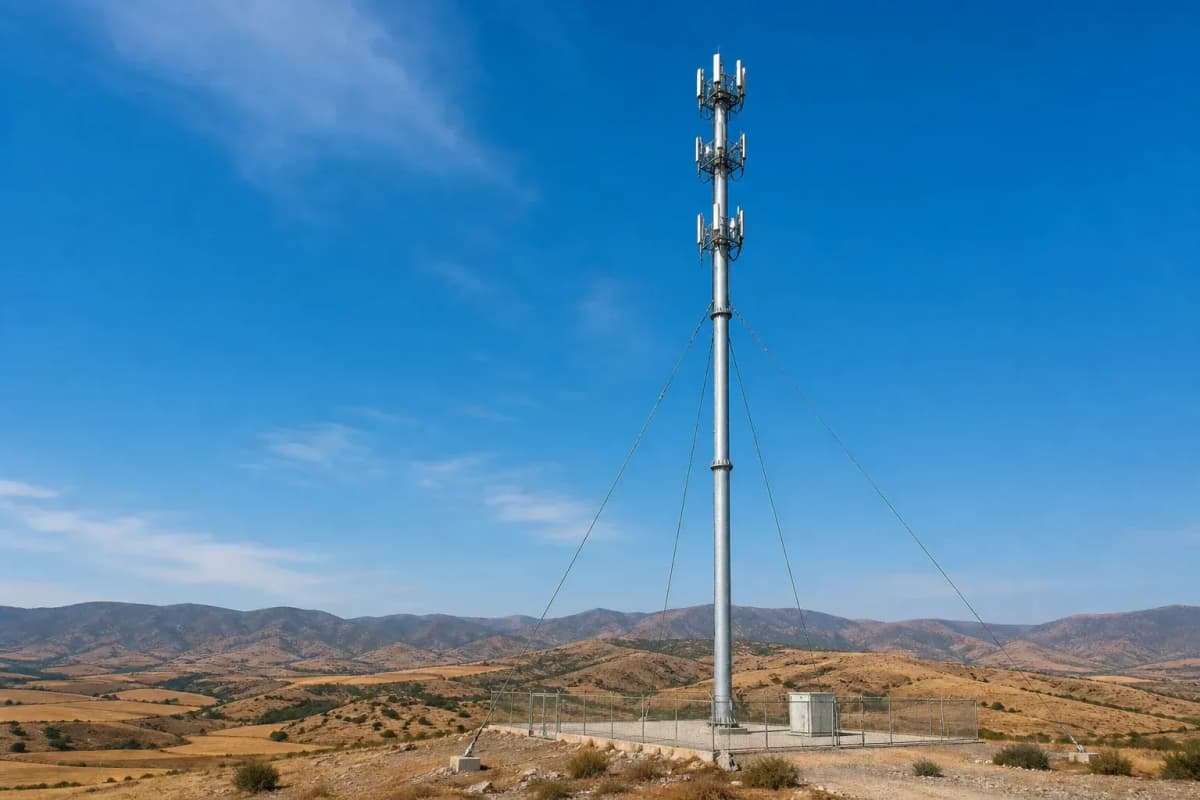
60m Guyed Tower Rural Wide Coverage Flanged - 47 m/s Steel Tube Mast
Key Features
- 60 m guyed steel-tube mast with flanged bolted sections for rural wide coverage
- 47 m/s design wind speed basis with TIA-222-H and EN 1993-3-1 structural references
- 3 antenna platform levels supporting up to 9 antennas and an indicative 650 kg total tip load
- 4-direction guy-wire system with typical 18-30 m anchor radius, equal to 30-50% of tower height
- EPC Turnkey price range of $63,070-$86,020 including installation, commissioning, and 1-year warranty
The 60m Guyed Tower Rural Wide Coverage Flanged is a steel-tube telecom mast for rural 4G/5G, microwave backhaul, GPS, and warning-light payloads, with 3 antenna platform levels, 9 antenna positions, and a 47 m/s design wind speed. EPC turnkey pricing is $63,070-$86,020 including engineering, procurement, construction, commissioning, and 1-year warranty support.
Description
The 60m Guyed Tower Rural Wide Coverage Flanged is a steel-tube telecom mast designed for open rural land where 60 m elevation, 3 antenna platforms, 9 antenna positions, and 47 m/s design wind speed are required for wide-area cellular, microwave, GPS, and monitoring payloads. The system uses flanged steel-tube sections, 4 guy-wire anchor directions, a central reinforced-concrete base, and a target grounding resistance below 4 ohms for a 30-year design life.
For B2B planners, this tower is positioned between 40 m compact masts and 80-100 m high-capacity guyed structures, giving procurement teams a cost-controlled 60 m option for rural macro coverage, utility communications, smart-agriculture networks, and solar-farm backhaul. SOLARTODO supplies this model under 3 commercial scopes, with FOB Supply at $39,103-$58,494, CIF Delivered at $50,006-$74,804, and EPC Turnkey at $63,070-$86,020; buyers can View all Telecom Tower products or Configure your system online before final engineering.
System Architecture
The structural concept is a 60 m guyed mast with a steel-tube vertical shaft, bolted flange joints, 3-4 guy elevations, and 4 ground anchor blocks located at approximately 18-30 m radius, equal to 30-50% of the tower height. Compared with a conventional 60 m self-supporting lattice tower, a guyed structure can reduce primary steel tonnage by roughly 35-55% on flat land because overturning loads are transferred through tensioned guy wires rather than heavier tower legs.
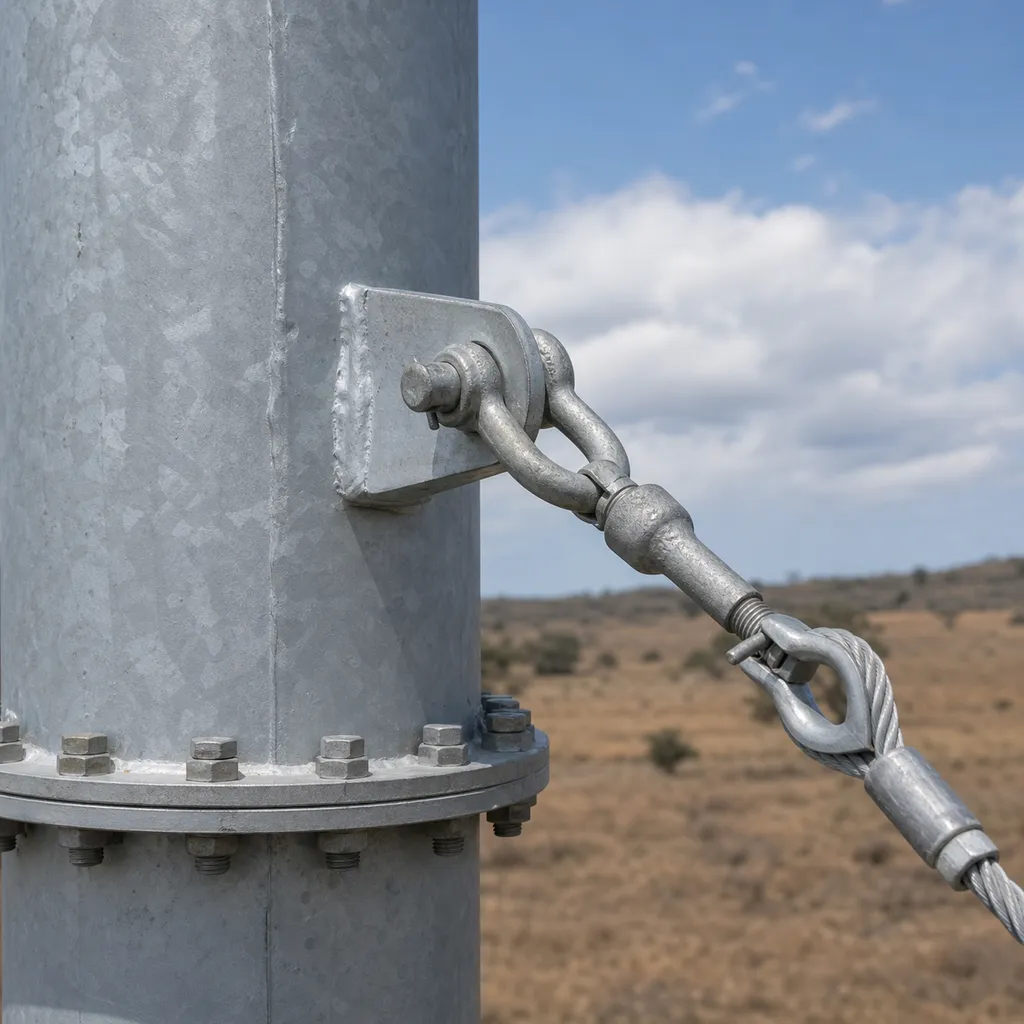
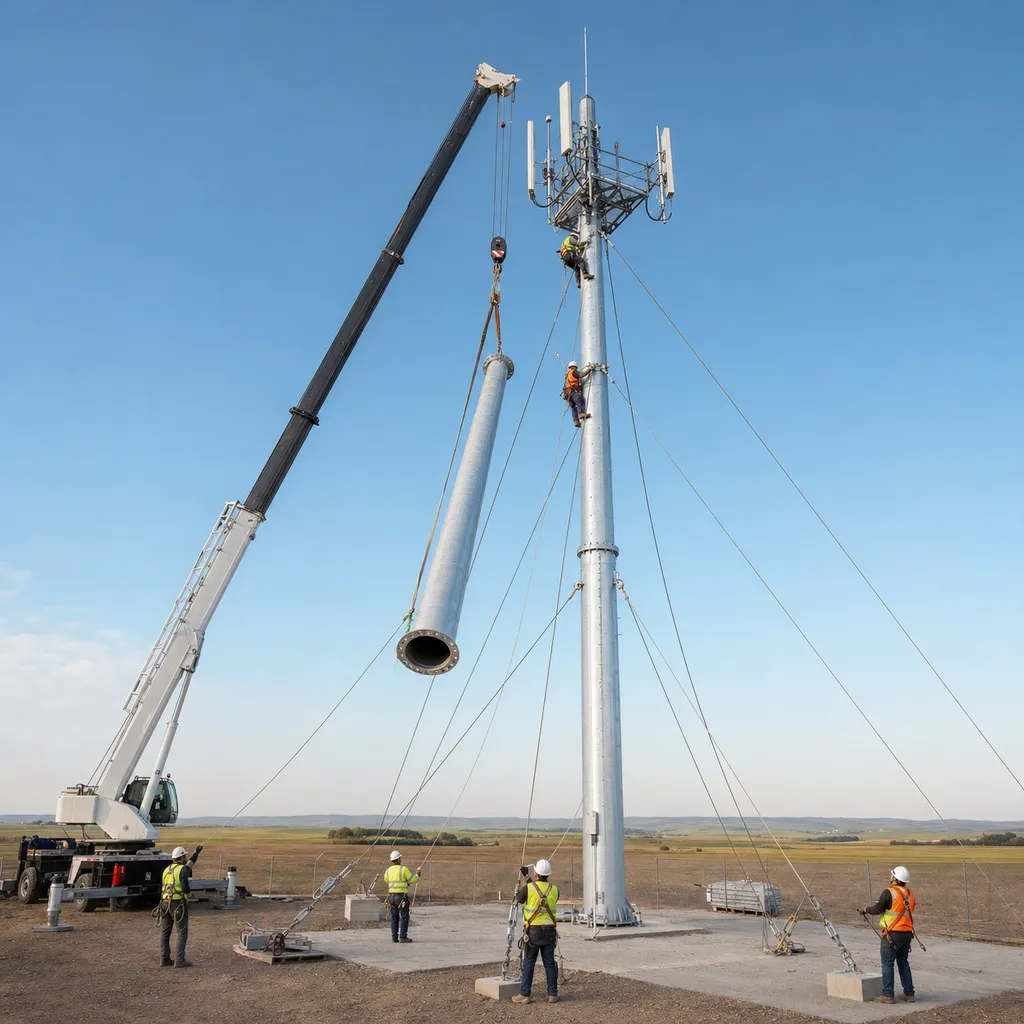
The tower body is supplied as modular steel-tube sections sized for containerized transport, hot-dip galvanizing, and site assembly with torque-controlled flange bolts. Each flange connection is designed to transfer axial compression, bending, shear, and local bolt-group forces generated by 47 m/s wind loading, 9 antenna positions, 3 maintenance platforms, 1 cable tray route, and 1 aviation warning-light circuit.
The guying system normally includes 4 anchor directions with pre-tensioned galvanized strands, turnbuckles, thimbles, clips, and anchor rods embedded into concrete blocks. During commissioning, the mast is plumbed in at least 2 perpendicular axes, guy-wire tensions are logged at all 4 anchor directions, and bolt torque records are retained for the 1-year warranty file.
Technical Specifications
| Parameter | Value |
|---|---|
| Tower height | 60 m |
| Tower type | Guyed steel-tube mast |
| Connection type | Flanged bolted sections |
| Antenna platforms | 3 levels |
| Antenna capacity | 9 antennas |
| Design wind speed | 47 m/s |
| Indicative total tip load | 650 kg |
| Guy radius | 18-30 m typical |
| Grounding target | Less than 4 ohms |
| Design life | 30 years |
The 47 m/s wind speed corresponds to a severe rural macro-site design basis and must be checked against local code maps, terrain category, topographic exposure, ice load, and antenna projected area before final fabrication. TIA-222-H, published for antenna supporting structures, defines structural design requirements for antenna supports, appurtenances, guy assemblies, insulators, and foundations, while EN 1993-3-1 covers Eurocode steel design rules for towers and masts.
The baseline payload is 9 antennas distributed across 3 platforms, which is suitable for 3-sector radio layouts with 2-3 panel antennas per sector or mixed panel-and-microwave configurations. A representative allowance of 650 kg total tip load includes antennas, mounts, jumpers, cable weight, small dishes, warning-light hardware, and maintenance reserve, but the final structural model should use actual antenna dimensions in square meters and actual equipment weights in kilograms.
Materials, Corrosion Protection, and Fabrication
The mast uses steel-tube members, typically Q355 or equivalent structural steel, selected for predictable yield strength, weldability, and galvanizing compatibility. Hot-dip galvanizing is specified for all exposed steel, and ISO 1461 is commonly used as the reference for zinc coating on fabricated iron and steel articles, with coating thickness verified at multiple points before packing.
Flanged construction is preferred for this 60 m rural tower because it gives repeatable bolt-up alignment, faster crane assembly, and simpler inspection than welded field splices. Each tower section is marked with 1 unique part number, each bolt kit is packed by flange level, and each shipment includes 1 assembly drawing set, 1 foundation loading schedule, and 1 packing list for procurement traceability.
Foundation and Site Requirements
A 60 m guyed tower requires more land than a self-supporting tower because the 4 anchor blocks typically occupy a radius of 18-30 m from the mast centerline. The foundation scope includes 1 central concrete base, 4 guy anchor blocks, grounding electrodes, cable route sleeves, and temporary works for mast erection, with final concrete volume adjusted after geotechnical bearing capacity and uplift checks.
The reference EPC cost model uses 55 m³ of reinforced concrete for the central base and anchor blocks, priced at $300/m³ in the component model before local excavation, rebar, and formwork adjustments. Where soil bearing capacity is below 100 kPa, where flood elevation exceeds the anchor block level by more than 0.3 m, or where expansive clay is present, anchor depth and reinforcement should be redesigned before procurement release.
Electrical, Lightning, and Grounding Design
The tower includes 1 lightning air terminal, 1 down-conductor path, bonding between steel sections, surge-protection coordination for equipment shelters, and an earth system designed to test below 4 ohms where soil conditions allow. IEC 62305:2026 covers lightning protection principles for structures and services, while IEEE 81-2025 provides test methods for earth resistivity, ground impedance, and earth surface potentials.
Grounding should be verified with a fall-of-potential or equivalent method after installation, and records should identify 3 measured points: tower base, equipment cabinet, and guy anchor bond. In high-resistivity soil above 1,000 ohm-m, additional radial conductors, chemical electrodes, or ring conductors may be required to reach the less-than-4-ohm target without overstating a universal guarantee.
Cloud Monitoring
The tower can support 1 optional remote-monitoring package covering aviation light status, cabinet power alarms, CCTV, door contact, and weather sensor data. For rural infrastructure operators managing 10-250 sites, cloud monitoring reduces inspection travel by turning fault discovery from a monthly field visit into a near-real-time alert, while still requiring scheduled structural inspections under TIA-222-H and local authority rules.
Applications
This 60 m tower is intended for rural wide coverage where large land parcels, lower population density, and longer radio paths make height more valuable than compact footprint. Typical applications include 4G/5G macro cells, microwave relay points, utility SCADA, solar-farm communications, smart-lighting gateways, wildfire or security cameras, agricultural IoT gateways, and rural broadband nodes with 1-9 antenna payload positions.
For a representative MENA solar farm scenario, a 60 m guyed tower can be placed near a central inverter yard to carry 3 sector antennas, 2 microwave dishes, 1 GPS timing antenna, 1 CCTV payload, and 2 spare positions across 3 platforms. In a 100 MW solar site covering more than 150 hectares, the height can improve line-of-sight planning for security cameras and wireless backhaul without implying any verified deployment result.
Procurement teams can pair the tower with solar power systems, lithium battery storage, smart lighting, surveillance cameras, or hybrid power cabinets from SOLARTODO for off-grid sites. For related design principles, see Learn about topic and Request a custom quotation when soil data, antenna schedules, or regional wind maps are available.
Standards and Compliance Basis
The structural basis references TIA-222-H for antenna supporting structures, EN 1993-3-1 for steel towers and masts, GB 50135 where Chinese code alignment is required, IEC 62305:2026 for lightning protection, IEEE 81-2025 for grounding measurements, and ISO 1461 for hot-dip galvanizing. These standards cover different engineering disciplines, so a 60 m tower submittal should include at least 6 document groups: structural calculation, foundation drawing, material certificate, galvanizing report, grounding plan, and installation method statement.
Energy and connectivity context also matters because rural telecom towers increasingly support distributed power, security, and infrastructure monitoring. IEA electricity-system analysis, IRENA renewable-infrastructure reporting, and NREL distributed-energy guidance all point to growing integration between power assets and communications assets, especially where 1 remote site may need generation, storage, communications, and monitoring in a single fenced compound.
EPC Investment Analysis and Pricing Structure
EPC Turnkey scope includes 5 major work packages: engineering, procurement, construction, commissioning, and 1-year warranty support. Engineering covers structural calculation, wind verification, foundation loads, grounding design, and shop drawings; procurement covers galvanized steel, guy sets, platforms, cable trays, warning lights, and bolt kits; construction covers foundation works, mast erection, guy tensioning, grounding, and handover documentation.
| Commercial tier | Scope | Price range |
|---|---|---|
| FOB Supply | Equipment only, ex-works China | $39,103-$58,494 |
| CIF Delivered | Equipment plus ocean freight and insurance | $50,006-$74,804 |
| EPC Turnkey | Installed, commissioned, and covered by 1-year warranty | $63,070-$86,020 |
| Order volume | Discount | Indicative EPC effect |
|---|---|---|
| 50+ towers | 5% | $59,917-$81,719 per tower |
| 100+ towers | 10% | $56,763-$77,418 per tower |
| 250+ towers | 15% | $53,610-$73,117 per tower |
The ROI logic for a rural 60 m guyed tower is mainly civil-cost avoidance and coverage consolidation, not direct electricity production. If 1 elevated macro tower replaces 2 lower 30-40 m structures on a flat rural route, the buyer may avoid 1 duplicate foundation, 1 duplicate equipment compound, and 1 duplicate maintenance visit cycle; on a $70,000 EPC midpoint, even $14,000 per year in avoided leasing, patrol, and duplicated civil costs gives an estimated 5.0-year simple payback.
A self-supporting 60 m lattice tower can be the better option when land is scarce, but on open land the guyed solution usually offers lower steel mass and lower procurement cost per meter. In a representative comparison, a guyed 60 m mast can reduce installed steel cost by 25-45% versus a heavier self-supporting alternative, while increasing land radius from roughly 6-10 m to 18-30 m around the tower center.
Standard payment terms are 30% T/T advance plus 70% against bill of lading, or 100% irrevocable L/C at sight for approved buyers. Project financing can be discussed for orders above $1,000K, and technical/commercial questions can be sent to [email protected] with 3 inputs: site coordinates, antenna schedule, and required delivery term.
Procurement Notes
Lead time depends on steel availability, galvanizing queue, drawing approval, and shipping lane, with typical procurement planning using 4-6 weeks for engineering and fabrication plus 3-6 weeks for ocean logistics. For a 60 m mast, the buyer should confirm 5 items before release: design wind speed, antenna projected areas, soil report, access-road constraints, and national aviation-lighting rules.
Inspection should include 100% visual checks of flanges, welds, galvanizing coverage, bolt markings, and guy hardware before packing. For EPC handover, SOLARTODO recommends 8 records: as-built drawings, bolt torque log, guy tension log, concrete test record, grounding resistance test, verticality survey, photo record, and warranty certificate for the 1-year support period.
Technical Specifications
| Tower Height | 60m |
| Tower Type | Guyed |
| Material | Steel tube |
| Connection Type | Flanged bolted sections |
| Antenna Platforms | 3levels |
| Antenna Capacity | 9antennas |
| Design Wind Speed | 47m/s |
| Total Tip Load | 650kg |
| Foundation Type | Central concrete base plus 4 guy anchor blocks |
| Guy Radius | 18-30m |
| Grounding Resistance Target | <4ohm |
| Corrosion Protection | Hot-dip galvanized / marine grade option |
| Design Life | 30years |
| Standards | TIA-222-H / EN 1993-3-1 / IEC 62305 / IEEE 81-2025 |
Price Breakdown
| Item | Quantity | Unit Price | Subtotal |
|---|---|---|---|
| Galvanized steel-tube mast sections | 1 pcs | $26,000 | $26,000 |
| Flanged splice plates, bolts, and hardware | 1 pcs | $4,200 | $4,200 |
| Guy wire set with anchors and tension hardware | 4 pcs | $1,500 | $6,000 |
| Antenna platform, installed steel type | 3 pcs | $800 | $2,400 |
| Climbing ladder and safety rail, 60 m route | 60 pcs | $15 | $900 |
| Cable tray system, 60 m route | 60 pcs | $10 | $600 |
| Lightning protection and grounding system | 1 pcs | $500 | $500 |
| Aircraft warning light set | 2 pcs | $300 | $600 |
| Concrete foundation package, central base plus 4 anchors | 55 pcs | $300 | $16,500 |
| Installation and commissioning | 1 pcs | $9,900 | $9,900 |
| Engineering, structural calculation, and QC documentation | 1 pcs | $4,200 | $4,200 |
| 1-Year warranty and technical support | 1 pcs | $2,850 | $2,850 |
| Site logistics, lifting coordination, and handover records | 1 pcs | $3,000 | $3,000 |
| Total Price Range | $63,070 - $86,020 | ||
Frequently Asked Questions
What is included in the EPC Turnkey price for this 60 m guyed tower?
How much land is required for the guy-wire anchors?
Can the tower support 5G antennas and microwave dishes together?
Which standards are used for structural and electrical design?
Why choose a guyed tower instead of a self-supporting tower?
Certifications & Standards



Data Sources & References
- •TIA TIA-222-H standard page: https://tiaonline.org/standard/tia-222/
- •TIA publication note for ANSI/TIA-222-H: https://standards.tiaonline.org/news-media/press-releases/tia-announces-publication-tia-222-H-standard-antennas-and-supporting
- •European Commission Eurocode 3 EN 1993-3-1 listing: https://eurocodes.jrc.ec.europa.eu/EN-Eurocodes/eurocode-3-design-steel-structures
- •IEC 62305:2026 lightning protection series: https://webstore.iec.ch/en/publication/6797
- •IEEE 81-2025 grounding measurement standard: https://standards.ieee.org/ieee/81/11218/
- •NREL distributed energy and resilience publications: https://www.nrel.gov/
- •IEA energy system analysis: https://www.iea.org/
- •IRENA renewable energy infrastructure resources: https://www.irena.org/
Interested in this solution?
Contact us for a customized quote based on your specific requirements.
Contact Us