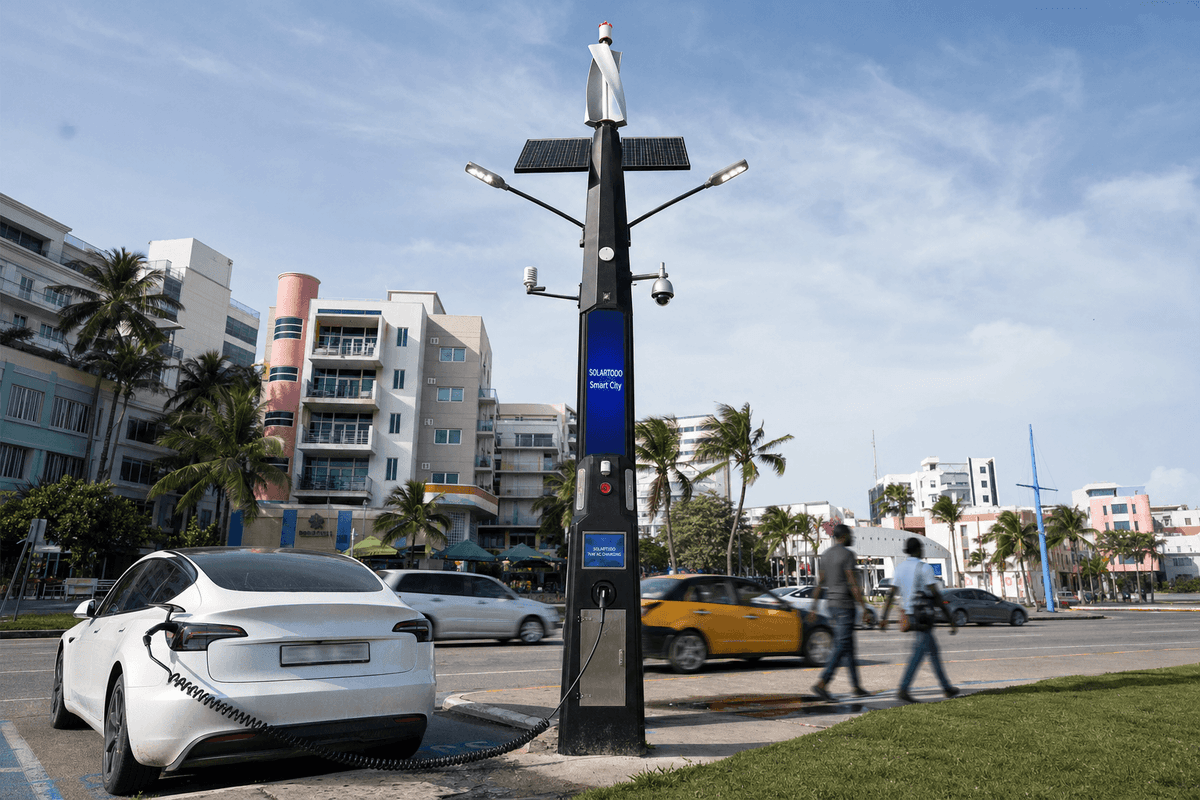
Accra Coastal Flood and Salt-Air Constraint: Smart Streetlight Hybrid Pole Configuration
Summary
Accra’s coastal, flood-prone streets favor sealed 13m hybrid Smart Streetlight poles: a typical 51-unit, 30m-spaced corridor covers about 1.5km, uses 2×80W LEDs, and aligns with Ghana’s 230/400V, 50Hz grid context.
Key Takeaways
A typical Accra Smart Streetlight package should treat 51 poles, 30m spacing, and 13m corrosion-protected steel structures as an urban-resilience specification.
- Approximately 51 units at 30m spacing would cover about 1.5km of arterial, market-access, or flood-resilience street frontage.
- Each 13m octagonal tapered pole uses a base Ø45cm to top Ø15cm profile with black RAL9005 powder coating.
- The lighting package delivers 2×80W LED output at 150 lm/W and 4000K for urban road and pedestrian visibility.
- Hybrid self-power combines a 400W Gorlov-type VAWT, 2×100W monocrystalline panels, 5kWh LFP battery, MPPT, and grid backup.
- Ghana’s ECG service context is 230V single-phase, 400V three-phase, 50Hz, with 11kV or 33kV supply for larger loads.
- Accra climate sizing should account for 23-31°C typical daily ranges, 750-1,000mm annual rainfall, Harmattan dust, and Gulf of Guinea salt air.
- Smart-city payloads include WiFi 6, 5G gateway, LoRaWAN, 4MP IR camera, SOS, IP audio, P5 LED display, USB, and 7kW Type 2 charging.
Market Context for Accra
Accra’s streetlight specification should respond to a dense coastal capital region of 5.46 million people, flood exposure, salt air, and Ghana’s 230/400V distribution practice.
Accra is not an inland dry-city lighting problem. It sits on the Gulf of Guinea around latitude 5.6, longitude -0.19, where coastal humidity, salt-laden air, and flood-prone low-lying drainage basins affect cabinet sealing, coating selection, cable glands, and foundation elevation. According to Ghana Statistical Service (2021), Greater Accra recorded 5,455,692 people and the highest regional density at 1,236 persons per square kilometre, making pole spacing and multifunction payload density more important than long highway mast coverage.
Climate loads are also specific. Public climate summaries for Accra report average daily temperatures around 23-31°C in January and 23-27°C in July, with mean annual rainfall commonly cited around 750-1,000mm. Harmattan dust from the Sahara is strongest in December and January across Ghana’s dry season, so optics, display glass, camera windows, and environmental sensor inlets need maintenance access and dust-tolerant enclosures rather than decorative exposed assemblies.
The grid and procurement context is Ghanaian, not generic West African. According to Electricity Company of Ghana (2026), standard low-voltage supply is 230V ±10% single-phase, 400V ±10% three-phase, 50Hz, while customers above 800kW may be supplied at 11kV or 33kV. Streetlight applications typically pass through Assemblies or ECG district channels, and ECG requires capacity checks on the feeder or transformer before additional lighting loads are connected.
Public infrastructure needs reinforce the same direction. According to the World Bank (2022), more than 56% of Ghana’s population lived in urban areas in 2021, and urban growth has outpaced basic service provision. The World Bank also states, “flooding affects around 45,000 Ghanaians every year,” which makes elevated electrical compartments, sealed base doors, and resilient communications useful features for Accra streets that combine mobility, drainage, safety, and public-service functions.
Recommended Technical Configuration
For Accra’s urban corridors, the recommended Smart Streetlight class is a 13m hybrid octagonal pole with integrated EV charging and grid backup.
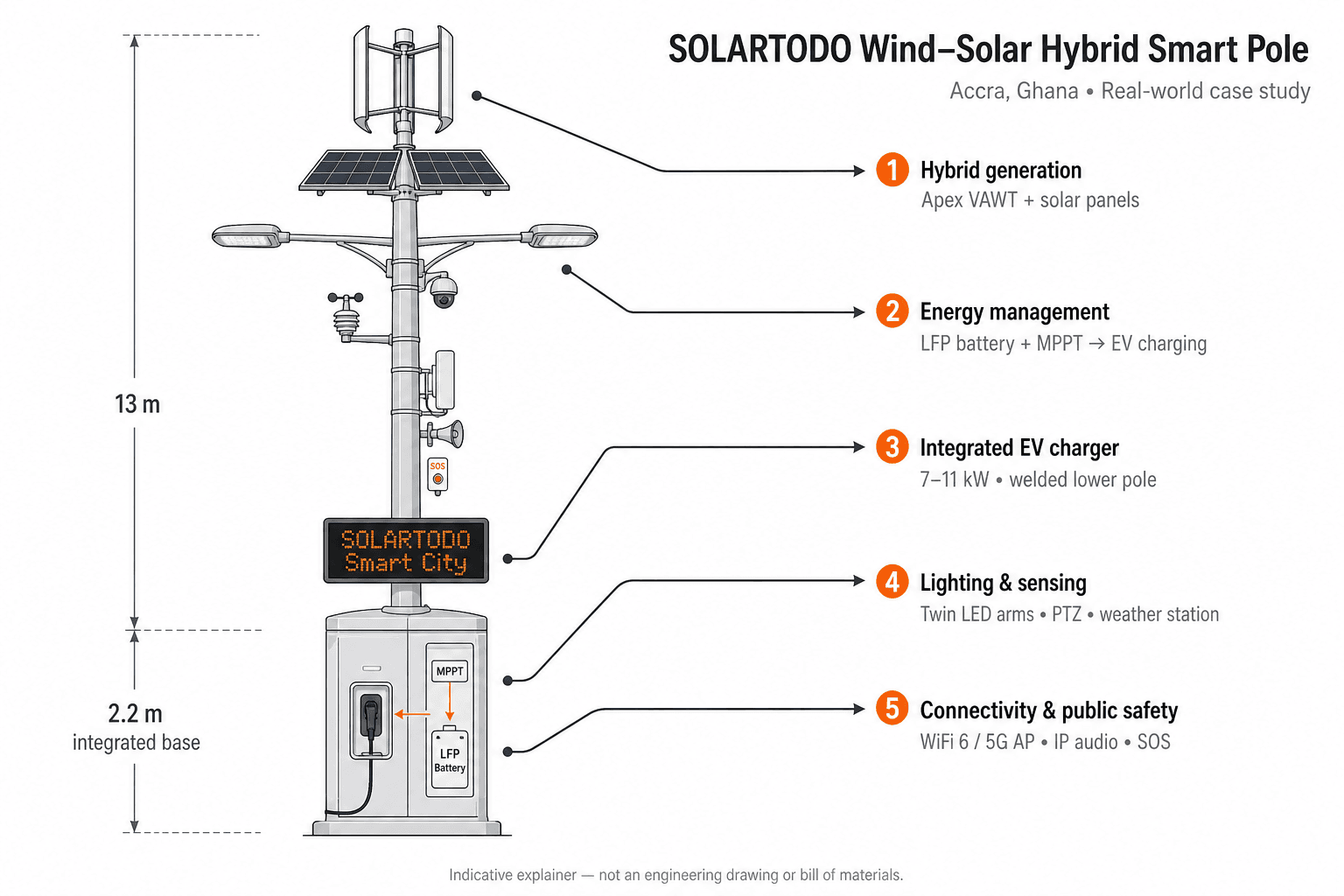
A typical 51-unit deployment in this profile would consist of 13m octagonal tapered steel Smart Streetlight poles at 30m spacing, giving approximately 1.5km of continuous corridor coverage. This is appropriate for urban street classes, not highways and not park paths. The 13m height supports twin lighting arms, communications equipment at 8.7m, environmental sensing, camera visibility, and an LED information display without shifting into a highway traffic-pole category.
The recommended SOLARTODO configuration is the hybrid12 variant adapted to Accra’s coastal and grid conditions. The lower 2.2m of the pole is the EV charging cabinet itself, welded as one continuous steel structure rather than installed as a separate roadside pillar. This matters in dense Accra streets, where old-town lanes, markets, drainage edges, and constrained sidewalks can make separate charger plinths harder to permit and protect.
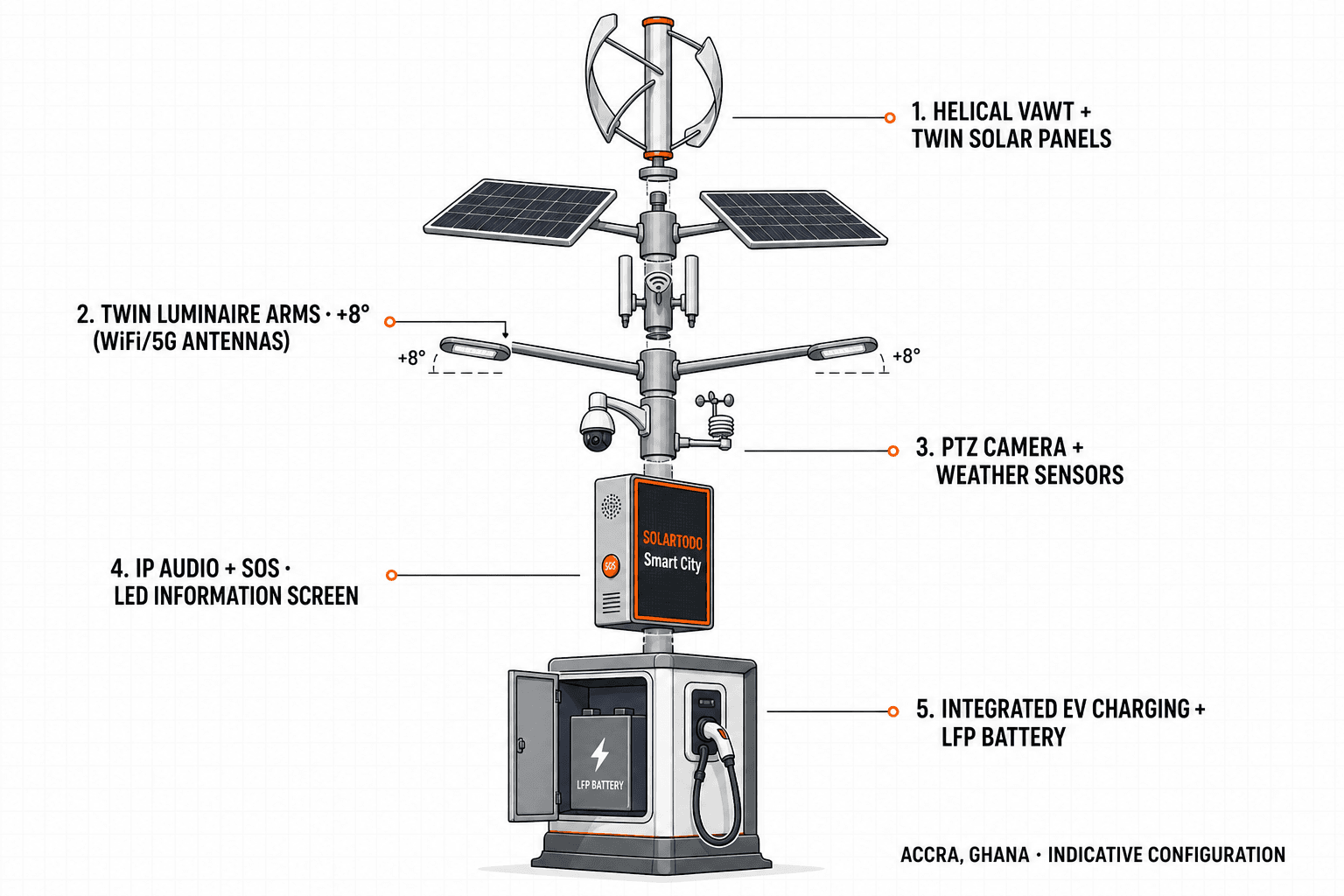
Power architecture should be hybrid rather than purely off-grid. The 400W Gorlov-type helical VAWT, 2×100W monocrystalline panels, MPPT, and 5kWh LFP battery reduce dependence on feeder availability, while grid backup maintains lighting, emergency, and communications service during low-renewable periods. According to ECG (2026), supply frequency is 50Hz and low-voltage supply is 230/400V, so charger and grid-tie equipment should be specified against Ghana-compatible AC supply and local licensed-contractor practice.
SOLARTODO should also position this as a municipal digital-infrastructure pole, not only a lighting fixture. The WiFi 6 plus 5G gateway, LoRaWAN controller, camera, SOS, IP audio, environmental sensor, and P5 LED display allow one foundation and one maintenance visit to support safety, connectivity, air-quality monitoring, charging, and public messaging. ITU states, “ICTs can act as a platform,” which supports the rationale for combining digital and physical urban services in one asset.
Technical Specifications
The Accra configuration uses 51 hybrid 13m poles, 2×80W LEDs, 5kWh batteries, 7kW Type 2 charging, and IEC-aligned luminaire safety.
- Product line: SOLARTODO Smart Streetlight, hybrid12 custom city configuration.
- Quantity basis: approximately 51 units, stated as a typical planning package rather than a completed deployment claim.
- Pole structure: 13m octagonal tapered steel smart pole, base Ø45cm to top Ø15cm.
- Finish: black RAL9005 powder coat over corrosion-protected steel, suitable for coastal urban exposure when paired with sealed doors and stainless external fasteners.
- Integrated cabinet: lower 2.2m of pole forms the EV charging cabinet, seamlessly welded into one continuous steel body.
- Wind system: Gorlov-type helical VAWT, 3 twisted white aluminum blades, Ø70×100cm, 400W, with red aviation LED.
- Solar system: 2×100W monocrystalline deep-black panels on symmetric east-west A-frame brackets at 15° tilt.
- Battery and controls: 5kWh LFP battery inside pole base with MPPT controller and backup grid tie.
- LED lighting: twin symmetric 1.5m arms, +8° upward tilt, 2×80W LED, 150 lm/W, 4000K.
- Camera: 4MP bullet camera with IR 50m range on 30cm short-arm bracket.
- Sensor: 8-parameter environmental sensor for temperature, humidity, wind, pressure, noise, PM2.5, PM10, and illuminance.
- Audio and safety: 30W/93dB TCP/IP IP audio column, one-press SOS button, camera linkage.
- EV charging: integrated 7kW dual-gun AC charger, 2× Type 2, OCPP 1.6J, 5m coiled cable, touchscreen, E-stop, and maintenance door.
- Display: P5 vertical LED screen, 1280×2560mm portrait format, more than 5000 cd/m², showing only SOLARTODO Smart City in white sans-serif on deep blue.
- Communications: flush dual-mode WiFi 6 plus 5G gateway with GbE uplink and LoRaWAN at 8.7m, color-matched to the pole face.
- User interface extras: USB-A ×2, 5V/2.4A, located on the charging cabinet.
- Standards basis: IEC 60598, GB/T 37024, and IEC 62196-2 for Type 2 EV connector compatibility.
According to IEC (2024), IEC 60598-1 covers general safety requirements for luminaires operating from supply voltages up to 1,000V. IEC states that IEC 60598-1 specifies “general safety requirements for luminaires,” which is why luminaire marking, earthing, wiring, serviceability, and battery-related requirements should be reviewed during submittal approval. For Ghana installation, Energy Commission electrical rules, ECG service requirements, and licensed electrical contractor procedures should be included in the method statement.
Implementation Approach
An Accra rollout should proceed in 5 controlled phases: survey, authority coordination, civil works, pole erection, and commissioning.
The first phase is route and foundation survey. Engineers should mark 30m nominal spacing, verify drainage channels, map underground utilities, identify flood hot spots, and confirm that doors, E-stops, touchscreens, and USB ports face safe pedestrian access zones. In dense areas such as market approaches, older neighborhood streets, or corridors near open drains, the practical spacing may need minor shifts while preserving lighting uniformity.
The second phase is authority and utility coordination. Ghana streetlight work may involve a Metropolitan, Municipal, or District Assembly, ECG district staff, the Department of Urban Roads, and licensed electrical contractors. According to ECG (2026), feeder or transformer reserve capacity should be verified before additional streetlighting loads are connected, which is relevant even when hybrid self-power reduces net draw.
The third phase is logistics and CKD delivery planning. For Accra, port arrival and urban transport should account for long 13m steel sections, traffic congestion, narrow access roads, overhead service lines, and restricted work windows. Components should be packed so LED arms, wind turbine blades, panels, display modules, charger doors, and telecom housings arrive protected from salt air and handling abrasion.
The fourth phase is civil installation and erection. Foundations should be set above nuisance flood level where practical, with drainage away from the integrated charger cabinet. Cable entries, anchor bolts, earthing, lightning protection, and inspection covers need to be checked before the pole is lifted, because post-erection rework is costly on constrained urban corridors.
The fifth phase is commissioning and data onboarding. Teams should test LED dimming, camera IR, SOS-camera linkage, OCPP 1.6J charger connectivity, LoRaWAN or 4G controller telemetry, WiFi 6 gateway performance, 5G backhaul readiness, IP audio, display content lock, and environmental sensor data. SOLARTODO cloud platform acceptance should include asset ID mapping, alarm thresholds, maintenance roles, and exportable logs for municipal reporting.
Expected Performance & ROI
A 51-unit Accra package can reduce grid lighting load, consolidate 8 smart-city functions per pole, and target a practical 4-7 year municipal payback.
The baseline comparison is usually a conventional sodium or non-networked LED streetlight plus separate CCTV, charger, speaker, and telecom boxes. The SOLARTODO hybrid pole concentrates those assets into one foundation, one cabinet, and one managed device profile. Energy savings depend on what the city replaces, but the LED side alone uses 160W per pole at high efficacy, while smart scheduling and hybrid generation can reduce grid draw during normal operation.
ROI should be modeled from avoided trenching, reduced separate enclosures, lighting electricity savings, fewer truck rolls, EV charging utilization, advertising display policy, and possible telecom lease value. For public-budget planning, a 4-7 year payback range is a reasonable scenario target when the corridor has meaningful night traffic, public-safety need, and charger turnover. It should not be presented as a guaranteed project result without measured tariff, utilization, and maintenance data.
The climate-resilience value is also material in Accra. According to the World Bank (2019), close to $3.2 billion of economic assets were at flood risk in Greater Accra, with exposure likely to quadruple by 2050 without mitigation. Smart poles cannot solve drainage, but sealed cabinets, elevated electrical interfaces, emergency audio, cameras, and environmental telemetry can support safer streets during rain events and post-storm recovery.
Digital-services performance should be assessed with KPIs rather than slogans. According to ITU-T Y.4223 (2023), smart city performance indicators span ICT, environmental sustainability, productivity, quality of life, equity, and physical infrastructure. For Accra, useful acceptance KPIs include lighting uptime above 98%, charger session availability, camera uptime, SOS response linkage time, PM sensor data completeness, and monthly maintenance closure rate.
Comparison Table
The hybrid 13m configuration fits Accra better than basic grid-only lighting because it combines 160W LED output, 5kWh storage, and integrated EV charging.
| Option | Typical Accra fit | Height and spacing | Power architecture | Smart payload | Main trade-off |
|---|---|---|---|---|---|
| Conventional LED pole | Basic road lighting only | 8-10m, 30-40m | 230/400V grid | Usually none | Lowest scope, but no EV, camera, sensor, or resilient backup |
| Separate solar streetlight plus CCTV | Limited sidewalks or local roads | 6-10m, 25-35m | Solar battery only | CCTV added separately | More roadside clutter and weaker charger integration |
| SOLARTODO hybrid Smart Streetlight | Urban corridors, drainage upgrades, civic streets | 13m, 30m | 400W VAWT + 200W PV + 5kWh LFP + grid backup | LED, 4MP camera, SOS, IP audio, WiFi 6, 5G, LoRaWAN, EV, display | Higher technical coordination, stronger multifunction value |
| Cylindrical wrapped solar pole | Premium plazas or design districts | Ø180-400mm, urban spacing | CIGS wrap plus grid | Flush modules and embedded charger | Sleeker form, but not the specified 51-unit Accra hybrid package |
Pricing & Quotation
SOLARTODO offers 3 commercial tiers for Accra buyers, including FOB Supply, CIF Delivered, and EPC Turnkey with 1-year warranty.
SOLARTODO offers three pricing tiers for this product line: FOB Supply (equipment ex-works China), CIF Delivered (including ocean freight and insurance), and EPC Turnkey (fully installed, commissioned, with 1-year warranty). Volume discounts are available for large-scale deployments. Configure your system online for an instant estimate, or request a custom quotation from our engineering team at [email protected].
For Accra procurement files, the bill of quantities should separate poles, foundations, electrical works, communications commissioning, charger testing, cloud onboarding, spares, and training. A buyer comparing EPC offers should require corrosion protection details, Ghana-compatible AC connection assumptions, Type 2 charger compliance, OCPP testing, foundation design responsibility, and post-commissioning response time. Product details can be reviewed at SOLARTODO Smart Streetlight, and commercial discussions can be routed through contact us.
Frequently Asked Questions
These 10 Accra Smart Streetlight FAQs cover specifications, installation, maintenance, pricing, warranty, ROI, standards, and comparison points for municipal buyers.
Q1: Why is a 13m hybrid Smart Streetlight suitable for Accra? A 13m pole gives enough height for twin 80W luminaires, camera sightlines, the 8.7m communications gateway, wind turbine clearance, and a 1280×2560mm display. Accra’s dense streets need multifunction coverage at about 30m spacing, while coastal flood and grid constraints favor hybrid generation plus grid backup rather than a simple grid-only light.
Q2: Is this a claimed SOLARTODO deployment in Accra? No. This guide is a market analysis and technical configuration recommendation, not a fabricated case study. The 51-unit quantity is a typical planning package using the provided Accra-oriented specification. It should be treated as an engineering basis for quotation, procurement comparison, and route design, not as a completed installation record.
Q3: What is integrated into the lower 2.2m charging cabinet? The lower 2.2m of the steel pole is the EV charging cabinet itself, welded into one continuous structure. It contains the 7kW dual-gun AC charger, 2× Type 2 connectors, OCPP 1.6J communications, 5m coiled cable, touchscreen, E-stop, maintenance door, and 2 USB-A charging ports.
Q4: How long would installation typically take for 51 units? A 51-unit corridor normally requires phased scheduling rather than one continuous closure. Survey and approvals may take several weeks, foundation works another few weeks, and erection plus commissioning can follow in batches. Final duration depends on road permits, rainy-season constraints, utility checks, port clearance, and whether civil works are packaged with drainage or road rehabilitation.
Q5: What maintenance is important in Accra’s coastal environment? Maintenance should focus on salt-air corrosion checks, dust cleaning after Harmattan, display glass cleaning, camera lens inspection, drainage around foundations, door gasket condition, charger connector wear, and battery health. A practical plan includes monthly visual inspection, quarterly electrical and communications checks, and annual torque, coating, earthing, and firmware review.
Q6: What ROI or payback should a city expect? A responsible model should use local tariffs, charger utilization, advertising policy, maintenance labor, and avoided separate infrastructure costs. For a busy urban corridor, a 4-7 year payback can be a planning scenario, not a guarantee. The strongest value usually comes from combining lighting, safety, connectivity, EV charging, and monitoring in one maintained asset.
Q7: How does this compare with standard solar streetlights? Standard solar streetlights usually provide lighting only and may use lower mounting heights. The SOLARTODO Smart Streetlight adds twin 80W LEDs, 400W wind, 200W solar, 5kWh LFP storage, grid backup, camera, SOS, audio, WiFi 6, 5G gateway, LoRaWAN, LED display, and integrated 7kW EV charging.
Q8: Which standards should be listed in an EPC tender? The tender should list IEC 60598 for luminaire safety, IEC 62196-2 for Type 2 EV connector compatibility, GB/T 37024 for smart lighting platform reference, and Ghana Energy Commission or ECG electrical requirements. EPC documents should also require licensed electrical contractors, earthing tests, insulation tests, charger commissioning records, and cloud telemetry acceptance.
Q9: Can the charger operate during grid outages? The lighting, controller, sensors, camera, and communications can be prioritized from the hybrid wind-solar-battery system, but 7kW EV charging should be managed carefully during grid outages. The recommended operating logic is to preserve safety and lighting loads first, then allow charging only when battery state, grid backup, and municipal policy permit.
Q10: What should buyers ask SOLARTODO before pricing? Buyers should provide road length, desired spacing, foundation soil conditions, flood history, grid access point, preferred communications carrier, charger payment requirements, display permit rules, and warranty expectations. SOLARTODO can then quote FOB Supply, CIF Delivered, or EPC Turnkey and align the configuration with Accra permitting and municipal maintenance capacity.
References
The analysis uses 7 public references covering Ghana population, urbanization, electricity supply, Accra flooding, smart-city ICT, luminaire safety, and EV connectors.
- Ghana Statistical Service (2021): 2021 Population and Housing Census reported Greater Accra at 5,455,692 people and 1,236 persons/km² regional density.
- Electricity Company of Ghana (2026): Technical information lists 230V ±10% single-phase, 400V ±10% three-phase, 50Hz supply, with 11kV or 33kV for higher-demand customers.
- World Bank (2022): Ghana urban population exceeded 56% in 2021; urban service provision has lagged growing demand.
- World Bank (2019): Greater Accra flood-risk analysis estimated about $3.2 billion of assets at risk and cited the 2015 flood’s severe impact.
- World Bank Group (2022): Ghana climate report states flooding affects around 45,000 Ghanaians yearly and coastal erosion/flooding risk affects half the coastline.
- ITU-T (2023): Recommendation Y.4223 defines smart city requirements and KPI dimensions across ICT, environmental sustainability, productivity, quality of life, equity, and physical infrastructure.
- IEC (2024): IEC 60598-1:2024 specifies general safety requirements and tests for luminaires operating from supply voltages up to 1,000V.
Equipment Deployed
- 51 units × 13m octagonal tapered steel Smart Streetlight pole, base Ø45cm to top Ø15cm, black RAL9005 powder coat
- Integrated lower 2.2m pole-as-EV-charging cabinet, welded as one continuous steel structure
- 400W Gorlov-type helical VAWT, Ø70×100cm, 3 twisted white aluminum blades, red aviation LED
- 2×100W monocrystalline deep-black solar panels on 15° symmetric A-frame brackets
- 5kWh LFP battery inside pole base with MPPT controller and backup grid tie
- Twin 1.5m symmetric arms with +8° tilt and 2×80W LED, 150 lm/W, 4000K
- 4MP bullet camera with IR 50m on 30cm short-arm bracket
- 8-parameter environmental sensor for temperature, humidity, wind, pressure, noise, PM2.5, PM10, illuminance
- 30W/93dB TCP/IP IP audio column and one-press SOS button with camera linkage
- Integrated 7kW dual-gun AC charger, 2× Type 2, OCPP 1.6J, 5m coiled cable, touchscreen, E-stop
- P5 vertical LED display, 1280×2560mm, >5000 cd/m², SOLARTODO Smart City content only
- Flush WiFi 6 + 5G gateway with GbE uplink and LoRaWAN at 8.7m, plus USB-A ×2 at 5V/2.4A