Ashgabat Solar PV System Market Analysis: 1.9MW Industrial Rooftop Configuration Guide
Summary
Ashgabat’s 2022 census share implies roughly 1.03M residents; a 1.9MW industrial rooftop Solar PV System using 3,295 TOPCon modules would target about 2,999,315 kWh/year at 5 kWh/m²/day irradiance.
Key Takeaways
Ashgabat’s industrial-rooftop PV fit is a 1.9MW C&I configuration, with 3,295 modules, 30° tilt, 1.15 DC/AC ratio, and 30-year design life.
- Turkmenistan’s 2022 census reports 7,057,841 people, with Ashgabat representing 14.6%, implying about 1.03 million city residents.
- The recommended SOLARTODO Solar PV System is a 1.9MW industrial rooftop design using approximately 3,295 TOPCon panels at 580W each.
- The project-specific module specification is TOPCon, 25% efficiency, 0.4% annual degradation, IEC 61215 and IEC 61730 compliance, and 25-year panel warranty.
- The correct product class is 500kW-5MW C&I / industrial, requiring multiple arrays, central inverter architecture, and LV-to-10/35kV step-up readiness when utility interconnection requires it.
- With 5 kWh/m²/day irradiance and about 14% losses, the expected annual yield is approximately 2,999,315 kWh.
- The modeled environmental offset is about 1,260 tons CO₂ per year, equivalent to roughly 56,700 trees, subject to the selected grid emissions factor.
- The inverter basis is central inverter topology at 98% CEC efficiency, 5-year inverter warranty, and DC/AC ratio of 1.15 for C&I clipping control.
- Buyers should request structural roof verification, interconnection review, SCADA monitoring, and O&M planning before final quotation through contact us.
Market Context for Ashgabat
Ashgabat combines about 1.03 million implied residents, hot dry summers above 38°C average July highs, and national demand growth that favors industrial rooftop PV.
Ashgabat is Turkmenistan’s capital and largest administrative urban load center, located near 37.96°N, 58.33°E. According to the State Committee of Turkmenistan on Statistics (2022), the national census recorded 7,057,841 people, and Ashgabat accounted for 14.6% of the country’s population. That implies roughly 1.03 million residents in the city, before accounting for daytime institutional, commercial, and industrial loads.
Solar resource is a strong technical fit for Ashgabat’s industrial rooftops because the city sits in an arid Central Asian climate with high sun availability and limited summer rainfall. According to the World Meteorological Organization (2026), Ashgabat’s climatology shows July mean daily maximum temperature of 38.2°C and August mean precipitation of only 1 mm. These conditions support high annual irradiation but require careful module temperature derating, soiling control, and rooftop heat-management design.
According to the World Bank Global Solar Atlas (2026), Turkmenistan’s map-data range shows daily PVOUT of 3.93-4.63 kWh/kWp and GHI of 4.22-5.14 kWh/m²/day. World Bank states, "GHI is measured in kilowatthours per square metre," which makes it the right screening metric for comparing PV siting potential. For this Ashgabat guide, the project-specific irradiance assumption is 5 kWh/m²/day, consistent with a high-resource desert-edge urban site.
The grid context also supports a C&I rooftop configuration rather than a residential layout. According to UNECE (2026), Turkmenistan’s power generation capacity reached 6.5GW in 2023, almost entirely gas-based, while electricity demand grew by almost 60% over the last decade. According to World Bank (2023), Turkmenistan’s access to electricity reached 100% in 2023, so the local opportunity is not basic electrification; it is reducing grid energy intensity, peak daytime draw, and fuel-linked generation exposure.
Recommended Technical Configuration
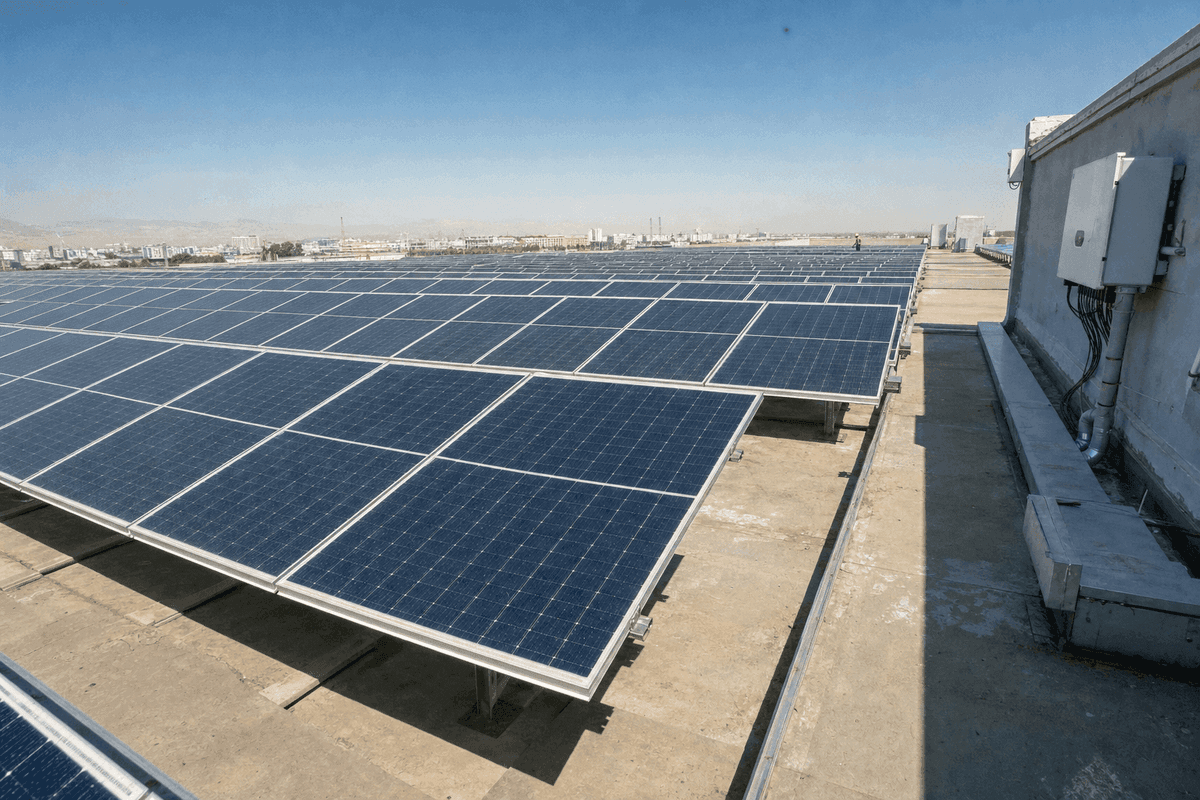
A recommended Ashgabat industrial rooftop Solar PV System is a 1.9MW C&I design using 3,295 TOPCon modules, fixed 30° tilt, and central inverter conversion.
Based on the SOLARTODO capacity architecture table, a 1.9MW plant belongs in the 500kW-5MW C&I / industrial class. That class calls for multiple inverters or central inverter blocks, a step-up transformer when interconnection requires LV-to-10/35kV export, and deployment on a large rooftop or suitable land. It should not be treated as a small commercial string-only project, and it should not use residential-scale inverter logic.
A typical deployment of this scale in Ashgabat would consist of approximately 3,295 TOPCon panels rated at 580W each, arranged across fixed-tilt industrial roof zones at 30°. The DC nameplate implied by 3,295 × 580W is about 1.911MWdc, while the DC/AC ratio of 1.15 indicates an AC inverter capacity around 1.66MWac. SOLARTODO’s engineering review would typically validate roof load, row spacing, cable routing, inverter room heat rejection, and utility metering interface before final bill of materials.
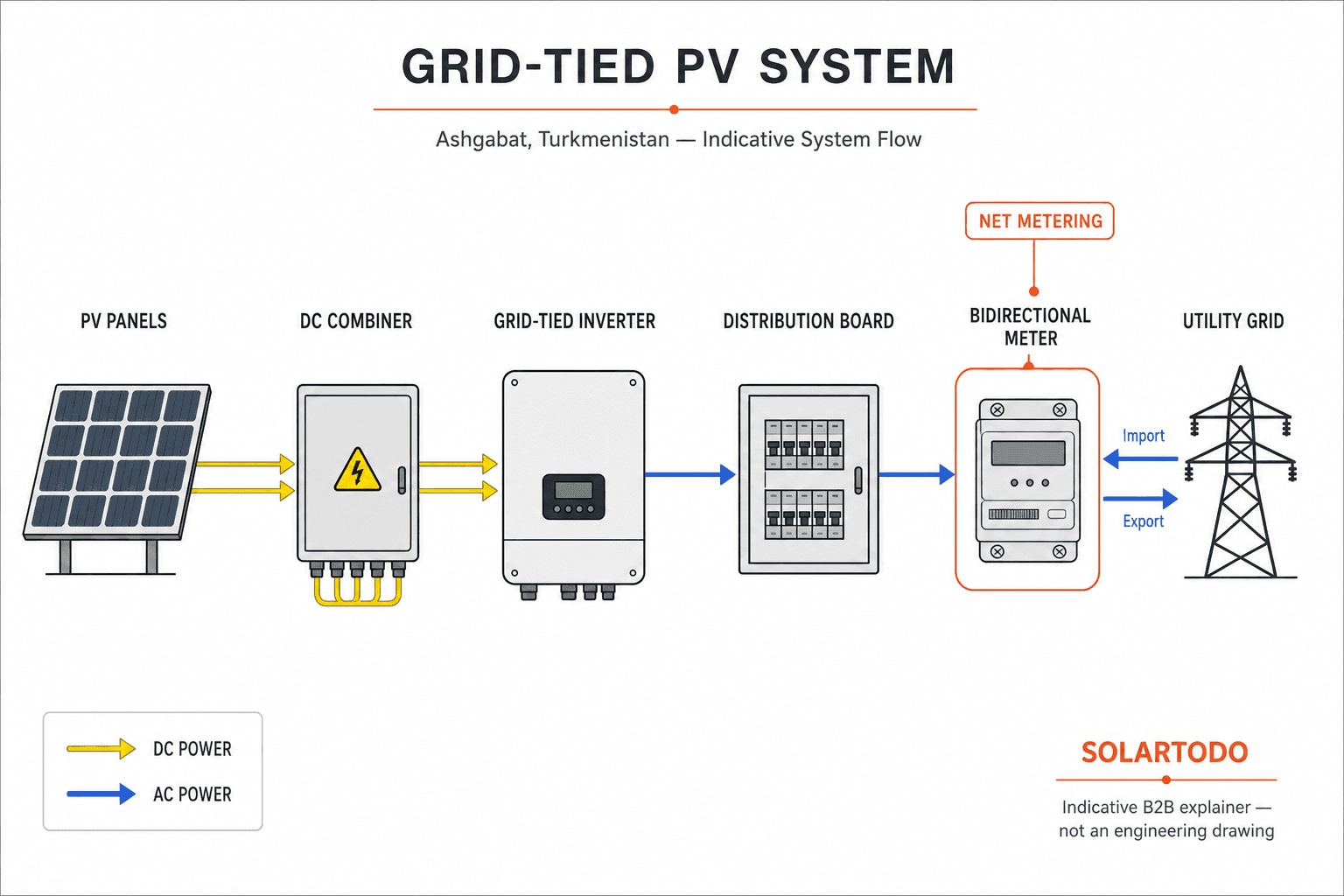
The preferred configuration uses a central inverter at 98% CEC efficiency with DC combiner boxes, AC distribution, bi-directional net metering provisions, and monitoring-ready protection. According to NREL PVWatts (2026), estimated system losses of 14% are a standard modeling input for typical PV systems. For this Ashgabat configuration, the loss stack is about 14%, including soiling 2%, shading 3%, mismatch 2%, wiring 3%, and availability 3%.
SOLARTODO should be positioned here as a product and engineering-fit supplier, not as a claimed installer of a past Ashgabat project. The recommended buyer pathway is technical selection through Solar PV System, roof and interconnection validation, quotation, and local EPC execution. For project-specific engineering input, buyers can use contact us without assuming that any past Ashgabat deployment has occurred.
Technical Specifications
The technical specification for Ashgabat is a 1.9MW industrial rooftop PV system with 25% TOPCon modules, 98% central inverter efficiency, and IEC 61215/61730 compliance.
Core System Design
- Product line: SOLARTODO Solar PV System for industrial rooftop C&I use.
- Size class: 500kW-5MW C&I / industrial, selected because the system is 1.9MW.
- Module count: approximately 3,295 TOPCon solar panels.
- Module rating: 580W per panel.
- Module efficiency: 25%.
- Module degradation: 0.4% per year.
- Mounting structure: aluminum fixed-tilt rooftop racks.
- Tilt angle: 30° fixed tilt.
- Inverter type: central inverter.
- Inverter efficiency: 98% CEC efficiency.
- DC/AC ratio: 1.15.
- Estimated system losses: about 14%.
- Irradiance assumption: 5 kWh/m²/day.
- Annual yield: approximately 2,999,315 kWh.
- CO₂ reduction: approximately 1,260 tons per year.
- Tree equivalent: approximately 56,700 trees.
- System lifetime: 30 years.
- Warranty basis: 25-year panel warranty and 5-year inverter warranty.
- Standards: IEC 61215 and IEC 61730.
Electrical Architecture
The recommended electrical architecture includes DC strings grouped through combiner boxes, central inverter conversion, AC distribution, protection relays, and a revenue-grade bi-directional meter. For C&I plants in the 500kW-5MW class, a LV-to-10/35kV step-up transformer may be required where the utility requests medium-voltage export or plant-level interconnection. The transformer decision should be made after grid-connection review, not assumed solely from rooftop capacity.
According to IEC (2023), IEC 61730-1 specifies construction requirements for PV modules to support safe electrical and mechanical operation. IEC states, "IEC 61730-1:2023 specifies and describes the fundamental construction requirements for photovoltaic modules." IEC 61215 remains the durability qualification reference for crystalline silicon PV modules, while IEC 61730 addresses safety against shock, fire, and mechanical hazards.
Ashgabat Design Constraints
Ashgabat’s hot summer climate makes inverter ventilation and module thermal coefficients important. WMO (2026) reports July mean daily maximum temperature of 38.2°C, and rooftop surface temperatures can exceed ambient air temperature during clear-sky periods. A practical design should therefore preserve rear ventilation under modules, avoid dense cable trays that trap heat, and specify inverter-room airflow suitable for central inverter operation.
Dust and low rainfall also affect the performance model. WMO (2026) reports only 1 mm mean total precipitation in August, so cleaning access and water-efficient maintenance procedures should be included in the O&M plan. NREL PVWatts (2026) identifies soiling, shading, mismatch, wiring, and availability as loss categories; this guide uses the project-specific 14% aggregate loss assumption.
Implementation Approach
A typical Ashgabat implementation would proceed through 6 phases: feasibility, design, procurement, logistics, installation, commissioning, and monitored handover.
The first phase is rooftop and load feasibility. Engineers should verify available roof area, structural capacity, waterproofing limits, fire lanes, parapet shading, cable riser routes, and the facility’s daytime load profile. For a 1.9MW system, the feasibility package should include single-line diagrams, preliminary energy yield, roof-zone layout, and interconnection screening.
The second phase is detailed design and equipment selection. This includes module layout, string planning, DC combiner placement, inverter sizing, AC distribution, grounding, lightning protection, monitoring, and net-metering interface. The 1.15 DC/AC ratio should be checked against hourly irradiance assumptions to balance clipping, inverter utilization, and high-temperature operation.
The third phase is procurement and logistics. A typical C&I supply package would include TOPCon modules, aluminum tilt racks, central inverter, DC combiner boxes, AC distribution equipment, cables, protection devices, monitoring hardware, and spare parts. For international procurement, CKD or containerized shipment planning should protect modules from vibration, moisture, and customs delays.
The fourth phase is installation. Work should sequence roof preparation, rack anchoring or ballast, module placement, DC stringing, combiner wiring, inverter installation, AC cabling, earthing, labeling, and safety inspection. In Ashgabat, installation planning should avoid unnecessary exposure during peak summer heat and should include wind-safe staging for modules on large roof decks.
The fifth phase is commissioning and handover. Commissioning should include insulation resistance tests, polarity checks, string I-V verification, inverter startup, relay settings, meter verification, SCADA data checks, and performance baseline recording. SOLARTODO documentation should be provided as product datasheets, warranties, as-built drawings, O&M manuals, and recommended spare-part lists.
Expected Performance & ROI
The expected performance for this 1.9MW Ashgabat configuration is about 2,999,315 kWh/year, with 30-year production shaped by 0.4% annual module degradation.
The energy model uses 5 kWh/m²/day irradiance, 3,295 × 580W TOPCon modules, fixed 30° tilt, 98% central inverter efficiency, and approximately 14% system losses. The annual yield of about 2,999,315 kWh is a planning estimate, not a claimed measured result. Site-specific shading, roof azimuth, grid curtailment, maintenance quality, and dust accumulation can materially change delivered output.
From an ROI perspective, buyers should evaluate avoided electricity purchases, demand-charge effects where applicable, export compensation, operating cost, inverter replacement allowance, cleaning water availability, and roof lifecycle timing. No prices are stated in this guide, but payback can be calculated once the facility’s tariff, load profile, export policy, EPC scope, tax treatment, and financing assumptions are known. For a B2B quotation, the correct output is a financial model with sensitivity ranges rather than a single generic payback number.
According to the World Bank (2020), average daily output above 4.5 kWh/kWp indicates excellent solar PV conditions in about 70 countries globally. Ashgabat’s modeled 5 kWh/m²/day irradiance supports C&I PV screening, but final bankability should use a bankable resource file, metered roof geometry, and utility interconnection rules. SOLARTODO’s technical recommendation is therefore conditional: the 1.9MW configuration is suitable when the roof and interconnection study confirm capacity.
Results and Impact
A modeled 1.9MW Ashgabat Solar PV System would offset about 1,260 tons CO₂/year and generate roughly 89.98GWh over 30 years before degradation adjustment.
This is a market-analysis impact estimate, not a case study result. The CO₂ reduction figure of approximately 1,260 tons per year depends on the emissions factor used for displaced grid electricity. The tree equivalent of about 56,700 trees is a communication metric and should be secondary to audited energy output and emissions-factor methodology.
For industrial owners, the strongest operational impact is the ability to cover daytime consumption with on-site generation. In Ashgabat’s hot climate, cooling, ventilation, pumps, process loads, warehousing, and administrative buildings often create daytime load overlap with PV production. That overlap can reduce export dependence and improve the practical value of rooftop generation.
For Turkmenistan’s energy transition, C&I rooftop PV can add distributed renewable capacity without requiring large new land allocations. According to ADB (2025), Turkmenistan had recently connected 7MW of solar power to the grid as part of a 10MW hybrid renewable plant, indicating that solar is still an emerging grid-connected technology in the country. A replicable 1.9MW industrial design helps standardize engineering, procurement, and maintenance expectations for future rooftop projects.
Comparison Table
The 1.9MW Ashgabat recommendation fits the C&I class, while 3-15kW residential and 50MW+ utility designs use different inverter and interconnection logic.
| Metric | 3-15kW Residential | 15-100kW Small Commercial | 500kW-5MW C&I / Industrial | 50MW+ Utility Large |
|---|---|---|---|---|
| Typical use | House roof | Store, office, carport | Factory roof or large facility | Utility generation site |
| Correct inverter basis | 1 string inverter | 1-2 string inverters | Multiple or central inverters | Central inverters |
| Ashgabat guide fit | No | No | Yes, 1.9MW | No |
| Recommended module count here | Not applicable | Not applicable | Approximately 3,295 × 580W | Not applicable |
| Mounting form | Tilt rack on house roof | Rooftop or carport | Fixed 30° industrial roof rack | Open land tracker |
| Interconnection | Low voltage | Low voltage | LV or step-up to 10/35kV if required | 110/220kV interconnection |
| Warranty basis in this guide | 25-year panel typical | 25-year panel typical | 25-year panel, 5-year inverter | Project-specific |
| Pricing posture | Residential quote | SME quote | FOB, CIF, or EPC Turnkey quotation | Utility tender |
Pricing & Quotation
A 1.9MW Ashgabat quotation should separate equipment supply, delivered logistics, and EPC turnkey scope without publishing fixed prices in this guide.
SOLARTODO offers three pricing tiers for this product line: FOB Supply (equipment ex-works China), CIF Delivered (including ocean freight and insurance), and EPC Turnkey (fully installed, commissioned, with 1-year warranty). Volume discounts are available for large-scale deployments. Configure your system online for an instant estimate, or request a custom quotation from our engineering team at [email protected].
Frequently Asked Questions
This FAQ covers 10 buyer questions on specifications, installation, ROI, warranty, maintenance, EPC pricing, and comparisons for a 1.9MW Ashgabat PV system.
Q1: What Solar PV System size is recommended for an Ashgabat industrial rooftop? A typical Ashgabat industrial rooftop profile would fit the 500kW-5MW C&I class. The project-specific recommendation is 1.9MW using approximately 3,295 TOPCon modules rated at 580W each, fixed at 30° tilt. Final capacity should be confirmed by roof area, structural loading, shading, daytime consumption, and utility interconnection limits.
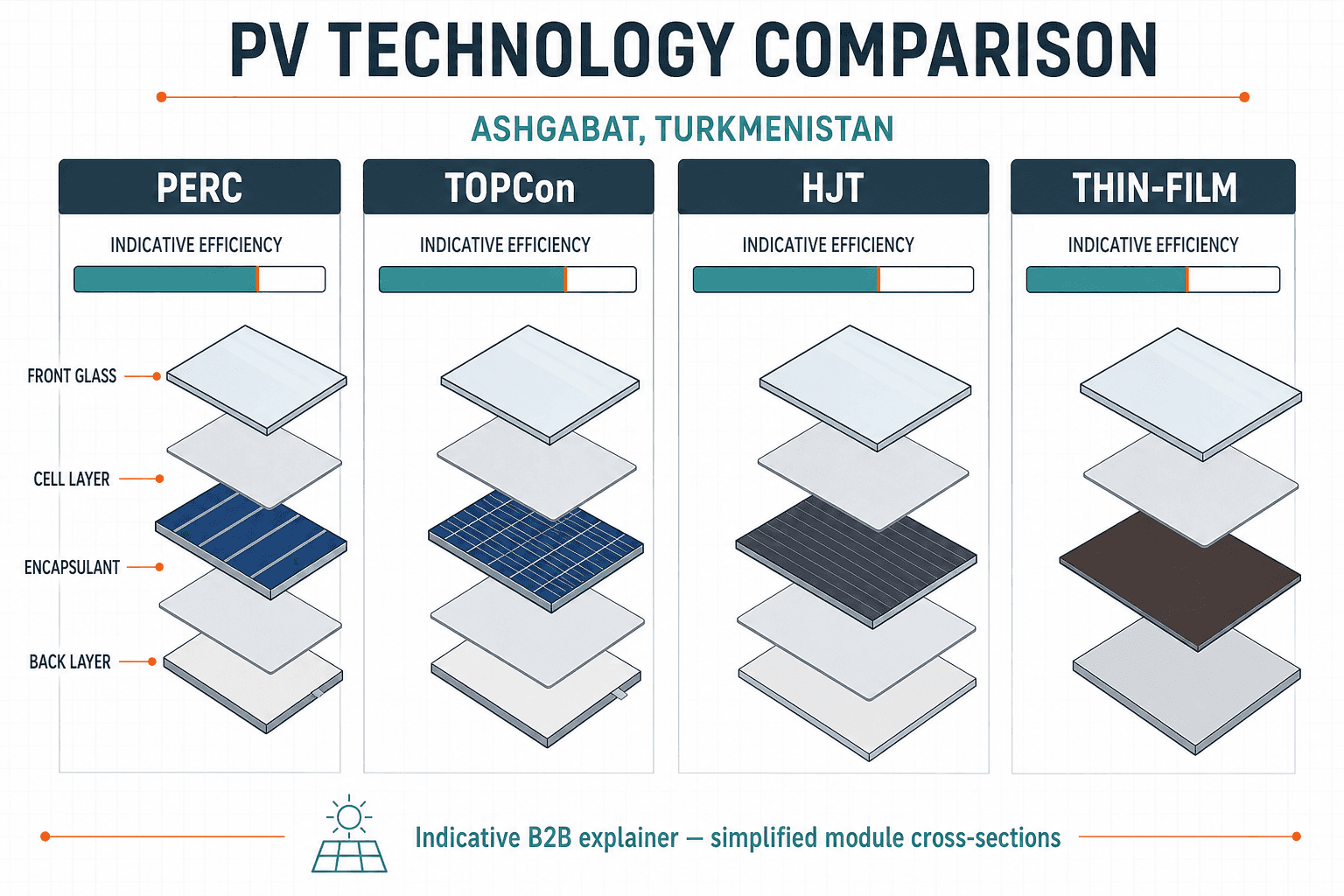
Q2: Why use TOPCon modules instead of standard PERC panels? TOPCon modules are recommended here because the project-specific specification requires 580W modules at 25% efficiency and 0.4% annual degradation. Compared with typical PERC modules, TOPCon can provide higher conversion efficiency and better long-term yield density, which matters on industrial rooftops where usable area, row spacing, and maintenance access constrain total installed capacity.
Q3: What annual energy yield should buyers expect? The modeled annual yield is approximately 2,999,315 kWh using 5 kWh/m²/day irradiance and about 14% system losses. This is a planning estimate, not a measured Ashgabat deployment result. A bankable forecast should add site-specific weather data, azimuth, roof shading, module temperature behavior, downtime assumptions, and interconnection constraints.
Q4: How long would installation usually take? A 1.9MW industrial rooftop PV project would typically require several stages: feasibility, detailed design, procurement, shipping, rooftop installation, electrical integration, and commissioning. The field installation period depends on roof access, local labor availability, customs clearance, utility inspection, and safety windows. Buyers should plan the schedule around production operations and summer heat constraints.
Q5: What maintenance is required in Ashgabat’s climate? Maintenance should focus on dust control, thermal inspection, connector checks, inverter ventilation, and monitoring alarms. Because WMO climate data shows very low August rainfall, soiling can persist during dry months. A practical O&M plan should define cleaning frequency, safe roof access, water-efficient methods, annual electrical testing, spare fuses, and inverter preventive maintenance.
Q6: How should ROI or payback be calculated? ROI should be calculated from actual tariff, daytime self-consumption, export compensation, financing cost, EPC scope, tax treatment, cleaning cost, inverter replacement allowance, and degradation. This guide does not publish prices. The useful output is a sensitivity model showing payback under low, base, and high production cases using approximately 2,999,315 kWh/year as the starting yield.
Q7: Does the system require a step-up transformer? For the 500kW-5MW C&I class, a LV-to-10/35kV step-up transformer may be required if the utility connection point is medium voltage or export capacity exceeds low-voltage limits. It is not automatic for every rooftop. The decision should follow utility interconnection review, protection study, metering requirements, and facility switchgear assessment.
Q8: What warranties apply to this configuration? The project-specific warranty basis is a 25-year panel warranty and a 5-year inverter warranty. The module degradation assumption is 0.4% per year over a 30-year lifetime. Buyers should review warranty exclusions for installation quality, improper cleaning, extreme weather, grid faults, unauthorized modifications, and inverter operating-temperature limits.
Q9: How does this compare with a small commercial PV system? A small commercial PV system in the 15-100kW class usually uses 2-4 strings and 1-2 string inverters. The Ashgabat recommendation is much larger at 1.9MW, so it belongs in the C&I class with central inverter architecture, combiner boxes, plant-level protection, and possible 10/35kV step-up interconnection.
Q10: What should be included in an EPC quotation? An EPC quotation should separate modules, racks, inverter, DC combiner boxes, AC distribution, cables, monitoring, protection, logistics, installation, commissioning, documentation, and O&M assumptions. It should also state exclusions such as roof reinforcement, utility fees, taxes, grid upgrades, and special access equipment. SOLARTODO can quote FOB Supply, CIF Delivered, or EPC Turnkey scopes.
References
This guide uses 7 public and standards references, including census, climate, solar-resource, energy-system, and PV safety sources.
- State Committee of Turkmenistan on Statistics (2022): Complete population and housing census reports 7,057,841 people nationally and Ashgabat city at 14.6% of population. https://www.stat.gov.tm/en/population-census
- World Meteorological Organization (2026): Ashgabat climatology lists July mean daily maximum temperature of 38.2°C and August mean precipitation of 1 mm. https://worldweather.wmo.int/en/city.html?cityId=212
- World Bank / Global Solar Atlas (2026): Turkmenistan PVOUT range is 3.93-4.63 kWh/kWp/day and GHI range is 4.22-5.14 kWh/m²/day. https://globalsolaratlas.info/map?c=39.070379%2C59.589844%2C6&r=TKM
- World Bank (2023): Access to electricity in Turkmenistan is reported at 100% of population for 2023. https://data.worldbank.org/indicator/EG.ELC.ACCS.ZS?locations=TM
- UNECE (2026): Turkmenistan energy-transition report notes 6.5GW power capacity in 2023, almost 100% natural-gas based, and electricity demand growth of almost 60% over the last decade. https://unece.org/taxonomy/term/715
- NREL PVWatts (2026): PVWatts calculator uses an estimated system losses input of 14% and defines soiling, shading, wiring, mismatch, and availability losses. https://pvwatts.nrel.gov/pvwatts.php
- IEC (2023): IEC 61730-1:2023 defines photovoltaic module safety qualification requirements for construction; IEC 61215 is used for PV module design qualification and type approval. https://webstore.iec.ch/en/publication/59803
Equipment Deployed
- 3,295 × TOPCon solar panels, 580W each, 25% efficiency, 0.4%/yr degradation
- Industrial rooftop aluminum fixed-tilt rack system, 30° tilt
- Central inverter, 98% CEC efficiency, 5-year warranty
- DC combiner boxes for multi-string aggregation
- AC distribution cabinet with protection and metering interface
- Bi-directional net metering provision
- Monitoring and performance data interface
- Optional LV-to-10/35kV step-up transformer if utility interconnection requires medium voltage