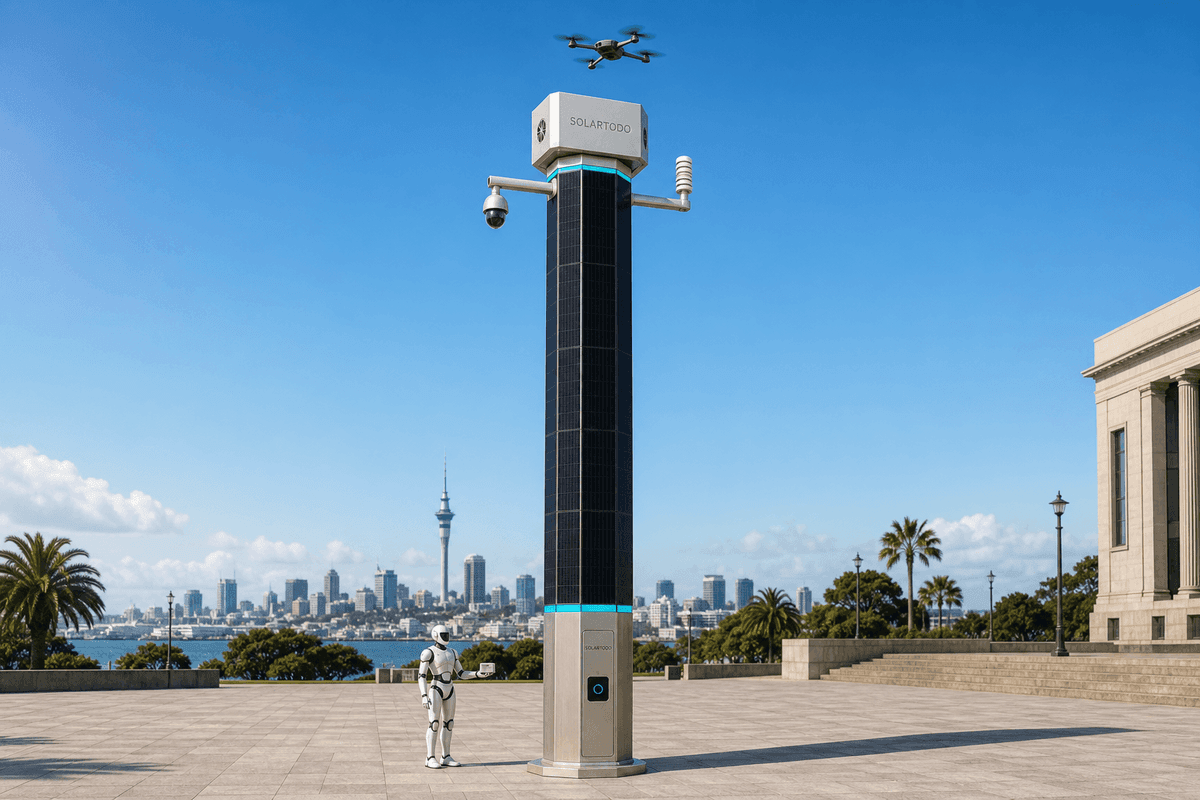
Auckland coastal flood-and-salt corridors: SOLARTODO Sentinel City AI Pole 20-node configuration guide
Summary
Auckland’s 1.816 million residents, 130,000-plus streetlight asset base, and $8.4 billion 2024-27 transport programme make a 20-node off-grid SOLARTODO Sentinel layout relevant for coastal perimeter monitoring.
Key Takeaways
Auckland’s edge-node decision is driven by 4 local constraints: coastal exposure, flood risk, dense corridors, and council-controlled procurement.
- A typical deployment would use approximately 20 SOLARTODO Sentinel City AI Pole nodes at about 35 m spacing, covering roughly 700 m of linear perimeter or corridor.
- Stats NZ (2025) reports Auckland Region at 1,816,000 residents, so public-realm sensing must prioritize privacy-preserving local processing.
- Auckland Transport reports more than 130,000 streetlights and 99% LED conversion by mid-2025; Sentinel should be positioned as non-lighting infrastructure, not a lighting replacement.
- NZ Transport Agency Waka Kotahi (2024) forecasts $8.4 billion for Auckland transport in 2024-27, including $941 million for maintenance operations.
- WorkSafe New Zealand states distribution networks commonly include 11 kV to 22 kV lines and 230-400 V customer supply, supporting clear electrical separation from Sentinel’s off-grid architecture.
- The Sky Hub configuration uses 5-20 kWh-class storage with on-pole PV replenishment, suitable for scheduled drone and robot duty cycles rather than unlimited solar operation.
- The environmental sensor set should log 9 parameters: wind speed, wind direction, temperature, humidity, pressure, noise, PM10, PM2.5, and illuminance.
Market Context for Auckland
Auckland needs compact off-grid edge nodes because a 1.816 million-person coastal city concentrates transport, stormwater, and public-space risk in narrow corridors.
According to Stats NZ (2025), Auckland Region has an estimated resident population of 1,816,000 and 229,770 businesses, making it New Zealand’s highest-density public-infrastructure market. The operational challenge is not simply adding cameras; it is managing event detection, maintenance dispatch, privacy boundaries, and autonomous field response without pushing raw video into centralized storage. For SOLARTODO, the city profile favors distributed physical-AI nodes that process on the pole and send only de-identified event and status metadata.
Climate is a material design input. According to NIWA (2013), Auckland has a subtropical climate with warm humid summers, mild winters, plentiful year-round rainfall, and around 2,000 hours of bright sunshine per year. NIWA’s 2023 Annual Climate Summary also records the Auckland Anniversary Floods, when more than 200 mm of rain fell in a few hours in many parts of Auckland. That history supports elevated equipment placement, sealed enclosures, corrosion-resistant fasteners, drainage-aware foundations, and conservative service scheduling after storm events.
Auckland is also a coastal network city rather than an inland grid city. Auckland Council’s shoreline adaptation programme covers the entire coast through 20 shoreline adaptation plans and considers coastal erosion, coastal inundation, and catchment flooding where it interacts with the coastal environment. This matters for Sentinel because the pole is best justified at ports, ferry approaches, campuses, industrial estates, stormwater-sensitive reserves, depots, and critical-infrastructure perimeters where salt air, wind, flooding, and public access intersect.
Procurement and corridor governance are local factors. Auckland Council operates through council-controlled organisations, including Auckland Transport, and New Zealand legislation requires substantive council-controlled organisations to give effect to relevant long-term plan requirements. Auckland Transport states, “more than 130,000 streetlights,” and reports 99% LED conversion by mid-2025. That public lighting context is useful for corridor asset coordination, but the SOLARTODO Sentinel City AI Pole is a pure smart pole with no lighting system.
Recommended Technical Configuration
Auckland’s recommended starting point is a 20-node off-grid Sky Hub layout with 35 m spacing, local AI processing, and human-authorized response workflows.
A typical 20-unit deployment in this profile would consist of SOLARTODO Sentinel City AI Pole nodes placed across coastal, campus, port-edge, or transport-adjacent zones rather than ordinary streetlight rows. At about 35 m spacing, the layout covers approximately 700 m if deployed linearly, or a tighter grid if used around a depot, ferry terminal edge, logistics yard, or flood-prone public asset. Site engineering should confirm wind exposure, foundation depth, setback from underground services, line-of-sight for drone operations, and safe robot docking paths.
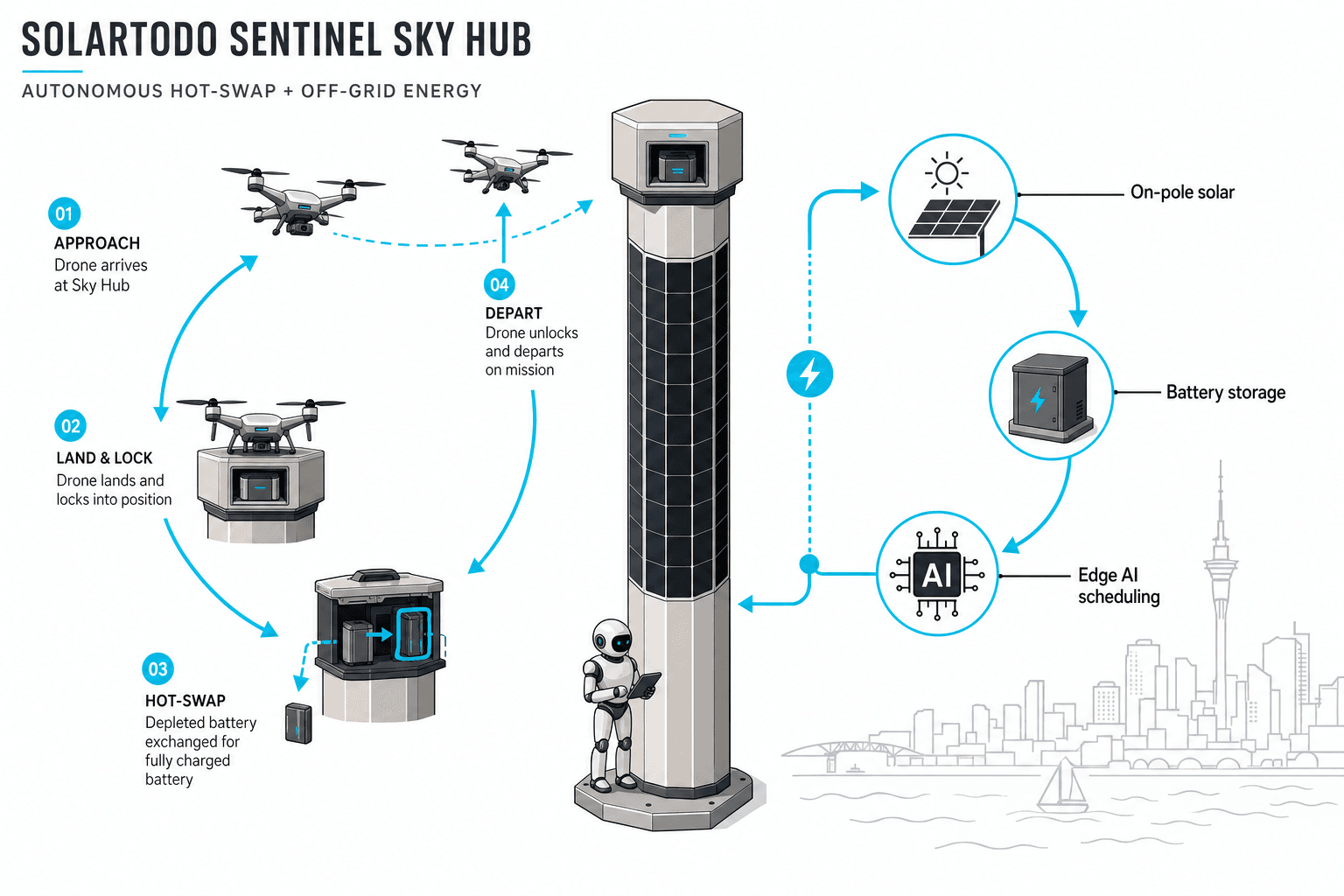
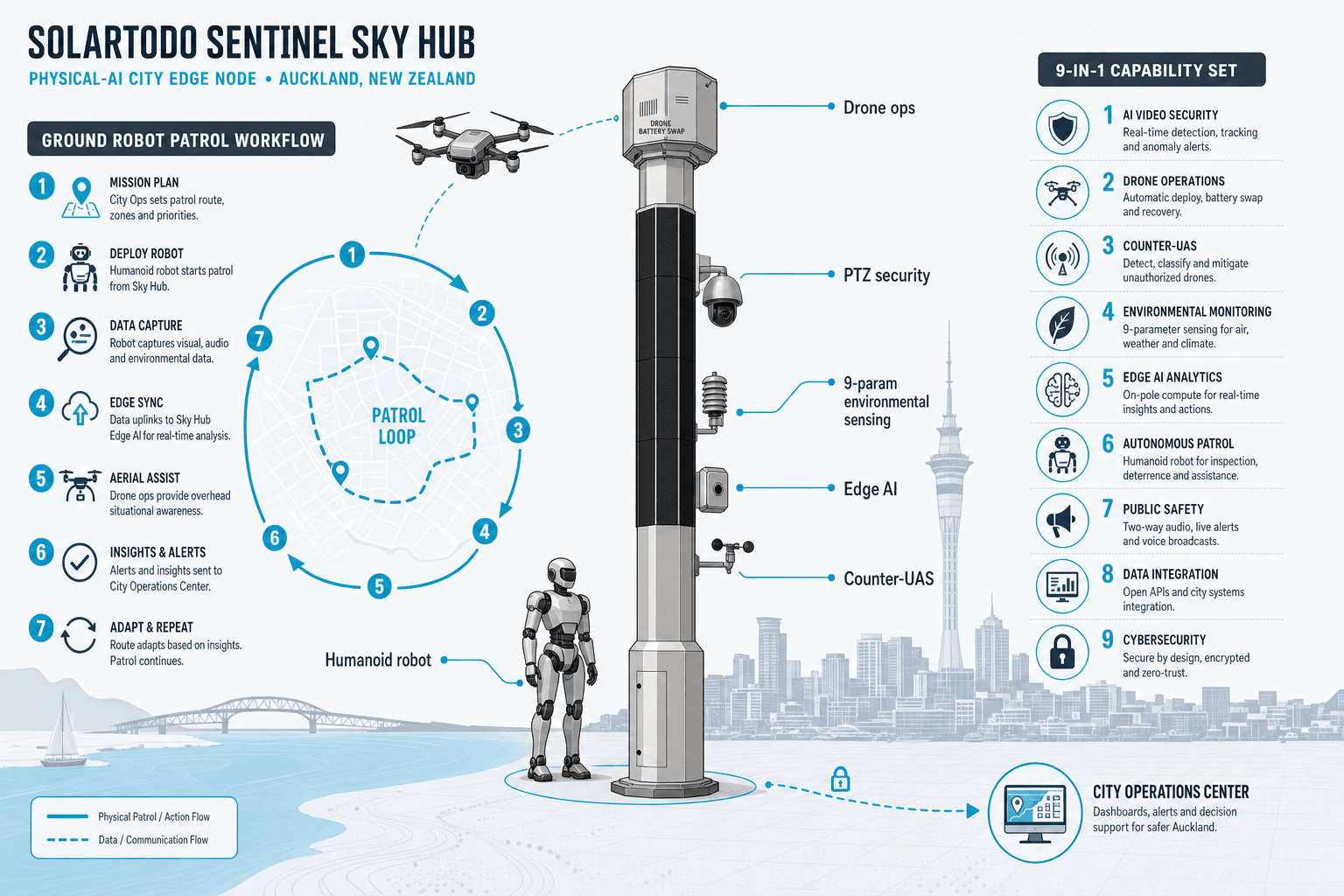
The recommended Auckland configuration should use the Sky Hub pole form as a self-contained edge micro-station. Each node would combine battery-backed off-grid operation, on-pole solar replenishment, Jetson-class edge compute, anonymous perception, environmental monitoring, drone mission management, drone battery exchange, ground robot coordination, and a common-operating-picture workflow. Raw video and sensor data stay on the pole; only event metadata, alarms, fleet status, and health telemetry leave the node.
For C-UAS coordination, Auckland deployments should remain non-lethal and human-authorized. The node can detect and track unauthorized drone activity through onboard sensing and optional partner-sensor inputs; radar should be treated only as an external integration, not pole hardware. Authorized response may coordinate a friendly drone for soft aerial net-capture or close-approach deterrence, but it must not include jamming, hard-kill effects, weapons, or autonomous attack.
Technical Specifications
The recommended 20-node Auckland configuration uses 5-20 kWh storage, 2.8-3.2 kWp on-pole PV nameplate, and local AI event processing.
- Product line: SOLARTODO Sentinel City AI Pole, city-ai-pole / physical-AI urban edge node.
- Deployment scale: approximately 20 units, project-based custom configuration, subject to engineering confirmation.
- Node spacing: about 35 m, yielding roughly 700 m of linear coverage when used as a corridor system.
- Energy architecture: fully off-grid, using on-pole solar replenishment plus 5-20 kWh-class battery storage.
- PV replenishment: about 2.8-3.2 kWp nameplate; high-irradiance clear-sky reference output is about 1.0-1.3 kW DC peak and 7-10 kWh/day, with Auckland yield to be modelled from local weather data.
- Compute: Jetson-class edge AI module for local inference, sensor fusion, mission scheduling, and event filtering.
- Sensing: PTZ visual sensor with local analytics for anonymous vehicle count, crowd density, intrusion, and perimeter awareness.
- Environmental monitoring: wind speed, wind direction, temperature, humidity, atmospheric pressure, noise, PM10, PM2.5, and illuminance.
- Robotics: autonomous drone launch, inspection routing, return, hot-swap battery service, and ground robot patrol with return-to-base wireless charging.
- Data handling: designed for local processing and PDPL-LGPD-oriented data minimization; no active face recognition or licence-plate recognition.
- Standards context: AS/NZS 3000 for low-voltage electrical installation practice, IEC 60529 for ingress protection classification, IEC 62305 for lightning protection design, and IEC 62443 for industrial control-system security controls.
Implementation Approach
Auckland implementation should follow 5 controlled phases: survey, consent/procurement alignment, CKD logistics, civil installation, and commissioning.
The first phase is corridor and hazard mapping. Engineers should confirm whether nodes sit near reclaimed waterfront land, stormwater overland-flow paths, coastal spray zones, old utility corridors, or narrow town-centre streets. According to Auckland Council (2025), shoreline adaptation planning considers sea-level-rise scenarios including up to 0.5 m, 0.5-1 m, and over 1 m of sea-level rise, so foundation and access assumptions should not be based only on current dry-weather conditions.
The second phase is procurement alignment. Because Auckland public assets may involve Auckland Council, Auckland Transport, Watercare, Eke Panuku, local boards, or private critical-infrastructure owners, the buyer should define asset ownership, maintenance responsibility, communications routing, and data-retention policy before civil works. NZ Transport Agency Waka Kotahi (2024) forecasts $8.4 billion of Auckland land-transport investment for 2024-27, which indicates a busy capital-works environment where coordination windows matter.
The third phase is logistics and pre-assembly. CKD or modular shipping should account for New Zealand import documentation, port handling, road corridor access, and limited laydown space in central Auckland or waterfront precincts. Coastal salt air means packaging, spare parts, and commissioning tools should be protected from moisture during staging. Dense town-centre streets can make night delivery or small-crane installation more practical than extended daytime lane occupation.
The fourth phase is civil and systems installation. Foundations should be checked against geotechnical conditions, flood exposure, underground services, and maintenance vehicle access. Each node should be commissioned for energy budget, battery reserve, local AI model thresholds, mission geofencing, drone recovery logic, environmental sensor calibration, and role-based operator authorization. The fifth phase is acceptance testing: verify local-only raw data processing, metadata export, drone hot-swap cycle, robot return-to-base charging, alarm workflow, and human approval gates for any C-UAS response.
Expected Performance & ROI
Auckland ROI should be modelled across 3 value streams: avoided trenching, reduced patrol labour, and faster incident triage.
Because Sentinel is fully off-grid, its business case is strongest where trenching, network connections, or utility coordination would be slow or expensive. WorkSafe New Zealand states, “230 to 400 volts,” for most consumer supply after distribution transformation, but Sentinel should not depend on site power. The off-grid design avoids new low-voltage service points while keeping high-load drone and robot missions inside battery-managed duty cycles.
Expected performance should be stated as conditional engineering outcomes, not a claimed Auckland deployment result. A 20-node system can support scheduled perimeter patrol, local event detection, environmental trend logging, and drone/robot tasking across a roughly 700 m linear corridor. In storm or high-wind conditions, operations should degrade gracefully: prioritize sensing and metadata reporting first, then defer high-power sorties until battery state and weather conditions are acceptable.
ROI varies with security staffing, incident frequency, trenching distance, communications backhaul, and civil constraints. For a realistic EPC business case, SOLARTODO recommends modelling 36-60 months for payback sensitivity rather than promising a universal period. According to MBIE (2024), New Zealand reached 88.1% renewable electricity generation in 2023, but this does not remove the practical value of off-grid nodes in places where connection cost, outage resilience, and deployment speed matter.
Comparison Table
Auckland buyers should compare 4 options across power, data, autonomy, and public-space suitability before selecting a 20-node Sentinel layout.
| Option | Power model | Typical Auckland fit | AI/data posture | Drone/robot capability | Key limitation |
|---|---|---|---|---|---|
| SOLARTODO Sentinel City AI Pole | Off-grid, 5-20 kWh storage plus on-pole PV | Coastal perimeters, depots, campuses, ports, flood-sensitive corridors | Raw data processed locally; metadata exits | Drone launch, battery hot-swap, robot charging and patrol | Requires duty-cycle design for winter and storm periods |
| Conventional CCTV pole | Grid or site power | Fixed surveillance points with existing power | Often centralized video backhaul | None unless separately integrated | Trenching, privacy, and bandwidth load can rise quickly |
| Mobile patrol vehicle | Fuel or EV charging | Temporary coverage and incident response | Human observation plus body/vehicle systems | No autonomous pole-based sortie loop | Labour-intensive and intermittent |
| Lighting-column attachment | Existing streetlight circuit | Road reserves with approved lighting assets | Depends on host system | Usually none | Sentinel is non-lighting; shared assets may complicate ownership |
Pricing & Quotation
SOLARTODO offers three pricing tiers for this product line: FOB Supply (equipment ex-works China), CIF Delivered (including ocean freight and insurance), and EPC Turnkey (fully installed, commissioned, with 1-year warranty). Volume discounts are available for large-scale deployments. Configure your system online for an instant estimate, or request a custom quotation from our engineering team at [email protected].
For Auckland, quotation inputs should include node count, foundation type, corrosion class, drone operating envelope, robot duty cycle, backhaul method, civil-access constraints, and required acceptance tests. Product and solution details can be reviewed through SOLARTODO solutions, while project scoping and engineering confirmation should start through contact us.
Frequently Asked Questions
Auckland buyers usually need 10 answers covering specifications, installation, maintenance, ROI, pricing, warranty, and comparison with conventional systems.
Q1: Is the SOLARTODO Sentinel City AI Pole a smart streetlight? No. It is a pure smart pole with no lighting system, no lamp head, and no streetlight retrofit claim. In Auckland, it should be specified as a physical-AI city edge node for sensing, drone operations, robot operations, environmental monitoring, local compute, and human-authorized response workflows.
Q2: What is the recommended Auckland deployment scale? The provided configuration is approximately 20 units at about 35 m spacing. In a straight corridor, that equates to roughly 700 m of coverage. The same 20 nodes can also be arranged around a campus, ferry-adjacent zone, logistics yard, water asset, or coastal public-space perimeter after survey confirmation.
Q3: How long would deployment typically take? A typical 20-node Auckland programme would usually be planned in phases: site survey, authority and stakeholder alignment, factory configuration, shipping, civil works, installation, and commissioning. The actual timeline depends on consenting, traffic management, geotechnical conditions, import logistics, and whether drone operating procedures require additional local approvals.
Q4: What ROI should Auckland buyers expect? SOLARTODO recommends modelling ROI as a sensitivity range rather than a fixed promise. The main value drivers are avoided trenching, fewer manual patrol hours, faster incident triage, and reduced bandwidth from local processing. For early budgeting, a 36-60 month payback scenario can be tested against site-specific labour and civil-cost assumptions.
Q5: How is the system maintained in coastal salt air? Maintenance should include enclosure inspection, fastener checks, seal inspection, PV surface cleaning, battery health review, sensor calibration, drone battery magazine testing, and robot charging verification. Auckland’s coastal exposure makes corrosion control and drainage checks more important than in dry inland sites, especially near waterfront, port, and reclaimed-land corridors.
Q6: Does the pole connect to Auckland’s grid? No. The Sentinel City AI Pole is fully off-grid, using battery storage with on-pole solar replenishment. The solar layer supports the energy budget but is not an unlimited self-sufficiency claim. Drone and robot missions are scheduled by battery state, weather, task priority, and reserve requirements.
Q7: What data leaves the pole? Raw video and sensor streams stay on the pole for local processing. Only de-identified event metadata, system status, alarms, and mission logs should leave the node. This design supports privacy-oriented operation in Auckland’s dense public spaces and avoids unnecessary centralized video transfer for routine analytics.
Q8: Can it perform face recognition or licence-plate recognition? No active face recognition or licence-plate recognition should be specified for this configuration. The appropriate analytics are anonymous vehicle count, crowd density, intrusion detection, perimeter awareness, environmental sensing, and operational status. That boundary is important for public-sector acceptability and privacy review.
Q9: How does Sentinel compare with conventional CCTV poles? A conventional CCTV pole mainly provides fixed observation and often depends on grid power plus central video backhaul. Sentinel adds off-grid storage, local AI inference, environmental sensing, drone launch and hot-swap service, ground robot coordination, and human-authorized response workflows. It is more complex, so it needs stronger commissioning and maintenance discipline.
Q10: What pricing information is available for EPC buyers? SOLARTODO provides FOB Supply, CIF Delivered, and EPC Turnkey quotation routes, but this Auckland guide does not publish numeric prices. EPC pricing depends on foundations, corrosion class, communications, civil access, commissioning scope, warranty terms, local subcontracting, and operational acceptance testing. Buyers should request a custom quotation with site drawings.
References
The 7 references below support Auckland market facts, New Zealand electricity context, and technical standards used in this configuration guide.
- Stats NZ (2025): Auckland Region quick stats report 1,816,000 estimated residents at 30 June 2025 and 229,770 businesses at February 2025.
- NIWA / Earth Sciences New Zealand (2013): The Climate and Weather of Auckland describes Auckland’s subtropical climate, mild winters, plentiful rainfall, and around 2,000 sunshine hours per year.
- NIWA / Earth Sciences New Zealand (2024): Annual Climate Summary 2023 records Auckland Anniversary Floods with more than 200 mm of rain in a few hours in many Auckland areas.
- Auckland Transport (2025): Sustainability reporting states Auckland Transport owns and maintains more than 130,000 streetlights and had converted 99% to LED by mid-2025.
- NZ Transport Agency Waka Kotahi (2024): Auckland NLTP 2024-27 forecasts $8.4 billion of regional investment, including $941 million for maintenance operations.
- WorkSafe New Zealand (2026): Electricity industry structure describes sub-transmission at 33 kV, 50 kV, and 66 kV, distribution at 11 kV to 22 kV, and consumer voltages of 230-400 V.
- MBIE (2024): Energy in New Zealand 2024 reports 43,488 GWh total electricity generation in 2023 and an 88.1% renewable electricity generation share.
- IEC (2013-2024): IEC 60529, IEC 62305, and IEC 62443 provide reference frameworks for ingress protection, lightning protection, and industrial cybersecurity controls.
Equipment Deployed
- 20 x SOLARTODO Sentinel City AI Pole Sky Hub edge nodes
- 5-20 kWh-class battery storage per node with off-grid power architecture
- 2.8-3.2 kWp on-pole PV replenishment layer per node
- Jetson-class edge AI compute module for local inference and scheduling
- PTZ sensing package for anonymous vehicle count, crowd density, intrusion, and perimeter awareness
- Nine-parameter environmental monitoring package: wind speed, wind direction, temperature, humidity, pressure, noise, PM10, PM2.5, illuminance
- Autonomous drone operations module with route planning, return, mission logs, and battery hot-swap magazine
- Ground robot patrol and wireless return-to-base charging interface
- Common-operating-picture software workflow with human-in-the-loop authorization
- Optional partner-sensor input interface for external radar or perimeter systems