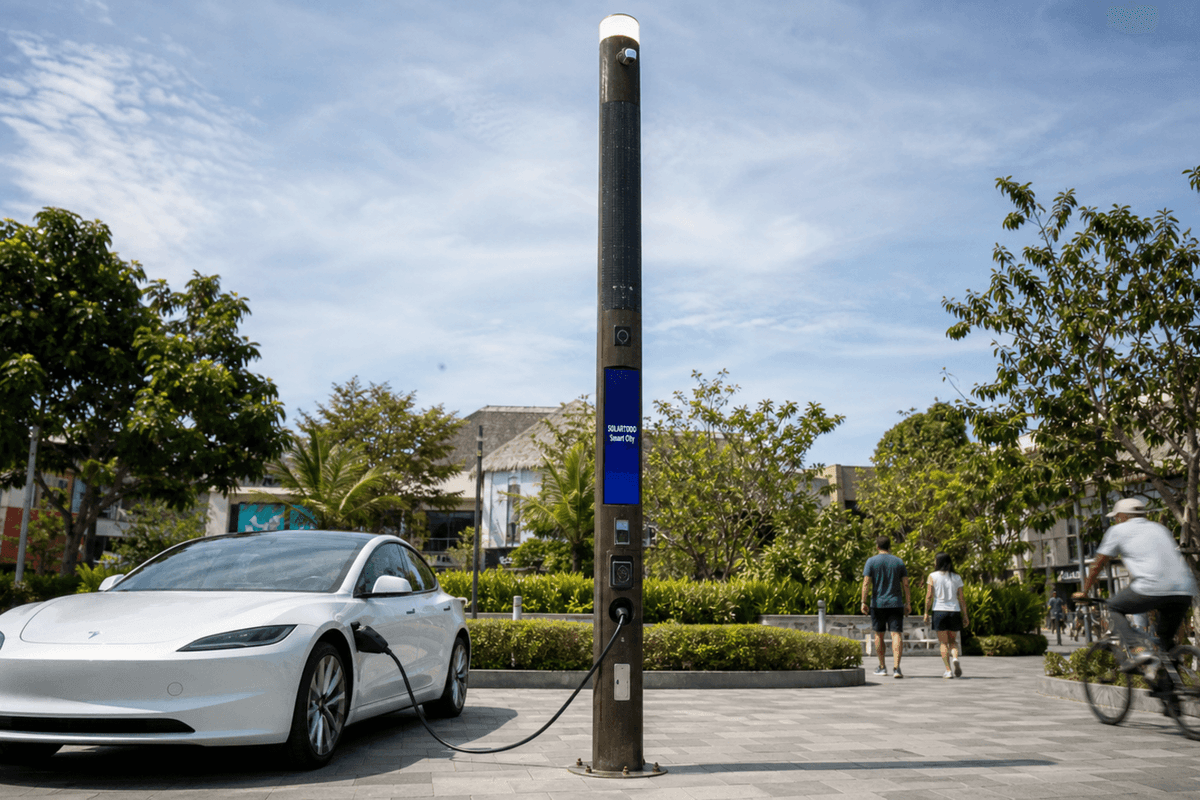
Bali Salt-Air Tourism Corridors: Ø200mm Flush Smart Streetlight Configuration Guide
Summary
Bali's 4.32m residents, 345mm January rainfall near Denpasar, and 20kV/230-400V PLN distribution context favor a sealed Ø200mm, 10m Smart Streetlight with 120 typical units at 28m spacing for coastal tourism corridors.
Key Takeaways
A 120-pole Bali Smart Streetlight corridor should prioritize corrosion control, narrow streetscape fit, and PLN-compatible low-voltage integration over highway-scale mast height.
- Approximately 120 units at 28m spacing would cover about 3.36km of urban or resort-access road frontage.
- The recommended pole is a 10m seamless Ø200mm cylinder with constant diameter, 5mm wall thickness, and RAL8011 antique bronze finish.
- Each pole integrates an 80W, 12,000lm, 4000K COB top luminaire behind a PMMA top window segment.
- CIGS thin-film solar wraps 360° from 6.5m to 9.3m, delivering about 183W without tilted panels or brackets.
- Bali's Denpasar climate normals show January rainfall around 345mm and daily maxima around 33°C, requiring sealed flush modules.
- PLN Bali distribution practice commonly uses 20kV medium voltage and 230/400V low voltage, so charger tie-in design should follow local LV interfaces.
- The embedded 7kW AC Type 2 charger, 2,400Wh LFP battery, WiFi 6, SOS, and 8MP fisheye camera remain inside the Ø200mm cylinder envelope.
- SOLARTODO should position this Smart Streetlight as a premium streetscape asset for coastal tourism roads, old-town approaches, and EV stopover zones, not highways or garden parks.
Market Context for Bali
Bali's Smart Streetlight demand is shaped by 5,780km² of island land, dense tourism corridors, high rainfall seasonality, and 230/400V urban service points.
Bali is not a generic tropical city; it is an island province where road lighting must serve residents, hotels, ports, temples, markets, and night-time tourism flows in the same corridor. According to BPS Bali (2021), the 2020 census recorded 4.32 million residents and 747 people per km², giving lighting planners a dense but fragmented service area. According to BPS Bali (2024), direct foreign tourist arrivals in December 2023 reached 481,646 visits, with Australia representing 25.70% of arrivals that month. This raises the value of consistent night visibility, pedestrian confidence, wayfinding, and emergency access along coastal and resort roads.
Climate drives the technical decision. According to WMO/BMKG climate normals for Denpasar, January rainfall is about 345mm with 27 rain days, while August rainfall drops to about 25mm and daily maximum temperatures remain near 29.6-34.4°C across the year. According to a Bali rainfall study using BMKG data, northern Bali averaged about 1,761mm/year and southern Bali about 2,025mm/year, reflecting complex terrain and different rainfall exposure across a 0-3,028m elevation range. For Smart Streetlight equipment, that means connectors, screens, buttons, camera windows, and charging sockets must resist rain splash, humidity, UV, and salt-laden coastal air.
Grid and procurement context also matter. According to PLN/AIIB (2019), the East Java-Bali Power Distribution Strengthening Project covers about 17,000km of distribution lines and includes medium-voltage and low-voltage expansion, urban trenching, new poles, transformer installation, and customer connection work. A PLN Bali distribution construction reference identifies 20kV medium-voltage distribution and 230/400V low-voltage distribution as the common interface classes for Bali distribution work. For municipal procurement, Bali uses provincial LPSE/PBJ platforms; LPSE Bali is listed in the national e-procurement system, and the Bali PBJ portal reports more than 10,000 procurement packages and 500 registered work units. That procurement environment favors clear technical specifications, standards mapping, and maintainable accessories rather than vague smart-city claims.
The city-hard constraint is coastal fit. Denpasar, Badung, Sanur, Kuta, Benoa, and port-linked roads face salt air, crowded sidewalks, parked scooters, narrow shopfronts, and seasonal flooding risk. DOE corrosion guidance notes that marine environments with humidity and chlorides can create corrosion challenges for electrical systems, especially where joints trap moisture. DOE states, 'Marine environments with high humidity and the presence of salts' present additional corrosion challenges. A monolithic flush cylinder is therefore more suitable than a pole with side arms, external boxes, protruding speakers, or separated charging bollards.
Recommended Technical Configuration
For Bali, the correct SOLARTODO size class is a 10m cylindrical Smart Streetlight because coastal streets need flush integration, not highway poles.
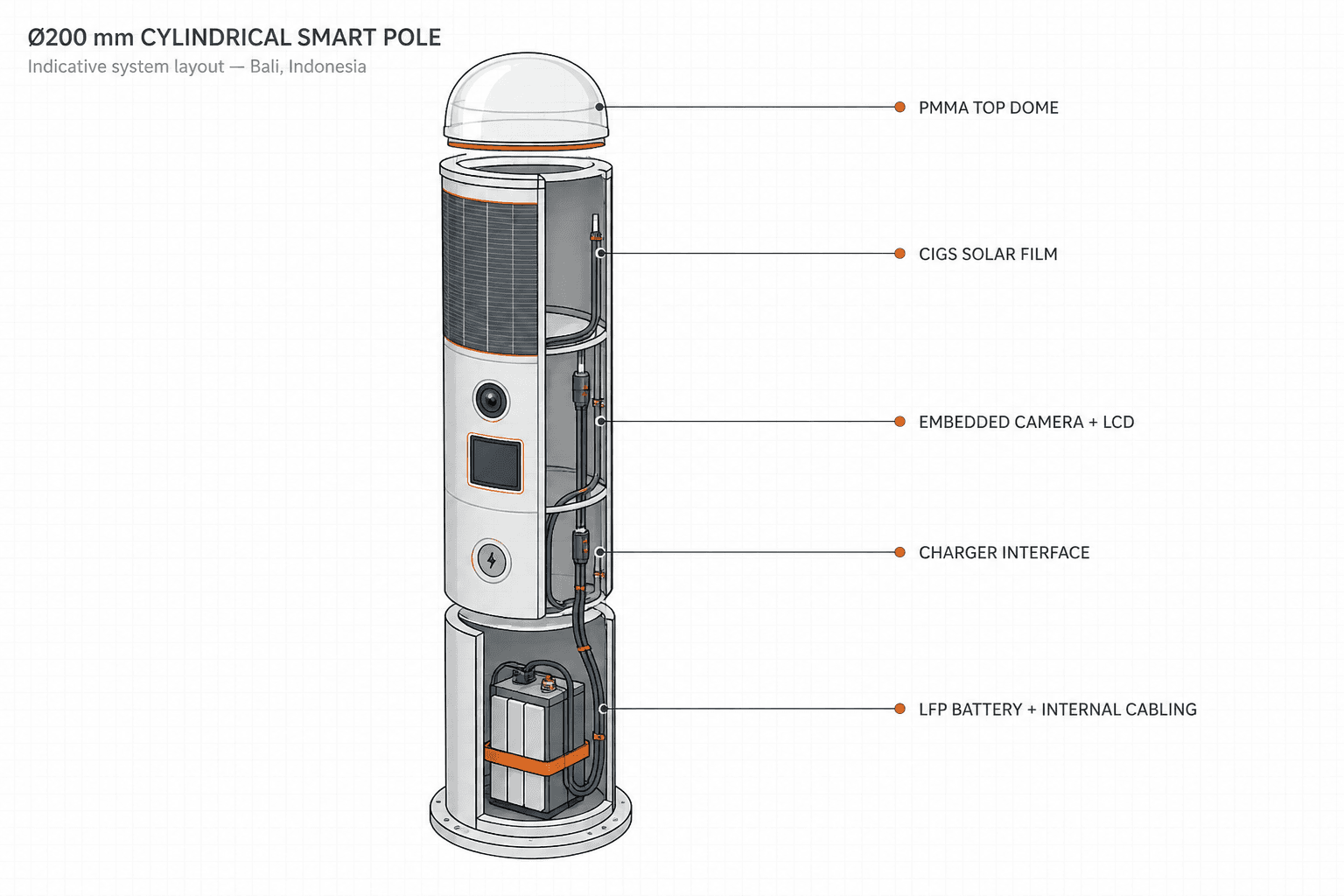
A typical 120-unit deployment in this profile would use the SOLARTODO cylindrical smart pole variant, not the 12m hybrid armature pole and not a garden-lighting class product. The recommended configuration is 120 units x 10m seamless cylindrical Ø200mm pole, constant diameter from top to bottom, with 5mm hot-dip galvanized steel and antique bronze RAL8011 finish. This form factor protects the streetscape on premium tourist corridors because all modules are flush-integrated into the cylinder skin and the EV charging hardware remains embedded inside the same Ø200mm body. SOLARTODO should specify no side arms, no luminaire outriggers, no external IP speaker columns, no public-address modules, no external boxes, and no separate bollard.
The spacing basis is 28m. At this density, 120 poles represent approximately 3.36km of corridor frontage, aligned with urban street lighting practice in the 25-50m spacing range and 30-50 poles per km band. The product is suitable for city and urban street classes, resort approach roads, waterfront promenades with vehicle access, ferry or marina approach roads, and dense commercial lanes where protrusions are a safety and vandalism risk. It is not recommended for highways, where 12m-plus traffic-pole systems are better, and it is not a 6-8m garden-lighting product for park-only pathways.
The configuration should connect to PLN-compatible low-voltage service where available, while the 2,400Wh LFP battery and 183W CIGS wrap provide resilience for controls, sensing, emergency intercom, and partial lighting continuity. According to IEA (2022), Indonesia's power system planning includes achieving 23% renewables in the national electricity mix by 2025 and making grids progressively smarter. IEA states, 'making grids progressively smarter,' which aligns with street-level controllers, metering, and connected public infrastructure. For SOLARTODO, the local recommendation is therefore a grid-supported smart pole with sealed self-generation support, not an off-grid-only solar streetlight.
Technical Specifications
The Bali configuration uses 120 identical 10m Ø200mm flush smart poles, each with 80W lighting, 183W CIGS, 7kW AC charging, and 2,400Wh LFP storage.
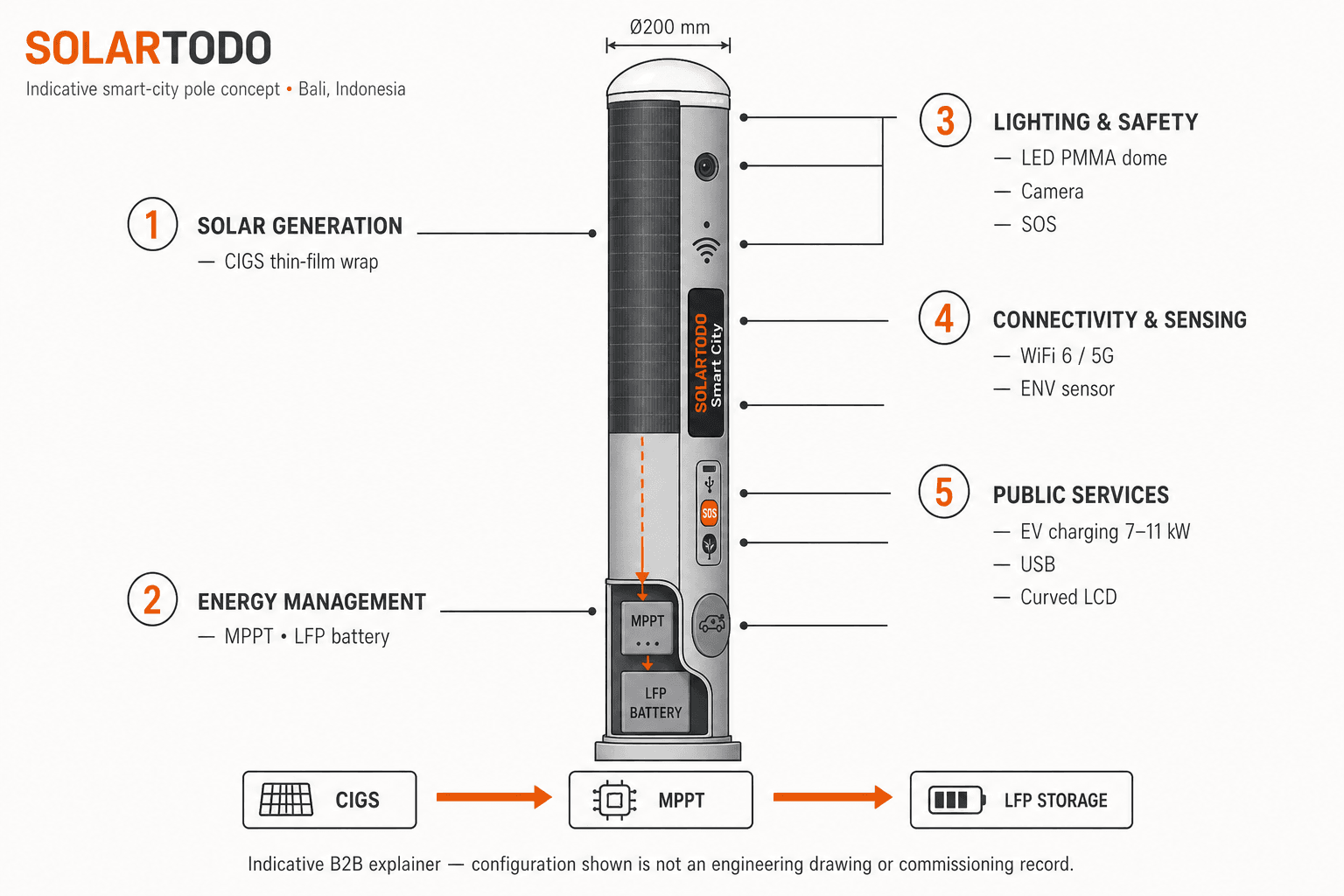
- Product: SOLARTODO Smart Streetlight, cylindrical smart pole variant for premium urban and coastal markets.
- Quantity model: approximately 120 units for a typical 3.36km corridor at 28m spacing.
- Pole structure: 10m seamless cylindrical Ø200mm pole, constant diameter top-to-bottom, 5mm wall, hot-dip galvanized steel.
- Finish: antique bronze RAL8011 for heritage-sensitive resort, temple-access, and old-town streetscape compatibility.
- Mechanical design: monolithic cylinder; all modules flush-integrated into the pole skin; no side arms, no luminaire outriggers, no external boxes, no external speaker columns, and no widened EV base.
- Luminaire: Ø200mm internal COB flood behind PMMA top window segment, 80W, 12,000lm, 4000K, integrated with the pole body.
- Solar surface: 360° CIGS flexible thin-film cells wrapped from 6.5m to 9.3m, approximately 183W total, dark blue-black semi-transparent laminate, flush to the pole skin.
- Storage and charging control: 2,400Wh LFP battery inside pole base with MPPT.
- EV charging: embedded 7kW AC charger, Type 2 Mennekes, flush flip-cap socket at 1.2m, 5m coiled Type 2 cable, and flush touchscreen at 1.5m.
- Display: vertical curved LCD, 2,200mm tall x about 170mm wide, bent to Ø200mm radius and flush-inset on the front face only.
- Display content: strictly stacked text, 'SOLARTODO' uppercase at top and 'Smart City' title case below, white sans-serif on deep blue, with no imagery, video, or advertising.
- Camera: flush 8MP 180° fisheye panoramic camera behind dome glass window, with no protrusion.
- Environmental sensing: flush dome-top 4-parameter sensor for temperature, humidity, wind speed, and noise.
- Communications: embedded WiFi 6 with internal antenna inside the cylinder; LoRaWAN/4G smart controller and cloud platform compatibility.
- Emergency and user ports: flush SOS button, dual-way audio intercom through pinhole speaker grille only, USB-C PD 30W, and USB-A flush outlet.
- Standards basis: IEC 60598 for luminaire safety and GB/T 37024 for multifunction smart pole system guidance.
According to IEC (2020), IEC 60598-1 covers luminaires operating from supply voltages up to 1,000V and addresses marking, mechanical construction, electrical construction, and photobiological safety. IEC states, 'general requirements and tests,' which is the right baseline for the integrated 80W luminaire rather than a decorative fixture-only specification. For Indonesia, PUIL/SNI-derived LV practice and PLN interfaces should be checked during shop drawing approval, especially for 230/400V supply, earthing, residual-current protection, surge protection, and charger isolation.
Implementation Approach
A Bali rollout of 120 smart poles would typically move through 6 phases: survey, utility coordination, CKD logistics, foundations, installation, and commissioning.
The first phase should be a corridor survey that separates coastal, old-town, and inland segments. Survey teams should confirm sidewalk width, drainage level, existing PJU locations, PLN LV connection points, underground utilities, trees, temple sightlines, storefront canopies, and locations where a protruding charger or arm bracket would conflict with pedestrians. Because the pole remains Ø200mm from top to bottom, foundation and duct design must handle EV charging cable routing without adding external cabinets. The survey output should include pole coordinates, foundation type, earthing plan, feeder segmentation, and maintenance access rules.
The second phase is technical approval and procurement. Specifications should be written around the exact cylinder geometry, flush module requirement, CIGS wrap height, display content restriction, and Type 2 charger integration. Procurement files should reference IEC 60598, GB/T 37024, local PLN low-voltage connection practice, and local public-lighting approval routes. According to Bali's PBJ portal (2026), provincial procurement data is synchronized from INAPROC and covers tender, non-tender, e-catalog, and RUP data, so technical clarity helps evaluators distinguish premium smart poles from ordinary PJU LED luminaires.
The third phase is logistics. For Bali, CKD or modular shipment through Indonesian import channels should be planned around sea freight, port handling, local road access, rainy-season storage, and corrosion protection during staging. Narrow access lanes in Denpasar and resort districts can make large cranes inefficient, so installation packages should consider smaller lifting equipment, night work windows, and staged civil works. Salt-air exposure means stainless fasteners, sealed glands, gasket inspection, and protective packaging should be verified before the poles leave storage.
The final installation sequence would include foundations and ducts, pole erection, LV connection, charger protection checks, controller provisioning, camera angle validation, WiFi commissioning, SOS test calls, and display content verification. Commissioning should record luminaire output, leakage protection, earth continuity, MPPT status, battery state-of-health baseline, network signal level, and touchscreen function. SOLARTODO should provide as-built drawings and a pole-by-pole asset register so Bali operators can link maintenance tickets to exact equipment modules.
Expected Performance & ROI
A 120-unit Bali corridor could replace single-purpose poles with 120 lighting, sensing, WiFi, SOS, display, and 7kW EV charging nodes.
The expected value is not only LED energy savings. Each pole consolidates lighting, panoramic camera, WiFi 6 access, emergency intercom, USB charging, environmental sensing, information display, solar-assist surface, LFP storage, and AC EV charging inside a single Ø200mm streetscape object. For a premium corridor, that can reduce sidewalk clutter, separate foundation work, cable congestion, and visual impact compared with separate PJU, CCTV, EV charger, public-display, and communications cabinets. NREL research on PV lifetime notes that modules often degrade by about 0.5-1.0% per year, so the 183W CIGS wrap should be treated as a resilience and auxiliary-energy feature rather than the only energy source.
ROI should be assessed as a lifecycle cost stack rather than a simple lamp replacement payback. The direct savings come from 80W high-efficiency LED lighting replacing older higher-wattage public luminaires, plus remote control reducing truck rolls for fault finding. The indirect value comes from improved visitor safety, charger availability at parking dwell points, reduced street furniture, better incident visibility, and standardized maintenance data. For EPC planning, buyers should request a corridor-specific ROI model with baseline lamp wattage, local electricity tariff, operating hours, charger utilization, civil works scope, and O&M cost.
Results and Impact
The expected impact for Bali is a 3.36km smart corridor with 120 unified nodes, not a claimed past deployment or fabricated client result.
A typical installation of this scale would create a visible, measurable upgrade path for coastal tourism districts and mixed-use commercial roads. The most important result would be equipment consolidation: 120 lighting points, 120 SOS access points, 120 WiFi-capable nodes, 120 environmental sensing points, 120 panoramic camera positions, and up to 840kW of distributed AC charging nameplate capacity if every 7kW charger is energized under approved load management. Actual charging availability should be limited by PLN connection capacity, parking rules, feeder design, and municipal operating policy.
Operational impact should be measured in asset uptime, lighting uniformity, maintenance response time, corrosion incidents, SOS call success rate, charger sessions, and public acceptance of the vertical LCD content. Because the display is restricted to 'SOLARTODO Smart City' text with no ads or video, this configuration is especially suitable where the visual environment matters, such as tourism streets and heritage-sensitive corridors. The recommended acceptance test is a 30-day pilot batch followed by pole-by-pole inspection before scaling to the full 120-unit corridor.
Comparison Table
The Bali decision compares 4 pole forms, but the Ø200mm cylindrical option best fits 10m coastal streets and premium sidewalk constraints.
| Option | Best fit in Bali | Height and form | Energy and charging | Streetscape risk | Recommendation |
|---|---|---|---|---|---|
| SOLARTODO cyl_219 | Coastal tourism roads, old-town corridors, resort streets | 10m Ø200mm constant cylinder | 183W CIGS wrap, 2,400Wh LFP, embedded 7kW AC Type 2 | Lowest: no arms, no boxes, no bollard | Primary recommendation |
| SOLARTODO standard | General municipal PJU upgrades | 6-12m octagonal modular pole | LED plus optional EV, WiFi, camera, sensors | Medium: accessories may protrude | Use for non-premium streets |
| SOLARTODO hybrid_12m | Sites with weak grid backup and open sky | 12m octagonal wind-solar hybrid | 100-300W wind plus panels, LFP, EV charging | Higher: panels and turbine visible | Use only where visual rules allow |
| Conventional PJU LED | Basic lighting replacement only | Usually 6-10m pole and arm | Grid LED only | Medium: single function | Insufficient for smart corridor goals |
For a Bali Smart Streetlight tender, the cyl_219 choice should be locked by drawing, not only by product name. The key differentiator is the Ø200mm constant cylinder with all modules flush-mounted and the EV charger embedded inside the cylinder. That geometry directly addresses salt air, pedestrian clearance, scooter parking, storefront width, and premium visual requirements better than a bracketed multi-accessory pole.
Pricing & Quotation
SOLARTODO quotations for Bali should separate FOB, CIF, and EPC scope because 120 poles involve sea freight, local civil works, PLN coordination, and commissioning.
SOLARTODO offers three pricing tiers for this product line: FOB Supply (equipment ex-works China), CIF Delivered (including ocean freight and insurance), and EPC Turnkey (fully installed, commissioned, with 1-year warranty). Volume discounts are available for large-scale deployments. Configure your system online for an instant estimate, or request a custom quotation from our engineering team at [email protected].
For specification review, the product page at SOLARTODO Smart Streetlight should be used with corridor drawings, load schedules, and the requested finish. Buyers should contact us with route length, pole spacing, PLN service assumptions, corrosion class, EV charger operating policy, and any local restrictions on cameras or emergency audio.
Frequently Asked Questions
These 10 FAQ items address Bali's 120-unit, 10m Ø200mm Smart Streetlight configuration, including installation, maintenance, ROI, pricing, warranty, and comparison.
Q1: Why is a 10m Ø200mm cylindrical Smart Streetlight recommended for Bali? A 10m Ø200mm cylinder fits Bali's mixed tourism and municipal streets better than a larger highway pole because it keeps all modules flush within one constant-diameter body. The design avoids side arms, external boxes, separate EV bollards, and speaker columns, which helps in narrow sidewalks, shopfront roads, resort approaches, and salt-air coastal zones.
Q2: How many poles would a typical Bali corridor require? At the specified 28m spacing, approximately 120 poles would cover about 3.36km of corridor frontage. The actual count should be finalized after survey drawings confirm intersections, driveways, trees, drainage structures, existing PLN connection points, camera sightlines, and EV parking bays. SOLARTODO should treat 120 units as a planning configuration, not a completed deployment claim.
Q3: What lighting performance does each pole provide? Each pole uses an integrated Ø200mm internal COB flood behind a PMMA top window segment, rated 80W, 12,000lm, and 4000K. The luminaire is integrated into the pole body, with no arm bracket or outrigger. Lighting simulation should still verify road width, mounting height, surface reflectance, glare control, and spacing before procurement.
Q4: Is the 183W CIGS wrap enough to power the whole pole off-grid? No. The 183W 360° CIGS wrap and 2,400Wh LFP battery provide auxiliary resilience and smart-system support, but Bali's recommended configuration should use grid-backed operation for lighting and EV charging. The thin-film wrap is valuable because it stays flush to the cylinder and avoids wind-loaded panel brackets in coastal streets.
Q5: How should the 7kW EV charger be installed in the Ø200mm pole? The 7kW AC charger is embedded inside the cylinder, with a Type 2 Mennekes flush flip-cap socket at 1.2m, a 5m coiled Type 2 cable, and a touchscreen at 1.5m. The pole must stay Ø200mm all the way down, so feeder, protection, earthing, and cable routing must be resolved in the foundation and duct design.
Q6: What is a realistic deployment timeline for 120 units in Bali? A typical schedule would allocate 2-4 weeks for survey and utility coordination, 4-8 weeks for manufacturing and inspection, 3-6 weeks for sea freight and customs, and 4-8 weeks for civil works, installation, and commissioning. Rainy-season access, hotel-area work windows, and PLN service approvals can shift the final timeline.
Q7: What maintenance plan is appropriate for coastal Bali? Maintenance should include quarterly visual inspection of seals, PMMA windows, touchscreen gaskets, flip-cap charger sockets, grounding points, and CIGS laminate edges. Coastal roads should add corrosion checks for fasteners, cable glands, and base compartments. Annual electrical testing should verify residual-current protection, earthing, battery health, MPPT status, camera clarity, WiFi signal, and SOS audio operation.
Q8: How does this compare with ordinary PJU LED street lighting? Ordinary PJU LED lighting mainly provides illumination, often with a separate bracket arm and limited remote intelligence. The SOLARTODO cylindrical Smart Streetlight combines 80W LED lighting, 8MP panoramic camera, WiFi 6, SOS, environmental sensing, vertical LCD text display, USB charging, CIGS wrap, LFP storage, and 7kW EV charging in one flush Ø200mm body.
Q9: How should ROI or payback be calculated for Bali buyers? ROI should compare the full lifecycle cost of multiple separate assets against one integrated pole network. Inputs should include baseline lamp wattage, electricity tariff, lighting hours, avoided civil works, maintenance truck rolls, charger utilization, network fees, corrosion-related replacement risk, and public-service value. SOLARTODO should provide corridor-specific modeling rather than a universal payback claim.
Q10: Does SOLARTODO provide EPC pricing and warranty options? Yes. SOLARTODO can quote FOB Supply, CIF Delivered, or EPC Turnkey scopes, with the EPC option including installation, commissioning, and a 1-year warranty under the required paragraph above. Exact pricing depends on route survey, foundation design, shipping scope, import conditions, PLN interface, charger protection design, and local installation responsibilities.
References
These 7 references support the Bali market analysis with population, tourism, climate, grid, procurement, lighting safety, and energy-transition evidence.
- BPS Bali (2021): 2020 Population Census recorded Bali Province at 4.32 million residents, 5,780.06km² land area, and 747 people per km² density.
- BPS Bali (2024): Bali Province Tourism Development December 2023 reported 481,646 direct foreign tourist visits and 25.70% Australian visitor share that month.
- WMO/BMKG (2026): World Weather Information Service climate normals for Denpasar list monthly rainfall, rain days, and temperature ranges including 345mm January rainfall.
- PLN/AIIB (2019): East Java-Bali Power Distribution Strengthening Project described about 17,000km of distribution lines, MV/LV expansion, urban trenching, poles, transformers, and customer connections.
- Bali PBJ/LPSE (2026): Bali procurement portals describe provincial electronic procurement via INAPROC and report more than 10,000 procurement packages and 500 registered work units.
- IEC (2020): IEC 60598-1:2020 specifies general requirements and tests for luminaires up to 1,000V, including marking, mechanical construction, electrical construction, and safety.
- IEA (2022): Enhancing Indonesia's Power System identifies Indonesia's 23% renewable electricity-mix target for 2025 and the need to make grids progressively smarter.
Equipment Deployed
- 120 units x 10m seamless cylindrical Ø200mm Smart Streetlight pole, constant diameter, 5mm wall, hot-dip galvanized, RAL8011 antique bronze
- Ø200mm internal COB top luminaire, 80W, 12,000lm, 4000K, behind PMMA top window segment
- 360° CIGS flexible thin-film solar wrap from 6.5m to 9.3m, approximately 183W total, flush laminated to pole skin
- 2,400Wh LFP battery inside pole base with MPPT
- Embedded 7kW AC Type 2 Mennekes charger, flush flip-cap socket at 1.2m, 5m coiled Type 2 cable, touchscreen at 1.5m
- Vertical curved LCD display, 2,200mm tall x about 170mm wide, Ø200mm radius, flush front inset
- Flush 8MP 180° fisheye panoramic camera behind dome glass window
- Top 4-parameter ENV sensor for temperature, humidity, wind speed, and noise
- Embedded WiFi 6 with internal antenna, LoRaWAN/4G smart controller, cloud platform compatibility
- Flush SOS button, dual-way intercom through pinhole grille, USB-C PD 30W, and USB-A flush outlet