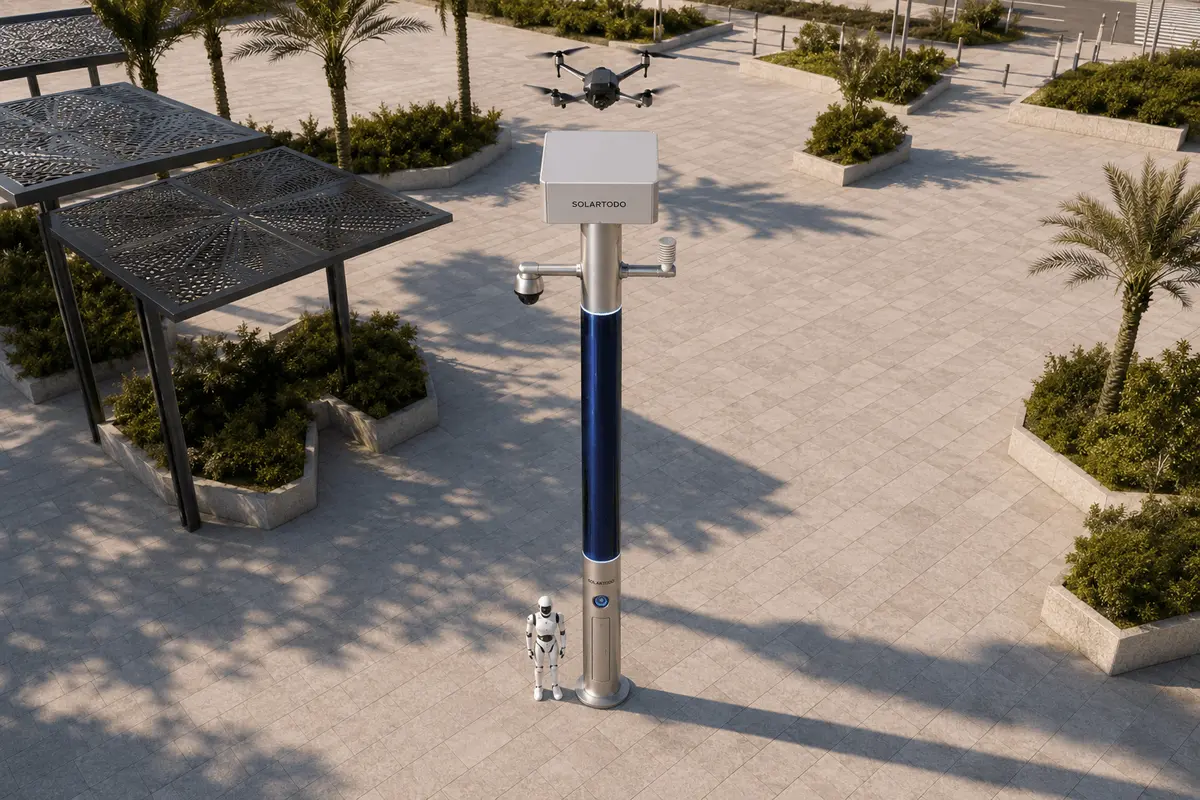
A City AI Pole, in this case SOLARTODO Sentinel Sky Hub, is a non-lighting physical-AI edge node that combines off-grid energy storage, wrapped CIGS solar replenishment, edge AI compute, sensing, droneport operations, robot charging and command coordination. In Bangkok, the proposed deployment supports flood-season night patrols along river-network zones where outages can delay inspection and response.
Procurement Context
Bangkok’s city risk profile is shaped by water. The Chao Phraya River, khlong networks, drainage canals, low-lying roads, waterfront communities, industrial edges and port-adjacent logistics areas create an operating environment where flood-season inspection is not a single route problem. It is a distributed night-patrol problem across narrow access points, temporary obstructions, standing water, unstable communications and changing public-safety priorities.
For an eco-environment buyer, the task is not only security. It is also environmental continuity: checking waterlogged perimeters, monitoring air and noise conditions around emergency works, identifying blocked access lanes, supporting pollution-response teams and keeping an auditable record when normal fixed infrastructure is unavailable. The procurement question is therefore framed around response-time targets during network-outage conditions, not around replacing an existing pole category.
This proposed configuration positions SOLARTODO Sentinel Sky Hub as a post-disaster-infill node: a fully off-grid physical-AI micro-station installed where permanent infrastructure is damaged, overloaded or absent. Each node is a pure smart pole without a lighting role. Its value comes from local compute, autonomous drone operations, ground robot coordination, environmental sensing and a common-operating-picture command view that keeps raw video and sensor data on the pole while sending only de-identified event and status metadata when communications allow.
Deployment Scenario
The representative deployment scenario is flood-season night patrol across a river-network district. A small number of priority locations would be selected by the buyer after engineering survey: canal junctions, drainage pump approaches, embankment access points, temporary waste-collection zones, industrial water edges, perimeter gates and emergency staging areas. No specific node count, coverage area or service level is claimed here; those are procurement variables subject to final engineering confirmation.
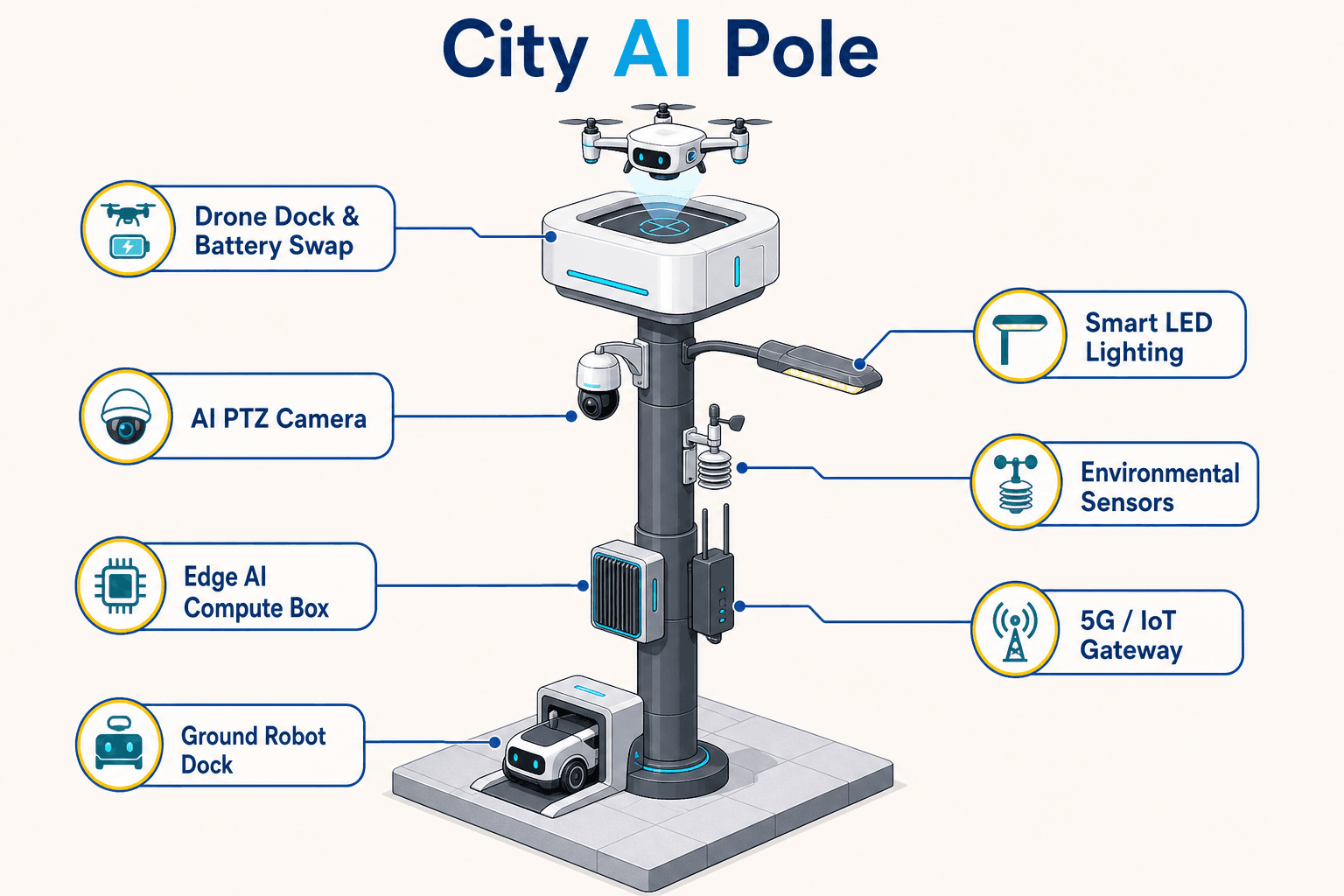
Sky Hub is used as a droneport rather than a generic sensor mast. During night patrol windows, the pole schedules autonomous sorties, manages route plans, maintains the charge and swap state machine, records mission logs and redeploys the drone for follow-up tasks after human authorization. When a drone lands, a rear-service multi-bay battery magazine performs an automated hot-swap, replacing the depleted pack with a charged one so the aircraft can relaunch without an operator at the site. Multiple bays allow several consecutive sorties, constrained by stored energy, weather, airspace rules and the buyer’s duty-cycle policy.
Ground robot operations complement aerial patrol. A service or humanoid robot can patrol accessible walkways, inspect underpasses or respond to alarms near the pole base, then return for wireless charging. Air-ground coordination is managed through OTATODO at the edge so the drone provides rapid area context while the robot handles closer inspection where ground access is safe. The COP view presents sensing, authorized response, compute scheduling and maintenance status as one operational loop.
Network-Outage Design
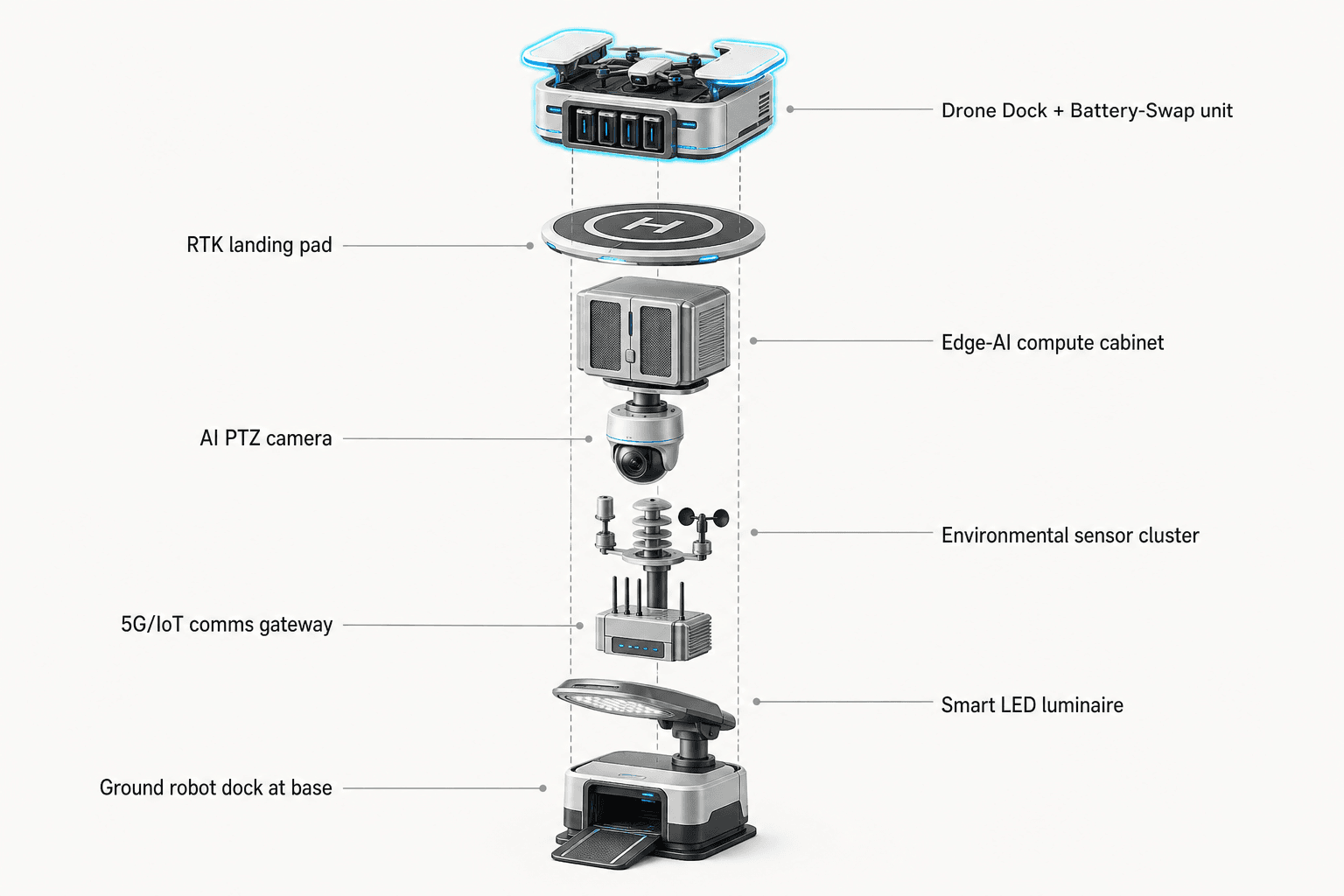
The core pain point is outage resilience. Flood-season operations often degrade communications exactly when an eco-environment team needs inspection evidence and task coordination. Sky Hub addresses this by moving the first layer of perception, classification, scheduling and recordkeeping onto the pole. PTZ camera feeds, environmental readings, mission state, robot docking state and battery-swap state are processed locally. Raw video and raw sensor data stay on the pole. Only de-identified event summaries, alerts, health status and mission metadata may leave the node when policy and connectivity permit.
This matters for Bangkok because a river-network patrol may continue even when the backhaul is intermittent. The pole can still detect a perimeter anomaly, estimate anonymous vehicle count or crowd density, monitor wind, temperature, humidity, pressure, noise, PM10, PM2.5 and illuminance, and queue a patrol task for authorized review. When communications return, the command view can synchronize event metadata and maintenance logs without needing to upload continuous raw footage.
The fully off-grid design is equally important. Sky Hub is specified as battery-backed with approximately 15 m² of 360-degree wrapped flexible CIGS thin-film solar replenishment over a vertical cylindrical body about 8 m tall and 0.6 m wide. Nameplate capacity is approximately 2.4-2.7 kWp. Because a vertical cylinder collects direct sun on its sun-facing projection rather than the whole wrap, realistic clear-sky output in a high-irradiance region is roughly 0.8-1.1 kW DC peak and about 6-9 kWh per day. Bangkok flood-season output must be engineered more conservatively. The CIGS layer is a replenishment layer for a fully off-grid battery-backed micro-station, while high-power drone and robot work is buffered by 5-20 kWh-class storage and scheduled by duty cycle.
Battery-Swap Impact
For procurement evaluation, the module focus is the drone battery hot-swap system because it directly affects response-time planning. A conventional patrol workflow can lose time when an operator must travel to a site, recover equipment, charge packs, relaunch, and manually compile logs. In the proposed Sky Hub workflow, the node holds the droneport, battery magazine, edge AI scheduler and mission log together in one autonomous field station.
The buyer can define target response-time metrics around alert-to-assessment, assessment-to-authorized-sortie, landing-to-relaunch and event-to-record availability. These should be treated as evaluation metrics, not claimed achieved results. During night patrol, a node can receive a local anomaly from the PTZ perception layer or a partner sensor input, score it on the edge, request human authorization through the COP view where connectivity allows, and command a drone sortie or robot dispatch according to policy. If the drone returns with a depleted battery, the magazine performs the swap and OTATODO updates the mission queue before the next sortie.
Counter-UAS coordination remains bounded. The pole can detect and track an unauthorized drone through its sensing stack or optional partner-sensor inputs and command the node’s own friendly drone for soft aerial net-capture or close-approach deterrence only when authorized by a human or competent authority. The case does not include shoot-downs, destructive actions, RF or GNSS denial, or autonomous attack. If radar is used, it is external partner-sensor input rather than built into the pole.
Buyer Evaluation
A Bangkok eco-environment procurement team would evaluate this configuration as a resilient city edge layer for flood-season continuity. The case should be tested through site engineering, energy modeling, airspace procedure review, privacy review, emergency workflow design and maintenance planning. The key question is whether post-disaster-infill nodes can reduce target response times for inspection and verification when the network is degraded, without exporting raw surveillance data or depending on external site power.
The recommended procurement case structure is therefore practical: define target patrol zones, specify night-patrol event classes, define authorization rules, set battery reserve thresholds, model cloudy-season energy budgets, set retention rules for local data, and decide which metadata leaves the site. The KPI dashboard should separate planning targets from accepted performance after field validation. Useful procurement indicators include target alert-to-review time, target sortie redeployment time after battery swap, target number of automated patrol windows per week, target manual inspection displacement and target percentage of events with complete local audit records.
The result is not a generic smart-city pitch. It is a proposed, subject-to-final-engineering-confirmation configuration for Bangkok’s river-network flood-season problem: a non-lighting, fully off-grid Sentinel Sky Hub droneport that keeps local data local, keeps operations available through outages, and gives eco-environment teams a human-authorized air-ground response loop when access is constrained.
System Configuration
| Parameter | Configuration |
|---|---|
| Node form | SOLARTODO Sentinel Sky Hub pure smart pole, non-lighting physical-AI edge node with droneport and robot-ready base |
| Energy system | Fully off-grid battery-backed micro-station with 5-20 kWh-class storage and approximately 15 m² wrapped flexible CIGS replenishment |
| Droneport | Autonomous launch, landing, route management, mission queueing, health logs and rear-service multi-bay battery hot-swap magazine |
| Edge AI compute | Jetson-class Orin- or Thor-class on-pole inference module running OTATODO workload scheduling and local event processing |
| Sensing | AI PTZ perception for anonymous vehicle count, crowd density, intrusion and perimeter awareness plus nine-parameter environmental monitoring |
| Robot interface | Ground robot patrol coordination, alarm response tasking and pole-base wireless charging return workflow |
How It Works
- On-pole PTZ and environmental sensors flag a flood-season night anomaly near a river-network access point.
- Edge AI classifies the event locally and creates a de-identified alert with confidence, location and sensor status.
- A human operator reviews the COP alert and authorizes a drone sortie, robot dispatch or observation-only response.
- The drone launches, patrols the route, returns to the Sky Hub and receives an automated battery hot-swap if redeployment is needed.
- OTATODO records mission logs, battery state, sensor metadata and operator decisions locally, then synchronizes approved metadata when network service is available.
Planning Assumptions (Indicative)
Illustrative planning inputs a buyer can recompute — target metrics, not achieved results. Subject to final engineering confirmation.
| Metric | Planning assumption | Indicative value |
|---|---|---|
| Response-time target | local detection and drone dispatch are used to reduce delay during flood-season night incidents | target alert-to-assessment window set by buyer, e.g. under 15 minutes |
| Patrol automation | scheduled sorties replace selected manual night patrol rounds in outage-prone river-network zones | ~10-20 patrol windows per week automated per priority node group |
| Battery-swap continuity | multi-bay magazine reduces field visits for battery replacement during repeated night sorties | ~3-6 consecutive sortie opportunities before manual service planning |
| Inspection labor | drone and robot checks displace routine visual inspections while keeping exceptions for human crews | ~30-50% of routine night checks targeted for automation |
| Data handling | raw video and raw sensor data remain on-pole, with only de-identified event/status metadata exported | 100% local-first processing target, subject to buyer policy |
Deployed Equipment
- SOLARTODO Sentinel Sky Hub pole-form edge node
- Wrapped flexible CIGS thin-film solar replenishment layer
- 5-20 kWh-class battery storage and power-management system
- AI PTZ camera and local perception module
- Nine-parameter environmental sensor package
- Autonomous droneport with multi-bay battery hot-swap magazine
- Ground robot wireless charging interface
- OTATODO edge OS command and COP workflow stack
Frequently Asked Questions
Is Sky Hub a smart street asset for illumination?
No. In this procurement case, Sky Hub is specified as a pure smart pole and physical-AI edge node with no illumination role. The value is in off-grid energy storage, edge compute, droneport operations, robot coordination, environmental sensing, privacy-oriented local processing and human-authorized response workflows for flood-season night patrol.
How does the proposed Bangkok deployment work during a network outage?
The node is designed to keep the first operational loop local. Camera perception, environmental monitoring, task scheduling, battery-swap state, mission logs and robot charging status are processed on the pole. Raw video and raw sensor data stay on the node. When connectivity is degraded, the pole can continue local patrol scheduling and later synchronize approved de-identified metadata.
What makes battery-swap important for the response-time KPI?
Battery hot-swap shortens the downtime between sorties because a landed drone can receive a charged pack from the rear-service magazine and be prepared for redeployment without an operator arriving at the site. For procurement, the buyer should measure target landing-to-relaunch time, sortie availability and maintenance visit reduction during flood-season night patrol windows.
Does the off-grid design mean unlimited solar self-sufficiency?
No. The wrapped CIGS layer is a supplemental replenishment layer, not an unlimited energy source. The vertical cylindrical geometry produces less than its full nameplate projection in real operation. High-power drone and robot missions are buffered by battery storage and scheduled by duty cycle, with final energy autonomy subject to Bangkok weather, shade, mission frequency and engineering confirmation.
How is privacy handled for eco-environment operations?
The configuration is designed for local processing and PDPL-LGPD-oriented data handling. Raw video and raw sensor records remain on the pole by default, while only de-identified event summaries, status metadata and mission logs may leave the node according to buyer policy. This supports privacy review, but it should not be described as certified compliance without separate verification.
Can the node respond to unauthorized drones?
The node can support detection, tracking and command coordination for unauthorized drone events, using its own sensing stack or optional partner-sensor inputs. Any mitigation must be non-lethal and human-authorized, such as soft aerial net-capture or close-approach deterrence by the friendly drone. The case excludes destructive action, jamming, denial effects and autonomous attack.
Explore Further
- City AI Pole / smart streetlight product line
- More smart-city deployment cases
- Talk to our engineering team
Planning a similar physical-AI deployment for streets, campuses or public spaces? Request an engineering consultation