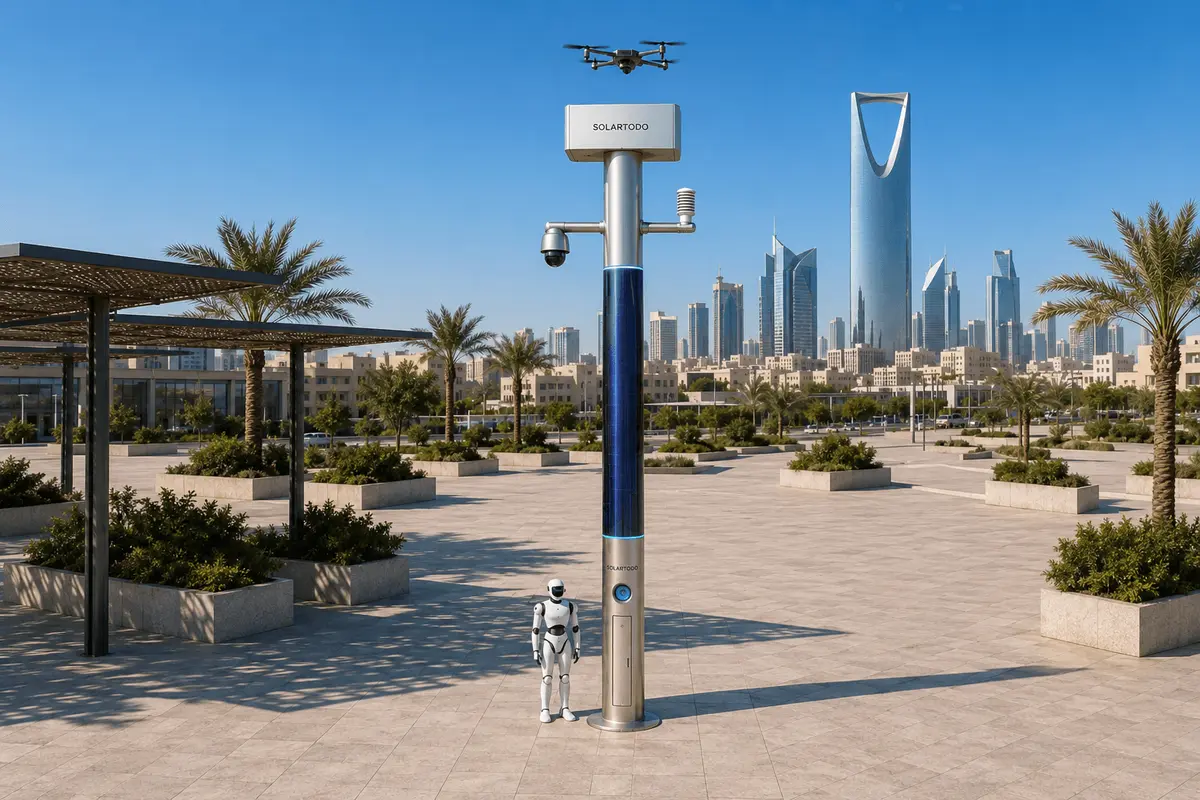
A City AI Pole is a non-lighting physical-AI edge node that combines on-pole sensing, compute, energy storage, drone operations and robot coordination. In this Bangkok port-side deployment, SOLARTODO Sentinel Sky Hub forms a fully off-grid grid-mesh for night response during major events, processing raw data locally and sharing only de-identified status metadata.
1. Bangkok Port-Side Operating Context
For a Bangkok port-side industrial park operator, the major-event problem is not ordinary patrol volume; it is compression. A public event, trade fair, cruise-related peak, emergency drill, or regional sports movement can push truck gates, visitor flows, contractor activity, waterside boundaries and service roads into the same night window. During Thailand’s heatwave season, the pressure becomes sharper: more night work is scheduled to avoid daytime heat, fatigue rises, and manual security patrols can become slower exactly when the operator needs faster confirmation.
This proposed case study frames SOLARTODO Sentinel Sky Hub as a city-ai-pole deployment for a port archetype, not as a lighting asset. Each Sky Hub is a pure smart pole with no lighting system. It is a physical-AI urban edge node intended for smart districts, campuses, industrial parks, ports, perimeters and critical-infrastructure zones where sensing, edge inference, drone operations and ground robot operations must be coordinated locally.
The stakeholder in this scenario is the park operator responsible for tenant continuity, perimeter safety, event-night access control support, contractor movement visibility and evidence-grade incident logs. The target KPI is labor replacement in repetitive inspection work: reducing the number of manual night patrol rounds that must be physically walked or driven, while keeping human supervisors in charge of assessment and authorized response. The deployment is presented as a proposed configuration subject to final engineering confirmation, not as a claim of achieved Bangkok results.
2. Grid-Mesh Deployment Plan
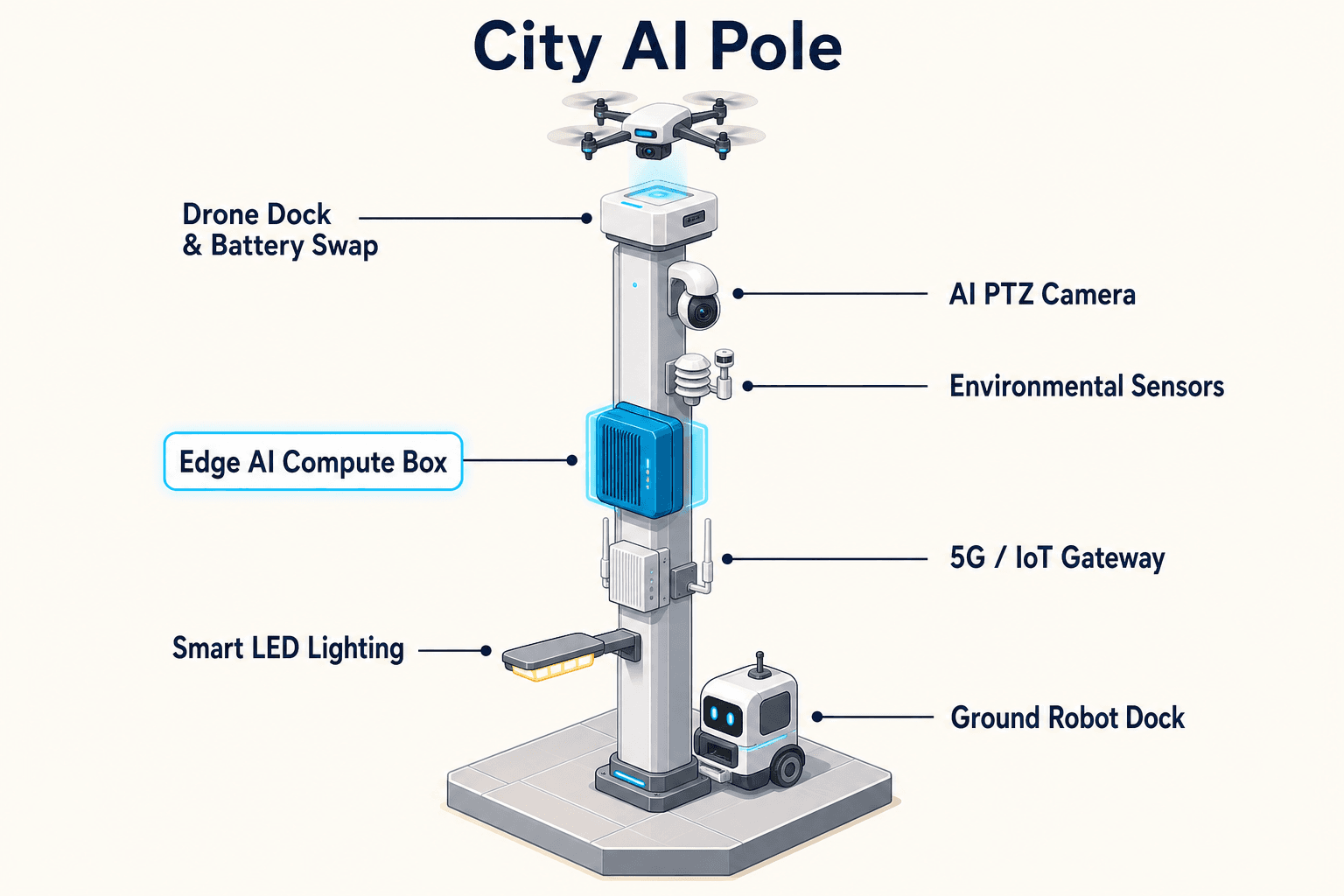
The proposed deployment mode is a grid-mesh of Sky Hub nodes placed at operating choke points: port-park gate approaches, container-yard edges, utility corridors, waterside service roads, temporary event parking approaches, contractor muster areas and blind perimeter corners. The mesh is planned so each node can act locally first, then share de-identified event and status metadata with the common-operating-picture command view. Raw video and raw sensor streams stay on the pole and are processed locally.
The mesh design supports the operations loop known as sensing, authorized assessment and response, edge-compute scheduling, and field operations and maintenance. In practical terms, the pole detects an anomaly, classifies it locally, presents a scored event to the command view, waits for human authorization where response is regulated or operationally sensitive, then coordinates drone, robot or maintenance action. This separation matters in a port environment where a false alarm can interrupt gate throughput, but a missed intrusion or delayed heat-stress response can create safety exposure.
Each node is fully off-grid, using battery storage and a 360-degree wrapped flexible CIGS thin-film solar replenishment layer. The Bangkok plan should not be read as unlimited solar independence. The pole carries about 15 square meters of vertical wrapped CIGS over an approximately 8 meter tall, 0.6 meter-wide cylindrical body, with about 2.4 to 2.7 kWp nameplate. Because the sun-facing projection, not the whole wrap, produces the useful direct-sun peak, high-irradiance clear-sky output is realistically about 0.8 to 1.1 kW DC peak and about 6 to 9 kWh per day in a strong solar region. Battery storage in the 5 to 20 kWh class buffers high-power drone and robot tasks, with OTATODO scheduling duty cycles by mission priority, state of charge and heatwave operating conditions.
3. Drone-Nest Night Response Workflow
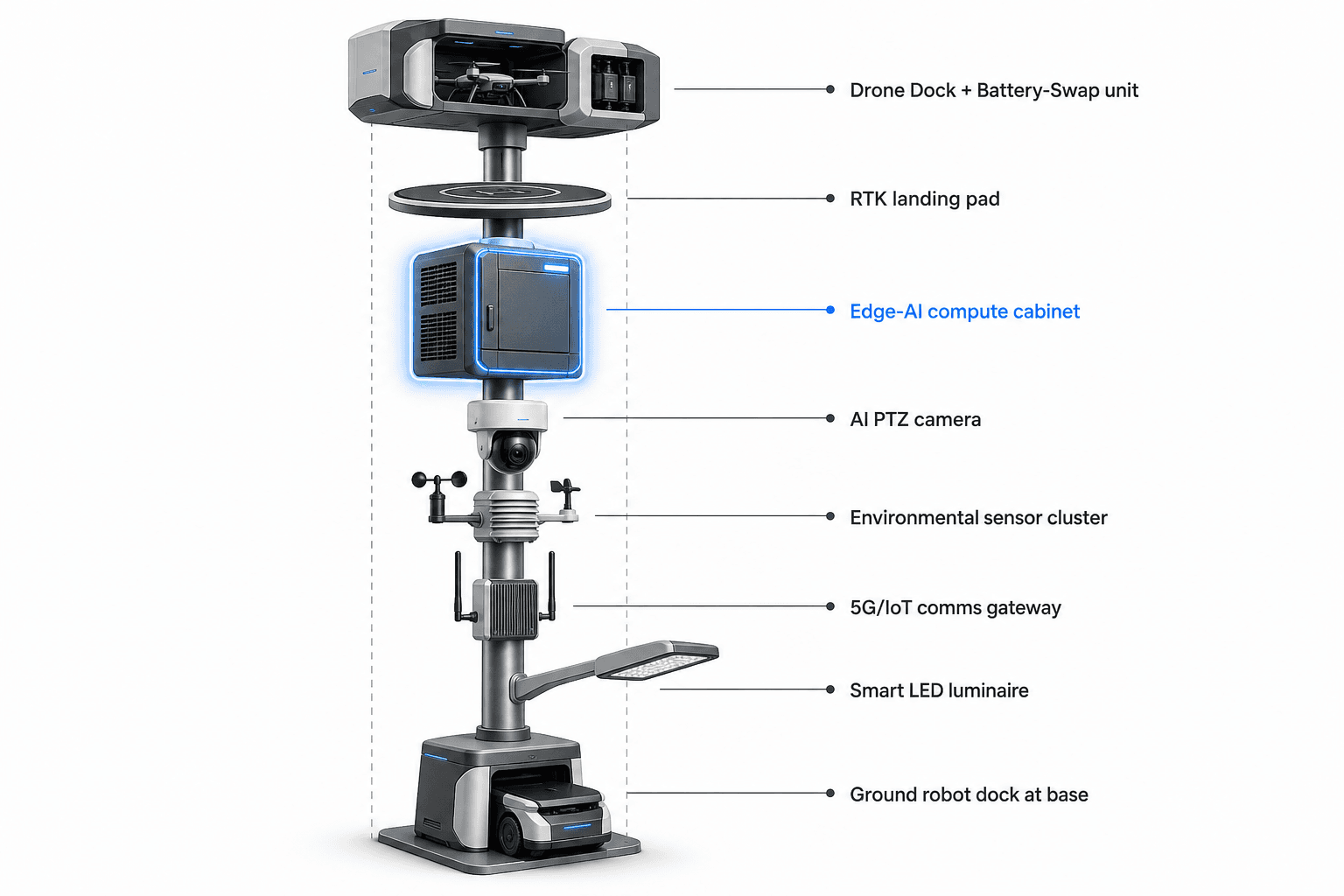
The module focus for this Bangkok scenario is the drone nest. During a major-event night, the operator needs rapid eyes-on confirmation without dispatching a guard team to every perimeter alert. A Sky Hub drone operation starts with local sensing: a PTZ camera and environmental package detect movement patterns, crowd density shifts, access-lane congestion, noise spikes, wind conditions or intrusion cues. The on-pole edge module classifies the situation and schedules the next workload without exporting raw feeds.
When the command view flags a high-priority event, an authorized supervisor can task a friendly drone from the node. The drone launches for regional patrol, inspection, return and task redeployment with no operator stationed at the pole. The drone operations management layer handles route planning, task queueing, charge and swap state transitions, fleet health and mission logs. After landing, a multi-bay rear-service battery magazine performs automated battery hot-swap, giving the aircraft a charged pack and allowing several consecutive sorties where the operating plan and stored energy budget permit.
This workflow changes the labor model. A manual night patrol often consumes time in travel, access coordination and low-yield visual checking. The proposed Sky Hub approach makes the first response an edge-computed decision and aerial verification task. Human teams can then be reserved for confirmed interventions, escort duties, maintenance and authority-led response. The KPI is therefore not a claimed detection rate; it is a planning target: how many routine patrol rounds, follow-up checks and long-distance perimeter confirmations can be shifted from manual movement to automated drone-nest sorties under human supervision.
4. Edge Computing, Robots And C-UAS Coordination
The edge-computing pillar is what keeps the port-park workflow credible. A Jetson-class Orin- or Thor-class edge module runs local inference and workload scheduling on the pole. Video analytics are constrained to anonymous vehicle count, crowd density, intrusion and perimeter awareness. Face recognition and licence-plate recognition are not described as active deployed capabilities in this configuration. Raw video and sensor data stay on the pole; only de-identified event summaries, status metadata, logs and health signals may leave the node according to policy.
Ground robot operations complement the drone nest. A humanoid or service robot can patrol a defined route, inspect a gate queue, respond to an alarm, coordinate with the drone’s aerial view and return to the pole base for wireless charging. The robot is not positioned as a replacement for authority or site management judgment. It is an operational asset for repetitive inspection, heat-stress avoidance and confirmation tasks that would otherwise consume night-shift labor.
For unauthorized drones near a major event perimeter, the node supports C-UAS coordination within strict boundaries. The pole can detect and track an unauthorized drone using its own sensors and optional partner-sensor inputs, including radar only if provided externally. Radar is not built into the pole. Any mitigation is non-kinetic and human-authorized: the node may command its own friendly drone for soft aerial net-capture or close-approach deterrence under approved rules of engagement. The system is not a weapon, does not jam RF or GNSS, and does not autonomously attack targets.
5. Operator Evaluation Plan
A credible park-operator evaluation should measure whether the grid-mesh reduces avoidable manual night work while improving response discipline. The baseline is the operator’s current event-night patrol plan: number of guard rounds, vehicle kilometers within the park, perimeter checks, gate-support escalations, incident confirmation trips and supervisor review time. The proposed Sentinel Sky Hub plan then assigns which checks can be performed by local edge sensing, which require drone verification, which can be handled by a ground robot, and which still require a human team.
The common-operating-picture command view becomes the evaluation anchor. It should show node health, battery state, drone battery magazine status, environmental readings, mission queue, patrol evidence, event score, authorization state and maintenance tickets. Heatwave triggers should be explicit: when temperature, humidity and workload exceed the operator’s threshold, the schedule should favor remote verification and autonomous inspection before sending personnel into low-yield checks.
For governance, the operator should document data handling as PDPL/LGPD-oriented by design: local processing, de-identification, export policy, audit logs and role-based access. This wording is deliberate. It supports compliance planning but does not claim certification. The decision to proceed should remain subject to final engineering confirmation of mounting, wind load, local solar yield, battery sizing, communication resilience, permitted air operations, robot route safety and the authority model for any regulated response. The result is an ops-plan case: a proposed city-ai-pole grid-mesh for Bangkok port-side major-event night response, evaluated by labor replacement targets and operating evidence rather than unsupported rollout claims.
System Configuration
| Parameter | Configuration |
|---|---|
| Deployment mode | Grid-mesh of fully off-grid Sky Hub physical-AI edge-node poles for port-side perimeter, gate and service-road coverage planning |
| Energy system | ~15 m² vertical 360° wrapped flexible CIGS replenishment, ~2.4-2.7 kWp nameplate, 5-20 kWh-class battery storage |
| Drone nest | Autonomous launch, return, route tasking and rear-service multi-bay battery hot-swap for consecutive event-night sorties |
| Edge AI compute | Jetson-class Orin- or Thor-class on-pole inference and workload scheduling; raw data processed locally |
| Security sensing | AI PTZ for anonymous vehicle count, crowd density, intrusion cues and perimeter awareness |
| Environmental package | Wind speed, wind direction, temperature, humidity, atmospheric pressure, noise, PM10, PM2.5 and illuminance |
| Robot interface | Ground robot patrol coordination with pole-base wireless charging and air-ground task handoff |
How It Works
- On-pole PTZ and environmental sensors flag a night-event anomaly.
- Edge AI classifies the event and assigns priority without exporting raw video.
- The command view presents location, score, node health and recommended response.
- A human supervisor authorizes drone launch, robot dispatch or manual follow-up.
- The drone or robot performs inspection, returns, recharges or swaps battery, and files mission metadata.
- The operator reviews de-identified logs against labor-replacement and response-time planning metrics.
Planning Assumptions (Indicative)
Illustrative planning inputs a buyer can recompute — target metrics, not achieved results. Subject to final engineering confirmation.
| Metric | Planning assumption | Indicative value |
|---|---|---|
| Inspection labor | Drone patrol replaces routine manual night perimeter checks during event windows | ~20-40 checks/week automated as a planning target |
| Supervisor workload | Edge-scored alerts reduce low-priority video review and radio confirmation tasks | ~30-50% fewer manual triage actions targeted |
| Heatwave exposure | Remote verification is prioritized when temperature and humidity exceed operator thresholds | ~10-20 personnel dispatches/week avoided as a planning input |
| Drone continuity | Multi-bay battery hot-swap supports repeated sorties before manual battery service is needed | ~3-6 consecutive sorties per node planned by duty cycle |
| Robot utilization | Ground robot covers short repetitive inspection loops from the pole base | ~2-4 patrol loops/night per active node targeted |
Deployed Equipment
- SOLARTODO Sentinel Sky Hub non-lighting physical-AI edge-node pole
- 360° wrapped flexible CIGS thin-film solar replenishment layer
- 5-20 kWh-class battery storage and power management cabinet
- Drone nest with autonomous landing interface and multi-bay hot-swap battery magazine
- AI PTZ sensing package
- Nine-parameter environmental monitoring package
- Jetson-class edge compute module running OTATODO
- Ground robot wireless charging interface at pole base
Frequently Asked Questions
Is Sky Hub a lighting product for Bangkok roads?
No. In this proposed Bangkok port-side configuration, Sky Hub is a pure smart pole and physical-AI edge node with no lighting system. Its role is to host sensing, edge compute, energy storage, drone-nest operations, ground robot coordination and operator workflows for port-park response, not to provide illumination.
Does the fully off-grid design mean the pole can run unlimited drone and robot missions from solar alone?
No. The pole is designed as a fully off-grid micro-station using battery storage plus on-pole CIGS replenishment, but the vertical solar wrap is a supplemental replenishment layer. High-power drone and robot tasks are buffered by 5-20 kWh-class storage and scheduled by duty cycle, weather and mission priority.
What data leaves the pole during normal operations?
The operating model is designed for local processing. Raw video and sensor data stay on the pole, where edge inference classifies events and prepares logs. Only de-identified event metadata, status information, health signals and mission records may leave the node according to policy, supporting PDPL/LGPD-oriented deployment planning without claiming certification.
How does the drone battery hot-swap change night-response staffing?
The multi-bay battery magazine lets a landed drone receive a charged pack through automated rear-service exchange and relaunch for another sortie, where the duty cycle allows. For a park operator, that shifts repetitive perimeter confirmation from manual patrol movement to authorized aerial inspection, reserving personnel for confirmed interventions and complex decisions.
Can the system respond to unauthorized drones near a major event?
It can support detection, tracking and coordination, but mitigation remains non-kinetic and human-authorized. The node may command its own friendly drone for soft aerial net-capture or close-approach deterrence under approved rules. It does not perform autonomous attacks, hard-kill actions, RF/GNSS jamming or denial.
What should a Bangkok park operator verify before procurement?
The operator should confirm mounting constraints, wind loading, salt and humidity exposure, actual solar yield, battery sizing, permitted drone operations, robot route safety, communications resilience, data-governance policy and the authorization model for regulated response. The case study is an illustrative planning configuration, subject to final engineering confirmation.
Explore Further
- City AI Pole / smart streetlight product line
- More smart-city deployment cases
- Talk to our engineering team
Planning a similar physical-AI deployment for streets, campuses or public spaces? Request an engineering consultation