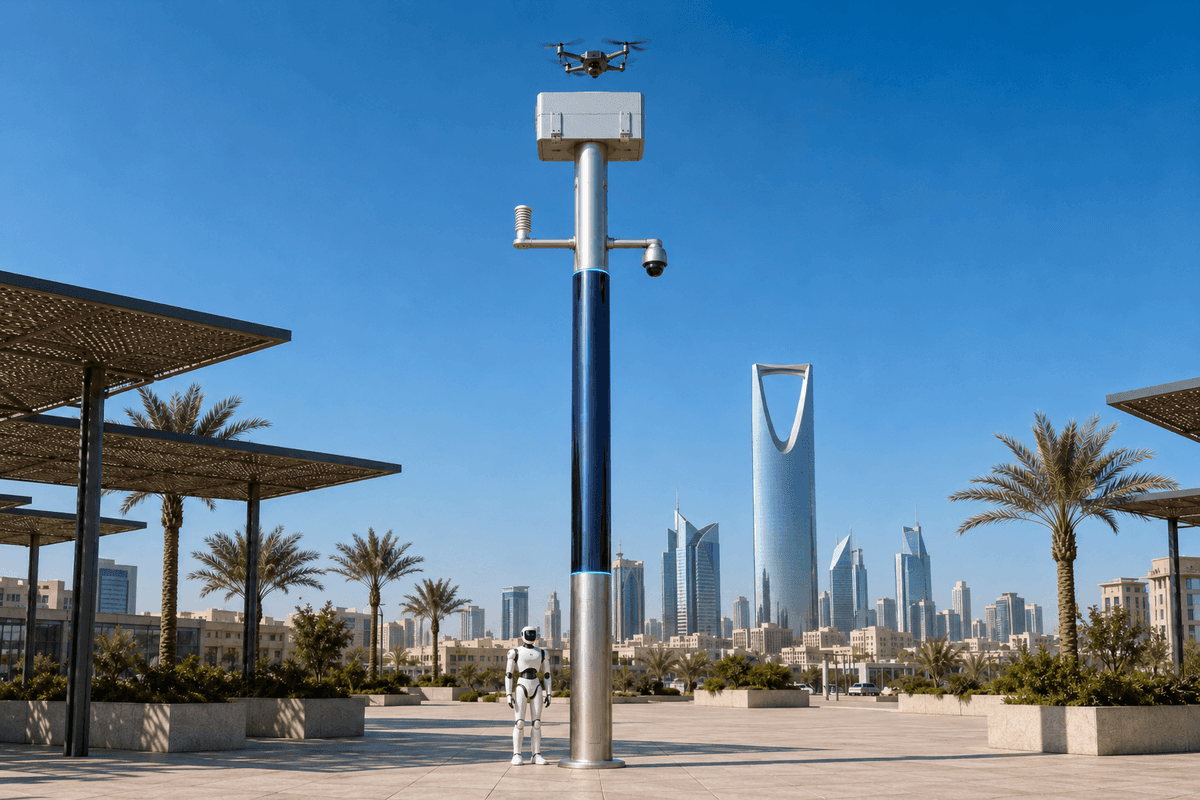
A City AI Pole is a non-lighting physical-AI edge node that combines off-grid energy, local sensing, edge compute, drone operations and ground robot support in one urban pole. In this Bangkok industrial-park case, SOLARTODO Sentinel Sky Hub monitors a river-cross-section night-patrol zone and coordinates human-authorized field response from a common operating picture.
Procurement Context: Bangkok Industrial Park Night Response
For a Bangkok industrial-park operator, night response is not a single security task. It includes perimeter awareness, worker-safety checks, warehouse-yard inspection, storm and heatwave monitoring, quay-side observation, and response coordination across roads, canals and river-facing assets. In an industrial zone near the Chao Phraya or connected khlong corridors, the operator may need to watch both land-side movement and water-adjacent access points without adding fixed power works at every location. This procurement case frames SOLARTODO Sentinel Sky Hub as a proposed physical-AI pole configuration for that problem: a fully off-grid, battery-backed edge node placed at selected cross-section points between gate, road, yard, utility corridor and river-facing boundary. The buyer is the park operator, not a public works department. The KPI frame is opex: fewer avoidable manual patrol rounds, faster triage of night alarms, fewer unnecessary dispatches during heatwave conditions, and clearer event records for contractors, tenants and internal security teams. The configuration is subject to final engineering confirmation, including foundation design, solar exposure, drone flight permissions, local safety review and site-specific communications planning.
Deployment Mode: River-Cross-Section Pole Network
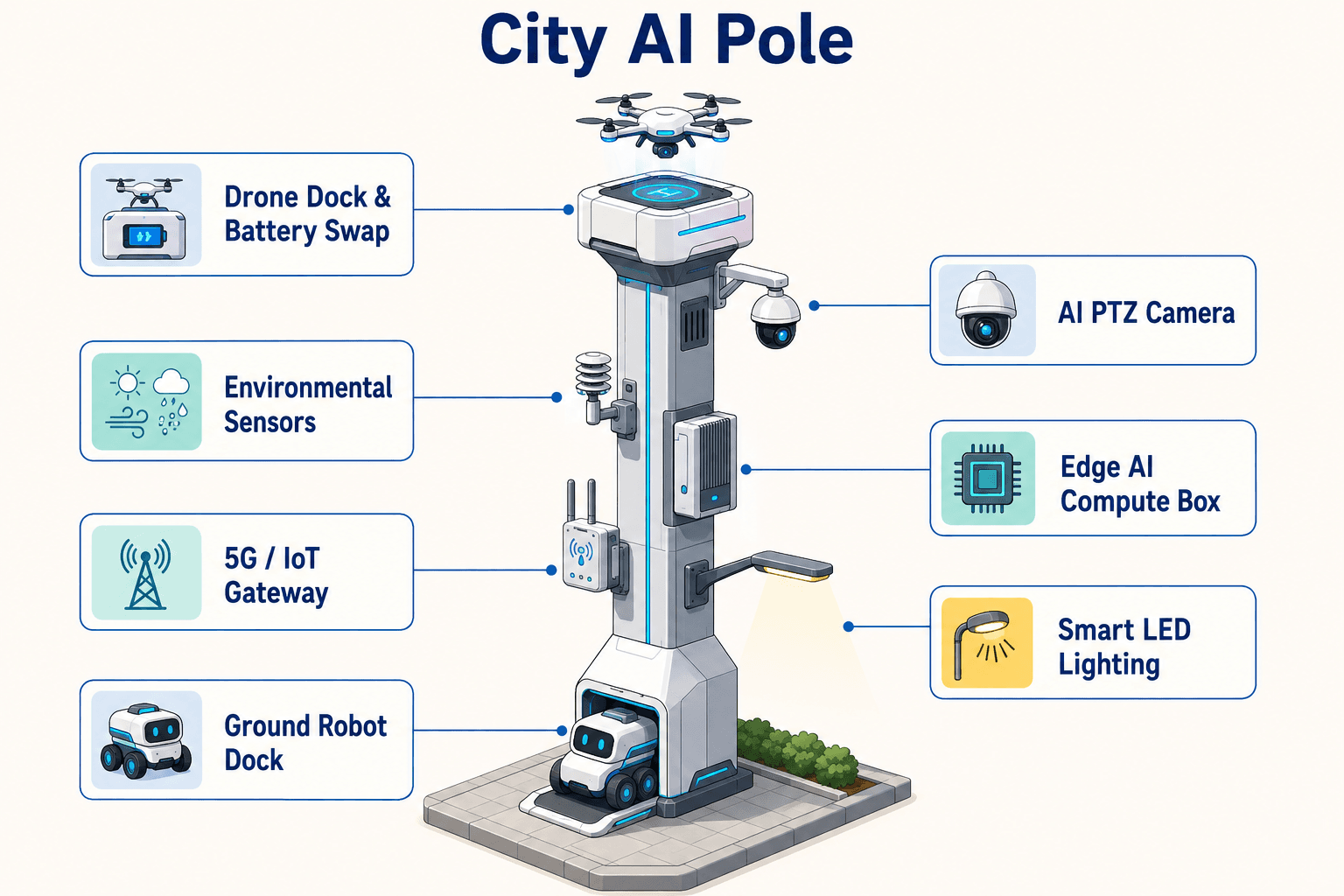
The proposed deployment uses a river-cross-section pattern rather than a uniform citywide grid. Each Sky Hub pole is positioned where multiple operational layers intersect: the park boundary, internal logistics road, drainage or canal edge, river access, utility corridor, storage yard or security checkpoint. This gives the operator a practical night-patrol fabric without inventing broad rollout claims or fixed coverage numbers. Each node acts as a local edge station. It runs anonymous vehicle count, crowd density, intrusion and perimeter awareness on pole; reads the nine environmental channels; schedules drone sorties; coordinates ground robot patrol and return-to-base wireless charging; and reports de-identified status or event metadata to a common operating picture. The system is not designed as a passive camera point. A night anomaly can be assessed locally, scored, routed for human authorization, and then handed to a field asset. A drone can launch for overhead inspection, return, receive an automated rear-service battery exchange from a multi-bay battery magazine, and redeploy for consecutive sorties. A humanoid or service robot can patrol ground-level paths, inspect access doors or respond to an alarm, then return to the pole base for wireless charging.
Weather-Sensor Focus During Heatwave Operations
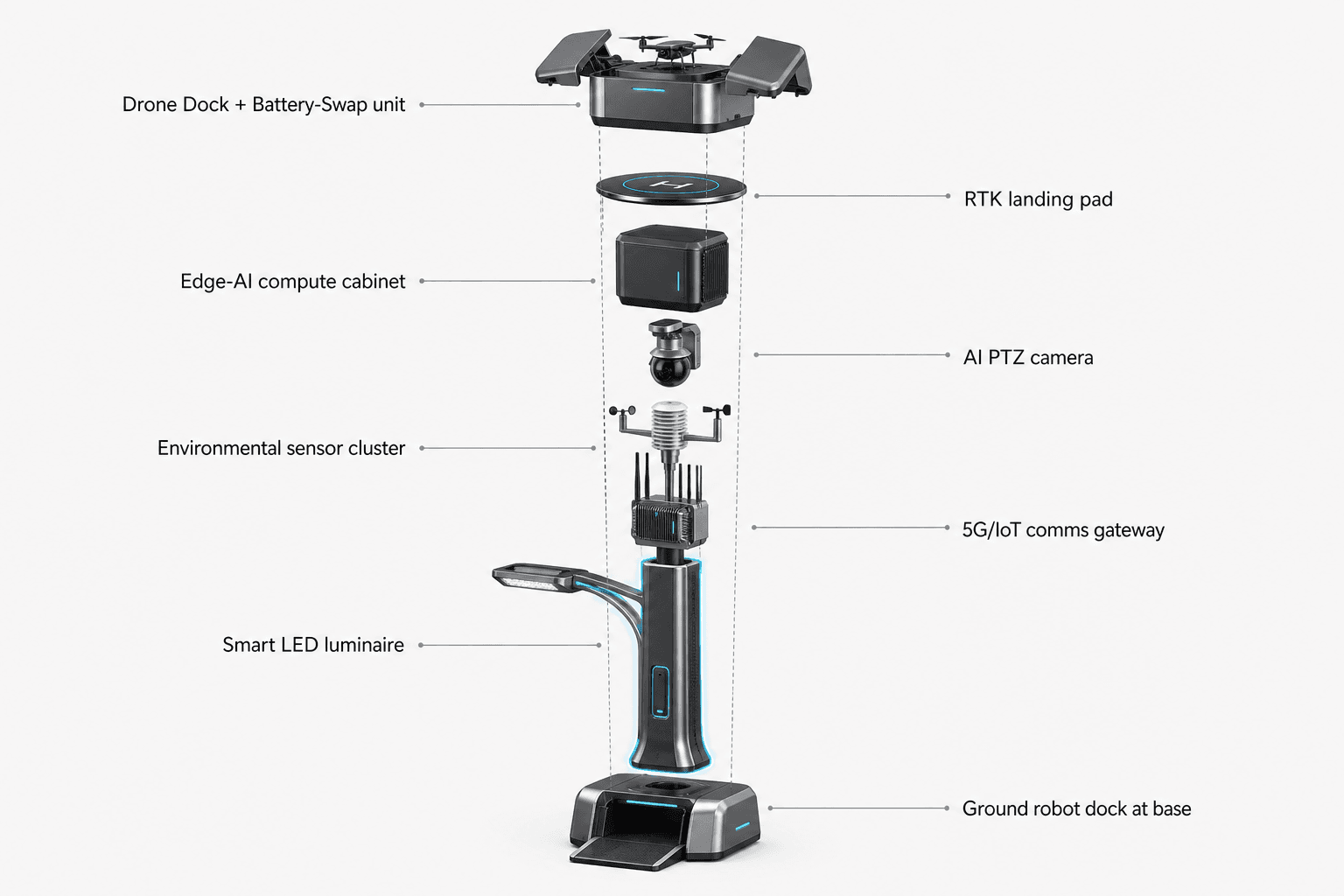
Bangkok heatwave conditions change how night response should be planned. High evening temperatures, humidity, low wind, noise events and airborne particulates can affect guard endurance, contractor work windows, equipment yards and tenant complaints. The weather-sensor module is therefore treated as an operating input, not an accessory. The Sky Hub environmental package measures wind speed, wind direction, temperature, humidity, atmospheric pressure, noise, PM10, PM2.5 and illuminance. In the common operating picture, those readings help the park operator decide when a manual check is necessary, when an autonomous drone or ground robot can reduce human exposure, and when a tenant-facing incident should be documented with environmental context. The same sensor package also supports drone and robot scheduling. Strong wind or poor particulate conditions can change sortie priority, return timing or maintenance inspection routing. Edge compute on the pole schedules workloads locally so weather readings, camera events, battery state and mission queues are interpreted together. Raw video and raw sensor streams stay on the pole for local processing; only de-identified event and status metadata may leave the pole. The data posture is PDPL/LGPD-oriented by design, supporting local processing and minimization without claiming certification.
Operations Loop: Sense, Decide, Act, Record
The operating model follows a practical sensing to response loop: sensing, authorized assessment and response, edge-compute scheduling, and field operations and maintenance. A PTZ camera and local perception identify anonymous night anomalies such as unexpected movement near a river-facing boundary, a crowd-density change near a gate, a vehicle-count deviation in a logistics lane, or a perimeter event after tenant operating hours. The on-pole edge module classifies the event, checks weather and power state, and presents a recommended response in the common operating picture. A human operator authorizes the action. The pole then coordinates the relevant field asset: drone launch for overhead patrol, drone return and hot-swap for another sortie, ground robot patrol for close inspection, or a maintenance task when the event is environmental or equipment-related. Counter-UAS coordination follows the same human-authorized principle. The pole detects and tracks an unauthorized drone using its available sensing inputs and may also ingest optional partner-sensor information. Radar is not built into the pole. When authorized, the node can command its own friendly drone for non-lethal soft aerial net-capture or close-approach deterrence. No autonomous attack, denial technique or destructive response is part of this case.
Opex Evaluation and Procurement Fit
The procurement logic is to evaluate whether a small number of strategically placed physical-AI poles can reduce recurring night-response cost while improving documentation quality. The buyer should not evaluate Sky Hub as a product datasheet or as a claim of unlimited energy autonomy. The pole is a fully off-grid micro-station with battery storage and approximately 15 square meters of 360-degree wrapped flexible CIGS thin-film solar on a vertical cylindrical body about 8 meters tall and 0.6 meters wide. Nameplate capacity is approximately 2.4 to 2.7 kWp, but vertical cylindrical collection is governed by sun-facing projection, not the full wrap at once. In a high-irradiance region, realistic clear-sky output is roughly 0.8 to 1.1 kW DC peak, usually peaking mid-morning or mid-afternoon rather than noon, and about 6 to 9 kWh per day. Bangkok engineering should be confirmed against local shading, monsoon season, maintenance access and operating duty cycle. The solar layer replenishes a 5 to 20 kWh-class storage buffer; high-power drone and robot tasks are scheduled by duty cycle. Procurement acceptance should focus on target metrics: manual patrol substitution, alarm triage rate, autonomous sortie availability, weather-aware dispatch reduction and event-record completeness.
System Configuration
| Parameter | Configuration |
|---|---|
| Pole form | SOLARTODO Sentinel Sky Hub, non-lighting PURE smart pole with sensing, compute, energy, drone and robot operations |
| Energy system | Fully off-grid battery-backed micro-station with 360-degree wrapped flexible CIGS thin-film replenishment and 5-20 kWh-class storage |
| Environmental monitoring | Wind speed, wind direction, temperature, humidity, atmospheric pressure, noise, PM10, PM2.5 and illuminance |
| Edge AI compute | Jetson-class on-pole inference and workload scheduling cabinet; raw video and sensor data processed locally |
| Camera and sensing | AI PTZ for anonymous vehicle count, crowd density, intrusion and perimeter awareness |
| Drone and robot operations | Autonomous drone launch, route tasking, return, rear-service battery hot-swap, plus ground robot patrol and wireless charging at pole base |
| Command view | Common operating picture for event metadata, mission logs, fleet health, weather state and human authorization |
How It Works
- On-pole sensing flags a night anomaly at a river-facing industrial-park boundary.
- Edge AI classifies the event, checks weather state, battery state and mission queue priority.
- The COP presents a recommended response and waits for human authorization.
- The pole commands a drone sortie, ground robot patrol or maintenance task after approval.
- The node records de-identified event metadata, mission status, weather context and closure notes.
Planning Assumptions (Indicative)
Illustrative planning inputs a buyer can recompute — target metrics, not achieved results. Subject to final engineering confirmation.
| Metric | Planning assumption | Indicative value |
|---|---|---|
| Inspection labor | Night drone and robot patrols substitute selected routine manual rounds in the river-cross-section zone | ~10-20 patrol rounds/week targeted for automation |
| Alarm triage | Edge classification filters low-priority night anomalies before dispatching a guard or maintenance contractor | ~30-50 events/week reviewed as metadata first |
| Heatwave exposure | Weather-aware scheduling shifts some ground checks to autonomous assets during high heat and humidity windows | ~3-5 high-exposure checks/night targeted for remote or robotic handling |
| Drone continuity | Multi-bay hot-swap supports consecutive night sorties before manual battery service is needed | ~3-6 consecutive sorties per operating window planned |
| Record quality | COP logs link event type, authorization, weather context, sortie record and closure status | ~100% of authorized responses targeted for structured logging |
Deployed Equipment
- SOLARTODO Sentinel Sky Hub off-grid pole body
- Flexible CIGS thin-film solar wrap and battery storage system
- AI PTZ camera with local perception processing
- Nine-channel environmental monitoring package
- On-pole Jetson-class edge compute cabinet
- Autonomous drone operations bay with multi-bay battery hot-swap magazine
- Ground robot wireless charging base
- COP command-view software for park-operator control room
Frequently Asked Questions
Is this case claiming a completed Bangkok rollout?
No. This is a proposed and illustrative procurement configuration for a Bangkok industrial-park operator. It does not claim achieved results, named customers, deployment quantities, coverage area, certifications, awards or measured performance. Final node count, siting, communications, permissions and acceptance metrics would require engineering confirmation and buyer-side procurement review.
How does Sky Hub reduce night-response opex for a park operator?
The opex case comes from shifting selected routine patrols, first-look inspections and low-priority alarm triage from manual dispatch to local edge assessment, drone sorties and ground robot patrol. The buyer should evaluate target inputs such as automated patrol rounds, avoided unnecessary dispatches, event documentation quality and contractor response time, rather than treating the configuration as a guaranteed savings result.
Why is the weather-sensor package important in Bangkok?
Heat, humidity, wind, pressure, particulate levels, noise and illuminance affect night operations in industrial parks, especially during heatwave periods and storm-prone seasons. The nine-channel environmental package helps operators decide when to dispatch people, when to use a drone or ground robot, and how to attach environmental context to incident records and tenant communications.
Does raw video leave the pole?
The intended data architecture keeps raw video and raw sensor data on the pole for local processing. The common operating picture receives de-identified event and status metadata such as event type, score, weather context, asset state and closure status. This is a PDPL/LGPD-oriented design posture for local processing and minimization, not a claim of formal certification.
How is the pole powered if it is fully off-grid?
The pole uses battery storage with on-pole flexible CIGS thin-film solar replenishment. The vertical wrap has about 15 square meters of solar surface and approximately 2.4 to 2.7 kWp nameplate, but practical output depends on sun-facing projection, shading and weather. High-power drone and robot tasks are buffered by 5 to 20 kWh-class storage and scheduled by duty cycle.
What happens if an unauthorized drone is detected?
The pole can detect and track an unauthorized drone using available sensing inputs, with optional partner-sensor data if integrated. Any mitigation is human-authorized and non-lethal. The node may command its own friendly drone for soft aerial net-capture or close-approach deterrence. The case excludes destructive responses, denial techniques and autonomous attack behavior.
Explore Further
- City AI Pole / smart streetlight product line
- More smart-city deployment cases
- Talk to our engineering team
Planning a similar physical-AI deployment for streets, campuses or public spaces? Request an engineering consultation