
Summary
For the proposed Barcelona pilot of the SOLARTODO classic twin-arm bronze smart streetlight, choose Power over Ethernet (PoE) for the auxiliary module only if the supplier confirms support for the exact offered module and the proposed switch-and-cable configuration passes startup, simultaneous port loading, and power-cycle recovery tests. If PoE support remains unconfirmed or the configuration fails those tests, evaluate a supplier-supported separate supply. If evidence is missing for both options, defer the power decision. Barcelona is solely the proposed site for this evaluation. The source pack provides insufficient evidence to select either architecture today and contains no product PDF URL or page references.
Key Takeaways
- Obtain the exact module revision and a written list of its Ethernet interfaces and supported power inputs.
- Map the proposed cable route and document every termination and connection before the bench test.
- For a PoE offer, check startup margin against the supplier’s limits at the module and at the switch.
- Start the planned switch-port group together and observe the auxiliary module and neighboring ports.
- Time recovery through the first verified application function after restoring power.
- Select an architecture only after the supplier-approved configuration meets the agreed acceptance criteria.
Proposed problem
For the proposed Barcelona pilot, compare PoE and separate power only after the supplier confirms Ethernet support for the exact auxiliary module offered. The question assumes Ethernet capability for that module, while the supplied catalog record identifies modular communications and control as options and leaves the specific Ethernet interface and power inputs undocumented. Ask the supplier to confirm which module the offer covers and whether it supports power through its Ethernet connection, a separate input, or both. Make the decision for that offered hardware revision and its intended cable path.
Treat the auxiliary power choice as a distinct item on the wiring schedule. Ask the supplier to identify which connections belong to the module and which serve other functions shown in the catalog. This lets the procurement team specify which loads are represented in the switch test and which documents govern the rest of the assembly. It also puts the effect of switch maintenance on the module into the comparison with a separately powered configuration.
Source-backed product boundary
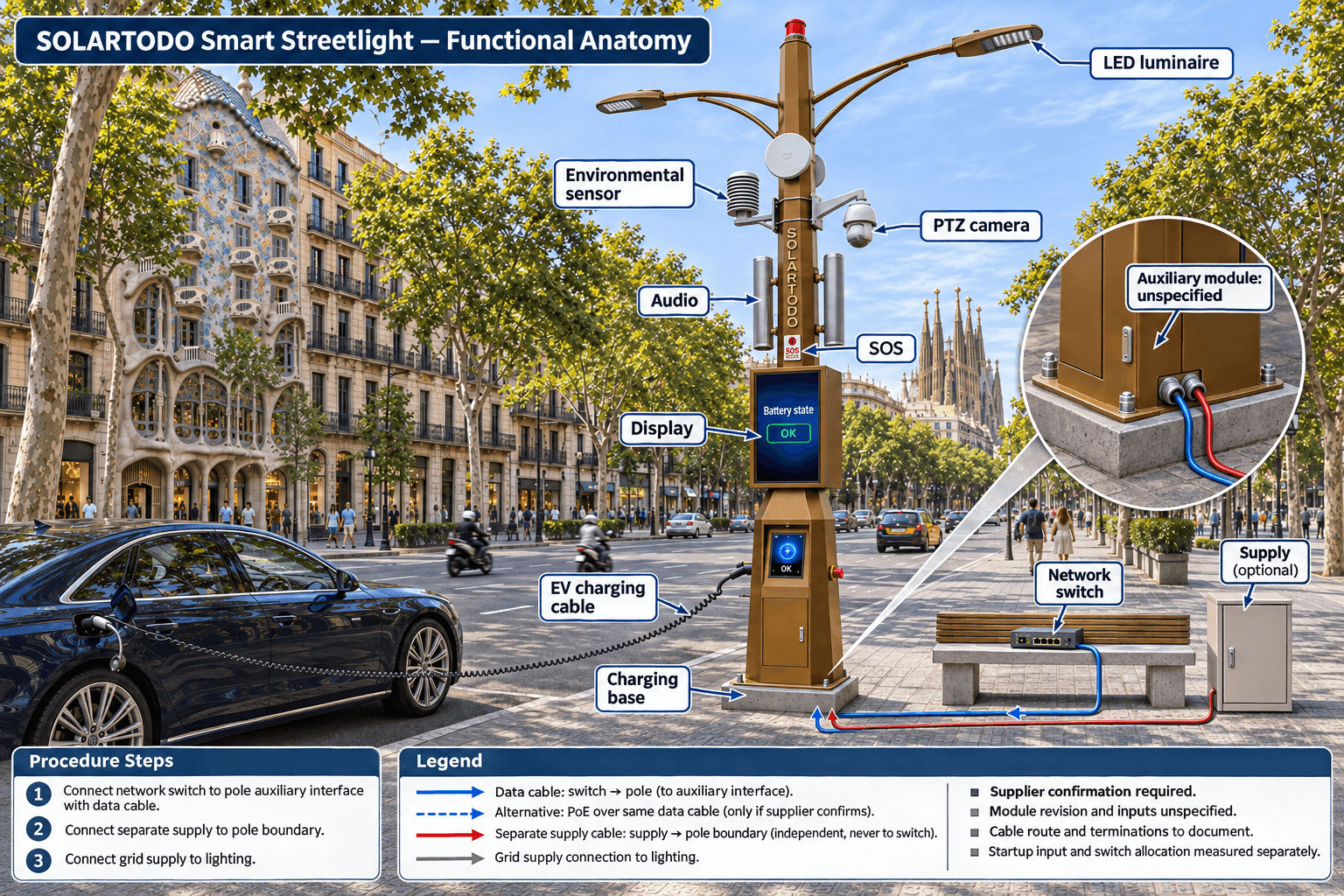
The catalog extraction city-catalog-2026-11-01-v1 describes the SOLARTODO classic twin-arm bronze smart streetlight as having a bronze polygonal pole and two curved luminaire arms. The bound catalog appearance shows a PTZ camera, environmental sensor, display, audio/SOS, and an integrated EV charging base. Grid-fed lighting and modular communications and control are catalog options. The appearance record does not identify which component would serve as the offered auxiliary module. SOLARTODO smart streetlight product family
The catalog establishes appearance and option scope for this model. The source pack omits a product PDF, page numbers, module-level electrical specifications, and supported operating conditions for either power configuration. It also provides no basis for numerical dimensions, a charging rate, compliance claims, or an installed-project result. Obtain the applicable PDF for the exact offered module revision. Use its model, page, and operating-condition details as the authority for product specifications wherever descriptions differ. [SOLARTODO public catalog] (https://solartodo.com/products/smart-streetlight)
Proposed design
Ask the supplier for a connection diagram and input specification for each offered architecture. In either case, mark the module’s data interface, the network endpoint, and the boundary between the module and the rest of the streetlight. For PoE, identify the supported switch-side power configuration, the module’s input requirements for startup and steady operation, and any documented cabling or termination conditions. For separate power, identify the approved supply, the module-side input and connector, and the intended relationship between data-link interruptions and power interruptions. Include the wiring arrangement if the module has both kinds of power input and ask how they may be used.
Startup margin. Use the proposed cable run or a documented bench equivalent that reproduces its relevant characteristics. Identify the measured point and record the startup trace using a supplier-approved measurement method. Compare the lowest observed module input during startup with the supplier’s minimum for the relevant operating condition, where that measurement is available. If the supplier specifies margin through another quantity, use the documented quantity and method. Record the switch-side allocation and the observed startup demand separately so the buyer can assess both the module input and the source budget. Where the equipment exposes only summary data, document the visibility and ask the supplier what evidence can establish the missing margin.
Simultaneous port loading. Run a single-module startup as a diagnostic baseline, then populate the switch with the loads planned for its shared power budget. Restore power in the intended group-start scenario. Record port allocations, any port denials or resets, the module’s readiness, and whether neighboring ports recover as intended. Ask the supplier to document any relied-upon startup sequencing or port priorities. Keep the test switch configuration with the results, since the procurement decision applies to the tested configuration.
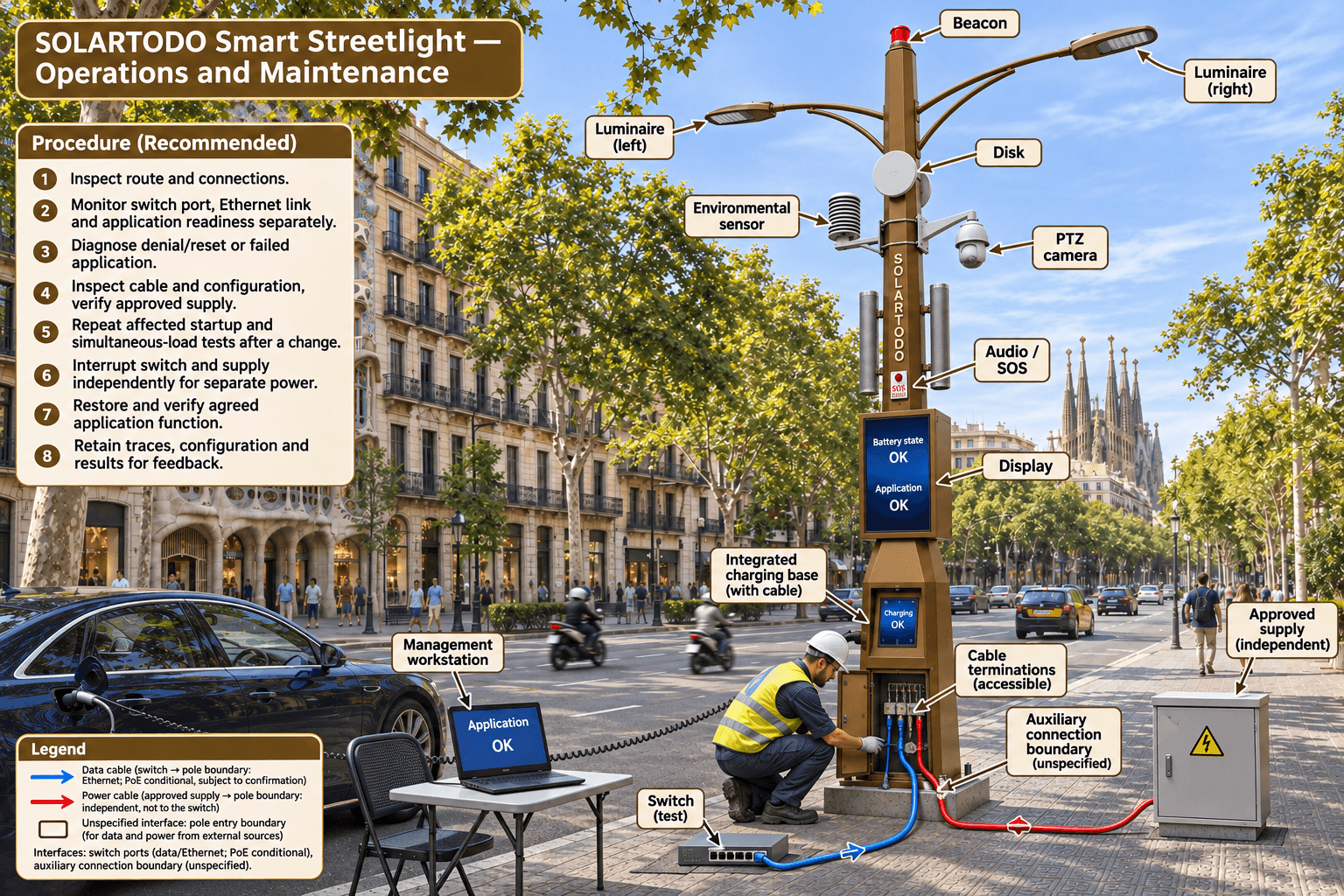
Power-cycle recovery. Measure elapsed time from the defined restoration event to completion of an agreed application function. Capture port state, Ethernet link state, and application readiness as separate timestamps. Choose the function after the supplier identifies what the module does and how it exposes a successful transaction. If separate power is offered, exercise supply interruption and switch interruption individually as well as the restoration sequence relevant to the design. That comparison gives the buyer evidence about what each architecture does during maintenance and on return to service. The U.S. Department of Energy’s connected-lighting research provides test-bed context for examining network infrastructure and electrical performance under varying power conditions. DOE Connected Lighting Systems
Explicitly hypothetical measurable evaluation assumptions
These draft criteria are for buyer and supplier review before testing. Record the supplier’s limits and their operating conditions separately in the protocol.
Hypothetical evaluation assumption: The acceptance test uses a cable path matching the surveyed end-to-end length and documented connection layout.
Hypothetical evaluation assumption: The startup test uses ten cold starts after the supplier-defined off interval.
Hypothetical evaluation assumption: Every startup meets the supplier-documented minimum input requirement throughout the declared startup measurement window.
Hypothetical evaluation assumption: The simultaneous-start test includes every port in the documented pilot load plan and records zero unplanned power denials or resets during the observation window.
Hypothetical evaluation assumption: The auxiliary module completes the agreed application function within 120 seconds of the defined power-restoration event on each of ten recovery trials.
Survey and acceptance checklist
- Survey the route. Record the intended switch and module endpoints, cable length, patch leads, intermediate connections, and accessible locations for measurements. If procurement precedes the final route, record the tested path and the survey items that must be reconciled before acceptance.
- Freeze the configuration. Record the module revision, switch hardware and configuration for PoE, supply identification for separate power, and software versions used in the test. Attach the supplier documents that define startup, input, and operating conditions.
- Capture comparable evidence. Use the same application readiness check in both architectures when both are offered. Record what was interrupted, the order of restoration, the timing reference, and the observed outcome for every run.
- Investigate failures. Retain traces and logs from unsuccessful runs. If the team changes a cable, port setting, load plan, or supply during diagnosis, identify the change and repeat the affected acceptance tests against the configuration proposed for purchase.
- Record sign-off. Tie the acceptance decision to the cable path, port loading plan, configuration, observed startup margin, and application recovery. List unresolved deviations with their disposition before ordering.
Limitations
The evidence supports a conditional procurement decision and a test plan. It contains no electrical measurements for smart-classic-twin-bronze or for an auxiliary module offered with it. A bench pass would apply to the documented hardware, route representation, loading, and operating conditions. Reassess the result if the eventual order or surveyed path differs in ways that affect those conditions.
The DOE research page supplies evaluation context. The U.S. Federal Energy Management Program page offers separate context for requesting exterior-lighting performance documentation and describes a U.S. federal purchasing framework. Use it as background when assembling lighting documentation for the proposed pilot. The source pack establishes no Barcelona purchasing, installation, or approval requirements. DOE FEMP exterior lighting purchasing guidance
Procurement questions
- What exact module and revision are included, and which PDF pages state the Ethernet interface, supported power inputs, and applicable operating conditions?
- If PoE is offered, which switch-side configurations and cabling conditions does the supplier support, and which measurements demonstrate startup margin?
- What startup and steady-state demand should the buyer use when planning the shared switch budget, and how should simultaneous restoration be configured?
- If separate power is offered, which supply and wiring arrangement does the supplier approve, and what should happen during a switch outage or loss of module power?
- Which observable application function proves recovery, and what logs or status signals can the acceptance team use to timestamp it?
- Which changes to the module, switch configuration, supply, or cable path would require the buyer to repeat acceptance tests?
FAQ
Does Ethernet capability confirm PoE support?
No. Confirm Ethernet support for the exact offered module revision with the supplier. Obtain written PoE support for the exact offered module revision and intended switch-side configuration.
Which power architecture should the buyer select?
Select PoE if the supplier confirms support and the proposed configuration passes startup, simultaneous port loading, and recovery tests. If that path remains unconfirmed or fails, evaluate a supplier-supported separate supply.
What establishes startup margin?
Compare measured startup behavior over the proposed cable path with the supplier’s documented input limits and check switch-side power allocation separately.
Why start the planned ports together?
A group start tests the shared switch power budget during restoration. Record each planned port’s allocation, any denial or reset, and recovery to its intended state.
When is the module considered recovered?
Count recovery when the agreed application function succeeds after the defined power-restoration event. Log Ethernet link restoration separately.
What should be tested with separate power?
Use the supplier-approved supply and wiring, then exercise module power interruption and switch interruption independently and test the restoration sequence relevant to the design.
Does the catalog identify which auxiliary module uses Ethernet or PoE?
The catalog shows the streetlight appearance and lists modular communications and control as options. The supplier’s offer and module documentation must establish the identity and interfaces of the specific module.
What can the buyer verify from a product PDF today?
The supplied evidence includes no PDF URL or page references. Obtain the applicable document and record the pages and operating conditions for the exact module revision before accepting electrical specifications.
References
- SOLARTODO public catalog extraction
city-catalog-2026-11-01-v1for the classic twin-arm bronze smart streetlight. The supplied record documents the model’s appearance and catalog options. SOLARTODO smart streetlight - U.S. Department of Energy connected-lighting research and test-bed overview, with network and electrical evaluation context. Connected Lighting Systems
- U.S. Federal Energy Management Program exterior-lighting acquisition guidance, included as foreign procurement context. Purchasing Energy-Efficient Exterior Lighting
- Product PDF for
smart-classic-twin-bronzeand the offered module. The evidence pack supplies no PDF link or page numbers. Electrical page citations and operating conditions remain pending supplier documentation.
Proposed Equipment
- SOLARTODO classic twin-arm bronze smart streetlight
- Twin curved luminaire arms shown in the catalog appearance
- PTZ camera shown in the catalog appearance
- Environmental sensor shown in the catalog appearance
- Display shown in the catalog appearance
- Audio/SOS shown in the catalog appearance
- Integrated EV charging base shown in the catalog appearance