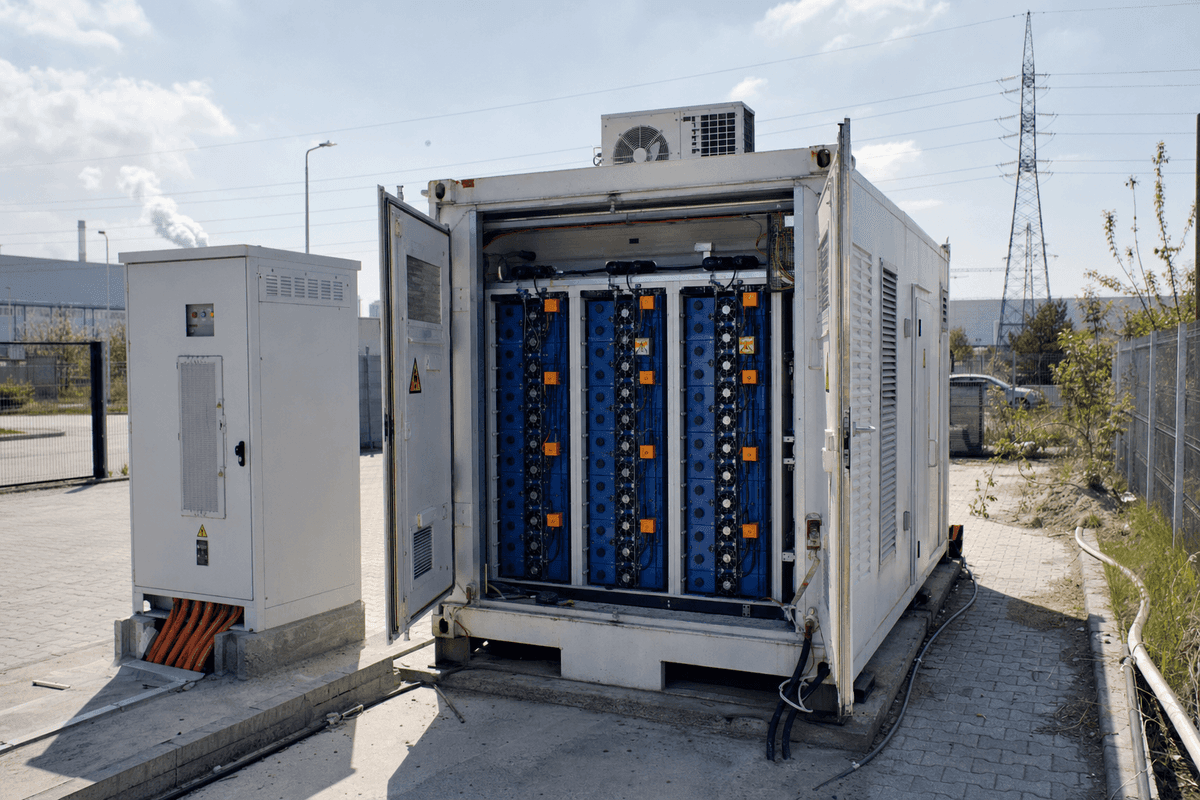
Bucharest Battery Energy Storage (BESS) Market Analysis: 500kWh / 250kW Container Configuration Guide
Summary
Bucharest has 1.72 million residents, a 228 km² urban footprint, and 220/400 kV transmission reinforcement nearby, making 500kWh / 250kW BESS suitable for industrial solar self-consumption and surplus storage.
Key Takeaways
Bucharest industrial BESS planning should match 500kWh capacity, 250kW power, and one 20ft container to urban grid constraints and factory load profiles.
- A recommended industrial configuration is 500kWh / 250kW, housed in 1× 20ft container, with PCS and step-up transformer integration.
- The operating mode should prioritize solar self-consumption + surplus storage, assuming 1 cycle/day and 85% depth for daily energy shifting.
- The Premium LFP battery specification uses 97% round-trip efficiency, 95% DoD, 10,000-cycle life, and 2%/year degradation.
- Bucharest’s official municipal area is 228 km², and the 2021 census count is 1,716,961 residents, supporting dense commercial energy demand.
- Transelectrica’s Bucuresti branch manages 12 substations and 1,330.254 km of 220 kV and 400 kV overhead lines in the regional network.
- Safety design should align with IEC 62619, UL 9540, and NFPA 855, including BMS, liquid cooling, and water mist fire suppression.
- A typical 500kWh installation would require approximately 250kW AC export/import capability, grid interconnection studies, civil foundation, and commissioning tests.
Market Context for Bucharest
Bucharest’s 1.72 million residents, 228 km² area, and dense industrial-commercial load make behind-the-meter BESS technically relevant for solar surplus control.
Bucharest is Romania’s capital and largest economic center, with a census population of 1,716,961 in 2021 according to Romania’s National Institute of Statistics data summarized by CityPopulation (2021). The Municipality of Bucharest states that the city covers 228 km², with around 70% built-up land, which concentrates commercial, logistics, healthcare, retail, and light-industrial electricity demand into a compact service area. For SOLARTODO energy-storage planning, that density matters because a factory or commercial campus can reach meaningful demand-charge and self-consumption benefits without requiring utility-scale land.
According to the World Bank (2021), Bucharest and Romania’s seven largest metropolitan areas concentrate 50% of the national population and generate 75% of firm revenues. That economic concentration supports the technical case for medium-scale BESS in facilities with daytime solar production, evening loads, process continuity requirements, or constrained grid export permissions. World Bank also notes that Bucharest is a high-growth urban economy, which increases pressure on resilient energy infrastructure rather than only generation capacity.
The electrical context is also relevant. According to Transelectrica (2026), Romania’s power transmission grid includes nominal voltages above 110 kV, while the Bucuresti branch operates 12 substations and 1,330.254 km of 220 kV and 400 kV overhead lines across Bucharest and surrounding counties. Transelectrica identifies Bucuresti Sud at 400/220/110/10 kV, Fundeni at 220/110/10 kV, and Domnesti at 400/110/20 kV, indicating that industrial BESS interconnection normally steps through local medium-voltage distribution or customer-side low-voltage infrastructure rather than directly into the national transmission grid.
Climate and solar resource strengthen the use case. According to the European Commission Joint Research Centre PVGIS (2026), PVGIS provides solar radiation and photovoltaic performance data for global locations, including Europe. A peer-reviewed European solar-resource analysis reports Bucharest at approximately 1,640 kWh/m² annual irradiation on a horizontal plane and about 1,563 kWh/m² on an optimally inclined plane, making daily solar surplus storage technically plausible for industrial rooftops and carports. IRENA states, "Battery electricity storage is a key technology," and that role is especially practical where urban loads and distributed PV appear in the same meter boundary.
Recommended Technical Configuration
A typical Bucharest industrial site with solar surplus would use approximately 1 containerized 500kWh / 250kW BESS operating at 1 cycle per day.
For the specified SOLARTODO product line, the correct size class is 500 kWh - 2 MWh, which requires a standard 20ft container with PCS inside. This avoids the two common configuration errors: a 100kWh system should not be over-housed in a 20ft container, and a 10MWh system cannot be described as a single 20ft unit. The 500kWh / 250kW rating fits an industrial or commercial load profile where solar production is stored during midday and discharged into afternoon or evening consumption.
A recommended Bucharest configuration is industrial BESS: 500kWh / 250kW, 1× 20ft container, using Premium LFP batteries with 97% round-trip efficiency, 95% DoD capability, 10,000 cycle life, 2% annual degradation, and a 20-year warranty. The expected operating profile is solar self-consumption + surplus storage, with 1 cycle/day and 85% depth. Under that profile, the usable daily shifted energy is approximately 425kWh before system efficiency losses, and approximately 412kWh after applying 97% round-trip efficiency.
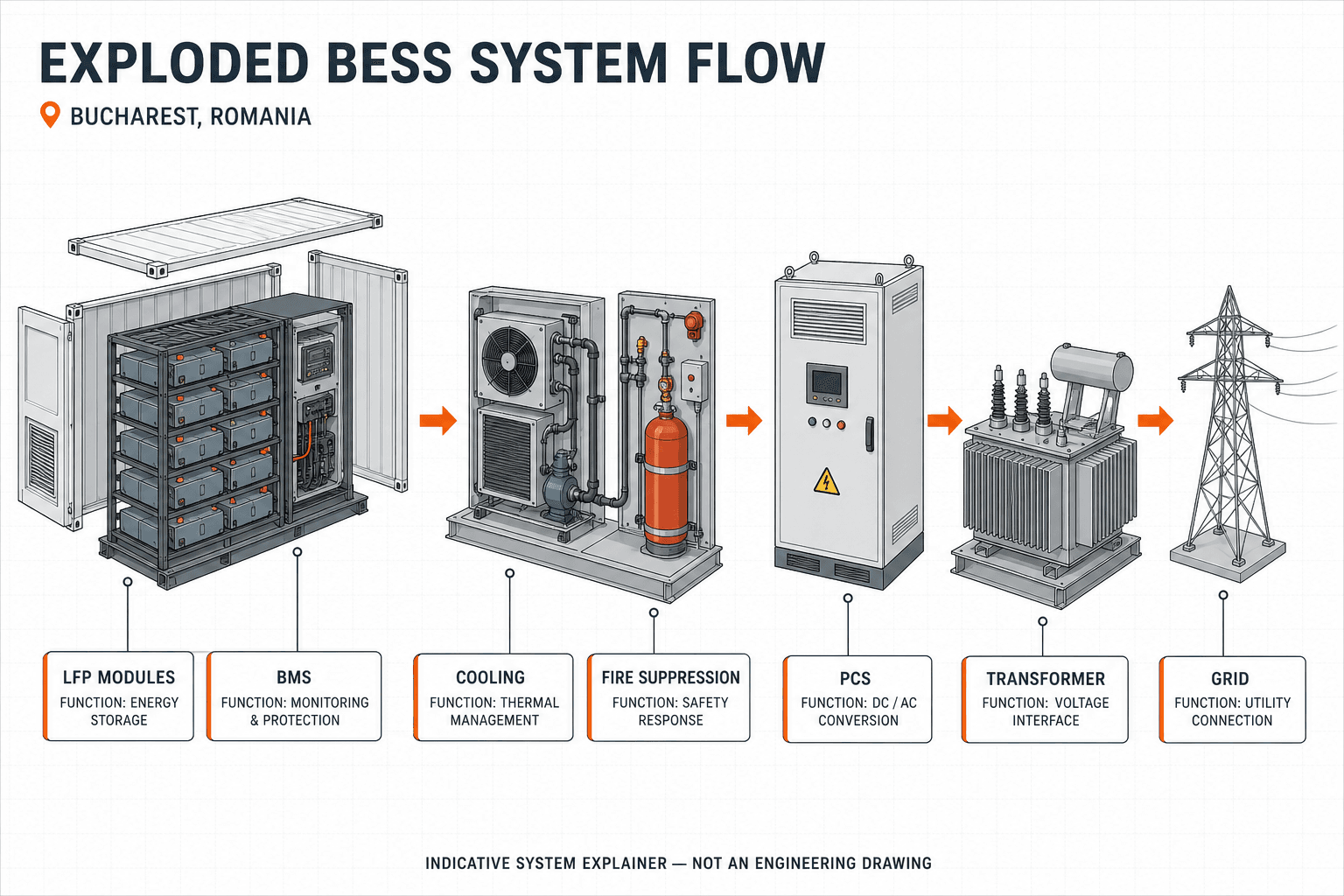
The recommended balance of system includes BMS, glycol liquid cooling, water mist fire suppression, PCS inverter, and step-up transformer. Grid integration should be engineered around the customer’s point of common coupling, local protection settings, anti-islanding requirements, transformer capacity, and export-limitation rules. SOLARTODO should be framed here as an equipment and engineering supplier for analysis and quotation, not as a past Bucharest deployment claimant; prospective buyers can review the product line at SOLARTODO Battery Energy Storage or contact us for project-specific sizing.
Technical Specifications
The 500kWh / 250kW BESS specification uses one 20ft container, Premium LFP batteries, 97% efficiency, liquid cooling, and IEC/UL/NFPA safety alignment.
- Product: SOLARTODO Battery Energy Storage (BESS), industrial containerized system.
- Rated energy capacity: 500kWh.
- Rated AC power: 250kW.
- Housing: 1× standard 20ft container, appropriate for the 500kWh - 2MWh product class.
- Battery chemistry: Premium LFP, selected for thermal stability and long cycle life.
- Round-trip efficiency: 97% under specified operating assumptions.
- Depth of discharge capability: 95% DoD, with recommended project operation at 85% depth.
- Cycle life: 10,000 cycles, supporting long-duration daily cycling use cases.
- Degradation assumption: 2% per year, to be modeled in lifecycle yield and warranty planning.
- Warranty: 20 years for the Premium LFP configuration specified in this guide.
- Thermal management: glycol liquid cooling, suitable for container temperature control and cell balancing.
- Fire protection: water mist fire suppression, integrated with detection and BMS alarms.
- Power conversion: PCS inverter + step-up transformer, engineered to the site voltage and protection scheme.
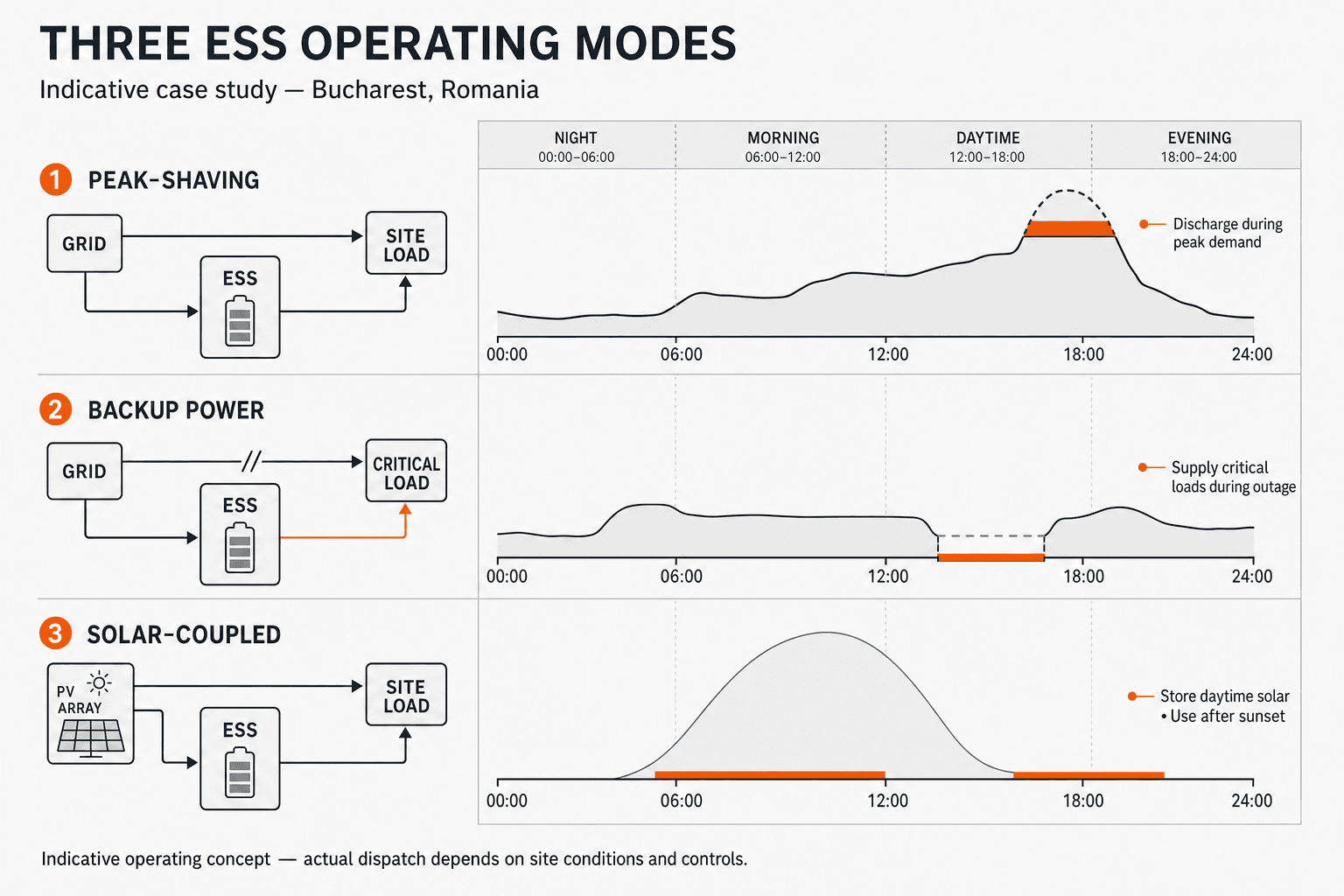
- Operating mode: solar self-consumption + surplus storage, one of SOLARTODO’s three BESS operating modes.
- Standards basis: IEC 62619, UL 9540, and NFPA 855.
According to IEC (2022), IEC 62619 specifies safety requirements for secondary lithium cells and batteries used in industrial and stationary applications. According to UL Standards & Engagement (2023), UL 9540 evaluates the integrated energy storage system, including energy storage function, power conversion equipment, and balance-of-plant compatibility. NFPA 855 is the installation reference for stationary energy storage systems and should inform clearance, detection, ventilation, emergency response, and commissioning documentation.
Implementation Approach
A typical Bucharest BESS implementation would move through 6 phases: load study, permitting, engineering, logistics, installation, and commissioning.
The first phase is a site load and PV-export study. Engineers should collect 12 months of interval data where available, transformer nameplate capacity, peak demand records, PV inverter clipping or export-limitation data, and tariff structure. The goal is to validate whether 500kWh / 250kW is right-sized for the site’s solar surplus and load-following profile.
The second phase is grid and safety engineering. For Bucharest, interconnection planning should confirm the point of common coupling, short-circuit level, relay coordination, earthing arrangement, transformer thermal margin, and local fire authority expectations. The BESS layout should reserve access lanes, emergency shutoff points, water mist system access, HVAC/liquid-cooling service clearance, and signage consistent with NFPA 855 principles.
The third phase is procurement and shipping. A typical SOLARTODO supply package would include the 20ft BESS container, Premium LFP battery racks, BMS, liquid-cooling loop, water mist fire suppression, PCS inverter, step-up transformer, EMS gateway, and test documentation. CKD or containerized shipping plans should separate spare parts, lifting gear requirements, commissioning tools, and site acceptance test procedures.
The fourth phase is civil and electrical installation. The container requires a level foundation, drainage, lifting plan, cable trenching or tray routing, transformer pad or integrated transformer area, communication cabling, grounding, and clear separation from high-traffic areas. The installation should include insulation-resistance checks, torque checks, coolant checks, fire-system inspection, BMS communication checks, and PCS parameter review before energization.
The fifth phase is commissioning and performance validation. Commissioning should test charge/discharge ramps, emergency stop behavior, BMS alarms, HVAC/liquid-cooling operation, water mist alarms, PCS protection settings, transformer energization, EMS scheduling, and remote monitoring. The acceptance test should confirm usable energy, AC power limit, round-trip behavior, and one-cycle-per-day scheduling for solar self-consumption.
Expected Performance & ROI
At 85% operating depth and 97% efficiency, a 500kWh Bucharest BESS can shift approximately 412kWh of delivered energy per daily cycle.
The daily energy calculation is straightforward: 500kWh nominal capacity multiplied by 85% operating depth equals approximately 425kWh charged or discharged within the planned cycle window. Applying 97% round-trip efficiency gives approximately 412kWh of delivered AC energy per cycle, before site-specific transformer and auxiliary losses. Across 300 effective cycling days per year, that implies roughly 123.6MWh of annual shifted energy; across 365 days, the upper technical estimate is about 150.4MWh.
According to IEA (2024), global energy storage capacity needs to increase sixfold to 1,500GW by 2030, and batteries represent 90% of that increase in its net-zero scenario. IEA states, "energy storage needs to increase six-times," which supports the broader market logic for BESS attached to solar and grid-flexibility applications. According to IRENA (2023), global battery storage could expand from 17GW in 2020 to 359GW in 2030 under its 1.5°C pathway.
ROI should be modeled rather than asserted as a fixed claim. For a Bucharest industrial customer, payback depends on retail electricity spread, grid export compensation, demand charges, PV curtailment, balancing-market access, and financing cost. A practical feasibility model should compare at least 3 scenarios: conservative cycling at 250 effective days/year, base cycling at 300 days/year, and high-utilization cycling at 365 days/year.
Results and Impact
A correctly sized 500kWh / 250kW BESS could support about 123.6-150.4MWh/year of solar energy shifting in Bucharest.
The main technical impact is not a claimed deployment result; it is an expected operating envelope for a properly engineered system. At 1 cycle/day and 85% depth, the BESS would reduce midday solar export, increase on-site renewable utilization, and provide controlled discharge during late-day demand periods. For facilities with sensitive processes, the PCS and BMS architecture can also support backup transition planning, although this guide’s primary mode remains solar self-consumption plus surplus storage.
From a lifecycle standpoint, the 10,000-cycle Premium LFP specification provides enough cycle headroom for long-term daily operation. At 365 cycles/year, 10,000 cycles corresponds to more than 27 theoretical cycling years, while commercial warranties, degradation, PCS service life, and project finance assumptions should be modeled separately. The stated 20-year warranty and 2% annual degradation assumption should be incorporated into capacity-retention planning.
Comparison Table
The 500kWh / 250kW Bucharest recommendation sits between cabinet-scale systems below 500kWh and multi-container utility systems above 2MWh.
| Configuration class | Capacity range | Correct housing | Typical Bucharest fit | Why it fits or does not fit |
|---|---|---|---|---|
| Small commercial cabinet | 100-500kWh | Outdoor cabinet, IP54 | Mini-market, small office, telecom room | Too small for many factory solar-surplus profiles |
| Recommended industrial BESS | 500kWh / 250kW | 1× 20ft container | Factory, warehouse, commercial campus | Matches 500kWh - 2MWh class and daily surplus shifting |
| Large commercial array | 2-10MWh | Multiple 20ft/40ft containers | Industrial park or feeder-scale user | Requires larger land, transformer, and grid studies |
| Grid-scale BESS | 10MWh+ | Container farm + dedicated substation | Utility or TSO/DSO project | Too large for a single behind-the-meter factory project |
Pricing & Quotation
SOLARTODO’s Bucharest BESS quotation model uses 3 commercial scopes, but technical sizing should be finalized before any EPC offer.
SOLARTODO offers three pricing tiers for this product line: FOB Supply (equipment ex-works China), CIF Delivered (including ocean freight and insurance), and EPC Turnkey (fully installed, commissioned, with 1-year warranty). Volume discounts are available for large-scale deployments. Configure your system online for an instant estimate, or request a custom quotation from our engineering team at [email protected].
No price is stated in this guide because Bucharest BESS economics depend on transformer scope, civil works, grid approval, fire-system requirements, metering, logistics, and commissioning responsibilities. Buyers should request a technical quotation that separates battery container, PCS, transformer, EMS, shipping, installation, protection engineering, and acceptance testing.
Frequently Asked Questions
These 10 FAQ answers cover the 500kWh / 250kW Bucharest BESS scope, including standards, timeline, ROI, warranty, and installation.
Q1: What BESS size is recommended for an industrial solar self-consumption site in Bucharest? A typical recommendation is 500kWh / 250kW in 1× 20ft container. This size belongs to the 500kWh - 2MWh industrial class, so it is not over-housed like a 100kWh container concept and not under-scaled like a single container for 10MWh. The assumed use case is 1 daily cycle at 85% depth.
Q2: How much usable energy can the 500kWh system deliver per day? At 85% operating depth, the system cycles approximately 425kWh from the nominal 500kWh capacity. With 97% round-trip efficiency, delivered energy is approximately 412kWh per daily cycle before site-specific auxiliary and transformer losses. Actual results depend on PV surplus, load shape, EMS scheduling, temperature, and grid export limitations.
Q3: Which standards apply to this Bucharest BESS configuration? The specified standards basis is IEC 62619, UL 9540, and NFPA 855. IEC 62619 addresses industrial lithium battery safety, UL 9540 addresses the integrated energy storage system, and NFPA 855 addresses stationary ESS installation requirements. Local Romanian permitting, grid codes, fire authority review, and electrical inspection still need project-specific confirmation.
Q4: How long would deployment typically take? A practical timeline is usually measured in months, not days. Site data collection, grid review, fire-safety review, civil design, manufacturing, shipping, foundation work, electrical installation, and commissioning must be sequenced. IEA notes battery storage can often be built in months, but Bucharest schedule risk depends on utility approvals, transformer availability, and site readiness.
Q5: What ROI or payback period should buyers expect? ROI should be calculated from electricity tariffs, solar export value, avoided curtailment, demand charges, operating days, financing cost, and maintenance. The technical model can estimate 123.6-150.4MWh/year of shifted energy at 300-365 cycles. Payback should not be presented as a fixed number until the buyer provides interval load data and tariff details.
Q6: What maintenance does a containerized LFP BESS require? Maintenance typically includes BMS alarm review, liquid-cooling inspection, glycol loop checks, fire-suppression inspection, PCS filter and firmware checks, thermal scans, insulation tests, transformer inspection, and EMS schedule review. For a 500kWh / 250kW system, quarterly remote reviews and annual on-site preventive maintenance are common planning assumptions, subject to warranty manual requirements.
Q7: How does this system compare with a diesel backup generator? A BESS delivers fast, quiet, emissions-free power from stored electricity, while a diesel generator supplies fuel-based backup for longer outages. For Bucharest solar self-consumption, the BESS is mainly an energy-shifting and surplus-storage asset. Backup operation is possible when engineered, but runtime depends on available state of charge and critical-load size.
Q8: Does SOLARTODO provide EPC pricing for Bucharest projects? SOLARTODO can structure quotations as FOB Supply, CIF Delivered, or EPC Turnkey. EPC pricing requires site drawings, grid connection details, foundation conditions, transformer scope, fire-safety requirements, and commissioning responsibilities. This article intentionally avoids price claims because costs vary by installation boundary and local approval requirements.
Q9: What warranty applies to the specified Premium LFP configuration? The project-specific configuration states a 20-year warranty, 10,000-cycle life, and 2% annual degradation assumption. Warranty interpretation should be checked against operating limits such as temperature, DoD, C-rate, maintenance compliance, and approved EMS settings. Daily operation at 85% depth is aligned with the stated solar self-consumption profile.
Q10: Where should the 20ft BESS container be installed on-site? The container should be placed on a level engineered foundation with drainage, lifting access, service clearance, cable routing, grounding, and emergency access. It should not block logistics routes or fire access. Final placement must account for transformer distance, PCC cable length, ventilation, water mist system access, signage, and local safety review.
References
These 8 references support Bucharest population, city area, grid voltage context, solar resource, battery-market growth, and BESS safety standards.
- Romania National Institute of Statistics (2021): Bucharest census population reported as 1,716,961 residents; summarized at https://www.citypopulation.de/en/romania/bucuresti/
- Municipality of Bucharest (2026): Municipal area listed as 228 km², with about 70% built-up land; https://www2.pmb.ro/orasul/date_geografice/asezare/asezare.php
- World Bank (2021): Bucharest and seven major metropolitan areas concentrate 50% of Romania’s population and 75% of firm revenues; https://www.worldbank.org/en/country/romania/brief/romania-urban-development
- Transelectrica (2026): Bucuresti branch manages 12 substations and 1,330.254 km of 220 kV and 400 kV overhead lines; https://transelectrica.ro/stbucuresti?print=true
- European Commission JRC PVGIS (2026): PVGIS provides solar radiation and PV-performance data for European locations; https://joint-research-centre.ec.europa.eu/photovoltaic-geographical-information-system-pvgis_en
- IEA (2024): Batteries and Secure Energy Transitions says storage capacity must rise sixfold to 1,500GW by 2030; https://www.iea.org/reports/batteries-and-secure-energy-transitions/executive-summary
- IRENA (2023): Tripling renewable power pathway projects battery storage growth from 17GW in 2020 to 359GW in 2030; https://www.irena.org/Digital-Report/Tripling-renewable-power-and-doubling-energy-efficiency-by-2030
- IEC / UL / NFPA (2022-2026): IEC 62619, UL 9540, and NFPA 855 define lithium battery safety, ESS equipment, and stationary ESS installation requirements; https://webstore.iec.ch/en/publication/64073, https://ulse.org/insight/news-ulse-publishes-third-edition-ul-9540-energy-storage-systems-and-equipment/, https://link.nfpa.org/all-publications/855/2026
Equipment Deployed
- 500kWh / 250kW SOLARTODO Battery Energy Storage (BESS) industrial system
- 1× standard 20ft container for 500kWh - 2MWh class deployment
- Premium LFP battery modules with 97% round-trip efficiency and 95% DoD capability
- Battery management system (BMS) with monitoring, alarms, and protection logic
- Glycol liquid-cooling system for containerized battery thermal management
- Water mist fire suppression system aligned with NFPA 855 planning principles
- PCS inverter integrated with step-up transformer for site interconnection
- EMS gateway for solar self-consumption and surplus-storage scheduling