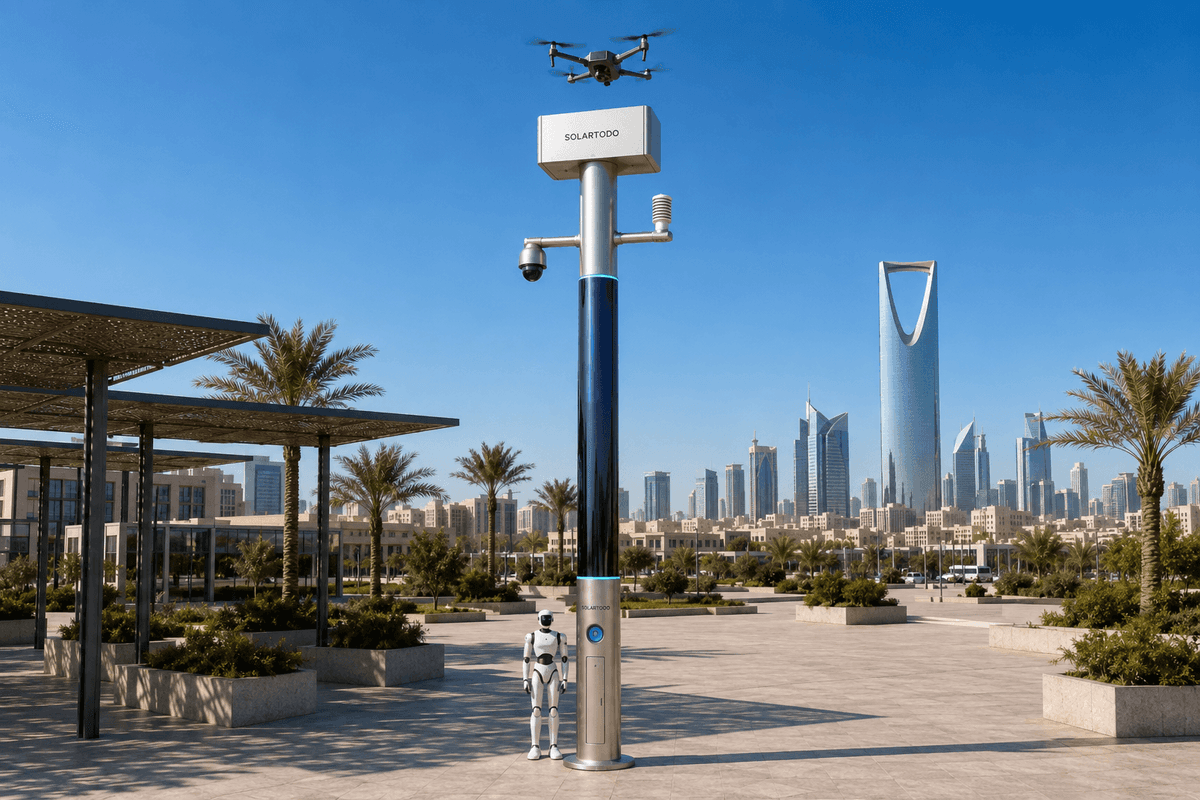
A City AI Pole is a non-lighting physical-AI urban edge node that combines off-grid energy, sensing, edge compute, drone operations and robot support in one pole-form site asset. In this Cairo deployment, SOLARTODO Sentinel Sky Hub provides local PTZ-based incident awareness, battery-swapped drone sorties and robot-ready field coordination for temporary-event traffic operations around a dry-port logistics corridor.
1. City Task And Deployment Context
Cairo’s transport challenge is not only central-city congestion. It also includes logistics movement at the metropolitan edge, where container trucks, service vehicles, buses, ride-hail traffic and event visitors can converge on the same arterial roads. For this illustrative deployment, the operating geography is a Cairo dry-port and logistics access zone, aligned with the city’s role in national road, rail and inland-port corridors. Public sources describe the 6th of October Dry Port as Egypt’s first inland dry port, established on about 100 feddans with electronic gates, truck facilities, trading areas, rail connections and customs functions. Cairo Governorate also lists dedicated transport and roads entities, including the Cairo Transportation Authority and the Directorate of Roads and Transportation, which underscores the need for coordinated traffic and field operations rather than single-purpose devices. Sources: https://www.presidency.eg/EN/%D8%A7%D9%84%D9%85%D8%B4%D8%A7%D8%B1%D9%8A%D8%B9-%D8%A7%D9%84%D9%82%D9%88%D9%85%D9%8A%D8%A9/projects-1562023-2/ and https://www.cairo.gov.eg/en/governorate-entities/authorities/.
The proposed stakeholder is a transport authority responsible for a temporary night-economy event near a port-style logistics district: extended evening retail activity, hospitality traffic, riverfront or district programming, and heavy-goods access continuing into late hours. The operational scenario is a traffic incident at an access junction: a disabled truck, minor collision, crowd spillover, blocked service lane or unsafe queue formation near a temporary pickup and inspection zone. The core pain point is network outage. During crowded night operations, cellular congestion, damaged backhaul, power interruptions or command-center disconnection can slow confirmation of what happened, who should respond, and whether a lane can reopen.
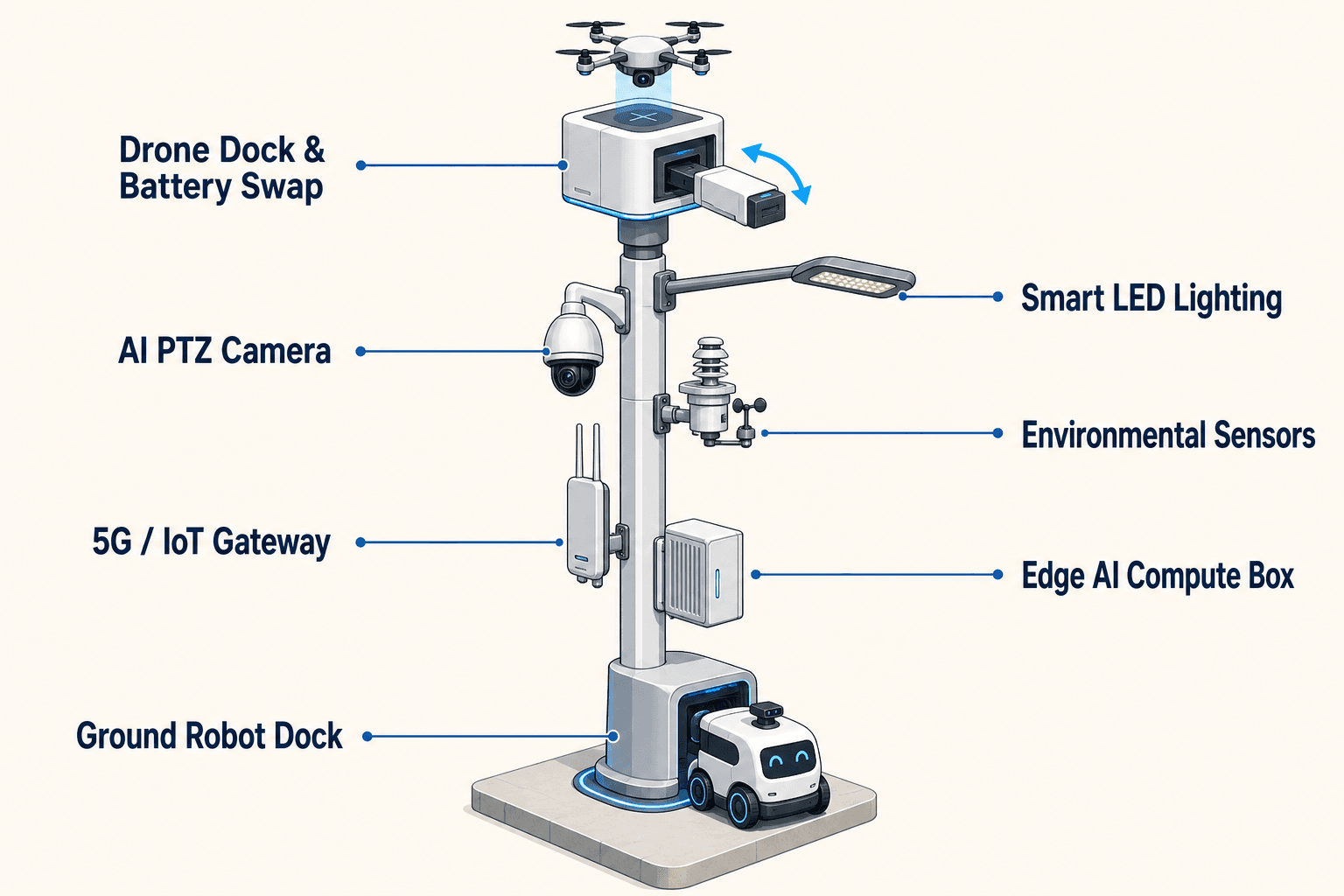
SOLARTODO Sentinel Sky Hub is framed here as an autonomous field node for that situation. It is a PURE smart pole with no lighting system. It does not require grid, city or site power. It combines battery storage, 360-degree wrapped flexible CIGS thin-film solar replenishment, PTZ perception, edge compute, drone battery hot-swap, drone operations management, ground robot charging support and counter-UAS coordination into one physical-AI micro-station. The article is not a claim of an existing Cairo customer rollout, achieved results or certified compliance. It is a proposed, subject-to-engineering-confirmation configuration for buyers evaluating response-time improvement during temporary-event traffic operations.
2. Field Layout And Off-Grid Operating Model
The deployment mode is temporary-event. That matters because the buyer may need capability for a defined period without civil works, trenching, grid connection or permanent CCTV mast installation. A practical plan would place Sky Hub nodes at access-road decision points: the dry-port gate approach, truck holding area, event shuttle turn, pedestrian crossing pressure point, temporary inspection bay and incident diversion route. The pole is treated as a battery-backed field operations node, not a street-lighting asset and not a decorative smart-city kiosk.
The off-grid design is important for Cairo’s network-outage pain point. Each Sky Hub carries roughly 15 square meters of 360-degree wrapped flexible CIGS thin-film solar over a vertical body about 8 meters tall and about 0.6 meters wide. The solar layer is a supplemental replenishment surface, not an unlimited pure-solar promise. Because a vertical cylinder collects direct sun primarily on the sun-facing projection rather than across the full wrap at once, planning should use conservative solar assumptions. In high-irradiance regions, a similar pole geometry can be planned around approximately 0.8 to 1.1 kW DC clear-sky peak and about 6 to 9 kWh per day, with peaks typically arriving mid-morning and mid-afternoon rather than exactly at noon. Cairo engineering review should adjust those values for local dust, shading from elevated roads, seasonal angle, wind, thermal conditions and cleaning intervals.
Energy is buffered by 5 to 20 kWh-class battery storage. The operating plan schedules high-power loads by duty cycle: PTZ patrol and edge inference remain continuous or near-continuous; drone sorties are sequenced; robot charging is assigned return windows; and communication backhaul is prioritized for event and status metadata. During a network outage, raw video and sensor data stay on the pole and are processed locally. Only de-identified event or status metadata is intended to leave the node when a permitted communication path is available. This keeps the local common-operating-picture useful even when upstream connectivity is degraded.
For a temporary event, the off-grid model changes procurement logic. The transport authority is not buying a lamp post, a camera, a drone dock or a robot charger separately. It is defining a temporary incident-response cell at each difficult junction. The pole becomes the field unit that senses, assesses, dispatches, records and recovers equipment without requiring an operator to stand beside it overnight.
3. PTZ-Led Traffic Incident Detection And Edge Assessment
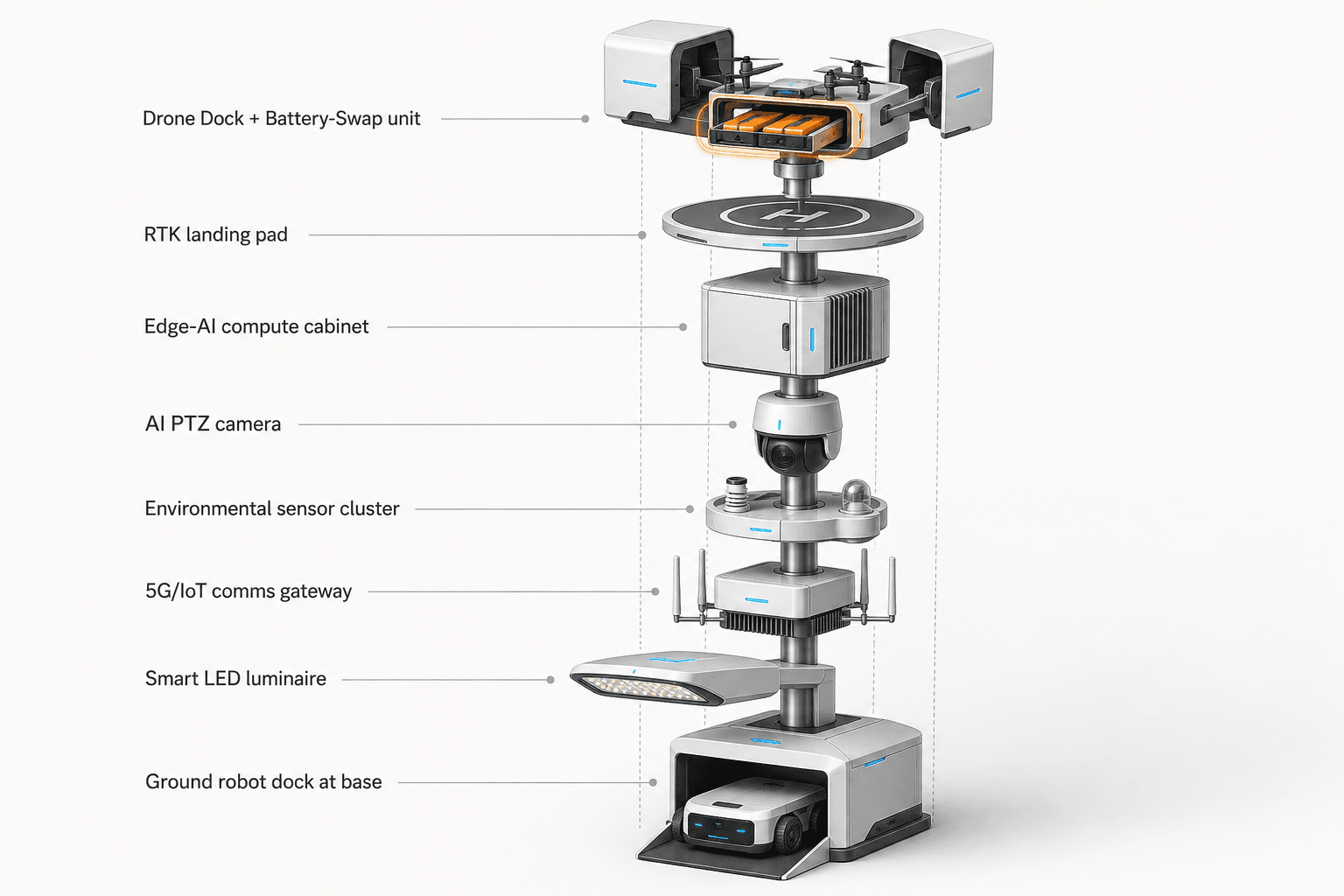
The module focus for this Cairo case is the PTZ camera. The PTZ is not positioned as a face-recognition or licence-plate-recognition device. Its role is anonymous operational perception: vehicle count, crowd density, queue growth, intrusion into restricted lanes, perimeter awareness, wrong-area stopping, abnormal dwell and blocked-lane confirmation. For a traffic incident at a dry-port access road during a night-economy event, that distinction is commercially important. The authority needs faster operational truth, not a privacy-heavy identity system.
The PTZ camera patrols predefined views: inbound truck lane, outbound gate, shuttle lay-by, pedestrian conflict area, temporary diversion barrier and emergency access path. Local perception models running on Jetson-class edge compute classify whether the scene is normal, congested, obstructed or escalating. The on-pole scheduler then decides which workloads deserve energy and compute priority. For example, if the PTZ detects a stopped heavy vehicle and queue expansion at the same time, the pole can elevate PTZ frame analysis, request a drone launch, reserve battery capacity for a second sortie, alert the COP dashboard and suppress lower-priority environmental sampling bursts.
This is where the response-time KPI is framed. The article does not claim achieved response-time numbers. Instead, the authority would evaluate target intervals: time from anomaly to local event creation, time from event creation to human authorization, time from authorization to drone launch, time from drone overhead view to lane decision, and time from decision to field closure, diversion or reopening. The PTZ camera creates the first reliable event. The edge node keeps that event alive even if the network path to the central command room is intermittent.
Because Cairo’s temporary-event conditions can involve dust, glare, dense headlights and mixed pedestrian-vehicle movement, the PTZ plan should be tuned around zones rather than identity. The operational question is: Is lane A blocked? Is the queue exceeding the safe holding line? Are pedestrians entering the truck path? Is there an unauthorized drone above the event perimeter? Is the response robot or field team safely returning? The local node answers those questions without exporting raw video by default. That architecture supports a PDPL-LGPD-oriented data posture: local processing first, de-identified metadata outward, and final policy subject to legal and engineering review.
4. Battery-Swap Drone And Robot Response Plan
Battery-swap is the differentiator for a temporary traffic-incident operation. A single drone launch can confirm an obstruction, but night-economy traffic is dynamic. One sortie may see the first lane blockage, a second may inspect the upstream queue, and a third may verify that the diversion is clearing. Sky Hub’s multi-bay battery magazine supports automated rear-service battery exchange: a landed friendly drone receives a charged pack and can relaunch for the next assigned task. Multiple bays allow several consecutive sorties without a human operator stationed at the pole.
The drone operations management layer handles route planning, charge and swap state, task queueing, fleet health and mission logs. In the Cairo port-archetype scenario, approved routes would be short and operational: rise from the pole, inspect the access road, check a holding lane, observe an incident perimeter, return, swap battery if needed, and redeploy. The system is not designed around open-ended flight or unbounded surveillance. It is a controlled incident-response asset with human authorization in the loop.
Ground robot operations add another layer. A humanoid or service robot can patrol the pole base area, inspect temporary barriers, verify whether a warning sign has shifted, approach a stopped service vehicle, support alarm response, coordinate with the aerial view, and return to the pole base for wireless charging. In a network outage, the robot does not need raw cloud video to decide every movement; it can receive local tasking from the pole and report de-identified status back into the COP when the link is available.
Counter-UAS coordination is treated carefully. The pole may detect and track an unauthorized drone through its own sensing and, if integrated, optional partner-sensor inputs. Radar is not built into the pole. If a credible event is assessed and a human authorizes response, the node can command its own friendly drone to perform non-kinetic mitigation such as soft aerial net-capture or close-approach deterrence. The plan excludes shoot-downs, hard-kill actions, weapons, RF or GNSS jamming, autonomous attack and denial effects. For a transport authority, this means the C-UAS workflow is part of event safety and perimeter control, not a separate weaponized security program.
5. Common Operating Picture And KPI Evaluation
The operations loop follows the Chinese formulation ‘运查打算协同’ as a practical sequence: sensing, authorized assessment and response, edge-compute scheduling, and field operations and maintenance. In the COP view, the transport authority sees current node health, PTZ incident cards, drone sortie state, battery magazine state, robot charge state, environmental conditions, C-UAS alerts, operator decisions and mission logs. The dashboard should be designed for incident commanders, not data scientists. The key question is whether the temporary-event operation can compress decision time when the network is degraded.
The KPI framing is response-time, expressed as target and evaluation metrics rather than achieved outcomes. Before the event, the authority defines baseline manual workflows: who receives a traffic call, who verifies the scene, how long a patrol vehicle takes to arrive, how a blocked lane is confirmed, and when a diversion is authorized. During the event, Sky Hub records time-stamped local events: PTZ anomaly flag, edge classification, operator authorization, drone launch, battery swap, robot task, field note, COP acknowledgement and closure. After the event, the buyer can compare manual incident handling against node-assisted incident handling using the same categories.
The environmental nine-in-one package supports the same decision process. Wind speed and direction inform drone launch safety. Temperature and humidity affect battery and equipment envelopes. Atmospheric pressure, noise, PM10, PM2.5 and illuminance provide operating context for crews and public-space conditions. These measurements do not turn the pole into a generic environmental station; they help decide whether a traffic incident can be assessed by drone, whether crowd density is likely to rise, and whether field maintenance is needed.
A credible Cairo deployment plan should end with an engineering confirmation pack: pole placement survey, solar exposure study, battery autonomy model, route safety review, local data policy review, airspace and site permissions, robot path assessment, communication fallback design and temporary-event removal plan. SOLARTODO Sentinel Sky Hub is mature product capability applied to a proposed city task, but each Cairo site must still be engineered against the actual access road, event calendar, wind exposure, dust load, security perimeter and authority procedures.
System Configuration
| Parameter | Configuration |
|---|---|
| Node type | SOLARTODO Sentinel Sky Hub pure smart pole; non-lighting physical-AI edge node for temporary-event traffic operations. |
| Energy system | Fully off-grid battery-backed micro-station with ~15 m2 wrapped flexible CIGS replenishment and 5-20 kWh-class storage, subject to site sizing. |
| Camera | AI PTZ camera for anonymous vehicle count, crowd density, intrusion and perimeter awareness; no active face or licence-plate recognition claim. |
| Edge AI compute | Jetson-class on-pole inference and workload scheduling cabinet; raw video and sensor data processed locally on the pole. |
| Drone operations | Autonomous launch, route patrol, incident inspection, return, multi-bay battery hot-swap and redeployment with human-authorized missions. |
| Ground robot support | Base-side wireless charging and task coordination for patrol, alarm response, inspection and air-ground field checks. |
| C-UAS coordination | Detection and tracking with human-authorized friendly-drone soft net-capture or close-approach deterrence; optional partner-sensor inputs only. |
How It Works
- PTZ patrol flags a stopped vehicle, queue growth or restricted-lane intrusion at the dry-port access route.
- Edge AI classifies the anomaly locally, scores urgency and creates a de-identified event card in the COP.
- A human operator authorizes the response, selecting drone inspection, robot check, field crew dispatch or diversion watch.
- The friendly drone launches, inspects the traffic incident, returns and receives an automated battery hot-swap if another sortie is queued.
- The pole records mission state, battery state, PTZ snapshots as local evidence, environmental context and operator decisions without exporting raw video by default.
- The COP closes the incident when the lane, queue and perimeter return to the authority’s defined operating threshold.
Planning Assumptions (Indicative)
Illustrative planning inputs a buyer can recompute — target metrics, not achieved results. Subject to final engineering confirmation.
| Metric | Planning assumption | Indicative value |
|---|---|---|
| Response-time evaluation | Measure target interval from PTZ anomaly flag to authorized field decision during temporary-event traffic incidents. | ~5-10 minute target decision window for planning comparison. |
| Manual verification load | Drone overhead confirmation substitutes some dispatches of staff vehicles solely for visual verification. | ~10-20 incident-verification checks per event night automated or assisted. |
| Consecutive aerial sorties | Battery hot-swap enables repeat inspections of access roads, holding lanes and diversion routes without on-site battery handling. | ~3-6 short sorties planned per high-pressure operating window. |
| Network-outage resilience | Local edge processing keeps incident detection and mission logs active when upstream communication is degraded. | ~2-4 hours of degraded-backhaul operation modeled per event scenario. |
| Patrol coverage inputs | Robot and drone tasks reduce repetitive walking checks around the pole base, barriers and temporary lanes. | ~4-8 routine patrol loops assisted per event night. |
Deployed Equipment
- SOLARTODO Sentinel Sky Hub pure smart pole body with 360-degree wrapped flexible CIGS film.
- 5-20 kWh-class battery storage cabinet and off-grid power management system.
- AI PTZ camera and local perception stack for traffic and perimeter awareness.
- Jetson-class edge compute module with on-pole scheduling and local data processing.
- Autonomous drone launch and landing interface with multi-bay battery hot-swap magazine.
- Ground robot base-side wireless charging and task coordination interface.
- Nine-in-one environmental sensor package: wind speed, wind direction, temperature, humidity, pressure, noise, PM10, PM2.5 and illuminance.
- COP command view for incident cards, mission authorization, logs and node health.
Frequently Asked Questions
Is Sky Hub a smart streetlight for Cairo road upgrades?
No. In this case study, Sky Hub is a pure smart pole and physical-AI city edge node with no lighting system. Its purpose is sensing, local compute, off-grid energy, drone operations, robot support and incident coordination. It should be procured and evaluated as a temporary traffic operations node, not as roadway illumination infrastructure.
How does the system keep working during a network outage?
The pole processes PTZ video and sensor inputs locally through on-pole edge compute. Raw video and raw sensor streams are intended to stay on the pole, while only de-identified event and status metadata may leave the node when communications are available. During degraded backhaul, the local mission log, event scoring and equipment scheduling can continue for the modeled operating window.
What makes battery-swap relevant to a traffic incident?
A traffic incident near a dry-port access road may require repeated checks: first confirmation, upstream queue inspection, diversion monitoring and reopening verification. The multi-bay battery magazine lets a landed friendly drone receive a charged pack through automated rear service and relaunch for consecutive short sorties, reducing dependence on a human battery handler at the pole.
Does the PTZ camera identify people or licence plates?
This proposed configuration does not claim active face recognition or licence-plate recognition. The PTZ camera is used for anonymous operational perception such as vehicle counts, crowd density, stopped vehicles, restricted-lane intrusion and perimeter awareness. That keeps the deployment focused on transport response-time and supports a local-processing, PDPL-LGPD-oriented data posture.
Can the pole power itself only from the wrapped solar surface?
The system is fully off-grid because it combines battery storage with on-pole CIGS solar replenishment, but the solar wrap is not an unlimited pure-solar guarantee. Planning should treat the wrap as supplemental replenishment. High-power drone and robot tasks are buffered by 5-20 kWh-class storage and scheduled by duty cycle after site engineering confirmation.
How is counter-UAS handled at a temporary event?
Counter-UAS is limited to detection, tracking and human-authorized coordination with the node’s own friendly drone for non-kinetic actions such as soft aerial net-capture or close-approach deterrence. Radar is not built into the pole and would only be an optional partner-sensor input. The plan excludes autonomous attack, weapons, jamming, denial effects and shoot-down actions.
What should a Cairo transport authority validate before procurement?
The buyer should validate pole placement, solar exposure, dust and cleaning assumptions, battery autonomy, communications fallback, airspace permissions, robot movement paths, event traffic plans, privacy policy, evidence retention and command-center procedures. The response-time KPI should be defined before the event so manual and node-assisted workflows can be compared consistently.
Explore Further
- City AI Pole / smart streetlight product line
- More smart-city deployment cases
- Talk to our engineering team
Planning a similar physical-AI deployment for streets, campuses or public spaces? Request an engineering consultation