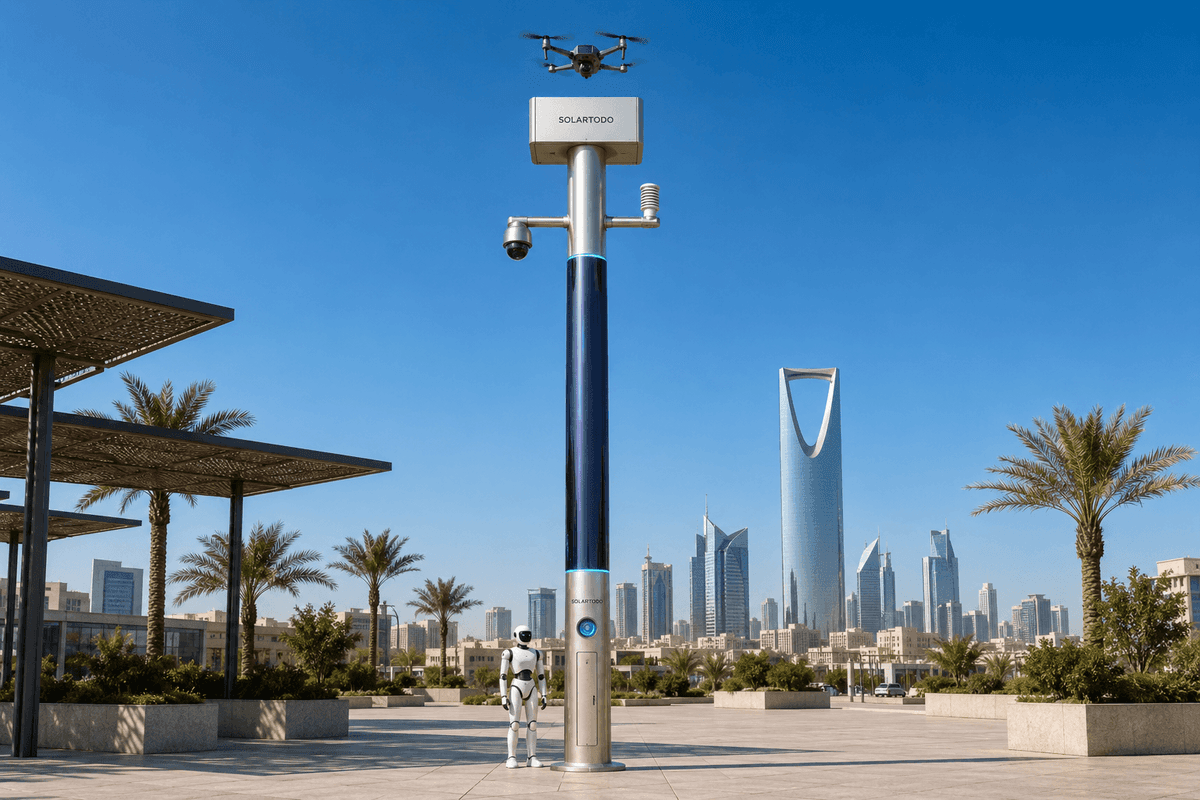
A City AI Pole is a non-lighting physical-AI edge node that combines off-grid energy storage, on-pole sensing, edge compute, drone operations and ground robot coordination. In this proposed Casablanca deployment, a SOLARTODO Sentinel Sky Hub supports a park operator with local security awareness, drone battery hot-swap and human-authorized response workflows.
1. Casablanca Security Context
Casablanca is Morocco’s largest commercial city and a dense operating environment for industrial parks, logistics yards, port-adjacent activity, private campuses and managed city perimeters. This case study frames a proposed, illustrative configuration for a park operator responsible for a mountain-archetype security zone on Casablanca’s inland edge: elevated access roads, service yards, perimeter gates, rooflines, slopes, utility corridors and exposed open areas that become harder to inspect during heatwave periods. The stakeholder is not trying to illuminate streets or replace conventional facilities management. The task is security-led operational awareness: detect anomalies, decide whether a response is justified, dispatch the right autonomous asset and record the event in a common-operating-picture view.
The primary scenario is low-altitude inspection. During a heatwave, manual patrols are physically constrained, drone endurance is shortened by thermal management and return-to-base margins, and the operator needs faster confirmation of perimeter events without placing staff repeatedly into exposed zones. A single SOLARTODO Sentinel Sky Hub is positioned as the local physical-AI node for this first evaluation cell. It is a pure smart pole with no lighting system, no dependency on city power and no raw video upload requirement. The pole hosts sensing, compute, battery-backed energy, drone operations and ground robot coordination at the site edge.
The operational question is response time: how long it takes to move from a perimeter cue to an authorized field check and usable incident record. The case therefore treats the drone nest and automated battery hot-swap magazine as the module focus. Instead of waiting for a human operator to travel to a launch point, replace a battery or manually re-task the aircraft after every short sortie, the pole supports a repeatable loop: local sensing, edge assessment, human authorization, sortie launch, return, rear-service battery exchange and redeployment when the task queue requires it. Final siting, aviation permissions, radio design and duty cycle must be confirmed through engineering and local operating review.
2. Single-Pilot Node Design
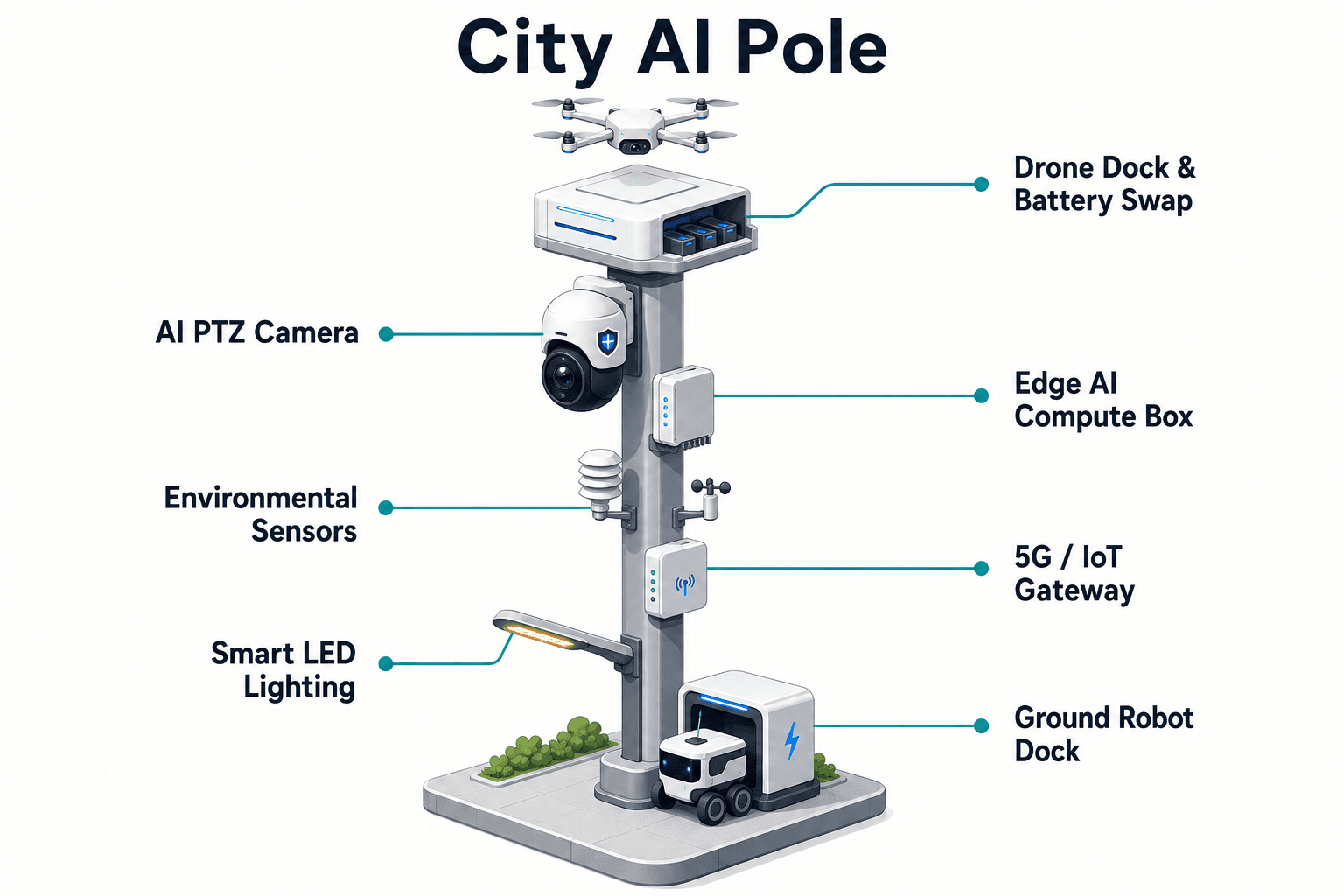
The proposed deployment mode is a single-pilot cell: one Sky Hub serving a defined park-operator security perimeter before any wider network design is considered. This keeps the evaluation grounded in a measurable operating task rather than a city-scale claim. The node is placed where it can observe gate approaches, fence lines, service roads and elevated blind spots while giving the drone a practical launch and recovery envelope. The pole body carries roughly 15 square meters of 360-degree wrapped flexible CIGS thin-film solar on a vertical cylinder of about 8 meters height and about 0.6 meters width. Because a vertical cylinder collects direct sun through its sun-facing projection rather than from the whole wrap at once, the planning model treats solar as supplemental replenishment, not unlimited self-sufficiency.
For energy planning, the node is designed as a fully off-grid battery-backed micro-station. In high-irradiance regions, a comparable vertical CIGS wrap may produce roughly 0.8 to 1.1 kW DC peak in clear sky, typically strongest in mid-morning or afternoon rather than solar noon, and about 6 to 9 kWh per day. Casablanca’s actual yield depends on season, siting, shading, salt exposure, dust, heat and maintenance. The planning assumption is therefore conservative: 5 to 20 kWh-class storage buffers high-power operations, and OTATODO schedules drone, robot, sensing and compute workloads by duty cycle.
The drone nest is configured for autonomous launch, patrol, inspection, return and task redeployment, with a multi-bay battery magazine for automated rear-service battery exchange. After landing, the aircraft receives a charged pack and can relaunch when authorized and when the mission queue requires it. Multiple bays support several consecutive sorties before replenishment and charge constraints dominate the schedule. Drone operations management covers route planning, swap state, task queueing, fleet health and mission logs.
At the base, a ground service robot can patrol accessible paths, verify alarms, inspect assets at human height and return for wireless charging. The robot is not the first response for every event; the COP can assign air or ground tasks according to location, confidence score, heat exposure, battery state and operator authorization.
3. Operations Loop
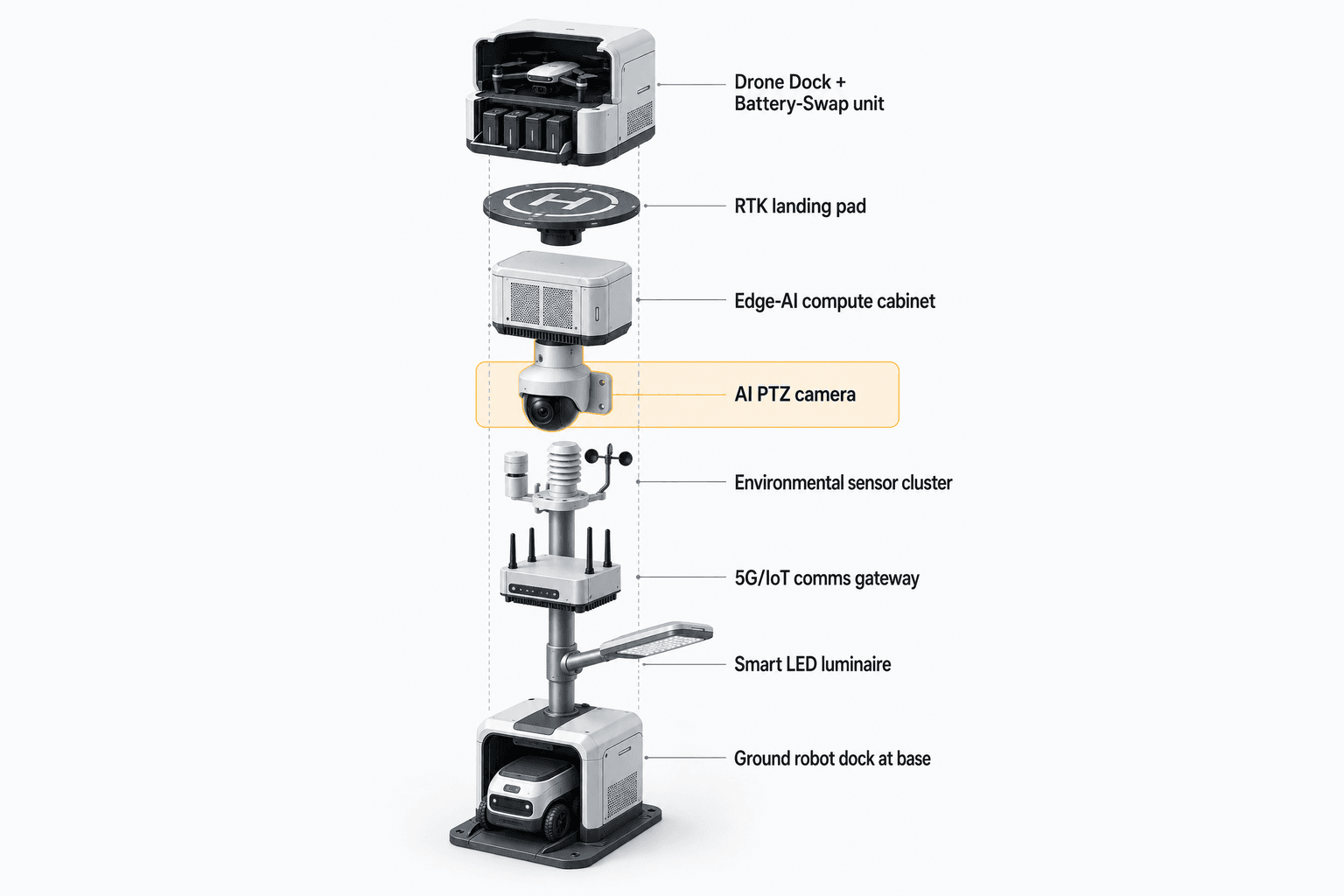
The operational loop follows the sensing to authorized response to edge scheduling to field operations and maintenance pattern. In the Casablanca park context, the PTZ camera performs local perception for anonymous vehicle count, crowd density, intrusion and perimeter awareness. The nine-parameter environmental package measures wind speed, wind direction, temperature, humidity, atmospheric pressure, noise, PM10, PM2.5 and illuminance. These readings matter during heatwaves because they influence drone launch windows, worker exposure, dust risk, battery behavior and the decision to send a robot instead of a person.
Edge AI compute runs on a Jetson-class module in the on-pole cabinet. The compute layer performs local inference, event scoring and workload scheduling at the pole. Raw video and sensor data stay on the pole and are processed locally; only de-identified event and status metadata may leave the node for the command view. This data posture is PDPL/LGPD-oriented and designed for local processing, subject to final governance, legal and security review by the buyer.
A typical low-altitude inspection begins when the camera or another connected sensor flags unusual activity near a perimeter segment, service road or restricted utility area. The node classifies the event locally and proposes an inspection task in the COP. A human operator authorizes the response. The drone launches for a low-altitude route designed around site restrictions, thermal conditions and return reserve. If the first pass is inconclusive, the system can queue a second pass after the battery exchange sequence or dispatch the ground robot for close inspection where access permits.
Counter-UAS coordination is treated as a controlled security workflow, not a weapons function. The pole can detect and track an unauthorized drone through its own sensing and, where configured, optional partner-sensor inputs. Radar is not pole hardware. With human authorization, the node can command its friendly drone to conduct non-kinetic mitigation such as soft aerial net-capture or close-approach deterrence. The plan excludes shoot-down, hard-kill action, jamming, denial and autonomous attack.
4. KPI Plan
The KPI frame is response time, supported by endurance management. The operator should define a baseline before installation: current time from alert to visual confirmation, current staff travel time to exposed perimeter points, frequency of heat-limited patrol reductions and average time lost to manual drone battery handling. The Sky Hub evaluation then measures target operating inputs rather than claiming achieved results. The relevant question is whether a single off-grid node can shorten the path from cue to authorized inspection while keeping raw data local and maintaining enough battery reserve for repeated security tasks.
Drone endurance is the core pain point. A conventional drone patrol can be limited by flight time, reserve margin, thermal conditions and manual turnaround. The Sky Hub addresses this by making the pole the operational home base: route planning, autonomous launch, return, battery hot-swap, task queueing and fleet health logging are handled as a managed state machine. The operator can schedule short, frequent low-altitude inspections around heatwave windows, then preserve higher-energy sorties for events that justify them.
The single-pilot mode also helps procurement and operations teams evaluate fit without implying broad coverage or fixed performance numbers. Target metrics may include alert-to-launch interval, launch-to-first-look interval, number of authorized inspection sorties available during a defined shift, proportion of events resolved by air inspection versus staff dispatch and percentage of records containing sufficient de-identified metadata for review. These are evaluation metrics, subject to final engineering confirmation, site geometry and operating permissions.
Because the system is fully off-grid, energy policy is part of the KPI design. The operator should define minimum state-of-charge thresholds, heatwave operating profiles, restricted launch conditions and priority rules for security events. In practice, the pole’s CIGS wrap replenishes the storage layer, while the battery bank buffers cameras, compute, drone swaps and robot charging. That means the system should be judged by duty-cycle resilience and response discipline, not by a claim that the solar wrap alone runs unlimited missions.
5. Deployment Governance
The proposed Casablanca deployment is best governed as an ops plan with acceptance criteria agreed before installation. The park operator, security team, drone operations lead, data protection reviewer and maintenance owner should define the permitted inspection zones, human authorization thresholds, event-retention rules, emergency overrides, heatwave duty cycles and maintenance intervals. This keeps the Sky Hub aligned with operational security work rather than turning it into a generic smart-city object.
Siting review should confirm solar exposure, salt and dust conditions, wind behavior, safe launch and recovery clearance, robot paths, antenna placement and service access to the rear battery magazine. Physical protection should account for the pole as critical equipment: tamper awareness, cabinet access control, maintenance logging and environmental sealing are part of the deployment design. The COP should present alerts, drone state, robot state, battery status, environmental conditions, mission logs and human authorization steps in one view so decisions are auditable.
Data governance is intentionally local-first. The pole processes raw video and sensor streams at the edge, and the command view receives only de-identified event and status metadata unless the buyer separately defines a lawful, approved evidence-export procedure. No face recognition or licence-plate recognition is positioned as an active capability in this configuration. The planning language is PDPL/LGPD-oriented, not a certification claim.
This approach gives the Casablanca park operator a bounded way to test whether a physical-AI edge node can reduce response-time friction during heatwaves: fewer delayed inspections, clearer dispatch choices, better drone turnaround discipline and a more reliable record of what happened, who authorized action and which field asset responded.
System Configuration
| Parameter | Configuration |
|---|---|
| Deployment mode | single-pilot Sky Hub cell for a Casablanca park-operator security perimeter |
| Pole type | pure non-lighting smart pole with sensing, compute, energy, drone and robot operations |
| Energy system | fully off-grid battery-backed micro-station with 360-degree wrapped flexible CIGS replenishment |
| Drone nest | autonomous launch, return, rear-service multi-bay battery hot-swap and task redeployment |
| Edge AI compute | Jetson-class on-pole inference cabinet running local event scoring and workload scheduling |
| Security sensing | AI PTZ camera for anonymous vehicle count, crowd density, intrusion and perimeter awareness |
| Environmental package | wind speed, wind direction, temperature, humidity, pressure, noise, PM10, PM2.5 and illuminance |
How It Works
- On-pole sensing flags a perimeter anomaly or low-altitude security cue.
- Edge AI classifies the event locally and creates a de-identified COP alert.
- A human operator authorizes drone inspection, robot response or observation only.
- OTATODO schedules the sortie, battery swap state and any robot task from the pole.
- The node records mission status, environmental context and authorization history for review.
Planning Assumptions (Indicative)
Illustrative planning inputs a buyer can recompute — target metrics, not achieved results. Subject to final engineering confirmation.
| Metric | Planning assumption | Indicative value |
|---|---|---|
| Response-time baseline | park operator compares current alert-to-visual-confirmation workflow against Sky Hub assisted inspection | ~15 to 30 minute baseline window to be validated |
| Automated inspection cadence | low-altitude drone patrols replace selected heat-exposed manual perimeter walks during defined periods | ~3 to 6 patrol windows per shift targeted |
| Battery turnaround | multi-bay battery hot-swap reduces manual handling between short inspection sorties | ~2 to 4 consecutive sorties planned before duty-cycle review |
| Staff dispatch avoidance | air or robot verification resolves low-confidence alarms before sending staff into exposed zones | ~30 to 50 percent of routine checks targeted for remote triage |
| Heatwave resilience | storage policy reserves energy for security events while solar wrap provides daily replenishment | ~5 to 20 kWh-class storage envelope for planning |
Deployed Equipment
- SOLARTODO Sentinel Sky Hub pole body
- 360-degree wrapped flexible CIGS thin-film solar layer
- 5 to 20 kWh-class battery storage system
- Drone nest with autonomous landing interface
- Multi-bay drone battery hot-swap magazine
- AI PTZ camera and local perception stack
- Environmental monitoring sensor package
- Ground robot wireless charging base
Frequently Asked Questions
Is the Sky Hub a smart streetlight for Casablanca?
No. In this proposed configuration, the Sky Hub is a pure smart pole and physical-AI edge node with no lighting system. Its role is security operations: local sensing, edge compute, drone operations, ground robot coordination, battery-backed energy and command-view integration for a park operator.
How does the deployment address drone endurance during a heatwave?
The plan treats drone endurance as an operational scheduling problem rather than a single-flight specification. The pole manages launch, return, battery hot-swap, charge state, task priority and relaunch decisions. During heatwave periods, missions can be shorter, more frequent and more selective, with storage reserves protected for authorized security events.
Does raw video leave the pole?
The proposed data posture is local-first. Raw video and sensor streams are processed on the pole by the edge AI module, and only de-identified event or status metadata is sent to the common-operating-picture view. Any evidence export would need a separate buyer-approved governance process.
What makes this useful for a park operator rather than a city-wide authority?
A park operator typically controls a bounded perimeter, known access points and repeatable patrol routes, which makes a single-pilot cell measurable. The operator can evaluate response-time improvements, drone turnaround discipline, heatwave inspection coverage and staff dispatch rules without claiming broad city-wide performance.
Is the off-grid solar wrap enough for unlimited drone and robot missions?
No. The flexible CIGS wrap is a supplemental replenishment layer for a fully off-grid, battery-backed micro-station. Planning should use realistic daily replenishment and storage limits, then schedule drone, robot, sensing and compute workloads by duty cycle, mission priority and minimum reserve thresholds.
How is Counter-UAS handled in this configuration?
Counter-UAS coordination is non-lethal and human-authorized. The pole can detect and track an unauthorized drone through onboard sensing and optional partner-sensor inputs, then command its friendly drone for soft aerial net-capture or close-approach deterrence. The workflow excludes jamming, shoot-down, hard-kill action and autonomous attack.
Explore Further
- City AI Pole / smart streetlight product line
- More smart-city deployment cases
- Talk to our engineering team
Planning a similar physical-AI deployment for streets, campuses or public spaces? Request an engineering consultation