Cebu City's coastal salt and narrow-road constraints: Telecom Tower configuration guide for 30m macro sites
Summary
Cebu City's 964,169 residents, coastal port exposure, and 115.3 Philippine mobile subscriptions per 100 people support a typical 9-unit, 30m SOLARTODO Telecom Tower design using galvanized Q345 monopoles for dense urban coverage.
Key Takeaways
- A typical Cebu City configuration would use approximately 9 units of 30m tapered steel monopole towers, each weighing about 15t at 500kg/m.
- The recommended antenna package is 9 panel antennas, 6 RRUs, and 3 small cells per tower for dense urban hotspot and regional macro coverage.
- Cebu City's 2020 population was 964,169, and the wider Central Visayas region reached 8,081,988 people, according to the Philippine Statistics Authority (2021).
- The Philippines recorded 115.29875 mobile cellular subscriptions per 100 people in 2024, based on World Bank data sourced from ITU indicators.
- World Bank reporting shows Philippine telecom towers increased from 17,850 in 2020 to 35,043 in 2023, indicating strong tower-infrastructure demand.
- Wind Class 1, 40 m/s, factor 1.0 per TIA-222-H is suitable for the stated configuration, subject to final site wind and permitting checks.
- Concrete pad foundations suit 30m, 15t monopoles where geotechnical reports confirm bearing capacity, groundwater level, and flood exposure.
- CKD shipping can reduce tower shipping volume by 60-70%, which is useful for Cebu's port-led logistics and constrained city streets.
Market Context for Cebu City
Cebu City's telecom tower decisions are shaped by 964,169 residents, coastal exposure, dense roads, and a Philippine mobile market above 115 subscriptions per 100 people.
Cebu City is a highly urbanized city on Cebu Island at approximately 10.31 degrees north and 123.89 degrees east. According to the Philippine Statistics Authority (2021), the City of Cebu had 964,169 residents in the 2020 Census, while Central Visayas had 8,081,988 residents. That density changes tower planning: the question is not only wide-area signal reach, but also sector capacity, line-of-sight clearing, and a tower footprint that can fit urban parcels.
The city has a coastal and port-oriented economy. Cebu City's land-use material identifies the port area as a primary sea-link to Luzon, Visayas, and Mindanao, and notes road corridors such as Cebu North Road, Cebu South Road, Cebu South Coastal Road, and Cebu Transcentral Highway. For telecom tower planning, that means a 30m monopole must balance upland viewsheds, old-town streets, port corrosion, and truck access for 15t tower sections.
Climate is a design driver. According to PAGASA (2024), the Philippines has a tropical maritime climate characterized by high temperature, high humidity, and abundant rainfall, with rainy season commonly from June to November. For Cebu City, this supports a medium corrosion-zone assumption rather than a dry inland profile, especially near the waterfront, reclaimed areas, and road corridors exposed to salt-laden air.
Power and permitting context also matter. The Philippine distribution system uses 60 Hz as the nominal frequency under the Philippine Distribution Code, and public works procurement commonly follows RA 9184 open competitive bidding rules for government purchases. Cebu City procurement notices reference BAC procedures, bid security, post-qualification, and award rules under RA 9184, so tower supply packages should be documented with standards, bill of materials, fabrication certificates, and inspection hold points.
According to the World Bank (2025), the number of installed telecommunications towers in the Philippines increased from 17,850 in 2020 to 35,043 in 2023. The same World Bank account notes that only 28% of Philippine households had fixed broadband access in 2023, making mobile broadband infrastructure especially important. ITU states, "the official source for global ICT statistics," which is relevant because World Bank mobile indicators are sourced from ITU's telecom database.
Recommended Technical Configuration
A Cebu City 30m SOLARTODO Telecom Tower package would typically use 9 monopoles with dense-urban antennas, pad foundations, and CKD logistics.
The project-specific configuration is a typical 9-unit deployment of 30m tapered steel monopole towers. This fits the 25-35m size class from the SOLARTODO Telecom Tower table: suburban/residential, 2 platforms, 6-9 panel antennas, and 15-22t per tower. At 30m and about 500kg/m, each tower weighs approximately 15t, which sits at the lower edge of that class and remains realistic for a telecom monopole.
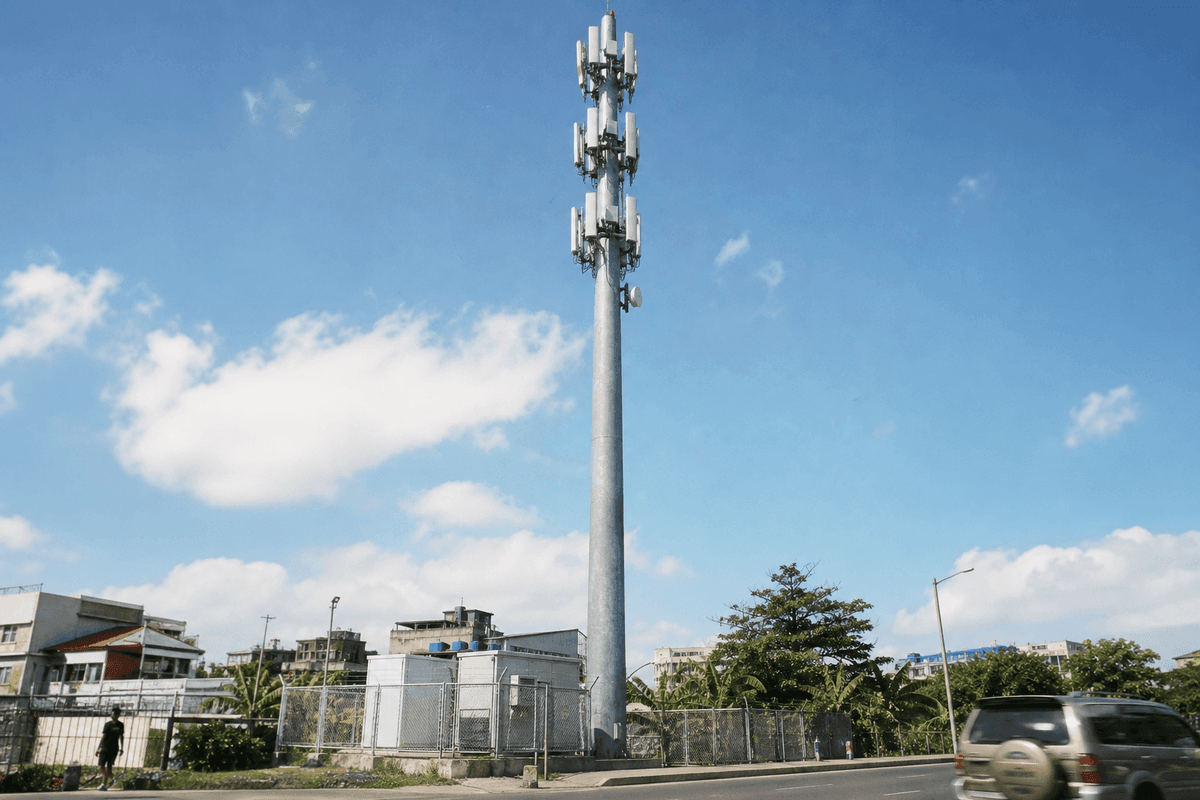
The recommended structure is a tapered round or octagonal steel tube, manufactured from hot-dip galvanized Q345 steel. The design should use a flanged bolt-on sectional system rather than lattice, FRP, or joint-use pole forms. A flanged sectional monopole is more appropriate for Cebu City's constrained access because it allows CKD shipment, smaller truckloads, and controlled assembly near coastal or roadside sites.
For antenna loading, the Cebu City profile favors the dense urban hotspot configuration: 9 panel antennas, 6 RRUs, and 3 small cells. This is stronger than a single-tier rural site because barangays such as Guadalupe and Lahug need capacity layers, not just basic signal presence. A 30m height gives enough clearance for regional macro coverage while avoiding the visual and foundation burden of a 40m or 45m tower.
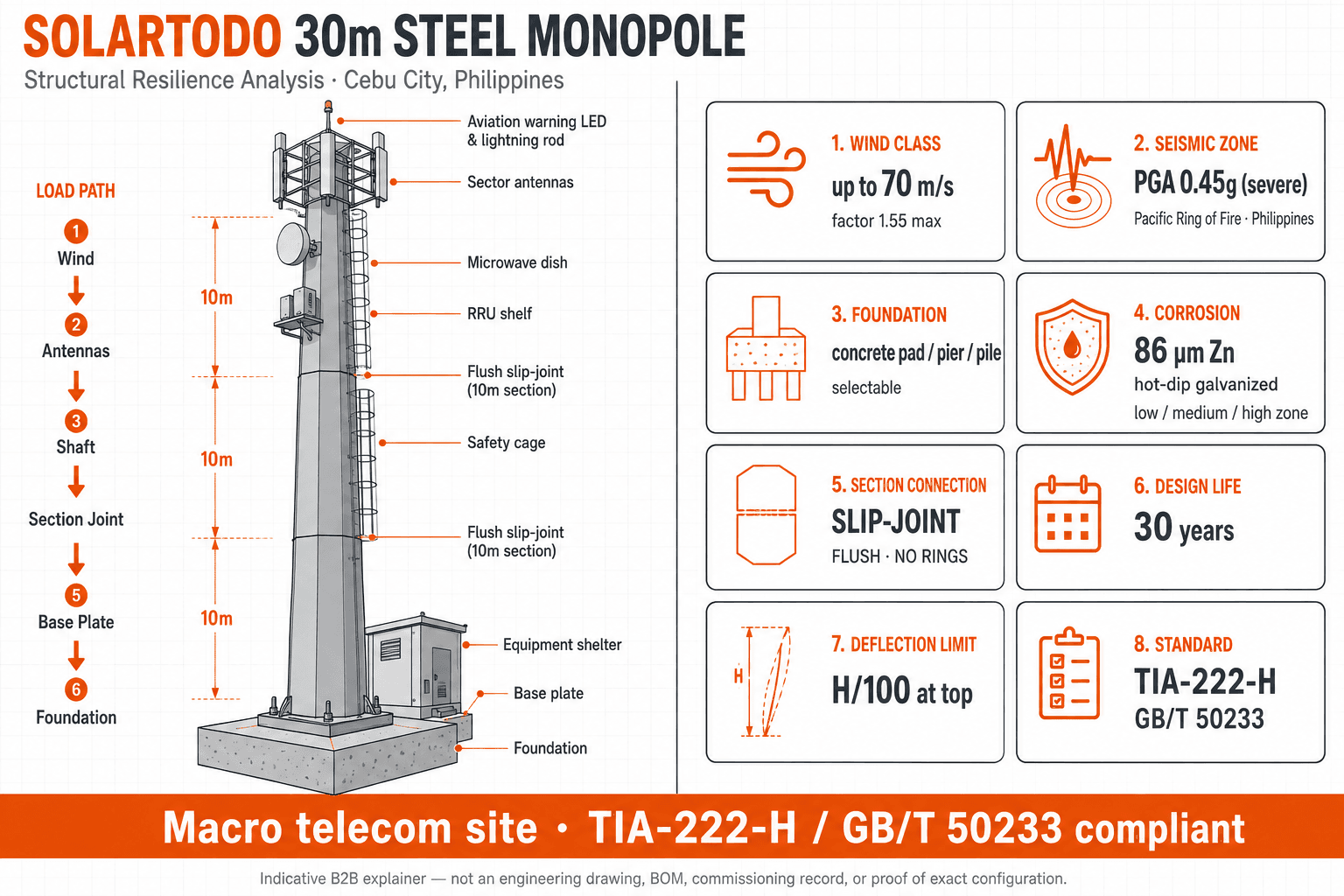
SOLARTODO would recommend Wind Class 1 for the stated configuration: 40 m/s with factor 1.0 per TIA-222-H design logic, subject to site-specific confirmation by licensed structural engineers. The baseline corrosion zone is medium, but sites within direct salt spray or flood-prone drainage corridors should receive coating inspection plans, sealed interfaces, and more frequent bolt checks.
Technical Specifications
The Cebu City specification is a 30m, 15t, Q345 galvanized steel monopole with 2 platforms and a 9-panel dense urban antenna load.
- Product: SOLARTODO Telecom Tower, steel monopole form only.
- Quantity: approximately 9 units for this city-profile configuration.
- Height: 30m tapered round or octagonal steel tube.
- Size class: 25-35m, suburban/residential, 2 platforms, 6-9 panel antennas, 15-22t per tower.
- Weight: about 15t per tower, based on the engineering rule of 500kg/m x 30m.
- Material: hot-dip galvanized Q345 steel.
- Connection: flanged bolt-on sectional design for CKD shipping and controlled erection.
- Antenna load: 9 panel antennas, 6 RRUs, and 3 small cells per tower.
- Foundation: concrete pad foundation, subject to geotechnical bearing checks and drainage assessment.
- Wind class: Class 1, 40 m/s, factor 1.0 per TIA-222-H basis.
- Corrosion zone: medium, with coastal salt-air inspection allowances.
- Accessories: climbing ladder, cable tray, aircraft warning light, grounding system, lightning rod, 2 antenna platforms, and safety cage.
- Design life: 30 years with periodic structural inspection and coating maintenance.
- Shipment: CKD format, normally reducing shipping volume by 60-70%.
- Production lead time: 30-45 days after approved drawings and fabrication release.
- Applicable references: TIA-222-H for antenna-supporting structures and GB/T 50233 for steel tower construction acceptance principles.
TIA states, "Structural Standard for Antenna Supporting Structures and Antennas," which makes TIA-222-H the correct family of standards for a Telecom Tower rather than a lighting-pole or power-transmission standard. According to KSCE Journal research (2021), TIA-222-H wind analysis affects communication tower member-force evaluation, especially as basic wind speed increases. For Cebu City, final calculations should still consider terrain exposure, nearby buildings, antenna sail area, and equipment eccentricity.
Implementation Approach
A typical Cebu City rollout would sequence 30-45 days of production, CKD ocean delivery, civil works, erection, and commissioning by site batch.
The practical implementation sequence starts with site screening. Candidate parcels should be checked against right-of-way limits, barangay access, flood records, soil bearing capacity, and line-of-sight to adjacent sites. In Cebu's denser old-town streets and port-facing corridors, this step reduces the chance that a technically sound tower becomes difficult to deliver or erect.
Procurement should package the tower as a standards-based supply, not as a vague steel fabrication. The bid file should include general arrangement drawings, foundation loads, antenna loading assumptions, galvanizing requirements, welding inspection requirements, bolt grades, grounding details, and aircraft-warning-light provisions. Where a government agency or utility-linked buyer is involved, RA 9184 documentation discipline helps align technical submittals with BAC review.
Fabrication would proceed after drawings are approved. SOLARTODO's 30-45 day production window fits a 9-unit order when the tower geometry, flange layout, ladder, cable tray, and platform drawings are frozen early. Factory inspection should verify steel grade, galvanizing thickness, weld quality, trial fit-up, packing marks, and CKD bundle labeling.
Logistics should account for Cebu's port advantage and urban delivery constraints. CKD shipping reduces volume by 60-70%, but local handling still needs route planning for sectional steel tubes, crane access, and temporary laydown space. For locations near the port, the corrosion risk begins during storage, so bundles should remain elevated, drained, and inspected before erection.
Installation then moves through excavation, concrete pad foundation, grounding grid, curing period, section lifting, flange bolt tightening, antenna platform installation, and telecom equipment mounting. Commissioning should include verticality checks, bolt torque records, grounding resistance measurements, aircraft warning light tests, cable tray inspection, and as-built documentation.
Expected Performance & ROI
A 9-unit, 30m Telecom Tower plan can improve urban capacity economics by supporting 9 panels, 6 RRUs, and 3 small cells per site.
The core return is infrastructure utilization. A 30m monopole with 2 platforms can support multi-sector 4G/5G equipment and localized small-cell densification while keeping a compact footprint. In a market where World Bank data shows tower counts nearly doubled from 17,850 in 2020 to 35,043 in 2023, tower owners and operators should evaluate ROI through tenancy, lease-up speed, and avoided rooftop limitations.
According to World Bank (2025), mobile internet penetration in the Philippines rose from 45.5% in 2019 to 56.3% in 2022, before reaching 54.1% in 2024. That demand profile favors assets that can host both macro panels and capacity-focused RRUs. A 30-year design life also lets the buyer amortize steel, civil works, and permitting over multiple technology cycles.
Expected payback should be modeled, not promised. A single-tenant tower may recover more slowly, while two or more operators, microwave backhaul, or small-cell co-location can materially improve revenue density. For EPC screening, SOLARTODO typically recommends comparing three cases: conservative 1-tenant occupancy, base 2-tenant occupancy, and upside 3-tenant occupancy with additional RRU or small-cell loading reserved in the structural calculation.
Results and Impact
For Cebu City planning, the expected impact is higher 4G/5G capacity from 9 macro towers without claiming any completed SOLARTODO deployment.
The recommended configuration addresses four local constraints at once. First, the 30m height improves signal clearance in dense barangays without moving into the heavier 35-45m highway class. Second, the 15t tower weight supports practical delivery through port and city routes. Third, the galvanized Q345 steel body is suitable for medium corrosion exposure. Fourth, the 9-panel plus RRU plus small-cell load profile supports both coverage and capacity.
The public-sector impact is also procurement clarity. A buyer can issue a bill of quantities around tower height, steel grade, accessories, foundation type, wind class, and standards rather than relying on ambiguous tower descriptions. That matters in Cebu City because urban sites may involve separate stakeholders for road access, local permits, power connection, and telecom equipment.
Comparison Table
The 30m Cebu City configuration fits the 25-35m class, while taller 35-45m towers are better reserved for highway and peri-urban corridors.
| Option | Best fit | Antenna load | Approx. tower weight | Cebu City fit |
|---|---|---|---|---|
| 25m monopole | Rooftop edge or tight urban infill | 3-6 panels | 12.5t | Lower visual profile, less clearance for mixed macro and small-cell load |
| 30m SOLARTODO Telecom Tower | Dense urban and regional macro | 9 panels + 6 RRUs + 3 small cells | 15t | Recommended balance for Cebu City density, access, and medium corrosion |
| 35m monopole | Residential fringe or lower-density corridors | 6-9 panels + limited microwave | 17.5t | Useful where line-of-sight is constrained by terrain or buildings |
| 40m monopole | Highway or peri-urban backhaul | 6-9 panels + 1-2 microwave dishes | 20t | More reach, but larger foundation and stronger logistics constraints |
| 45m monopole | Wider peri-urban coverage | 9-12 panels | 22.5t | Consider only where site area, permitting, and crane access are adequate |
Compared with lattice towers, the specified monopole has a smaller ground presence and a cleaner city profile. Compared with rooftop sites, it gives the tower owner more control over structural capacity, lease conditions, and equipment access. Compared with FRP or light decorative poles, it is a true telecom-supporting steel structure with defined loading assumptions and a 30-year design life.
Pricing & Quotation
SOLARTODO quotes Cebu City Telecom Tower projects through 3 commercial scopes while keeping engineering specs separate from public article pricing.
SOLARTODO offers three pricing tiers for this product line: FOB Supply (equipment ex-works China), CIF Delivered (including ocean freight and insurance), and EPC Turnkey (fully installed, commissioned, with 1-year warranty). Volume discounts are available for large-scale deployments. Configure your system online for an instant estimate, or request a custom quotation from our engineering team at [email protected].
For Cebu City, quotation inputs should include site coordinates, foundation soil data, wind exposure category, corrosion exposure, antenna schedule, platform elevations, grounding requirements, delivery address, and whether installation is supply-only or EPC. The product reference page is SOLARTODO Telecom Tower, and procurement teams can contact us for drawing-based evaluation.
Frequently Asked Questions
These 10 Cebu City Telecom Tower FAQs cover 30m structure, 15t weight, 40 m/s wind class, timeline, installation, maintenance, ROI, warranty, and pricing scope.
Q1: Why is a 30m Telecom Tower recommended for Cebu City? A 30m monopole fits Cebu City's dense urban and coastal profile because it provides regional macro coverage without the heavier foundation and visibility impact of a 40m or 45m tower. It also matches the 25-35m size class: 2 platforms, 6-9 panels, and 15-22t per tower.
Q2: What is the exact SOLARTODO tower configuration for this guide? The recommended configuration is approximately 9 units of 30m tapered steel monopole towers, each about 15t, using hot-dip galvanized Q345 steel. Each tower carries 9 panel antennas, 6 RRUs, and 3 small cells, with 2 antenna platforms, cable tray, ladder, safety cage, grounding system, lightning rod, and aircraft warning light.
Q3: Is this a completed SOLARTODO project in Cebu City? No. This is a market analysis and technical configuration guide, not a fabricated case study. The article uses public Cebu City and Philippine telecom context to recommend a likely tower specification. It does not claim that SOLARTODO deployed towers, completed installation, served a named client, or delivered a past project in Cebu City.
Q4: What standards should be used for structural design? The tower should be checked against TIA-222-H for antenna-supporting structures and relevant steel tower fabrication and acceptance practices such as GB/T 50233. Final design should also follow local Philippine permitting, civil engineering, grounding, aviation marking, and utility coordination requirements. Site-specific wind, soil, and antenna data remain mandatory.
Q5: How long would procurement and production take? Production is typically 30-45 days after approved drawings, confirmed antenna loading, finalized accessories, and purchase release. Total project duration depends on site acquisition, local permits, geotechnical investigation, foundation curing, ocean freight, customs handling, and contractor availability. A 9-unit rollout is usually planned in batches rather than treating all sites identically.
Q6: What foundation type is recommended for this Cebu City profile? The specified foundation is a concrete pad foundation, suitable for a 30m, 15t monopole when soil bearing capacity and drainage conditions are acceptable. Sites near reclaimed land, waterways, flood-prone streets, or soft coastal soils may require deeper investigation or redesign. The foundation should never be finalized without a geotechnical report.
Q7: How should maintenance be planned in a coastal city? For Cebu City, maintenance should focus on galvanizing condition, flange bolts, drainage around the pad foundation, grounding resistance, ladder and safety cage integrity, cable tray corrosion, and aircraft warning light operation. Medium corrosion exposure is assumed, but waterfront or salt-spray sites should be inspected more frequently, especially after typhoons or heavy monsoon rainfall.
Q8: How does a steel monopole compare with a lattice tower? A steel monopole has a smaller visual and land footprint, which is useful in dense city streets and commercial corridors. A lattice tower may offer high capacity for some rural or large-compound sites, but it needs more ground area. For Cebu City macro coverage, the 30m Q345 monopole is usually the cleaner urban fit.
Q9: What drives ROI or payback for this tower type? ROI depends on tenant count, lease rate, installation cost, civil works, permitting time, backhaul availability, and reserved structural capacity. A 30m monopole with 9 panels, 6 RRUs, and 3 small cells creates better revenue options than a low-capacity pole. Payback should be modeled using 1-, 2-, and 3-tenant scenarios.
Q10: Does SOLARTODO publish EPC prices in this article? No. This guide intentionally avoids public price figures because freight, foundation scope, local contractor costs, permits, corrosion requirements, and antenna loading can change materially by site. SOLARTODO provides FOB Supply, CIF Delivered, and EPC Turnkey quotation scopes after reviewing drawings, delivery terms, civil works, and installation responsibilities.
References
These 7 references support Cebu City's 964,169 population, Philippine 115.3 mobile subscriptions per 100 people, tropical maritime climate, and telecom tower growth.
- Philippine Statistics Authority (2021): 2020 Census reported Cebu City population of 964,169 and Central Visayas population of 8,081,988.
- PAGASA (2024): Climate of the Philippines describes a tropical maritime climate with high temperature, high humidity, abundant rainfall, and a June-November rainy season.
- World Bank (2025): Philippines digital transformation results report states fixed broadband household access was 28% in 2023 and telecom towers increased from 17,850 in 2020 to 35,043 in 2023.
- World Bank / ITU (2026): World Development Indicators series IT.CEL.SETS.P2 reports Philippine mobile cellular subscriptions at 115.29875 per 100 people in 2024.
- ITU (2026): ICT statistics page identifies ITU as the official source for global ICT statistics and provides fixed, mobile, and broadband data series.
- Energy Regulatory Commission (2016): Philippine Distribution Code 2016 identifies 60 Hz as the nominal distribution-system frequency.
- Telecommunications Industry Association (2018): TIA-222-H provides structural criteria for antenna-supporting structures and antennas, including wind-load design basis.
- Cebu City / CLUP planning materials (2013-2022 planning horizon): Cebu City infrastructure context identifies coastal, downtown, upland, seaport, road, drainage, and communication planning constraints relevant to tower siting.
Equipment Deployed
- 9 units x 30m tapered steel monopole Telecom Tower
- Hot-dip galvanized Q345 steel, medium corrosion-zone configuration
- Approx. 15t per tower based on 500kg/m engineering rule
- Wind Class 1: 40 m/s, factor 1.0 per TIA-222-H basis
- Antenna load: 9 panel antennas + 6 RRUs + 3 small cells per tower
- Concrete pad foundation subject to geotechnical confirmation
- 2 antenna platforms per tower
- Climbing ladder + safety cage + cable tray
- Aircraft warning light + grounding system + lightning rod
- Flanged bolt-on sectional design shipped CKD with 60-70% volume reduction