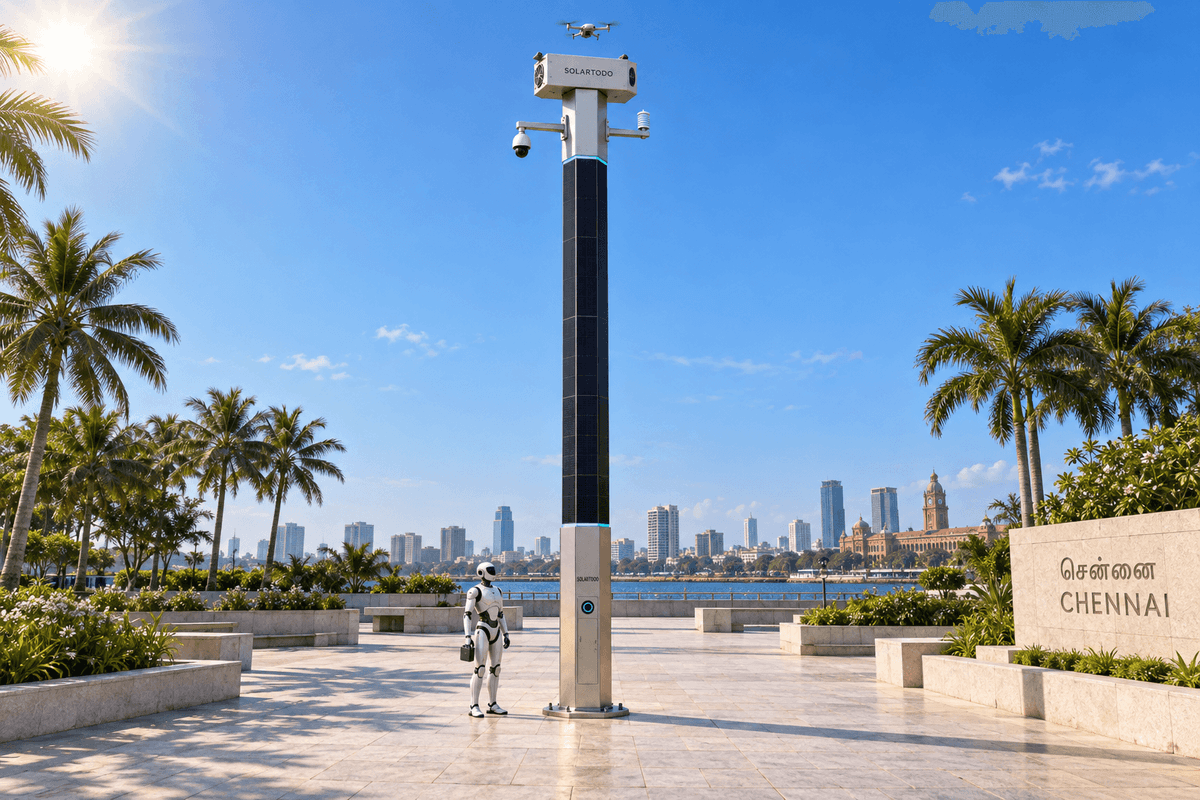
Chennai Coastal Flood and Salt-Air Risk: SOLARTODO Sentinel City AI Pole Configuration for 103 Off-Grid Edge Nodes
Summary
Chennai's coastal AI pole fit centers on 103 off-grid nodes at about 35 m spacing, designed around 1,382.9 mm annual rainfall, roughly 2 m mean land level, and a 10.9 million metro population.
Key Takeaways
For Chennai, a 103-node Sentinel City AI Pole plan should prioritize flood clearance, salt-air protection, local processing, and human-authorized aerial response.
- A typical 103-unit deployment at about 35 m spacing would cover approximately 3.6 km of corridors, campuses, port edges, or civic perimeters.
- According to IMD (1981-2010 normals), Chennai records 1,382.9 mm annual rainfall and 58.8 rainy days, with October-November carrying the heaviest rainfall months.
- According to Greater Chennai Corporation (2026), Chennai's average land level is only about 2.0 m above mean sea level, making plinth height and drainage interfaces critical.
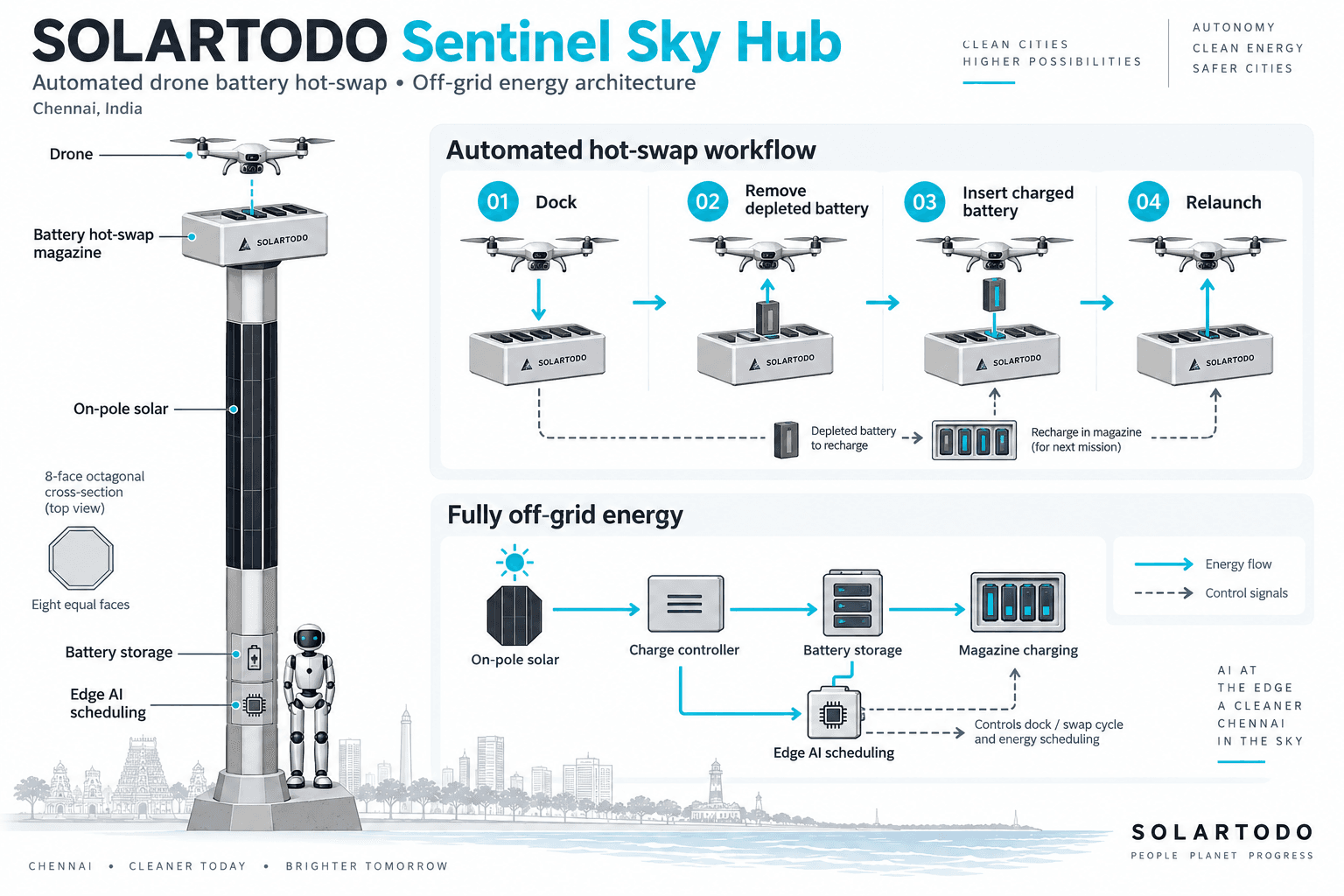
- Each SOLARTODO Sentinel City AI Pole is fully off-grid, using 5-20 kWh-class storage and on-pole solar replenishment for scheduled drone, sensing, and compute loads.
- The recommended edge payload includes anonymous vehicle count, crowd density, intrusion awareness, PM2.5, PM10, wind, humidity, pressure, noise, and illuminance sensing.
- Counter-UAS workflows should remain non-lethal and human-authorized, with detection, tracking, command coordination, and soft net-capture or close-approach deterrence only.
- According to World Bank (2021), the Chennai Metropolitan Area has about 10.9 million people, which supports dense metadata-first command-center integration.
Market Context for Chennai
Chennai needs off-grid edge nodes because its coastal, flood-prone, high-density urban fabric creates monitoring gaps where grid-connected cabinets are difficult to protect.
Chennai is not an inland smart-city environment. It sits on India's southeast coast near the Bay of Bengal, with salt air, cyclone exposure, tidal effects, and intense northeast monsoon rainfall. According to IMD (2010), Chennai's climate normals show annual rainfall of 1,382.9 mm, daily maximum mean temperature of 33.1 degrees C, and May-June maximum means around 37 degrees C. That combination pushes edge equipment toward sealed electronics, elevated service compartments, corrosion-aware hardware selection, and conservative thermal derating.
Greater Chennai Corporation states, 'The flat terrain of Chennai City needs effective Storm Water Drainage System.' According to Greater Chennai Corporation (2026), the Corporation area expanded from 176 sq km to 426 sq km in 2011, and the average land level is only about 2.0 m above mean sea level. Those two facts matter for SOLARTODO because a pole base in Chennai cannot be treated as a generic roadside foundation. Battery and compute compartments should be above expected waterlogging level, cable entries should be upward-looped or sealed, and installation drawings should coordinate with storm-water drains and footpath utilities.
According to World Bank (2021), the Chennai Metropolitan Area is home to about 10.9 million people and is India's fourth-most populous metropolitan area. The same program approved a USD 150 million Chennai City Partnership for water, mobility, health, and solid waste services. World Bank states, 'more green, livable, competitive, and resilient to climate change and other shocks.' That policy language supports distributed edge sensing, but it does not justify surveillance overreach; raw video and sensor data should stay on the pole, with only de-identified event and status metadata sent to command systems.
Chennai also has a municipal procurement context that favors open tenders, staged technical evaluation, and public-service integration. Chennai Smart City Limited listed an international competitive bidding package for Chennai Metropolitan Area Intelligent Transport Systems in 2021-2022, while the Tamil Nadu eProcurement system shows Greater Chennai Corporation service tenders using two-cover and PPP-BoT-annuity structures. For a SOLARTODO Sentinel City AI Pole package, the commercial framing should therefore be technical compliance, lifecycle serviceability, and command-center interoperability rather than a claimed past deployment.
India-specific electrical and standards context still matters even though the pole is fully off-grid. According to BIS (2026), IS 12360:2026 is aligned with IEC 60038:2009 for voltage bands and preferred voltage and frequency, while CEA distribution planning materials cover 33 kV, 22 kV, and 11 kV distribution switchgear and planning topics. The pole should not depend on city or site power, but its earthing, lightning protection, EMC, and maintenance access should be reviewed against Indian practice and local authority requirements.
Recommended Technical Configuration
A typical Chennai configuration would use 103 SOLARTODO Sentinel City AI Poles as off-grid physical-AI edge nodes spaced about 35 m apart.
The recommended size class is the Sky Hub pole-form SOLARTODO Sentinel configuration, not a smart lighting product and not a grid-fed communications mast. The core use case is city edge intelligence across flood-sensitive corridors, transport nodes, waterfront stretches, industrial edges, campuses, and civic perimeters. A typical 103-unit deployment in this profile would be project-based custom engineering, subject to wind, foundation, soil, drainage, and municipal access confirmation.
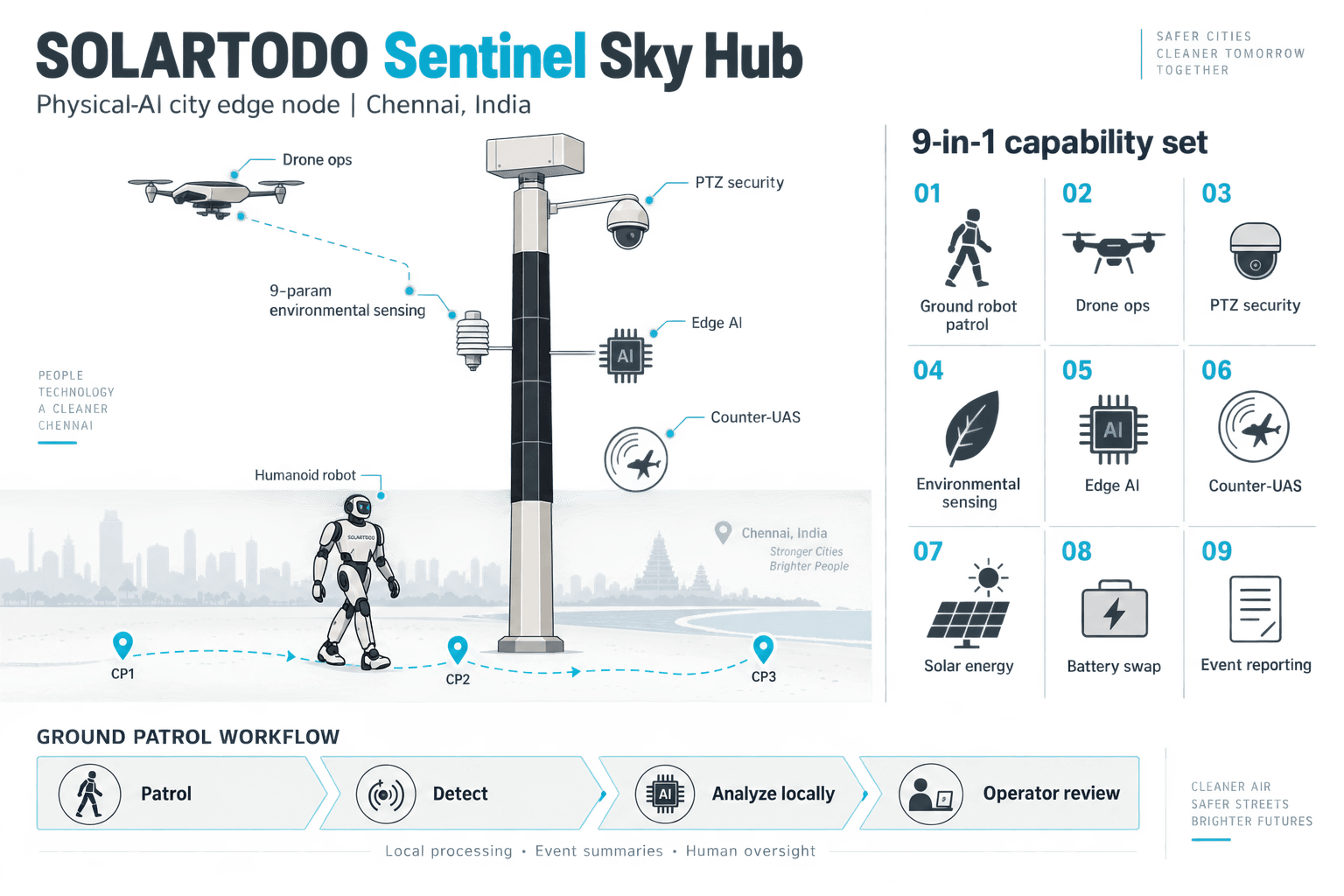
Each pole should operate as a local processing station with edge compute, anonymous scene analytics, environmental sensing, autonomous drone service, ground robot coordination, energy scheduling, and command-view metadata. For Chennai, the configuration should emphasize salt-air resistance, waterlogged-road maintainability, monsoon-safe service access, and thermal control under sustained 30-37 degrees C daytime conditions. SOLARTODO should position the deployment as a resilient edge network that reduces truck rolls and improves inspection cadence, not as a public lighting replacement.
A practical deployment layout would group the 103 nodes into operational clusters of 8-15 poles. Each cluster can share geofenced mission rules, local event taxonomies, maintenance windows, and command-center dashboards. Drone tasks should be duty-cycle scheduled so high-power sorties do not exceed the battery budget during cloudy monsoon periods. Where radar is required for wider-area drone detection, it should be treated as an optional partner-sensor input, not as pole hardware.
Technical Specifications
The 103-node Chennai configuration should combine 5-20 kWh storage, 2.8-3.2 kWp nameplate on-pole PV, local AI inference, and metadata-only uplink.
- Product line: SOLARTODO Sentinel City AI Pole, Sky Hub pole-form physical-AI edge node.
- Quantity assumption: approximately 103 units at about 35 m spacing, subject to final route survey.
- Power architecture: fully off-grid battery-backed micro-station with on-pole solar replenishment; no grid, city, or site power dependency.
- Solar replenishment: about 2.8-3.2 kWp nameplate on the pole body, with realistic clear-sky high-irradiance output around 1.0-1.3 kW DC peak and about 7-10 kWh/day in strong solar regions.
- Storage: 5-20 kWh-class battery buffer sized by mission duty cycle, local climate, sortie frequency, and reserve autonomy target.
- Compute: Jetson-class edge AI module, Orin- or Thor-class depending on workload density, running local inference and workload scheduling.
- Data policy: raw video and raw sensor streams stay on the pole; only de-identified event, health, and status metadata may leave the node.
- Sensing: PTZ visual sensing for anonymous vehicle count, crowd density, intrusion, and perimeter awareness; no active face recognition or licence-plate recognition claim.
- Environment package: wind speed, wind direction, temperature, humidity, atmospheric pressure, noise, PM10, PM2.5, and illuminance.
- Drone workflow: launch, patrol, inspection, return, automated battery exchange, route management, task queueing, fleet health, and mission logs.
- Robot workflow: ground patrol, inspection, alarm response, air-ground coordination, and return-to-base wireless charging.
- C-UAS coordination: detection, tracking, command coordination, and human-authorized soft net-capture or close-approach deterrence; no jamming, shoot-down, hard-kill, or autonomous attack.
- Standards context: review earthing, lightning protection, voltage bands, EMC, and installation practices against BIS IS 12360:2026, IEC 60038:2009, IEC 62305, and applicable Indian authority requirements.
Implementation Approach
A Chennai rollout should proceed in 6 phases, from corridor survey through commissioning, with flood and salt-air checks before acceptance.
The first phase is route and authority mapping. Engineers should identify whether each pole falls near a storm-water drain, footpath utility, transport stop, beach-front exposure zone, heritage street, port perimeter, or dense commercial frontage. According to Greater Chennai Corporation (2026), storm-water drains may include inlets at 10 m intervals and rainwater-harvesting structures at 30 m intervals, so foundation drawings should be coordinated before excavation.
The second phase is geotechnical and civil design. Chennai's low elevation and flood history make plinth height, cabinet ingress protection, uplift resistance, and maintenance access more important than in dry inland cities. Foundations should be designed after soil bearing checks and local wind assessment, and the installation method should avoid blocking drainage inlets or pedestrian movement.
The third phase is factory configuration and CKD logistics. For 103 units, SOLARTODO would typically prepare pole bodies, battery packs, edge-compute cabinets, drone service modules, robot charging interfaces, sensing kits, and communication gateways as project-matched assemblies. Shipping plans should account for Chennai port handling, monsoon scheduling, customs documentation, and phased site storage to reduce street congestion.
The fourth phase is installation and commissioning. Each pole should be erected, sealed, earthed, mechanically inspected, and then commissioned through energy, compute, sensing, drone-service, robot-service, and metadata-uplink tests. Acceptance should validate local data retention, event anonymization, human authorization gates, and command-view integration.
The fifth phase is operations training. Operators should learn the sensing-assessment-response-compute-maintenance loop as a single common operating picture. Human approval rules are essential for C-UAS and regulated response workflows, because detection and tracking do not equal authority to intervene.
The sixth phase is seasonal optimization. After 60-90 days, duty cycles should be adjusted around actual solar replenishment, cloud cover, thermal loads, drone sortie demand, and maintenance findings. This is especially relevant before Chennai's October-December northeast monsoon peak.
Expected Performance & ROI
Expected value comes from faster inspection cycles, reduced manual patrol exposure, and lower trenching work, not from selling energy savings or lighting upgrades.
According to IEA (2026), India's electricity demand is expected to grow at an average 6.4% annually through 2030, while solar PV generation is forecast to rise by 24% per year. For Chennai buyers, that reinforces the logic of off-grid edge equipment: avoiding new grid service points can shorten permitting and reduce dependency on congested roadside electrical infrastructure. It does not mean the pole has unlimited solar self-sufficiency; storage and duty-cycle management remain required.
According to India's Press Information Bureau and MNRE (2026), India had 283.46 GW of non-fossil capacity as of 31 March 2026, including 150.26 GW solar power. That national context supports solar replenishment familiarity in procurement, but SOLARTODO should still size each node as a battery-backed edge station. In Chennai's monsoon season, conservative reserve settings should protect sensing and communications first, then allocate remaining energy to drone and robot tasks.
ROI should be framed around operational substitution and risk reduction. A 103-node edge network can reduce repeated manual inspection trips, support faster verification after flooding or public-space alarms, and preserve evidence summaries without exporting raw streams. Payback should be quoted only after route length, patrol frequency, labor cost, drone sortie schedule, maintenance scope, and local civil works are known. For early budgeting, buyers should request a model comparing baseline patrol cost, incident response time, and avoided trenching against FOB Supply, CIF Delivered, or EPC Turnkey scope.
Results and Impact
A 103-node Chennai plan would create about 3.6 km of dense edge coverage while keeping regulated response human-authorized and data local.
The expected result is a distributed common operating picture for high-density public infrastructure zones. Operators would receive event and health metadata from each pole, including environmental readings, intrusion alerts, anonymous density changes, equipment status, and mission logs. Raw video and raw sensor streams remain on the pole by design, supporting PDPL-LGPD-oriented data handling without claiming certification.
The operational impact is strongest in locations where flood access, salt air, dense streets, or utility congestion make conventional cabinet deployment difficult. The SOLARTODO Sentinel City AI Pole is most relevant for campuses, logistics parks, transport interchanges, beaches, industrial perimeters, port-adjacent zones, and critical infrastructure edges. It should be evaluated as physical-AI infrastructure, not as a generic camera pole or a public lighting asset.
Comparison Table
The 103-node SOLARTODO option differs from grid-fed camera poles by combining off-grid energy, drone service, robot charging, and local inference.
| Evaluation factor | SOLARTODO Sentinel City AI Pole | Conventional grid-fed camera pole | Standalone environmental station |
|---|---|---|---|
| Typical Chennai quantity | 103 nodes | Varies by camera plan | Varies by sensor plan |
| Spacing assumption | About 35 m | Often site-specific | Usually sparse |
| Power model | Fully off-grid, 5-20 kWh storage | Requires site/grid power | Battery or grid, limited loads |
| Solar replenishment | 2.8-3.2 kWp nameplate, scheduled use | Usually none | Small auxiliary panel |
| Local AI processing | Jetson-class inference on pole | Often server-side or NVR-led | Limited analytics |
| Drone operations | Launch, return, hot-swap, task queue | Not integrated | Not integrated |
| Ground robot support | Patrol coordination and wireless return charging | Not integrated | Not integrated |
| Data handling | Raw data stays on pole; metadata leaves | Often streams to central systems | Sensor data upload common |
| C-UAS posture | Non-lethal, human-authorized coordination | Not typical | Not applicable |
| Chennai fit | Coastal, flood-aware, dense-edge operations | Useful for fixed viewing only | Useful for environment trend data only |
Pricing & Quotation
SOLARTODO offers 3 quotation scopes for Chennai: FOB Supply, CIF Delivered, and EPC Turnkey, with final pricing based on engineering confirmation.
SOLARTODO offers three pricing tiers for this product line: FOB Supply (equipment ex-works China), CIF Delivered (including ocean freight and insurance), and EPC Turnkey (fully installed, commissioned, with 1-year warranty). Volume discounts are available for large-scale deployments. Configure your system online for an instant estimate, or request a custom quotation from our engineering team at [email protected].
For Chennai, quotation inputs should include the exact corridor map, foundation constraints, flood-risk notes, salt-air exposure level, drone sortie frequency, robot duty cycle, retention policy, telecom availability, command-center interface, and warranty service model. Buyers evaluating SOLARTODO solutions should request a configuration matrix rather than a generic pole price.
Frequently Asked Questions
These 10 answers cover Chennai technical fit, timeline, ROI, installation, EPC quotation, warranty, maintenance, and comparison for a 103-node deployment.
Q1: Is the SOLARTODO Sentinel City AI Pole a smart streetlight? No. The SOLARTODO Sentinel City AI Pole is a pure smart pole with no lighting system. For Chennai, it should be evaluated as an off-grid physical-AI edge node for sensing, local inference, drone service, robot coordination, environmental monitoring, and human-authorized response workflows. It should not be specified as a luminaire replacement or road-lighting upgrade.
Q2: Why is Chennai a strong fit for this product line? Chennai combines coastal salt air, 1,382.9 mm annual rainfall, low-lying terrain near 2.0 m above mean sea level, dense streets, and major civic infrastructure. A 103-node off-grid edge network can reduce dependence on vulnerable roadside power cabinets while improving situational awareness across corridors, campuses, beaches, industrial edges, and transport-adjacent zones.
Q3: What would a typical deployment timeline look like? A typical 103-unit project would usually require site survey, authority review, civil design, factory configuration, logistics, installation, commissioning, and operator training. The practical timeline depends on permitting, soil conditions, monsoon scheduling, port clearance, and command-center integration. For planning, buyers should separate procurement lead time from foundation and commissioning work packages.
Q4: How should ROI be calculated for Chennai? ROI should be calculated from patrol substitution, faster incident verification, avoided trenching, reduced manual exposure during floods, and lower repeated inspection costs. It should not be based on lighting energy savings. For a 103-node Chennai model, SOLARTODO would need patrol frequency, labor rates, drone sortie plans, civil costs, maintenance scope, and metadata integration requirements.
Q5: How does the off-grid energy system work? Each pole uses battery storage as the main buffer and on-pole solar as a replenishment layer. The reference storage range is 5-20 kWh, with about 2.8-3.2 kWp nameplate solar on the pole body. Drone and robot tasks are scheduled by duty cycle, especially during cloudy or rainy northeast monsoon periods.
Q6: What maintenance is required in Chennai's coastal environment? Maintenance should focus on seal integrity, corrosion inspection, drainage clearance around foundations, battery health, solar surface cleaning, sensor calibration, drone battery magazine checks, robot charging alignment, and firmware updates. Chennai's salt air and monsoon waterlogging make quarterly physical inspection sensible, with additional checks before and after the October-December heavy rainfall period.
Q7: What data leaves the pole? By default, raw video and raw sensor data stay on the pole and are processed locally. Only de-identified event metadata, status alerts, device health, and mission logs should leave the node. This supports PDPL-LGPD-oriented data handling, but it should not be described as certified compliance unless a separate legal and technical audit confirms it.
Q8: Does the pole include counter-UAS capability? Yes, but only in a non-lethal, human-authorized form. The pole can support detection, tracking, command coordination, and tasking of a friendly drone for soft net-capture or close-approach deterrence. It must not be specified for jamming, shoot-down, autonomous attack, hard-kill action, or weaponized response.
Q9: What affects EPC pricing for Chennai? EPC pricing depends on route survey results, foundation design, flood elevation, salt-air protection requirements, logistics, installation access, drone and robot duty cycle, command-center integration, telecom backhaul, warranty scope, and local approvals. SOLARTODO provides FOB Supply, CIF Delivered, and EPC Turnkey tiers, so buyers should request a scope-specific quotation through contact us.
Q10: What warranty model is appropriate? For an EPC Turnkey scope, the required paragraph specifies a 1-year warranty. Chennai buyers may also request extended service terms covering battery health, drone battery exchange modules, sensor calibration, edge-compute diagnostics, and corrosion inspection. Warranty boundaries should distinguish product defects, consumables, civil works, storm damage, misuse, and third-party network failures.
References
These 8 references support Chennai climate, population, flood, procurement, voltage, energy, and standards assumptions used in the 103-node guide.
- India Meteorological Department (2010): Chennai climatological table for 1981-2010 shows 1,382.9 mm annual rainfall, 58.8 rainy days, and 33.1 degrees C mean daily maximum temperature. https://city.imd.gov.in/citywx/extreme/JUL/chennai2.htm
- Greater Chennai Corporation (2026): Storm Water Drain Department notes Chennai's 426 sq km Corporation area, about 2.0 m mean land level, flood vulnerability, and storm-water drain programs. https://chennaicorporation.gov.in/gcc/department/storm-water/
- World Bank (2021): Chennai City Partnership approved USD 150 million and identifies the Chennai Metropolitan Area as about 10.9 million people and climate-vulnerable. https://www.worldbank.org/en/news/press-release/2021/09/30/new-world-bank-project-to-support-southern-indian-city-of-chennai-deliver-better-services-to-its-people
- Bureau of Indian Standards (2026): IS 12360:2026, aligned with IEC 60038:2009, covers voltage bands and preferred voltage and frequency for electrical installations. https://standards.bis.gov.in/website/standard-details
- Central Electricity Authority (2026): Distribution Planning and Technology Division lists distribution network planning criteria and materials for 33 kV, 22 kV, and 11 kV systems. https://cea.nic.in/distribution-planning-and-technology-division/?lang=en
- Tamil Nadu SLDC (2026): Chennai operation-circle substation listings show 400/230-110 kV and 230/110 kV grid infrastructure around Chennai. https://tnebsldc.org/Sslist.aspx
- IEA (2026): Electricity 2026 forecasts India's electricity demand growth at 6.4% annually through 2030 and solar PV generation growth at 24% per year. https://www.iea.org/reports/electricity-2026/supply
- Press Information Bureau, Government of India and MNRE (2026): India reports 283.46 GW non-fossil capacity and 150.26 GW solar power as of 31 March 2026. https://www.pib.gov.in/PressReleasePage.aspx?PRID=2250039
Equipment Deployed
- Approximately 103 SOLARTODO Sentinel City AI Pole Sky Hub edge nodes at about 35 m spacing
- 5-20 kWh-class battery storage per node with duty-cycle-based energy scheduling
- 2.8-3.2 kWp nameplate on-pole solar replenishment per node
- Jetson-class edge AI compute module for local inference and workload scheduling
- PTZ sensing for anonymous vehicle count, crowd density, intrusion, and perimeter awareness
- Nine-parameter environmental sensing: wind speed, wind direction, temperature, humidity, pressure, noise, PM10, PM2.5, illuminance
- Autonomous drone launch, return, task queueing, fleet health, mission logs, and automated battery exchange
- Ground robot patrol coordination and return-to-base wireless charging interface
- Human-authorized non-lethal C-UAS coordination for detection, tracking, soft net-capture, or close-approach deterrence
- Metadata-only command-view integration with raw video and raw sensor data retained on the pole