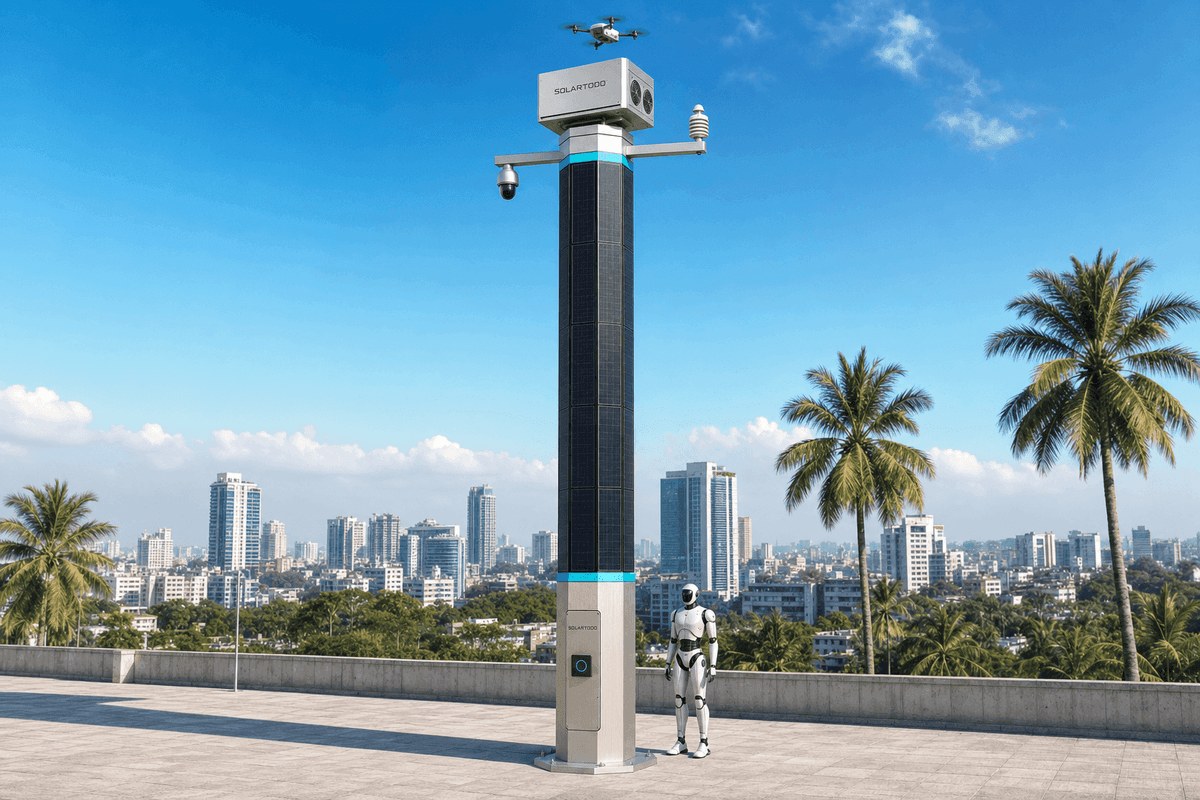
Chittagong flood-salt corridor decisions for SOLARTODO Sentinel City AI Pole: 82-node edge configuration guide
Summary
Chittagong’s 7 million-city coastal setting, July rainfall near 733 mm, and port handling about 90% of Bangladesh maritime trade make an 82-node SOLARTODO Sentinel City AI Pole layout at 35 m spacing a practical off-grid edge-infrastructure profile.
Key Takeaways
- A typical 82-unit deployment at approximately 35 m spacing would cover about 2.87 km of corridor, assuming a single linear alignment before detailed junction engineering.
- Chittagong City Corporation reports an estimated 70 lakh population and 60 sq mi area, so node siting should prioritize port, hill-edge, market and flood-prone access corridors.
- According to WMO/Bangladesh Meteorological Department (2026), Chittagong averages 733 mm rainfall in July and 600 mm in June, requiring sealed cabinets and monsoon access planning.
- Chittagong Port Authority states the port handles about 90% of Bangladesh maritime trade, making logistics continuity and perimeter awareness higher priorities than decorative smart-city hardware.
- The recommended SOLARTODO Sentinel City AI Pole is a pure smart pole with no lighting system, combining edge AI, environmental sensing, drone operations, robot support and local metadata reporting.
- Each node should be specified as fully off-grid with on-pole PV replenishment, 5-20 kWh-class storage, and duty-cycle scheduling for drone and robot activity.
- Bangladesh BPDB lists 33 kV, 11 kV and 11/0.4 kV distribution classes, so the pole should remain electrically independent from utility feeders and avoid grid-interconnection dependency.
- Procurement should align with Bangladesh e-GP practice; BPPA reported 1,18,084 registered tenderers and 1,472 agencies in e-GP by October 2024.
Market Context for Chittagong
Chittagong’s edge-node opportunity is driven by 4 local pressures: coastal corrosion, monsoon flooding, port logistics, and dense municipal procurement governance.
Chittagong, also written Chattogram, is Bangladesh’s primary port city and a high-density commercial gateway rather than a generic inland municipality. According to Chittagong City Corporation (2025), the city corporation covers about 60 square miles and has an estimated population of 70 lakh, or roughly 7 million people. This population and trade role create a strong case for distributed physical-AI nodes around corridors where congestion, intrusion, air quality and logistics disruption have operational value.
The climate is unusually important for product selection. According to WMO/Bangladesh Meteorological Department (2026), Chittagong’s mean daily maximum temperature ranges from about 26.0°C in January to 32.3°C in May, while rainfall rises to 600 mm in June and 733 mm in July. A pole in this market therefore needs corrosion-conscious sealing, controlled condensation paths, and maintenance access that remains workable during monsoon months.
The city is also a coastal and port-side environment. According to Chittagong Port Authority (2017), Chittagong Port is the principal seaport of Bangladesh and handles about 90% of the country’s maritime trade. Salt air, truck traffic, port gates, container yards, hill-adjacent roads and low-lying drainage zones make a fully off-grid node more useful than a grid-dependent device that needs utility trenching in congested corridors.
Bangladesh’s electrical context supports electrical independence. According to Bangladesh Power Development Board (2021), BPDB distribution networks include 33 kV, 11 kV and 11/0.4 kV lines, and Chittagong is one of its distribution zones. The recommended SOLARTODO architecture is not a power-distribution pole and does not connect to those feeders; the relevance is that public works near distribution routes must avoid unnecessary shutdowns, permits and utility interface risk.
Procurement is another local constraint. According to Bangladesh Public Procurement Authority (2024), e-GP had 1,18,084 registered tenderers, 1,472 agencies and 8,68,093 invited tenders valued at USD 107.35 billion by 31 October 2024. For SOLARTODO Sentinel City AI Pole projects, technical schedules should therefore be written as performance requirements: off-grid operation, local processing, event metadata export, C-UAS authorization boundaries, and environmental sensing coverage.
The World Bank also links Bangladesh’s urban infrastructure investment to climate resilience. According to World Bank (2024), a USD 400 million Resilient Urban and Territorial Development Project targets urban management and climate-resilient infrastructure across a 950 km economic corridor benefiting about 17 million people. World Bank states, “Bangladesh is one of the most vulnerable countries to climate change,” which is directly relevant to Chittagong’s coastal-monsoon risk profile.
Recommended Technical Configuration
A typical Chittagong configuration would use 82 SOLARTODO Sentinel City AI Pole nodes at 35 m spacing, with off-grid energy buffering and edge-first data governance.
For Chittagong, the correct product class is the city-ai-pole / physical-AI urban edge node, not a smart streetlight and not a utility power pole. The deployment context specifies approximately 82 units in Sky Hub pole form at about 35 m spacing. That spacing implies about 2.87 km of linear coverage before allowance for road curvature, junction offsets, restricted port-side access and foundation setbacks.
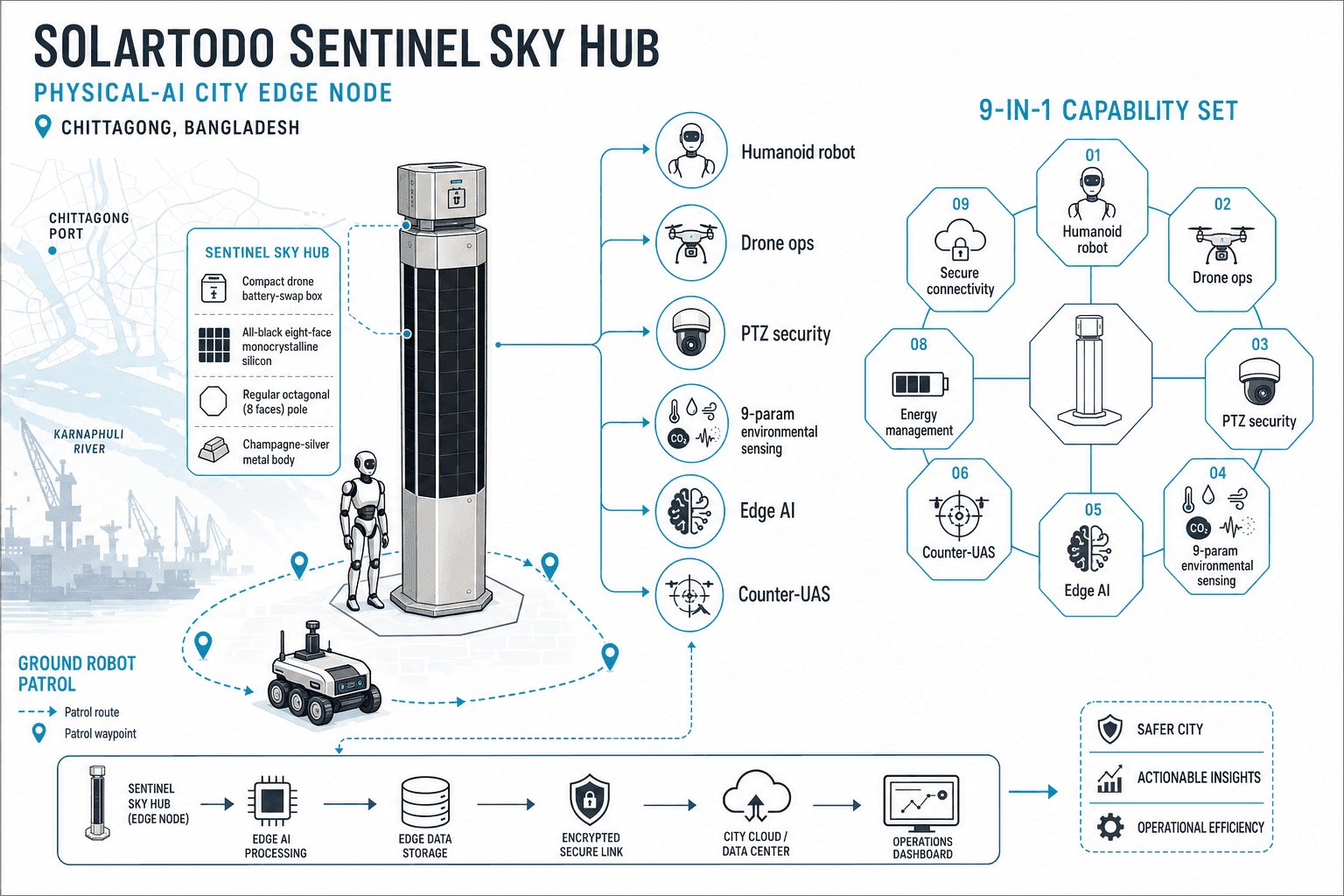
A typical 82-unit deployment in this profile would consist of autonomous edge nodes placed at decision points: port approach roads, logistics queues, bridge or culvert approaches, dense old-town streets, hill-foot drainage routes and industrial-park perimeters. Each pole would process raw video and sensor inputs locally, producing de-identified event and health metadata for the command view. Raw video and raw sensor streams should remain on the pole unless a separately approved local policy requires controlled extraction.
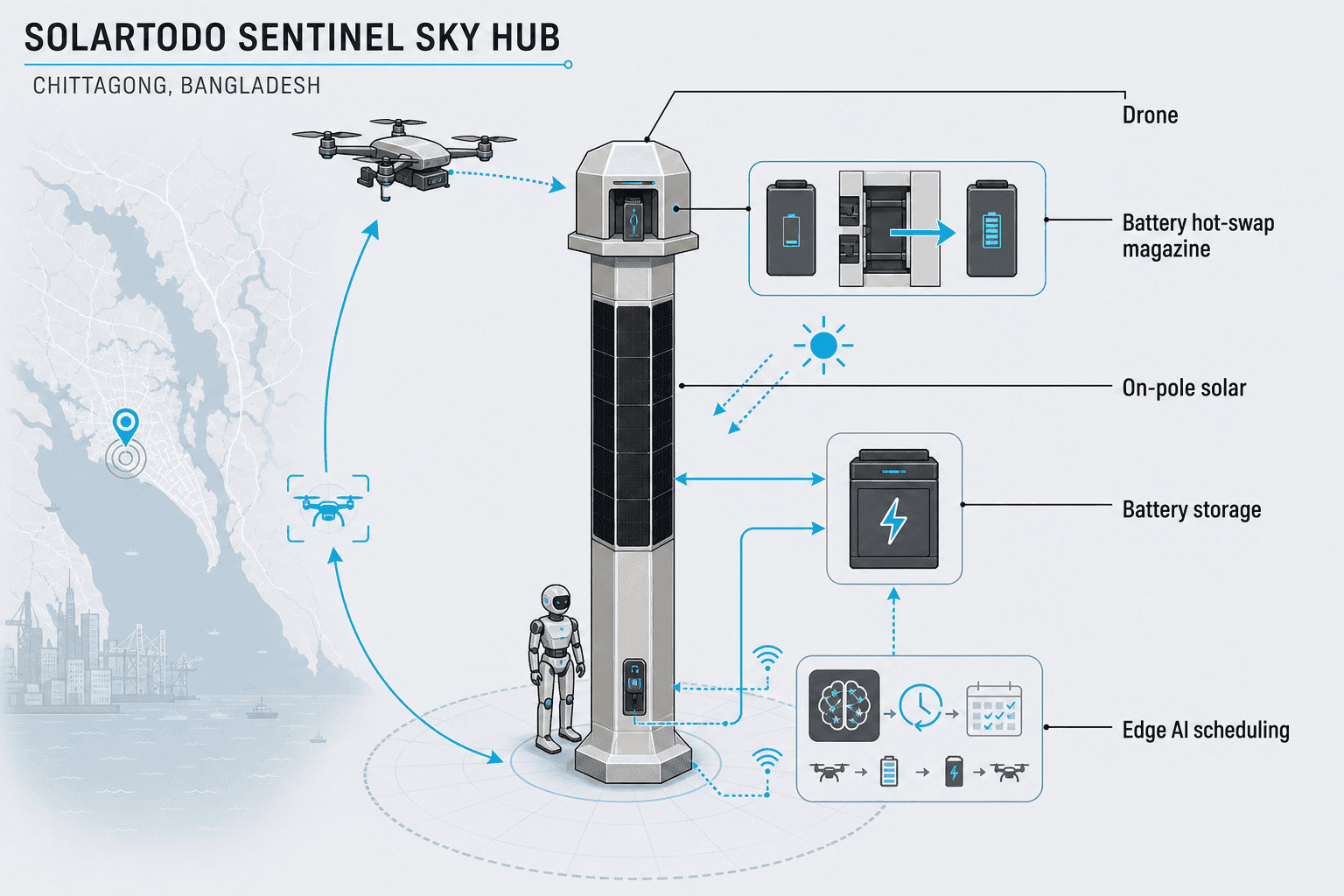
The SOLARTODO Sentinel City AI Pole should be specified as fully off-grid, with on-pole PV used as a replenishment layer and storage used as the operating buffer. This matters in Chittagong because trenching, feeder coordination and municipal right-of-way works can slow implementation. The design assumption should be conservative: mission frequency, drone battery exchanges, robot charging windows and high-compute analytics are scheduled by duty cycle, not treated as unlimited solar-only operation.
The recommended capability set includes local perception for anonymous vehicle count, crowd-density estimation, intrusion detection and perimeter awareness. It also includes nine-parameter environmental monitoring: wind speed, wind direction, temperature, humidity, atmospheric pressure, noise, PM10, PM2.5 and illuminance. C-UAS functions should be written as non-lethal, human-authorized workflows: detection, tracking, command coordination, soft aerial net-capture or close-approach deterrence, with optional partner radar input only where procured separately.
Technical Specifications
The 82-node Chittagong specification should combine local AI processing, 5-20 kWh-class storage, 2.8-3.2 kWp PV nameplate replenishment and nine-parameter environmental sensing.
- Product: SOLARTODO Sentinel City AI Pole, Sky Hub pole-form physical-AI city edge node.
- Product type: pure smart pole with no lighting system and no dependence on city, grid or site power.
- Quantity basis: approximately 82 units, project-based custom configuration, subject to engineering confirmation.
- Spacing basis: approximately 35 m, equal to about 2.87 km of single-corridor node spacing before field adjustment.
- Energy architecture: on-pole PV replenishment plus 5-20 kWh-class battery storage, scheduled by workload duty cycle.
- PV design basis: approximately 2.8-3.2 kWp nameplate integrated PV surface, with local monsoon and shading derating confirmed during engineering.
- Compute: Jetson-class edge AI module for on-pole inference, workload scheduling and mission state management.
- Data handling: raw video and raw sensor data stay on the pole; only de-identified event and status metadata may leave the node.
- Drone operations: autonomous launch, patrol, inspection, return, task redeployment and automated battery hot-swap through a multi-bay magazine.
- Robot operations: ground robot patrol, alarm response, inspection, air-ground coordination and wireless charging at the pole base.
- Environmental sensing: wind speed, wind direction, temperature, humidity, atmospheric pressure, noise, PM10, PM2.5 and illuminance.
- Security sensing: PTZ perception for anonymous vehicle count, crowd density, intrusion and perimeter awareness; no face or licence-plate recognition claims.
- C-UAS coordination: non-lethal, human-authorized detection, tracking and response coordination; no jamming, shoot-down, autonomous attack or hard-kill wording.
- Optional sensor integration: partner radar may be used as an external input; radar is not specified as pole hardware.
- Battery standard reference: IEC 62619:2022 for industrial secondary lithium battery safety requirements.
- Smart-city reference: ITU-T smart sustainable city guidance for ICT-enabled service efficiency and quality-of-life improvements.
According to IEC (2022), IEC 62619 specifies safety requirements and tests for secondary lithium cells and batteries used in industrial applications, including stationary applications. IEC states, “Safety requirements for secondary lithium cells and batteries” in its 62619 scope, which is the correct class for pole-side storage specifications. For Chittagong, the commercial schedule should require compliance evidence from suppliers rather than treating battery safety as a marketing note.
According to ITU (2016), a smart sustainable city uses ICT and other means to improve quality of life, service efficiency and competitiveness. ITU states, “uses information and communication technologies (ICTs) and other means to improve quality of life,” which supports edge-node deployment as an infrastructure-management layer. The SOLARTODO design should therefore be evaluated by operational workflows, not by decorative urban-furniture features.
Implementation Approach
An 82-node Chittagong rollout should be phased across 5 workstreams: survey, procurement, logistics, civil works, and commissioning acceptance.
The first phase is corridor and risk mapping. Survey teams would confirm drainage level, salt exposure, right-of-way width, buried services, telecom backhaul availability, port security boundaries and truck-turning conflicts. In old-town streets, the main issue is not pole height; it is foundation access, cable avoidance, lifting equipment movement and keeping market traffic open during works.
The second phase is procurement documentation. Bangladesh public-sector buyers typically need clear technical schedules, acceptance criteria and warranty obligations. According to BPPA (2024), Bangladesh’s e-GP process is mandatory for public agencies and is intended to improve transparency and efficiency. For a SOLARTODO Sentinel City AI Pole tender, the schedule should define local data processing, no raw-data export by default, battery safety evidence, corrosion protection, and human-authorized C-UAS workflow boundaries.
The third phase is shipping and staging. A practical approach would use CKD or SKD logistics where permitted, staging nodes outside congested streets before final delivery by corridor segment. Chittagong has port access advantages, but the same port-zone traffic can make daytime lifting inefficient. Night works or short possession windows may be needed near container routes, schools, hospitals and market streets.
The fourth phase is foundation, erection and commissioning. Each node should be installed with foundation design adapted to local soil, drainage and wind exposure, then commissioned for battery health, PV input, camera field validation, environmental sensor calibration, drone bay state machine, robot charging and command-view metadata. Acceptance should test monsoon-mode operations, offline buffering and recovery after communications interruption.
Expected Performance & ROI
A Chittagong 82-node system would be assessed by avoided trenching, faster inspection cycles, lower patrol labor exposure and improved incident response metadata, not electricity resale.
The return model should be framed as operational risk reduction and lifecycle-cost control. Fully off-grid nodes avoid feeder connection work, utility shutdown coordination and recurring site-power disputes. In a coastal city with June-July rainfall above 1,300 mm combined, the value of local processing and local storage is continuity during weather and congestion events.
According to World Bank (2023), Bangladesh reached 99.5% access to electricity, but high access does not remove the need for resilient edge systems in exposed corridors. A grid-available city can still benefit from off-grid equipment where trenching, permitting and outage coordination slow deployment. For buyers, payback should compare avoided patrol hours, fewer manual inspection trips, reduced temporary-power works and faster incident triage over a 5-10 year asset horizon.
According to NREL (2025), resilience planning focuses on continuing energy services and protecting systems during human or natural disruptions. That is the correct lens for the SOLARTODO Sentinel City AI Pole in Chittagong: battery-backed operation, local inference and metadata-only communication help maintain awareness when weather, road access or communications degrade. ROI should be validated in the quotation model using local labor rates, asset-risk value and required sortie frequency.
Results and Impact
A typical 82-node Chittagong configuration would create about 2.87 km of edge coverage and a common operating picture without claiming a past deployment.
The expected impact is a more resilient urban-edge monitoring layer for port-adjacent corridors, flood-prone access roads and municipal assets. Because raw data stays on the pole, command centers receive event summaries, system health, environmental alerts and mission logs instead of continuous raw feeds. That architecture supports PDPL-LGPD-oriented data minimization while leaving final compliance review to local counsel and project authorities.
Operationally, the strongest use cases are periodic drone inspection, perimeter awareness, anonymous traffic and crowd analytics, air-quality monitoring and robot-supported response. The system should not be sold as a general surveillance promise or a law-enforcement replacement. Human authorization remains required for regulated C-UAS response, and any optional partner radar input must be separately scoped, procured and integrated.
Comparison Table
The main Chittagong choice is between 82 off-grid edge nodes, grid-powered CCTV poles, and patrol-only operations across a 2.87 km corridor.
| Evaluation factor | SOLARTODO Sentinel City AI Pole | Conventional grid-powered CCTV pole | Manual patrol-only model |
|---|---|---|---|
| Typical corridor quantity | 82 nodes at ~35 m spacing | 40-80 camera points, site dependent | Patrol beats, not fixed nodes |
| Power model | Fully off-grid, PV replenishment + 5-20 kWh storage | Utility feeder or site power | Vehicle or staff energy cost |
| Raw data handling | Processed locally; metadata leaves node | Often streams to VMS/NVR | Human notes and reports |
| Drone workflow | Launch, patrol, return, battery hot-swap | Not native | Manual drone team if available |
| Robot workflow | Patrol, response, inspection, wireless charging | Not native | Human-only response |
| Environmental data | 9 parameters including PM2.5 and PM10 | Usually absent unless added | Spot measurement only |
| C-UAS boundary | Human-authorized, non-lethal coordination | Usually absent | Visual reporting only |
| Chittagong fit | Strong for salt air, flood access and port corridors | Useful where power and fiber exist | Flexible but labor-intensive |
Pricing & Quotation
SOLARTODO provides 3 commercial paths for Chittagong buyers: FOB Supply, CIF Delivered, and EPC Turnkey, with final pricing based on engineering scope.
SOLARTODO offers three pricing tiers for this product line: FOB Supply (equipment ex-works China), CIF Delivered (including ocean freight and insurance), and EPC Turnkey (fully installed, commissioned, with 1-year warranty). Volume discounts are available for large-scale deployments. Configure your system online for an instant estimate, or request a custom quotation from our engineering team at [email protected].
For a city-ai-pole buyer, the quotation should separate equipment, foundation works, shipping, local lifting, drone/robot options, communications, acceptance testing and operator training. Use the SOLARTODO solutions page for product-line context and contact us for project sizing. No price should be treated as final until site survey, duty-cycle modeling and local civil works are confirmed.
Frequently Asked Questions
A Chittagong buyer should evaluate 10 items before tendering: node count, off-grid storage, data policy, installation access, warranty, maintenance and ROI assumptions.
Q1: Is the SOLARTODO Sentinel City AI Pole a smart streetlight? No. The SOLARTODO Sentinel City AI Pole is a pure smart pole and includes no lighting system. It is designed for edge AI, sensing, drone operations, robot operations, environmental monitoring and command metadata. In Chittagong, this distinction matters because the buying case is port-corridor awareness and resilient field operations, not illumination replacement.
Q2: Why does Chittagong need an off-grid pole if Bangladesh has high electricity access? According to World Bank data, Bangladesh reached 99.5% electricity access in 2023, but grid access is not the same as fast project deployment. Off-grid poles avoid trenching, utility feeder coordination and outage risk. For Chittagong’s port roads, dense streets and flood-prone areas, storage-backed independence can shorten deployment and reduce interface complexity.
Q3: What is the recommended quantity for this Chittagong configuration? The specified market-analysis configuration is approximately 82 SOLARTODO Sentinel City AI Pole nodes at about 35 m spacing. If arranged as one corridor, that equals roughly 2.87 km of coverage. Final node count should be adjusted after field survey for road curvature, gates, junctions, port restrictions, drainage setbacks and foundation access.
Q4: What battery and solar configuration should be used? Each node should use 5-20 kWh-class battery storage with on-pole PV replenishment sized around 2.8-3.2 kWp nameplate. The PV layer is supplemental, not unlimited self-sufficiency. Chittagong’s monsoon cloud cover and shading require duty-cycle scheduling for drone operations, robot charging and AI workloads, confirmed by engineering simulation.
Q5: How long would implementation typically take? A typical 82-node project would usually be planned in phases: survey, procurement, shipping, foundations, erection, commissioning and acceptance. The timeline depends on e-GP tendering, customs, civil access, monsoon windows and corridor permissions. For planning, buyers should separate factory lead time from local foundation work and allow staged commissioning by corridor segment.
Q6: What maintenance is required in coastal Chittagong? Maintenance should focus on salt-air inspection, cabinet sealing, battery health, PV surface cleaning, sensor calibration, drone bay checks, robot charging alignment and software update logs. Monsoon inspections should verify drainage around foundations and condensation control. A practical schedule is monthly remote health review plus field service after severe storms or port-side construction activity.
Q7: How does this compare with conventional CCTV poles? Conventional CCTV poles usually depend on grid power, external recording infrastructure and separate analytics. The SOLARTODO Sentinel City AI Pole processes data locally, keeps raw video on the pole, supports drone and robot operations, and reports de-identified event metadata. It is better suited to corridors needing resilient operations rather than simple camera coverage.
Q8: What ROI or payback should buyers expect? ROI should be calculated from avoided trenching, reduced manual patrol exposure, fewer inspection trips, faster incident triage and improved asset availability. It should not be based on electricity resale or lighting savings. For Chittagong, the strongest payback cases are port-adjacent logistics corridors, flood-prone access roads and sites where repeated patrols are costly.
Q9: What pricing options are available for EPC buyers? SOLARTODO offers FOB Supply, CIF Delivered and EPC Turnkey options for this product line, with volume discounts for larger deployments. EPC pricing should include equipment, shipping, foundations, lifting, commissioning, operator training and a 1-year warranty. Buyers should request a custom quotation because local civil works and duty-cycle requirements strongly affect scope.
Q10: Does the pole include counter-drone capability? The pole supports non-lethal, human-authorized C-UAS coordination: detection, tracking, command coordination, soft aerial net-capture or close-approach deterrence. It does not use jamming, shoot-down, autonomous attack or hard-kill methods. Radar is not built into the pole; any radar feed must be an optional partner-sensor input scoped separately.
References
- Chittagong City Corporation (2025): City profile reports about 60 sq mi current area and approximately 70 lakh population.
- WMO / Bangladesh Meteorological Department (2026): Chittagong climate normals show 26.0-32.3°C monthly mean maxima and July rainfall of 733 mm.
- Chittagong Port Authority (2017): Citizen Charter states Chittagong Port handles about 90% of Bangladesh maritime trade.
- Bangladesh Power Development Board (2021): Distribution network context lists 33 kV, 11 kV and 11/0.4 kV classes and includes Chittagong as a distribution zone.
- Bangladesh Public Procurement Authority (2024): e-GP reform data reports 1,18,084 tenderers, 1,472 agencies and 8,68,093 invited tenders by 31 October 2024.
- World Bank (2024): Bangladesh urban and climate resilience financing includes USD 400 million for resilient urban infrastructure along a 950 km corridor benefiting about 17 million people.
- IEC (2022): IEC 62619:2022 specifies safety requirements for secondary lithium cells and batteries used in industrial and stationary applications.
- ITU (2016): ITU-T smart sustainable city guidance defines ICT-enabled urban systems for improved quality of life, service efficiency and sustainability.
Equipment Deployed
- 82 SOLARTODO Sentinel City AI Pole nodes in Sky Hub pole form
- Approximately 35 m node spacing for about 2.87 km single-corridor coverage
- 5-20 kWh-class on-pole battery storage per node, final size by duty-cycle model
- 2.8-3.2 kWp nameplate on-pole PV replenishment layer per node
- Jetson-class edge AI compute module for local inference and workload scheduling
- Nine-parameter environmental sensor set: wind speed, wind direction, temperature, humidity, pressure, noise, PM10, PM2.5 and illuminance
- Drone operations module with autonomous sortie management and automated battery hot-swap
- Ground robot support with patrol workflow and wireless charging at pole base
- PTZ perception for anonymous vehicle count, crowd density, intrusion and perimeter awareness
- Human-authorized, non-lethal C-UAS coordination workflow with optional partner-sensor input