Summary
For the proposed Córdoba, Argentina, pilot, prepare a placement schedule before approving SOLARTODO soil-node quantities. Base the schedule on surveyed soil differences, representative monitoring locations and the selected crop’s root-zone depth. Córdoba is a proposed site only; the supplied evidence establishes no local survey, installation or operating results.
University of Minnesota Extension describes paired sensors at one-third and two-thirds of crop root-zone depth and at two or more field locations. These recommendations do not specify SOLARTODO equipment quantities. The supplied catalog identifies the product family but provides no exact soil-node model, product PDF, applicable pages or model-specific operating conditions. Obtain those documents and an itemized equipment mapping before final quantity approval.
Key Takeaways
- Document soil differences and the crop root-zone basis before preparing quantities.
- Where contrasting heavy and light textured soils are found, use the extension recommendation to plan separate monitoring.
- Assess representative locations using the extension guidance, and record the reason for each selection.
- Discuss sensing depths at one-third and two-thirds of the documented root zone; confirm installation against the selected manufacturer’s instructions.
- Ask the supplier to distinguish sensing elements, observation locations and communications nodes in the equipment mapping.
- Obtain the exact model, product PDF, applicable pages and operating conditions before approving quantities, power or communications.
Proposed problem
The buyer needs to decide where and at what depths to observe soil moisture before requesting a final equipment count. The supplied catalog establishes no guaranteed farm-area coverage. It therefore provides no basis for calculating node quantities from hectares alone.
The extension source describes placement in relation to representative soils and crop root-zone depth. Applying that guidance requires site information that is absent here: no Córdoba soil survey, selected crop, root-zone measurements, irrigation layout or connectivity test was supplied.
The workflow below proposes procurement deliverables. It does not report completed fieldwork, establish local requirements or demonstrate equipment suitability.
Source-backed product boundary
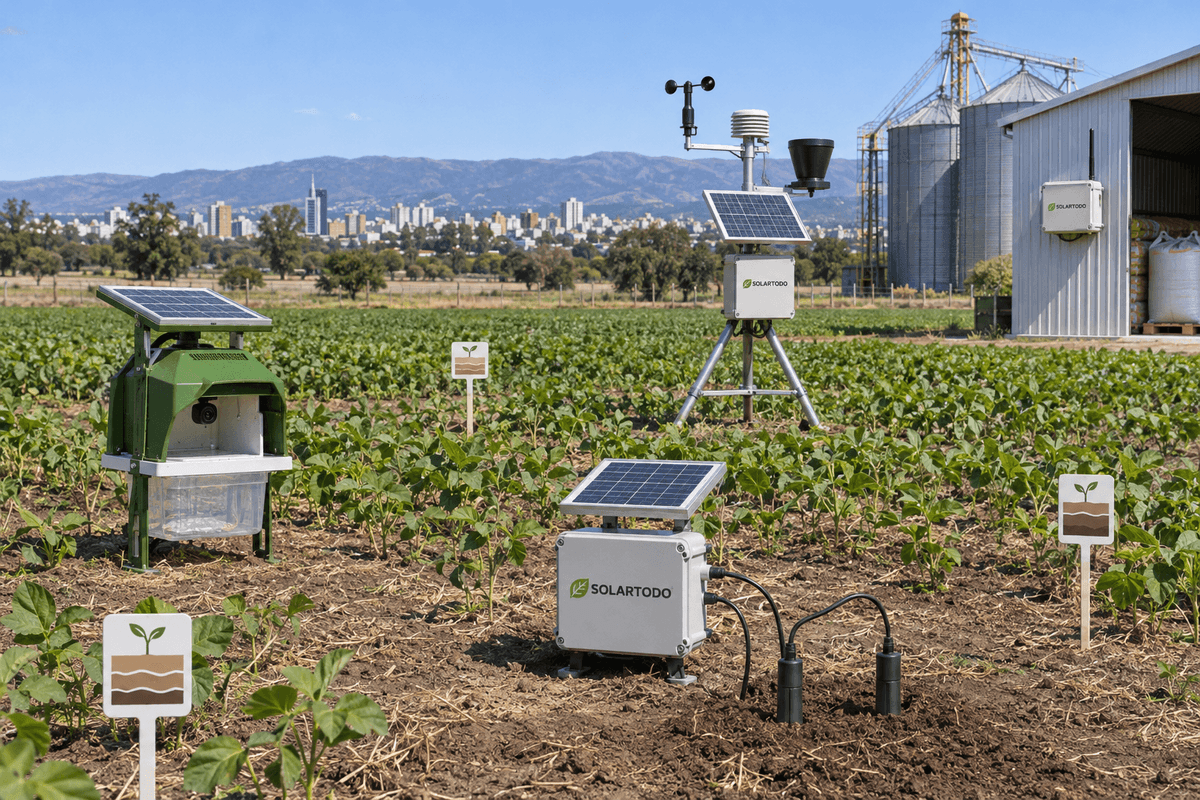
The supplied SOLARTODO smart-agriculture catalog, extraction identity city-catalog-2026-11-01-v1, covers weather, soil, pest, disease, rodent and storage monitoring. Its family-level scope includes sensor nodes, solar power and LoRaWAN or cellular communications. It states that soil sensing and site calibration must be selected for the intended task.
The extraction does not identify an exact soil-node model, measurement principle, supported sensing depths, sensor connection capacity or bundled configuration. Solar power and communications remain catalog options; neither has been selected for this proposal.
No product PDF or PDF URL was supplied. Exact model identification, applicable product pages and model-specific operating conditions remain unavailable. Request these before technical approval. The internal smart-agriculture product page provides product-family navigation.
The supplied catalog establishes no guaranteed farm-area coverage, yield improvement, water saving or prediction accuracy. No such outcome is claimed for the proposed pilot.
Proposed placement workflow
1. Establish the monitoring decision and soil zones
Prepare a buyer brief recording the crop, growth stage, irrigation question, field boundaries and available soil observations. Identify missing information explicitly.
The supplied University of Minnesota Extension article recommends separate monitoring and irrigation management for heavy and light textured soils where both occur in a field. It describes field mapping as a way to identify different soils and create management zones.
For this proposal, request a zone schedule that links each proposed zone to survey evidence. Whether the Córdoba site contains contrasting soils remains unknown. Do not create zones solely to reach a predetermined equipment quantity.
2. Select representative horizontal locations
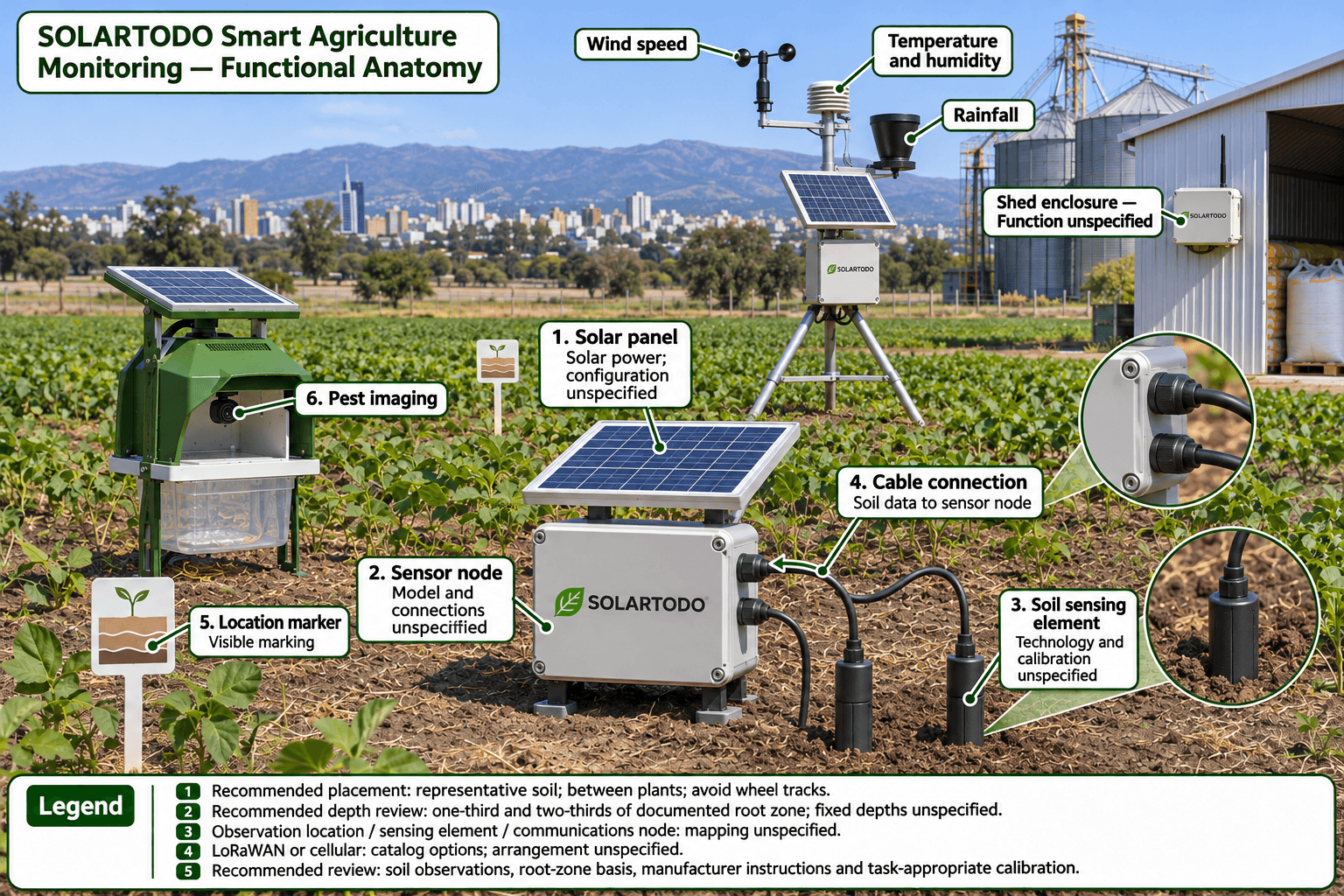
The extension article typically recommends monitoring at two or more field locations, preferably in representative soil away from high points, depressions and slopes. For stationary sensors, it advises placement between plants within a crop row and away from pivot wheel tracks.
Use these recommendations to discuss candidate locations where relevant to the surveyed field and irrigation arrangement. They are not a verified Córdoba layout or a SOLARTODO node specification. Record the observations supporting each proposed location.
If the buyer also wants to investigate an unusual wet or dry area, this proposal suggests recording that diagnostic purpose separately. No such area has been documented at the proposed site.
3. Establish the root-zone basis and candidate depths
The extension article typically describes paired sensors at one-third and two-thirds of crop root-zone depth. It also states that installation depends on sensor design and directs readers to follow the manufacturer’s instructions.
Prepare a depth schedule identifying the crop, the basis for the root-zone depth and the candidate sensing depths. Leave fixed depths unresolved until that basis is documented. Review the proposed depths against the selected model’s installation instructions.
The extension recommendation does not establish whether one SOLARTODO device can measure both depths or whether separate sensing elements or nodes are needed. The supplied catalog does not resolve that relationship.
4. Request an itemized equipment mapping
Send the supplier a placement schedule containing each zone, candidate location, monitoring purpose, root-zone basis and candidate depth. Request an itemized explanation of how the proposed equipment addresses each entry.
Keep observation locations, physical sensing elements and communications nodes distinct in the schedule until model documentation establishes their relationship. Do not translate the extension article’s paired-depth recommendation directly into a node count.
Ask the supplier to identify the exact model, sensing technology, calibration requirements, supported connections, proposed power components and communications arrangement. Require supporting document references for the proposed configuration. The family catalog alone does not establish these details.
5. Review installation requirements
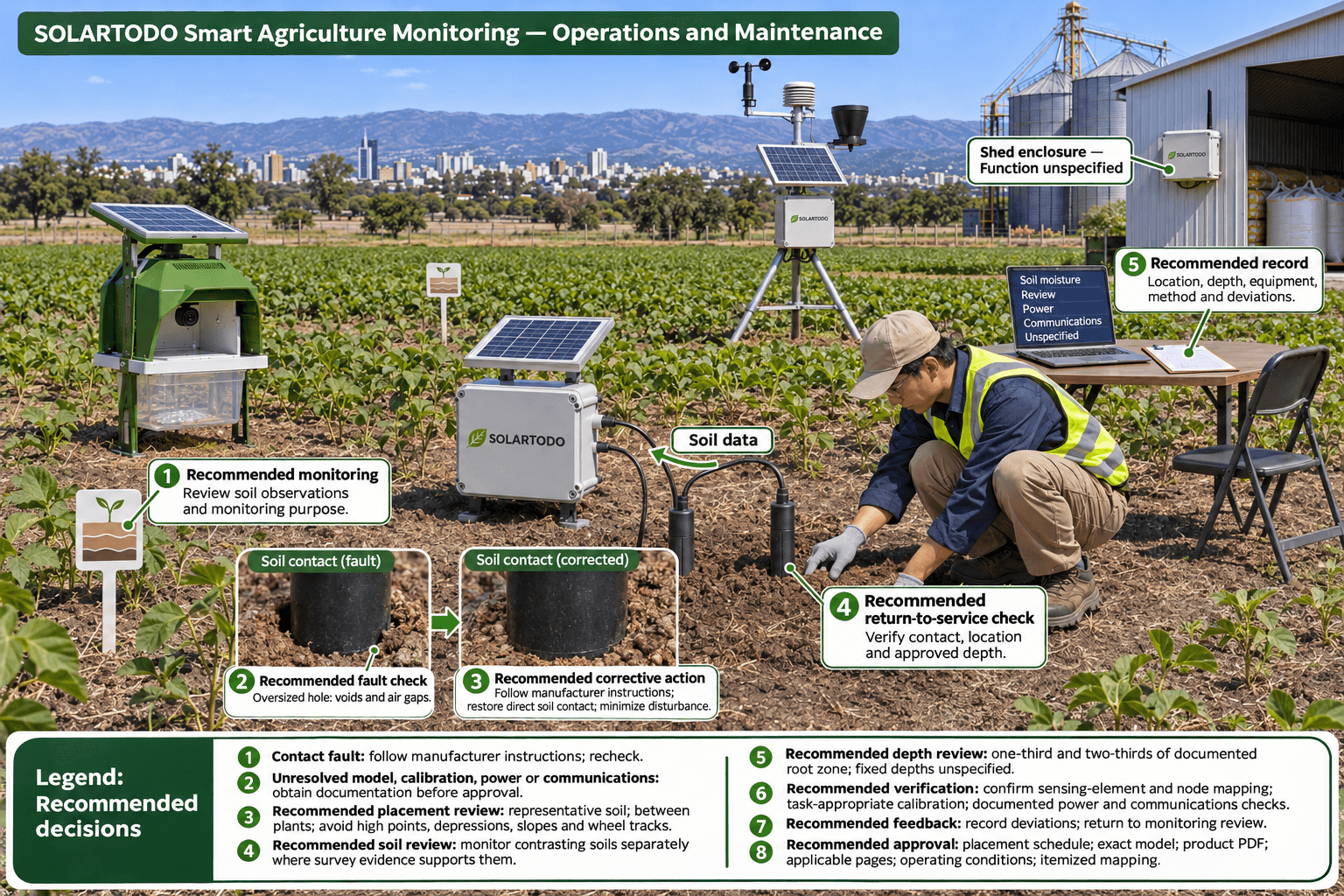
The extension article recommends direct contact between sensor and soil, minimal disturbance during installation and visible marking of sensor locations. It warns that oversized holes can leave voids and air gaps. It also cautions that a soil-and-water slurry can have a different structure from surrounding soil and adversely affect readings.
These are attributed installation considerations, not findings about the Córdoba site or proof of a SOLARTODO installation method. Obtain the exact manufacturer’s instructions before choosing the method.
For the proposed project record, request the approved location, sensing depth, equipment identifier, installation method and any deviations. These are buyer-requested records; no SOLARTODO logging or export capability is established by this request.
Proposed evaluation and approval record
Before ordering, ask the buyer and supplier to agree how the proposed configuration will be evaluated. The following are proposed review questions, with no result or acceptance threshold assumed:
- Placement: Does every proposed location have a documented monitoring purpose and supporting soil observations?
- Depth: Is each candidate depth linked to the documented crop root zone and compatible with the selected manufacturer’s instructions?
- Equipment: Does the itemized mapping explain which sensing elements and nodes serve each location and depth?
- Calibration: What task-appropriate calibration does the selected model require, and what documentation supports that procedure?
- Power and communications: What model documentation and proposed site checks will support the selected arrangement at the intended positions?
The supplied evidence provides no model-specific accuracy tolerance, communications range, power autonomy, logging interval or export function. It supplies no Córdoba test results. Leave equipment performance criteria unresolved until the relevant documentation and buyer requirements are available.
Next purchasing decision
Request the survey-led placement schedule and exact model documentation through SOLARTODO contact. Ask for the product PDF, applicable pages, operating conditions and itemized mapping from locations and depths to equipment.
Review those materials before approving quantities. The extension article supplies general placement and installation context; it does not establish Córdoba-specific requirements or SOLARTODO capabilities. Its examples for other technologies and irrigation calculations are not specifications for this proposal.
FAQ
Is Córdoba an existing deployment in this article?
No. Córdoba, Argentina, is solely the proposed site. The supplied evidence establishes no local survey, installation or operating results.
Can farm area determine the node count?
The supplied catalog establishes no guaranteed farm-area coverage, so it provides no basis for a hectares-per-node calculation. Prepare a placement schedule and obtain a documented equipment mapping before approving quantities.
How should contrasting soil types affect placement?
The extension article recommends separate monitoring and irrigation management where heavy and light textured soils occur in the same field. Survey evidence is needed to determine whether that condition exists at the proposed Córdoba site.
Which sensing depths does the extension article recommend?
It typically describes paired sensors at one-third and two-thirds of crop root-zone depth and at two or more field locations. Establish the crop root-zone basis before choosing fixed depths, and follow the selected manufacturer’s installation instructions.
How should representative and diagnostic locations be distinguished?
The extension article favors representative soil away from high points, depressions and slopes, and advises avoiding pivot wheel tracks. This proposal suggests separately recording any location chosen to investigate an unusual condition; no such condition is documented at the proposed site.
Does each sensing depth require a separate node?
The supplied evidence does not establish that relationship. Request the exact model’s documentation and an itemized mapping of sensing elements, depths, connections and nodes.
What remains unresolved about calibration, power and communications?
The catalog says soil sensing and site calibration must suit the task and lists solar power plus LoRaWAN or cellular communications. Model-specific requirements, the proposed configuration and suitability at the intended Córdoba positions remain unresolved.
What is needed before final quantity approval?
Obtain the placement schedule, exact model, product PDF, applicable pages, operating conditions and itemized equipment mapping. Resolve the proposed configuration and evaluation criteria without assuming guaranteed coverage, water savings or yield gains.
References
- SOLARTODO smart-agriculture catalog: supplied extraction city-catalog-2026-11-01-v1. Establishes product-family scope, task-appropriate selection of soil sensing and site calibration, and the absence of established coverage and outcome guarantees.
- University of Minnesota Extension: Soil moisture sensors for irrigation scheduling: supplied text supports the attributed soil-type, representative-location, paired-depth and installation recommendations.
- Product PDF: no PDF, PDF URL, exact SOLARTODO soil-node model, applicable product pages or model-specific operating conditions were supplied. Model-level technical verification remains pending.
Proposed Equipment
- SOLARTODO soil-monitoring equipment: exact model, sensing arrangement and quantity unresolved pending the placement schedule and model documentation
- Solar power: catalog option; inclusion and configuration unresolved
- LoRaWAN or cellular communications: catalog options; selection, configuration and site suitability unresolved