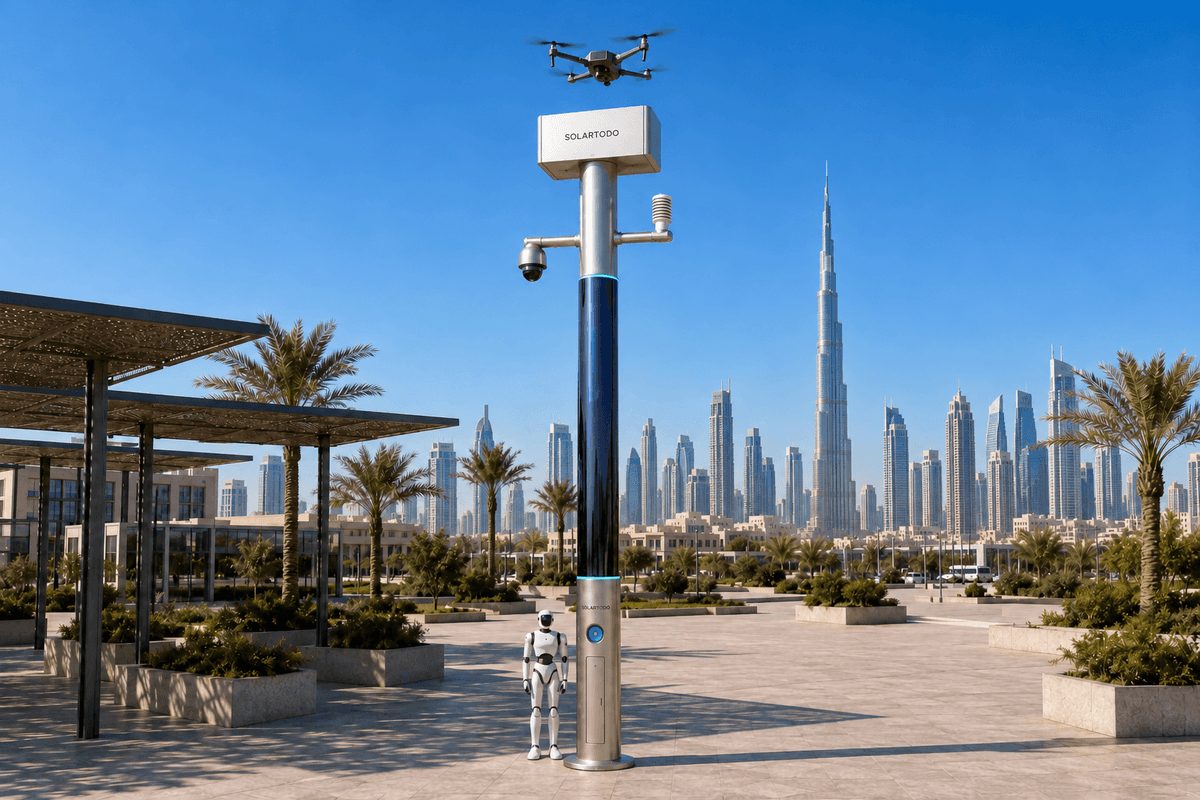
A City AI Pole is a non-lighting physical-AI edge node combining local computing, sensing, communications, energy storage and coordinated drone and ground-robot operations. SOLARTODO Sentinel’s Sky Hub form runs OTATODO at the edge. This proposed Dubai deployment uses fully off-grid nodes along a power-utility campus perimeter to collect evidence locally and coordinate human-authorized security responses.
1. Procurement brief: holiday security at an old-town utility boundary
The procurement task is to strengthen evidence collection along a power-utility campus perimeter in Dubai’s old-town setting during a holiday operating period. The illustrative corridor follows the campus boundary between controlled service access and adjoining pedestrian approaches. It addresses a practical security question: when an alarm occurs near a gate, boundary recess or maintenance entrance, can the duty team establish what happened without repeatedly sending personnel to reconstruct the sequence?
This is a proposed configuration using Sentinel’s in-service capabilities, not a report of a completed Dubai installation. No utility customer, deployment quantity or achieved outcome is asserted. The old-town archetype sets the design priorities: constrained approaches, mixed pedestrian and service movements, sensitive sightlines and careful placement around existing buildings. Holiday activity is a planning trigger for reviewing staffing and access patterns; its actual effect must be established from the buyer’s own records.
The buyer is the utility’s security and operations team, supported by communications, facilities and procurement staff. Its primary pain point is fragmented evidence: separate alarm records, patrol notes and device statuses can leave an investigator uncertain about timing, response authority and equipment availability. The proposed purchase therefore centers on a communications-supported evidence workflow rather than a camera count.
The procurement boundary should identify the campus corridor, permitted observation areas, authorized responders and retention responsibilities before pole locations are finalized. Acceptance should test whether the system replaces defined repetitive work while preserving escalation coverage. Sky Hub is a PURE smart pole with no lighting system. Its purpose here is security sensing, edge computing and coordinated field operations, subject to final engineering confirmation.
2. Proposed corridor configuration: communications make evidence usable
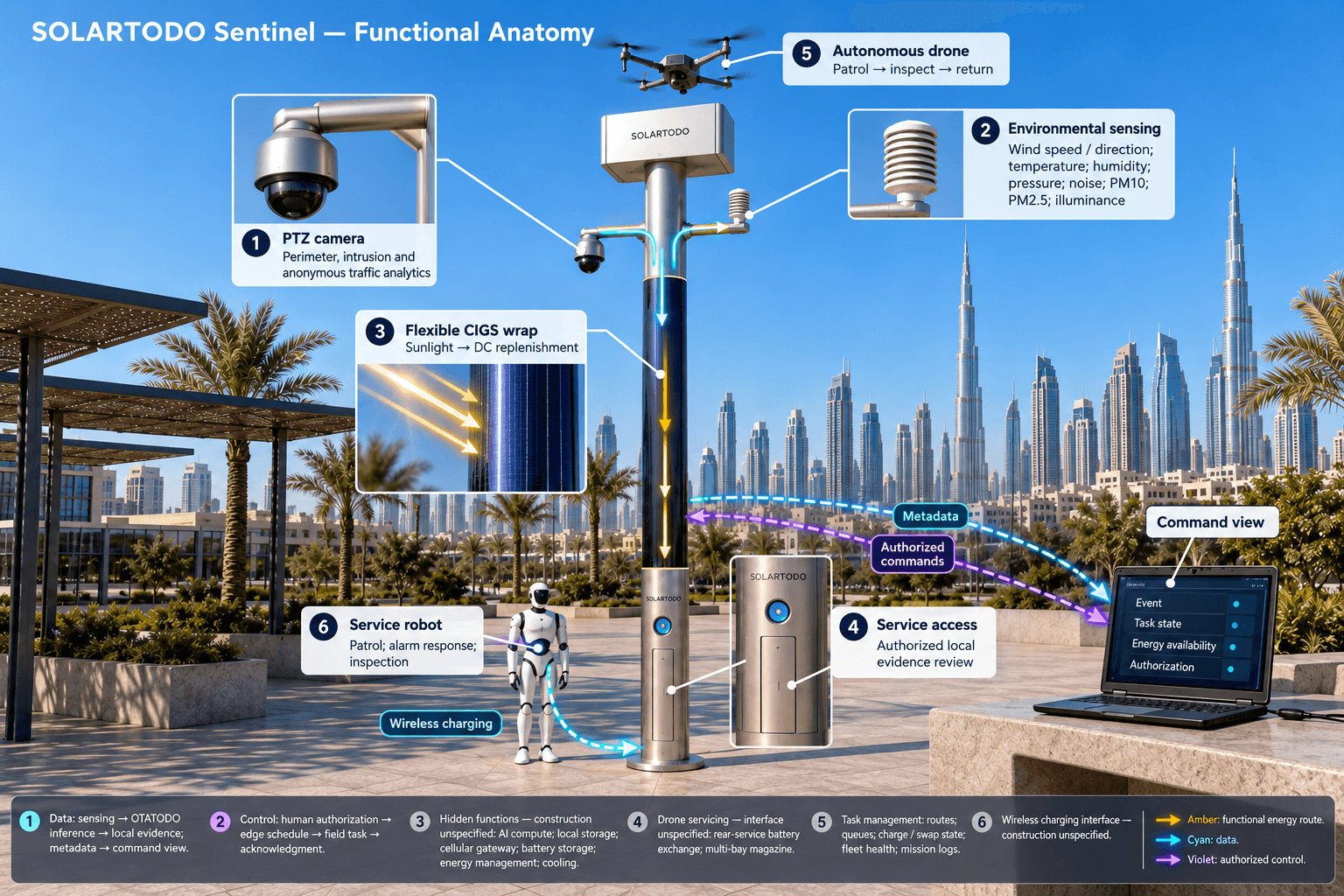
Communications is the organizing module for this deployment. The proposed arrangement connects local sensing, the edge runtime, drone servicing and robot charging into one operational sequence. A secure cellular uplink would carry permitted de-identified event and status metadata to the utility’s common-operating-picture command view. Final radio selection, antenna placement and network arrangements require a corridor survey; no coverage or latency performance is assumed.
Each pole processes and retains raw video and sensor data locally. The remote command view receives event identifiers, de-identified classifications, task states, energy availability and authorization records. It does not receive a raw video stream. Authorized personnel inspect original evidence through controlled access at the pole. This distinction belongs in the tender’s interface specification so an apparently convenient remote-viewing feature cannot silently change the data boundary.
The communications design should require authenticated commands, synchronized timestamps, acknowledgments and explicit handling of missing messages. An instruction being transmitted is different from a field task being accepted or completed. Procurement should require those states to remain distinguishable, including after an interrupted connection. Deferred metadata delivery must preserve the original event sequence without exporting underlying recordings.
The proposed integrated configuration combines the non-lighting pole; autonomous drone launch, patrol, inspection, return and redeployment; automated rear-service battery exchange using a multi-bay magazine; and drone operations management. That management layer coordinates routes, charge and swap states, task queues, fleet health and mission logs. Ground-robot operations add patrol, alarm response, inspection and air-ground coordination, with return to the pole base for wireless charging.
The remaining functions are security sensing, nine-parameter environmental monitoring, on-pole AI compute and human-authorized C-UAS coordination. A PTZ camera supports anonymous vehicle count, crowd density, intrusion and perimeter awareness. Environmental sensing measures wind speed, wind direction, temperature, humidity, atmospheric pressure, noise, PM10, PM2.5 and illuminance. Together, these functions help explain an event and whether a field response was operationally appropriate.
3. Operating case: one incident, one authorized response history
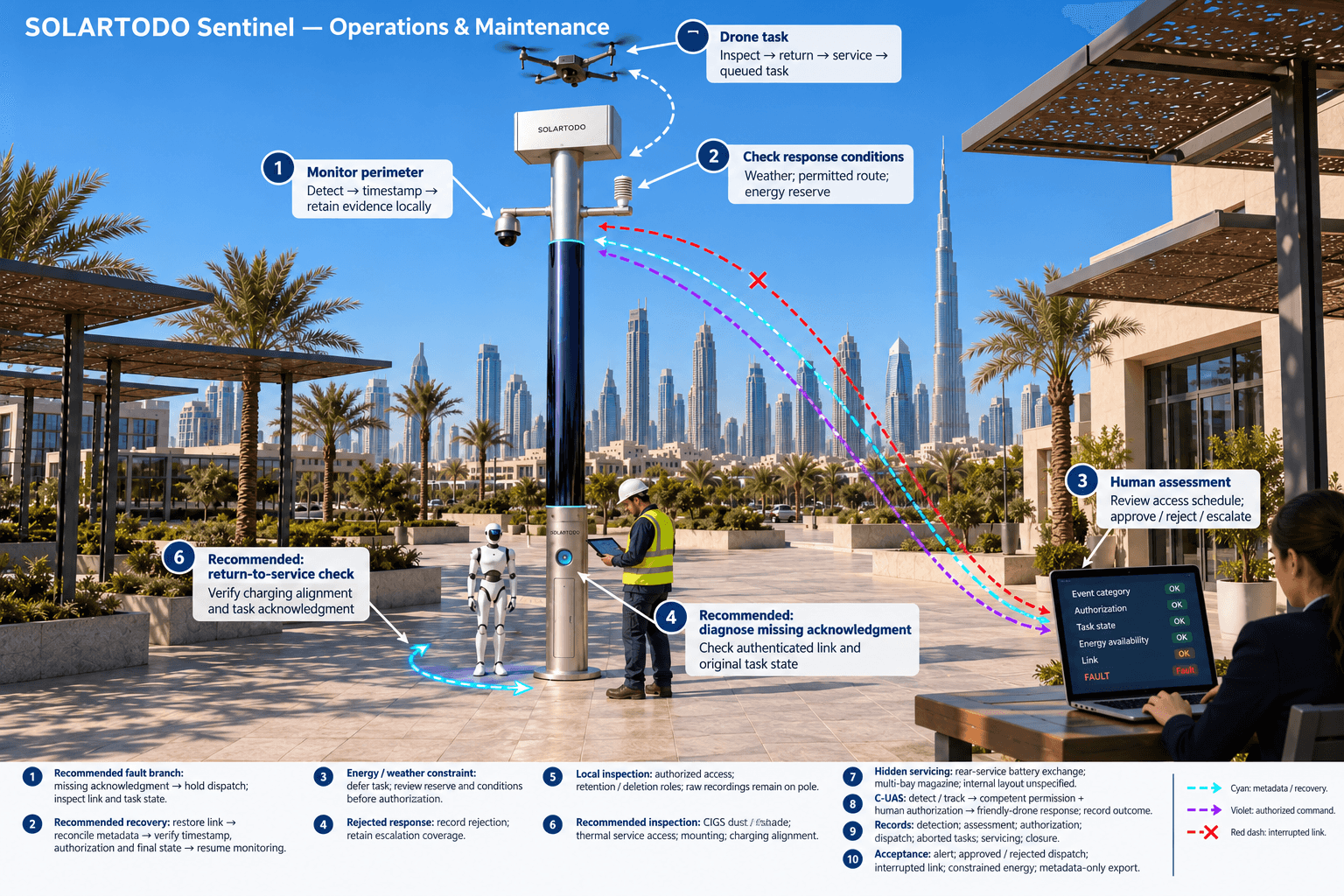
Consider an illustrative holiday-period alert near a campus service entrance. The PTZ camera detects movement across a configured perimeter boundary. Local inference associates the observation with a location and time, distinguishes it from routine anonymous traffic where possible, and creates an event record. The raw recording remains on the pole. De-identified event metadata reaches the common-operating-picture view for assessment by the utility’s authorized duty team.
The operator reviews the event category, access schedule, equipment status and available response options. The system supports the complete loop: sensing, authorized assessment and response, edge-compute scheduling, then field operations and maintenance. The command view keeps the incident and its associated tasks together. Human authorization remains visible as a recorded decision rather than an assumption hidden inside automated scheduling.
For an approved inspection task, the edge runtime schedules a ground robot or an autonomous drone sortie according to route permissions, weather conditions and energy reserve. A service robot can inspect an accessible boundary segment and return to the base for wireless charging. A drone can inspect a permitted perimeter approach, return, receive a charged battery through the automated rear-service exchange and relaunch for another queued task. Multiple magazine bays support consecutive sorties within the available battery and energy budget, without an operator stationed at the pole.
An unauthorized-drone event follows a separate authorization path. Sentinel detects and tracks the aircraft and coordinates the node’s own friendly drone. Where the competent authority permits and a human explicitly authorizes it, the response can involve soft aerial net-capture or close-approach deterrence. The workflow remains non-lethal and human-authorized. Radar is not pole hardware; any radar contribution would be an optional partner-sensor input.
The resulting record links detection, assessment, authorization, dispatch, servicing and closure. Communications failures, aborted tasks and maintenance actions must remain visible alongside successful actions. That history is the procurement objective: less manual reconstruction, with a clearer account of who approved which response and what the equipment actually did.
4. Engineering and information boundaries before purchase
Every proposed node is fully off-grid, using on-pole solar replenishment and battery storage without grid, city or site power. The cylindrical configuration carries approximately 15 m² of 360°-wrapped flexible CIGS thin-film on a body approximately 8 m tall and 0.6 m wide, with about 2.4–2.7 kWp nameplate capacity. Nameplate capacity must not be treated as simultaneous field output from the whole wrap.
A vertical cylinder collects direct sunlight on its sun-facing projection. The supplied high-irradiance reference envelope is approximately 0.8–1.1 kW DC clear-sky peak and 6–9 kWh per day, with peaks typically in mid-morning or afternoon rather than at noon. These figures are an engineering reference, not a verified Dubai yield forecast. Nearby buildings, seasonal shading, heat, dust and maintenance access require site-specific assessment.
Solar is supplemental replenishment for a battery-backed micro-station. Proposed storage is in the 5–20 kWh class, with usable capacity and reserves selected against measured loads. Storage buffers high-power drone and robot tasks; it does not create additional energy. Procurement should require an energy budget covering continuous sensing, communications, compute, cooling, battery exchange and charging. Task duty cycles must fit replenishment and reserve requirements over the assessment period.
Local inference and workload scheduling run on the pole under OTATODO. Raw video and sensor data stay on the pole; only de-identified event and status metadata may leave. The proposed handling is designed for local processing and is PDPL/LGPD-oriented. That describes a design approach, not verified certification or an assertion of existing legal compliance.
Before purchase, the utility should confirm mounting and foundation requirements, thermal design, service access, wireless charging alignment and permitted flight and robot operating boundaries. Local evidence inspection also requires defined access roles, retention periods and deletion procedures. These are engineering and governance acceptance conditions, with final configuration subject to engineering confirmation.
5. Commercial evaluation: replace repetitive labor and verify the evidence chain
The labor-replacement case should target named activities: routine boundary rounds, repeated status calls, manual assembly of incident timelines and avoidable dispatches to check equipment readiness. It should not equate automated patrol with the removal of every security role. Human assessment, authorized response, maintenance and exception handling remain part of the operating model.
The buyer should establish baseline task minutes from its own records, then compare them with the proposed workflow over an agreed evaluation period. Measure routine patrol minutes displaced, evidence-assembly minutes per incident, manual communication handoffs and residual intervention time. Count inspection and maintenance effort added by the nodes. Report net task-hours released separately from staffing decisions, since released time may be reassigned rather than removed from a roster.
Acceptance should include controlled examples of a perimeter alert, an authorized dispatch, a rejected response, a communications interruption and an energy-constrained task. For each, inspect whether timestamps, acknowledgments, authorization and final task states form a consistent record. Verify at the network boundary that only permitted metadata leaves the pole. Review raw evidence locally and confirm that the remote command view supports assessment without depending on raw-data export.
The illustrative calculations below establish a recomputable planning method, not achieved savings or product performance. A purchase decision should depend on observed reductions in the selected manual tasks, acceptable residual workload and a complete local evidence chain. For this Dubai old-town utility corridor, the procurement value is a better-supported holiday security operation: communications connect decisions to field actions, while evidence remains at its source.
System Configuration
| Parameter | Configuration |
|---|---|
| Pole and energy | PURE non-lighting cylindrical smart pole; approximately 8 m tall and 0.6 m wide; fully off-grid with approximately 15 m² wrapped flexible CIGS and 5–20 kWh-class storage. |
| Communications | Proposed secure cellular metadata uplink, authenticated command channel, local device networking and acknowledged task-state messaging; radio configuration subject to survey. |
| Edge compute and evidence | On-pole AI inference and workload scheduling under OTATODO; local raw-video and sensor-data retention; de-identified event/status metadata export only. |
| Security and environment | AI PTZ camera; anonymous perimeter analytics; wind speed/direction, temperature, humidity, pressure, noise, PM10, PM2.5 and illuminance sensing. |
| Drone operations | Autonomous launch/return interface, automated rear-service battery exchange, multi-bay battery magazine and route, task, health and mission management. |
| Robot and C-UAS coordination | Service robot with base wireless charging; unauthorized-drone detection/tracking and human-authorized friendly-drone response coordination; radar excluded from pole hardware. |
How It Works
- On-pole sensing flags a campus-perimeter anomaly and retains the raw evidence locally.
- Edge inference creates a timestamped event and sends only de-identified metadata to the command view.
- An authorized human assesses the event and approves, rejects or escalates the response.
- The edge runtime schedules an approved drone or robot task within route, weather and energy constraints.
- The node records acknowledgments, task outcome, servicing and closure against the original event.
Planning Assumptions (Indicative)
Illustrative planning inputs a buyer can recompute — target metrics, not achieved results. Subject to final engineering confirmation.
| Metric | Planning assumption | Indicative value |
|---|---|---|
| Routine patrol labor replacement | ILLUSTRATIVE ONLY: 6 rounds/day at 20 minutes each; assume 50% of this routine work is displaced over 14 holiday operating days. | 6 × 20 × 0.50 × 14 = 840 minutes, or 14 gross task-hours displaced before residual support. |
| Evidence assembly effort | ILLUSTRATIVE ONLY: 12 reviewable incidents; compare 30 manual minutes with a target of 15 minutes per incident. | 12 × (30 − 15) = 180 minutes, or 3 task-hours potentially released. |
| Manual status handoffs | ILLUSTRATIVE ONLY: 4 handoffs/day at 5 minutes each; assume 50% replacement over 14 days. | 4 × 5 × 0.50 × 14 = 140 minutes of potentially displaced communication work. |
| Residual support allowance | ILLUSTRATIVE ONLY: allocate 20 minutes/day for inspection and exception handling over 14 days, against 840 gross displaced patrol minutes. | 840 − (20 × 14) = 560 minutes, or approximately 9.3 net patrol-related task-hours released. |
Deployed Equipment
- Non-lighting cylindrical Sentinel Sky Hub pole with wrapped flexible CIGS solar replenishment
- Battery storage cabinet with energy management and charging controls
- On-pole AI compute, local evidence storage and secure communications gateway
- PTZ security camera and nine-parameter environmental sensor assembly
- Autonomous drone with rear-service battery interface and multi-bay exchange magazine
- Ground service robot and pole-base wireless charging interface
Frequently Asked Questions
Is this an existing Dubai utility installation?
This article describes a proposed procurement configuration using Sentinel’s in-service capabilities. It does not identify a real customer or claim a completed Dubai deployment. Pole locations, corridor extent, equipment quantities and acceptance criteria must be established with the buyer, subject to final engineering confirmation.
How does the communications module improve evidence collection?
It connects event identifiers, timestamps, authorization records and equipment task states into a common operating picture. The remote team receives de-identified metadata while original recordings remain on the pole. Acknowledgments distinguish an issued command from an accepted or completed task, reducing the manual work required to reconstruct an incident.
Can the wrapped solar layer support unrestricted drone operations?
No. The wrapped CIGS layer provides supplemental replenishment, with the supplied high-irradiance reference of approximately 0.8–1.1 kW DC peak and 6–9 kWh daily. Dubai yield requires site assessment. Battery storage buffers demanding tasks, while scheduling must keep total consumption within replenishment and reserve limits.
What does labor replacement mean in this procurement case?
It means replacing measurable repetitive tasks, such as selected routine patrol rounds, status calls and manual evidence assembly. Evaluation must subtract maintenance and exception-handling effort. The illustrative calculations are planning assumptions, not achieved results, and do not establish that a particular staffing position can be removed.
What authorization applies to counter-UAS response?
Detection and tracking support assessment; they do not independently authorize mitigation. Where permitted by the competent authority, a human can authorize the node’s friendly drone to conduct soft aerial net-capture or close-approach deterrence. The response remains non-lethal, with authorization and task outcomes recorded in the incident history.
Does local processing establish privacy compliance?
Local processing supports a PDPL/LGPD-oriented design, but it does not establish certification or legal compliance. Raw video and sensor data remain on the pole, and only de-identified event/status metadata may leave. The buyer must still define access, retention, deletion, operational responsibilities and applicable governance requirements.
Explore Further
- City AI Pole / smart streetlight product line
- More smart-city deployment cases
- Talk to our engineering team
Planning a similar physical-AI deployment for streets, campuses or public spaces? Request an engineering consultation