Summary
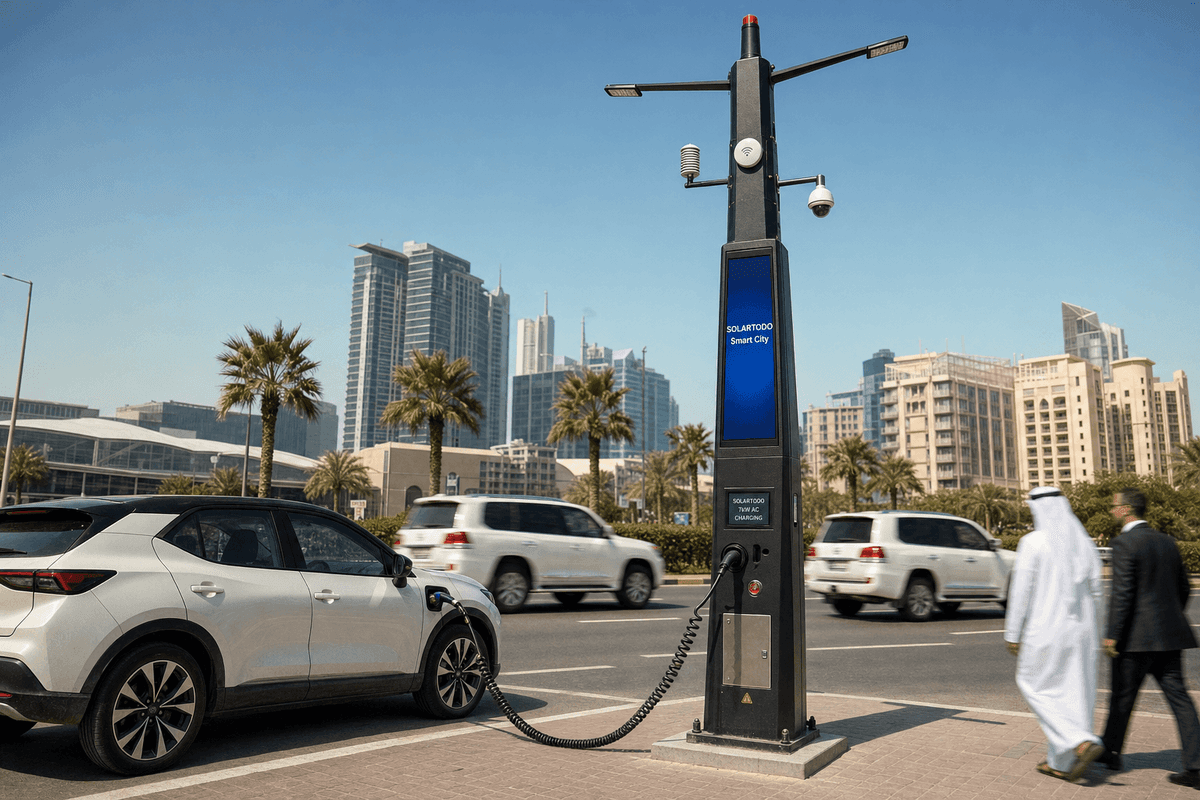
Durban should specify 209 grid-powered SOLARTODO Smart Streetlights: 12 m poles, 30 m spacing, 22 kW Type 2 AC charging, and coastal-grade corrosion protection for humid, high-rainfall streets.
Key Takeaways
Answer Capsule: A Durban Smart Streetlight package should use 12 m poles, 30 m spacing, and 22 kW AC chargers as the baseline.
- Durban’s coastal exposure requires hot-dip galvanizing, RAL9005 powder coating, sealed cable entries, and IP-rated access panels because the Durban Metro coast receives about 1,000-1,200 mm of annual rainfall.
- A 209-pole layout at 30 m spacing covers about 6.27 km of street frontage and provides roughly 33 poles per km for lighting, EV charging, CCTV, WiFi, sensing, and alerts.
- According to Stats SA Census 2022 municipal data, eThekwini has 4,239,901 residents across 2,556 km², or about 1,659 people/km², supporting dense urban pole spacing.
- Each SOLARTODO pole should use 2 x 80 W LED luminaires at 150 lm/W and 4000 K, creating a connected lighting load of about 33.44 kW before dimming.
- Each pole should integrate one 22 kW Type 2 AC charger; 209 chargers create a theoretical peak EV load of about 4.60 MW, so feeder segmentation and load management are mandatory.
- According to eThekwini Electricity (2026), the municipal network is supplied from Eskom at 275 kV into 275/132 kV substations, making grid-powered AC street assets practical for main corridors.
- According to IEC (2024), IEC 60598-1 covers luminaire safety up to 1,000 V, so Durban luminaires should be specified against IEC safety requirements and local SANS sign-off.
- SOLARTODO is strongest for Durban where one foundation must consolidate lighting, EV charging, PTZ surveillance, WiFi 6, public audio, SOS response, environmental sensing, and civic display hardware.
Durban Design Basis
Answer Capsule: Durban’s correct sizing basis is coastal resilience, because 1,000-1,200 mm annual rainfall changes enclosure, coating, foundation, and maintenance requirements.
Durban is a humid Indian Ocean port city, not a dry inland retrofit market. Salt air, summer rainfall, wind-driven moisture, and flood-prone drainage corridors make corrosion resistance more important than decorative pole styling. The Smart Streetlight must therefore be treated as a marine-adjacent public asset with sealed electrical compartments and robust base detailing.
According to the South African Government (1998), the Durban Metro coast has a warm subtropical climate with plentiful rainfall of 1,000-1,200 mm per year, mostly in summer. According to the South African Government (2015), South Africa’s national average annual rainfall is about 464 mm. That contrast justifies hot-dip galvanizing, durable powder coating, stainless fasteners, gasketed charger doors, protected cable glands, and drainage-aware foundations.
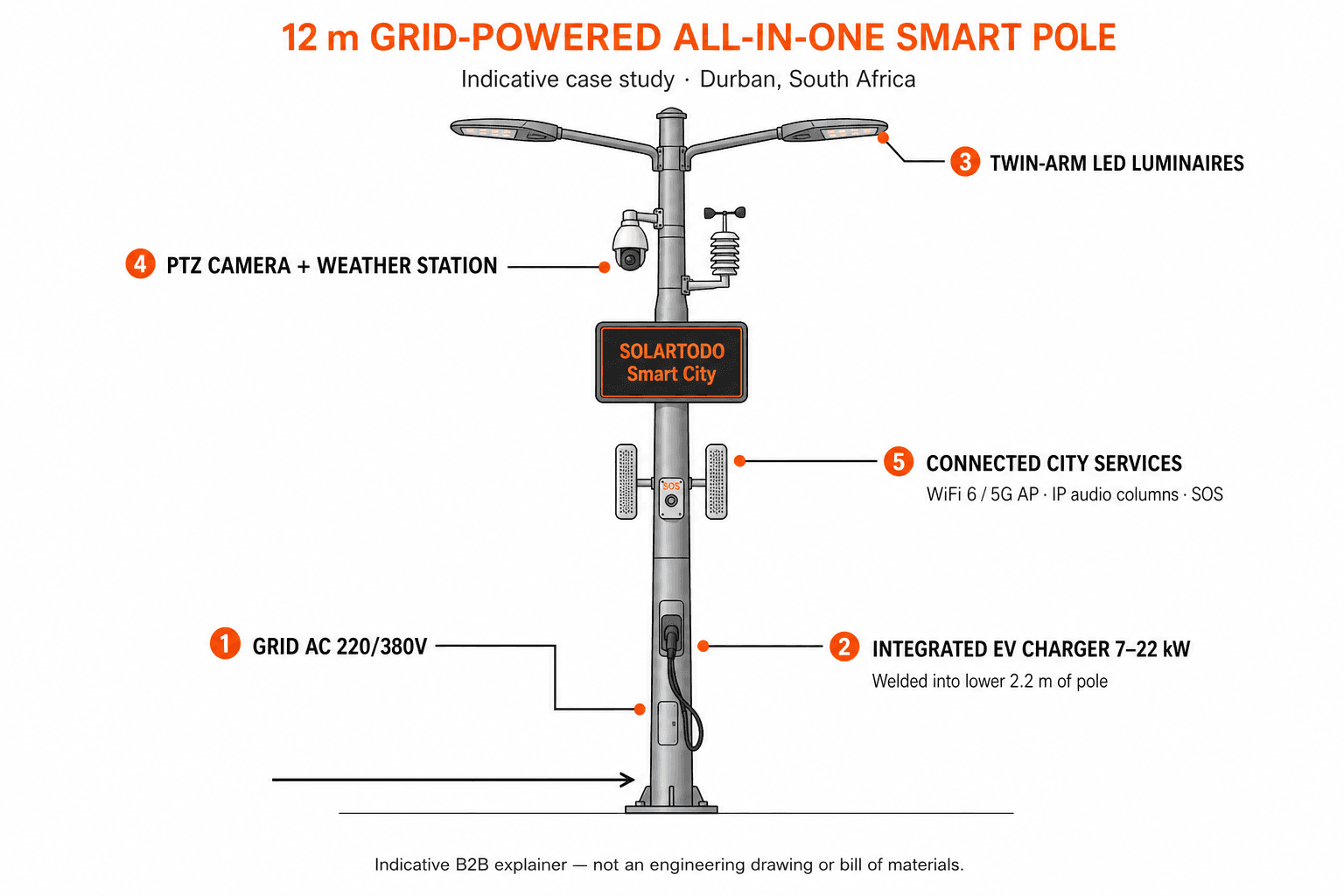
For SOLARTODO, the recommended product fit is the 12 m octagonal tapered steel Smart Streetlight, not a high-mast highway product and not a park-scale garden light. The lower 2.2 m section should act as the integrated EV charging cabinet, reducing pavement clutter while keeping electrical service access inspectable. The pole should remain grid-powered for dense urban corridors where municipal low-voltage supply is available.
Recommended 209-Unit Configuration
Answer Capsule: The recommended Durban package uses 209 grid-powered 12 m SOLARTODO poles, producing 418 luminaires and about 6.27 km of coverage.
The baseline configuration is the SOLARTODO Smart Streetlight grid_12m variant. Each pole is a 12 m octagonal tapered steel structure with a 45 cm base diameter and 15 cm top diameter. The finish should be black RAL9005 powder coat over hot-dip galvanized steel, with coastal inspection intervals defined before procurement.
Each pole should carry twin symmetric 1.5 m arms with +8 degree tilt. Each arm should hold one 80 W LED luminaire at 150 lm/W and 4000 K. Across 209 poles, this gives 418 luminaires and about 33.44 kW of connected lighting load before dimming, scheduling, and adaptive control.
The EV charging package should be one integrated 22 kW single-gun AC charger per pole. It should use a Type 2 connector, 5 m coiled cable, OCPP 1.6J communication, an 8-inch touchscreen at about 1.5 m height, a red mushroom E-stop, and a stainless maintenance door. If all chargers run simultaneously, the maximum charger demand is about 4.60 MW, so load management is not optional.
Electrical And Smart-City Integration
Answer Capsule: Durban electrical integration should align 220/380 V equipment with 230/400 V local practice, OCPP 1.6J, and 4.60 MW peak-load planning.
According to eThekwini Electricity (2026), the city’s electricity network is supplied from Eskom at 275 kV into 275/132 kV substations for onward transmission and distribution. Street-level connection still depends on municipal approvals, metering, protection, feeder capacity, wayleaves, and SANS 10142-1 installation sign-off. The design should include surge protection, residual-current protection, protective earthing, isolation, and power-quality tolerance.
According to IEC (2016), IEC 62196-2 applies to AC EV charging accessories up to 480 V AC and includes Type 2 dimensional compatibility. That makes IEC 62196-2 the right connector reference for a 22 kW AC Type 2 Durban pole charger. According to NREL (2023), Level 1 and Level 2 charging are expected to handle 80% of EV charging duties by 2030, supporting AC curbside charging as a practical urban layer.
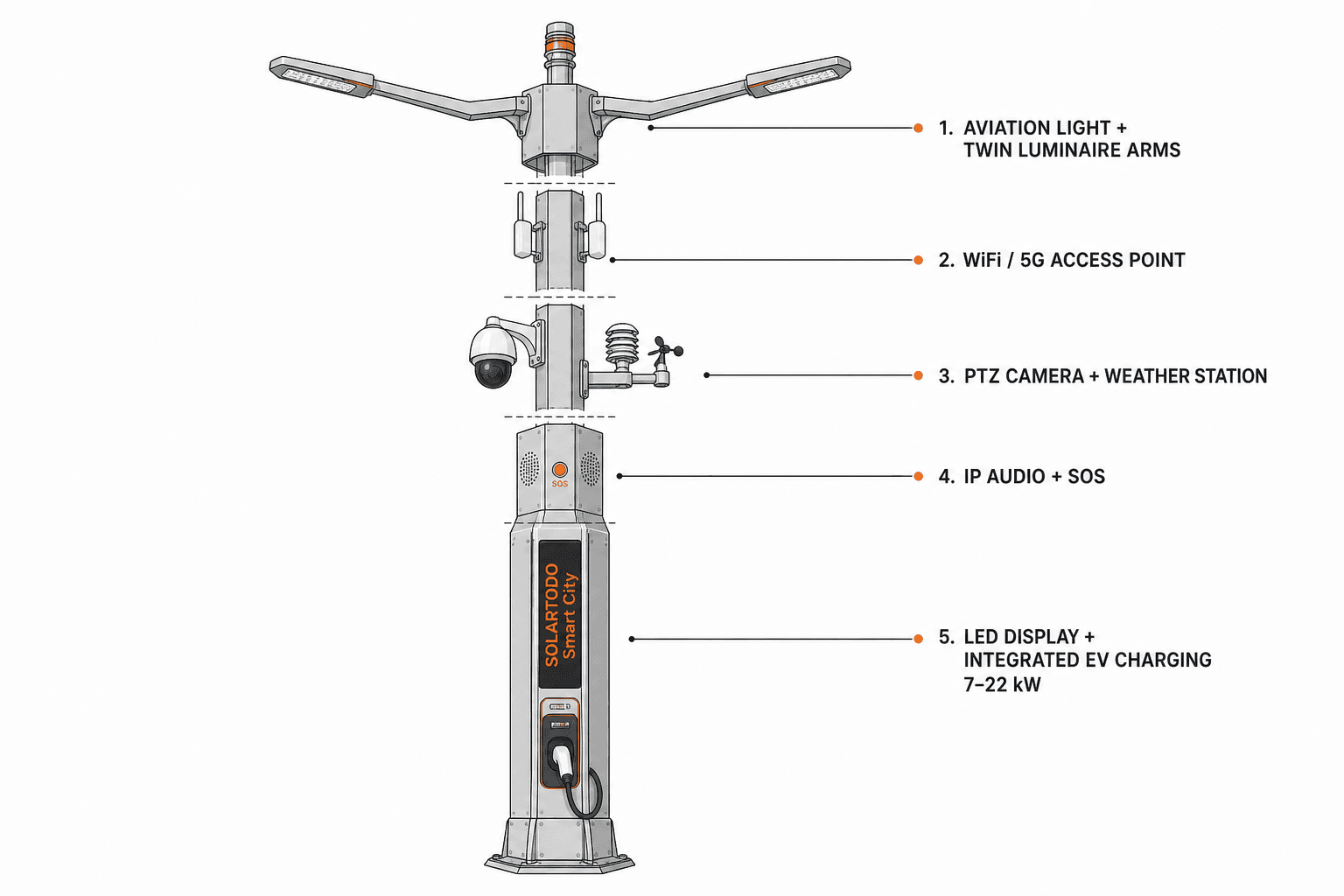
The smart-city module set should include a flush-mounted WiFi 6 access point at 8.7 m, LoRaWAN/4G smart controller, cloud monitoring, and dimming control. Safety and sensing should include a 15 cm white mini PTZ dome camera with 360 degree rotation, 20x zoom, and 100 m IR; a 12-parameter environmental sensor; a 30 W, 93 dB TCP/IP speaker; and a one-press SOS button linked to camera events.
Standards And Procurement Requirements
Answer Capsule: A compliant Durban specification should reference IEC 60598-1, IEC 62196-2, GB/T 37024, SANS 10142-1, and 6-month coastal inspections.
According to IEC (2024), IEC 60598-1 specifies general safety requirements for luminaires operating at supply voltages up to 1,000 V. According to IEEE (2026), IEEE smart-city standards work includes communications architecture, component discovery, semantic exchange, and reference architecture projects. These references support a modular Smart Streetlight specification rather than a custom one-off pole.
Procurement should define the bill of materials, coating system, electrical protection, charger interface, communications protocol, screen specification, installation test plan, and warranty boundaries. eThekwini supplier processes should be addressed before shipment, including municipal database registration, wayleave coordination, and site inspection timing. The SOLARTODO package should be presented as a typical 209-unit configuration, not as a completed Durban project claim.
The P4 vertical LED display should be 960 x 1920 mm in portrait format and above 5500 cd/m² brightness. To avoid distracting civic messaging, the default artwork should display only “SOLARTODO Smart City” in white sans-serif text on deep blue. Display approvals, advertising permissions, and brightness limits should be confirmed locally before commissioning.
Comparison Table
Answer Capsule: The 209-unit grid_12m option is the best Durban fit because it combines 12 m lighting, 22 kW charging, and coastal serviceability.
| Option | Durban Fit | Typical Scale | Key Limitation |
|---|---|---|---|
| SOLARTODO grid_12m Smart Streetlight | High | 209 poles, 6.27 km, 22 kW AC per pole | Requires feeder studies and managed charging |
| Hybrid 12 m smart pole | Medium | 12 m pole with solar-wind backup | More exposed hardware in salt air |
| Standard 6-8 m LED streetlight | Low to medium | Parks, local roads, low-load areas | Cannot support EV, PTZ, display, and WiFi loads well |
| Highway mast lighting | Low | High-speed corridors and interchanges | Oversized for CBD, beachfront, and pedestrian streets |
Implementation And Expected ROI
Answer Capsule: A 209-pole Durban rollout should be phased over 8-12 weeks after approvals, feeder validation, corrosion review, and photometric checks.
Implementation should begin with route selection, geotechnical checks, drainage review, wayleave approvals, photometric modeling, and 220/380 V feeder validation. Procurement should confirm hot-dip galvanizing, RAL9005 powder coating, IP-rated access doors, Type 2 charger compliance, OCPP 1.6J integration, and CKD shipment scope. Installation should prioritize beachfront, CBD, transport-node, and mixed-use corridors where one pole can replace multiple sidewalk assets.
Expected ROI should not be claimed before tariff, utilization, advertising, and maintenance assumptions are modeled. According to the World Bank (2023), South Africa’s 2022 load shedding averaged 8 hours per day and cost an estimated 2-3% of GDP growth. That supports outage logging, surge protection, power-quality monitoring, and staged energization in the Durban design.
According to IEA (2025), nearly 600 million people in Africa still live without electricity access, and fewer than 19 million people gained access in both 2023 and 2024. According to IRENA (2026), global off-grid renewable capacity reached 11.1 GW at the end of 2024 and connected 86 million people. Durban’s case is different: it is an urban grid-integration project, not a rural off-grid access project.
Pricing And Quotation
Answer Capsule: SOLARTODO pricing should be quoted in 3 tiers: FOB Supply, CIF Delivered, and EPC Turnkey with 1-year warranty options.
SOLARTODO should price the Durban Smart Streetlight package in three commercial formats. FOB Supply covers equipment ex-works China and is suitable when the buyer controls shipping and local installation. CIF Delivered adds ocean freight and insurance. EPC Turnkey can include foundations, trenching coordination, installation, commissioning, and a 1-year warranty, subject to survey, municipal approval, and final engineering scope.
Volume discounts should be available for large deployments such as 209 poles. Pricing should separate the structural pole, LED luminaires, EV charger, display, camera, WiFi, controller, sensor, speaker, SOS device, software, freight, installation, and warranty. Buyers can configure the system online or request a custom quotation from SOLARTODO at [email protected].
Frequently Asked Questions
Answer Capsule: The FAQ covers 10 procurement questions across price, specifications, shipping, warranty, installation, comparison, maintenance, standards, and ROI.
Q1: Why is a 12 m Smart Streetlight recommended for Durban?
A 12 m pole gives enough height for twin 80 W luminaires, PTZ camera visibility, WiFi 6 coverage, environmental sensing, and a 960 x 1920 mm civic display. It is still more suitable for CBD, beachfront, transport-node, and mixed-use corridors than a highway mast. For Durban, 12 m also helps keep the EV charger, lighting, and safety modules on one foundation.
Q2: What is the recommended technical specification?
The recommended SOLARTODO specification is a 12 m octagonal tapered steel pole with a 45 cm base diameter, 15 cm top diameter, hot-dip galvanized steel, and RAL9005 powder coating. Each pole uses 2 x 80 W LED luminaires at 150 lm/W and 4000 K, one 22 kW Type 2 AC charger, WiFi 6, PTZ camera, sensor, speaker, SOS button, and P4 display.
Q3: Is this configuration solar-powered or grid-powered?
This Durban configuration is grid-powered AC 220/380 V, aligned with South African 230/400 V low-voltage practice after local engineering review. It is not a solar-only streetlight. SOLARTODO can offer hybrid variants separately, but dense Durban corridors are better suited to grid power because EV charging, displays, communications, and cameras create loads that need stable feeder planning.
Q4: How much EV charging capacity does a 209-pole project create?
A 209-pole project with one 22 kW AC charger per pole creates about 4.60 MW of theoretical simultaneous EV charging load. The design should not assume all chargers run at full output at the same time. Durban projects should use load management, feeder segmentation, time-of-use rules, metering, and staged energization before final commissioning.
Q5: How should pricing be requested?
Pricing should be requested in three tiers: FOB Supply, CIF Delivered, and EPC Turnkey. Buyers should ask SOLARTODO to separate pole structure, luminaires, charger, display, camera, WiFi, controller, sensors, software, freight, installation, civil works, and warranty. A 209-unit quote should also identify spare parts, commissioning support, and any local certification costs.
Q6: What logistics model is suitable for Durban?
For a 209-unit package, CKD or modular shipment is usually more practical than shipping fully assembled poles. The buyer should confirm port delivery terms, customs documents, packing protection, coating protection, module labeling, and inland transport limits. Durban’s coastal environment also means storage should keep charger cabinets, displays, lenses, and gaskets dry before installation.
Q7: How long does installation take?
A typical 209-pole Durban rollout should be planned over about 8-12 weeks after approvals, feeder validation, and foundation readiness. The schedule normally includes trenching coordination, foundation construction, pole erection, AC testing, charger commissioning, controller setup, network integration, display checks, and night photometric verification. Flood-prone or high-traffic sites may require additional staging.
Q8: What warranty structure is appropriate?
Warranty should be separated by component because each system has a different risk profile. The structural pole, coating, LED luminaire, driver, EV charger, display, camera, WiFi device, controller, and software support should have explicit terms. EPC Turnkey pricing can include a 1-year warranty, but long-term coastal maintenance should also define inspection, cleaning, corrosion repair, and spare-part response times.
Q9: How does this compare with a hybrid solar smart pole?
A hybrid solar smart pole can help where grid access is weak, but it adds panels, batteries, brackets, and more exposed hardware. In Durban’s salt-air environment, those extra parts can increase maintenance and corrosion risk. For main urban corridors with available municipal supply, the grid_12m SOLARTODO option is cleaner, stronger for EV charging, and easier to inspect.
Q10: What maintenance interval should Durban use?
Durban should use 6-month visual inspections, annual electrical testing, scheduled lens cleaning, and corrosion checks around base plates, access doors, fasteners, cable glands, and display mounts. Coastal humidity, salt air, summer rainfall, and traffic film can reduce optical performance and accelerate enclosure wear. Maintenance should also include charger connector checks and OCPP event-log review.
References
Answer Capsule: This specification uses 10 reference points from government, municipal, standards, energy, and smart-city sources dated 1998-2026.
- South African Government (1998), Coastal Policy Green Paper, Durban Metro rainfall and coastal context: https://www.gov.za/documents/coastal-policy-green-paper
- South African Government (2015), Geography and Climate, national average rainfall of about 464 mm: https://www.gov.za/about-sa/geography-and-climate
- Stats SA Census 2022 via SA Data Hub (2026), eThekwini population, area, and density: https://sadatahub.tech/municipalities/ETH
- eThekwini Electricity (2026), municipal supply from Eskom at 275 kV into 275/132 kV substations: https://ethekuat.durban.gov.za/page/electricity
- World Bank (2023), South Africa load shedding averaged 8 hours per day in 2022 and cost 2-3% of GDP growth: https://www.worldbank.org/en/news/press-release/2023/10/25/south-africa-afe-world-bank-backs-reforms-to-advance-energy-security-and-low-carbon-transition
- World Bank, IEA, IRENA, WHO, and UNSD (2025), Tracking SDG7 Energy Progress Report: https://www.worldbank.org/en/topic/energy/publication/tracking-sdg-7-the-energy-progress-report-2025
- IEC (2024), IEC 60598-1:2024 luminaires safety requirements up to 1,000 V: https://webstore.iec.ch/en/publication/66620
- IEC (2016), IEC 62196-2 AC EV charging accessory compatibility up to 480 V AC: https://webstore.iec.ch/en/publication/24204
- NREL via U.S. Department of Energy (2024), Level 1 and Level 2 charging expected to handle 80% of EV charging duties by 2030: https://www.energy.gov/cmei/vehicles/articles/fotw-1335-march-25-2024-level-1-and-level-2-ev-charging-expected-account-80
- IEEE Standards Association (2026), smart-city standards portfolio and communications architecture projects: https://standards.ieee.org/initiatives/smart-cities-standards/
- IEA (2025), Financing Electricity Access in Africa, nearly 600 million Africans without electricity access: https://www.iea.org/reports/financing-electricity-access-in-africa/executive-summary
- IRENA (2026), off-grid renewable capacity reached 11.1 GW at the end of 2024 and connected 86 million people: https://www.irena.org/News/articles/2026/Jan/Offgrid-Renewables-Role-is-Beyond-Closing-the-Energy-Access-Gap
Equipment Deployed
- Approximately 209 units × 12m octagonal tapered steel Smart Streetlight pole, base Ø45cm to top Ø15cm
- Black RAL9005 powder coat over corrosion-protected steel for Durban coastal salt-air exposure
- Grid-powered AC 220/380V architecture aligned with South African 230/400V low-voltage distribution context
- Integrated 22kW single-gun AC EV charger, Type 2, OCPP 1.6J, 5m coiled cable, 8-inch touchscreen, E-stop
- Lower 2.2m pole section functions as the welded EV charging cabinet, not a separate roadside charger
- Twin symmetric 1.5m arms with +8° tilt and 2 × 80W SOLARTODO LED luminaires, 4000K, 150 lm/W
- 15cm mini white PTZ dome camera, 360°, 20x zoom, IR 100m, mounted on 40cm L-bracket
- 12-parameter environmental sensor covering meteorology, air quality, rain, CO, NO2, and O3
- Flush IP audio column speaker, Ø10 × 50cm, 30W/93dB, TCP/IP networked, color-matched to pole face
- P4 portrait LED display, 960 × 1920mm, >5500 cd/m², content limited to “SOLARTODO Smart City”
- WiFi 6 AP, 802.11ax, 256 devices, 1.8Gbps, flush-mounted at 8.7m
- Qi wireless phone charging pad, USB-A, SOS button with camera linkage, LoRaWAN/4G smart controller