
Summary
For Guadalajara, Mexico, specify fallback when a required demand feed becomes stale, goes missing, or fails a validity check, and the remaining inputs cannot support an approved operating mode. Require the controller to stop accepting new adaptive timing changes and transfer to a predefined timing plan through an approved phase sequence. Resume adaptation only after the required feeds demonstrate sustained validity and the controller confirms an authorized handover. Guadalajara is solely a proposed evaluation site. The SOLARTODO catalog supports preliminary equipment scoping, while purchase acceptance depends on records from an interruption test of the exact candidate configuration.
Key Takeaways
- Identify which inputs each adaptive operating mode requires before defining what causes fallback.
- Define freshness and missing-data checks separately so a connected feed with frozen data still triggers the intended response.
- Approve the fallback plan, its selection rules, and the phase sequence for entering and leaving it.
- Require sustained valid data and controller authorization before handing control back to adaptation.
- Interrupt inputs deliberately and reconcile controller state changes with the executed phase sequence.
- Obtain model-specific documentation, interface details, and sample log exports before accepting a bid on the proposed behavior.
Proposed Problem
Adaptive signal control uses current demand information to evaluate and adjust signal timing. Hypothetical evaluation assumption: In the first test case, a simulated demand feed stays connected while the test harness supplies repeated or delayed observations. Hypothetical evaluation assumption: In the second test case, the test harness stops demand reports while the controller remains powered and available. In either case, observing that the traffic lights keep cycling is insufficient to show that adaptation has stopped or that the approved fallback plan has taken effect. The buyer needs evidence both that control authority changed and that the signals executed the expected phase sequence. FHWA Adaptive Signal Control FAQs
The evaluation question is whether the proposed integration can make that change predictably and then recover without accepting stale demand or briefly returning to adaptation on an unstable feed. Define the test around loss of usable demand data while the controller remains available to execute a timing plan. Assess power loss, controller restart, and signal equipment faults under separate requirements if they are in scope. The evidence pack contains no Guadalajara site survey, candidate installation records, or test results.
Source-Backed Product Boundary
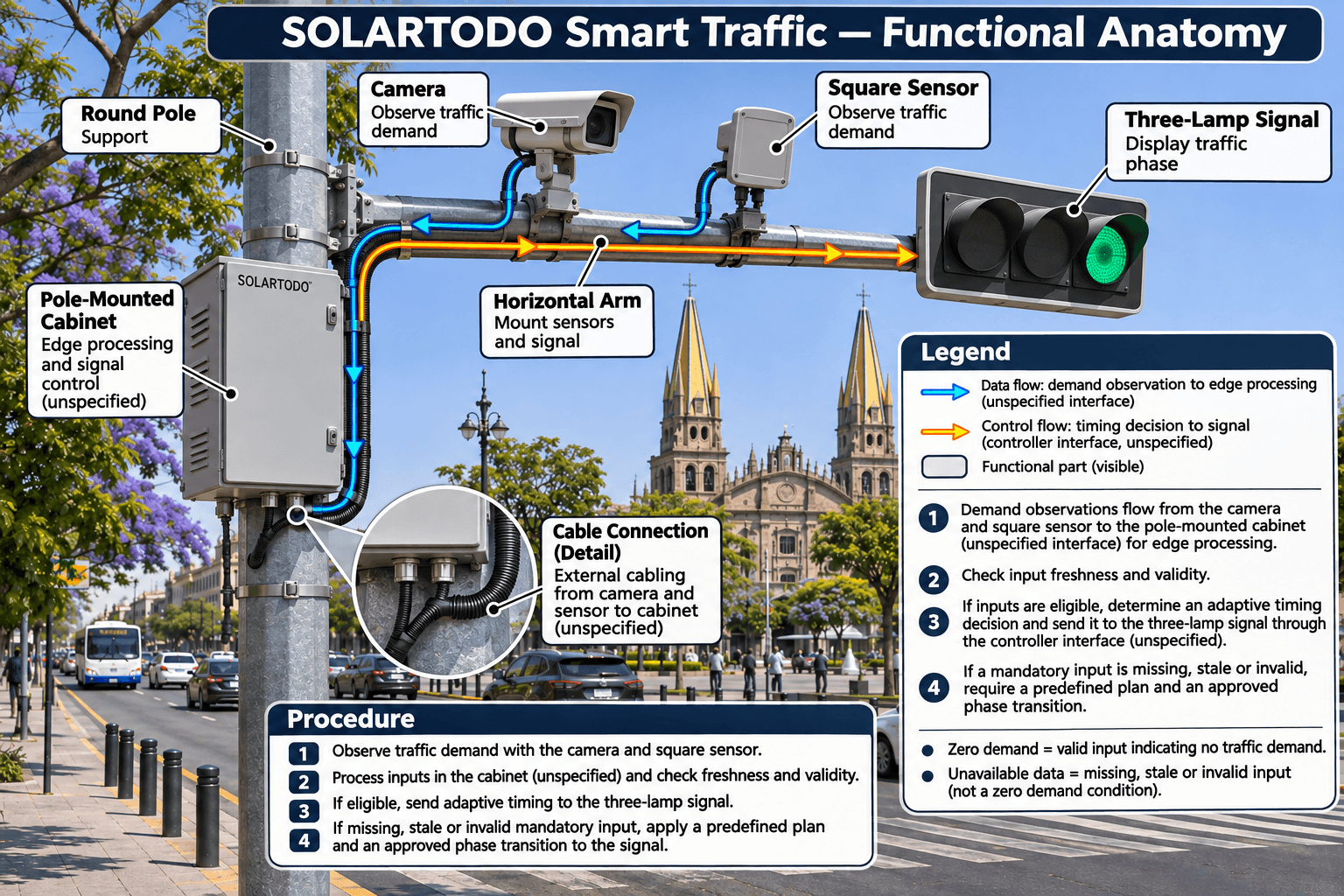
The SOLARTODO smart traffic catalog record, city-catalog-2026-11-01-v1, identifies a product family that combines a traffic pole, camera, radar, signal equipment, and edge processing. Use the SOLARTODO smart traffic product page to identify the family in procurement documents. The selected configuration determines the pole geometry, sensor selection, and signal interfaces. The catalog extraction does not identify a model, model-specific operating conditions, or controller evidence for fallback, recovery, or interoperability. Public SOLARTODO smart traffic catalog
The supplied pack includes no product PDF, PDF URL, page, or model designation. A model-and-page citation for the requested function therefore remains unavailable. Obtain the exact product PDF and relevant pages before attributing the proposed behavior to a model. The proposed design below is a specification for evaluating an integration, and each behavior remains subject to configuration-specific verification.
Proposed Design
Define what makes an input usable. Create an input register for each operating mode with the required source, the demand it represents, the expected reporting cadence, the freshness check, and the validity checks. Define a missing input as one that fails to deliver an expected report or heartbeat within its agreed interval. Define a stale input as an observation whose acquisition timestamp exceeds the permitted age, even if messages continue to arrive. Where the interface exposes a sequence identifier, test repeated and out-of-order values. Agree how to flag malformed messages, invalid quality indicators, and clock faults. For each interface, specify how a legitimate observation of zero demand is encoded and distinguished from unavailable data.
Define the fallback trigger and transfer. On detection of an unusable mandatory input, invalidate adaptation for the affected scope unless the approved input matrix permits continued operation with the data still available. Require the controller integration to record which input failed, which check fired, and which fallback plan it selected. Specify when new adaptive timing decisions are inhibited and how pending changes are cleared or rejected. The controller should request the predefined plan and activate it through a transition permitted by its approved timing configuration. The buyer should define how pedestrian service, clearance intervals, and any applicable coordination are handled during that transfer. Record the request and the actual activation as separate events.
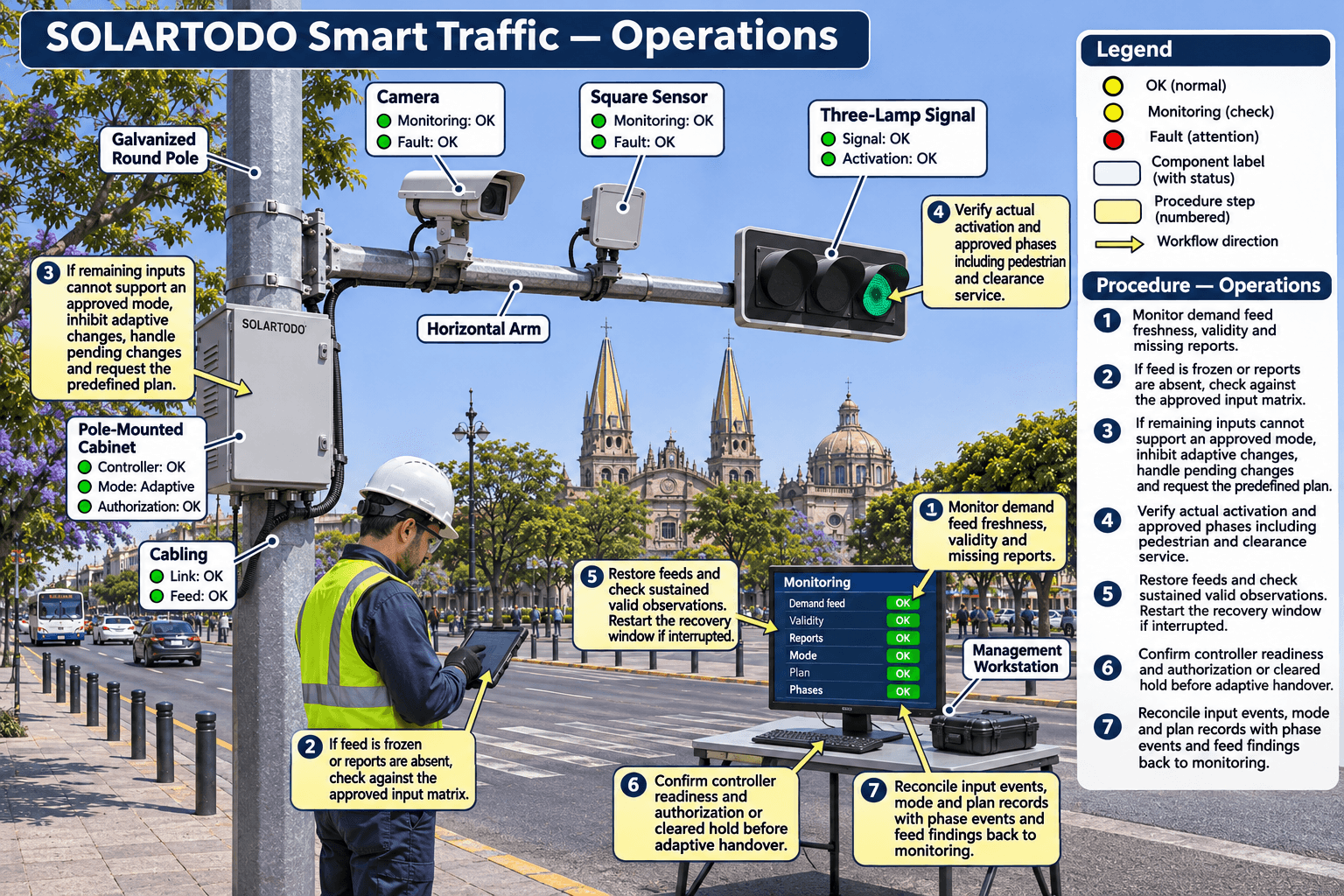
Define the return to adaptive control. Require every input needed for the requested adaptive mode to deliver fresh, valid observations through an uninterrupted recovery window. Restart the window when a required feed fails its checks again. Specify how the integration handles buffered observations so that a burst of old messages cannot qualify as recovery. Before handing control back, confirm that the controller is ready, the required inputs still qualify, and any operator hold has cleared. State whether authorization comes from configured recovery logic or an operator action. Record the recovery decision and the actual return to adaptive operation, then compare the executed phases with the agreed transition rules.
Explicitly Hypothetical Measurable Evaluation Assumptions
Hypothetical evaluation assumption: A mandatory feed is classified as missing after 3 seconds without a report where the test configuration calls for regular reporting.
Hypothetical evaluation assumption: An observation received more than 2 seconds after acquisition is classified as stale in a test with a verified common time base.
Hypothetical evaluation assumption: The controller records a fallback request within 1 second of classifying an input fault that invalidates the active mode.
Hypothetical evaluation assumption: The approved fallback plan becomes active at the first eligible phase boundary after the request.
Hypothetical evaluation assumption: Every required feed must pass its freshness and validity checks continuously for 30 seconds before adaptation becomes eligible to resume.
Hypothetical evaluation assumption: Each scripted transition produces zero phase events that violate the approved transition rules.
These values are worksheet examples for a controlled test. Set contractual thresholds from the selected interface cadence, clock behavior, and controller transition rules. Measure fault classification, fallback request, and actual plan activation independently so the record can distinguish slow detection from time needed to reach a permitted phase boundary.
Survey and Acceptance Checklist
- Confirm the proposed site and control scope. Survey movements, pedestrian service, existing controller configuration, and any coordination with neighboring signals. Identify which control functions the candidate would influence and which would remain under the predefined plan during an interruption.
- Freeze the candidate configuration. Record the selected equipment and controller identifiers, firmware or software versions, interface settings, required-input matrix, timing plan identifiers, and approved transition rules. Preserve the configuration used for the test so the buyer can repeat it.
- Verify the evidence paths. Confirm that the test can capture the input interruption, controller mode and plan state, and time-stamped phase events. Check clock alignment and export a baseline with valid inputs and adaptation active before injecting faults. Agree on how the exported records will show the event order if logs have different time resolutions.
- Interrupt data in a controlled setup. With the integration configured as proposed, stop a mandatory feed, then run a separate case where messages arrive with frozen or stale observations. If the input matrix permits operation with a feed unavailable, exercise that case and confirm the authorized mode stays within its allowed scope. Test interruptions at different points in the phase sequence to exercise the permitted transfer boundaries.
- Exercise unstable and sustained recovery. Restore a required feed briefly and interrupt it again before it qualifies. Verify that fallback remains active. Restore the required feeds with sustained valid observations and verify the authorized handover. Include an operator-hold case if the requested configuration uses that feature.
- Reconcile the records. Assemble a timeline with the last valid observation, fault classification, fallback request, active plan change, recovery qualification, authorization, and adaptive activation. Compare the controller's mode and plan record with phase events, including relevant pedestrian and clearance intervals. Review pending adaptive commands where the interface exposes them. Mark cases with missing decisive records as inconclusive and correct the evidence gap before repeating the case.
The U.S. Federal Highway Administration's validation guidance connects operational objectives with appropriate evidence and includes phase timing and detector status records. Use it as methodological context for test design. Guadalajara acceptance conditions should come from the responsible project authority and the selected configuration. FHWA validation guidance, Chapter 1
Limitations
The catalog evidence establishes the equipment family. It does not establish whether a candidate configuration exposes acquisition timestamps, records mode changes, implements a recovery window, or supports the controller interface needed for this design. A test can confirm behavior only for the tested versions, settings, interruption cases, and timing plans. A closed test can demonstrate transfer behavior under its scripted conditions. Local operational effects would require a separate evaluation with site evidence and defined measures. The pack supports no Guadalajara-specific finding on traffic demand, performance, deployment, or legal approval.
Procurement Questions
Request the exact model and supporting PDF pages for each interface or behavior claimed in the bid. Ask for the operating conditions and version dependencies under which the documentation applies. Who owns the switch to fallback, and whose records show when the controller actually accepted it? Which feeds are mandatory by mode, and what evidence supports continued operation when a feed fails? Who selects and approves the timing plan, and what happens to a pending adaptive change during transfer? Ask the integrator to show how recovery authorization is configured, how a hold is released if applicable, and how the controller and phase records can be exported. Include the controlled interruption cases and required evidence in the acceptance terms so the same checks apply to the configuration delivered for evaluation.
FAQ
When should the candidate fall back?
Fall back when a required input is stale, missing, or invalid and the remaining inputs cannot support an approved operating mode.
How do stale and missing data differ?
A stale observation arrives or remains available after its usable age has expired. A missing input fails to provide an expected report or heartbeat within the agreed interval.
Does losing any feed require fallback?
Use the approved input matrix. Continue only in a mode whose required inputs remain valid and whose operation with the failed feed unavailable has been approved and tested.
What should happen during the interruption?
Inhibit new adaptive timing changes, handle pending changes according to the agreed interface rules, and activate the predefined timing plan through an approved phase transition.
When should adaptation resume?
Resume after every required feed passes its checks throughout the agreed recovery window, the controller confirms readiness, and the configured or operator authorization permits handover.
How should the test handle intermittent recovery?
Briefly restore a required feed and interrupt it before the recovery window qualifies. Verify that fallback remains active and the recovery window restarts after valid reporting returns.
Which records demonstrate a successful transition?
Match input fault and recovery events to controller mode and active plan records, then compare time-stamped phase events with the approved transition rules.
What does the SOLARTODO source establish?
Catalog record city-catalog-2026-11-01-v1 identifies the smart traffic equipment family. Model-specific fallback, recovery, interfaces, and operating conditions require documentation and testing for the selected configuration.
References
- SOLARTODO smart traffic equipment, catalog identity
city-catalog-2026-11-01-v1. The supplied catalog extraction provides family scope. A product PDF link, page reference, and model are absent from the pack. SOLARTODO smart traffic catalog - U.S. Federal Highway Administration, Measures of Effectiveness and Validation Guidance for Adaptive Signal Control Technologies, Chapter 1, for validation methods and evidence selection. Chapter 1
- U.S. Federal Highway Administration, Adaptive Signal Control FAQs, for definitions and the role of detection. Adaptive Signal Control FAQs
Proposed Equipment
- Traffic pole
- Camera
- Radar
- Signal equipment
- Edge processing