Harare load-shedding streets and 30m corridors: Smart Streetlight hybrid configuration guide
Summary
Harare’s inland 1,479m altitude, Zimbabwe’s 62.0% electricity access, and 12-14 hour historical outages support a 149-unit hybrid Smart Streetlight profile at 30m spacing with 5kWh LFP backup.
Key Takeaways
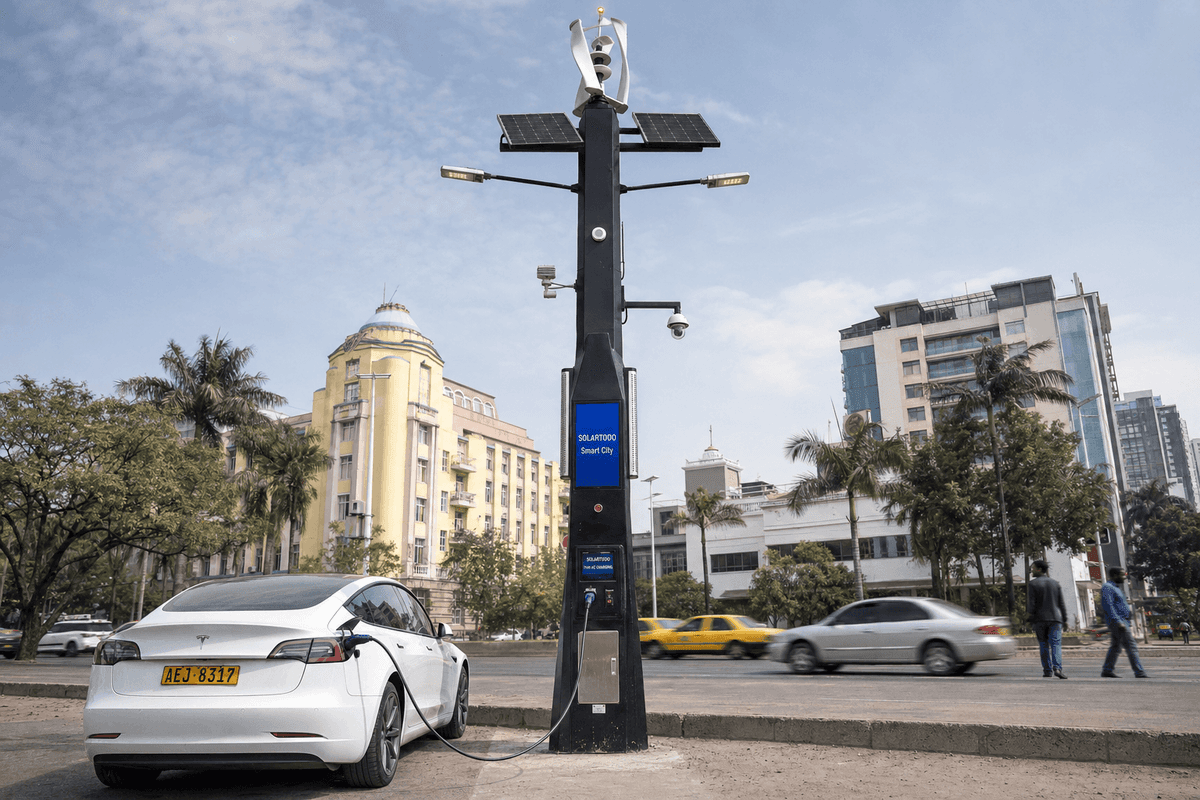
Harare’s Smart Streetlight fit is strongest for 30m urban corridors where lighting, 7kW EV charging, 5G, security, and sensors share one 13m pole.
- A typical 149-unit deployment would cover approximately 4.47km at 30m spacing, using 13m octagonal tapered steel poles.
- Each pole carries 2x80W LED heads at 150 lm/W, producing approximately 24,000 lm at 4000K.
- Hybrid autonomy comes from 2x200W monocrystalline panels, a 300W Savonius VAWT, and 5kWh LFP battery storage.
- Zimbabwe’s ZETDC public supply reference is 225V single-phase and 390V three-phase at 50Hz, with permitted voltage bands.
- Harare’s Kutsaga climate station sits at 1,479m, so foundations and wind exposure matter more than coastal salt protection.
- The lower 2.2m of the SOLARTODO pole is the welded EV charger cabinet, not a separate sidewalk pillar.
- Communications are specified as 5G NR n78, 4T4R MIMO, approximately 200m coverage, plus LoRaWAN/4G control.
- Standards alignment should include IEC 60598 for luminaires, IEC 62196-2 for Type 2 AC charging, and GB/T 37024 smart pole requirements.
Market Context for Harare
Harare’s road-lighting problem is a grid-reliability and municipal-integration problem across a high-altitude inland capital, not a coastal corrosion problem.
According to ZIMSTAT (2022), Harare Province population projections cover Harare Urban, Chitungwiza, and Epworth, with the province projected around 2.50 million people in 2026. This demand profile creates pressure for public lighting that also supports security, air-quality monitoring, mobile connectivity, and controlled EV charging. According to World Bank (2023), Zimbabwe’s access to electricity reached 62.0% in 2023, which is relevant because urban lighting assets should be able to ride through unstable supply rather than assume continuous grid availability.
According to World Bank (2024), Zimbabwe’s power shortages were estimated to cost 6.1% of GDP per year, including generation inefficiencies, network losses, and downstream costs from unreliable energy. World Bank states, "Power shortages have a significant adverse impact" on productive sectors, which explains why hybrid self-powered street assets are practical for arterial and commercial corridors. In Harare, a lighting program that depends only on the AC feeder risks service gaps during load-shedding windows.
Harare is inland, elevated, and seasonal. According to the Japan Meteorological Agency’s ClimatView/WMO station listing (2026), Harare Kutsaga is at 1,479m elevation near 17.92°S and 31.13°E, with monthly mean temperatures from about 14.0°C in July to 22.0°C in November. Dry-season dust, high UV exposure, and intense summer rain require sealed electronics, corrosion-resistant coating, serviceable filters, and drainage-aware foundations. The correct design emphasis is powder-coated galvanized steel, IP-rated compartments, and wind-plus-solar hybrid input, not marine-grade salt-air overdesign.
Local grid interfaces should follow Zimbabwe utility practice. According to ZETDC (2026), normal contractual supply voltage is 225V single-phase and 390V three-phase, with frequency at 50Hz ±5%. According to the Zimbabwe Grid Code referenced by ZERA (2016), the distribution system includes 132kV, 88kV, 33kV, 11kV, and 0.4kV levels, with a Harare region in the distribution structure. That supports a low-voltage pole charger connection with protective coordination rather than any claim that the streetlight itself is a 33kV or highway power pole.
Procurement context is also specific. The City of Harare Master Plan 2025-2045 identifies roads, storm water, energy, transport, ICT, and service delivery as planning concerns. Zimbabwe’s e-GP/PRAZ tender records in 2026 show City of Harare road works using competitive bidding and a separate public-lighting subcontracting requirement for medium-density works. That means a SOLARTODO Smart Streetlight package should be written as a municipal infrastructure item with civil works, electrical commissioning, OCPP integration, and content controls specified in the bill of quantities.
Recommended Technical Configuration
A Harare urban-corridor specification should use approximately 149 hybrid 13m Smart Streetlight poles spaced at 30m for about 4.47km of coverage.
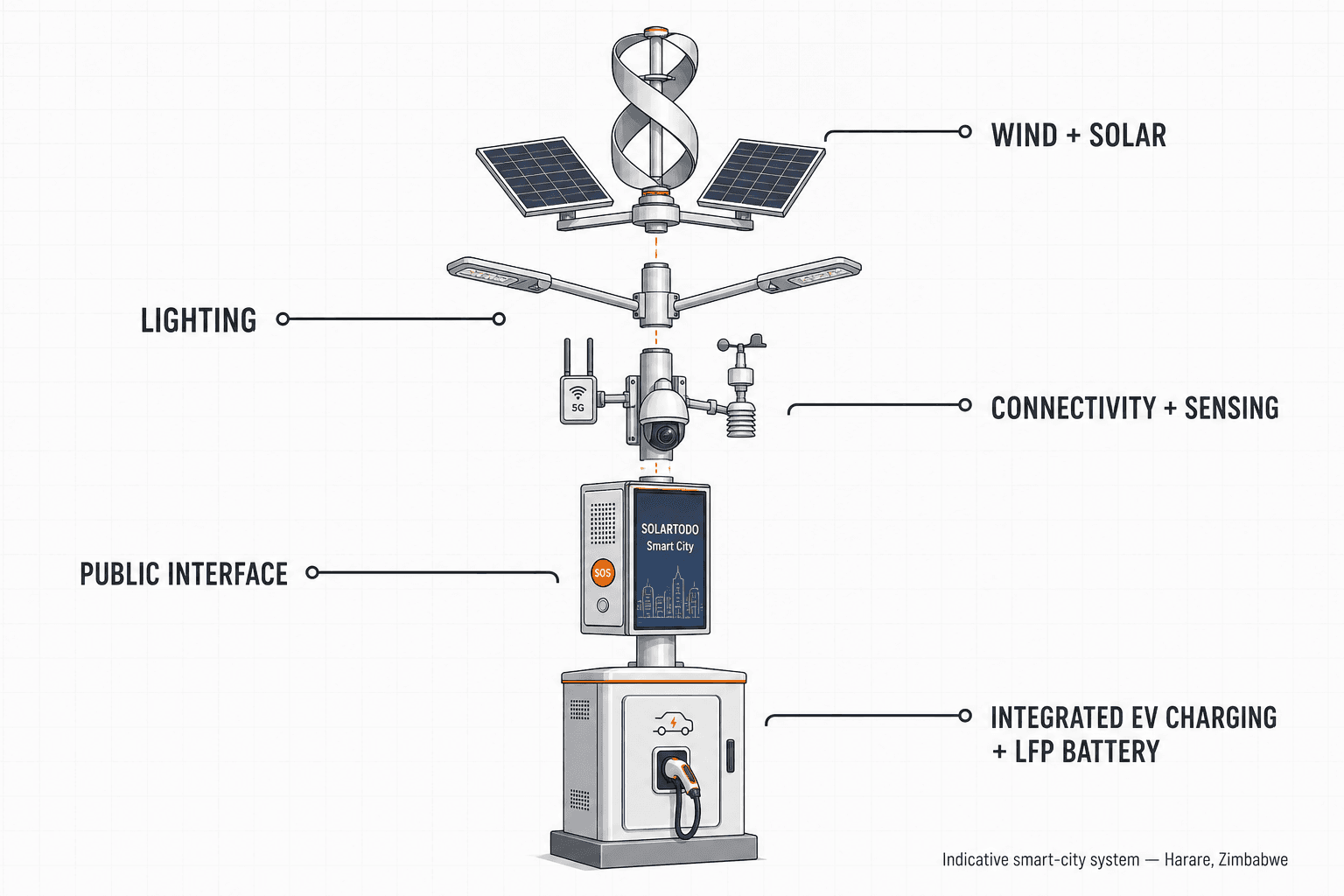
The recommended SOLARTODO configuration is the hybrid 12m-class product adapted to the supplied 13m project profile: a tapered octagonal steel smart pole with wind-solar hybrid self-power, LFP battery storage, grid backup, integrated Type 2 AC charging, LED lighting, PTZ surveillance, public address, environmental sensing, and 5G small-cell readiness. This is appropriate for Harare because the city needs resilient lighting along grid-constrained corridors, but it is not a highway mast and not a park garden-lighting product.
A typical 149-unit deployment of this scale would consist of 13m octagonal tapered poles, each with a base diameter of 45cm tapering to 15cm at the top. The black RAL9005 powder coat reduces visual clutter on formal CBD and arterial streets while protecting the steel surface in dusty dry-season conditions. The lower 2.2m of the pole is the EV charging cabinet, welded as one continuous steel structure, so the sidewalk footprint remains cleaner than a pole-plus-separate-charger layout.
For Harare, the hybrid energy package is not a standalone solar-streetlight claim; it is a resilience layer for a multifunction pole. Each pole uses an apex 300W Savonius bucket VAWT with two curved scoops, two 200W monocrystalline panels on 15° east-west A-frame brackets, a 5kWh LFP battery, MPPT control, and grid backup. According to World Bank/ESMAP (2023), Zimbabwe has public Global Solar Atlas layers for PVOUT, GHI, DNI, GTI, and optimum tilt, so detailed corridor design should confirm local shading before foundation casting.
Technical Specifications
The Harare specification centers on a 13m tapered hybrid pole with 160W LED load, 400W solar input, 300W wind input, and 5kWh storage.
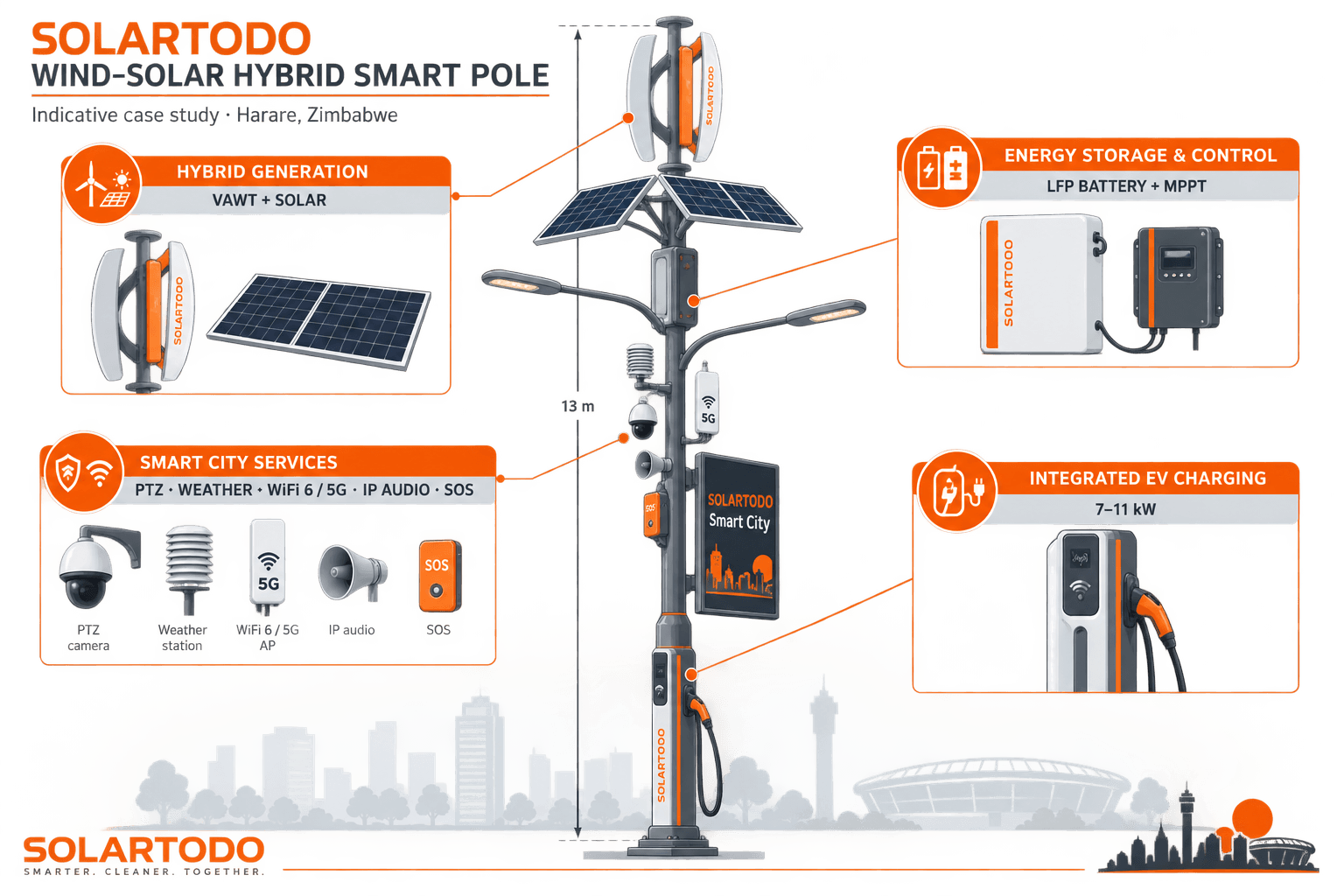
- Product line: SOLARTODO Smart Streetlight, hybrid 12m-class, Harare-adjusted 13m octagonal tapered steel structure.
- Quantity: approximately 149 units for a typical 4.47km corridor at 30m spacing.
- Pole body: base Ø45cm to top Ø15cm, black RAL9005 powder coat, tapered octagonal steel.
- Integrated EV design: lower 2.2m of pole forms the 7kW single-gun AC charging cabinet, welded into one continuous structure.
- Charger interface: Type 2 connector, IEC 62196-2, OCPP 1.6J, 5m coiled cable, touchscreen, E-stop, maintenance door.
- Wind generation: 300W Savonius bucket VAWT, two curved scoops, Ø60x90cm, red aviation LED.
- Solar generation: 2x200W deep-black monocrystalline modules, symmetric east-west A-frame, 15° tilt.
- Battery and control: 5kWh LFP battery inside pole base with MPPT controller and grid backup tie.
- Lighting: twin symmetric 1.5m arms with +8° upward tilt, 2x80W LED, 150 lm/W, 4000K.
- Camera: 15cm mini white PTZ dome, 360° rotation, 20x zoom, IR range 100m, mounted on 40cm L-bracket.
- Environmental monitoring: 12-parameter sensor covering meteorology, air quality, rain, CO, NO2, and O3.
- Public address: 2x slim IP audio column speakers, Ø10x50cm, 30W, 93dB, TCP/IP networked, flush on opposite pole faces.
- Emergency system: one-press SOS button, dual-way audio intercom, and visual LED status indicator.
- LED display: P3 portrait screen, 1000x2000mm, greater than 6000 cd/m², content fixed to “SOLARTODO Smart City” in white on deep blue.
- Telecom: 5G NR n78 small cell, 4T4R MIMO, approximately 200m coverage, flush color-matched housing at 8.7m.
- User extras: Qi wireless phone charging pad and USB-A port.
- Standards: IEC 60598, GB/T 37024, and IEC 62196-2.
According to the U.S. Department of Energy FEMP (2023), outdoor pole and roadway luminaires in its procurement guidance use luminaire efficacy rating thresholds such as 136 lm/W for pole-mounted area and roadway categories. The specified 150 lm/W LED package therefore fits a high-efficiency procurement language. IEC 60598 should govern luminaire safety testing, while IEC 62196-2 should govern the Type 2 AC charging interface.
Implementation Approach
A Harare rollout should proceed in 5 stages: survey, municipal procurement, CKD logistics, civil-electrical installation, and cloud commissioning.
First, survey the road corridor by pole spacing, feeder availability, sightlines, pedestrian crossings, existing overhead utilities, storm-water channels, and telecom backhaul. Harare’s older streets and medium-density roads may have narrow footpaths, mixed utilities, and drainage channels close to the kerb. The survey should confirm whether each 30m pole bay has safe EV cable reach without blocking pedestrian movement.
Second, procurement documents should separate supply scope from civil works, because the smart pole integrates multiple asset classes. The bill of quantities should list the pole, LED heads, wind turbine, solar pair, battery, charger, camera, 5G housing, display, PA columns, SOS hardware, controller, and cloud platform as coordinated components. Tender language should require IEC 60598, GB/T 37024, IEC 62196-2, OCPP 1.6J, and factory acceptance testing before shipment.
Third, CKD or SKD shipping should protect the VAWT, deep-black panels, P3 LED display, PTZ dome, and touchscreen from vibration and dust. Inland logistics to Harare reduce salt-air exposure compared with ports, but road handling and customs staging can still damage display modules and coated surfaces. Packaging should use labeled crates, spare fasteners, and a serial-number map for commissioning.
Fourth, installation should use engineered foundations matched to soil, drainage, pole overturning moment, equipment mass, and the 13m exposed height. The contractor should cast foundations, install earthing, pull AC backup cables where available, erect the pole, connect the integrated charger cabinet, test insulation resistance, and verify protective devices. The +8° luminaire tilt should be checked during night aiming because glare control matters on mixed pedestrian and vehicle corridors.
Fifth, commissioning should connect LoRaWAN/4G controllers, OCPP charger management, camera video management, IP audio, SOS intercom, LED-display content, and 5G small-cell backhaul. ITU states, "Policy-makers’ actions will make a difference" for 5G deployment, and in Harare that means permissions, power access, and infrastructure-sharing terms should be resolved before poles arrive. SOLARTODO should provide as-built records, QR-coded maintenance labels, and a cloud dashboard handover.
Expected Performance & ROI
A 149-unit Harare deployment would typically target 160W LED lighting per pole, resilient hybrid backup, remote monitoring, and 5-8 year simple payback.
For energy performance, each pole’s lighting load is 160W before dimming, while the combined renewable input is 700W nameplate from 400W solar plus 300W wind. The 5kWh LFP battery provides a resilience buffer for evening lighting, controls, SOS, sensing, and communications, but final autonomy depends on dimming schedule, EV charging policy, weather, and grid-backup availability. According to DOE Roadway Lighting Research (2023), LED roadway lighting can achieve road light levels with less than half the generated light of older technologies because optical control is better.
For ROI, the strongest savings are avoided trenching, fewer separate street assets, lower lighting energy, reduced truck rolls from remote diagnostics, and possible telecom or advertising revenue where local rules permit. DOE’s retrofit analysis tool framework (2017) evaluates annualized energy savings, maintenance savings, greenhouse-gas reductions, net present value, and simple payback, which is the right method for Harare budgeting. A conservative municipal model should test 5-year, 8-year, and 12-year cases rather than promise one fixed payback.
For resilience, Zimbabwe-specific context matters more than generic smart-city claims. According to World Bank (2024), Zimbabwe had available generation capacity of 1,585MW against 1,900MW peak demand in 2020, with outages reported at 12-14 hours per day before later capacity additions. A hybrid Smart Streetlight does not solve national generation constraints, but it keeps corridor lighting, sensing, emergency audio, and basic communications more available during grid interruptions.
Comparison Table
The hybrid 13m Harare configuration has more resilience and street integration than a standard AC pole, but more complexity than a basic LED retrofit.
| Option | Best use in Harare | Height / spacing | Power model | Integrated functions | Main constraint |
|---|---|---|---|---|---|
| Basic LED retrofit | Existing serviced streets | Existing poles / 30-50m | Grid only | 80-150W LED, controller | Load-shedding exposure |
| Standard smart pole | Stable utility corridors | 6-12m / 25-50m | Grid with modular backup | LED, camera, WiFi, audio, display | Separate EV cabinet may crowd footpaths |
| SOLARTODO hybrid Smart Streetlight | Grid-constrained urban corridors | 13m / 30m | 400W solar + 300W wind + 5kWh LFP + grid backup | LED, 7kW Type 2 EV, PTZ, 5G n78, SOS, display, sensors | Requires careful foundation and commissioning |
| Cylindrical CIGS smart pole | Premium civic districts | Ø180-400mm / 25-50m | Wrapped CIGS plus grid | Flush modules and embedded EV | Higher finish-control requirement |
Pricing & Quotation
SOLARTODO structures Smart Streetlight quotes in 3 tiers so Harare buyers can compare supply-only, delivered, and turnkey EPC scopes.
SOLARTODO offers three pricing tiers for this product line: FOB Supply (equipment ex-works China), CIF Delivered (including ocean freight and insurance), and EPC Turnkey (fully installed, commissioned, with 1-year warranty). Volume discounts are available for large-scale deployments. Configure your system online for an instant estimate, or request a custom quotation from our engineering team at [email protected].
For technical scope review, buyers can also compare the base product family at SOLARTODO Smart Streetlight or contact us for corridor drawings, foundation assumptions, and component datasheets. Final EPC pricing should depend on civil works, trenching distance, SIM or fiber backhaul, grid-connection fees, customs, traffic management, and warranty response terms.
Frequently Asked Questions
These 10 answers cover the main Harare buyer questions on 149-unit sizing, 13m poles, hybrid backup, EV charging, installation, ROI, and warranty.
Q1: Why is the recommended Harare configuration a hybrid Smart Streetlight rather than a grid-only pole? Zimbabwe’s urban grid is useful but not always sufficient for public lighting continuity. According to World Bank (2024), historical outages reached 12-14 hours per day during shortage periods. The hybrid pole combines 400W solar, 300W wind, 5kWh LFP storage, and grid backup, so lighting, SOS, sensing, and communications can remain available during interruptions.
Q2: What does a typical 149-unit deployment cover at 30m spacing? At 30m spacing, approximately 149 poles cover about 4.47km of corridor before allowances for intersections, skipped driveways, bridges, and utility conflicts. This density fits urban streets where lighting uniformity, cameras, pedestrian safety, and WiFi or 5G coverage matter. It should not be treated as a highway mast-lighting design.
Q3: Is the EV charger a separate roadside cabinet? No. In this specification, the lower 2.2m of the 13m steel pole is the EV charging cabinet, welded as one continuous structure. It includes a 7kW single-gun AC charger, Type 2 connector, OCPP 1.6J, 5m coiled cable, touchscreen, E-stop, and maintenance door.
Q4: What installation timeline should Harare buyers expect? A realistic schedule is phased: 2-4 weeks for corridor survey and drawings, 4-8 weeks for procurement and factory acceptance, then staged civil works and commissioning by road segment. Exact timing depends on foundations, permits, traffic control, utility approvals, import clearance, and whether 5G backhaul uses fiber or wireless links.
Q5: What maintenance does the hybrid system require? Maintenance should include quarterly visual checks, cleaning of panels and display faces in dusty months, VAWT bearing inspection, battery health review, charger safety testing, camera lens cleaning, and firmware updates. The cloud controller should flag LED driver faults, low battery state, offline chargers, SOS events, and abnormal energy generation before field crews are dispatched.
Q6: How should ROI or payback be calculated? ROI should combine avoided grid energy, lower maintenance visits, reduced separate-pole procurement, potential OCPP charging revenue, and any lawful telecom or display revenue. Use a 5-, 8-, and 12-year scenario with local tariffs and uptime assumptions. Do not rely on a single generic payback number because Harare civil works and feeder access vary by corridor.
Q7: How does this compare with a normal 80-150W LED streetlight? A normal LED streetlight solves illumination only. The SOLARTODO Smart Streetlight adds 2x80W LED heads, 5kWh battery storage, 400W solar, 300W wind, PTZ camera, 12-parameter sensor, IP audio, SOS intercom, 7kW EV charging, P3 display, and 5G n78 small-cell readiness in one pole.
Q8: What standards should be specified in tender documents? Tender documents should call for IEC 60598 for luminaire safety, IEC 62196-2 for the Type 2 AC charging interface, GB/T 37024 for smart pole requirements, OCPP 1.6J for charger communication, and Zimbabwe utility interface requirements. Local earthing, protection, civil foundation, and traffic-management approvals remain project-specific.
Q9: What warranty scope is appropriate for EPC procurement? For EPC Turnkey, specify at least 1-year installed-system warranty because SOLARTODO lists this tier with commissioning and warranty. Buyers should separately define warranty terms for LED drivers, LFP batteries, PV modules, VAWT mechanical parts, charger electronics, display modules, cameras, and paint finish, because each component has different service risk.
Q10: Can the LED display show local advertising or public alerts? The project-specific display content is restricted to “SOLARTODO Smart City” in white sans-serif on deep blue, with no other imagery. For a municipal tender, any future public messaging or advertising would require written content policy, brightness controls, road-safety review, and approval from the relevant Harare authority.
References
These 8 references support Harare-specific population, climate, grid, procurement, lighting, telecom, and Africa electricity-access assumptions used in this guide.
- World Bank (2023): Zimbabwe access to electricity reached 62.0% of population in 2023 through World Development Indicators / SDG7 tracking.
- World Bank (2024): Zimbabwe Economic Update reports power shortages costing 6.1% of GDP annually and historical 12-14 hour outages during supply deficits.
- ZIMSTAT (2022): 2022-2042 Harare Province population projections provide district-level population planning data for Harare Urban, Chitungwiza, and Epworth.
- ZETDC (2026): Client Charter states normal contractual voltage of 225V single-phase and 390V three-phase, with 50Hz ±5% supply frequency.
- ZERA / Zimbabwe Grid Code (2016): Distribution system references 132kV, 88kV, 33kV, 11kV, and 0.4kV levels and includes a Harare distribution region.
- City of Harare (2025): Harare Master Plan 2025-2045 strategic documents address roads, storm water, energy, ICT, transport, governance, and service delivery planning.
- U.S. Department of Energy FEMP (2023): Exterior lighting procurement guidance includes roadway and area luminaire efficacy requirements and recognized lighting test standards.
- ITU (2020): 5G deployment guidance discusses small-cell investment, infrastructure sharing, spectrum, access costs, and policy actions for urban network densification.
Equipment Deployed
- 149 units × 13m octagonal tapered steel Smart Streetlight pole, base Ø45cm to top Ø15cm, RAL9005 black powder coat
- Integrated 7kW single-gun AC EV charger in lower 2.2m pole body, Type 2, OCPP 1.6J, 5m coiled cable
- 300W Savonius bucket VAWT, Ø60×90cm, red aviation LED
- 2×200W monocrystalline deep-black solar panels on 15° symmetric east-west A-frame brackets
- 5kWh LFP battery inside pole base with MPPT controller and grid backup tie
- Twin 1.5m symmetric arms with +8° tilt and 2×80W LED, 150 lm/W, 4000K
- 15cm mini white PTZ dome camera, 360°, 20x zoom, IR 100m, 40cm L-bracket
- 12-parameter environmental sensor for meteorology, air quality, rain, CO, NO2, and O3
- 2× Ø10×50cm 30W/93dB IP audio column speakers, flush color-matched on opposite pole faces
- P3 portrait LED screen 1000×2000mm, >6000 cd/m², fixed SOLARTODO Smart City content
- 5G NR n78 small cell, 4T4R MIMO, approximately 200m coverage, flush housing at 8.7m
- One-press SOS button with dual-way audio intercom, visual LED indicator, Qi pad, and USB-A