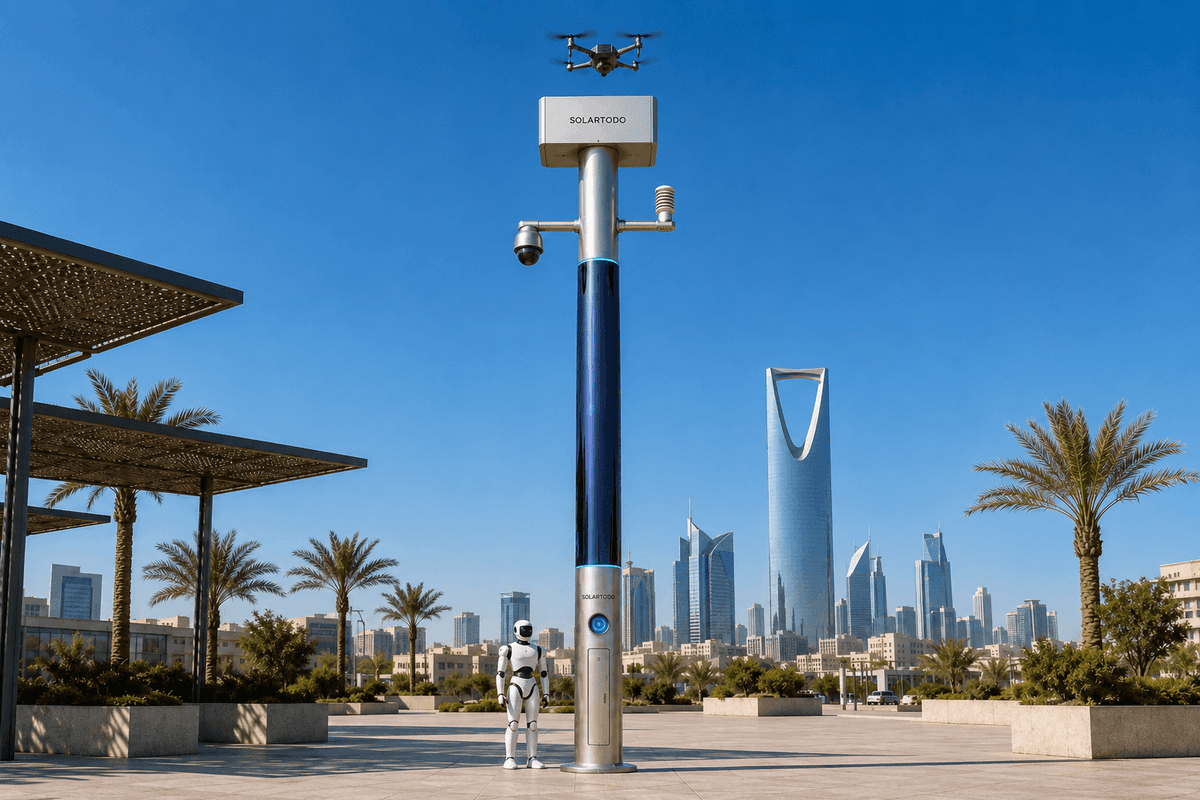
A City AI Pole is an off-grid physical-AI edge node that hosts sensing, compute, energy storage, drone operations, and ground-robot operations in one pole-form station. In this proposed Jakarta deployment, SOLARTODO Sentinel Sky Hub supports holiday industrial-park inspection by keeping local patrol intelligence, robot response, and de-identified command metadata available at the edge.
Procurement Context: Jakarta Holiday Risk Window
For a Jakarta power utility, the holiday period changes the inspection problem. Industrial parks, logistics yards, port-adjacent warehouses, utility switching areas, and fenced feeder corridors do not stop operating simply because staffing thins out. During major public holidays, night shifts can be lighter, contractors may be off site, and manual patrol rounds can slow down just when weather, crowd movement, cargo traffic, and temporary site access patterns become less predictable. The procurement question is therefore not whether to buy another camera or another patrol vehicle. It is how to keep inspection availability high when human coverage is stretched.
This proposed configuration treats SOLARTODO Sentinel Sky Hub as a temporary-event physical-AI edge node for low-altitude inspection around an industrial-park utility perimeter in Jakarta. The buyer is assumed to be a power-utility operator responsible for continuity of service, asset inspection, and incident escalation during a planned holiday operating window. The site may include transformer yards, service roads, cable galleries, logistics gates, temporary contractor entrances, and areas where manual patrols are slow because teams must move between separated assets.
Sky Hub is positioned as a pure intelligent pole, not an illumination asset. It carries its own battery-backed off-grid energy system and 360-degree wrapped flexible CIGS thin-film solar replenishment, so the temporary deployment does not require tapping grid, city, or site power. That matters for procurement because temporary utility operations often lose time on civil works, cabling, permits for power access, and restoration after the event. Here, the pole is specified as a self-contained micro-station that can be placed where inspection value is highest, subject to final structural, solar-yield, communications, and safety engineering confirmation.
Deployment Task: Availability for Low-Altitude Inspection
The operational scenario is low-altitude inspection, but the core KPI is availability. The utility is not procuring a spectacle of automation. It is procuring more consistent patrol coverage, faster field verification, and better command visibility during a period when manual patrols are slow. In this case, availability means several things at once: the edge node remains powered, the camera and environmental sensors remain online, the ground robot can return for charging, the drone operation queue can be scheduled around energy state, and the command view can continue showing status and event metadata even when site communications are imperfect.
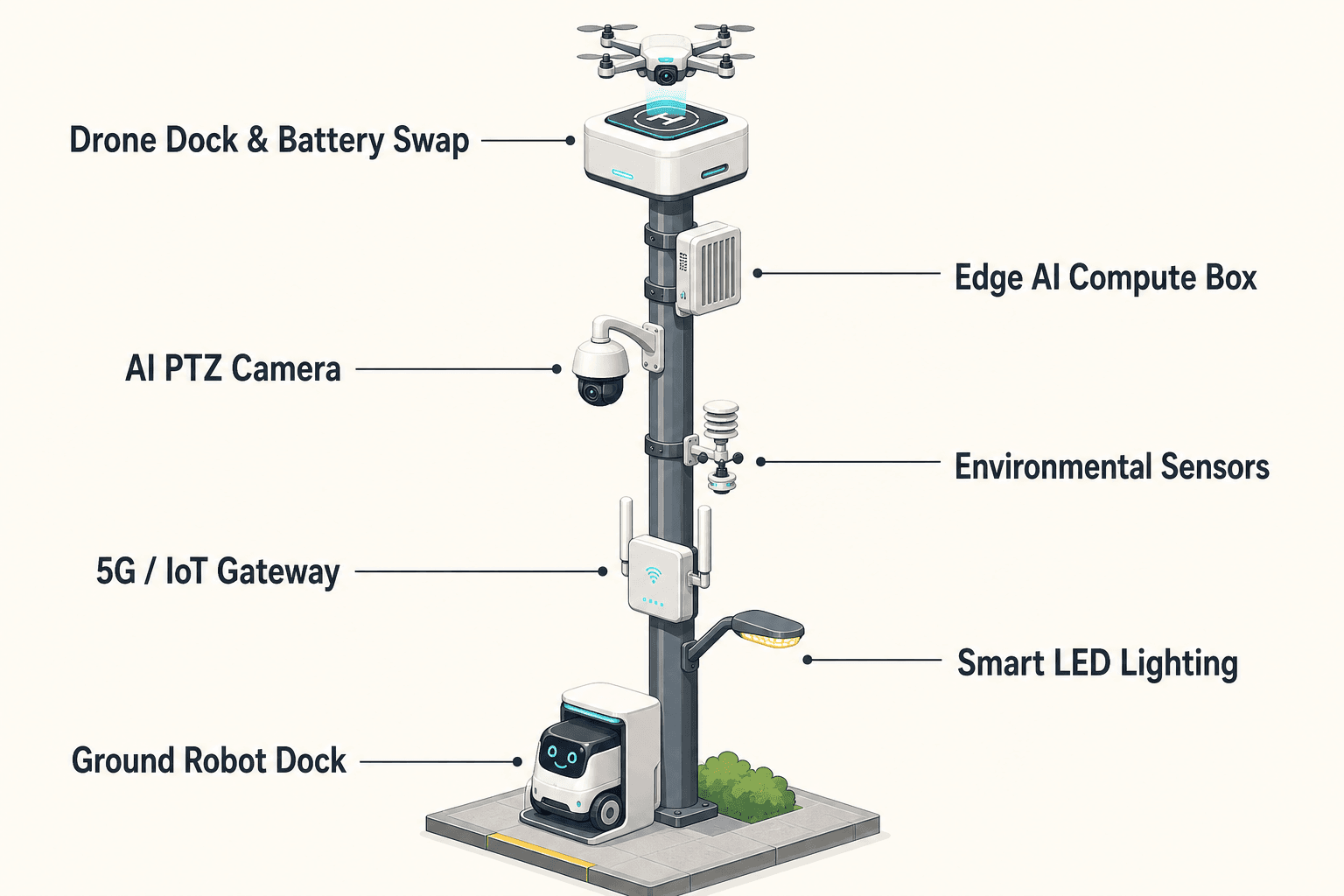
Jakarta is a practical setting for this availability framing. Heat, humidity, heavy rain, local flooding risk, dense vehicle movement, and constrained industrial roads can all slow manual teams. A PTZ camera with local perception gives the node anonymous vehicle count, crowd density, intrusion, and perimeter awareness without sending raw video away from the pole. Environmental monitoring covers wind speed, wind direction, temperature, humidity, atmospheric pressure, noise, PM10, PM2.5, and illuminance, helping the operator understand whether a patrol should be performed by ground robot, by drone, or by a human team.
The procurement scope should define the deployment as a temporary holiday service package rather than a claimed citywide rollout. Target evaluation metrics can include patrol availability by time window, percentage of scheduled robot inspection loops completed, number of manual patrol substitutions accepted by the operator, event review completeness, and command-view uptime. Those are planning and acceptance inputs, not achieved results. Final values should be set only after site survey, route validation, radio assessment, solar exposure review, battery sizing, and operating-rule approval.
Ground-Robot-Centered Operations Model
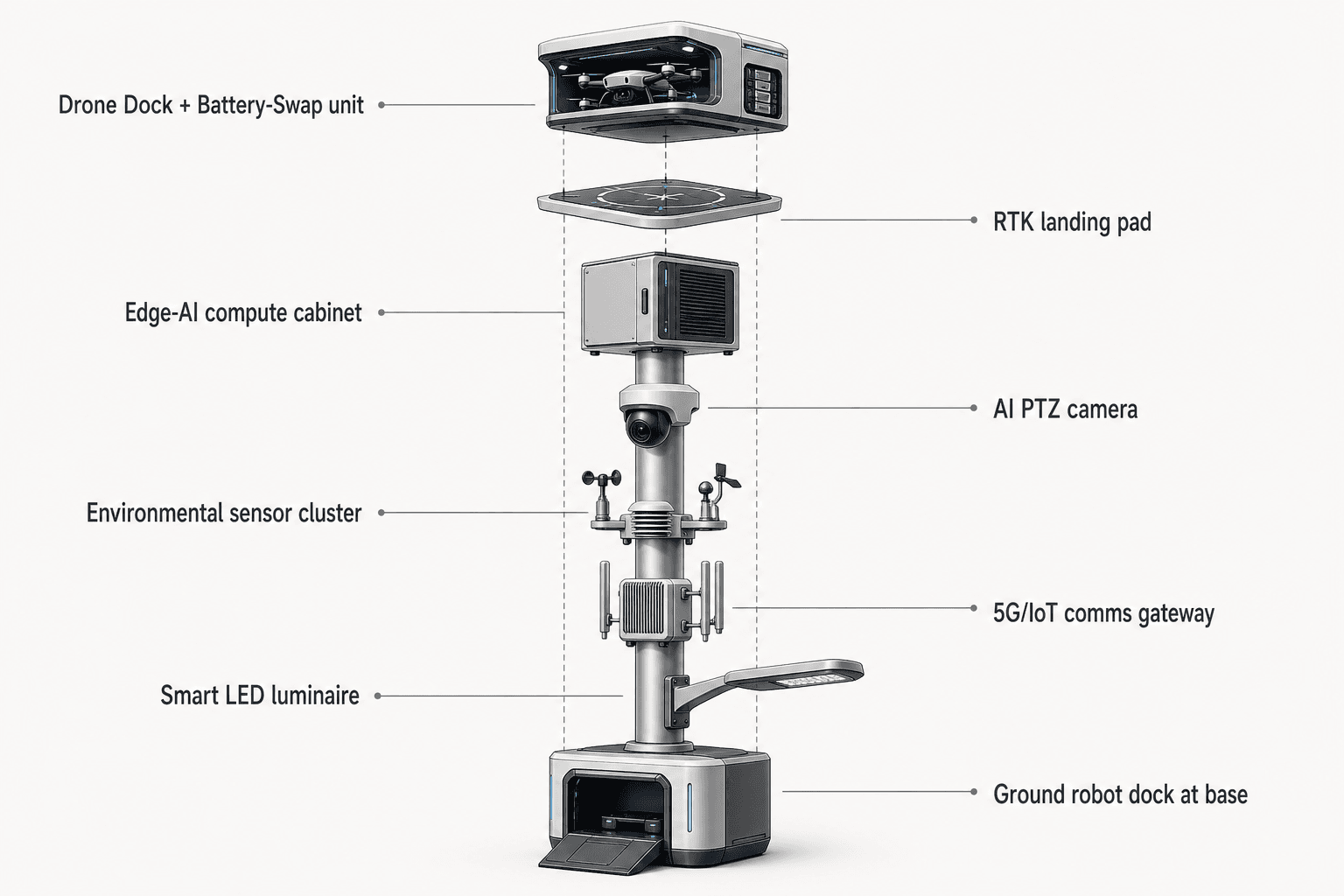
Although Sky Hub integrates drone operations, the module focus for this Jakarta case is the ground robot. The reason is straightforward: many industrial-park inspection tasks remain ground-level tasks. A robot can move along service lanes, approach a fence line, inspect equipment cabinets from a closer angle, respond to an alarm area, and return to the pole base for wireless charging. During holiday coverage, that robot becomes the first field verifier for routine anomalies that would otherwise consume slow manual patrol time.
The pole acts as the robot's local operations anchor. The on-pole edge compute module schedules workloads, scores incoming events, maintains the patrol queue, and decides whether available energy should be reserved for robot charging, drone battery exchange, local inference, or communications. The ground robot receives tasks such as perimeter sweep, gate-area check, cable-route inspection, response to intrusion alerts, and air-ground coordination after a drone sortie. It returns to the pole base for wireless charging instead of depending on a staffed depot.
Drone operations remain part of the same loop, especially for low-altitude inspection. A drone can launch for a regional patrol, inspect rooflines or inaccessible corridors, return to the pole, and receive an automated rear-service battery exchange from a multi-bay battery magazine. Multiple bays allow consecutive sorties within the energy plan, but the article does not assume unlimited flight availability. The drone operation manager handles route planning, charge or swap state, task queueing, fleet health, and mission logs. The ground robot then handles closer verification when the aerial view identifies a local area that needs ground presence.
This division is useful for a power utility because it avoids forcing every alert into a human dispatch. The system can sense, classify, assign, record, and escalate with a human in the loop, while reserving human teams for events that require authority, repair, switching procedures, or safety intervention.
Edge Data, C-UAS Coordination, and COP Governance
The proposed command model follows a single common-operating-picture loop: sensing, authorized assessment and response, edge-compute scheduling, field operations, and maintenance. In Chinese operational shorthand, this aligns with the sensing to response to planning to coordination loop often described as "运查打算协同", but in procurement language it is a governed detect-decide-act-record workflow. The COP should show node health, battery state, solar replenishment trend, robot charge state, drone task state, camera event list, environmental readings, and operator authorization records.
Data handling is deliberately local. Raw video and sensor data stay on the pole and are processed by on-pole inference. Only de-identified event metadata, status messages, logs, and operator-approved summaries may leave the node. This is a PDPL/LGPD-oriented design posture for local processing and auditability; it should not be described as certified compliance unless a separate legal and technical assessment confirms it for the exact deployment.
For unauthorized drone risk around utility assets, Sky Hub can coordinate non-lethal C-UAS response within approved rules. The pole detects and tracks an unauthorized drone using its own sensing and, where engineered into the project, optional partner-sensor inputs. Radar, if used, is not part of the pole hardware; it is an external or partner input. After human authorization, the node can command its own friendly drone to perform soft aerial net-capture or close-approach deterrence. The boundary is important: no shoot-down, no jamming, no denial action, no autonomous attack, and no weaponized response.
This governance model is procurement-relevant because power utilities must document who authorized a response, what evidence was available, what field asset was assigned, and what was recorded afterward. The value is not only automation. The value is a repeatable operating picture that makes holiday coverage auditable.
Energy and Acceptance Framing
The off-grid design is a deployment enabler, but it must be framed honestly. The pole carries about 15 square meters of 360-degree wrapped flexible CIGS thin-film over a vertical cylindrical body roughly 8 meters tall and 0.6 meters wide, with about 2.4 to 2.7 kWp nameplate. A vertical cylinder does not collect direct sun across the full wrap at once. In a high-irradiance region, realistic clear-sky output is roughly 0.8 to 1.1 kW DC peak, usually peaking mid-morning or mid-afternoon rather than noon, and about 6 to 9 kWh per day. Jakarta conditions require local solar-yield confirmation because cloud cover, rain, shading, and site geometry affect the replenishment layer.
For this procurement case, CIGS should be treated as supplemental replenishment for a fully off-grid, battery-backed micro-station, not as a promise of unlimited self-sufficiency. High-power robot and drone activities are buffered by 5 to 20 kWh-class storage and scheduled by duty cycle. That means the acceptance plan should combine energy budgeting and operational prioritization: keep sensing and compute online first, maintain robot return-to-charge capability, schedule drone sorties by battery state, and preserve communications for event metadata and command status.
A practical evaluation package would ask vendors to submit a site-specific energy model, robot route map, drone sortie policy, storage reserve rule, maintenance plan, communications fallback, and COP log sample. The buyer can then compare proposals on availability targets rather than feature claims. For Jakarta holiday operations, that is the correct procurement frame: fewer slow manual patrol dependencies, more local field verification, and a documented edge-node operating loop subject to final engineering confirmation.
System Configuration
| Parameter | Configuration |
|---|---|
| Node type | SOLARTODO Sentinel Sky Hub pure smart pole, no illumination hardware, temporary-event deployment package |
| Energy system | Fully off-grid battery-backed micro-station with 360-degree wrapped flexible CIGS replenishment, subject to site yield confirmation |
| Storage class | 5-20 kWh-class battery storage sized by duty cycle, robot charging demand, drone sortie plan, and reserve policy |
| Edge AI compute | Jetson-class on-pole inference and workload scheduling cabinet, raw video and sensor data processed locally |
| Sensing package | AI PTZ camera plus nine environmental channels: wind speed, wind direction, temperature, humidity, pressure, noise, PM10, PM2.5, illuminance |
| Air-ground operations | Autonomous drone launch, return, multi-bay battery hot-swap, ground robot patrol and wireless return-to-charge at pole base |
| Command view | Common operating picture for node health, task queue, charge state, event metadata, mission logs, and human authorization records |
How It Works
- On-pole PTZ and environmental sensors flag an anomaly near a utility perimeter zone.
- Edge AI classifies the event locally and records de-identified metadata in the command view.
- The operator reviews the event score, site rule, battery state, and patrol availability before authorizing response.
- The ground robot is dispatched for close inspection while drone inspection is queued if an aerial view is needed.
- Field assets return to the pole for charging or battery exchange, and the COP records status, mission log, and closure metadata.
Planning Assumptions (Indicative)
Illustrative planning inputs a buyer can recompute — target metrics, not achieved results. Subject to final engineering confirmation.
| Metric | Planning assumption | Indicative value |
|---|---|---|
| Inspection labor | Target planning input: robot and drone patrols substitute for selected routine manual rounds during the holiday window | ~10-20 routine patrol rounds/week automated for evaluation |
| Availability window | Target planning input: core sensing, edge compute, event logging, and robot return-to-charge remain available through scheduled holiday operating hours | ~90-95% target service availability, site-engineering dependent |
| Manual response filtering | Target planning input: local perception and robot verification reduce dispatches for low-priority perimeter checks | ~30-50% of routine checks screened before human dispatch |
| Drone redeployment | Target planning input: multi-bay battery exchange supports consecutive low-altitude inspection tasks within the energy budget | ~3-6 planned sorties/day, duty-cycle dependent |
| Evidence completeness | Target planning input: each event should include time, node status, sensor context, task decision, operator authorization when required, and closure note | ~100% target event-log completion for accepted workflows |
Deployed Equipment
- SOLARTODO Sentinel Sky Hub pure smart pole body
- 360-degree wrapped flexible CIGS thin-film replenishment layer
- Battery storage and energy-management cabinet
- Jetson-class edge AI compute module
- AI PTZ security camera
- Nine-channel environmental sensor package
- Ground robot wireless charging interface at pole base
- Drone bay with automated multi-bay battery hot-swap magazine
Frequently Asked Questions
Is this Jakarta deployment described as an achieved rollout?
No. This is a proposed and illustrative procurement configuration for a Jakarta industrial-park holiday operating scenario. It avoids claiming installed quantities, named customer results, coverage area, detection rates, certifications, awards, or achieved service levels. The KPI figures are target planning inputs that a buyer should recompute after site survey and engineering confirmation.
Why is the case focused on a ground robot when Sky Hub also supports drone operations?
The ground robot is the strongest fit for slow manual patrol in an industrial-park utility environment. It can move along service roads, check cabinets and fence lines, respond to local alarms, coordinate with aerial inspection, and return to the pole base for wireless charging. Drone operations add reach, but the robot provides close ground verification.
How does the off-grid energy model affect availability planning?
The pole is designed as a fully off-grid micro-station with battery storage and on-pole CIGS replenishment. The solar layer should be treated as supplemental replenishment, not unlimited self-sufficiency. Availability planning should reserve energy for sensing, edge compute, robot return-to-charge, critical communications, and scheduled drone tasks under a site-specific duty cycle.
What data leaves the pole during normal operation?
Raw video and sensor data stay on the pole and are processed locally by the edge compute module. The command system may receive de-identified event metadata, node status, task records, health logs, and operator-approved summaries. This is a PDPL/LGPD-oriented local-processing design posture, not a claim of completed legal certification.
Does the pole perform face recognition or licence-plate recognition?
No. The proposed security sensing package is framed around anonymous vehicle count, crowd density, intrusion, and perimeter awareness. It does not claim active face recognition or licence-plate recognition. That distinction matters for buyer trust, data-minimization design, and public-sector procurement review in privacy-sensitive urban environments.
How is unauthorized drone response controlled?
The C-UAS workflow is non-lethal and human-authorized. The pole can detect and track an unauthorized drone, then coordinate a friendly drone for soft aerial net-capture or close-approach deterrence only under approved rules. It does not perform shoot-downs, jamming, denial actions, autonomous attacks, or weaponized response.
What should a power utility verify before procurement approval?
The buyer should verify site solar exposure, rain and wind operating assumptions, route access for the ground robot, drone operating permissions, communications coverage, battery reserve policy, mounting and foundation requirements, cybersecurity controls, data-retention rules, and COP audit logs. Final acceptance should be tied to availability targets rather than broad feature claims.
Explore Further
- City AI Pole / smart streetlight product line
- More smart-city deployment cases
- Talk to our engineering team
Planning a similar physical-AI deployment for streets, campuses or public spaces? Request an engineering consultation