Jeddah Coastal Salt Air and 35m Urban Spacing: Smart Streetlight Configuration Guide
Summary
Jeddah’s 3.71 million residents, Red Sea salt air, and 39.4°C July mean highs make a 163-unit, 11m grid-powered Smart Streetlight package suitable for 35m urban corridors.
Key Takeaways
A Jeddah Smart Streetlight program should prioritize 11m sealed steel poles, 35m spacing, 400/230V grid compatibility, and coastal corrosion resistance.
- A typical corridor package would use approximately 163 units at 35m spacing, covering about 5.7km of urban street frontage.
- Each SOLARTODO pole uses 2×80W LED luminaires at 150 lm/W and 4000K, providing 24,000 lm per pole.
- Saudi Electricity Company notes the Kingdom is transitioning toward 400/230V distribution, while this configuration accepts AC 220/380V input.
- Jeddah’s coastal setting requires hot-dip galvanizing, RAL7021 powder coating, sealed cable entries, and stainless maintenance doors.
- The lower 2.2m is the integrated 7kW Type 2 EV charging cabinet, not a standalone roadside charger.
- Smart modules include WiFi 6, 5G gateway, LoRaWAN, 4MP IR camera, 4-param ENV sensor, IP audio, SOS, USB-A ×2, and P5 display.
- According to Saudi Census 2022 reporting, Jeddah has about 3.71 million residents, creating dense curbside lighting and EV-access demand.
- According to the Saudi Green Initiative, 12.3GW of renewable capacity is connected to the grid, supporting smarter public-energy planning.
Market Context for Jeddah
Jeddah’s coastal streetlight requirements differ from inland Saudi cities because 3.71 million residents, Red Sea exposure, and flash-rain drainage risk converge in one market.
Jeddah is Saudi Arabia’s major Red Sea city and a dense municipal-service market for lighting, public safety, digital wayfinding, and curbside EV readiness. According to Saudi Census 2022 reporting via Data Commons, Jeddah’s city population was 3,712,917 in 2022, while the wider Jeddah governorate was about 3.75 million. That scale makes street furniture procurement a municipal infrastructure decision, not a decorative lighting purchase.
Climate is the first technical filter. According to the World Meteorological Organization climatology for Jeddah, July mean daily maximum temperature reaches 39.4°C, while rainfall is low annually but concentrated in short winter events. WMO’s local forecast pages also mark dust conditions during summer periods, which matters for camera lenses, LED display brightness, gasket life, and sensor maintenance intervals.
Jeddah is coastal, not inland. Salt-laden Red Sea air increases corrosion risk at cable glands, maintenance doors, bracket welds, fasteners, and the charger cabinet face. The city also has older, denser districts near historic Jeddah where narrow street geometry makes separate EV pillars and large roadside cabinets harder to justify; an integrated pole-as-charger helps reduce sidewalk conflict.
Drainage is the second local constraint. According to the Saudi Press Agency (2022), Jeddah Municipality’s Al-Asalah drainage project included 130 rainwater catch basins, 129 manholes, 9,500m of pipe, and a lift station with 23,000m³/hour pumping capacity. Smart pole foundations in this market should therefore use raised plinth details, sealed low-voltage compartments, and commissioning checks after intense rain rather than assuming ordinary arid-city runoff behavior.
Grid context also points to a grid-powered smart pole. According to Saudi Electricity Company, Saudi Arabia is shifting toward 400/230V distribution, and the national frequency remains 60Hz. For a Jeddah urban street class, SOLARTODO’s grid-powered 11m smart pole with AC 220/380V compatibility is a practical fit because it can connect through municipal low-voltage feeders while supporting lighting, communications, EV charging, and emergency functions from one cabinetized structure.
Saudi Vision 2030 and city mobility planning reinforce the need for multi-function poles. According to the Saudi Press Agency (2025), Jeddah’s public bus project phase introduced 91 buses, including 3 electric buses. This is not evidence for a specific SOLARTODO project; it is a market signal that public transport stops, curbside pickup areas, and mixed-use corridors increasingly need power, communication, and public-safety nodes.
The Saudi Green Initiative states, “50% of its power generated from renewable sources by 2030.” For smart streetlights, the relevance is not that every pole must be solar; rather, municipal buyers are under pressure to reduce energy waste, measure environmental conditions, and integrate future-ready EV and communications hardware. In Jeddah, sealed grid-powered smart poles are usually more defensible than exposed hybrid arms on dense coastal corridors.
Recommended Technical Configuration
A typical Jeddah urban corridor deployment would use approximately 163 SOLARTODO 11m grid-powered smart poles at 35m spacing.
The recommended product fit is SOLARTODO Smart Streetlight form [grid_12m], adapted to the project-specific 11m octagonal tapered steel pole. This size is appropriate for city and urban street classes, where 25-50m spacing and 30-50 poles per km are typical. At 35m spacing, approximately 163 poles cover about 5.7km of corridor, depending on intersections, medians, pedestrian crossings, and setback rules.
This configuration is not a highway mast and should not be positioned as a park-lighting solution. High-speed roads usually require taller traffic-pole engineering, different crash protection, and roadway photometric classes. Parks normally use 6-8m garden lighting with lower brightness and fewer public-safety modules.
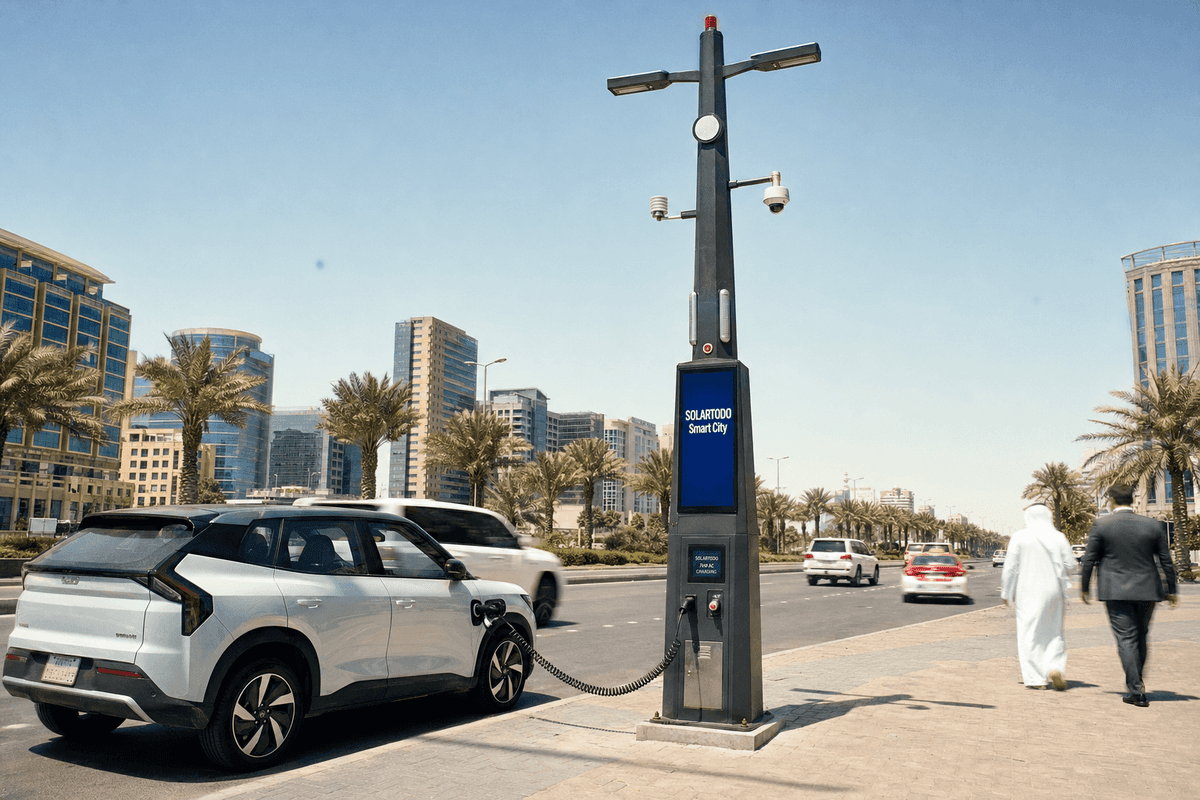
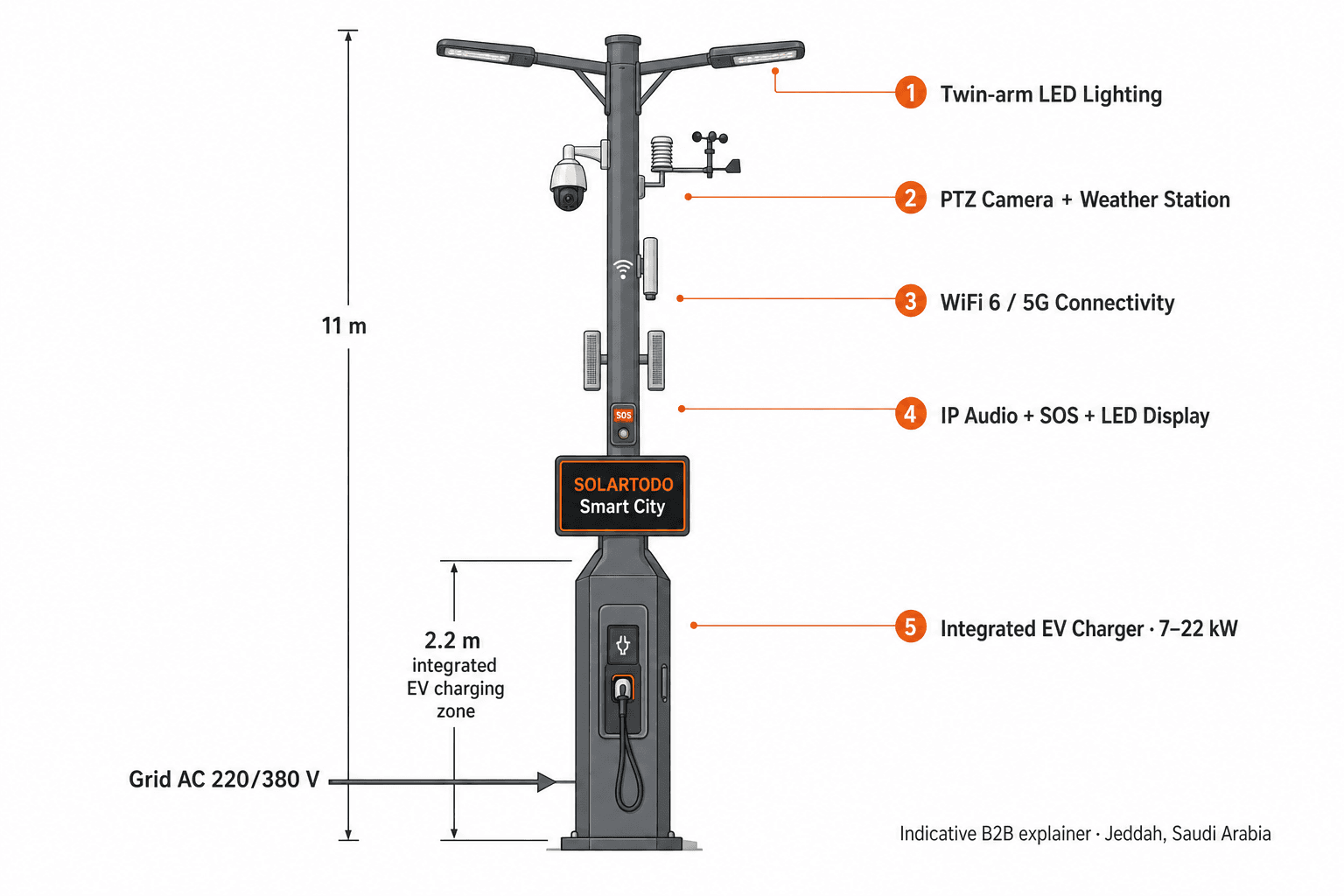
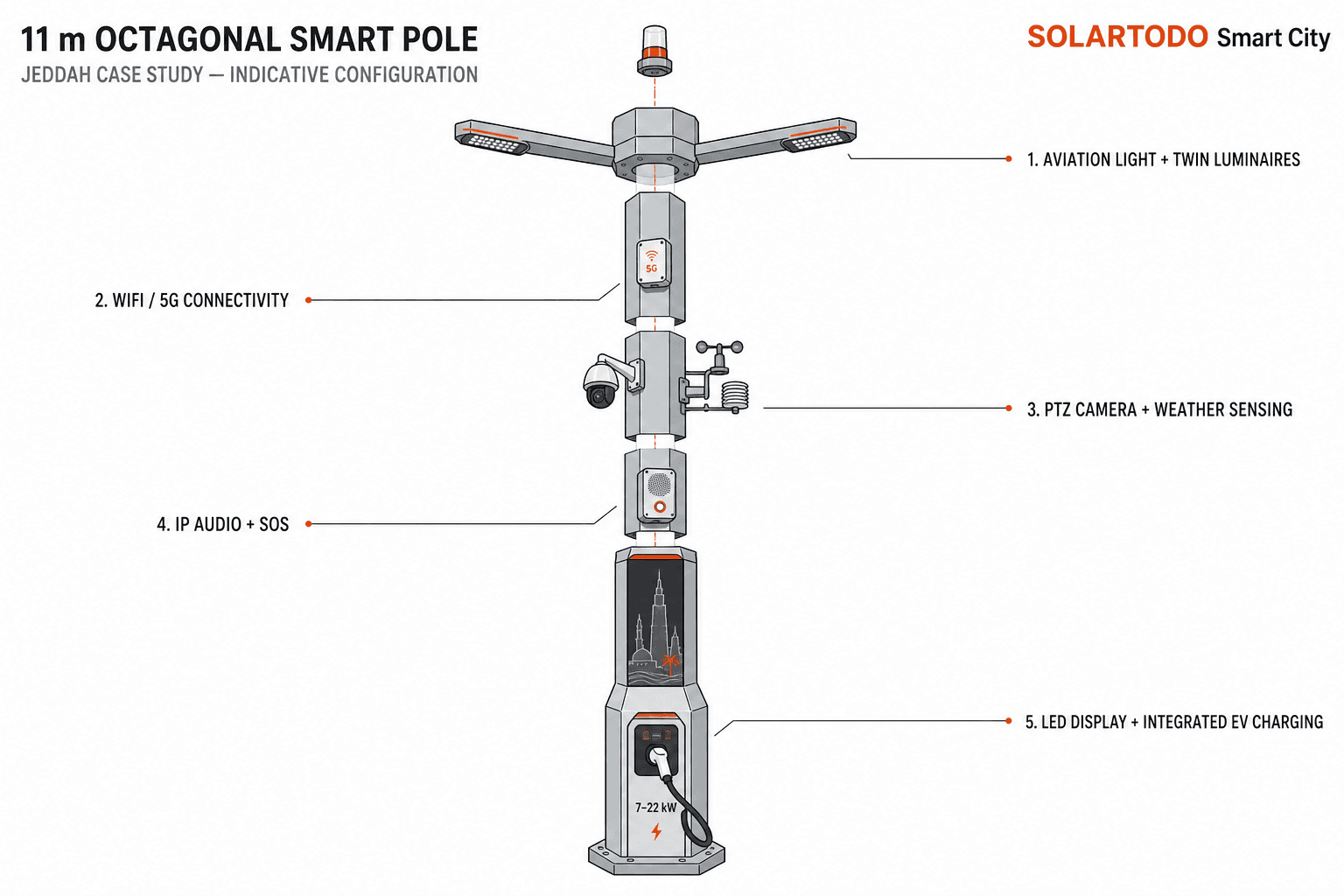
A typical 163-unit deployment of this scale would consist of charcoal RAL7021 powder-coated poles, twin symmetric LED arms, an integrated lower EV charging cabinet, communication modules, camera, environmental sensor, public address, SOS intercom, USB charging, and a portrait LED information display. The most important design detail is structural integration: the lower 2.2m of the pole is the EV charging cabinet, welded into one continuous steel structure, not a separate charger beside the pole.
The Jeddah-specific reason for selecting grid power is reliability under high heat, coastal humidity, and dense streetscape conditions. Solar-hybrid smart poles can work in open sites, but exposed panels and turbines add maintenance surfaces where dust, salt, and vandalism risk are higher. A sealed grid-powered pole keeps the silhouette cleaner and centralizes access control for municipal and EPC maintenance teams.
Technical Specifications
The recommended 163-unit Jeddah Smart Streetlight specification combines 11m tapered steel structure, 160W LED output, 7kW AC EV charging, and IP networked safety systems.
- Product: SOLARTODO Smart Streetlight, grid-powered MENA urban configuration.
- Quantity basis: approximately 163 units for a typical 35m-spaced corridor package.
- Pole structure: 11m octagonal tapered steel smart pole, base Ø45cm to top Ø15cm.
- Finish: charcoal RAL7021 powder coat over corrosion-protected steel, suitable for coastal maintenance planning.
- Power input: grid-powered AC 220/380V, aligned with Saudi low-voltage transition context.
- Lighting: twin symmetric arms, 1.5m each, +8° upward tilt.
- LED luminaires: 2×80W SOLARTODO LED, 150 lm/W, 4000K, total 160W per pole.
- Camera: 4MP bullet camera with 50m IR range on 30cm short-arm bracket.
- Environmental sensing: top-mounted 4-param sensor for temperature, humidity, wind speed, and noise.
- Public address: 1× IP audio column, Ø10×50cm, 30W/93dB, TCP/IP networked, flush-mounted against flat pole face.
- Emergency system: SOS button, panic alarm, camera linkage, and emergency broadcast trigger.
- EV charger: integrated 7kW single-gun AC charger with Mennekes Type 2 IEC 62196-2 connector.
- EV interface: OCPP 1.6J, 5m coiled Type 2 cable, 8-inch touchscreen at 1.5m height, red mushroom E-stop.
- Charger cabinet: lower 2.2m of the pole body, stainless maintenance door, USB-A ×2 at 5V/2.4A.
- Display: P5 portrait LED screen, 1280×2560mm, >5000 cd/m², content restricted to “SOLARTODO Smart City” in white sans-serif on deep blue.
- Communications: dual-mode WiFi 6 + 5G gateway with GbE uplink and LoRaWAN, flush-mounted at 8.7m.
- Device finish: color-matched housing with continuous paint flow across the device-pole boundary.
- Applicable standards: IEC 60598 for luminaires, GB/T 37024 for smart lighting systems, IEC 62196-2 for EV connector interface.
According to IEC, IEC 60598 defines luminaire safety requirements, while IEC 62196-2 covers AC charging coupler dimensional compatibility. IEC states, “IEC 60598 specifies general requirements for luminaires.” For Saudi procurement, the technical submittal should also reference SASO conformity pathways where required by the buyer, utility connection approvals, and municipal right-of-way requirements.
Implementation Approach
A 163-unit Jeddah rollout should be phased through survey, utility coordination, CKD logistics, foundation works, pole erection, and digital commissioning.
The first phase is corridor survey and utility mapping. EPC teams should confirm feeder capacity, earthing, existing lighting circuits, sidewalk widths, drainage inlets, curb ramps, and bus-stop conflict points. In older districts and coastal boulevards, the integrated pole-as-charger format reduces footprint, but it still requires safe cable routing and maintenance-door clearance.
The second phase is engineering submittal and municipal procurement alignment. Drawings should include pole elevation, foundation design, cable gland sealing, EV charger single-line diagram, OCPP settings, camera field of view, display content lock, and IP audio coverage. Saudi Electricity Company connection context should be documented for AC 220/380V supply and future 400/230V compatibility planning.
The third phase is CKD shipping and site preparation. For a typical 163-unit deployment, poles, LED arms, cabinets, displays, chargers, and communications modules can be packed as controlled lots to simplify inspection on arrival. Jeddah’s port access is a logistics advantage, but coastal storage needs wrapped surfaces, dry staging, and fastener protection before installation.
The fourth phase is foundation, erection, and commissioning. Crews should install foundations with drainage-conscious levels, set poles vertically, connect AC feeds, bond earthing points, configure OCPP 1.6J, test WiFi 6 and 5G backhaul, validate LoRaWAN controller data, and trigger SOS-to-camera-to-broadcast workflows. Final acceptance should include night photometry, EV charger safety checks, emergency audio audibility, and display brightness verification above 5000 cd/m².
Expected Performance & ROI
A 163-unit Jeddah configuration would deliver about 26.1kW of connected LED load plus 163 integrated 7kW AC charging points.
Lighting energy performance depends on dimming schedules, existing lamp baseline, and tariff class. At full lighting load, 163 poles × 160W equals 26.08kW; with 12 operating hours nightly, annual LED consumption is about 114,200kWh before adaptive dimming. If replacing older 250-400W luminaires, an LED retrofit can materially reduce energy use while improving camera-ready uniformity.
According to the IEA (2023), LEDs are a central technology for reducing lighting electricity demand, and connected controls can improve savings where dimming policies are enforced. For Jeddah, ROI should be modeled across four value pools: lower lighting energy, avoided separate EV charger civil works, reduced standalone CCTV/public-address poles, and monetizable advertising or 5G-ready lease potential where legally permitted.
The EV charging element changes the business case. A 7kW AC charger is not designed for highway fast charging; it is suitable for curbside dwell time, municipal fleet top-up, parking streets, hotels, waterfront promenades, and mixed-use retail areas. A typical financial model should separate lamp energy savings from charger utilization revenue, because charging income depends on parking behavior and operator tariff policy.
Maintenance cost is also a local ROI variable. Jeddah’s salt air, heat, dust, and short intense rain events justify inspection cycles for gaskets, powder coat damage, display seals, cable glands, camera lens cleanliness, and charger connector wear. The integrated design reduces clutter but makes preventive maintenance discipline more important because several services share one structure.
Results and Impact
A Jeddah-ready 163-unit Smart Streetlight package would consolidate 6 public systems into one 11m pole line while preserving sidewalk space.
Expected impact should be stated as forecasted performance, not a completed deployment claim. The configuration supports safer night visibility, curbside AC charging, environmental sensing, public announcements, emergency calls, and managed communications from one municipal asset. For procurement teams, this converts multiple low-voltage roadside devices into a standardized pole bill of materials.
For urban design, the main benefit is footprint control. Separate lighting poles, EV pillars, CCTV masts, loudspeakers, and LED signs can crowd sidewalks and complicate maintenance access. In Jeddah’s denser streets and waterfront corridors, the integrated lower 2.2m charger cabinet and flush communications housing help keep the pole line visually consistent.
For operations, the measurable outputs should include lighting uptime, charger session data, SOS response logs, camera availability, sensor readings, gateway uptime, and maintenance tickets per 100 poles. These metrics allow a city or EPC buyer to decide whether to expand from a 163-unit pilot-class package to district-wide procurement.
Comparison Table
Compared with solar-hybrid and premium cylindrical poles, the 11m grid-powered configuration is the strongest Jeddah fit for dense coastal urban corridors.
| Option | Best Fit in Jeddah | Height/Form | Power | Key Modules | Main Trade-off |
|---|---|---|---|---|---|
| SOLARTODO grid smart pole | Dense coastal roads, mixed-use streets | 11m octagonal tapered steel | AC 220/380V | 2×80W LED, 7kW Type 2 EV, 4MP camera, WiFi 6/5G, SOS | Requires utility feeder coordination |
| Hybrid wind-solar smart pole | Open inland plazas or remote roads | 12m octagonal with panels/turbine | Wind-solar + LFP + grid backup | LED, hybrid generation, battery, optional EV | More exposed surfaces for dust and salt maintenance |
| Cylindrical CIGS smart pole | Premium boulevards and design districts | Ø180-400mm seamless cylinder | Grid + wrapped CIGS assist | Flush modules, embedded EV, 360° solar wrap | Higher design-control requirement |
| Standard modular smart pole | Budget municipal retrofits | 6-12m octagonal galvanized | Grid or modular | LED, camera, WiFi, display, SOS options | Less integrated EV-cabinet identity |
For this market analysis, SOLARTODO recommends the grid-powered Smart Streetlight because Jeddah’s AC utility access, coastal corrosion exposure, and sidewalk constraints favor sealed integrated hardware. The smart-streetlight product page provides a broader product overview at SOLARTODO Smart Streetlight, while project-specific engineering review can be requested through contact us.
Pricing & Quotation
A Jeddah quotation should separate 163-unit equipment supply, CIF delivery, and EPC turnkey scope because civil works and utility approvals vary by corridor.
SOLARTODO offers three pricing tiers for this product line: FOB Supply (equipment ex-works China), CIF Delivered (including ocean freight and insurance), and EPC Turnkey (fully installed, commissioned, with 1-year warranty). Volume discounts are available for large-scale deployments. Configure your system online for an instant estimate, or request a custom quotation from our engineering team at [email protected].
For EPC comparison, buyers should request a priced bill of quantities that separates pole supply, foundation works, trenching, cable, earthing, OCPP platform integration, SIM/data service, testing, and warranty support. Do not compare only pole unit price; in Jeddah, drainage details, salt-air protection, traffic management, and municipal permit requirements can materially affect installed cost.
Frequently Asked Questions
A Jeddah Smart Streetlight buyer should validate 10 technical and commercial points before approving a 163-unit urban corridor package.
Q1: What Smart Streetlight configuration is recommended for Jeddah? The recommended configuration is the SOLARTODO grid-powered 11m octagonal tapered smart pole with AC 220/380V input, 2×80W LED lighting, integrated 7kW Type 2 EV charging, 4MP IR camera, ENV sensor, IP audio, SOS, WiFi 6, 5G gateway, LoRaWAN, and P5 display. It fits dense coastal urban corridors better than exposed hybrid solar-wind hardware.
Q2: Why use an integrated pole-as-charger instead of a separate EV pedestal? The lower 2.2m of the pole is the EV charging cabinet, welded as one continuous steel structure with the upper pole. This reduces sidewalk clutter, simplifies asset ownership, and protects the charger inside the pole envelope. In Jeddah’s dense streets and waterfront areas, avoiding separate roadside pillars can improve pedestrian clearance and visual consistency.
Q3: How long would a typical 163-unit deployment take? A typical timeline is 8-16 weeks after approved drawings, depending on permits, feeder readiness, trenching scope, and traffic access. Survey and design usually come first, followed by CKD shipment, foundation works, pole erection, electrical connection, OCPP setup, camera alignment, display testing, and emergency-system commissioning. Live-road work may extend the schedule.
Q4: What ROI should a municipality or EPC buyer expect? ROI should be modeled from four sources: LED energy reduction, avoided standalone EV charger civil works, consolidation of CCTV/audio/display hardware, and potential communications or advertising value where permitted. The 163-unit package has about 26.1kW of LED load and 163×7kW AC charging points, so charger utilization assumptions matter more than lighting alone.
Q5: What maintenance is required in Jeddah’s coastal environment? Maintenance should include periodic washing, salt-deposit inspection, gasket checks, powder-coat touch-up, stainless-door inspection, camera lens cleaning, LED display seal checks, and Type 2 connector wear review. Because Jeddah combines high heat, humidity, dust, and occasional intense rain, the maintenance plan should treat corrosion prevention and cable-entry sealing as core tasks.
Q6: How does this compare with solar-hybrid smart streetlights? Solar-hybrid poles are useful where grid access is weak, but Jeddah’s dense corridors usually have utility access and tighter streetscape limits. Exposed panels and turbines add cleaning and corrosion surfaces in salt air. The grid-powered SOLARTODO pole keeps EV charging reliable, supports 160W lighting, and reduces visible attachments on urban streets.
Q7: What standards apply to this configuration? The luminaire design should reference IEC 60598, the EV connector should reference IEC 62196-2 Type 2, and the smart lighting system should reference GB/T 37024. Saudi projects may also require SASO-related conformity documentation, Saudi Electricity Company connection approval, municipal right-of-way permits, and project-specific earthing and low-voltage protection drawings.
Q8: Can the P5 LED display show advertising content? For this specified configuration, the LED advertising display content is strictly limited to “SOLARTODO Smart City” in white sans-serif text on a deep blue background, with no other imagery. The display hardware is P5, portrait 1280×2560mm, and above 5000 cd/m², but content permissions remain subject to municipal rules.
Q9: What is included in EPC pricing? EPC pricing typically includes equipment, delivery coordination, foundations, trenching, cabling, earthing, pole erection, electrical connection, system commissioning, OCPP configuration, acceptance testing, and a 1-year warranty. Final scope depends on corridor drawings, feeder availability, traffic management, and permit conditions. Buyers should compare EPC totals, not only pole supply prices.
Q10: What warranty and after-sales terms should be requested? Buyers should request warranty terms for pole coating, LED drivers, EV charger electronics, touchscreen, camera, display module, gateway, sensor, and SOS/audio equipment. A practical Jeddah warranty package should include spare parts, response times, corrosion exclusions, preventive-maintenance requirements, and OCPP/cloud support. EPC Turnkey pricing includes a 1-year warranty by default.
References
These 7 references support the Jeddah market context, Saudi voltage assumptions, climate constraints, EV interface selection, and smart lighting standards.
- General Authority for Statistics / Saudi Census (2022): Saudi Census results report Jeddah as one of Saudi Arabia’s largest cities, with about 3.71 million residents in the city and 3.75 million in the governorate.
- World Meteorological Organization (1982-2011 normals): Jeddah climatology lists July mean maximum temperature at 39.4°C and shows rainfall concentrated in limited monthly events.
- Saudi Electricity Company (2024): Customer voltage guidance explains Saudi Arabia’s transition toward 400/230V distribution and confirms the national frequency remains 60Hz.
- Saudi Arabia Distribution Code (2024): Standard service voltages include 400/230V, 380/220V, 13.8kV, 33kV, and 69kV for distribution planning context.
- Saudi Press Agency (2022): Jeddah Municipality’s Al-Asalah drainage project included 130 catch basins, 129 manholes, 9,500m piping, and 23,000m³/hour pumping capacity.
- Saudi Press Agency (2025): Jeddah public bus project phase introduced 91 buses, including 3 electric buses, indicating municipal movement toward electrified public mobility.
- Saudi Green Initiative (2025): Saudi Arabia reports 12.3GW renewable capacity connected to the grid and targets 50% renewable electricity by 2030.
Equipment Deployed
- 163 units × 11m octagonal tapered steel smart pole, base Ø45cm to top Ø15cm, RAL7021 powder coat
- Integrated lower 2.2m EV charging cabinet welded as one continuous pole structure
- Grid-powered AC 220/380V electrical input
- Twin symmetric 1.5m lighting arms with +8° upward tilt
- 2×80W SOLARTODO LED luminaires, 150 lm/W, 4000K
- 4MP bullet camera with IR 50m on 30cm short-arm bracket
- Top 4-param ENV sensor: temperature, humidity, wind speed, noise
- 1× IP audio column Ø10×50cm, 30W/93dB, TCP/IP networked
- SOS + panic alarm + camera linkage + emergency broadcast trigger
- Integrated 7kW single-gun AC charger, Mennekes Type 2 IEC 62196-2, OCPP 1.6J
- 5m coiled Type 2 cable, 8-inch touchscreen at 1.5m, red mushroom E-stop, stainless maintenance door
- P5 vertical LED screen 1280×2560mm, portrait, >5000 cd/m², SOLARTODO Smart City text only
- Dual-mode WiFi 6 + 5G gateway with GbE uplink and LoRaWAN at 8.7m
- USB-A ×2, 5V/2.4A, mounted on charging cabinet
- Applicable standards: IEC 60598, GB/T 37024, IEC 62196-2