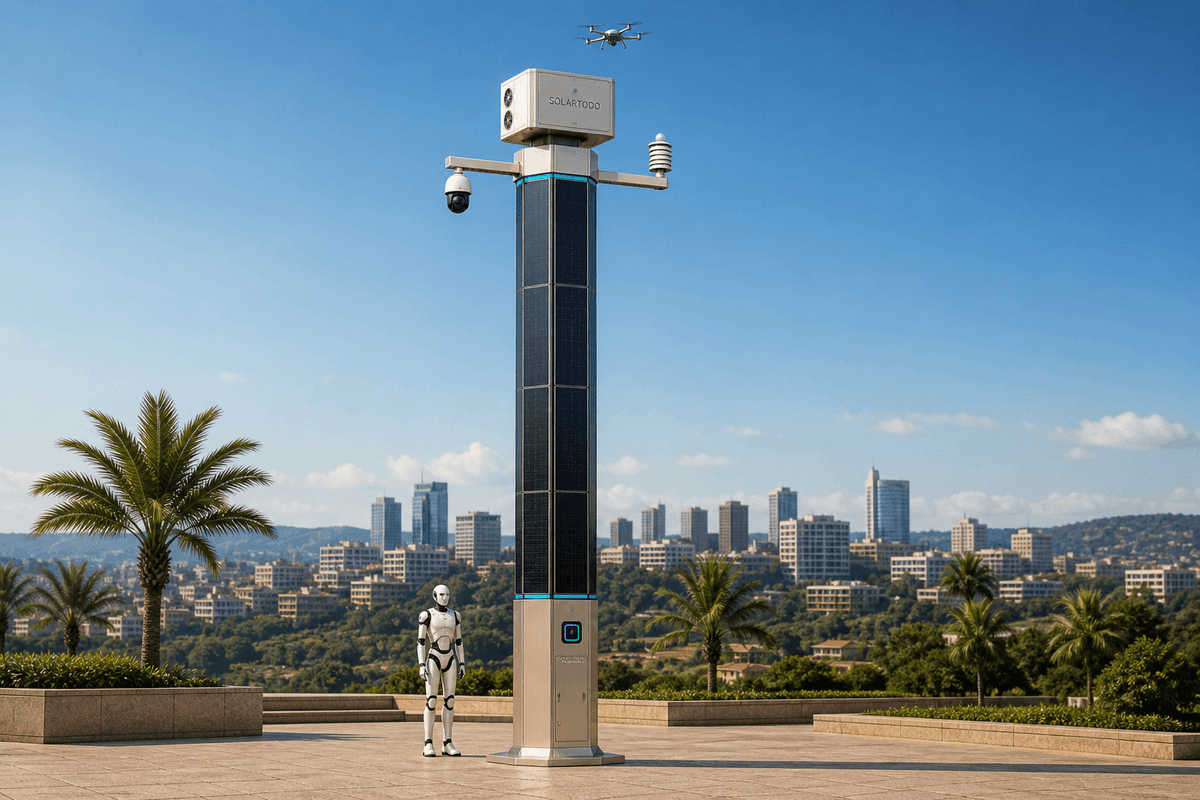
Keeping Kigali's hilly transit corridors observable off-grid: SOLARTODO Sentinel City AI Pole 26-node configuration
Summary
Kigali has 1.75 million residents, 2,401 people/km2, and a 2050 plan for 3.8 million residents. A typical 26-node SOLARTODO Sentinel City AI Pole layout at 35 m spacing would create an off-grid edge-AI corridor of about 875 m.
Key Takeaways
- A typical Kigali corridor deployment would use approximately 26 SOLARTODO Sentinel City AI Pole nodes at about 35 m spacing, covering roughly 875 m before detailed turning-radius and setback checks.
- Kigali's 2022 population is 1,745,555, with 86.9% urban residents, so edge nodes should prioritize dense pedestrian, transit, and perimeter environments.
- According to the City of Kigali (2020), the 2050 master plan projects 3.8 million residents and 1.8 million jobs, increasing demand for distributed urban monitoring.
- Rwanda's national grid includes 220 kV, 110 kV, 30 kV, 15 kV, and 0.4 kV classes, but this configuration remains fully off-grid with on-pole solar replenishment and battery storage.
- Each pole should be sized around a 2.8-3.2 kWp vertical PV body, 5-20 kWh-class battery storage, and clear-sky replenishment of about 7-10 kWh/day in high-irradiance conditions.
- The sensing package should include 9 environmental variables: wind speed, wind direction, temperature, humidity, pressure, noise, PM10, PM2.5, and illuminance.
- Rwanda's personal-data regime took effect under Law No. 058/2021, so raw video and sensor streams should remain on-pole with only de-identified metadata leaving the node.
- ITU DataHub reports Rwanda LTE/WiMAX coverage at 98.8% in 2024, making private LTE, fiber backhaul, or secured cellular fallback practical options for Kigali corridors.
Market Context for Kigali
Kigali's best-fit AI pole opportunity is not street lighting; it is off-grid corridor intelligence for hilly mobility routes, flood-sensitive nodes, and controlled public-infrastructure perimeters. According to the National Institute of Statistics of Rwanda (2022), the City of Kigali has 1,745,555 residents and 86.9% of them live in urban areas. The same national census data places Kigali's density at 2,401 inhabitants per km2, with Kicukiro reaching 2,944 inhabitants per km2. This density matters because a 26-node edge network at 35 m spacing is better treated as a corridor operating system than as isolated equipment.
Kigali is inland, elevated, and tropical-highland rather than coastal, so corrosion assumptions should not be copied from salt-air cities. According to the World Meteorological Organization (2026), Kigali monthly mean daily maximum temperatures sit roughly between 25.9 C and 28.2 C, while April rainfall averages 154.2 mm across 18 rain days. Visit Rwanda states, "The average daily temperature in Kigali is 21 C." For SOLARTODO, that points to rain sealing, drainage-aware foundations, and humidity protection rather than coastal salt-load overdesign.
The terrain constraint is equally important. Kigali's urban form is defined by hills, valleys, and rapidly upgrading mobility corridors, so pole siting has to account for vertical grades, stormwater channels, and line-of-sight breaks. According to the City of Kigali (2020), the Master Plan 2050 includes flood-risk mitigation, improved drainage infrastructure, and integrated use of streets, footpaths, and stormwater assets. This is why an AI pole should be specified as a local-processing edge node: it can observe corridor events where blind corners, valley roads, and transit interchanges create operational gaps.
Rwanda's grid context also supports an off-grid edge-node architecture. According to Rwanda's Ministry of Infrastructure (2026), the national grid uses high-voltage 110 kV and 220 kV, medium-voltage 15 kV and 30 kV, and low-voltage 0.4 kV classes, managed through SCADA. The SOLARTODO Sentinel City AI Pole should not be connected to these classes for normal operation; its value is avoiding trenching, feeder permits, and dependency on site power. Rwanda Standards Board RS 116-1:2011 covers low-voltage electrical installations up to 1,000 V AC and street furniture, so local engineering review should still confirm earthing, protection, isolation, and enclosure interfaces.
Digital readiness is stronger than many African city assumptions suggest. According to ITU DataHub (2024), Rwanda has 71.6 active mobile-broadband subscriptions per 100 people and 98.8% LTE/WiMAX population coverage. According to Rwanda's Ministry of ICT and Innovation, Rwanda reported 96.6% population coverage for 4G LTE services in its national ICT development materials. For Kigali buyers, this means the recommended design can rely on local edge processing first, then send small event packets through secured backhaul rather than streaming raw video.
Recommended Technical Configuration
A Kigali-ready configuration would use approximately 26 off-grid SOLARTODO Sentinel nodes to create a controlled urban edge-AI corridor of about 875 m. This recommendation uses the provided deployment context: 26 pole-form edge nodes across Kigali at approximately 35 m spacing, subject to survey confirmation. Because the product is a pure smart pole with no luminaire or lamp head, the configuration should be procured as sensing, compute, drone, robot, energy, and command infrastructure. The fit is strongest for smart districts, campuses, industrial parks, transport facilities, city perimeters, and critical-infrastructure zones.
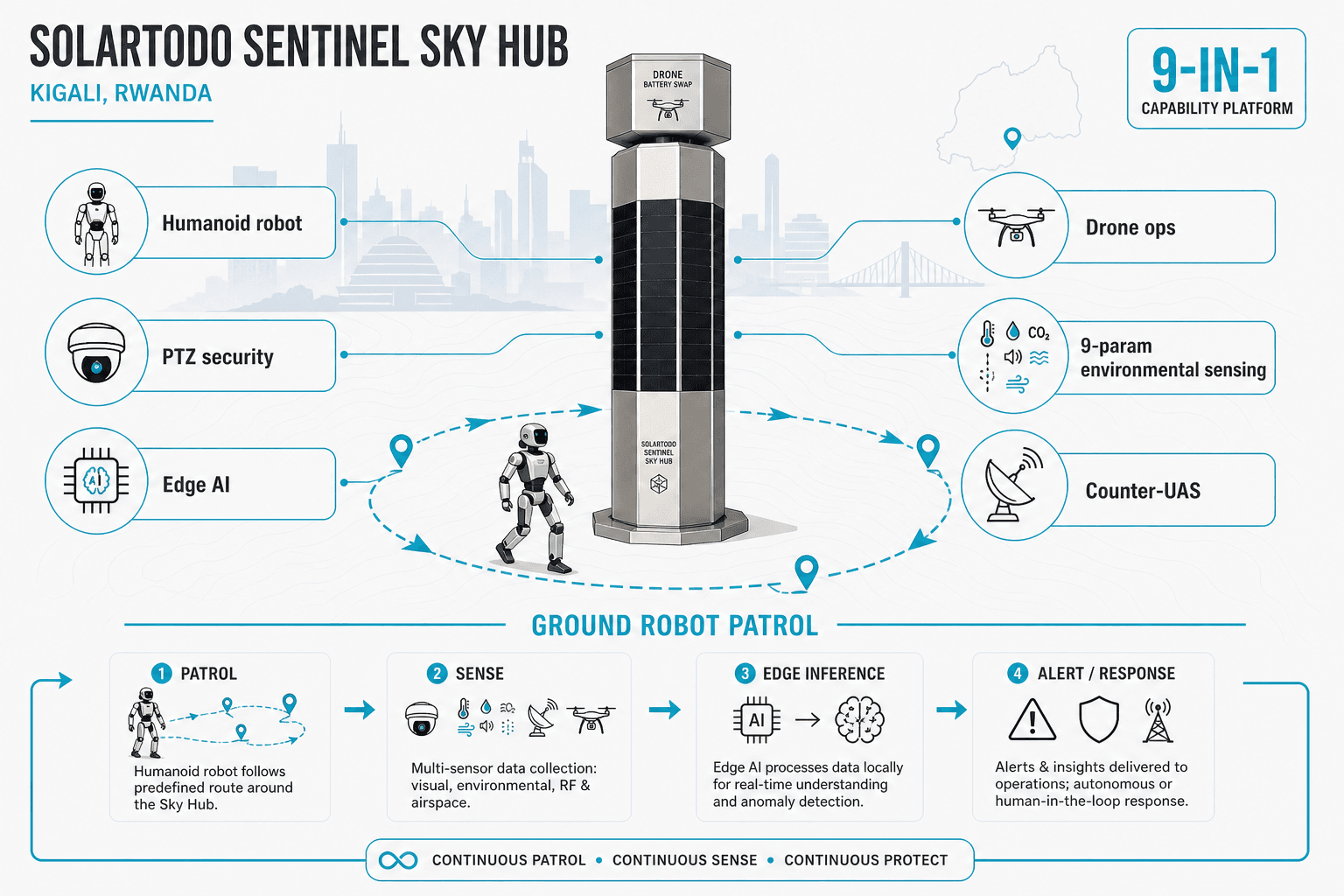
A typical 26-unit deployment in this profile would consist of one common-operating-picture command layer, 26 pole edge nodes, autonomous aerial-service capability, and ground-robot operations where route geometry allows. Each node should run local perception for anonymous vehicle counts, crowd density, intrusion detection, perimeter awareness, and environmental monitoring. Raw video and raw sensor streams should stay on the pole, while de-identified event metadata, health status, mission logs, and alert summaries may be transmitted. This architecture is designed for local processing and PDPL-LGPD-oriented data minimization, not for centralized raw surveillance storage.
The Kigali-specific reason for 35 m spacing is not illumination coverage; it is sensor continuity across hilly and mixed-use rights of way. In a flat industrial park, wider intervals may be acceptable, but Kigali's gradients and corner geometry argue for closer nodes at intersections, drainage pinch points, and transit edges. The 26-node count should therefore be treated as a design package for roughly one corridor segment, not as a citywide rollout claim. Final spacing should be confirmed by civil survey, radio planning, drone operating envelope, foundation geotechnics, and municipal setback rules.
Technical Specifications
A 26-node Kigali deployment should specify off-grid edge compute, 2.8-3.2 kWp-class on-pole solar replenishment, and 5-20 kWh storage per node. The SOLARTODO Sentinel City AI Pole in Sky Hub form is a pure smart pole, not a smart streetlight. It carries sensing, edge compute, drone operations, ground-robot support, storage, and solar replenishment in one pole-form micro-station. It should be linked from the SOLARTODO city intelligence portfolio at SOLARTODO solutions, with project-specific engineering confirmed through contact us.
Core technical specification for Kigali:
- Quantity: approximately 26 units for a typical corridor package.
- Spacing: about 35 m between nodes, subject to road reserve, gradients, radio path, and civil survey.
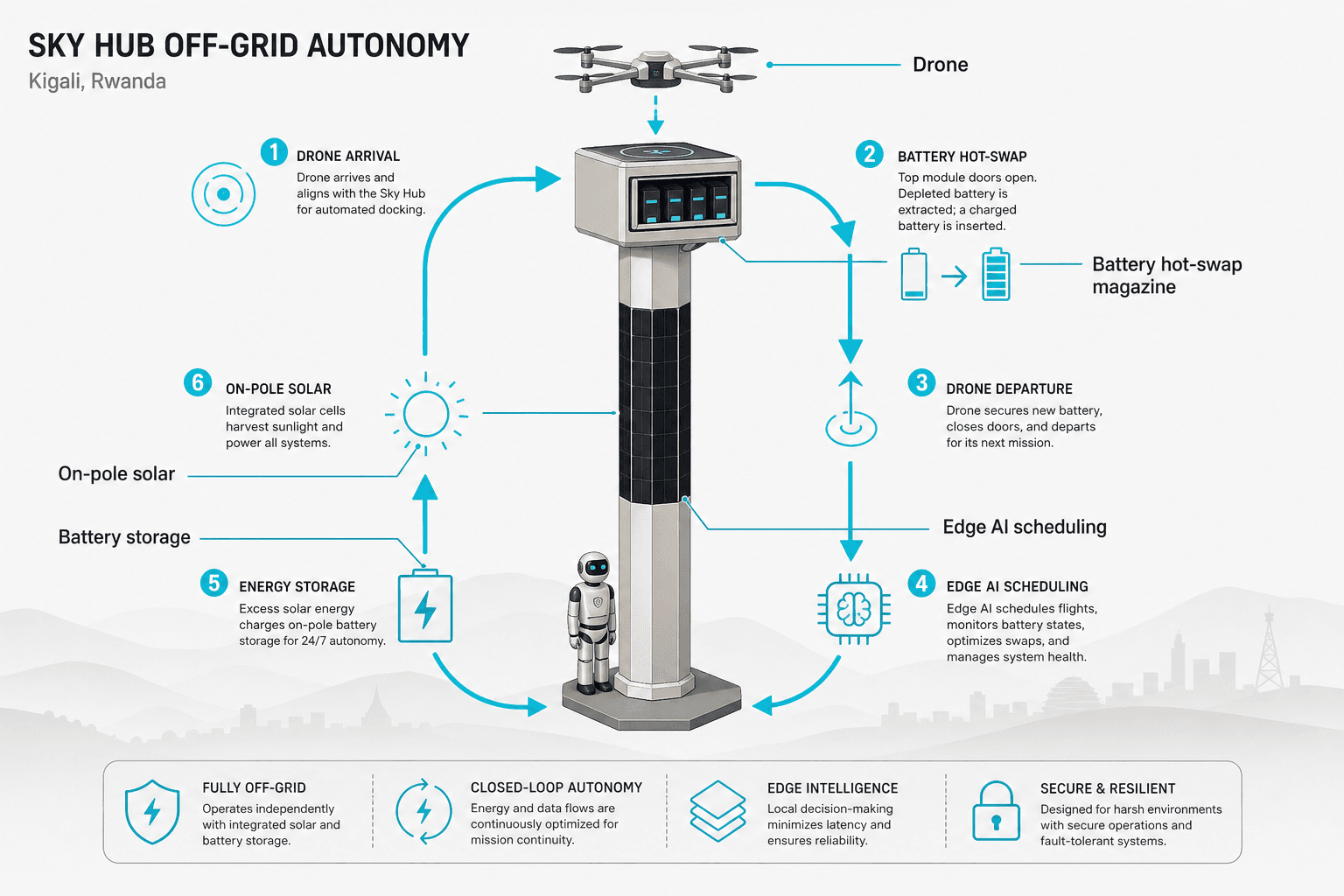
- Energy architecture: fully off-grid, battery-backed, with on-pole solar replenishment; no grid, city, or site power dependency for normal operation.
- Solar replenishment: approximately 2.8-3.2 kWp nameplate integrated into the pole body; realistic high-irradiance clear-sky operating output is about 1.0-1.3 kW DC peak and 7-10 kWh/day.
- Battery: 5-20 kWh-class storage, selected by patrol duty cycle, cloud-season autonomy target, drone sortie frequency, and robot charging schedule.
- Edge compute: Jetson-class module suitable for on-pole inference, workload scheduling, event filtering, and mission orchestration.
- Sensing: PTZ camera with local perception for anonymous vehicle count, crowd density, intrusion, and perimeter awareness; no active face recognition or licence-plate recognition claim.
- Environmental monitoring: wind speed, wind direction, temperature, humidity, atmospheric pressure, noise, PM10, PM2.5, and illuminance.
- Drone operations: autonomous launch, patrol, inspection, return, task redeployment, and automated battery hot-swap through a multi-bay service magazine.
- Ground robot operations: autonomous patrol, alarm response, inspection, air-ground coordination, and wireless charging at the pole base where route access is feasible.
- Counter-UAS coordination: detection, tracking, command coordination, soft aerial net-capture, or close-approach deterrence only after human authorization; no jamming, hard-kill, autonomous attack, or destructive action.
- Optional inputs: partner radar or external sensors may feed the command layer, but radar is not specified as built-in pole hardware.
According to Rwanda Standards Board (2011), RS 116-1 applies to low-voltage installations up to 1,000 V AC or 1,500 V DC and includes external consumer installations and street furniture. According to Rwanda Standards Board (2026), Rwanda's National Electrotechnical Committee encourages adoption of IEC standards where local conditions permit. For this reason, procurement should request IEC-aligned enclosure, surge, earthing, battery, and PV safety documentation even when the operating system is fully off-grid.
Implementation Approach
A practical Kigali rollout should proceed through 6 engineering phases: survey, permitting, assembly planning, foundations, node commissioning, and operations acceptance. Phase 1 is a corridor survey that confirms road reserve, drainage conflict, slope, cellular signal quality, drone clearance, robot route continuity, and safe maintenance access. Phase 2 is municipal and stakeholder coordination with the City of Kigali, utility interface reviewers where nearby services exist, transport authorities, and data-protection reviewers. This avoids treating smart-city hardware as a simple pole supply contract.
Phase 3 is configuration freeze and factory acceptance. For a 26-unit SOLARTODO package, this should include battery capacity selection, environmental sensor calibration plan, event metadata schema, role-based command permissions, and human-authorization workflow for C-UAS response. Phase 4 is CKD or modular shipping into Rwanda, with spare battery packs, pole electronics, drone service modules, and robot charging components packaged for staged installation. Logistics planning should account for Kigali's hillside roads, constrained urban sites, and wet-season access limitations.
Phase 5 is civil installation and commissioning. Foundations should be checked against local geotechnical data because valley fills, stormwater edges, and steep roadside embankments can behave differently during heavy rains. Electrical commissioning should verify DC isolation, battery BMS behavior, solar input, surge protection, enclosure sealing, and emergency shutdown. Digital commissioning should verify local inference, event-only data export, command audit logs, mission scheduling, and disconnected-mode operation.
Phase 6 is operational acceptance. A city or EPC team should validate event detection zones, drone route constraints, robot return-to-charge behavior, metadata retention, operator roles, and maintenance work orders. The acceptance test should include dry-season dust cleaning intervals and rainy-season water ingress checks. The outcome is not a fabricated Kigali deployment result; it is a recommended workflow for procuring and accepting a project-based custom configuration.
Expected Performance & ROI
The expected performance case is lower civil disruption, faster coverage of priority corridors, and reduced dependence on powered roadside cabinets over a 5-10 year asset horizon. According to the World Bank (2024), Rwanda increased household electricity access from 6% in 2009 to 75% by March 2024, one of the fastest energy-access expansions globally. That context matters because Kigali has an expanding grid, but an off-grid AI pole still avoids trenching, new service drops, and outage exposure for distributed urban intelligence. The ROI model should compare avoided power connection works, avoided raw-video backhaul costs, reduced manual patrol hours, and faster incident triage.
For a 26-node corridor, expected operating value comes from four measurable streams. First, local inference reduces upstream bandwidth because raw video stays on the pole and only event/status metadata leaves the node. Second, autonomous drone battery hot-swap can extend inspection availability without keeping an operator on site for each sortie. Third, environmental sensing provides localized PM2.5, PM10, noise, wind, humidity, and rainfall-adjacent operating signals for city or campus teams. Fourth, robot patrol and return-to-charge workflows can reduce repetitive inspection routes where pavement and access conditions are suitable.
A conservative financial model should not promise a universal payback period because labor cost, civil-work avoidance, corridor risk value, and maintenance contracts vary by owner. For budget screening, many EPC teams model smart-city edge infrastructure over 5-7 years, then stress-test battery replacement, cleaning labor, network subscription, and spare parts. Kigali's rainy seasons create maintenance value for sealed, local-processing nodes, but they also require realistic assumptions for solar replenishment during cloudy periods. SOLARTODO should therefore size storage against duty cycle, not against an unlimited solar claim.
World Bank states, "The goal of lighting up every household is not a dream, but an achievable reality." Rwanda's public-infrastructure trajectory supports disciplined technology adoption, but it does not remove the need for engineering confirmation. NCSA states, "The law now brings Rwanda in line with international data protection standards." That is the right framing for SOLARTODO Sentinel: process locally, export minimal metadata, document operator authorization, and align the system with Rwanda's personal-data governance.
Comparison Table
For Kigali, the main procurement decision is whether the site needs an off-grid AI edge node, a conventional powered camera pole, or a small cabinet-based sensor station. The table below compares the SOLARTODO Sentinel City AI Pole against common alternatives for a 26-node corridor-style project. It intentionally excludes pricing because project-specific EPC scope, civil works, freight, and warranty terms must be quoted separately.
| Metric | SOLARTODO Sentinel City AI Pole | Grid-powered CCTV pole | Cabinet sensor station |
|---|---|---|---|
| Typical Kigali package | 26 nodes at about 35 m spacing | 26 poles plus power/network works | 6-12 cabinets, wider gaps |
| Normal power source | Off-grid battery + on-pole solar replenishment | 0.4 kV service or building feed | Grid, cabinet battery, or hybrid |
| Solar replenishment | 2.8-3.2 kWp nameplate; about 7-10 kWh/day in high-irradiance clear sky | Usually none | Usually small auxiliary PV only |
| Edge compute | Jetson-class local inference per pole | Often central VMS-dependent | Limited gateway analytics |
| Raw video handling | Stays on-pole; event metadata may leave | Often backhauled to VMS | Usually no rich video stream |
| Drone operations | Launch, patrol, return, hot-swap support | Not integrated | Not integrated |
| Robot operations | Patrol and wireless return-to-charge where routes allow | Not integrated | Not integrated |
| C-UAS posture | Human-authorized, non-lethal coordination only | Detection-only if separately integrated | Detection-only if separately integrated |
| Kigali fit | Hilly corridors, campuses, perimeters, flood-sensitive nodes | Fixed sites with existing power | Environmental sensing points |
Pricing & Quotation
SOLARTODO quotes Kigali projects in 3 commercial tiers, but final EPC pricing depends on civil works, freight, battery size, and acceptance scope. SOLARTODO offers three pricing tiers for this product line: FOB Supply (equipment ex-works China), CIF Delivered (including ocean freight and insurance), and EPC Turnkey (fully installed, commissioned, with 1-year warranty). Volume discounts are available for large-scale deployments. Configure your system online for an instant estimate, or request a custom quotation from our engineering team at [email protected].
For Kigali, the quotation pack should state whether the buyer needs FOB equipment only, CIF delivery to Rwanda, or EPC turnkey delivery with foundation, installation, commissioning, and training. It should also state whether the 26-node package includes drone batteries, robot charging accessories, spare modules, network devices, and local operator training. No responsible quotation should finalize price before civil survey, access review, drainage conflict check, and local compliance review.
Frequently Asked Questions
Q1: Is the SOLARTODO Sentinel City AI Pole a smart streetlight for Kigali? No. The SOLARTODO Sentinel City AI Pole is a pure smart pole with no lighting system, no LED luminaire, and no lamp head. In Kigali it should be specified for edge AI sensing, drone operations, robot support, environmental monitoring, and human-authorized security coordination, not for roadway illumination.
Q2: Why is approximately 26 units a reasonable Kigali configuration? The provided deployment context defines approximately 26 nodes at about 35 m spacing, which creates a corridor of roughly 875 m before adjustments. Kigali's hills, curves, dense district centers, and drainage-sensitive routes may require tighter spacing at junctions and wider spacing on open campus sections after survey.
Q3: Does the system need Kigali grid power? No. The recommended configuration is fully off-grid for normal operation, using battery storage plus on-pole solar replenishment. Rwanda's grid includes 30 kV, 15 kV, and 0.4 kV classes, but the Sentinel design avoids routine grid connection, trenching, feeder dependency, and site-power outage exposure.
Q4: What battery size should be used in Kigali? A Kigali project should normally evaluate 5-20 kWh-class storage per node. The final size depends on drone sortie frequency, robot charging demand, cloudy-season autonomy, communications duty cycle, and edge-compute workload. The solar body replenishes storage, but high-power operations should be scheduled by duty cycle.
Q5: How long would installation and commissioning take? A typical 26-node corridor should be planned in phases rather than a single delivery date. Survey, permitting, factory acceptance, shipping, foundations, erection, digital commissioning, and operator acceptance can each affect schedule. Kigali's rainy seasons and hillside access constraints should be built into the project plan.
Q6: What maintenance does Kigali's climate require? Kigali is inland and highland, so the main maintenance concerns are rain sealing, humidity, dust accumulation during dry months, drainage around foundations, and battery health. A practical plan should include periodic PV cleaning, enclosure inspection, sensor calibration, drone battery checks, BMS review, and mission-log audits.
Q7: How should ROI be calculated for a Kigali buyer? ROI should compare avoided trenching and grid service work, reduced raw-video backhaul, fewer manual patrol hours, faster incident triage, and improved environmental visibility. The model should use a 5-7 year asset view and include battery replacement, cleaning labor, network service, spares, and local support costs.
Q8: How does Sentinel compare with conventional CCTV poles? A conventional CCTV pole usually depends on fixed power and backhauls more video to a central system. Sentinel processes raw video locally, exports de-identified event metadata, supports drone and robot operations, and runs from battery-backed off-grid energy. It is better suited to autonomous corridor operations than passive observation.
Q9: Can SOLARTODO provide EPC pricing for Rwanda? Yes, but EPC pricing requires project inputs: final site list, foundation requirements, logistics scope, battery size, communications design, commissioning tests, warranty expectations, and local installation responsibility. SOLARTODO also offers FOB Supply and CIF Delivered tiers for buyers who use their own Rwanda-based EPC partners.
Q10: What warranty should be requested? The required commercial paragraph specifies EPC Turnkey with a 1-year warranty. Buyers should also request component-level warranty schedules for battery packs, PV body modules, compute units, drone service modules, sensors, and mechanical assemblies. Warranty terms should define response time, spare parts, exclusions, and local service workflow.
Q11: Does the system use face recognition or licence-plate recognition? No active face recognition or licence-plate recognition should be claimed for this configuration. The recommended Kigali setup uses local perception for anonymous vehicle counts, crowd density, intrusion, and perimeter awareness. This supports PDPL-LGPD-oriented data minimization because raw video remains on the pole.
Q12: What counter-drone actions are allowed? The C-UAS workflow is non-lethal and human-authorized. The pole can detect and track an unauthorized drone, coordinate command response, and direct a friendly drone for soft aerial net-capture or close-approach deterrence. It should not be specified for jamming, hard-kill effects, autonomous attack, or destructive interception.
References
- National Institute of Statistics of Rwanda (2022): Fifth Rwanda Population and Housing Census reports Kigali at 1,745,555 residents, 86.9% urban population, and national density of 503 inhabitants/km2.
- National Institute of Statistics of Rwanda (2024): Kigali City district statistics list city density at 2,401 inhabitants/km2 and Kicukiro at 2,944 inhabitants/km2.
- City of Kigali (2020): Kigali Master Plan 2050 projects 3.8 million residents, 1.8 million jobs, and flood-risk mitigation through improved drainage infrastructure.
- Rwanda Ministry of Infrastructure (2026): Rwanda grid classes include 220 kV and 110 kV HV, 30 kV and 15 kV MV, and 0.4 kV LV systems managed through SCADA.
- Rwanda Standards Board (2011): RS 116-1:2011 covers low-voltage installations up to 1,000 V AC or 1,500 V DC, including street furniture and external installations.
- ITU DataHub (2024): Rwanda shows 71.6 active mobile-broadband subscriptions per 100 people and 98.8% LTE/WiMAX population coverage.
- World Bank (2024): Rwanda increased electricity access from 6% in 2009 to 75% by March 2024 and reached 100% electrification of health centers and sector-level administrative facilities.
- National Cyber Security Authority (2021): Rwanda's Law No. 058/2021 established personal-data and privacy obligations with NCSA supervisory responsibility.
Equipment Deployed
- 26 SOLARTODO Sentinel City AI Pole edge-node poles at approximately 35 m spacing
- Fully off-grid battery-backed micro-station per node with 5-20 kWh-class storage
- On-pole solar replenishment body, approximately 2.8-3.2 kWp nameplate per pole
- Jetson-class edge AI compute module for local inference and workload scheduling
- PTZ camera with local perception for anonymous vehicle count, crowd density, intrusion, and perimeter awareness
- Nine-variable environmental sensor package: wind speed, wind direction, temperature, humidity, pressure, noise, PM10, PM2.5, illuminance
- Autonomous drone operations module with launch, return, mission queueing, and battery hot-swap
- Ground robot operations interface with patrol support and wireless return-to-charge where routes allow
- Human-authorized non-lethal C-UAS coordination workflow with optional partner-sensor inputs
- Common-operating-picture command layer for event metadata, status telemetry, mission logs, and audit trails