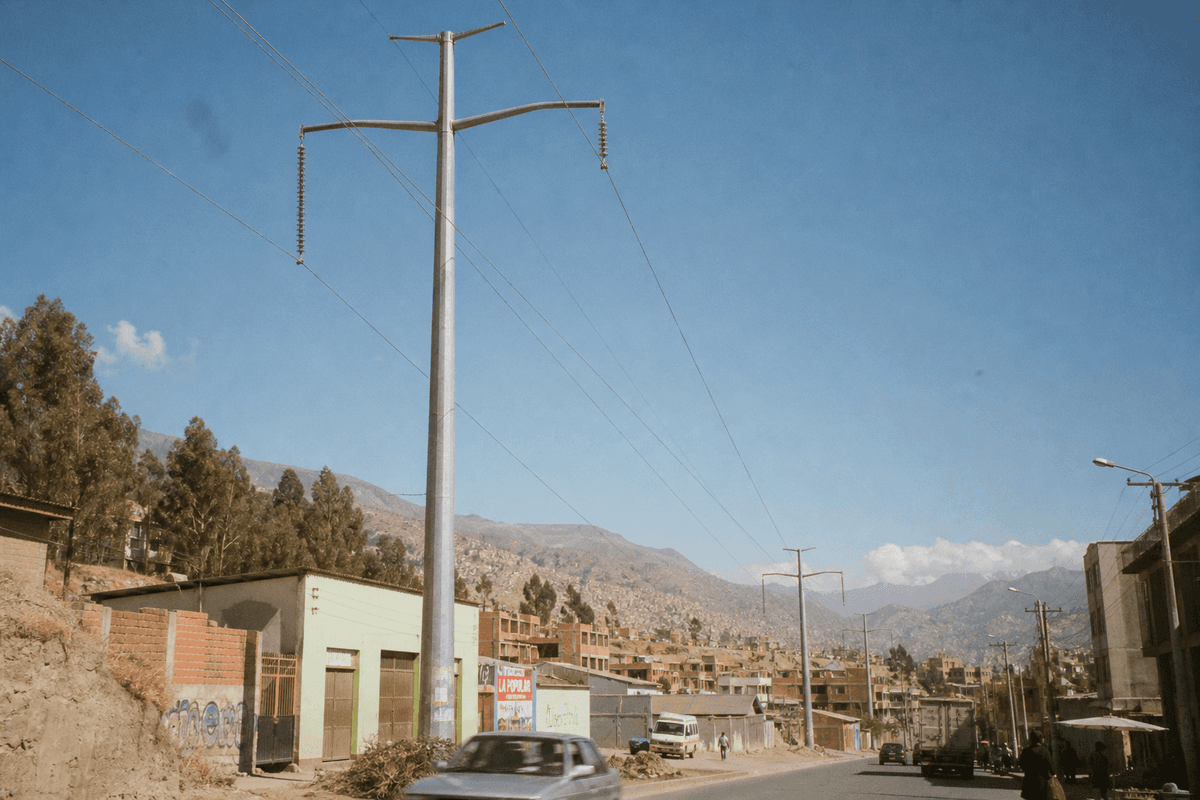
La Paz High-Altitude 220kV Backbone Constraint: Power Transmission Tower Configuration Guide
Summary
La Paz’s 3,625 m altitude, 14.6 °C average climate, and steep urban basin favor compact 220kV steel monopoles: a typical 20-unit, 35m, 5km single-circuit backbone uses ACSR 400 and 21t poles.
Key Takeaways
- La Paz sits at about 3,625 m above sea level, so access roads, crane capacity, and worker oxygen management affect 35m pole erection.
- The recommended SOLARTODO configuration is approximately 20 units of 35m tapered steel tubular Power Transmission Tower for a 220kV single-circuit line.
- Each pole is Q345 hot-dip galvanized steel, approximately 21t per pole, matching the 220kV size class of 35-55m and 15-35t per pole.
- The proposed electrical set uses ACSR 400 at 1,520 kg/km, maximum conductor tension of 110kN, 6m phase spacing, and 2.5m insulator strings.
- A 250m span gives an approximately 5km corridor with 20 poles, denser than the 350-450m generic 220kV range because La Paz terrain is constrained.
- According to the Gobierno Autónomo Municipal de La Paz, the metro area has 1.83 million people and altitude varies from 420m to 6,438m.
- According to the World Bank, Bolivia built or rehabilitated 708km of distribution lines from 2014 to 2019, showing continued grid-extension demand.
Market Context for La Paz
La Paz requires compact high-voltage support structures because a 220kV corridor must cross steep Andean terrain, dense urban access points, and altitude above 3,600m.
La Paz is not a coastal corrosion market; it is an inland Andean city where altitude, thermal swing, UV exposure, and slope stability are the dominant engineering constraints. According to the Gobierno Autónomo Municipal de La Paz Atlas Metropolitano, the municipality is located at 3,625 m above sea level and has an average temperature of 14.6 °C. The same municipal atlas describes a distinctive hoyada, or bowl-shaped basin, which makes wide lattice tower footprints harder to place near road corridors and hillside neighborhoods.
The metropolitan context is large enough to justify backbone planning rather than only feeder hardening. According to the Gobierno Autónomo Municipal de La Paz, the metropolitan area covers 7,284 km2 and has 1,831,350 inhabitants. For the municipality of La Paz itself, the same source reports about 780,000 residents in 2012, 226,000 households, and electricity access in 99 of every 100 households. That high urban connection rate shifts the technical question from first access to reliability, congestion relief, and substation interconnection.
Bolivia’s public electrification context also matters. According to the World Bank (2020), Bolivia connected 4,300 households, served about 20,200 people, and constructed or rehabilitated 708km of distribution lines between 2014 and 2019 under grid-extension programs. The World Bank also notes that autonomous departmental governments and municipalities have responsibilities in periurban electrification, while distribution companies and contractors participate in operation and maintenance arrangements.
Local utility responsibility is clear for distribution interfaces. According to ENDE Corporación, DELAPAZ distributes and commercializes electricity in the department of La Paz. For national high-voltage planning, a 220kV backbone pole package should be coordinated with the transmission owner, the distribution utility interface, municipal road-access permits, and Bolivian electrical norms such as IBNORCA NB 777-1:2024 for low-voltage installation interfaces where substations, auxiliaries, or site power are involved.
Road logistics are the practical differentiator. The municipal mobility authority emphasizes accessibility, safety, efficiency, and sustainable urban transport, while La Paz also has old-town streets, steep gradients, and constrained staging areas. A flanged steel monopole is therefore more suitable than a wide-base lattice tower when the route must minimize land take, reduce foundation footprint, and fit crane work into narrow rights-of-way.
Recommended Technical Configuration
A typical La Paz 220kV backbone of this scale would use approximately 20 SOLARTODO steel monopoles, each 35m high and about 21t.
The voltage class must be selected before height and weight. For 220kV high-voltage transmission, the required engineering band is 35-55m height, 15-35t per pole, usually double circuit, 350-450m generic span, and typically 2-3 poles per km. The project-specific La Paz recommendation is a 220kV single-circuit line using 35m tapered steel tubular poles at approximately 21t per pole, which stays inside the correct 220kV height and weight class.
The recommended SOLARTODO Power Transmission Tower is not lattice, FRP, wood, or concrete. It is a tapered round or dodecagonal steel monopole fabricated from hot-dip galvanized Q345 steel, supplied in flanged bolt sections for transport and erection. Cross-arm brackets support the insulator strings and ACSR conductors, while an anchor-bolt cage foundation transfers overturning load into reinforced concrete.
A typical 20-unit deployment of this scale would cover approximately 5km at a 250m average span. The span is shorter than the generic 220kV flatland range because La Paz terrain introduces slope breaks, right-of-way constraints, access-road bends, and possible foundation location limits. For this route profile, 250m is a conservative technical choice that reduces conductor sag risk, simplifies clearance control, and allows better alignment around dense urban or hillside constraints.
SOLARTODO would recommend Wind Class 2 at 30 m/s for the stated configuration, with local wind amplification reviewed against ridge, valley, and escarpment exposure. IEC states, 'specifies the loading and strength requirements of overhead lines', and IEC 60826 applies to lines 45kV and above. That makes it a suitable design reference for a 220kV La Paz backbone, alongside GB 50545 and DL/T 5092.
Technical Specifications
The specified 220kV SOLARTODO Power Transmission Tower package uses 35m, 21t Q345 galvanized monopoles with ACSR 400 conductors and 250m spans.
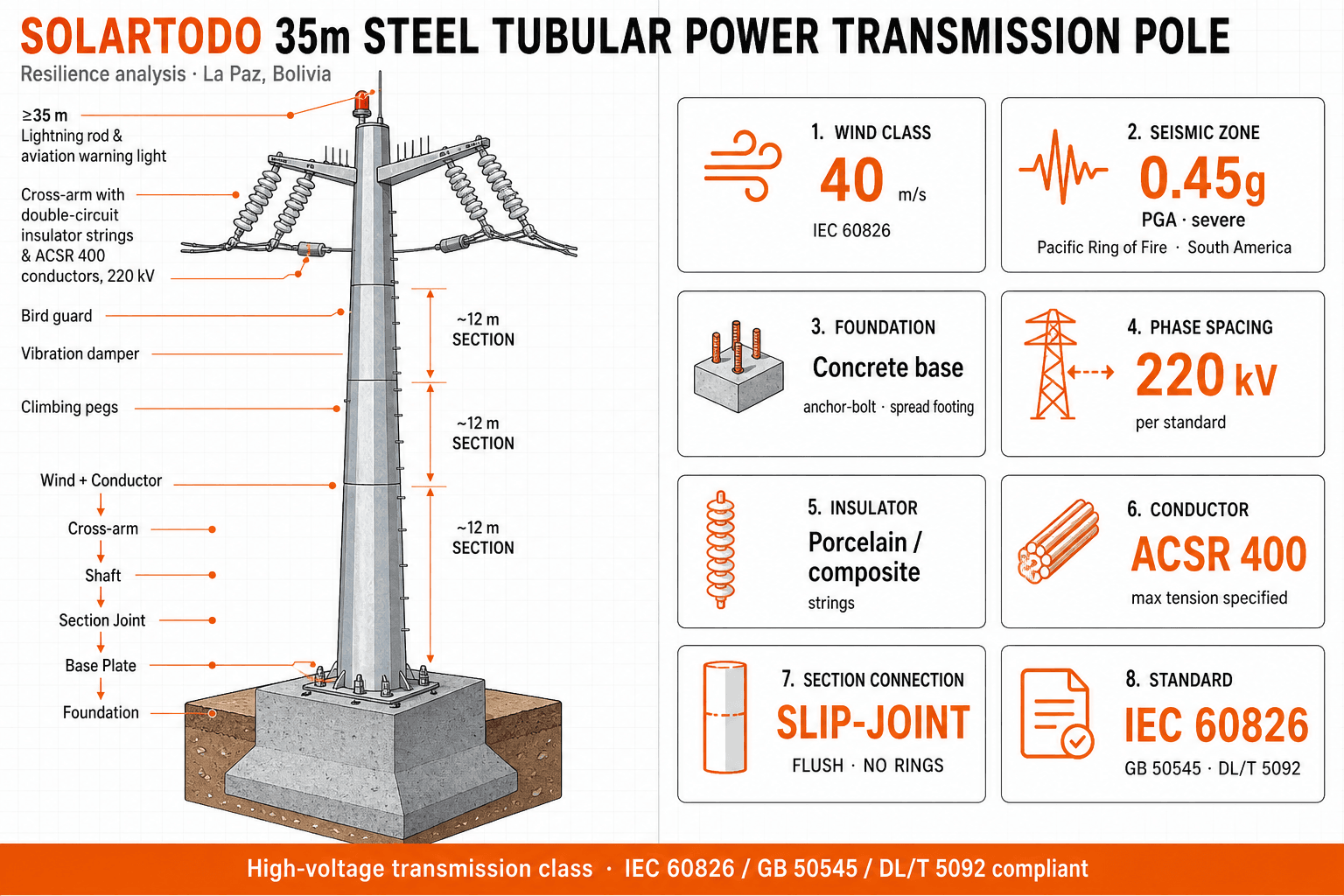
- Product: SOLARTODO Power Transmission Tower, high-voltage transmission backbone class.
- Form: tapered round or dodecagonal steel tubular monopole, not lattice, FRP, wood, or concrete.
- Voltage class: 220kV single circuit, selected before height and weight.
- Quantity profile: approximately 20 units for a typical 5km La Paz corridor.
- Pole height and mass: 35m height, about 21t per pole, equal to 600 kg/m.
- Material: hot-dip galvanized Q345 steel; Q420 can be evaluated for higher strength zones if load cases require it.
- Conductor: ACSR 400, approximately 1,520 kg/km, maximum tension 110kN.
- Electrical geometry: 6m phase spacing, 7m ground clearance, 2.5m insulator length.
- Span: 250m average span, selected for terrain-constrained routing.
- Foundation: reinforced concrete foundation with anchor-bolt cage.
- Accessories: climbing steps, cross arm, grounding, bird guard, vibration damper, and line hardware.
- Wind class: Class 2, 30 m/s basic design wind for the stated package.
- Design life: 30 years with inspection, galvanizing maintenance, and hardware replacement planning.
- Standards basis: IEC 60826, GB 50545, and DL/T 5092 for overhead line design criteria.
According to IEC (2017), IEC 60826 provides reliability-based loading and strength requirements for overhead lines at 45kV and above. According to China’s GB 50545-2010 listing, the code covers 110kV to 750kV overhead transmission line design. For La Paz, these references should be supplemented by local geotechnical investigation, Bolivian permitting requirements, and project-specific conductor sag-tension calculations.
Voltage-to-Pole-Class Check
A 220kV La Paz backbone must remain in the 35-55m and 15-35t range, so the 35m, 21t pole is correctly sized.
| Voltage class | Correct height band | Correct weight band | Typical span | La Paz recommended fit |
|---|---|---|---|---|
| 10-35kV distribution | 12-18m | 1-3t/pole | 80-150m | Not selected; too small for 220kV backbone |
| 66-110kV sub-transmission | 18-30m | 5-15t/pole | 200-300m | Not selected; height is below 220kV requirement |
| 220kV HV transmission | 35-55m | 15-35t/pole | 350-450m | Selected: 35m, 21t, 250m constrained span |
| 500kV UHV | 50-70m | 35-55t/pole | 400-500m | Not selected; overbuilt for this corridor |
Implementation Approach
A La Paz installation plan should sequence permitting, geotechnical checks, CKD logistics, anchor cages, pole erection, stringing, and commissioning over 4-7 months.
The first phase is route validation. Survey teams would confirm pole coordinates against topography, road access, existing distribution assets, traffic restrictions, and substation interfaces. In La Paz, this step is unusually important because a short horizontal distance can involve major elevation change, retaining walls, drainage channels, or unstable slopes.
The second phase is engineering verification and procurement. The 220kV class determines the 35m height and 21t pole mass, then conductor tension, insulator length, ground clearance, and wind loading are checked. SOLARTODO can supply the steel pole package in flanged sections, allowing long members to move through constrained roads more easily than a single-piece pole or large lattice-panel bundle.
The third phase is civil work. Foundation crews would install reinforced concrete foundations with anchor-bolt cages after soil bearing capacity, slope drainage, and construction access are confirmed. The anchor template must be controlled tightly because a 35m pole leaves little tolerance for flange mismatch or verticality error.
The fourth phase is erection and electrical works. Crews lift each section, torque flange bolts, install cross arms, fit grounding, place bird guards and vibration dampers, then string ACSR 400 conductors under controlled tension. Final commissioning would include grounding resistance checks, clearances, bolt-torque records, conductor sag verification, insulation inspection, and as-built documentation for the asset owner.
Expected Performance & ROI
The expected benefit is a 30-year 220kV backbone asset with lower land take, fewer foundations, and faster urban erection than lattice alternatives.
IEA states, 'Grids are emerging as a bottleneck', and its 2026 electricity analysis links grid capacity constraints with congestion and slower connection of supply and demand. For La Paz, the value of a compact 220kV pole corridor is not simply energy throughput; it is the ability to reinforce a constrained urban system without requiring wide tower pads in high-value or unstable land.
ROI should be evaluated as avoided congestion, reduced right-of-way cost, fewer forced outages, and lower civil complexity rather than as a fixed payback claim. A 30-year design life spreads galvanizing, foundation, and conductor hardware costs across multiple regulatory planning cycles. Compared with lattice towers, monopoles usually reduce foundation footprint and simplify access management, which can be material in La Paz’s steep urban basin.
According to the World Bank (2026), seven out of ten Bolivians live in urban areas, and La Paz faces scarce land, extreme topography, unstable slopes, and limited access to basic services in hard-to-reach neighborhoods. That public context supports a compact transmission structure for grid reinforcement, especially where a new or uprated corridor must interact with roads, hillside neighborhoods, and municipal mobility routes.
Results and Impact
A correctly configured 20-pole, 5km 220kV monopole corridor would improve backbone capacity while limiting foundation count to about 4 poles/km.
The likely technical impact is improved high-voltage transfer capability between substations or urban-edge corridors, with 7m ground clearance and ACSR 400 conductor capacity supporting a backbone rather than a local distribution feeder. Because this is a market analysis, these are expected outcomes for a recommended configuration, not claims from a completed SOLARTODO deployment.
The operational impact is simpler inspection access and reduced visual and land-use burden compared with wide lattice structures. Climbing steps, grounding, vibration dampers, and bird guards improve maintainability and asset protection. For La Paz, the larger benefit is configuration discipline: 220kV receives a 35m, 21t pole, while 35kV distribution would remain in the 12-18m, 1-3t class.
Comparison Table
The La Paz recommendation favors steel tubular monopoles because 35m, 21t units fit 220kV duty with a smaller footprint than lattice towers.
| Option | Voltage suitability | Footprint in La Paz terrain | Logistics | Recommended use |
|---|---|---|---|---|
| SOLARTODO 35m steel tubular monopole | 220kV, 15-35t class | Compact anchor-cage foundation | Flanged sections support constrained road delivery | Preferred for 5km urban-edge backbone |
| Lattice steel tower | 220kV possible | Larger base and wider assembly area | Many members and longer site assembly | Open rural corridors with broad right-of-way |
| Concrete pole | Generally lower-voltage distribution | Heavy, brittle handling on steep roads | Difficult for 35m 220kV backbone | Not recommended for this package |
| 35kV distribution pole | 10-35kV only | Small footprint | 12-18m, 1-3t class | Wrong voltage class for 220kV backbone |
Pricing & Quotation
SOLARTODO supports three quotation modes for 220kV La Paz projects, but final pricing depends on steel mass, shipping terms, foundations, and EPC scope.
SOLARTODO offers three pricing tiers for this product line: FOB Supply (equipment ex-works China), CIF Delivered (including ocean freight and insurance), and EPC Turnkey (fully installed, commissioned, with 1-year warranty). Volume discounts are available for large-scale deployments. Configure your system online for an instant estimate, or request a custom quotation from our engineering team at [email protected].
For a technical review, buyers should prepare route length, voltage class, conductor family, wind speed, geotechnical assumptions, road-access limits, and foundation preferences. The SOLARTODO Power Transmission Tower product page is the correct starting point for engineering scope, while contact us should be used for La Paz-specific drawings, logistics checks, and EPC boundary definition.
Frequently Asked Questions
A La Paz 220kV buyer should confirm voltage class, pole geometry, wind loading, conductor tension, foundation type, logistics, warranty, and EPC scope before quotation.
Q1: Why is the La Paz recommendation a 220kV, 35m pole instead of a 35kV pole? The project-specific requirement is a 220kV single-circuit backbone, so the correct height class is 35-55m and the correct weight class is 15-35t per pole. A 35kV pole would be only 12-18m and 1-3t, which is not suitable for high-voltage transmission clearance, insulation, or conductor geometry.
Q2: What exact SOLARTODO Power Transmission Tower configuration fits this La Paz profile? The recommended package is approximately 20 units of 35m tapered steel tubular monopoles, each about 21t, fabricated from hot-dip galvanized Q345 steel. The electrical set uses ACSR 400 conductors, 6m phase spacing, 7m ground clearance, 2.5m insulators, 250m span, and anchor-bolt cage foundations.
Q3: How long would a typical deployment timeline be in La Paz? A typical 5km, 20-pole 220kV corridor would usually require about 4-7 months from detailed survey to commissioning, depending on permitting, geotechnical testing, import timing, and road access. La Paz’s altitude, steep streets, and constrained staging areas can extend lifting windows and require more detailed traffic coordination.
Q4: What maintenance does a galvanized steel tubular pole require? Maintenance should include annual visual inspections, bolt-torque sampling, grounding checks, bird guard condition review, corrosion inspection, and vibration damper checks. A 30-year design life is realistic when galvanizing is intact, drainage around foundations is controlled, and conductor hardware is replaced or tightened according to utility maintenance intervals.
Q5: How should ROI or payback be evaluated without inventing project savings? ROI should be modeled through avoided outage cost, reduced land acquisition, fewer foundations, faster erection, and lower right-of-way conflict versus wider alternatives. For La Paz, the financial case is strongest where compact 220kV support reduces slope works, road closures, and land-take risk in the urban basin.
Q6: How does this compare with lattice transmission towers? Lattice towers can carry 220kV lines, but they require larger foundations and broader assembly areas. A steel tubular monopole is usually better where La Paz road access, hillside plots, or urban-edge routing constrain working space. Lattice towers may still be better for open rural routes with generous rights-of-way.
Q7: What information is needed for EPC pricing? EPC pricing requires route coordinates, voltage class, conductor selection, span schedule, wind speed, geotechnical data, road-access limits, foundation drawings, customs scope, and commissioning requirements. SOLARTODO can quote FOB Supply, CIF Delivered, or EPC Turnkey, but civil works and logistics assumptions must be defined before a reliable quotation.
Q8: What warranty is typical for this product line? The quoted EPC tier includes a 1-year warranty as stated in SOLARTODO’s pricing paragraph. Long-term performance depends on the 30-year design life assumptions, correct installation, maintenance discipline, and local environmental exposure. Buyers should separate product warranty, galvanizing warranty, installation warranty, and utility acceptance requirements.
Q9: What installation risks are specific to La Paz? The main La Paz risks are altitude above 3,600m, steep access roads, narrow old-town streets, slope stability, and limited crane staging areas. These affect delivery sequencing, foundation equipment, lifting plans, and crew productivity. A flanged monopole reduces some logistics pressure because sections can be transported and assembled progressively.
Q10: Which standards should be referenced for technical acceptance? The recommended standards basis is IEC 60826 for overhead line loading and strength criteria, GB 50545 for 110kV-750kV overhead transmission design, and DL/T 5092 for transmission structure design practice. Local Bolivian requirements, ENDE or utility specifications, and municipal permits should be checked before final drawings are released.
References
- Gobierno Autónomo Municipal de La Paz Atlas Metropolitano (accessed 2026): La Paz municipality altitude of 3,625 m, 14.6 °C average temperature, 780,000 residents in 2012, and high household electricity access.
- Gobierno Autónomo Municipal de La Paz Atlas Metropolitano (accessed 2026): Metropolitan area of 7,284 km2, 1,831,350 inhabitants, 420m to 6,438m altitude range, and precipitation context.
- World Bank (2020): Bolivia grid-extension results connected 4,300 households, served about 20,200 people, and constructed or rehabilitated 708km of distribution lines from 2014 to 2019.
- World Bank (2026): Bolivia urban resilience analysis states seven out of ten Bolivians live in urban areas and identifies La Paz land scarcity, extreme topography, unstable slopes, and infrastructure gaps.
- ENDE Corporación (accessed 2026): DELAPAZ is the distribution and commercialization company for electricity in the department of La Paz.
- IEC (2017): IEC 60826:2017, Design criteria of overhead transmission lines, applies reliability-based loading and strength requirements to overhead lines 45kV and above.
- IEA (2026): Electricity 2026 identifies grid capacity as a bottleneck for connecting supply, demand, and storage, supporting transmission reinforcement planning.
- IBNORCA (2024): NB 777-1:2024 covers definitions and general requirements for low-voltage electrical installations in Bolivia, relevant to auxiliary and interface installations.
Equipment Deployed
- 20 units × 35m tapered Q345 hot-dip galvanized steel tubular monopole
- 220kV single-circuit configuration, high-voltage transmission backbone class
- Approx. 21t per pole, 600 kg/m steel mass profile
- ACSR 400 conductor, 1,520 kg/km, maximum tension 110kN
- 6m phase spacing, 7m ground clearance, 2.5m insulator length
- 250m average span, approximately 5km total line profile
- Wind Class 2, 30 m/s design wind basis
- Concrete anchor-bolt cage foundation
- Cross arm, climbing steps, grounding, bird guard, vibration damper
- Design standards basis: IEC 60826, GB 50545, DL/T 5092