Summary
For a proposed Lima installation, keep feeder capacity and electrical protection selection open until the supplier documents the quoted equipment and an agreed evaluation records concurrent demand and behavior under varying supply conditions. The supplied catalog describes the SOLARTODO classic twin-arm bronze smart streetlight, but establishes neither charging power nor total demand.
The brief requests model smart-classic-twin-bronze. That identifier is not present in the supplied catalog source text, so its correspondence to the described product remains unverified. No product PDF, PDF page reference, electrical ratings or Lima site measurements were supplied. The immediate buyer decision is whether the supplier can close those gaps before procurement and electrical design proceed. Lima remains a proposed site; no deployment or local operating results are established.
Key Takeaways
- Ask the supplier to reconcile the requested model smart-classic-twin-bronze with the catalog description, quotation and model-specific documents.
- Obtain the missing product PDF, revision and relevant pages before accepting a model or configuration match.
- Request input ratings and permitted supply conditions for lighting, pole electronics and the charging equipment actually included.
- Agree a concurrent-operation test matrix and record incoming demand, operating states and transitions for the quoted assembly.
- Agree supply-variation and recovery tests within documented manufacturer limits and verified project conditions.
- Submit the equipment documents, test records and site survey to the responsible electrical designer before approving feeder or protection selections.
Proposed Problem
The proposed project needs an evidence-backed electrical specification for lighting, pole electronics and the integrated EV charging base. The supplied material describes their catalog appearance and scope, but does not provide input ratings, charging demand, internal distribution drawings or assembly test results. It also provides no Lima supply survey.
Create an evidence register listing each missing item, the party responsible for supplying it and the document or observation needed to resolve it. Keep supplier specifications, proposed test procedures and measured results separate. A requested test is not evidence that the product has passed it.
The supplied DOE connected-lighting research description describes a test bed with circuit-level power and energy metering and programmable power sources for studying varying power conditions. This is relevant research context, but supplies no test results for the proposed SOLARTODO equipment and no Lima electrical requirements.
Product Identity and Evidence Boundary
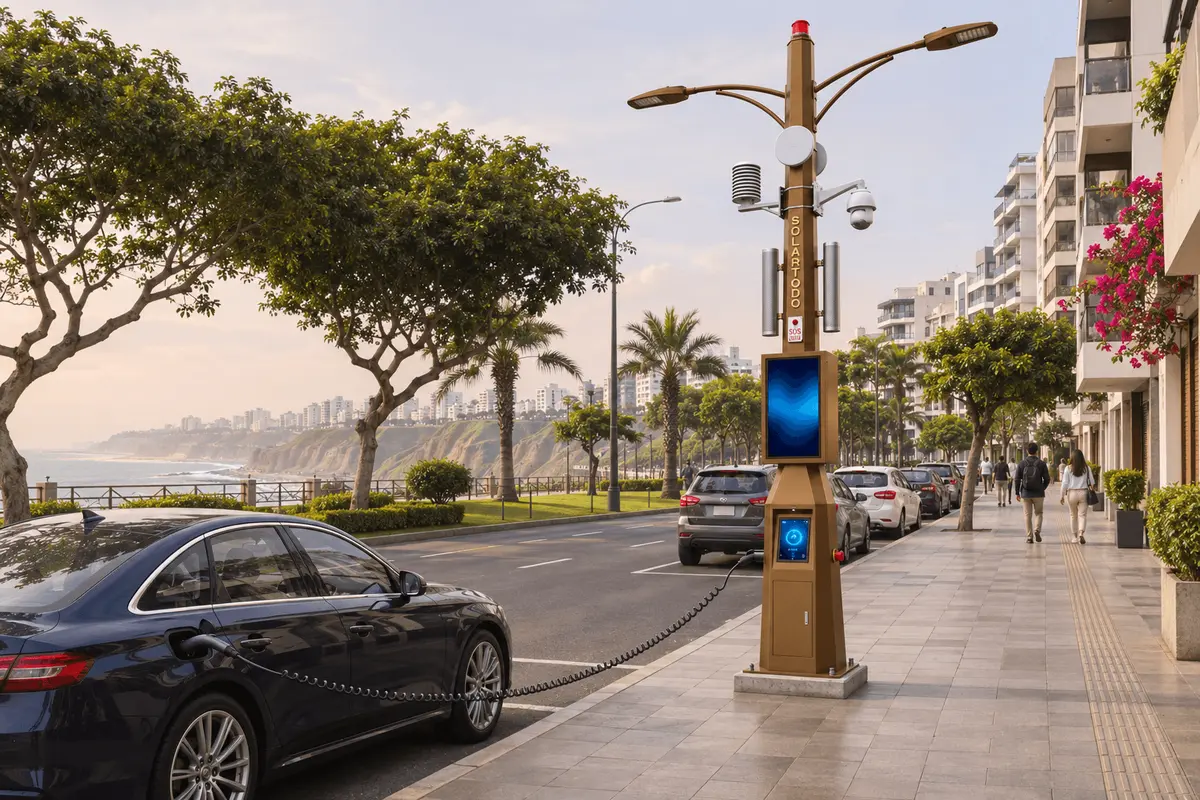
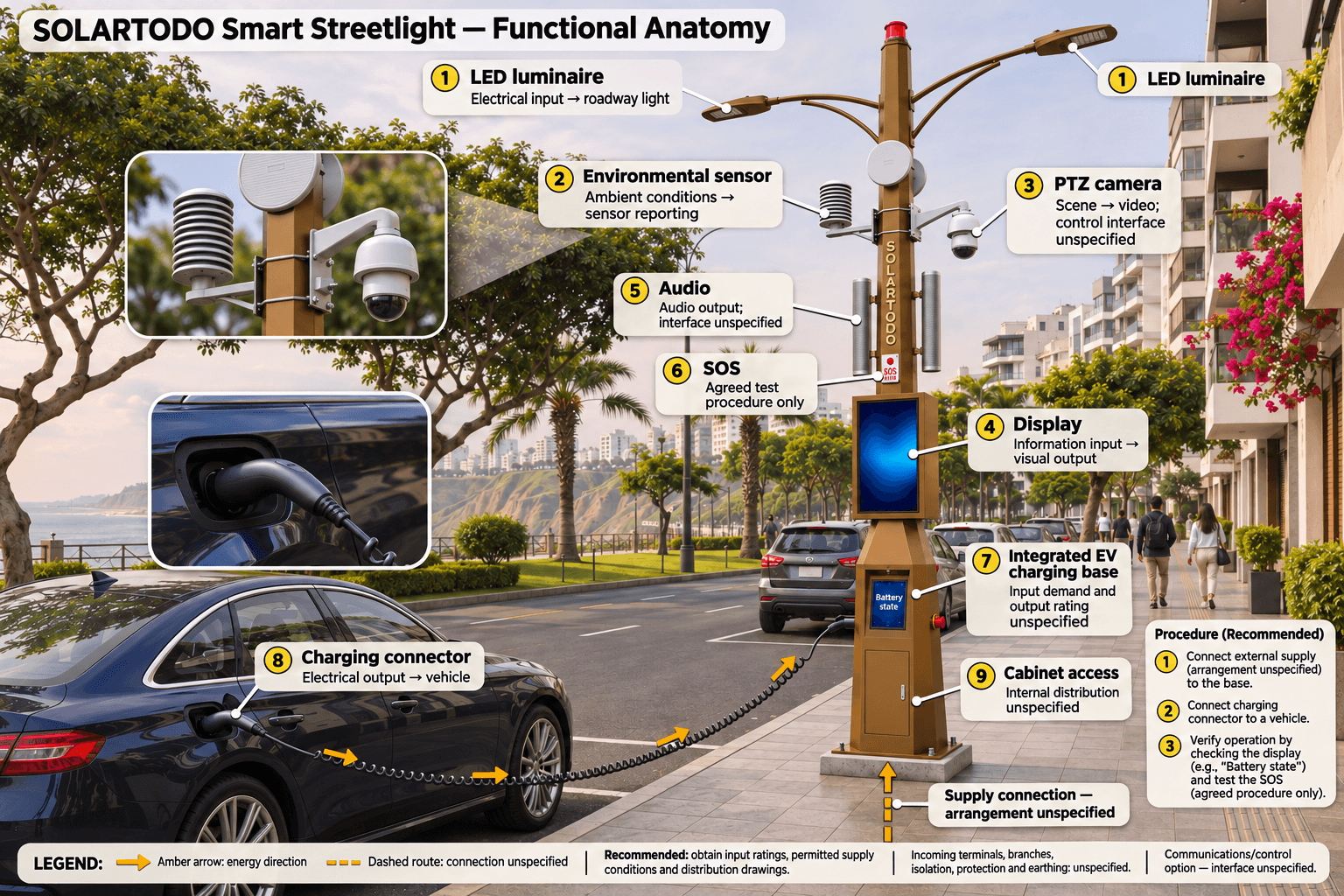
Catalog identity city-catalog-2026-11-01-v1 describes the SOLARTODO classic twin-arm bronze smart streetlight: a bronze polygonal pole with two curved luminaire arms, PTZ camera, environmental sensor, display, audio/SOS and an integrated EV charging base. Grid-fed lighting and modular communications/control are catalog options. The supplied product URL is the public product page; the corresponding navigation route is smart streetlight.
The requested model identifier smart-classic-twin-bronze comes from the brief. The supplied catalog source text does not independently verify that identifier. Request an explicit supplier cross-reference between the identifier, catalog description, quotation and technical documents. Until then, retain the requested identifier as an unresolved procurement reference.
The selected catalog appearance excludes a drone hangar, robot, wind turbine and wrapped CIGS photovoltaic surface. Do not add those features to this evaluation. The catalog establishes no numerical height, power, charging rate, performance, standard compliance or installed-project claim for the selected appearance.
No product PDF or PDF URL was supplied. The requested PDF-authoritative verification therefore remains unavailable: there is no supported PDF page or model-page citation to publish. Obtain the applicable PDF, revision and relevant pages, then reconcile them with the quotation and drawings before accepting the configuration.
Proposed Evaluation Plan
The following actions are proposed procurement and evaluation steps. They are not supplied product specifications, established local requirements or completed tests.
1. Obtain equipment ratings and drawings
Request an electrical schedule tied to the quoted configuration. Ask for rated input voltage, frequency, phase arrangement, maximum input current, input power, apparent power where applicable, power factor and permitted supply conditions for each included component. Request documented standby modes, startup information and settings that affect demand. Leave missing values unresolved rather than entering zero.
For the integrated EV charging base, ask the supplier to identify the charging equipment actually included. Request its input requirements, charging output rating, available current settings and operating limits. Ask the supplier to distinguish input demand from charging output and to document any offered load-control function. No charging rate or demand-control capability is established by the supplied catalog.
Request internal distribution drawings identifying incoming terminals, branches, isolation points, protective devices, earthing connections and the relationship between charging and auxiliary equipment. Ask which items are supplied and which are assigned to the installer. These are requests for evidence; they do not establish that any particular protective function is present.
Request installation instructions and model-specific supporting documents for any compliance claim. Keep identity verification open until those documents can be matched to the quoted assembly.
2. Agree concurrent-load measurements
Propose testing a representative assembly matching the quotation. Record component identities, settings, relevant software configuration and supply arrangement, together with any departures from the proposed purchase.
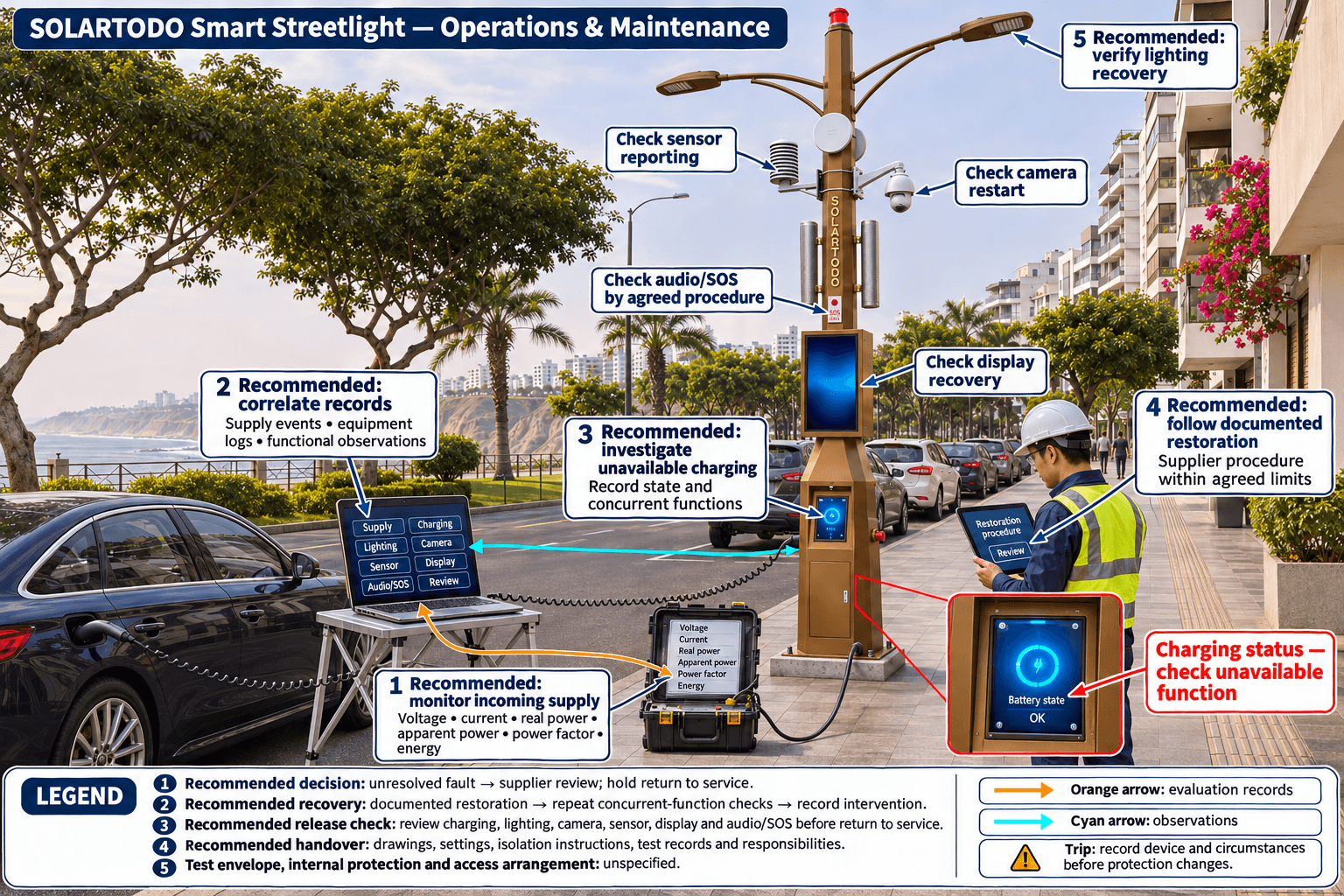
Ask the supplier and responsible designer to agree the instruments, sampling method, measurement uncertainty and observation periods before testing. Proposed measurements include incoming voltage, current, real power, apparent power, power factor and energy. Request branch measurements where accessible and any additional event capture the designer specifies.
Build an operating matrix around the functions actually supplied: lighting, camera, environmental sensing, display, audio/SOS and active charging. Include agreed concurrent states and transitions, such as charging start and stop, lighting startup and electronics restart. Exercise audio/SOS only through an agreed test procedure.
Report steady operating measurements and captured events separately. Ask the designer to state how each record will be used in the electrical assessment; the supplied sources do not establish a product-specific relationship between transient events and protective-device behavior.
If demand control is offered, request its documented limits and an agreed test of response and failure behavior. Do not assign it a demand-reduction allowance before the responsible designer accepts the supporting evidence.
3. Agree supply-variation and recovery tests
Obtain manufacturer limits and verified project supply information before defining test conditions. Ask the supplier and designer to specify permitted voltage and frequency cases, interruptions, restoration procedures and stop criteria. Do not invent allowable excursions or recovery-time targets.
Within the agreed envelope, propose recording charging status, lighting operation, camera restarts, display recovery, sensor reporting and audio/SOS availability. Record whether intervention is needed after restoration. Ask the supplier to explain observed shutdowns and recovery sequences against the equipment documentation.
Include agreed concurrent-load cases in the supply-variation matrix. Where available, correlate electrical records, functional observations and equipment logs. For any trip, record the device involved and the observed circumstances before considering a protection change.
DOE's description supports the existence of research infrastructure for metering and varying power conditions. It does not establish this test procedure as a standard or show that the proposed assembly has passed comparable testing.
4. Submit evidence for electrical design
Provide the responsible electrical designer with the verified equipment schedule, drawings, test records and site survey. Request a documented assessment covering feeder capacity, voltage drop, fault interruption and protection coordination. The supplied sources do not provide calculation methods or establish a final design for this project.
Ask the designer to identify the site information required, including cable routes, installation methods, supply arrangement, earthing and fault information. Request an explicit allocation of responsibility for isolation, overcurrent, residual-current and surge protection, without assuming that the charging base already contains the required arrangements.
If the proposed shared supply is not accepted, request assessed alternatives, such as revised distribution or a documented demand limit. No particular topology, feeder size or protective-device rating is established here.
Proposed Acceptance Conditions
These are proposed procurement conditions for agreement, not measured results or Lima requirements:
- Resolve the requested model's correspondence to the catalog description and technical documents.
- Identify every included electrical component and leave no undocumented load entry silently treated as zero.
- Agree test conditions, observation periods, repetitions and acceptance criteria before testing.
- Match the evaluated assembly to the quotation and document deviations or unavailable functions.
- Record concurrent-operation and supply-recovery observations, including unresolved trips, restarts or unavailable functions.
- Obtain the responsible designer's documented decision on feeder and protection selection, with any remaining limitations stated.
No numerical test duration, repetition count, timestamp tolerance, recovery guarantee or feeder margin is supplied by the evidence pack. Those values remain to be agreed using the equipment documentation and project assessment.
Survey and Handover Checklist
Before detailed design, confirm the proposed location and survey the actual supply. Ask the project team to identify the connection boundary, permissions and parties responsible for design and acceptance; the city name supplies none of those details.
Collect the product PDF and model pages, quotation, electrical schedule, internal distribution drawings and installation instructions. Request the site information identified by the designer and record outstanding gaps.
Before accepting electrical integration, reconcile the test configuration with the purchase, review the agreed test records and obtain decisions on unresolved observations. Request a handover package containing the accepted drawings, settings, isolation instructions, test records and maintenance responsibilities. Identify the evidence supporting each acceptance decision rather than treating an individual functional observation as approval of the whole assembly.
Limitations and Purchasing Context
This article is an evaluation proposal. It supplies no completed electrical design, verified model match, equipment rating, simultaneous-load result, supply-variation result or Lima site survey. It cannot establish charging capability, feeder capacity, breaker size, savings, reliability or certification.
The supplied FEMP exterior-lighting purchasing guidance advises buyers to gather accurate, relevant product performance, cost and reliability data. Its US federal purchasing requirements and example economics are foreign-jurisdiction context. They do not establish Lima requirements or performance for this SOLARTODO product, and its example operating hours and electricity prices are not project inputs.
The missing PDF and unresolved model correspondence remain evidence gaps. Neither the DOE research description nor the FEMP purchasing page closes them.
Procurement Questions
Ask the supplier to answer against the exact quoted configuration:
- Which document explicitly connects smart-classic-twin-bronze to the described catalog product?
- Which PDF revision and pages identify the offered configuration and electrical options?
- What are the input ratings and permitted supply conditions for each included component?
- What charging equipment, input demand, output rating and adjustable settings are included?
- Which internal circuits and protective functions are supplied, and which responsibilities remain with the installer?
- What concurrent-operation and supply-recovery records cover the quoted assembly?
- If demand control is offered, what documents and tests cover its limits and failure behavior?
- Which documents support any model-specific compliance claims, and which configuration changes require reassessment?
Use the contact route to request the evidence package. Proposed procurement conditions should identify the documentation and agreed evaluation required before feeder and protection decisions are accepted.
FAQ
Is Lima an existing deployment in this article?
No. Lima is solely a proposed site. The supplied evidence establishes no local installation, supply characteristics or operating results.
Is the requested model verified against the catalog?
No. The brief specifies smart-classic-twin-bronze, but that identifier is absent from the supplied catalog source text. Obtain a supplier cross-reference and the missing product PDF, revision and relevant model pages.
What equipment does the catalog describe?
It describes a bronze polygonal pole with two curved luminaire arms, PTZ camera, environmental sensor, display, audio/SOS and integrated EV charging base. Grid-fed lighting and modular communications/control are options; the quotation must identify what is included.
Does the catalog establish charging power or total demand?
No. Request the included charging equipment's input and output ratings, settings and operating limits, along with the input ratings of all other included components.
What concurrent-operation records should the buyer request?
As a proposed evaluation step, request an agreed operating matrix for the quoted assembly, incoming electrical measurements, available branch measurements and records of concurrent states and transitions. No such results are supplied.
Which supply-variation tests should be specified?
Agree voltage, frequency, interruption and restoration cases using documented manufacturer limits and verified project conditions. The supplied evidence establishes no numerical test envelope or recovery guarantee.
Can demand control be credited when selecting the supply?
No demand-control capability is established here. If offered, request documentation and agreed response and failure tests, then obtain the responsible designer's decision before assigning any demand-reduction allowance.
Do the DOE and FEMP sources approve this product or its electrical design?
No. DOE describes connected-lighting research infrastructure, and FEMP provides US federal purchasing guidance. Neither establishes product certification, a verified model match, Lima requirements or an accepted feeder and protection design.
References
- SOLARTODO smart streetlight: supplied catalog extraction city-catalog-2026-11-01-v1; supports the described appearance and scope, but its source text does not verify the requested model identifier or provide electrical ratings and PDF pagination.
- DOE Connected Lighting Systems: supplied description of connected-lighting research infrastructure, including circuit-level metering and programmable power sources; no results for the proposed equipment.
- FEMP Purchasing Energy-Efficient Exterior Lighting: supplied US federal purchasing guidance and buyer information; no Lima-specific requirements or SOLARTODO performance evidence.
- Product PDF: not supplied; no PDF URL, revision or model-page reference is available.
Proposed Equipment
- SOLARTODO classic twin-arm bronze smart streetlight; requested model smart-classic-twin-bronze remains unverified against the supplied catalog source text
- Bronze polygonal pole with two curved luminaire arms
- PTZ camera
- Environmental sensor
- Display
- Audio/SOS
- Integrated EV charging base; charging equipment ratings not supplied
- Grid-fed lighting option; inclusion requires quotation confirmation
- Modular communications/control option; inclusion requires quotation confirmation