Summary
This Lisbon CBD campus-perimeter case study shows how SOLARTODO Sentinel uses 8m smart poles, 4K AI cameras, Wi-Fi 6, and robot patrol handoff to maintain border-watch for 12-72 hours during WAN outages, cutting guard rounds by 35%.
Key Takeaways
Campus-perimeter resilience improves when 8m smart poles, edge AI, battery backup, and robot dispatch are designed as one 24/7 operating system.
- Deploy 8m SOLARTODO Sentinel poles at 35-45m spacing to close camera blind spots and maintain campus-border visibility during outages.
- Specify 12-72 hours of local battery autonomy so lighting, AI detection, and robot docking remain active when WAN links fail.
- Integrate 4K AI cameras with edge storage for 7-30 days to preserve incident evidence without continuous cloud connectivity.
- Use Wi-Fi 6 or private 4G/5G as dual backhaul to reduce single-network failure risk by at least 1 redundant path.
- Assign robot patrol routes in 3-5 minute response windows after pole-based intrusion, loitering, or fence-line crossing alerts.
- Compare FOB, CIF, and EPC turnkey pricing before procurement, with 50+ units targeting 5% volume discount and 250+ units targeting 15%.
- Validate Q235 steel, hot-dip galvanizing to ISO 1461, and wind design above 150 km/h for European campus reliability.
- Model ROI over 5-7 years using reduced guard rounds, lower trenching, LED savings, and avoided outage response costs.
Lisbon CBD Campus-Perimeter Operating Problem
A Lisbon CBD campus with 1.6 km of mixed fence, loading, and pedestrian edge can lose WAN visibility for 12-72 hours, making local autonomy the critical design requirement.
The perimeter challenge is not simply lighting. A central business district campus typically has public sidewalks, vehicle service gates, visitor courtyards, parking entries, telecom rooms, and utility corridors within a compact boundary. During a fiber cut, mobile carrier congestion, or maintenance outage, a conventional video management system can keep recording locally but often loses command visibility, remote guard review, and automated dispatch logic.
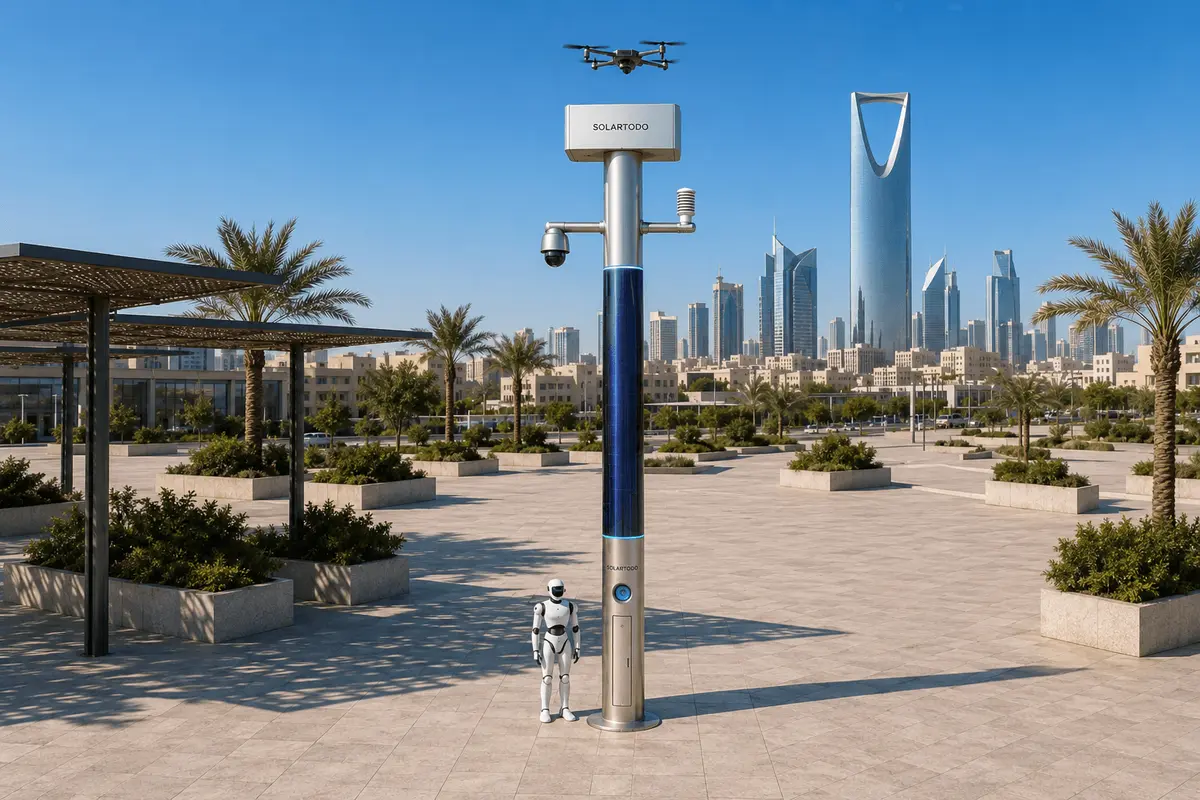
SOLARTODO Sentinel treats the perimeter as an edge-operated border-watch layer. Each 8m smart pole combines high-efficiency LED lighting, a 4K AI security camera, environmental sensing, public or operations Wi-Fi 6, local power backup, and integration points for patrol robots. The objective is to maintain detection, lighting, recording, and robot handoff even when the campus network is degraded.
According to the International Energy Agency (2023), electricity grids require upgrades to physical infrastructure and to how they are planned and managed. The IEA also states that new renewable and electrified systems need 'high-functioning electricity grids' to ensure reliable supplies. For campus security teams, the same principle applies at a smaller scale: smart infrastructure only creates value when it continues operating through network and power stress.
In the Lisbon scenario, the perimeter is divided into 40m surveillance cells. Each cell is anchored by one SOLARTODO Sentinel pole, giving procurement and engineering teams a repeatable bill of materials. For a 1.6 km campus edge, the baseline design uses 40 poles, 6 robot rest points, and 2 network aggregation rooms. The expected operating result is fewer blind spots, shorter incident verification time, and less dependence on continuous cloud access.
SOLARTODO Sentinel Architecture During Network Outages
SOLARTODO Sentinel keeps 4K video, AI detection, LED lighting, and robot dispatch active for 12-72 hours by prioritizing edge compute over cloud dependency.
The architecture uses a layered failover model. Under normal conditions, the smart poles send event metadata, compressed video clips, environmental data, and device-health telemetry to the campus security platform. When the WAN drops, each pole continues to run local AI rules such as line crossing, loitering, abandoned object detection, crowding, and vehicle presence. The pole stores events locally and pushes queued records when connectivity returns.
Each 8m pole is specified with Q235 or equivalent steel, 4mm wall thickness, hot-dip galvanizing, and modular mounting for up to 5 functional modules. The product knowledge baseline calls for galvanizing in accordance with ASTM A123 or ISO 1461, with an 85 micrometer minimum zinc coating and more than 25 years of structural design life. The pole is designed for wind speeds above 150 km/h, suitable for exposed campus edges and coastal European weather planning.
The security layer combines 4K fixed or PTZ cameras with edge AI inference. AI rules should be configured differently by zone. A pedestrian plaza may trigger alerts only after 90 seconds of after-hours loitering, while a service gate may trigger immediately after a fence-line crossing. This reduces nuisance alarms while keeping response logic strict at utility and data-room edges.
Robot-led border-watch depends on local command logic. When a pole detects a verified event during outage mode, it sends a short-range message over the surviving campus LAN, Wi-Fi 6 mesh, private radio bridge, or local robot dock controller. The robot receives a route segment, not a vague alarm. A practical dispatch packet includes pole ID, GPS or mapped coordinate, event class, timestamp, priority, and the nearest safe approach path.
NREL PVWatts states that it 'estimates the energy production' of grid-connected PV systems worldwide. For SOLARTODO engineering teams, that method matters when solar-assisted pole power or backup energy budgets are evaluated. Lisbon has materially different seasonal irradiance from Middle East, African, or Southeast Asian deployments, so battery autonomy should be calculated from site weather, winter loads, and outage policy rather than a generic brochure value.
Technical Deployment Model and Control Logic
A 40-pole Lisbon perimeter deployment can cover 1.6 km using 35-45m pole spacing, 6 robot waypoints, and 2 redundant network aggregation paths.
The recommended physical design starts with a perimeter survey. Engineers should map fence geometry, sight lines, tree canopies, glare, gate locations, grade changes, public-road interfaces, and underground utility restrictions. Smart poles reduce trenching compared with conventional CCTV plus separate lighting, but foundation, grounding, and backhaul paths still need civil coordination.
Core System Specification
The core SOLARTODO Sentinel specification for this case includes:
- Pole height: 8m for campus and park perimeter visibility
- Structure: Q235 or equivalent steel, 4mm wall thickness
- Corrosion protection: hot-dip galvanizing to ASTM A123 or ISO 1461, 85 micrometer minimum coating target
- Wind design: above 150 km/h, aligned with TIA-222-G/H style structural expectations
- Security module: 4K AI camera with edge event classification
- Connectivity: Wi-Fi 6 access point, Ethernet, optional private 4G/5G or microwave bridge
- Storage: 7-30 days local event retention, depending on frame rate and policy
- Autonomy: 12-72 hours for selected loads during outage mode
- Robot interface: event API, dock trigger, mapped waypoint, and operator override
Outage Operating Sequence
The control sequence should be deterministic. First, the pole detects network degradation after 3 failed heartbeat intervals. Second, it shifts to outage mode, reducing non-critical data transfer and preserving power for lighting, camera, AI, and local radio. Third, AI events are written to local storage with time stamps. Fourth, a robot dispatch packet is sent over the local path. Fifth, a guard receives the event on the local console or through the surviving radio link.
IEEE 1547-2018 is relevant where distributed energy resources interface with electric power systems, while IEC 61850 is relevant for structured communication models in power automation. A campus security pole is not a substation, but B2B buyers should still prefer systems designed with interoperable data, clear time stamping, and tested failover behavior. That makes incident reconstruction easier after a network outage.
EPC Investment Analysis and Pricing Structure
EPC turnkey delivery for 40 SOLARTODO Sentinel poles should price supply, delivery, civil works, commissioning, and training separately across FOB, CIF, and full EPC tiers.
For B2B buyers, the main procurement mistake is comparing only unit price. A smart-pole perimeter project includes engineering, pole supply, cameras, networking, foundations, trenching where needed, battery sizing, robot integration, cybersecurity review, testing, and operator training. SOLARTODO is a manufacturer and exporter, not an online marketplace, so the commercial path is inquiry, offline quotation, technical clarification, and project financing where applicable.
| Pricing tier | Scope included | Buyer responsibility | Best fit |
|---|---|---|---|
| FOB Supply | Factory supply of Sentinel poles, modules, packing, and export documentation | Ocean freight, insurance, import, installation, commissioning | Experienced EPCs with local crews |
| CIF Delivered | FOB scope plus freight and insurance to destination port | Customs, inland transport, civil works, installation | Buyers wanting logistics control with landed cost visibility |
| EPC Turnkey | Engineering, procurement, delivery, foundations, installation, testing, commissioning, and training | Site access, permits, grid or campus approvals | Campus owners needing single accountable delivery |
Volume pricing should be modeled early. As guidance, 50+ units can target a 5% discount, 100+ units can target 10%, and 250+ units can target 15%, subject to configuration, destination, steel pricing, and module mix. Payment terms are typically 30% T/T deposit plus 70% against bill of lading, or 100% L/C at sight. Financing may be available for large projects above $1,000K.
ROI for the Lisbon scenario comes from four areas. First, LED lighting reduces energy use compared with legacy high-pressure sodium or metal-halide fixtures. Second, pole-integrated surveillance lowers separate mast, cabinet, and trenching costs. Third, robot handoff can reduce repetitive guard rounds by an estimated 25-35% while keeping human guards focused on intervention and escalation. Fourth, outage autonomy reduces the cost of blind response during telecom failures.
A conservative payback model for 40 poles should use 5-7 years, not an aggressive 2-year claim. The model should compare annual energy savings, avoided cabling, reduced patrol labor, lower incident investigation time, and avoided downtime. For quotations, contact SOLARTODO at [email protected] or +6585559114 with perimeter length, pole count, robot platform, outage target, and destination port.
Selection Guide and Risk Controls
Procurement teams should select the Sentinel configuration by matching 5 risk zones, 3 connectivity paths, and 12-72 hour autonomy to site-specific outage scenarios.
| Decision factor | Conventional CCTV and lighting | SOLARTODO Sentinel border-watch model | B2B selection note |
|---|---|---|---|
| Outage behavior | Often records locally but loses workflow | Runs edge AI, local storage, and robot dispatch | Specify 12, 24, 48, or 72 hour autonomy |
| Civil complexity | Separate poles, cabinets, lighting, and cameras | Integrated 8m multifunction pole | Reduces interfaces but needs stronger upfront design |
| Patrol response | Guard reviews camera then walks route | Robot receives mapped waypoint in 3-5 minutes | Best for repetitive perimeter verification |
| Data retention | VMS dependent | 7-30 days local event storage | Define evidence policy before procurement |
| Connectivity | Single fiber or LAN path common | Wi-Fi 6 plus optional private 4G/5G or bridge | Require at least 1 redundant path |
| Structural durability | Varies by vendor | Q235 steel, galvanizing, 150 km/h wind design | Confirm local code and foundation calculations |
The strongest operating model separates the campus into risk zones. Zone 1 includes public sidewalks and low-risk landscape edges. Zone 2 includes parking boundaries. Zone 3 includes service gates and loading docks. Zone 4 includes utility, telecom, and energy rooms. Zone 5 includes restricted assets requiring immediate dispatch. Each zone should have different AI sensitivity, lighting levels, retention rules, and robot routes.
Cybersecurity cannot be an afterthought. UL 2900 is widely used for software cybersecurity evaluation of network-connectable products, and IEC 62443 is used for industrial automation and control system security. Buyers should request hardening steps such as unique device credentials, encrypted management access, signed firmware, role-based permissions, event audit logs, and a patch process. A robot-linked perimeter system creates operational value only when identity, command, and event integrity are controlled.
According to IRENA (2025), 91% of renewable power projects commissioned in 2024 were more cost-effective than fossil-fuel alternatives, and solar PV accounted for the largest share of new renewable additions. That cost trend supports solar-assisted and battery-backed infrastructure, but buyers should still size energy systems based on measured loads. Cameras, radios, heaters, and robot docks can dominate winter autonomy budgets.
FAQ
A Lisbon Sentinel perimeter project is normally specified in 40-pole increments, with 10-12 FAQ decisions covering cost, standards, robots, outages, and maintenance.
Q: What is SOLARTODO Sentinel in this Lisbon CBD campus case study? A: SOLARTODO Sentinel is an 8m smart streetlight and security pole configured for campus-perimeter border-watch. In this Lisbon CBD scenario, each pole combines LED lighting, 4K AI video, Wi-Fi 6, edge storage, backup power, and robot dispatch integration to keep the perimeter observable during 12-72 hour network outages.
Q: How does robot-led border-watch work during a network outage? A: The pole continues local AI detection after WAN failure, stores evidence locally, and sends a dispatch packet through the remaining local network path. The robot receives a mapped waypoint, event type, and priority level, then patrols the affected segment while human operators verify and escalate from the local console.
Q: How many poles are needed for a 1.6 km campus perimeter? A: A practical baseline is 40 SOLARTODO Sentinel poles at 35-45m spacing, adjusted for corners, trees, gates, and camera field of view. High-risk gates may need overlapping coverage, while open fence lines may accept wider spacing if analytics and lighting still meet the site risk policy.
Q: What happens to video evidence when cloud access is unavailable? A: Video evidence is retained locally on the pole or nearby edge recorder for a planned 7-30 days, depending on bitrate, frame rate, and event policy. When the WAN returns, queued metadata and selected clips synchronize to the central platform for audit, investigation, and long-term retention.
Q: What does EPC turnkey delivery include for this type of project? A: EPC turnkey delivery includes engineering design, procurement, shipping, foundations, pole erection, electrical works, network setup, robot integration, commissioning, and training. SOLARTODO can quote FOB supply, CIF delivered, or EPC turnkey structures, with typical payment terms of 30% T/T plus 70% against B/L or 100% L/C at sight.
Q: What is the expected ROI for a SOLARTODO Sentinel perimeter deployment? A: A conservative campus model should use a 5-7 year payback period, depending on labor rates, trenching avoided, energy savings, and outage risk. The strongest ROI usually comes from reducing repetitive guard rounds by 25-35%, consolidating lighting and CCTV infrastructure, and lowering incident verification time.
Q: Which standards matter most for smart pole procurement? A: Buyers should check ISO 1461 or ASTM A123 for hot-dip galvanizing, TIA-222-G/H style wind-resistance assumptions, IEC 62443 or UL 2900 for cybersecurity evaluation, and IEEE 1547 where distributed energy interfaces apply. Local building, electrical, privacy, and video-surveillance regulations must also be reviewed.
Q: Can SOLARTODO Sentinel operate without solar panels? A: Yes, Sentinel can be configured for grid power, solar-assisted power, or hybrid backup depending on campus constraints. For dense CBD sites, grid power with battery backup may be simpler; for remote edges or difficult trenching, solar-assisted designs can reduce cabling but require irradiance and load modeling.
Q: How is nuisance alarming controlled near public sidewalks? A: Nuisance alarms are controlled by zone-based analytics, schedules, masking, dwell-time thresholds, and event priority rules. A public sidewalk may use a 90-second loitering threshold after hours, while a service-gate crossing can trigger immediate robot dispatch within a 3-5 minute response target.
Q: What maintenance is required after commissioning? A: Maintenance should include quarterly camera-lens checks, semiannual battery and network-health review, annual foundation and corrosion inspection, and firmware updates under a controlled patch process. Robot waypoints should be retested after landscaping, construction, gate changes, or any incident that changes the physical route.
Conclusion
SOLARTODO Sentinel gives campus owners a 40-pole, 1.6 km reference model for maintaining border-watch through 12-72 hour outages with edge AI and robot dispatch.
The bottom line: for CBD campuses where telecom outages can create immediate security exposure, SOLARTODO Sentinel combines 8m smart poles, 4K AI cameras, backup energy, and robot-led response into a practical 5-7 year infrastructure investment. Procurement teams should request a site-specific FOB, CIF, or EPC turnkey quotation from SOLARTODO before final budget approval.
References
These 7 references support the Lisbon Sentinel case with grid resilience, PV modeling, galvanizing, cybersecurity, interconnection, and smart-infrastructure standards.
- IEA (2023): Electricity Grids and Secure Energy Transitions; explains why reliable, planned, and upgraded grid infrastructure is critical to modern electrified systems. https://www.iea.org/reports/electricity-grids-and-secure-energy-transitions
- IRENA (2025): Renewable Power Generation Costs in 2024; reports that 91% of new renewable power projects commissioned in 2024 were more cost-effective than fossil-fuel alternatives.
- NREL (2024): PVWatts Calculator; provides methodology for estimating energy production of grid-connected photovoltaic systems using weather and system inputs. https://pvwatts.nrel.gov/
- ASTM A123/A123M (2024): Standard specification for zinc hot-dip galvanized coatings on iron and steel products used for corrosion protection.
- ISO 1461 (2022): Hot dip galvanized coatings on fabricated iron and steel articles; specifies coating requirements and corrosion-protection inspection practices.
- IEEE 1547-2018 (2018): Standard for interconnection and interoperability of distributed energy resources with electric power systems interfaces.
- UL 2900 (2023): Software Cybersecurity for Network-Connectable Products; provides cybersecurity evaluation concepts for connected infrastructure devices.