Luanda Salt-Air Smart Streetlight Fit: 183-Unit Ø315mm Flush Cylinder Configuration
Summary
Luanda’s 8.67m-province scale, 74.8% electricity access, and 13.21-inch annual rainfall profile favor approximately 183 sealed 9m Ø315mm Smart Streetlight poles at 28m spacing for coastal urban corridors.
Key Takeaways
A Luanda Smart Streetlight program should prioritize sealed Ø315mm poles because 8.67m residents, 99.3% urbanization, and Atlantic salt air compress maintenance windows.
- A typical 183-unit deployment at 28m spacing would cover about 5.1km of dense urban streets, using 9m poles rather than highway-scale 12m+ traffic poles.
- The recommended pole is a constant Ø315mm seamless cylinder with 5mm wall thickness, hot-dip galvanizing, and matte white RAL9003 finish.
- Each unit integrates a 60W, 9,000lm, 4000K LED ring-light band at the pole top, avoiding side arms in Luanda’s narrow Baixa-style streets.
- Mid-pole 360° CIGS thin-film solar from 6.5m to 8.3m supplies about 259W without rigid panels, brackets, tilt frames, or wind-catching protrusions.
- Angola’s regulator IRSEA lists low-voltage supply at 220V/380V and medium voltage at 30kV, 20kV, 15kV, and 3kV, so street assets need LV protection coordination.
- Luanda province’s 2024 census shows 74.8% electricity access, making LFP 1,800Wh storage plus MPPT appropriate for outage buffering rather than full off-grid sizing.
- Angola had 29.20m mobile connections in early 2024, so embedded WiFi 6 plus 5G readiness can serve civic connectivity without visible antenna clutter.
- IEC 60598 and GB/T 37024 alignment should be specified from procurement stage, with factory acceptance tests before CIF or EPC release.
Market Context for Luanda
Luanda’s Smart Streetlight requirement is shaped by 8,665,510 provincial residents, 99.3% urbanization, Atlantic exposure, and flood-sensitive lowland corridors.
Luanda is not a generic African capital for pole configuration. According to INE Angola (2024), Luanda province has 8,665,510 residents, represents 23.7% of Angola’s population, and is 99.3% urban. That density creates a street furniture problem: lighting, CCTV, charging, SOS, public information, and telecom cannot all occupy separate posts without obstructing sidewalks and old-town road geometry.
The climate reinforces a sealed product architecture. According to Timeanddate climate averages (2012-2021), Luanda’s annual mean temperature is about 79°F, annual precipitation is 13.21 inches, humidity averages 79%, and October is the windiest month at about 14mph. Angola’s Atlantic coastal setting also brings salt-laden air; for a Smart Streetlight, this makes hot-dip galvanizing, flush glazing, gasketed service panels, and minimal external brackets more important than decorative form.
Electricity context is mixed enough to require hybrid resilience. According to the U.S. EIA (2025), World Bank estimates show 49% of Angolans had electricity access in 2022, while urban access was about 76%. According to INE Angola (2024), Luanda province itself reports 74.8% electricity access. That means a Luanda pole should assume grid availability in many corridors, but should not assume clean, uninterrupted supply for camera, SOS, controller, and display uptime.
Angola’s local electrical framework also matters. According to IRSEA, Angola’s nominal low-voltage supply is 220V/380V, while medium-voltage classes include 30kV, 20kV, 15kV, and 3kV. IRSEA states, “Os valores nominais das tensões de fornecimento” before listing these classes. For SOLARTODO, that points to a low-voltage Smart Streetlight interface with surge protection, earthing continuity checks, and separate circuits for EV charging, LED lighting, controls, and battery charging.
Logistics are unusually favorable at national-entry level but constrained inside the city. According to the Port of Luanda, the port handles about 80% of Angola’s imports and exports, operates 24 hours, and has 2,728m of quay. Once cargo leaves the port, dense central streets, waterfront corrosion, drainage works, and informal-edge roads make compact CKD packing, short erection closures, and reduced external appendages more practical than poles with arms, cabinets, or separate EV bollards.
Flood and drainage risk should be treated as an engineering input, not an afterthought. According to IDRC (2019), more than 12% of households in Luanda were identified as at risk of flooding, coastal inundation, and erosion. The Luanda Provincial Government also describes macrodrainage maintenance as a preventive program to reduce flooding in residences and rain-carried solid waste impacts. A pole base in Luanda therefore needs sealed access, raised cable entries where possible, corrosion-resistant fasteners, and a foundation detail coordinated with stormwater routes.
Recommended Technical Configuration
A typical 183-unit Luanda configuration should use 9m Ø315mm cylindrical Smart Streetlight poles at 28m spacing for roughly 5.1km.
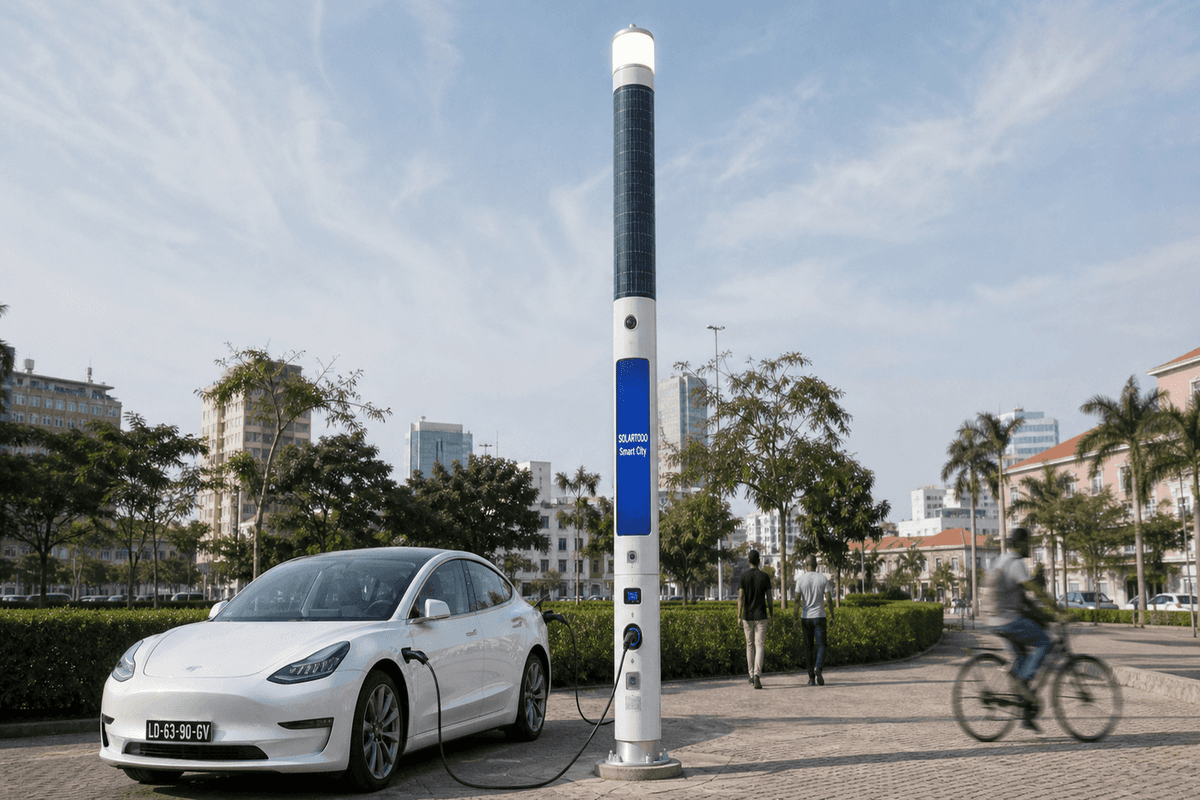
The recommended SOLARTODO form variant is the cylindrical premium Smart Streetlight, not an octagonal arm-type pole and not a park light. Luanda’s combination of coastal salt air, crowded sidewalks, prestige waterfront corridors, and old central streets favors a monolithic cylinder where every module is flush-integrated into the pole skin. This avoids side-arm luminaires, protruding public-address speakers, external solar panels, widened EV bases, and separate charging pillars.
A typical deployment of this scale would use approximately 183 units of 9m seamless cylindrical Ø315mm poles, placed at 28m spacing. The implied route length is about 5,124m, suitable for urban streets, mixed commercial corridors, waterfront pedestrian edges, municipal forecourts, and arterial sidewalks where 30-50 poles per km is normal. The 9m height keeps the product within city-street lighting class, below traffic-highway pole scale and above garden-light scale.
SOLARTODO should configure the Luanda version as a constant-diameter Ø315mm cylinder from top to bottom. The lower section includes a fully flush embedded 7kW dual-outlet EV charger with Type 2 and Type 1 flip-caps, a 5m coiled Type 2 cable, and a flush touchscreen at 1.5m. The design keeps the charging hardware inside the cylinder, so the pole does not need a widened base or a separate bollard.
For local user interface and civic communications, the pole should include a 1,800mm tall curved LCD display, about 170mm wide, bent to the Ø315mm radius and flush inset into the front face only. Content should remain strictly “SOLARTODO Smart City” in white sans-serif text on deep blue, with no imagery, video, or advertising. This keeps the display compliant with the specified configuration and avoids visual clutter in Luanda’s already dense streetscape.
Technical Specifications
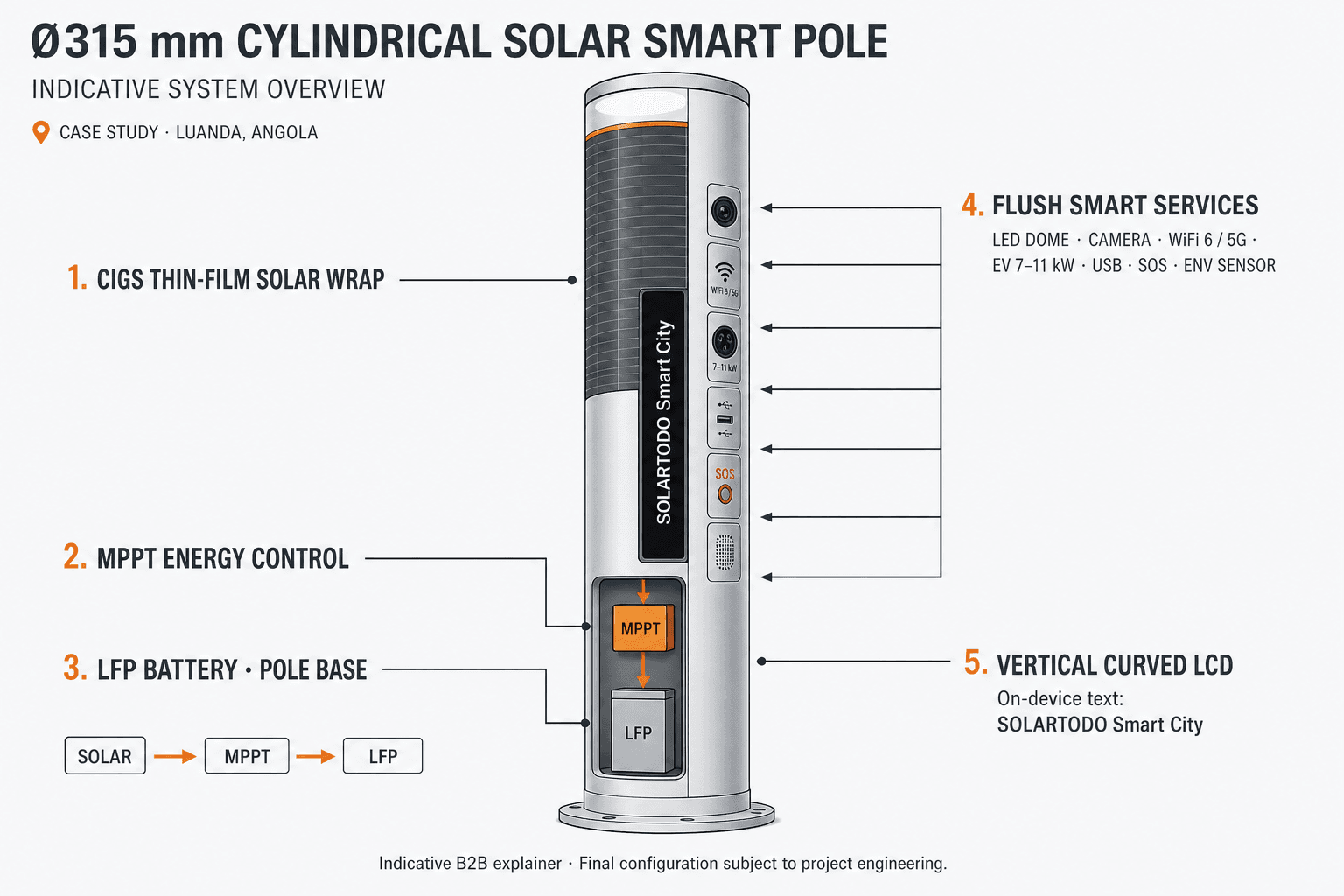
The Luanda configuration uses 183 units, 9m height, Ø315mm diameter, 60W LED output, 259W CIGS solar, and 1,800Wh LFP storage.
- Product: SOLARTODO Smart Streetlight, cylindrical premium variant for urban streets.
- Quantity: approximately 183 units for a typical corridor package.
- Pole: 9m seamless cylindrical Ø315mm pole, constant diameter top-to-bottom, 5mm wall thickness, hot-dip galvanized steel.
- Finish: matte white RAL9003 for heat reflection and coastal visual consistency.
- Structural rule: one monolithic cylinder with all modules flush-integrated into the cylinder skin.
- Prohibited attachments: no side arms, no luminaire outriggers, no external boxes, no IP speaker columns, no public-address audio modules, no widened base, no separate EV bollard.
- Luminaire: Ø315mm LED ring-light band at pole top, 360° glow, embedded, 60W, 9,000lm, 4000K.
- Solar: CIGS flexible thin-film cells wrapped 360° around the mid-section from 6.5m to 8.3m, about 259W total, dark blue-black semi-transparent film laminated flush to the pole skin.
- Storage: LFP 1,800Wh battery inside pole base with MPPT charge control.
- Sensor: flush dome-top 4-parameter environmental sensor for temperature, humidity, wind speed, and noise.
- Camera: flush bullet camera behind rectangular glass window, 4MP, IR 50m, no protruding camera body.
- Communications: embedded dual-mode WiFi 6 and 5G-ready internal antennas.
- Emergency: flush 12cm x 12cm SOS panel with integrated micro-camera, microphone, speakerphone grille, and no external speaker column.
- EV charging: embedded 7kW dual-outlet charger, Type 2 plus Type 1, two flush flip-caps, 5m coiled Type 2 cable, touchscreen at 1.5m.
- Display: vertical curved LCD, 1,800mm tall by about 170mm wide, portrait orientation, front face only, text-only SOLARTODO Smart City content.
- User extras: USB-A outlet and Qi wireless charging pad, both flush integrated.
- Spacing: 28m typical, equal to about 35.7 poles per km.
- Applicable standards: IEC 60598 for luminaires and GB/T 37024 for smart pole system requirements.
According to IEC (2024), IEC 60598-1 covers luminaires operating at supply voltages up to 1,000V. IEC states, “general safety requirements for luminaires,” which is directly relevant to Luanda’s 220V/380V low-voltage service interface. GB/T 37024 should be referenced for multi-function smart pole integration, platform connectivity, and modular smart-city equipment acceptance.
Implementation Approach
A Luanda rollout should phase 183 poles through survey, utility coordination, port clearance, foundations, erection, commissioning, and municipal handover.
The first phase is corridor selection and obstruction mapping. Survey teams should record sidewalk widths, drainage channels, road reserve limits, existing LV cabinets, telecom ducts, sight lines, flood-prone depressions, and streets where emergency access cannot be blocked for long periods. In Baixa-style streets and waterfront promenades, a flush-cylinder pole reduces lateral clearance risk because the LED, camera, SOS, LCD, charger, and antennas remain inside the Ø315mm envelope.
The second phase is electrical and civil design. Each pole should be assigned a service point compatible with Angola’s 220V/380V LV environment, with surge protection, earthing continuity, EV circuit separation, and protected cable routing. Foundation drawings should account for sandy coastal soils, drainage conflicts, and areas where low-lying corridors or clogged drains can expose base compartments to splash or standing water.
The third phase is factory acceptance and logistics. Because the Port of Luanda is Angola’s primary logistics gateway, CKD or semi-assembled packing should be organized around quay handling, customs documentation, and low-damage transport to municipal staging areas. Factory acceptance should verify LED output, CIGS lamination continuity, 7kW charger function, LCD text display, SOS audio path, 4MP IR image, WiFi 6/5G antenna status, battery capacity, MPPT operation, and cloud controller connectivity.
The fourth phase is installation and commissioning. A practical municipal schedule would install foundations first, pull cables second, erect poles third, and commission device groups in batches of 20-30 poles. Final handover should include as-built GIS coordinates, serial numbers, test reports, warranty records, controller IDs, SIM or backhaul settings, and maintenance instructions for gasket inspection, touchscreen cleaning, and salt-residue washdown.
Expected Performance & ROI
Expected Luanda benefits include 60W lighting per pole, 7kW charging per unit, 259W solar assist, and 1,800Wh backup storage.
Energy savings should be assessed against the replaced lighting baseline rather than claimed as a completed project result. If an existing corridor uses 150W conventional luminaires and the SOLARTODO configuration uses 60W LED ring lighting, connected lighting load falls by 90W per pole before controls. Across approximately 183 units, that equals 16.47kW lower lighting demand during operating hours, excluding camera, LCD, EV, and communications loads.
Return on investment in Luanda is likely to come from stacked municipal functions, not only electricity savings. One Ø315mm pole can replace separate lighting, CCTV, SOS intercom, small-cell mounting readiness, public information display, USB/Qi charging, and EV charging furniture. In dense streets, avoiding multiple foundations can reduce sidewalk disruption, permitting complexity, and maintenance visits.
According to ITU (2023), Africa had 48 mobile-broadband subscriptions per 100 inhabitants, while mobile-cellular subscriptions reached 92 per 100 inhabitants. ITU states, “mobile-cellular subscriptions now exceeds the world population,” highlighting why civic poles are increasingly used as communications-ready infrastructure. For Luanda, embedded antennas are especially useful because visible rooftop or pole clutter can conflict with waterfront and central-street urban design.
Payback should be modeled under three scenarios: municipal energy-only, shared-service smart-city, and EPC turnkey with advertising excluded. A conservative B2B model would include LED energy reduction, avoided standalone CCTV/SOS poles, reduced separate EV charger civil works, preventive maintenance savings from flush modules, and optional telecom lease value where local regulation allows. SOLARTODO should present ROI as a sensitivity range after site survey, not as a universal claim.
Results and Impact
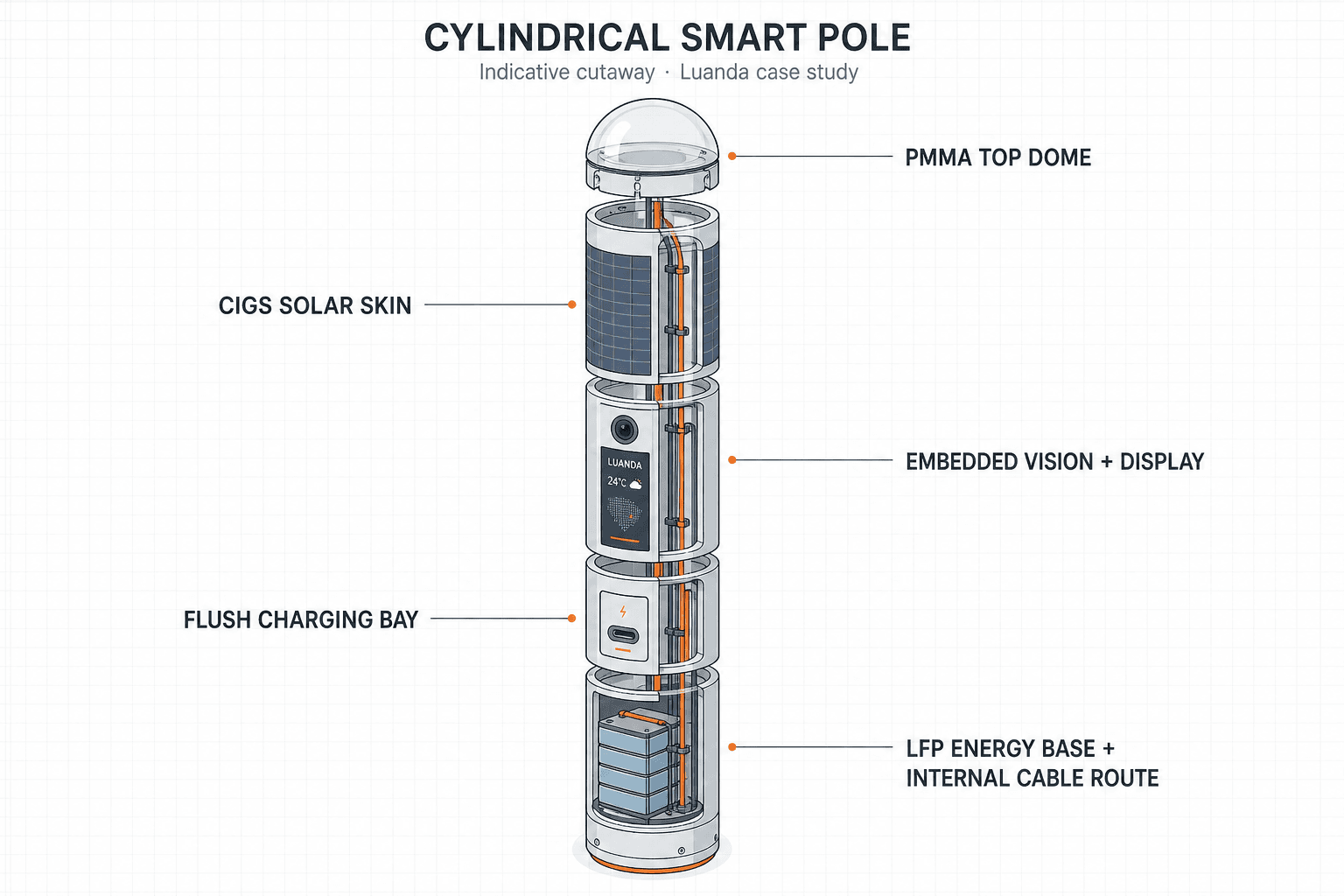
A 183-unit Luanda program would create about 5.1km of multi-function lighting coverage without claiming any completed deployment.
The expected impact is a cleaner and more maintainable street asset layer for high-density urban corridors. At 28m spacing, approximately 183 poles produce continuous lighting, SOS access, EV charging points, WiFi 6/5G readiness, environmental sensing, and camera coverage along a corridor package of roughly 5.1km. The key impact is integration: one foundation and one sealed cylinder instead of multiple cabinets, brackets, columns, and charging bollards.
For resilience, the 1,800Wh LFP battery provides a buffer for controller, communications, sensor, and emergency functions during grid disturbances. It should not be described as making every EV session solar-powered; the 259W CIGS wrap is a supplemental self-power layer for smart functions and battery charging. This distinction is important for procurement accuracy and for EPC bidders comparing grid service requirements.
For public-space quality, the cylindrical form is particularly relevant to Luanda’s coastal and old-town constraints. The absence of outriggers reduces wind-exposed surfaces and simplifies salt-air cleaning. The flush camera glass, SOS panel, LCD, and EV flip-caps also reduce snag points in crowded pedestrian areas and minimize vandal-access edges.
Comparison Table
The Ø315mm flush cylinder is strongest for 9m Luanda streets, while 12m hybrid and octagonal poles suit wider corridors.
| Configuration option | Luanda fit | Height / form | Power architecture | Visible attachments | Best-use corridor |
|---|---|---|---|---|---|
| SOLARTODO Ø315mm cylindrical Smart Streetlight | Highest | 9m constant Ø315mm seamless cylinder | 259W CIGS + 1,800Wh LFP + grid interface | None; all modules flush | Waterfront, Baixa streets, civic avenues |
| 12m grid smart pole with integrated EV cabinet | Medium | 12m octagonal tapered steel | Grid-powered AC with integrated lower charger | Larger cabinet zone | Wider arterial streets with stronger LV service |
| 12m wind-solar hybrid pole | Medium-low | 12m octagonal plus turbine and panels | Wind-solar hybrid with grid backup | Turbine and A-frame panels | Open suburban roads with clearance |
| Standard modular smart pole | Medium | 6-12m octagonal galvanized pole | Grid or modular hybrid options | Arms, boxes, accessories possible | Budget corridors and non-premium districts |
The recommended Luanda option is the Ø315mm cylindrical Smart Streetlight because the project-specific configuration requires no side arms, no external solar panels, no external speaker columns, and no separate EV bollards. That matters in a coastal city where visual order, corrosion control, and sidewalk clearance are operational requirements rather than aesthetic preferences.
Pricing & Quotation
SOLARTODO should quote Luanda in 3 commercial scopes: FOB Supply, CIF Delivered, and EPC Turnkey after site survey.
SOLARTODO offers three pricing tiers for this product line: FOB Supply (equipment ex-works China), CIF Delivered (including ocean freight and insurance), and EPC Turnkey (fully installed, commissioned, with 1-year warranty). Volume discounts are available for large-scale deployments. Configure your system online for an instant estimate, or request a custom quotation from our engineering team at [email protected].
For Luanda, EPC quotation inputs should include foundation class, trenching length, LV service availability, SIM or fiber backhaul choice, customs terms, staging location, night-work restrictions, and whether the corridor is waterfront, old-town, or peri-urban. Technical buyers can review the product family at SOLARTODO Smart Streetlight and contact the engineering team through contact us.
Frequently Asked Questions
These 10 Luanda Smart Streetlight answers cover 183 units, 9m Ø315mm poles, 7kW charging, timeline, ROI, maintenance, pricing, and warranty.
Q1: What Smart Streetlight configuration is recommended for Luanda? The recommended configuration is approximately 183 units of 9m seamless cylindrical Ø315mm Smart Streetlight poles at 28m spacing. Each pole uses a constant-diameter 5mm steel cylinder, 60W LED ring-light, 259W flush CIGS solar wrap, 1,800Wh LFP battery, 4MP IR camera, WiFi 6, 5G readiness, SOS panel, curved LCD, and embedded 7kW EV charger.
Q2: Why use a cylindrical flush pole instead of a standard arm-type pole? Luanda’s coastal salt air, dense central streets, and sidewalk pressure favor a sealed monolithic cylinder with no side arms, no external boxes, and no separate EV bollard. A constant Ø315mm profile reduces snag points, wind-exposed surfaces, corrosion-prone brackets, and visual clutter while keeping lighting, camera, SOS, display, charging, and communications inside one asset.
Q3: How long would a typical Luanda deployment take? A typical 183-unit deployment would usually be planned in phases: 2-4 weeks for survey and utility coordination, 4-8 weeks for production and factory testing, variable time for CIF shipping and customs, then batch installation and commissioning. Site access, rain-season drainage works, LV connection approvals, and municipal traffic controls determine the final schedule.
Q4: What ROI should Luanda municipal buyers expect? ROI should be modeled after survey, not claimed as a fixed result. Compared with a 150W legacy luminaire, each 60W LED pole can reduce lighting load by 90W before controls. Additional value comes from replacing separate CCTV, SOS, EV charging, WiFi, display, and sensor infrastructure with one foundation and one maintained asset.
Q5: Does the 259W CIGS solar wrap power EV charging? No. The 259W CIGS wrap and 1,800Wh LFP battery support smart functions, battery charging, controls, sensors, and resilience. The embedded 7kW EV charger should be treated as a grid-connected load coordinated with Angola’s 220V/380V LV service. This avoids overstating solar capacity and keeps EPC electrical design realistic.
Q6: What maintenance is important in Luanda’s coastal environment? Maintenance should focus on salt-residue washdown, gasket inspection, touchscreen cleaning, CIGS laminate inspection, earthing checks, surge protection status, charger connector checks, camera glass cleaning, and battery health reporting. The flush-cylinder design reduces exposed brackets and boxes, but coastal humidity and drainage splash still require scheduled inspection, especially after the October-April rainy season.
Q7: How does installation differ from separate streetlights and EV bollards? The Luanda configuration uses one pole foundation and one Ø315mm cylinder that contains lighting, charging, display, SOS, camera, connectivity, sensor, battery, and MPPT hardware. Separate bollards and cabinets require more sidewalk space, more civil works, more cable transitions, and more collision points. The integrated design is better for compact urban corridors.
Q8: What standards should procurement specify? Procurement should specify IEC 60598 for luminaire safety and GB/T 37024 for smart pole system requirements. For Angola, bidders should also coordinate LV service with IRSEA-listed 220V/380V supply classes, define surge protection and earthing tests, and require factory acceptance reports for LED, charger, battery, camera, display, SOS, and controller functions.
Q9: Does SOLARTODO provide EPC pricing for Angola? SOLARTODO can quote FOB Supply, CIF Delivered, or EPC Turnkey scopes. EPC pricing depends on foundation design, trenching, grid connection distance, local permits, installation windows, customs handling, communications backhaul, and commissioning requirements. Buyers should use the online configurator for an estimate and request a custom Luanda quotation for bankable procurement.
Q10: What warranty and handover documents should be requested? For a 183-unit Luanda package, buyers should request at least a 1-year EPC warranty if turnkey scope is selected, plus serial-number lists, factory acceptance reports, commissioning records, as-built coordinates, electrical test results, controller IDs, battery records, charger certificates, maintenance manuals, and spare-part recommendations. Warranty terms should separate pole structure, electronics, battery, charger, and display components.
References
These 8 references support Luanda-specific figures on 8.67m population, 74.8% electricity access, 13.21-inch rainfall, voltage classes, and port logistics.
- INE Angola (2024): Censo 2024 reports Luanda province at 8,665,510 residents, 99.3% urban population, and 74.8% electricity access.
- IRSEA (2026): Electricidade lists Angola nominal voltage classes: 220V/380V low voltage and 30kV, 20kV, 15kV, and 3kV medium voltage.
- U.S. Energy Information Administration (2025): Angola country analysis cites 7.6GW installed capacity in 2023 and World Bank electricity access estimates.
- Timeanddate (2012-2021 climate normals): Luanda climate averages reports 79°F mean temperature, 79% humidity, and 13.21 inches annual precipitation.
- Port of Luanda (2026): The Port of Luanda states the port handles about 80% of Angola imports and exports and has 2,728m of quay.
- IDRC (2019): Improving water security and reducing climate risk in Angola’s coastal cities reports over 12% of Luanda households at risk of flooding, coastal inundation, and erosion.
- ITU (2023): Facts and Figures 2023 reports Africa mobile-cellular and mobile-broadband subscription rates.
- IEC (2024): IEC 60598-1:2024 specifies general safety requirements for luminaires operating at supply voltages up to 1,000V.
Equipment Deployed
- 183 units × 9m seamless cylindrical Ø315mm Smart Streetlight pole, 5mm wall, hot-dip galvanized, RAL9003 matte white
- 60W / 9,000lm / 4000K Ø315mm 360° LED ring-light band integrated at pole top
- 259W 360° CIGS flexible thin-film solar wrap from 6.5m to 8.3m, flush laminated
- LFP 1,800Wh battery inside pole base with MPPT controller
- Flush 4MP IR 50m bullet camera behind rectangular glass window
- Embedded WiFi 6 + 5G-ready internal antenna system
- Flush SOS 12cm × 12cm panel with micro-cam, mic, and speakerphone grille
- Embedded 7kW dual-outlet EV charger with Type 2 + Type 1 flip-caps and 5m Type 2 cable
- 1,800mm × ~170mm curved LCD display, flush inset, SOLARTODO Smart City text only
- USB-A port and Qi wireless charging pad, flush integrated