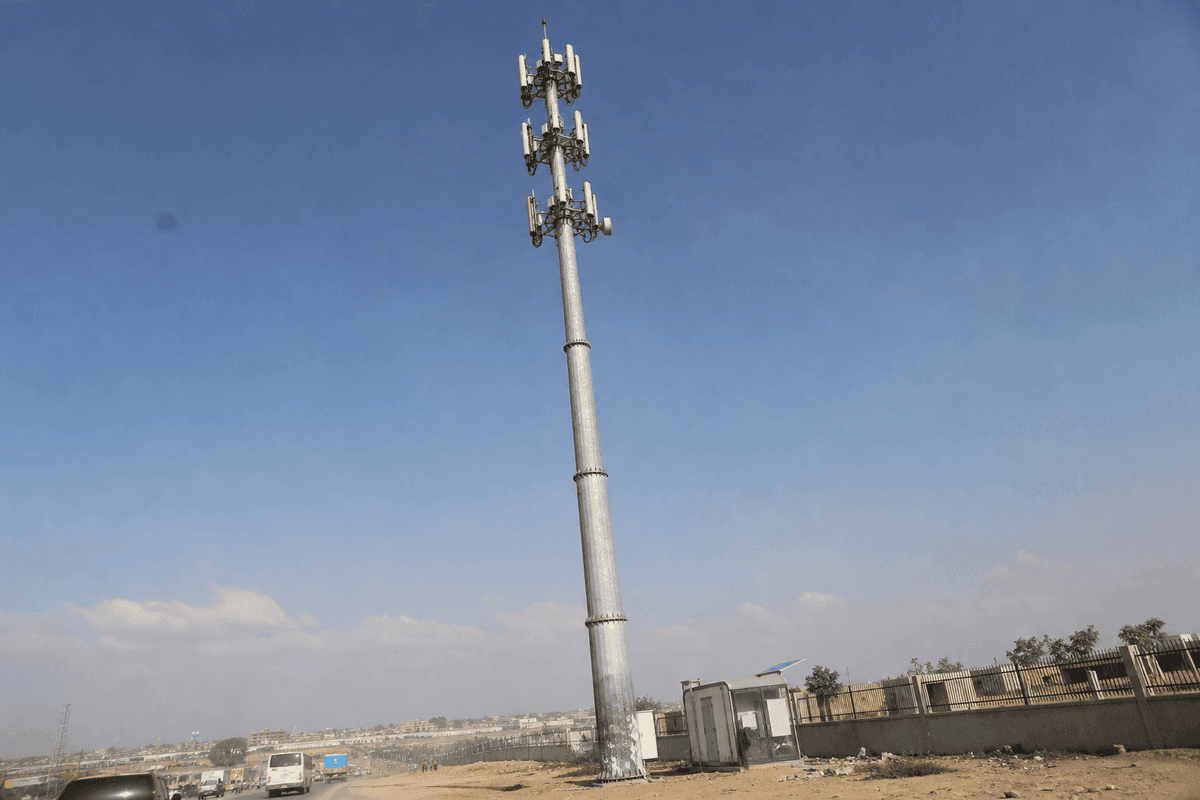
Luanda Coastal Coverage Pressure: Telecom Tower Configuration for 40m Steel Monopoles
Summary
Luanda's 8,665,510 residents, 99.3% urban profile, and coastal corrosion exposure make 40m steel monopoles a practical Telecom Tower option. A typical 10-unit SOLARTODO package uses 20t Q345 towers with 9 panels, 6 RRUs, and 3 small cells per site.
Key Takeaways
- A typical Luanda high-coverage package would specify approximately 10 units of 40m tapered steel monopole Telecom Towers for regional macro and dense urban hotspot coverage.
- Each tower would weigh about 20t using the engineering rule of 500kg/m × 40m, with final verification against the 35-45m class envelope.
- The antenna package is 9× panel antennas, 6× RRUs, and 3× small cells per tower, suited to dense urban data demand.
- Wind Class 1 under TIA-222-H means 40m/s basic wind design with factor 1.0 for this medium-corrosion Luanda specification.
- Pile foundations are recommended because Luanda includes coastal districts, drainage stress, and soft or variable urban soils.
- CKD sectional shipping reduces tower shipping volume by 60-70%, important for ocean freight into the Port of Luanda and city haulage.
- Production lead time is typically 30-45 days before shipment, excluding permitting, geotechnical works, customs, civil works, and RF commissioning.
Market Context for Luanda
Luanda tower planning is defined by 8,665,510 province residents, 99.3% urbanization, coastal humidity, and mixed utility resilience across dense and peri-urban districts.
Luanda is Angola's political, port, logistics, and commercial center on the Atlantic coast. According to Instituto Nacional de Estatistica Angola (2024), Luanda Province had 8,665,510 residents, representing 23.7% of Angola's population, and the province was 99.3% urban. That concentration changes telecom tower planning because site acquisition, interference control, backhaul, and upgrade space matter as much as nominal coverage radius.
Local climate is a technical input, not background color. According to Timeanddate climate normals for Luanda Airport (2012-2021), Luanda's annual mean temperature is about 79°F, the hottest monthly mean is about 83°F in March, humidity averages about 79%, and annual precipitation is about 13.21 inches. Coastal salt air, high humidity, and intermittent wet-season drainage stress justify hot-dip galvanizing, sealed cable routing, grounding inspection, and a medium corrosion-zone maintenance plan.
Utility and municipal context also affect tower design. Angola commonly uses 230V, 50Hz low-voltage supply for service equipment, while telecom sites require coordinated grounding, surge protection, aviation marking, and backup-power interfaces. According to the World Bank (2023), Angola's national access to electricity was 51.1%, so resilient tower sites in Luanda still need realistic assumptions about grid reliability, generator access, and service-road availability.
Telecom demand is expanding across Africa, and Luanda is exposed to the same densification pressure. According to GSMA (2024), Sub-Saharan Africa had 520 million unique mobile subscribers by the end of 2023, equal to 44% of the population, while mobile internet subscribers reached 320 million. ITU states, "Universal and meaningful connectivity" means users can have a safe, satisfying, productive, and affordable online experience. For Luanda, that points to macro-site quality, rooftop infill, and small-cell readiness rather than low-spec towers built only for voice coverage.
Recommended Technical Configuration
A Luanda high-coverage Telecom Tower package should use 10 units of 40m steel monopoles with pile foundations, 2 platforms, and dense-sector antenna loading.
For SOLARTODO, the correct product fit is a steel monopole Telecom Tower, not lattice, FRP, or a joint-use decorative pole. A typical 10-unit deployment in this profile would consist of 10 units × 40m tapered steel monopole towers, hot-dip galvanized Q345 steel, medium corrosion-zone detailing, and TIA-222-H Wind Class 1 at 40m/s. The pole class is regional macro / high-coverage tower, while the antenna package is dense enough to support high-traffic urban cells.
The correct size class is the 35-45m highway/peri-urban category, with 2-3 platforms, 6-9 panels plus microwave options, and 22-30t per tower in the product engineering table. The project-specific configuration uses 40m height and about 20t/tower under the supplied engineering rule of 500kg/m × height. Because class tables and project weights are planning tools, final drawings should verify shaft thickness, flange design, anchor bolts, deflection, and antenna sail area before fabrication.
In Luanda, a 40m monopole is especially useful outside the tightest historic streets, along arterial roads, near logistics corridors, and in peri-urban growth zones where rooftop leasing is inconsistent. Dense old-town streets may still require rooftop or 25-30m infill sites, but the 40m configuration is appropriate where one site must cover more users, hold more RRUs, and preserve upgrade space. SOLARTODO would normally pair this with route-access checks from the Port of Luanda, turning-radius review for long sections, and corrosion protection documentation before shipment.
Technical Specifications
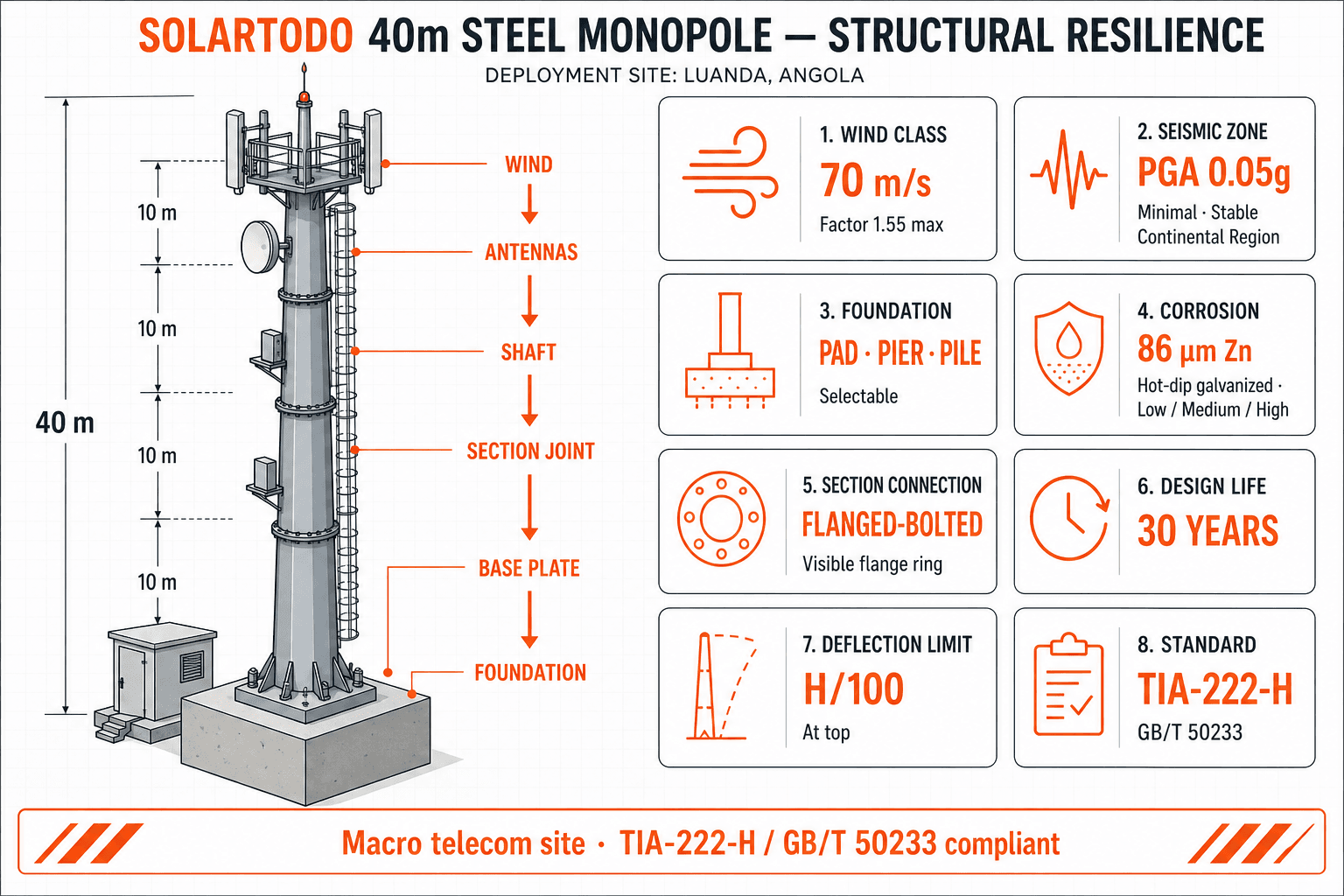
The specified Luanda Telecom Tower configuration is a 10-unit, 40m, Q345 hot-dip galvanized steel monopole package designed for 30 years and 40m/s wind loading.
- Product: SOLARTODO Telecom Tower, tapered round or octagonal steel monopole only.
- Quantity basis: approximately 10 units for a typical Luanda regional macro / high-coverage package.
- Height: 40m, matching the 35-45m size class for highway, peri-urban, and high-coverage urban edge sites.
- Structure: hot-dip galvanized Q345 steel, flanged bolt-on sectional design, CKD shipment.
- Weight: approximately 20t per tower by 500kg/m × 40m engineering rule.
- Antenna load: 9× panel antenna, 6× RRU, and 3× small cell per tower.
- Platforms: 2 antenna platforms with climbing ladder, cable tray, and safety cage.
- Safety accessories: aircraft warning light, grounding system, lightning rod, and fall-protection access.
- Foundation: pile foundation, selected for soft coastal soils, drainage uncertainty, and 40m tower overturning control.
- Wind class: Class 1, 40m/s with factor 1.0 under TIA-222-H design reference.
- Corrosion zone: medium, with hot-dip galvanizing and inspection planning for coastal salt exposure.
- Design life: 30 years, subject to routine bolt torque checks, corrosion inspection, and grounding resistance testing.
- Production lead time: 30-45 days before shipping, excluding local permitting, geotechnical testing, customs clearance, and installation.
- Standards: TIA-222-H for telecom structure loading and GB/T 50233 for steel tower construction practices.
According to TIA (2017), TIA-222-H provides critical guidance on minimum load requirements and design criteria for antenna-supporting structures. TIA states, "Revision H represents a significant update" to the antenna-supporting structure standard. That is the correct design family for a 40m steel Telecom Tower carrying panels, RRUs, small cells, cable trays, and aviation lighting.
Implementation Approach
A Luanda rollout should follow a 5-phase sequence: survey, engineering, CKD shipment, pile foundation construction, and tower erection with RF commissioning.
The first phase is site screening. Engineers would check zoning, landlord access, aircraft-warning requirements, nearby 230V service availability, flood exposure, and haulage routes from Luanda's port area. Dense districts may need night delivery windows or shorter sectional packaging, while peri-urban sites may need road reinforcement during rainy months.
The second phase is structural and geotechnical validation. For each 40m monopole, a local soil report should confirm pile depth, allowable bearing, lateral resistance, groundwater level, and concrete exposure class. The antenna load should be frozen before final fabrication because 9 panels, 6 RRUs, and 3 small cells affect mast deflection, platform loading, and cable-tray utilization.
The third phase is SOLARTODO factory production and CKD shipment. CKD packaging reduces shipping volume by 60-70%, improving container utilization and reducing the number of oversize transport movements. For Luanda, this matters because port clearance, city traffic, and restricted turns can become a larger scheduling risk than the tower erection itself.
The fourth phase is foundation and tower installation. A typical sequence includes pile drilling, reinforcement cage installation, anchor-bolt template setting, concrete placement, curing, base flange inspection, sectional lift, bolt torqueing, grounding connection, and aviation light testing. Commissioning should include verticality survey, photo record, grounding resistance test, antenna mount inspection, and punch-list closure before RF integration.
Expected Performance & ROI
The expected value of a 40m Luanda Telecom Tower package is higher network capacity per site, fewer repeated civil works, and a 30-year asset base.
The 9-panel and 6-RRU configuration is intended for dense 4G/5G urban demand where each tower must host multiple sectors and support future radio upgrades. According to GSMA (2024), mobile technology contributed $140 billion, or 7%, to Sub-Saharan Africa GDP in 2023 and could reach $170 billion by 2030. For Luanda, that means tower selection should prioritize payload margin, cable management, and upgradeable platforms rather than minimum-cost single-tier poles.
ROI depends on lease model, spectrum plan, power availability, and whether the buyer is an operator, towerco, EPC, or municipal infrastructure owner. A practical payback model would compare capex against tenant revenue, avoided rooftop lease fragmentation, reduced truck rolls from standardized equipment, and lower corrosion repair costs over 30 years. No price should be inferred without site drawings, soil reports, antenna drawings, and delivery term selection.
Maintenance should be budgeted as a lifecycle program, not as a one-time installation check. For coastal Luanda, inspection should focus on galvanized coating loss, fastener corrosion, ladder and safety-cage condition, grounding resistance, cable tray security, and aviation-light operation. A 6-12 month inspection interval is reasonable for the first operating year, then annual checks can be adjusted based on corrosion findings and site criticality.
Comparison Table
A 40m Luanda Telecom Tower sits between smaller rooftop infill poles and taller rural towers, offering 9-panel capacity with manageable logistics.
| Option | Best Luanda Fit | Height | Typical Antenna Load | Weight Range | Foundation Bias | Recommendation |
|---|---|---|---|---|---|---|
| Rooftop / urban infill | Dense old-town streets | 15-25m | 3-6 panels, 1 platform | 8-15t | Building-specific | Use only where rooftop rights and structural capacity are clear |
| Suburban monopole | Residential districts | 25-35m | 6-9 panels, 2 platforms | 15-22t | Pad or pier | Good for moderate-density expansion |
| SOLARTODO 40m monopole | Arterial, peri-urban, high-coverage zones | 40m | 9 panels, 6 RRUs, 3 small cells | ~20t specified; verify against class | Pile | Recommended for this Luanda configuration |
| Rural wide coverage | Outskirts and low-density routes | 45-55m | 9-12 panels, 3 platforms | 30-40t | Pile or heavy pier | Use when coverage radius matters more than urban logistics |
Pricing & Quotation
SOLARTODO provides 3 quotation paths for Luanda buyers: FOB Supply, CIF Delivered, and EPC Turnkey, with final pricing dependent on drawings, logistics, and foundation scope.
SOLARTODO offers three pricing tiers for this product line: FOB Supply (equipment ex-works China), CIF Delivered (including ocean freight and insurance), and EPC Turnkey (fully installed, commissioned, with 1-year warranty). Volume discounts are available for large-scale deployments. Configure your system online for an instant estimate, or request a custom quotation from our engineering team at [email protected].
For technical review, buyers should provide coordinates, site access notes, wind requirement, soil report if available, antenna drawings, RRU weight, platform count, aviation-light requirement, and preferred Incoterm. SOLARTODO can then align the Telecom Tower product configuration with local engineering review and installation planning. For procurement support, buyers can also contact us with site coordinates and antenna schedules.
Frequently Asked Questions
This FAQ answers 10 common Luanda buyer questions covering 40m tower specs, installation sequence, pricing scope, warranty, maintenance, ROI, and EPC responsibilities.
Q1: Why is a 40m steel monopole recommended for Luanda? A 40m steel monopole balances coverage, capacity, and logistics for Luanda's dense coastal market. It fits the 35-45m high-coverage class, supports 9 panel antennas, 6 RRUs, and 3 small cells, and avoids the larger transport and visual burden of 45-55m rural towers.
Q2: Is this a lattice tower, FRP pole, or joint-use structure? No. The recommended SOLARTODO Telecom Tower is one form only: a tapered round or octagonal steel monopole made from hot-dip galvanized Q345 steel. It uses flanged bolt-on sections for CKD shipping and is not a lattice tower, FRP pole, or decorative joint-use lighting pole.
Q3: What is the expected deployment timeline for 10 towers? Factory production normally takes 30-45 days after drawings, antenna loading, and commercial terms are approved. The full Luanda schedule also depends on soil testing, pile construction, concrete curing, customs clearance, transport permits, crane availability, and RF commissioning, so EPC planning should be built site by site.
Q4: What foundation type is recommended in Luanda? Pile foundations are recommended for this 40m configuration because Luanda includes coastal soils, drainage stress, and low-lying areas where shallow foundations may be less predictable. Final pile depth and reinforcement must follow a geotechnical report, tower reactions, groundwater conditions, and local engineer-of-record approval.
Q5: What maintenance is required in a medium corrosion zone? Maintenance should include galvanized coating inspection, bolt torque checks, grounding resistance testing, aviation-light verification, ladder and safety-cage checks, and cable-tray inspection. In coastal Luanda, a 6-12 month first-year inspection cycle is prudent, followed by annual maintenance adjusted to observed corrosion and site criticality.
Q6: How does ROI work if prices are not listed? ROI should be modeled from tenant revenue, avoided rooftop fragmentation, network capacity gain, maintenance cost, foundation scope, and 30-year asset life. SOLARTODO does not publish a one-size payback period because soil conditions, freight term, installation scope, antenna ownership, and towerco lease assumptions can materially change economics.
Q7: What is included in EPC Turnkey pricing? EPC Turnkey generally covers installed and commissioned equipment with a 1-year warranty, subject to the final quotation scope. For Luanda, the EPC boundary should clearly state whether permits, geotechnical testing, pile drilling, crane hire, grid connection, backup power interface, RF equipment, and site security are included.
Q8: What warranty should buyers expect? The pricing section defines EPC Turnkey with a 1-year warranty. Structural design life is 30 years, but warranty and design life are different: the warranty covers defined defects and obligations, while design life assumes correct installation, normal operating loads, periodic inspection, and maintenance of grounding and corrosion protection.
Q9: How does the 40m monopole compare with rooftop sites? Rooftop sites can work in dense districts, but they depend on building rights, roof strength, access control, and landlord continuity. A 40m monopole gives a dedicated structure, controlled grounding, known antenna geometry, and better upgrade space for 9 panels, 6 RRUs, and 3 small cells.
Q10: What information is needed for a custom quotation? A practical quotation needs site coordinates, tower height, antenna schedule, RRU and small-cell weights, wind class, soil report, corrosion environment, platform count, accessory list, delivery term, and installation responsibility. For Luanda, access constraints and flood exposure should also be shared early.
References
- Instituto Nacional de Estatistica Angola (2024): Censo 2024 portal reports Luanda Province population of 8,665,510, 23.7% national share, and 99.3% urban profile. https://censo2024.ine.gov.ao/
- World Bank (2023): Angola access to electricity indicator reports 51.1% national electricity access in 2023. https://data.worldbank.org/country/angola
- Timeanddate (2012-2021): Luanda Airport climate normals report 79°F annual mean temperature, 79% humidity, and 13.21 inches annual precipitation. https://www.timeanddate.com/weather/angola/luanda/climate
- GSMA (2024): Mobile Economy Sub-Saharan Africa reports 520 million unique mobile subscribers in 2023 and $140 billion mobile GDP contribution. https://www.gsma.com/solutions-and-impact/connectivity-for-good/mobile-economy/sub-saharan-africa-2024/
- ITU (2022): Universal and Meaningful Connectivity framework defines connectivity quality, availability, affordability, devices, skills, and security. https://www.itu.int/itu-d/sites/projectumc/
- Telecommunications Industry Association (2017): ANSI/TIA-222-H publication for antenna-supporting structures and structural design criteria. https://standards.tiaonline.org/news-media/press-releases/tia-announces-publication-tia-222-h-standard-antennas-and-supporting
- GB/T 50233 (2014): Chinese construction and acceptance practices for steel tower structures, referenced for fabrication and erection discipline.
Equipment Deployed
- 10 units × 40m tapered steel monopole Telecom Tower
- Hot-dip galvanized Q345 steel, medium corrosion-zone specification
- Approximately 20t per tower using 500kg/m × 40m engineering rule
- 9× panel antennas + 6× RRUs + 3× small cells per tower
- Pile foundation for coastal soil and drainage-risk conditions
- 2 antenna platforms with climbing ladder, cable tray, safety cage
- Aircraft warning light, grounding system, and lightning rod
- CKD sectional shipping with 60-70% volume reduction
- TIA-222-H Wind Class 1, 40m/s, factor 1.0
- 30-year design life with 30-45 day production lead time