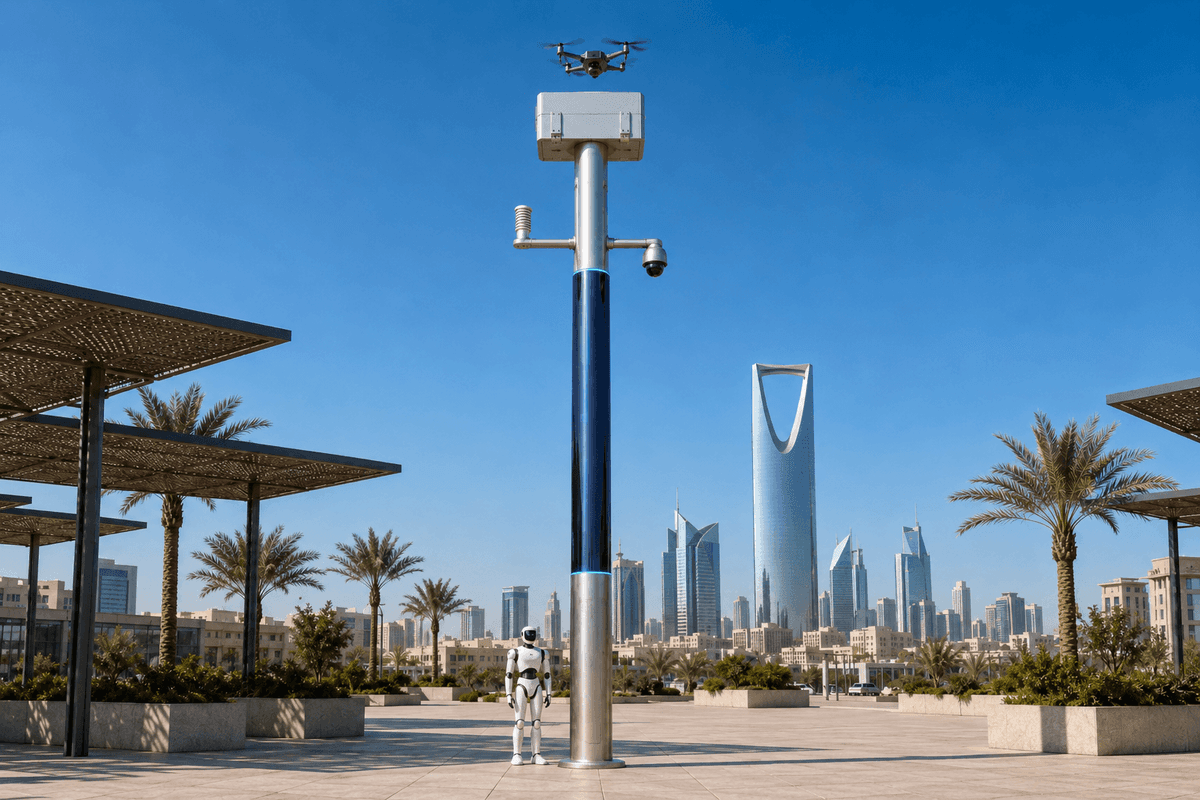
A City AI Pole is a fully off-grid physical-AI edge node that hosts sensing, compute, drone operations, robot operations and local energy storage without street lighting. In this Madrid deployment, SOLARTODO Sentinel Sky Hub acts as a temporary-event droneport for power-utility fire response, collecting de-identified evidence and coordinating field action from the pole edge.
Procurement Context
Madrid is not a coastal port city, but it operates as a major inland logistics and dry-port environment where freight, rail, warehousing, grid assets and road corridors converge. During the winter holiday season, traffic around logistics parks and intermodal yards can intensify as parcel, retail, food and spare-parts flows move through the metropolitan region before Christmas and Three Kings. For a power-utility stakeholder, that seasonal peak changes the operating problem: temporary substations, cable routes, depot perimeters, transformer yards and emergency access lanes require higher observation density, but adding permanent towers, fixed grid connections or round-the-clock manual patrols may not match the short event window.
This case study frames a proposed procurement configuration for SOLARTODO Sentinel Sky Hub as a temporary-event city-ai-pole deployment around a Madrid port-style logistics district. The buyer is a power utility supporting the event-period resilience plan. The primary operational scenario is fire response: detecting smoke-like visual anomalies, abnormal crowding near restricted utility zones, unauthorized perimeter activity, blocked access routes and post-incident conditions that need a defensible evidence trail. The core purchasing question is not whether the site needs another camera. It is whether a fully off-grid physical-AI edge node can reduce avoidable patrol dispatches, maintain drone sortie continuity and create cleaner incident evidence without sending raw video off the pole.
Deployment Concept
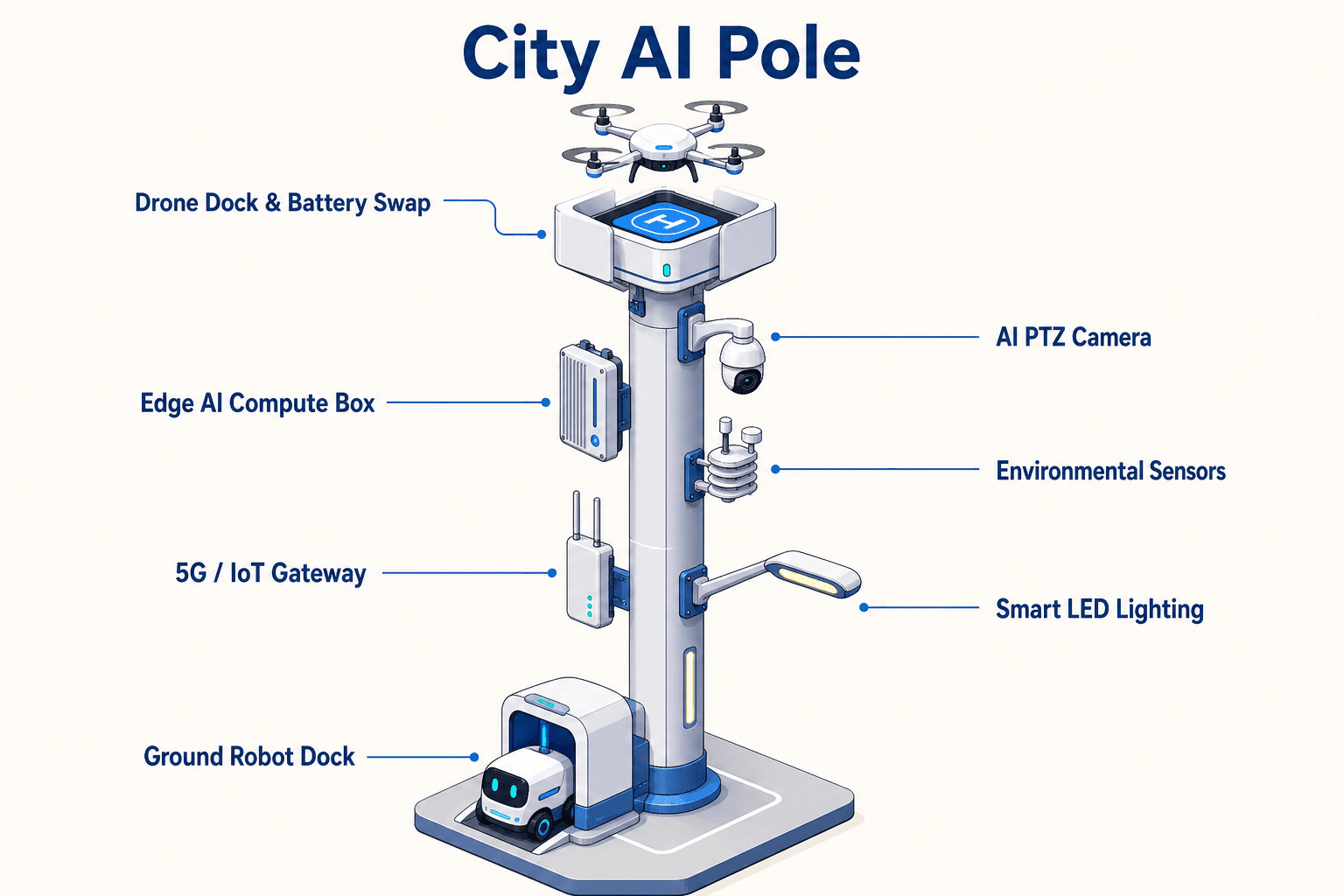
The proposed deployment uses SOLARTODO Sentinel Sky Hub as a pure smart pole: a non-lighting intelligent pole hosting edge compute, sensing, energy storage, drone operations and ground robot coordination. It is not a smart streetlight and includes no lighting system. The pole is designed as a fully off-grid micro-station with battery storage and 360-degree wrapped flexible CIGS thin-film solar replenishment. It does not require grid, city or site power, which is important for temporary-event procurement because civil works, cable permits and utility shutdown windows can dominate the schedule and cost profile.
For Madrid, the Sky Hub would be positioned as a droneport node at a dry-port perimeter, utility switching area, energy storage compound, logistics gate or event-critical service lane. Its job is to keep a drone available for fire-response observation, inspection and evidence collection while minimizing on-site operator presence. A landed drone returns to the pole for automated rear-service battery exchange through a multi-bay battery magazine. The battery-swap module is central to the use case: instead of waiting for a single pack to recharge, the drone receives a charged pack and relaunches, allowing several consecutive sorties subject to battery inventory, weather, aviation authorization, safety procedures and final engineering confirmation.
The pole also hosts a PTZ camera with local perception for anonymous vehicle count, crowd density, intrusion and perimeter awareness. Environmental sensors capture wind speed, wind direction, temperature, humidity, atmospheric pressure, noise, PM10, PM2.5 and illuminance. A Jetson-class edge module runs local inference and workload scheduling on the pole. Raw video and sensor data stay on the pole; only de-identified event and status metadata may leave the node for a common-operating-picture command view.
Fire-Response Operations
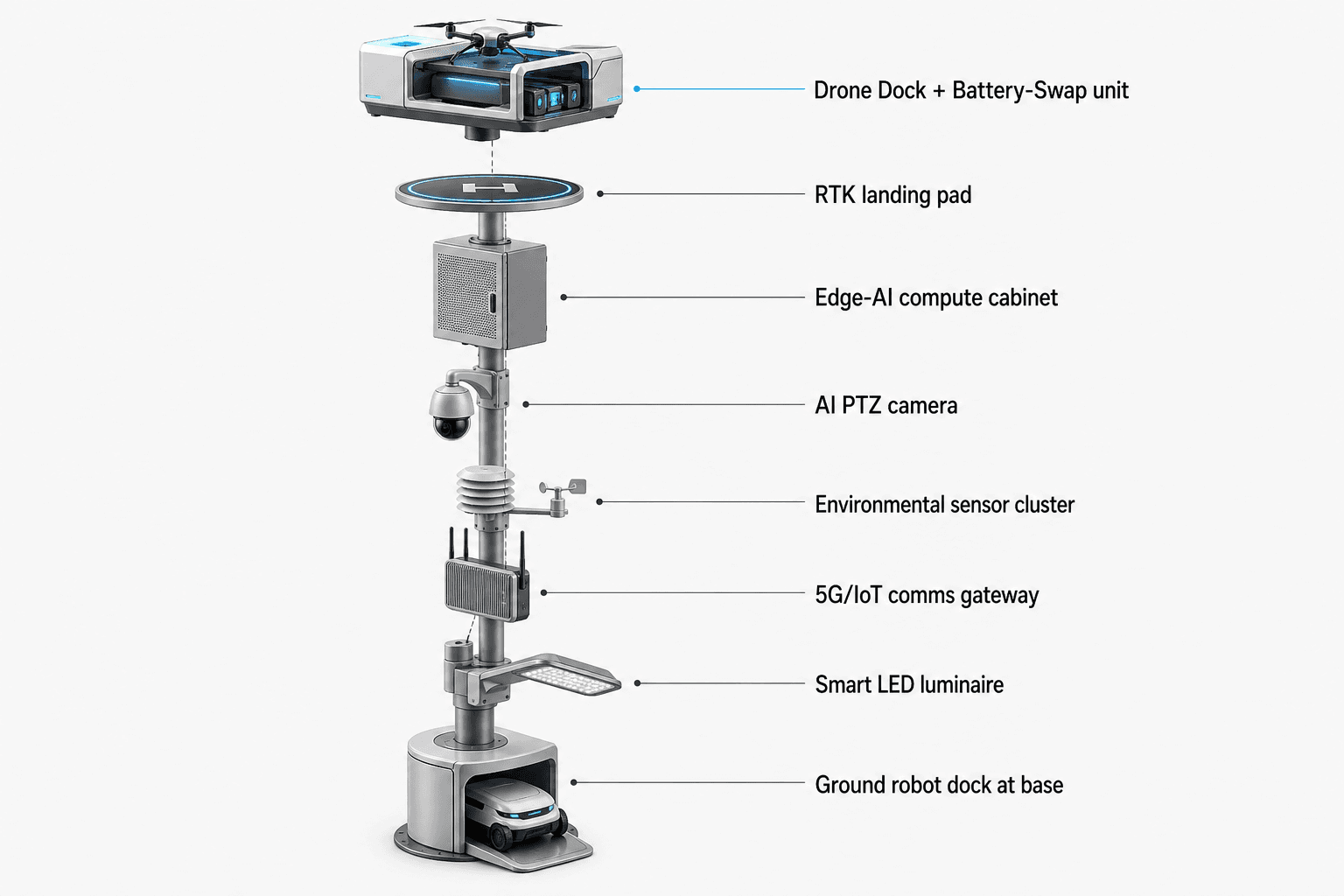
The operational loop follows sensing, authorized assessment and response, edge-compute scheduling, and field operations and maintenance as one command workflow. For a suspected fire event near a Madrid logistics yard or utility perimeter, the on-pole PTZ camera and environmental sensor set provide the first local signal. The edge system scores the event, checks whether the observation is persistent, and presents the operator with a structured incident card: time, location, sensor context, confidence band, camera view, environmental readings, drone availability, battery magazine state and nearby robot availability.
Human authorization remains central. The system can recommend a drone sortie for visual confirmation, but dispatch is subject to the buyer's operating rules, local airspace procedures and emergency plan. Once authorized, the drone launches from the Sky Hub, flies a pre-approved route or operator-approved task path, records the required evidence locally through the node workflow, and returns for battery swap if continued observation is needed. The goal is to shorten the time between anomaly detection and usable field evidence while avoiding a raw-video cloud workflow.
Ground robot operations complement the droneport role. A humanoid or service robot can perform autonomous patrol, alarm response, closer inspection and air-ground coordination, then return to the pole base for wireless charging. In a fire-response scenario, the robot is most valuable after the initial aerial assessment: checking a blocked gate, inspecting a cable route from ground level, or confirming whether smoke, heat haze, crowd movement or access obstruction still exists. The pole schedules compute workloads locally so drone operations, PTZ perception, environmental monitoring, mission logs and robot tasking do not compete blindly for limited battery and compute capacity.
Evidence And Opex
The power utility's pain point is evidence collection, not broad surveillance. Holiday-period events often create ambiguous calls: a smoke report that is dust from a vehicle, a crowd forming near a restricted lane, a gate left open by a contractor, or a heat-related concern near temporary equipment. Each ambiguous call can trigger manual dispatch, security escalation or delayed maintenance action. The proposed Sky Hub configuration is designed to make evidence collection more repeatable: local event classification, drone confirmation, environmental context, mission logs, battery-swap records and de-identified metadata are assembled into an incident timeline.
Opex framing should be handled as an evaluation model, not as a claimed result. A buyer can compare the temporary deployment against manual night patrols, mobile guard callouts, generator-powered camera towers, extra technician dispatches and incident documentation time. The battery-swap module is a major opex lever because it reduces idle time between sorties and lowers the need for an operator to physically attend the node after every flight. Multiple battery bays support consecutive sorties, while duty-cycle scheduling prevents the procurement case from relying on exaggerated energy claims.
Energy planning must remain conservative. The pole carries about 15 square meters of 360-degree wrapped flexible CIGS thin-film over a vertical body of roughly 8 meters height and 0.6 meters width, giving approximately 2.4 to 2.7 kWp nameplate. Because a vertical cylinder collects direct sun mainly on its sun-facing projection, not the full wrap at once, realistic clear-sky output in a high-irradiance region is roughly 0.8 to 1.1 kW DC peak, often peaking mid-morning or mid-afternoon rather than noon, and about 6 to 9 kWh per day. In Madrid, final yield must be confirmed by site shading, season, orientation, weather and duty-cycle modeling. Solar is a supplemental replenishment layer for a fully off-grid, battery-backed micro-station; high-power drone and robot tasks are buffered by 5 to 20 kWh-class storage and scheduled accordingly.
Procurement Evaluation
For procurement, the recommended evaluation is a temporary-event package with defined acceptance tests rather than an open-ended smart-city claim. The utility can specify a Madrid holiday operating window, target perimeters, aviation constraints, evidence-retention rules, local-processing requirements, battery-swap duty cycles, operator authorization procedures and emergency escalation paths. The case should be evaluated on whether the node improves evidence quality and reduces avoidable field attendance during the event period, subject to final engineering confirmation.
Compliance language should remain precise. The deployment is designed for local processing and is PDPL/LGPD-oriented: raw video and sensor data stay on the pole, while only de-identified event or status metadata may leave the site. That is a design posture, not a claim of certification. Counter-UAS coordination is also bounded. The pole may detect and track an unauthorized drone and command its own friendly drone for soft aerial net-capture or close-approach deterrence, only with human authorization and only through non-kinetic mitigation. Radar, if used, is an optional partner-sensor input and is not built into the pole hardware.
This makes Sky Hub suitable for buyers who need a physical-AI edge node rather than a lighting project. In the Madrid port-style logistics context, the proposed procurement value is a self-contained droneport and robot-ready operations node that can be placed where power is difficult, observation demand is temporary, and evidence collection must be fast, local and operationally accountable.
System Configuration
| Parameter | Configuration |
|---|---|
| Pole type | Pure non-lighting smart pole; fully off-grid city-ai-pole / physical-AI edge node |
| Energy system | ~15 m2 360-degree flexible CIGS wrap, 5-20 kWh-class battery storage, duty-cycle scheduling |
| Droneport module | Autonomous launch, patrol, inspection, return, mission logging and multi-bay battery hot-swap |
| Edge AI compute | Jetson-class on-pole inference and workload scheduling; raw video and sensor data processed locally |
| Security sensing | AI PTZ for anonymous vehicle count, crowd density, intrusion and perimeter awareness |
| Environmental monitoring | Wind speed, wind direction, temperature, humidity, pressure, noise, PM10, PM2.5 and illuminance |
| Robot operations | Ground service robot patrol, inspection, alarm response, air-ground coordination and base wireless charging |
How It Works
- On-pole PTZ and environmental sensors flag a smoke-like or access-risk anomaly.
- Edge AI classifies the event locally and prepares a de-identified incident card.
- A human operator authorizes drone launch from the Sky Hub droneport.
- The drone captures inspection evidence and returns for automated battery hot-swap if needed.
- The command view records mission logs, sensor context, authorization steps and final field disposition.
Planning Assumptions (Indicative)
Illustrative planning inputs a buyer can recompute — target metrics, not achieved results. Subject to final engineering confirmation.
| Metric | Planning assumption | Indicative value |
|---|---|---|
| Inspection labor | Drone patrol and local event scoring replace a portion of temporary holiday night patrol checks. | ~10-20 patrol checks/week automated |
| Evidence handling | Incident timelines combine local PTZ event, drone sortie record, environmental context and mission log. | ~1 structured evidence pack per validated event |
| Drone availability | Battery hot-swap reduces waiting time versus single-pack recharge during follow-up inspection cycles. | ~3-6 consecutive sorties per stocked magazine cycle |
| Field dispatch | Remote confirmation filters ambiguous fire or access reports before sending utility or security teams. | ~20-40% of ambiguous calls targeted for remote triage |
| Temporary works | Fully off-grid deployment avoids temporary grid connection work for short seasonal operations. | 0 site-power connection required |
Deployed Equipment
- SOLARTODO Sentinel Sky Hub pure smart pole
- 360-degree wrapped flexible CIGS solar replenishment layer
- 5-20 kWh-class on-pole battery storage cabinet
- Multi-bay drone battery hot-swap magazine
- Autonomous drone operations bay and rear-service mechanism
- AI PTZ camera with local perception
- Nine-parameter environmental sensor suite
- Ground robot wireless charging base
Frequently Asked Questions
Is Sky Hub a smart streetlight for Madrid logistics areas?
No. Sky Hub is a pure smart pole and includes no lighting system. The procurement case is for a physical-AI edge node that hosts energy storage, solar replenishment, edge compute, sensing, drone operations and ground robot coordination. It should be specified as city-ai-pole infrastructure, not as street lighting.
How does the battery-swap module help fire-response evidence collection?
In a fire-response scenario, the first drone sortie may confirm whether an alarm is real, but the incident may still need follow-up views from several angles or over time. Automated battery hot-swap gives a returned drone a charged pack so it can relaunch without waiting for a single battery to recharge, subject to operating rules and stocked battery capacity.
Does raw video leave the pole or get uploaded to a cloud system?
The proposed data posture is local processing. Raw video and sensor data stay on the pole and are processed by the on-pole edge AI module. Only de-identified event metadata, mission status, health data and structured incident records may leave the node for the common-operating-picture command view.
Can the pole operate without grid, city or site power?
Yes, the Sky Hub configuration is designed as fully off-grid, using battery storage plus on-pole CIGS solar replenishment. The solar wrap is a supplemental replenishment layer, not a claim of unlimited solar self-sufficiency. Drone and robot tasks are buffered by storage and scheduled by duty cycle after site-specific engineering confirmation.
What counter-UAS role is appropriate for this deployment?
The pole may detect and track an unauthorized drone and coordinate a friendly drone response, such as soft aerial net-capture or close-approach deterrence, only with human authorization. The mitigation model is non-kinetic. It does not include shoot-down, destructive action, RF denial, GNSS denial or autonomous attack.
What should a power utility evaluate before procurement?
The buyer should define the event window, utility perimeter, flight permissions, evidence-retention policy, local-processing requirements, expected patrol substitution, battery magazine duty cycle, weather limits and operator authorization workflow. The strongest procurement test is whether the node improves incident evidence and reduces avoidable field dispatch during the holiday operating period.
Explore Further
- City AI Pole / smart streetlight product line
- More smart-city deployment cases
- Talk to our engineering team
Planning a similar physical-AI deployment for streets, campuses or public spaces? Request an engineering consultation