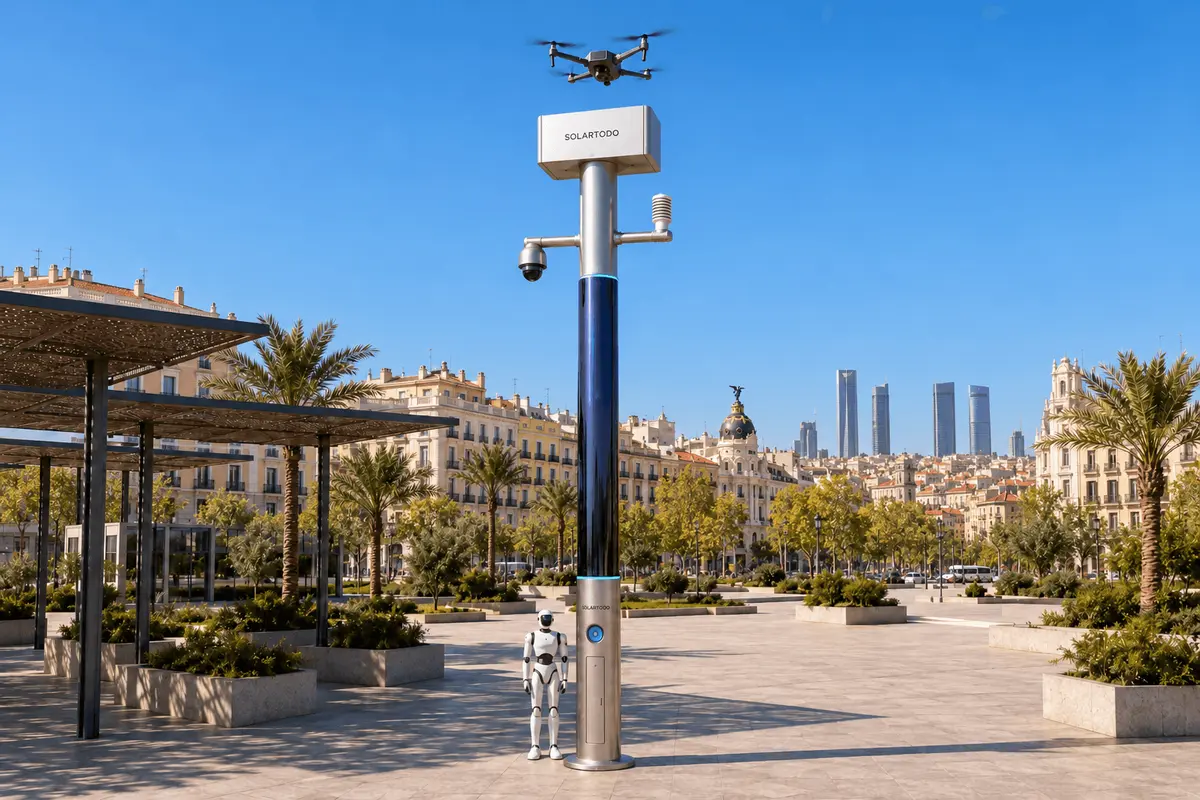
A City AI Pole is a non-lighting physical-AI edge node integrating local computing, sensing, battery storage, solar replenishment and coordinated drone and ground-robot operations. SOLARTODO Sentinel’s Sky Hub form runs OTATODO at the edge. This proposed Madrid dry-port campus deployment uses local inference and energy-aware scheduling to increase perimeter patrol frequency during post-disaster heatwave recovery.
1. Procurement brief: restore environmental patrol cadence
The procurement task is to restore repeatable environmental perimeter checks at a Madrid-region dry-port logistics campus during a heatwave, after a hypothetical damaging incident has disrupted normal inspection routes. The buyer is the campus eco-environment team, working with facilities, security and recovery coordinators. Its immediate problem is slow manual patrol: staff must negotiate temporary access restrictions, inspect separated boundary segments and return to record observations before the next round begins.
Madrid’s port archetype is inland. The Madrid-Coslada dry port connects the region’s freight movements with maritime gateways, providing a relevant setting for this campus-perimeter scenario. This geographical context is documented by the Port of Barcelona’s inland-terminal description. The proposed campus is illustrative; this article does not identify that terminal as a customer or claim an installation there.
For procurement planning, assume a localized fire has damaged a perimeter section and interrupted access to inspection points. The following heatwave makes repeated walking rounds harder to sustain. Dust, noise, disturbed fencing and changing access conditions require regular observation while recovery work continues. These are scenario assumptions, not reported Madrid incidents or measured local conditions.
The proposed response is post-disaster infill using SOLARTODO Sentinel Sky Hub nodes at surveyed recovery locations. Sky Hub is the flagship pole-form deployment of Sentinel, a mature, in-service physical-AI product. The Madrid configuration remains a proposal, subject to final engineering confirmation. The purchase decision should turn on whether on-pole computing can sustain a defined patrol cadence under actual recovery constraints.
2. Technical selection: buy the edge scheduler, not isolated sensors
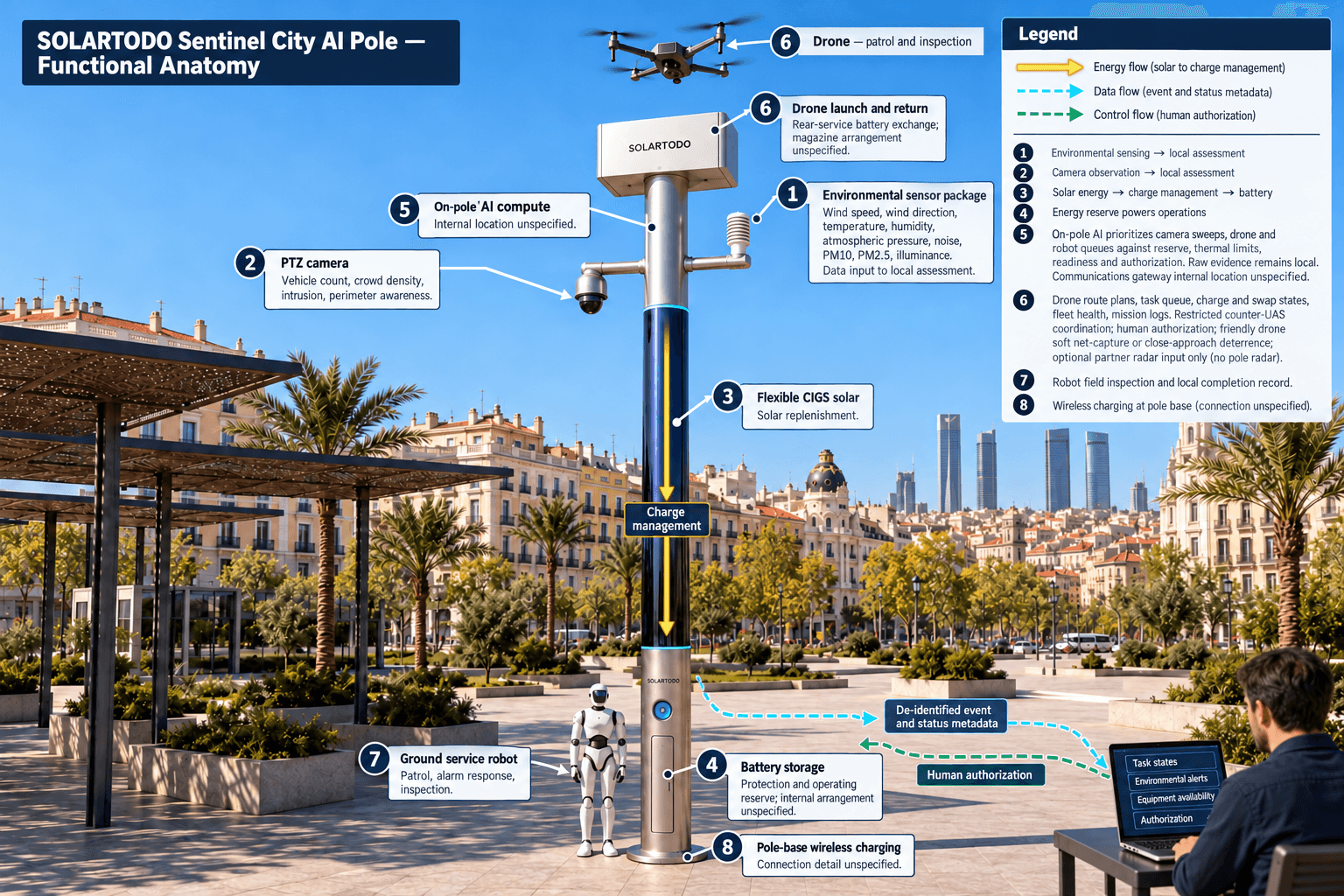
The central procurement requirement is edge computing. OTATODO processes observations on the pole, prioritizes inspection tasks and schedules workloads against available energy, equipment readiness and human authorization. This connects environmental sensing to field action without requiring staff to review every observation before a routine task can enter the queue. Exceptional or restricted responses retain their authorization gates.
Sky Hub integrates nine capability domains: a pure non-lighting smart pole, drone operations, automated drone battery hot-swap, drone operations management, ground robot operations, security sensing, nine-variable environmental monitoring, edge AI compute and counter-UAS coordination. For this buyer, their value lies in supporting a shared perimeter inspection schedule. The pole includes no lighting system.
The environmental package measures wind speed, wind direction, temperature, humidity, atmospheric pressure, noise, PM10, PM2.5 and illuminance. Local processing can associate observations with inspection zones and flag conditions for review. A PTZ camera supports anonymous vehicle count, crowd density, intrusion and perimeter awareness. Environmental readings provide operational context; they should not be represented as regulatory-grade measurements without separate instrument verification.
The on-pole inference module also manages competing workloads. A scheduled camera sweep, a robot inspection request and a drone departure should not each assume unrestricted compute and energy availability. Procurement should require documented priority rules, queue visibility and reasons for deferred tasks. During a heatwave, thermal limits must influence scheduling alongside battery reserve.
Raw video and sensor data stay on the pole and are processed locally. Only de-identified event and status metadata may leave it. The common operating picture therefore receives task states, environmental alerts and equipment availability rather than raw feeds. This local-processing design is PDPL/LGPD-oriented; it is not a claim of certification or established compliance in Spain.
3. Operating design: turn observations into repeatable patrols
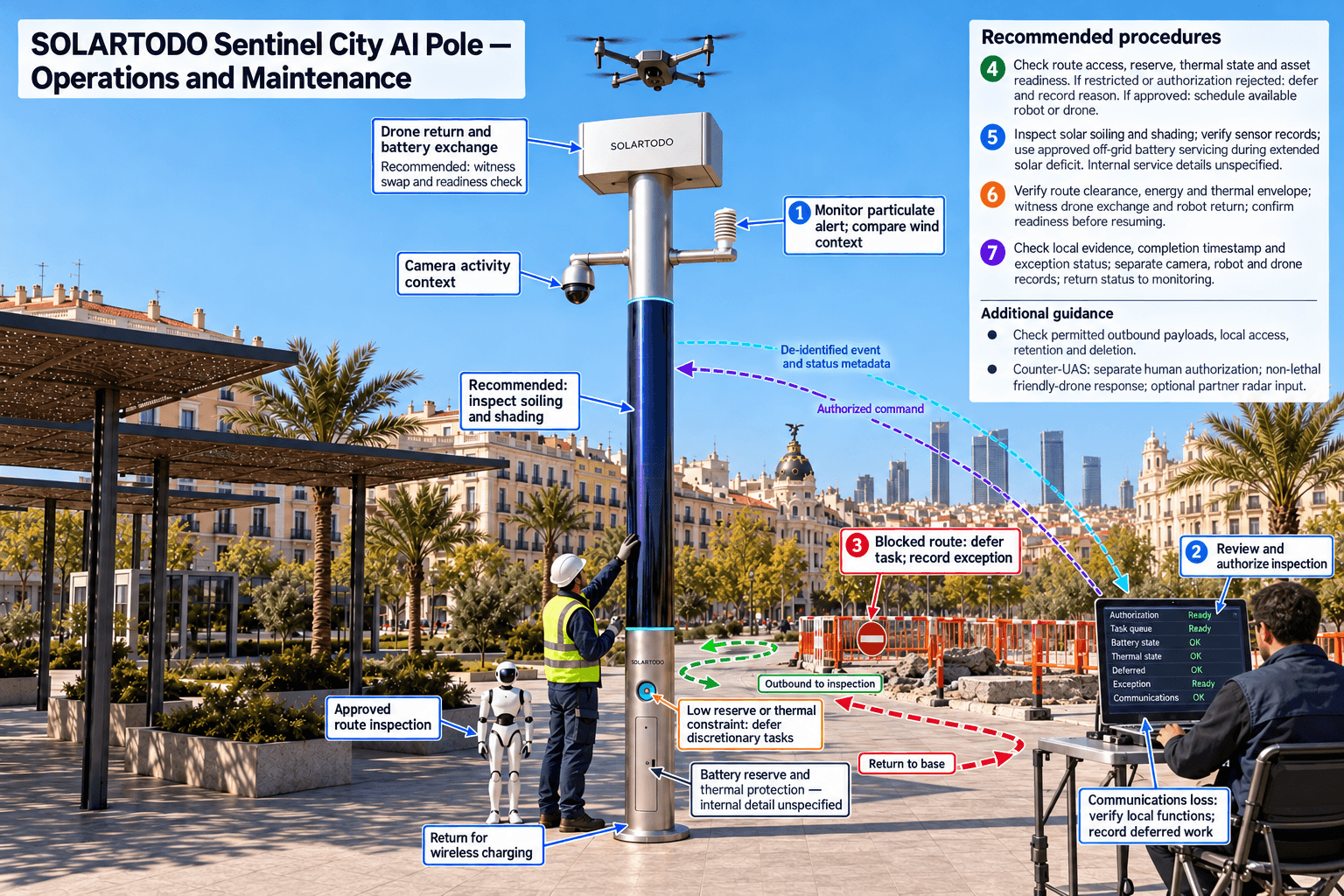
The operating loop is sensing → authorized assessment and response → edge-compute scheduling → field operations and maintenance. A single common-operating-picture command view connects those stages. The eco-environment lead sees which perimeter segments require inspection, which tasks are authorized, which assets are available and which checks remain overdue. Human-in-the-loop control is visible in the same task history.
For example, a particulate alert near a recovery boundary can prompt an on-pole assessment using wind direction, recent readings and camera-derived activity context. The system records an environmental anomaly without asserting an unverified cause. An authorized reviewer selects an inspection response, and the edge scheduler assigns an available ground robot or drone according to route access, energy reserve and operating permissions.
The ground service robot performs autonomous patrol, alarm response and inspection, coordinates with the aerial workflow and returns to the pole base for wireless charging. Its route should be confined to surveyed surfaces and approved recovery corridors. Damaged ground, blocked passages and worker movements are reasons to defer or redirect a task, with the exception recorded against the affected segment.
The drone workflow supports launch, regional patrol, inspection, return and task redeployment without an operator stationed on site. A multi-bay battery magazine performs an automated rear-service exchange after landing, supplying a charged pack for relaunch. Multiple bays support consecutive sorties, while the operations manager tracks route plans, charge and swap states, task queues, fleet health and mission logs. Remote oversight and operational authorization remain part of the deployment design.
Counter-UAS coordination is a separate, restricted response path. The node detects and tracks an unauthorized drone and, only with human authorization, commands its own friendly drone for soft aerial net-capture or close-approach deterrence. This is non-lethal coordination. Radar is not pole hardware; any radar contribution would be an optional partner-sensor input. Environmental patrol procurement must not imply automatic permission to execute this response.
4. Engineering gate: maintain cadence within an off-grid budget
Sky Hub is fully off-grid, using on-pole solar replenishment and battery storage, with no grid, city or site power. That independence suits recovery infill, but the procurement specification must still establish a sustainable energy budget. Storage buffers demand; it does not create energy, and repeated high-power tasks require a replenishment and reserve strategy.
The proposed cylindrical body is approximately 8 metres tall and 0.6 metres wide, carrying approximately 15 square metres of 360°-wrapped flexible CIGS thin-film solar, with approximately 2.4–2.7 kWp nameplate capacity. The whole wrap does not receive direct sunlight simultaneously. A vertical cylinder collects direct sun through its sun-facing projection, so nameplate capacity must not be treated as field output.
For a high-irradiance reference such as Saudi Arabia, realistic clear-sky output is roughly 0.8–1.1 kW DC peak and about 6–9 kWh per day, with peaks around mid-morning or afternoon rather than noon. Those figures are contextual engineering references supplied for this configuration, not a Madrid yield forecast. Madrid procurement requires a site-specific assessment of season, orientation, obstruction, temperature, soiling and recovery-site shading.
A 5–20 kWh-class battery configuration should be selected against measured base consumption, usable capacity, operating reserves and proposed drone and robot duty cycles. The scheduler must reduce or defer discretionary activity before essential monitoring exhausts the reserve. Heatwave engineering should also address enclosure temperature, battery protection, compute derating and access for maintenance.
Before ordering, require the supplier to document how stored energy is restored during an extended solar deficit without introducing a grid connection. The resulting operating envelope may limit sortie frequency or require an approved off-grid battery servicing arrangement. Acceptance should demonstrate the agreed patrol schedule within that envelope, rather than assume unlimited solar self-sufficiency.
5. Evaluation and award: measure completed checks per segment
The primary KPI is patrol frequency: completed, valid perimeter checks per defined segment per operating window. A valid check needs an approved route or observation point, sufficient evidence retained locally, a completion timestamp and an exception status. Camera sweeps, robot rounds and drone sorties should retain separate counts so that several observations of one easy segment cannot conceal an uninspected boundary.
Establish the manual baseline through observation before evaluating the proposed configuration. Record scheduled checks, completed checks, missed windows and reasons for delay. During evaluation, compare equivalent segments and operating windows, accounting for recovery access and heat restrictions. Report both planned frequency and delivered frequency; a queued task is not a completed patrol.
For an illustrative planning example, a 12-hour window with checks every 3 hours produces 4 rounds, while checks every 2 hours produce 6 rounds. That represents a target increase of 50%, subject to route feasibility and energy availability. These figures are hypothetical procurement inputs, not achieved Sentinel performance or measured Madrid statistics. Buyers should replace them with their own baseline and approved service requirement.
Evaluation should include obstructed routes, low battery reserve, thermal constraints, communications loss and a rejected authorization request. Inspect whether the node preserves the agreed local functions, records deferred work and avoids presenting unavailable assets as ready. Verify separately that raw video and sensor data remain on the pole and that outbound messages contain only permitted de-identified event or status metadata.
Award should depend on evidence: approved siting, a documented energy balance, witnessed battery-exchange and robot-return sequences, traceable authorization records and patrol-frequency logs covering the agreed conditions. The eco-environment team should also confirm sensor verification and maintenance responsibilities. This makes the procurement case specific: a proposed Madrid dry-port recovery deployment earns acceptance by demonstrating repeatable perimeter observation, supported by local computing and a bounded off-grid operating plan.
System Configuration
| Parameter | Configuration |
|---|---|
| Pole form and solar | Pure non-lighting cylindrical pole; approximately 8 m tall × 0.6 m wide; approximately 15 m² wrapped flexible CIGS, 2.4–2.7 kWp nameplate |
| Off-grid energy | 5–20 kWh-class battery storage, solar charge management and reserve-aware scheduling; final capacity subject to engineering confirmation |
| Edge compute and data | On-pole AI inference module running OTATODO; local raw-data storage; outbound de-identified event and status metadata only |
| Security and environment | PTZ camera plus wind speed, wind direction, temperature, humidity, atmospheric pressure, noise, PM10, PM2.5 and illuminance sensing |
| Drone operations | Launch and return interface, multi-bay rear-service battery exchange, route planning, task queue and mission logs |
| Ground operations | Service robot with surveyed perimeter routes, air-ground task coordination and pole-base wireless charging |
| Command and authorization | Common-operating-picture interface with human authorization records and restricted non-lethal counter-UAS coordination |
How It Works
- On-pole sensing flags an environmental or perimeter anomaly.
- Local AI assesses context and retains raw evidence on the pole.
- A human reviewer authorizes the required field response in the COP.
- OTATODO schedules an available asset against energy, route and authorization constraints.
- The drone or robot inspects the assigned segment and returns for battery exchange or wireless charging.
- The node records completion locally and sends only de-identified event and status metadata.
Planning Assumptions (Indicative)
Illustrative planning inputs a buyer can recompute — target metrics, not achieved results. Subject to final engineering confirmation.
| Metric | Planning assumption | Indicative value |
|---|---|---|
| Baseline patrol frequency | ILLUSTRATIVE ONLY: a 12-hour operating window and 1 completed round every 3 hours; replace with observed baseline inputs. | 12 hours ÷ 3 hours per round = 4 rounds per operating window |
| Target patrol frequency | ILLUSTRATIVE ONLY: a 12-hour operating window and 1 target round every 2 hours; validate route, energy and authorization feasibility. | 12 ÷ 2 = 6 target rounds; (6 − 4) ÷ 4 × 100 = 50% target frequency increase |
| Segment-check workload | ILLUSTRATIVE ONLY: 4 defined perimeter segments, each checked during 6 target rounds per day. | 4 segments × 6 rounds = 24 target segment-checks per day |
| Event review workload | ILLUSTRATIVE ONLY: 8 reviewable event summaries per day at 3 minutes of human review each. | 8 summaries × 3 minutes = 24 minutes of planned review per day |
| Evaluation sample | ILLUSTRATIVE ONLY: 10 evaluation days with 6 target rounds per day, excluding separately documented invalid windows. | 10 days × 6 rounds = 60 scheduled rounds for evaluation |
Deployed Equipment
- Sky Hub non-lighting pole with wrapped flexible CIGS solar
- Battery storage cabinet with charge management and protection
- On-pole AI compute module and local storage
- PTZ camera
- Nine-variable environmental sensor package
- Drone launch and return assembly with multi-bay battery magazine
- Ground service robot and pole-base wireless charger
- Communications gateway for permitted metadata and command traffic
Frequently Asked Questions
Is this a documented Madrid customer deployment?
No. This is a proposed procurement configuration for an illustrative Madrid-region dry-port campus. The recovery incident, operating schedule and evaluation calculations are hypothetical. The regional dry-port context is real, but no named terminal is presented as a customer, and no local installation, quantity or achieved result is claimed.
Why prioritize edge computing when the problem is slow manual patrol?
More sensors alone do not establish a repeatable patrol schedule. On-pole computing connects observations with task priority, asset availability, battery reserve and authorization status. Buyers should evaluate whether that coordination increases completed checks per segment within agreed operating windows, while preserving a clear record of deferred and failed tasks.
Can the solar wrap power unrestricted drone and robot activity?
No. The wrapped CIGS layer replenishes a fully off-grid battery-backed station. Its nameplate rating does not equal continuous output, and the high-irradiance reference is not a Madrid forecast. Drone and robot workloads must fit a site-specific energy budget, usable storage capacity, reserve policy and sustainable duty cycle.
What information can leave the pole?
Only de-identified event and status metadata may leave the pole. Raw video and sensor data remain on the pole for local processing and retention. Procurement should verify outbound payloads, local access controls, retention settings and deletion procedures. PDPL/LGPD-oriented design describes an approach, not certification or established Spanish compliance.
Does autonomous drone operation remove human authorization?
No. Launch, inspection, return, battery exchange and redeployment can operate without an operator stationed on site, within approved operating arrangements. Human oversight remains part of the command workflow. Counter-UAS mitigation specifically requires human authorization and is limited to non-lethal soft aerial net-capture or close-approach deterrence using the node’s friendly drone.
What should the eco-environment buyer require before acceptance?
Require a surveyed configuration, sensor verification records, an energy and thermal operating envelope, witnessed drone and robot servicing sequences, and traceable task logs. Evaluate completed patrol frequency by perimeter segment, including missed windows and exceptions. Final acceptance should rely on witnessed evidence under agreed conditions, subject to final engineering confirmation.
Explore Further
- City AI Pole / smart streetlight product line
- More smart-city deployment cases
- Talk to our engineering team
Planning a similar physical-AI deployment for streets, campuses or public spaces? Request an engineering consultation