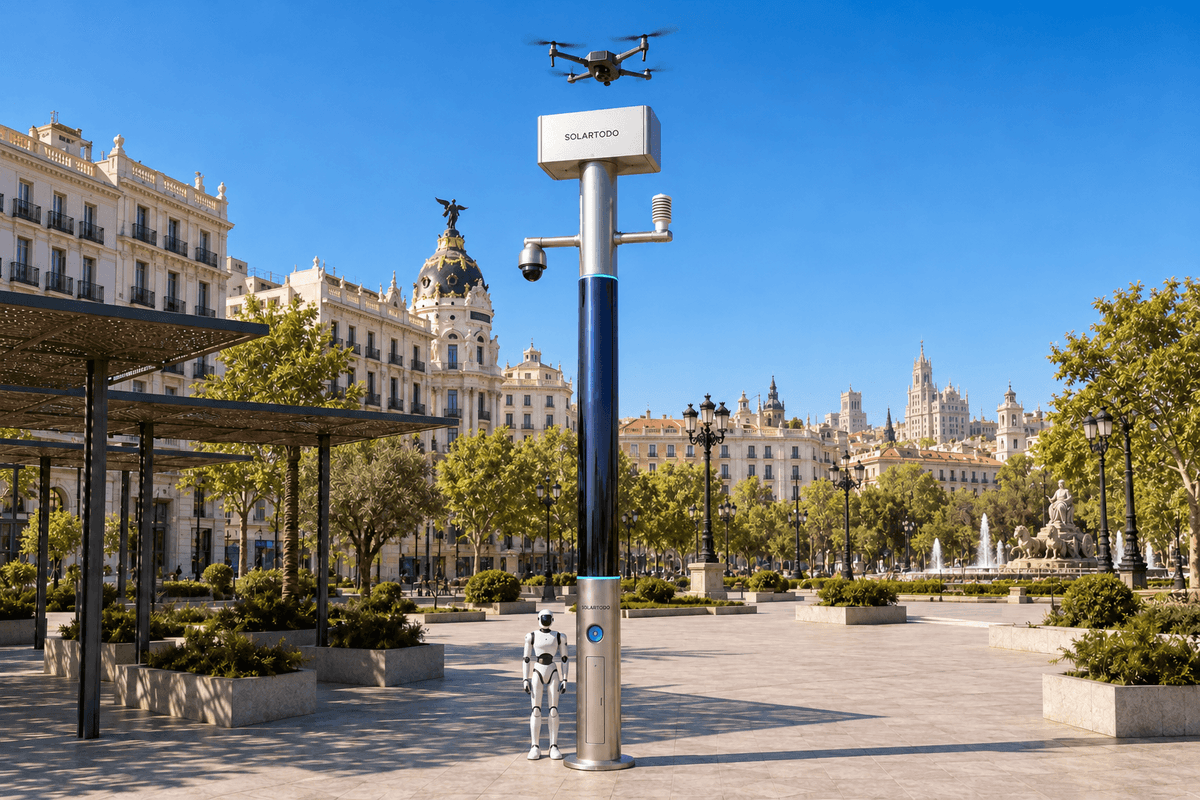
A City AI Pole is a non-lighting physical-AI urban edge node combining sensing, local computing, autonomous drone support and ground robot operations. SOLARTODO Sentinel’s Sky Hub form runs OTATODO on-pole using battery storage and solar replenishment, fully off-grid. This proposed Madrid configuration supports post-disaster security inspections, automated drone battery exchange and locally retained evidence under human authorization.
1. The Madrid task: rebuild inspection continuity before event activity returns
The city-management task begins with a hypothetical recovery problem: storm damage has interrupted access to a district perimeter and adjoining recreation routes before a seasonal sports event. Staff need repeatable observations of damaged barriers, restricted entrances and service approaches. Collecting disconnected photographs is insufficient; managers need a traceable sequence showing what changed, where an inspection stopped and which findings require a field visit.
Madrid provides a credible mountain-connected setting without treating its urban centre as alpine terrain. Official tourism material places the Sierra de Guadarrama northwest of the city and describes mountain recreation across the region. This proposal applies that mountain archetype to uneven urban-edge approaches and their inspection constraints; it does not imply installation inside a protected mountain area. Madrid regional tourism
The proposed deployment is post-disaster infill: place a SOLARTODO Sentinel Sky Hub at a structurally assessed position serving an affected security perimeter. Its purpose is low-altitude inspection and evidence collection during recovery and event preparation. No Madrid customer, disaster, event contract or installation quantity is asserted here. The configuration applies mature, in-service product capabilities to an illustrative local assignment, subject to final engineering confirmation.
The buyer’s primary evaluation metric is evidence-qualified patrol frequency: completed inspection circuits with reviewable local records per operating window. Counting launches alone would reward activity even when weather, missing observations or unresolved alarms make the inspection unusable.
2. The investment mechanism: battery exchange sustains repeat inspections
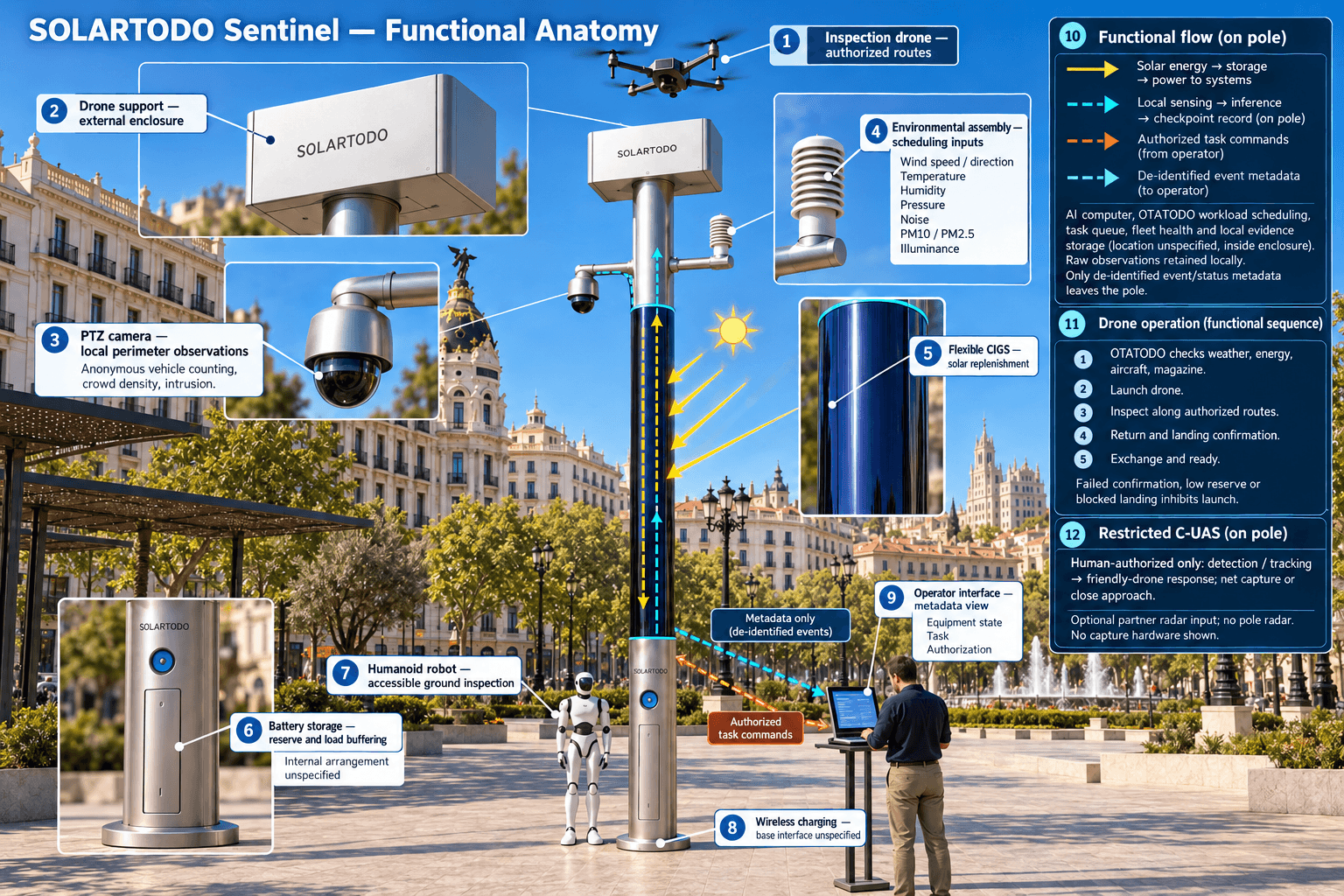
For this assignment, the battery-swap module links equipment investment to patrol frequency. A drone launches on an authorized route, inspects designated perimeter features, returns and lands. A multi-bay battery magazine performs an automated rear-service exchange, replacing the depleted pack with a charged pack before task redeployment. Several bays support consecutive sorties, bounded by available charged inventory, replenishment capacity, weather and maintenance requirements.
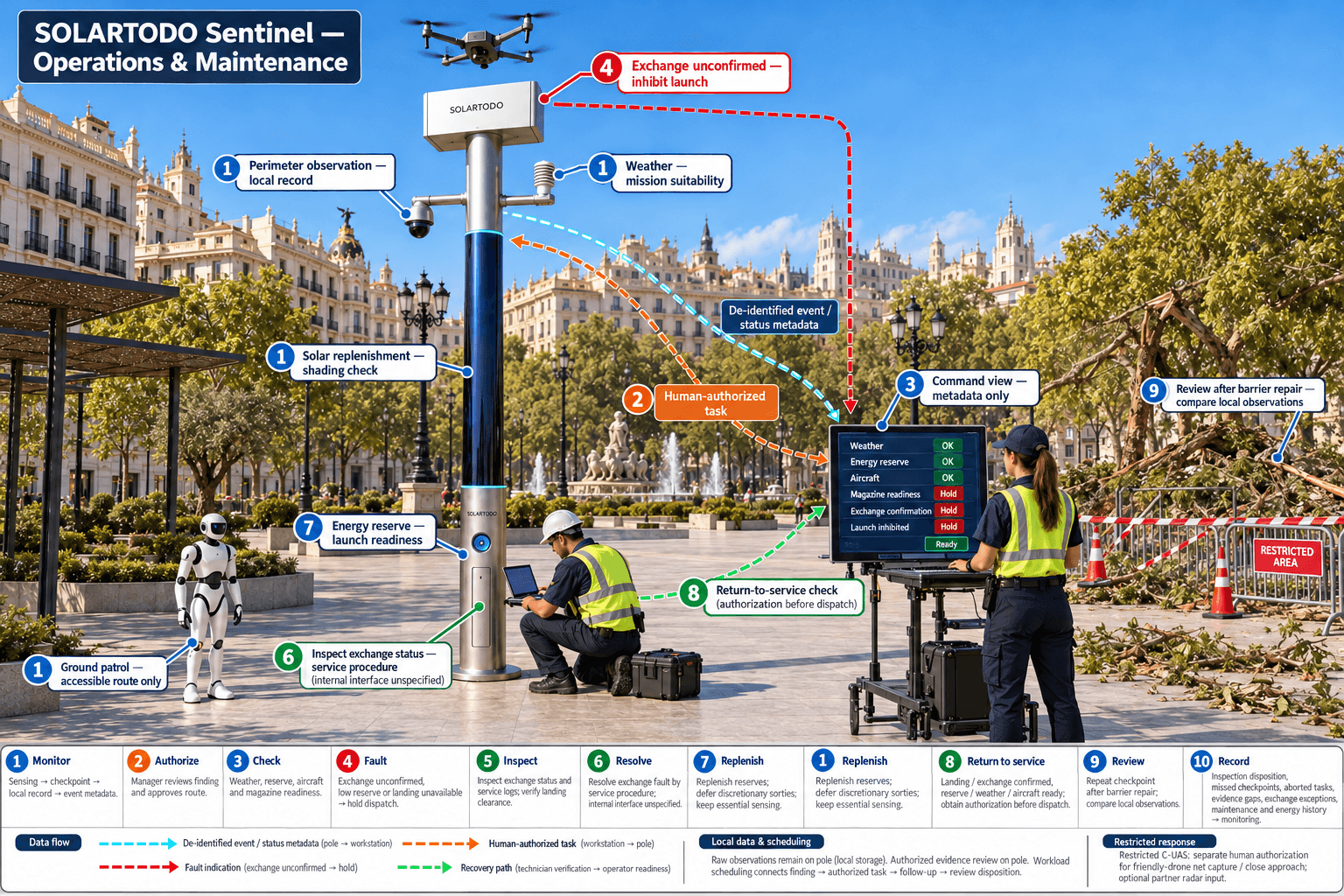
The operational advantage is continuity between inspections without an operator stationed beside the pole. It does not establish a guaranteed turnaround time or unlimited endurance. Route planning, the charge/swap state machine, task queueing, fleet health and mission logs coordinate each return with the next assignment. Failed exchange confirmation, insufficient reserve or an unavailable landing area prevents another launch and generates a service requirement.
For Madrid city managers, repeat routes create comparable observations of a damaged gate, temporary boundary or access corridor. A follow-up inspection can revisit the same task reference after a repair team reports completion. Local records then connect the original finding, authorized assignment and subsequent observation, supporting a defensible decision about whether further inspection is needed.
The return should therefore be evaluated as additional usable inspections relative to the operational burden. Maintenance visits, battery handling, remote supervision and evidence review remain part of that burden. Automated exchange can remove a recurring interruption at the pole, while city staff retain responsibility for deciding whether the resulting observations justify action.
3. A single command view connects sensing, authorization and field work
Sky Hub is a pure smart pole with no lighting system. Its integrated capabilities support one operating loop: sensing, authorized assessment and response, edge-compute scheduling, then field operations and maintenance. A common-operating-picture command view connects those stages through task identifiers, equipment state and de-identified event metadata. Raw video and sensor data stay on the pole and are processed locally; the command view does not export raw imagery.
A PTZ camera supports anonymous vehicle counting, crowd-density estimation, intrusion detection and perimeter awareness. Environmental monitoring adds wind speed, wind direction, temperature, humidity, atmospheric pressure, noise, PM10, PM2.5 and illuminance. These observations provide inspection context and scheduling inputs. They do not replace flight limits or an authorized person’s assessment of whether conditions permit a mission.
On-pole edge AI runs local inference and schedules workloads through OTATODO. Drone management coordinates launch, regional patrol, inspection, return and redeployment. A service or humanoid robot supports accessible ground patrol, alarm response and closer inspection, then returns to the pole base for wireless charging. Air-ground coordination lets managers assign complementary observations without sending a robot onto unsafe debris or assuming every damaged route is traversable.
Counter-UAS coordination remains a separate, restricted response path. The node detects and tracks an unauthorized drone and can command its own friendly drone for soft aerial net-capture or close-approach deterrence only following human authorization. Radar is not pole hardware; any radar contribution would be an optional partner-sensor input. Routine inspection scheduling never supplies authorization for mitigation.
4. The off-grid energy budget sets the patrol ceiling
The proposed node operates fully off-grid through on-pole solar replenishment and battery storage, with no grid, city or site power. Approximately 15 m² of flexible CIGS thin-film wraps a cylindrical body roughly 8 m tall and 0.6 m wide, providing approximately 2.4–2.7 kWp nameplate capacity. That nameplate figure must not be treated as continuous field output or a drone-charging allowance.
A vertical cylinder receives direct sunlight on its sun-facing projection, rather than across its entire wrapped surface simultaneously. The supplied high-irradiance reference, such as Saudi Arabia, is roughly 0.8–1.1 kW DC clear-sky peak and approximately 6–9 kWh per day, with peaks around mid-morning or afternoon rather than noon. Those figures are reference conditions, not a Madrid yield forecast. Local shading, season, temperature and installation geometry require an engineering assessment.
Storage in the 5–20 kWh class buffers computing, sensing, battery exchange, drone battery replenishment and robot charging. Final usable capacity must account for reserve policy, conversion losses and battery condition. Stored energy is finite: sustained demand must remain compatible with replenishment over the operating period. More magazine bays increase immediate sortie availability but do not create additional energy.
For the sports-event window, managers should prioritize inspection circuits and preserve reserves for safe recovery and essential sensing. The scheduler reduces discretionary missions when energy availability falls. Acceptance should test a sustainable patrol cadence across representative weather and shading conditions, including recovery after a busy operating window, rather than reporting a favourable afternoon’s launch count.
5. ROI analysis: measure evidence-qualified patrol frequency
The proposed business case uses operational return before financial valuation. Define a qualified patrol as an authorized circuit that covers its required checkpoints, creates a complete local inspection record and reaches a documented review disposition. Record missed checkpoints, aborted flights and unavailable evidence separately. This keeps patrol frequency meaningful when comparing an existing inspection process with the proposed battery-swap workflow.
The illustrative assumptions below use round planning inputs, not achieved results or verified Madrid statistics. Under those inputs, an eight-hour window with a two-hour inspection interval produces four planned circuits; a one-hour target interval produces eight. The difference is a target scheduling opportunity. Weather, energy limits, permissions, maintenance and evidence quality determine how many circuits actually qualify. No detection accuracy, coverage area or response latency is inferred.
Review workload belongs in the same calculation. More observations may create more review effort, especially where storm damage produces repeated alarms. City managers should track qualified circuits per operating window alongside review minutes per qualified circuit, exchange exceptions, service visits and reserve compliance. Comparable routes and checkpoint definitions help distinguish improved inspection continuity from merely changing the scope of each patrol.
A procurement decision should follow an agreed evaluation with local record inspection, battery-exchange logs, energy histories and maintenance entries. Retention rules, access permissions and evidentiary procedures need explicit ownership. Local processing is PDPL/LGPD-oriented design positioning, not a claim of certification or established Spanish compliance. The Madrid configuration remains proposed; its value depends on verified patrol continuity and usable evidence, subject to final engineering confirmation.
System Configuration
| Parameter | Configuration |
|---|---|
| Deployment form | Pure non-lighting Sky Hub pole; approximately 8 m cylindrical body, approximately 0.6 m wide; foundation and access subject to engineering confirmation |
| Off-grid energy | Approximately 15 m² wrapped flexible CIGS, approximately 2.4–2.7 kWp nameplate; 5–20 kWh-class battery storage; no external power connection |
| Drone battery exchange | Multi-bay charged-pack magazine, automated rear-service exchange, landing confirmation and charge/swap interlocks |
| Edge computing and records | On-pole AI inference, OTATODO workload scheduling and local evidence storage; only de-identified event/status metadata may leave |
| Security and environmental sensing | PTZ camera plus wind speed, wind direction, temperature, humidity, atmospheric pressure, noise, PM10, PM2.5 and illuminance sensors |
| Ground operations | Service or humanoid robot, accessible patrol routes and pole-base wireless charging |
| Command coordination | Common operating picture, human authorization, mission logs and restricted friendly-drone C-UAS coordination; no integrated radar |
How It Works
- On-pole sensing flags a perimeter anomaly and retains raw observations locally.
- Edge AI links the finding to an inspection checkpoint and creates de-identified event metadata.
- An authorized manager reviews the event and approves a suitable inspection task.
- OTATODO checks weather, energy, aircraft and battery-magazine readiness before dispatch.
- The drone inspects, returns and completes an automated rear-service battery exchange when another sortie is scheduled.
- The pole retains evidence locally and records the review disposition, follow-up task and maintenance exceptions.
Planning Assumptions (Indicative)
Illustrative planning inputs a buyer can recompute — target metrics, not achieved results. Subject to final engineering confirmation.
| Metric | Planning assumption | Indicative value |
|---|---|---|
| Baseline planned patrol frequency | ILLUSTRATIVE ONLY: an 8-hour operating window with 1 circuit every 2 hours. | 8 hours ÷ 2 hours/circuit = 4 planned circuits per window |
| Target planned patrol frequency | ILLUSTRATIVE ONLY: the same 8-hour window with a target of 1 circuit every 1 hour. | 8 hours ÷ 1 hour/circuit = 8 planned circuits; 8 − 4 = 4 additional target circuits |
| Evidence review workload | ILLUSTRATIVE ONLY: 8 qualified circuits per day, 5 review minutes per circuit and 10 evaluation days. | 8 × 5 × 10 = 400 minutes of planned review effort |
| Scheduled drone energy demand | ILLUSTRATIVE ONLY: 8 sorties consuming 0.3 kWh each; substitute measured mission consumption. | 8 × 0.3 kWh = 2.4 kWh of mission energy, excluding replenishment losses and other node loads |
| Storage operating allowance | ILLUSTRATIVE ONLY: 10 kWh nominal storage with a 30% reserve allocation, before conversion losses. | 10 kWh × (1 − 0.30) = 7 kWh remaining before losses and load allocation |
Deployed Equipment
- Non-lighting Sky Hub pole body and engineered foundation
- Wrapped flexible CIGS replenishment layer and battery-storage enclosure
- Inspection drone and multi-bay automated rear-service battery magazine
- PTZ security camera and nine-parameter environmental sensor assembly
- On-pole AI computer, OTATODO runtime and local evidence storage
- Service or humanoid robot with pole-base wireless charging
- Communications equipment for de-identified metadata and authorized task commands
Frequently Asked Questions
Is this an existing Madrid deployment?
This article describes a proposed Madrid configuration using SOLARTODO Sentinel’s mature, in-service capabilities. It does not assert a local installation, customer contract or achieved result. Deployment positions, task boundaries, energy sizing and evaluation criteria require confirmation for the selected recovery zone.
Does automated battery exchange guarantee hourly patrols?
No. Hourly patrols are an illustrative scheduling target. Automated exchange supports consecutive sorties when charged packs are available, but actual frequency depends on route duration, weather, energy reserves, maintenance and authorization. Evaluate completed circuits with usable local evidence rather than counting launches alone.
Can the command centre receive raw inspection footage?
Raw video and sensor data stay on the pole and are processed locally. Only de-identified event and status metadata may leave. Buyers should define authorized on-pole evidence review, access controls, retention and audit procedures before deployment, including how local records support incident investigation.
How should city managers assess the sports-event security benefit?
Compare evidence-qualified patrol frequency over equivalent routes and operating windows, then include review effort, maintenance visits and energy restrictions. Sports-event preparation creates a deadline for inspection continuity, but it does not justify assuming unrestricted flights or automated mitigation. Human authorization remains part of the operating process.
Explore Further
- City AI Pole / smart streetlight product line
- More smart-city deployment cases
- Talk to our engineering team
Planning a similar physical-AI deployment for streets, campuses or public spaces? Request an engineering consultation