Madrid’s 667m Inland Corridors: Smart Traffic System Fit for 8-Intersection 8m L-Arm Upgrades
Summary
Madrid’s 667 m elevation, 3.3M city population and dense radial corridors make integrated traffic sensing more valuable than camera-only retrofits. A typical 8-intersection SOLARTODO Smart Traffic System would use 8m L-arm poles, 77GHz radar and 5G/fiber backhaul.
Key Takeaways
Madrid’s 8-intersection smart-traffic fit is strongest where 8m poles, sub-50 ms edge response and BOT procurement reduce civil-work and budget friction.
- A typical deployment would cover approximately 8 intersections using 8m L-arm hot-dip galvanized steel poles in dark grey.
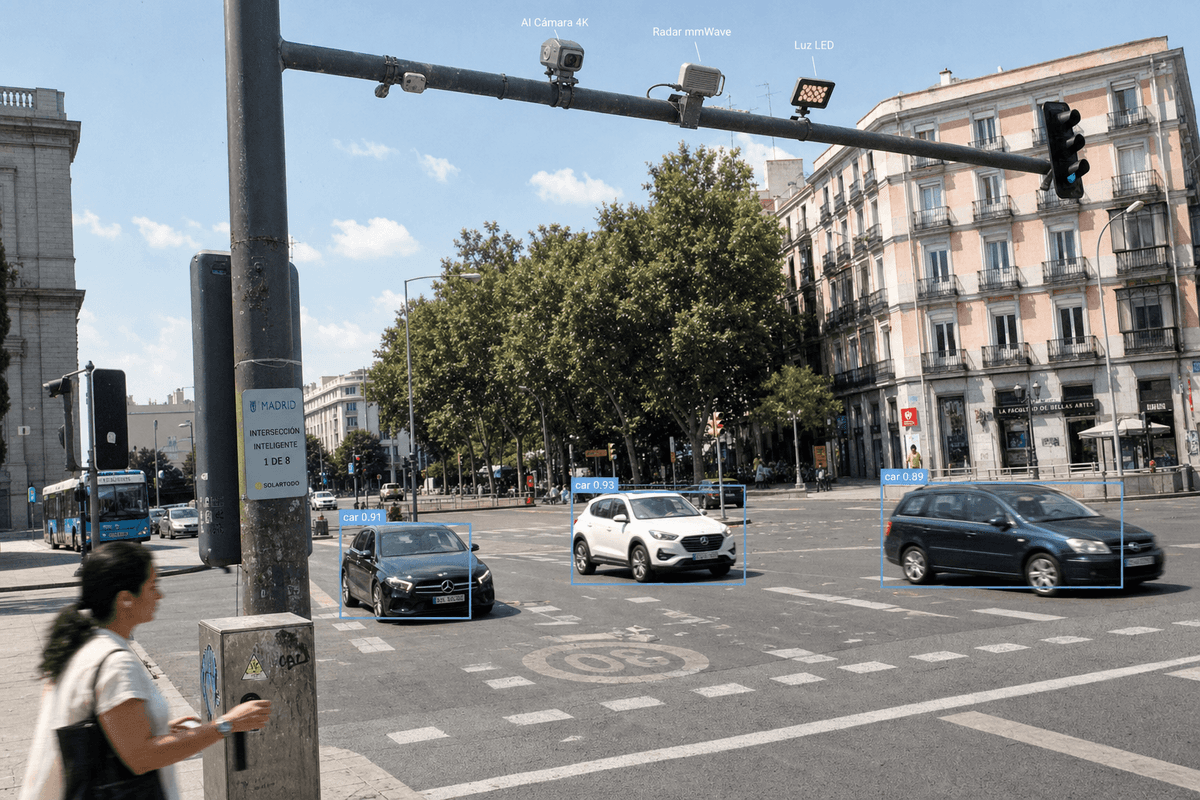
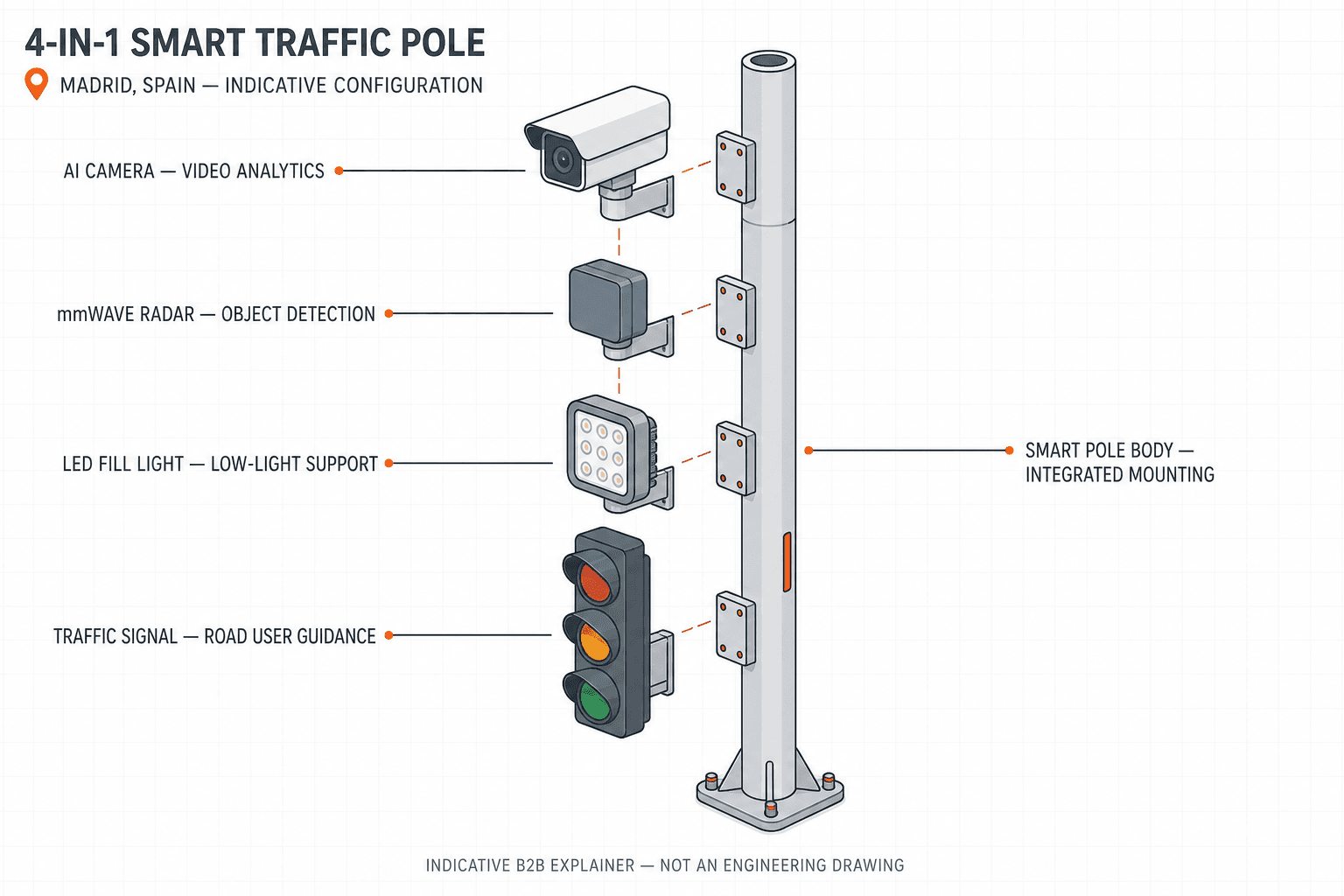
- Each pole integrates 4 modules: 4K AI camera, 77GHz mmWave radar, LED fill light and LED signal head.
- Edge AI runs on NVIDIA Jetson, targeting 98% detection accuracy, 45+ detection types and less than 50 ms response.
- Spain’s public low-voltage context is commonly 230/400 V at 50 Hz, with REBT compliance required for installations.
- Madrid’s inland plateau setting, around 667 m elevation, points to dust, UV, heat and freeze-thaw protection rather than coastal salt-air design.
- According to Eurostat (2024), Spain recorded about 36 road deaths per million inhabitants in 2023, below the EU average of about 46.
- A typical intersection may require 4-12 poles depending on approaches, turning lanes, crossings and sight-line constraints.
- BOT zero-upfront delivery can suit an 8-intersection pilot before scaling to wider municipal corridors.
Market Context for Madrid
Madrid’s traffic-signal modernization demand is shaped by a 3.3M-person capital city, a wider 6.8M regional economy and constrained central streets. The city is inland, not coastal, so the dominant environmental issues are heat, UV exposure, dust, stormwater runoff and winter freeze-thaw around foundations and cabinets.
Madrid sits near latitude 40.42 and longitude -3.7 on Spain’s central plateau at roughly 667 m elevation. According to AEMET (2024), Madrid’s climate profile includes hot, dry summers and seasonal rainfall rather than persistent maritime humidity. For smart traffic equipment, that favors sealed optics, surge protection, cabinet ventilation and planned cleaning of 4K camera lenses.
The road network is not uniform. Wide radial corridors such as Castellana, M-30 links and airport-facing arterials have different pole-spacing logic from narrow Centro streets with heritage constraints, underground utilities and limited crane access. According to the European Commission (2024), major TEN-T urban nodes must improve safe, connected and multimodal mobility; Madrid’s role as a Spanish capital node makes corridor-level traffic coordination relevant beyond isolated junction upgrades.
Spain’s electrical context is also important. Public low-voltage installations commonly use 230/400 V at 50 Hz, while Spain’s REBT framework governs low-voltage electrical installations. That means a Madrid Smart Traffic System should include documented earthing, cabinet isolation, surge protection, commissioning tests and maintenance responsibilities, not just pole supply.
The procurement context is usually municipal or concession-driven. Ayuntamiento de Madrid, regional transport authorities and public tender frameworks tend to favor measurable uptime, open interfaces, data governance and lifecycle support. For this reason, SOLARTODO’s BOT option is commercially relevant: it can let a buyer evaluate an 8-intersection corridor with zero upfront equipment payment, subject to contract terms.
According to Eurostat (2024), Spain’s road fatality rate was about 36 deaths per million inhabitants in 2023, compared with an EU average near 46. That does not imply a Madrid-specific project result, but it supports investment in pedestrian detection, adaptive signal timing and incident auto-alert functions at busy urban intersections.
Recommended Technical Configuration
A Madrid pilot corridor of 8 signalized intersections should use 8m L-arm smart traffic poles because they fit urban geometry without gantry-scale foundations. The recommended configuration is approximately 8 intersections × 8m L-arm steel pole, with 4-12 poles per intersection where full approach coverage is required.
For the specified Madrid profile, each SOLARTODO 4-in-1 Smart Traffic System pole would use hot-dip galvanized steel, a dark grey finish and an L-arm form suitable for signal visibility. The integrated modules are always-on: 4K AI camera, 77GHz mmWave radar, LED fill light and LED signal head. This avoids a fragmented retrofit where cameras, radar units and signal hardware sit on separate masts.
The edge AI layer should run on NVIDIA Jetson at the pole or cabinet edge. That supports pedestrian detection, adaptive signal optimization and incident auto-alert without waiting for every event to travel to a central server. The target performance is 98% AI accuracy, 45+ detection types and less than 50 ms local response.
Madrid’s dense old-town streets make the 8m class more practical than a larger pole for most signalized urban intersections. The 10-12m variant should be reserved for highway approaches, gantries or very large arterials with longer signal visibility distances. For district streets and mixed-use corridors, 8m offers a better balance of camera angle, signal mounting height, foundation size and streetscape acceptance.
Technical Specifications
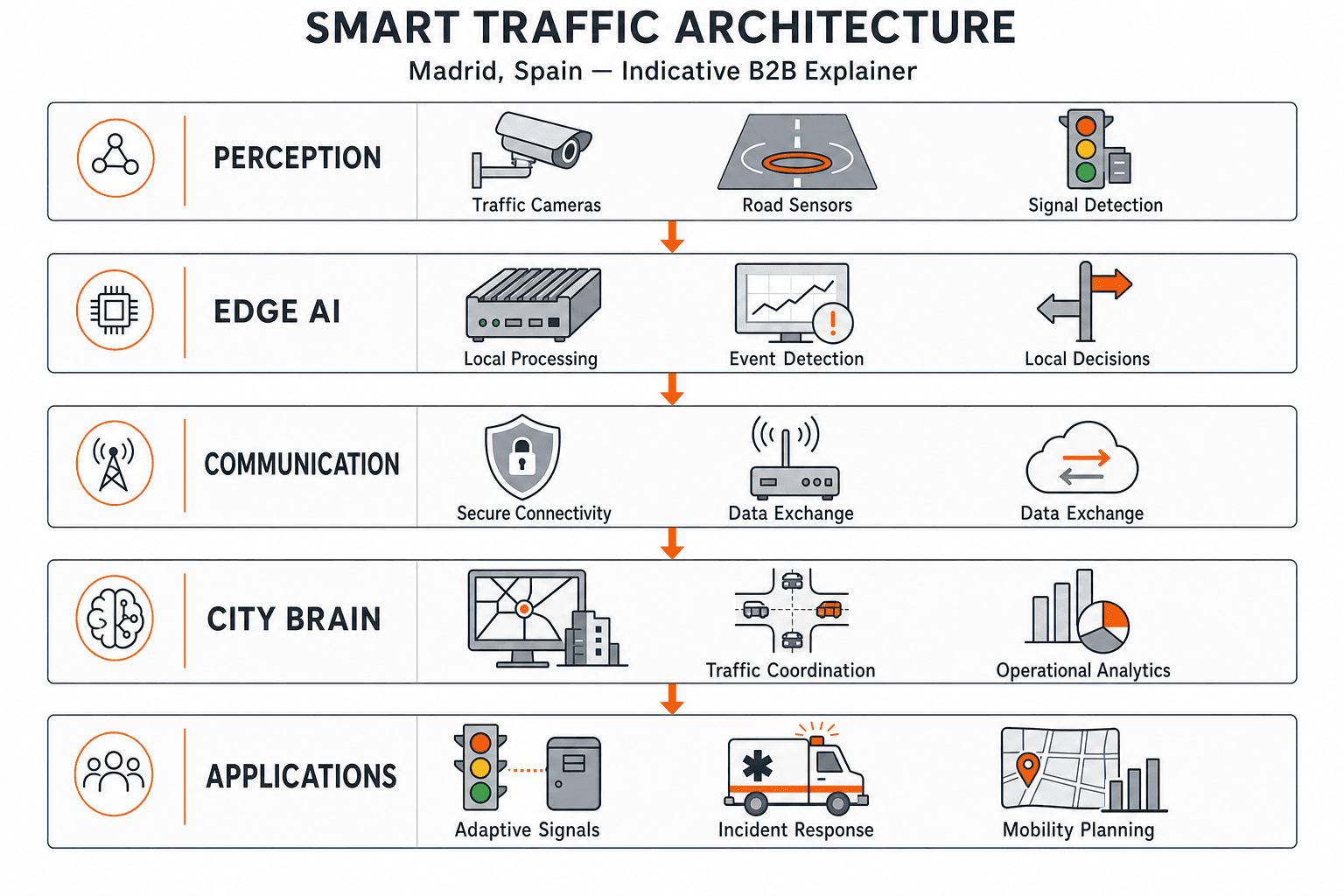
The 8-intersection Madrid baseline combines 8m L-arm poles, 4K AI vision, 77GHz radar and TrafficGPT backhaul into one integrated roadside system. SOLARTODO should configure the system around these fixed technical requirements:
- Pole form: 8m L-arm hot-dip galvanized steel pole, dark grey finish.
- Deployment scale: approximately 8 intersections, with 4-12 poles per intersection depending on geometry.
- Integrated modules: 4K AI camera, 77GHz mmWave radar, LED fill light and LED signal head.
- Edge compute: NVIDIA Jetson for local perception, filtering and low-latency event processing.
- AI performance: 98% accuracy target, 45+ detection types and less than 50 ms response.
- Features: pedestrian detection, adaptive signal optimization and incident auto-alert.
- Backhaul: 5G/fiber connection to TrafficGPT central platform with natural-language queries.
- Stack: Perception → Edge AI → Communications → City Brain (TrafficGPT) → Applications.
- Cooperation model: BOT, zero upfront, with performance KPIs defined in the contract.
- Standards: NTCIP for traffic-control interoperability and GB 25280 for traffic signal equipment reference.
According to IEC (2018), IEC 60529 defines enclosure ingress-protection classifications for dust and water resistance. In Madrid, that matters because roadside electronics must handle dust, high summer solar exposure and episodic rain without degrading sensor reliability.
ITU states, “IMT-2020 systems are mobile systems that include new radio interface(s).” For Madrid, 5G is useful where fiber exists only on selected corridors or trenching is slow because of utility conflicts.
Implementation Approach
An 8-intersection Madrid rollout would normally proceed through survey, permitting, civil works, installation, controller integration and commissioning. The first stage should map lane geometry, pedestrian crossings, cabinet condition, fiber availability, 5G signal quality, foundations, underground utilities and visibility constraints.
Procurement should define performance outcomes before ordering equipment. The city or concession owner can specify detection accuracy, uptime, alert latency, cybersecurity, data retention and traffic-controller interoperability. SOLARTODO would then supply the 8m L-arm pole package, edge AI layer and TrafficGPT integration under BOT or EPC terms.
Civil works should be planned intersection by intersection. Madrid’s older streets can contain dense underground services, drainage constraints and limited staging space. Where foundations cannot be enlarged easily, the 8m pole class reduces structural and streetscape impact compared with 10-12m gantry-style structures.
Installation should follow a repeatable sequence: utility detection, foundation preparation, cabinet isolation, pole erection, module mounting, signal wiring, edge-device setup, backhaul activation and controller testing. Commissioning should verify camera calibration, radar zones, pedestrian calls, signal-phase logic, incident alerts and TrafficGPT query accuracy before acceptance.
Expected Performance & ROI
Expected performance should be measured through delay reduction, alert latency, detection accuracy, uptime and maintenance savings across all 8 intersections. According to the U.S. Department of Transportation (2023), adaptive signal control technologies can improve travel time by more than 10% in suitable corridors.
For Madrid, ROI should be modeled over a 3-6 year window rather than claimed as a guaranteed project result. The main value drivers are shorter queues, faster incident alerts, fewer separate sensor masts, lower inspection complexity and improved pedestrian-phase responsiveness. The BOT model can shift early capital pressure into a service structure, while EPC turnkey is better when public capital budget is already approved.
The technical impact is strongest where existing signal timing is fixed or only partially responsive. 4K AI supports classification and pedestrian detection, while 77GHz radar improves presence detection in darkness, glare, rain and partial occlusion. TrafficGPT gives operators a central layer for asking natural-language questions about congestion, device alarms and incidents.
Comparison Table
The Madrid recommendation favors 8m L-arm poles for urban intersections, while 10-12m variants fit highways and larger arterial approaches. This comparison summarizes the likely options for a Madrid buyer:
| Option | Best Madrid Use Case | Height | Core Sensors | Backhaul | Procurement Fit | Main Trade-Off |
|---|---|---|---|---|---|---|
| SOLARTODO 8m L-arm Smart Traffic System | Dense urban and district intersections | 8m | 4K AI + 77GHz radar | 5G/fiber | BOT or EPC | Best balance of visibility and civil-work footprint |
| SOLARTODO 10-12m variant | Highway approaches and large arterials | 10-12m | 4K AI + 77GHz radar | Fiber preferred | EPC | Better long-range mounting, heavier foundations |
| Conventional signal pole plus camera mast | Legacy retrofit | Varies | Camera or loop detector | Fiber/ethernet | EPC | More street clutter and separate maintenance |
| Camera-only analytics retrofit | Observation-only corridor | Existing mounts | 4K camera | 5G/fiber | Service contract | Weaker under glare, darkness and occlusion |
Pricing & Quotation
Madrid buyers should compare BOT, FOB, CIF and EPC pricing using the same 8-intersection scope, 8m pole class and 1-year warranty assumption. SOLARTODO offers three pricing tiers for this product line: FOB Supply (equipment ex-works China), CIF Delivered (including ocean freight and insurance), and EPC Turnkey (fully installed, commissioned, with 1-year warranty). Volume discounts are available for large-scale deployments. Configure your system online for an instant estimate, or request a custom quotation from our engineering team at [email protected].
For Madrid, BOT is the recommended starting model because the specified configuration calls for zero upfront procurement and an 8-intersection validation scope. EPC turnkey remains appropriate where a public buyer wants immediate asset ownership, fixed delivery milestones and direct warranty accountability.
Frequently Asked Questions
A Madrid Smart Traffic System buyer should clarify 8m pole fit, BOT terms, ROI assumptions, maintenance scope and standards before quotation.
Q1: What is the recommended Smart Traffic System configuration for Madrid? A typical Madrid configuration would use approximately 8 intersections with 8m L-arm hot-dip galvanized steel poles in dark grey. Each SOLARTODO pole integrates a 4K AI camera, 77GHz mmWave radar, LED fill light, LED signal head and NVIDIA Jetson edge AI. The system connects by 5G/fiber to TrafficGPT for central operations.
Q2: Why is the 8m L-arm pole better than a 10-12m structure in central Madrid? The 8m L-arm pole fits urban intersections where sidewalks, underground utilities and older street geometry limit heavy foundations. A 10-12m variant is better for highway gantries or large arterial approaches. In Madrid’s dense districts, 8m usually gives adequate signal visibility and sensor geometry with less civil disruption.
Q3: How long would an 8-intersection deployment typically take? A typical 8-intersection rollout would require site survey, permitting, foundation work, pole erection, controller integration, communications testing and commissioning. The exact timeline depends on municipal approvals and underground utility conflicts. Buyers should separate factory production, ocean logistics, local civil works and live-signal cutover into distinct milestones.
Q4: What ROI should Madrid expect from adaptive signal optimization? ROI should be modeled from delay reduction, incident-response improvement, maintenance consolidation and avoided separate sensor masts. According to the U.S. Department of Transportation (2023), adaptive signal control can improve travel time by more than 10% in suitable corridors. Madrid should validate payback over 3-6 years using measured corridor data.
Q5: Does the system require fiber, or can it use 5G? The recommended design uses 5G/fiber backhaul. Fiber is preferred where ducts already exist and recurring telecom cost is important. 5G is valuable for faster rollout, redundancy or streets where trenching is difficult. Edge AI on NVIDIA Jetson keeps critical detection local, reducing dependence on cloud round trips.
Q6: What maintenance is required in Madrid’s climate? Madrid’s dry summers, dust and episodic rain make lens cleaning, enclosure inspection and thermal checks important. Maintenance should include camera cleaning, radar alignment verification, surge-protection inspection, firmware updates and signal-head checks. A practical SLA should track uptime, false alerts, detection accuracy and response time at every intersection.
Q7: How does this compare with a camera-only traffic analytics retrofit? A camera-only retrofit can be cheaper but is weaker during glare, darkness, rain and occlusion. SOLARTODO’s 4-in-1 pole combines 4K AI vision with 77GHz radar, LED fill light and signal hardware. That combination supports detection, actuation and incident alerting rather than only post-event observation.
Q8: What is included in EPC turnkey pricing? EPC turnkey normally includes equipment supply, delivery coordination, installation, commissioning and a 1-year warranty. For Madrid, a clear EPC quotation should also define foundation assumptions, controller interfaces, backhaul responsibility, acceptance tests, training and documentation. Civil exclusions should be explicit because underground utilities can materially change installation cost.
Q9: What does the BOT zero-upfront model mean for a municipality? BOT means SOLARTODO can structure the system as a service with zero upfront equipment payment, subject to approval and commercial terms. The city evaluates performance through agreed KPIs such as uptime, detection accuracy and corridor delay. After the BOT term, ownership or renewal terms should be specified contractually.
Q10: Which standards matter for Madrid traffic-signal integration? The product references NTCIP for traffic-control interoperability and GB 25280 for traffic-signal equipment. In Spain, installation design should also respect REBT, European low-voltage practice and municipal procurement specifications. Standards alignment should be verified during controller-interface testing and commissioning.
References
Madrid’s configuration guidance relies on 8 public or standards sources covering climate, voltage, road safety, mobility policy and communications.
- AEMET (2024): Madrid climate normals and inland climate context for heat, rainfall seasonality and dry-summer exposure.
- Ayuntamiento de Madrid (2024): Municipal open data and mobility-planning context for Madrid roads, traffic management and urban services.
- Eurostat (2024): EU road safety statistics reporting Spain at about 36 road deaths per million inhabitants in 2023 versus an EU average near 46.
- European Commission (2024): TEN-T urban node policy and sustainable urban mobility requirements relevant to major nodes such as Madrid.
- Ministerio de Industria, Comercio y Turismo / REBT (2002): Reglamento Electrotécnico para Baja Tensión for Spanish low-voltage electrical installations.
- IEC (2018): IEC 60529 ingress-protection code for dust and water protection classification of electrical enclosures.
- ITU (2020): IMT-2020 framework describing enhanced 5G capability requirements for advanced mobile communications.
- U.S. Department of Transportation (2023): Adaptive Signal Control Technology guidance noting travel-time improvement potential above 10% under suitable corridor conditions.
Equipment Deployed
- 8m L-arm hot-dip galvanized steel pole, dark grey, urban intersection class
- 4K AI camera with 98% accuracy target, 45+ detection types and <50ms local response
- 77GHz mmWave radar for vehicle and pedestrian presence support
- Integrated LED fill light for night and low-visibility detection support
- Integrated LED signal head aligned with NTCIP and GB 25280 reference standards
- NVIDIA Jetson edge AI unit for local perception and event filtering
- 5G/fiber backhaul equipment for TrafficGPT central platform connectivity
- TrafficGPT city-brain platform with natural-language traffic queries
- Pedestrian detection, adaptive signal optimization and incident auto-alert software functions
- BOT zero-upfront cooperation model for 8-intersection rollout