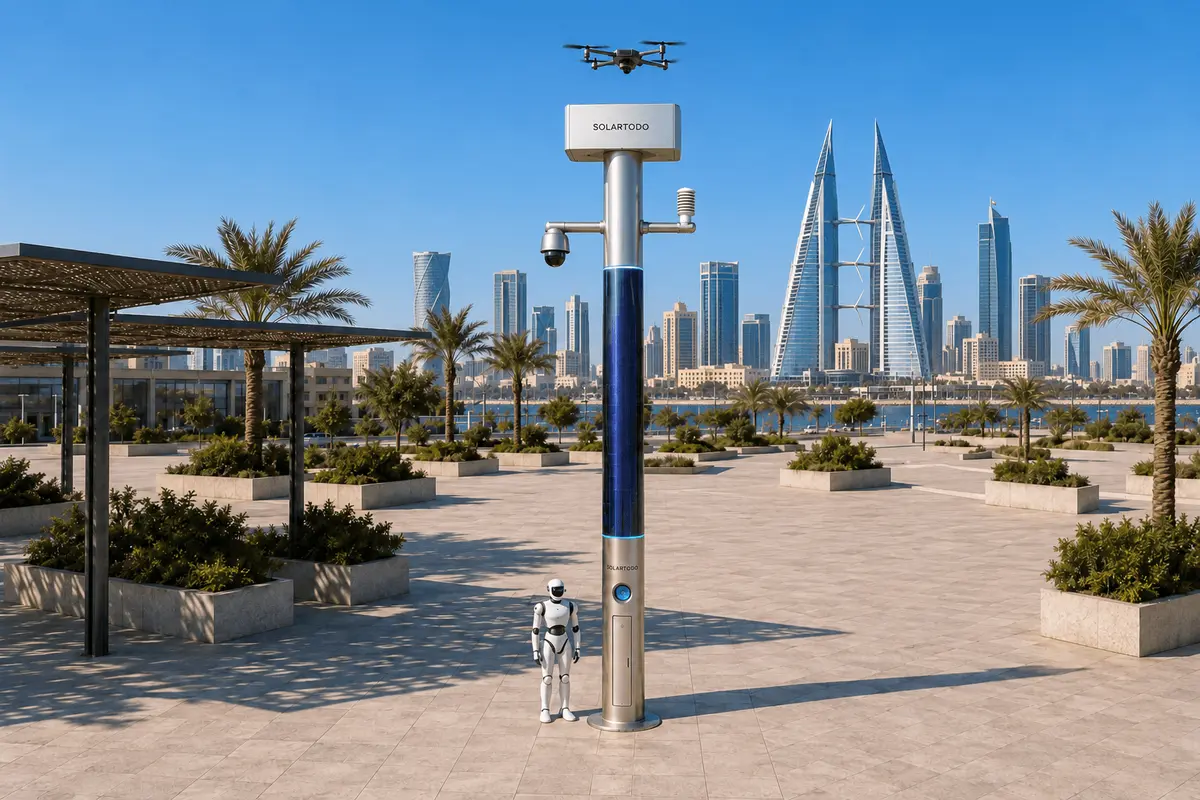
A City AI Pole is a non-lighting physical-AI urban edge node combining local computing, sensing, off-grid energy and drone and ground-robot operations. SOLARTODO Sentinel’s Sky Hub form runs OTATODO on the pole. This proposed Manama deployment supports police-led fire-response coordination after a disaster, using autonomous observation missions, human-authorized responses and locally retained raw data.
1. Police planning: adapting the mountain-response brief to Manama
The proposed city task is specific: restore repeatable observation around a disaster-affected district while police manage access, fire responders assess hazards and maintenance teams recover essential infrastructure. Slow manual patrol is the operating problem. Officers repeatedly travel to check the same perimeter, confirm whether an access route remains open and relay observations between departments. A SOLARTODO Sentinel pole provides a persistent local base for those observation tasks, with the drone nest as the principal operational module.
The brief’s mountain archetype requires a factual distinction. Manama is not a mountain city; Bahrain is generally low-lying, as described in its national report hosted by the United Nations. Here, mountain-response planning supplies an operational pattern: access-constrained sectors, interrupted routes and distributed observation points. It does not describe local terrain. The proposed Manama application transfers that pattern to storm debris, cordons and temporarily inaccessible urban blocks.
Likewise, typhoon-season is the exercise and procurement trigger specified for this case, not a claim about Manama’s normal weather calendar or a documented local disaster. Local readiness and flight decisions would follow Bahrain’s official weather bulletins. The illustrative incident is a fire within a storm-disrupted district, after conditions permit safe field operations.
This is a proposed deployment case using mature, in-service Sentinel capabilities. It does not report a completed Manama installation, a named customer or achieved savings. Police are the primary buyer and coordination stakeholder; final siting, permissions and operating envelopes remain subject to final engineering confirmation.
2. Joint siting: insert a drone-nest pole where patrol effort accumulates
Post-disaster infill means placing the node within a gap in observation and operational access, rather than redesigning an entire district. Police identify repeated verification journeys. Fire responders identify safe observation positions and emergency access needs. Municipal engineering checks foundations, ground condition, recovery access and separation from damaged structures. The selected location must support safe drone approaches without obstructing evacuation or emergency vehicles.
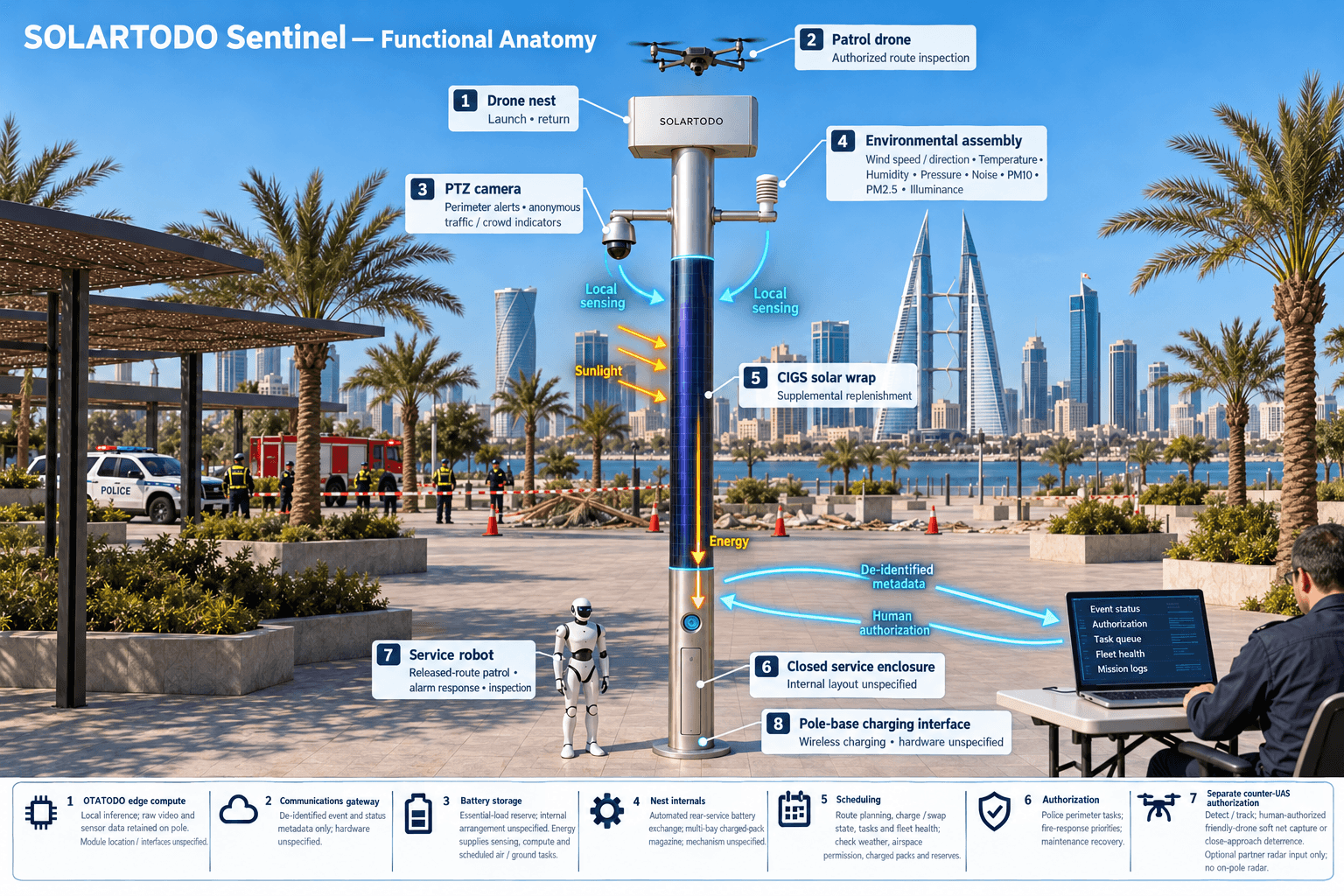
Sky Hub is a PURE smart pole with no lighting system. Its role is to host sensing, compute, energy and air-ground operations. For Manama, the proposed configuration concentrates on the drone nest: launch, regional patrol, inspection, return and task redeployment without an operator stationed beside the pole. Remote supervision and incident authority remain part of the operating model.
A landed drone receives a charged battery through an automated rear-service exchange. A multi-bay battery magazine supports several consecutive sorties, while operations management coordinates route planning, the charge/swap state machine, task queues, fleet health and mission logs. Consecutive missions remain bounded by charged-pack availability, weather, airspace permission, maintenance condition and the station’s energy reserve.
The nest changes the patrol workflow because each authorized observation task can begin from a persistent local base. Officers need not repeat every journey simply to establish whether a perimeter condition has changed. Where physical inspection or intervention is necessary, people still attend.
Ground operations complement that aerial focus. A humanoid or service robot performs autonomous patrol, alarm response and inspection on routes released as safe, coordinates with the drone and returns to the pole base for wireless charging. It receives no assumption of access to unstable structures, active fire interiors or uncleared debris.
3. Incident command: connect sensing, authorization and field action
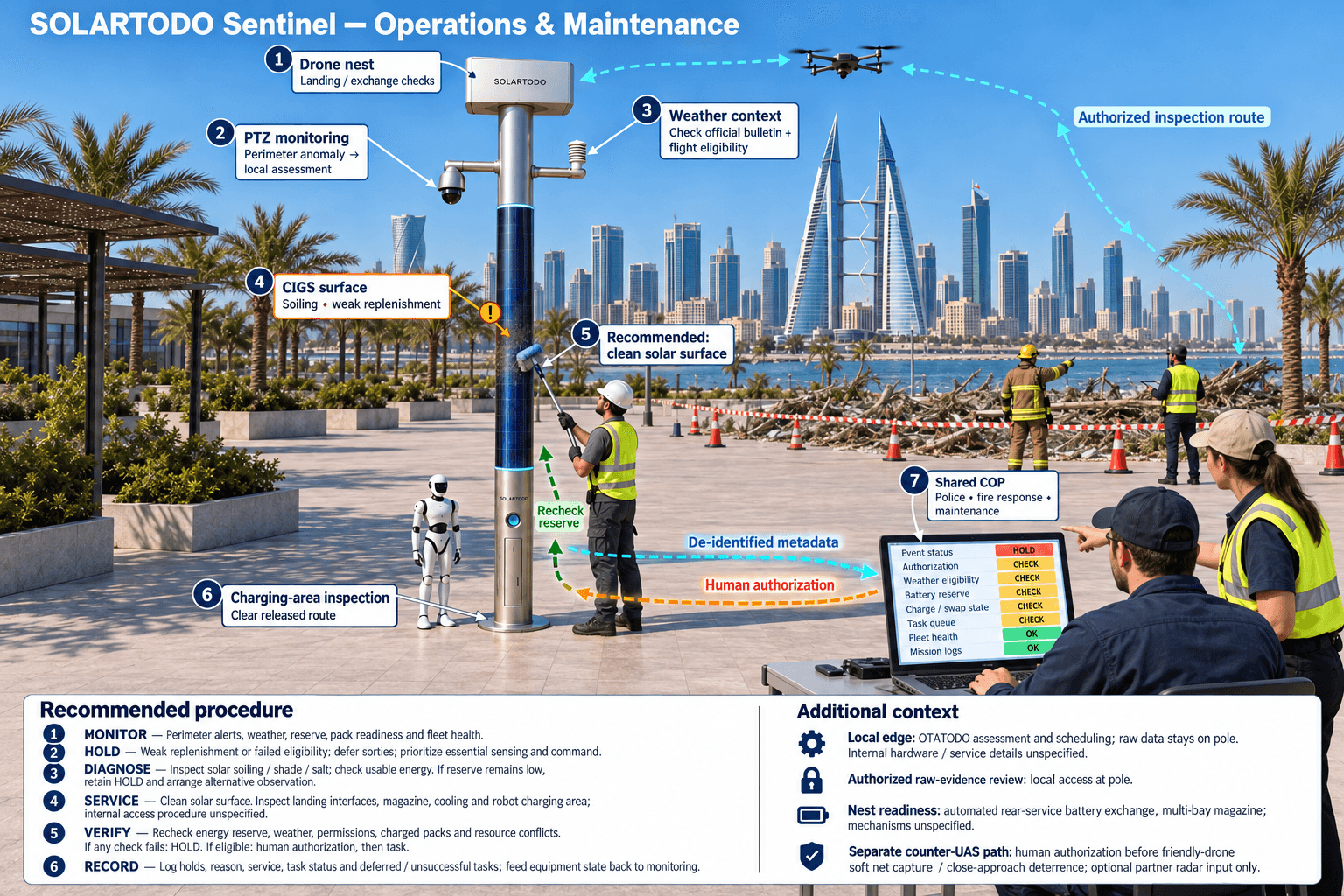
The common-operating-picture command view brings police, fire responders and maintenance personnel into one operational loop: sensing → authorized assessment/response → edge-compute scheduling → field operations and maintenance. Each department sees the event status, assigned task, authorization state and resource readiness relevant to its responsibilities. A shared incident reference reduces repeated explanations without removing departmental authority.
On-pole PTZ perception supplies anonymous vehicle counts, crowd-density indicators, intrusion alerts and perimeter awareness. In this fire-response configuration, observations can flag movement into a cordoned sector or congestion near an emergency access point. They support assessment; they do not establish the cause of a fire or replace the incident commander’s judgment. Face and licence-plate recognition are not active capabilities in this configuration.
The environmental package measures wind speed, wind direction, temperature, humidity, atmospheric pressure, noise, PM10, PM2.5 and illuminance. These readings add context for dispatch and local conditions. They are not a substitute for specialist fireground instruments, structural assessment or an aviation weather decision.
OTATODO runs local inference and schedules workloads on the edge module. Raw video and sensor data stay on the pole and are processed there. Only de-identified event and status metadata may leave it. Consequently, the shared COP receives event summaries, task progress and equipment state rather than remote raw-video feeds. Detailed raw evidence review requires authorized access at the pole under the agreed handling procedure.
Police control perimeter tasks, fire responders direct fireground priorities, and maintenance personnel manage equipment recovery. The scheduling layer checks mission eligibility, reserves and resource conflicts before execution. If conditions invalidate a mission, the COP records the hold and its reason so departments can arrange an alternative observation or inspection.
4. Engineering and maintenance: sustain a fully off-grid operating rhythm
The proposed micro-station is fully off-grid, using battery storage and on-pole solar replenishment with no grid, city or site power connection. Approximately 15 m² of flexible CIGS thin-film wraps a vertical cylindrical body approximately 8 m tall and 0.6 m wide. The wrap has approximately 2.4–2.7 kWp nameplate capacity, but nameplate capacity is not the station’s expected instantaneous production.
A vertical cylinder receives direct sunlight on its sun-facing projection, not across the entire wrap at once. The supplied high-irradiance reference envelope is roughly 0.8–1.1 kW DC clear-sky peak and approximately 6–9 kWh per day, with peaks in mid-morning or afternoon rather than noon. These figures are planning references for a region such as Saudi Arabia, not measured Manama yields or guaranteed daily energy.
For Manama, engineering must account for shading, heat, salt exposure, soiling, conversion losses and seasonal conditions. CIGS is a supplemental replenishment layer. Storage in the 5–20 kWh class buffers high-power drone and robot tasks, while scheduling governs duty cycle. Storage shifts energy availability; it does not create additional energy or establish unlimited solar self-sufficiency.
The operating plan therefore assigns an essential-load reserve, mission priorities and maintenance thresholds. During weak replenishment or restricted weather, observation sorties can be deferred while essential sensing and command functions receive priority within the engineered reserve. Maintenance includes inspection of the battery magazine, landing interfaces, cooling arrangements, solar surface and robot charging area.
Police and engineering teams should agree these constraints before procurement. A requested sortie frequency becomes credible only after a load budget, usable battery calculation, charging schedule and recovery plan support it. Physical installation also requires structural and wind-load assessment; an off-grid energy design does not by itself establish disaster survivability.
5. Police procurement: evaluate operating expenditure across departments
The purchasing case should measure operating effort per completed observation task, rather than count flights as an outcome. Establish a manual-patrol baseline, then compare equivalent tasks using the proposed node. Record officer travel and observation time, remote review time, repeat dispatches, maintenance attendance, battery handling and mission holds. Include unsuccessful and deferred tasks so the evaluation does not reward selective reporting.
The assumptions below are hypothetical arithmetic for buyer planning. They are not product performance, verified local statistics or achieved reductions. One useful comparison subtracts remote review effort from displaced manual observation effort, then adds maintenance and reporting time. The result is a candidate labor allocation change, not automatically a cash saving: officers may be reassigned while staffing expenditure remains unchanged.
Cross-department review matters because effort can move between teams. Police may make fewer verification journeys while fire responders request additional inspections or maintenance staff spend longer cleaning exposed equipment. A credible opex evaluation captures those transfers. Target metrics include staff-hours per completed task, avoidable repeat attendance, maintenance hours and the proportion of requested tasks completed within the authorized operating envelope. Set targets after the baseline is understood.
Counter-UAS coordination follows a separate authorization path. The pole detects and tracks an unauthorized drone and, only after human authorization, commands its own friendly drone for soft aerial net-capture or close-approach deterrence. This is non-lethal, non-kinetic mitigation subject to legal authority, airspace conditions and incident priorities. Radar is not built into the pole; any radar contribution is an optional partner-sensor input.
The procurement decision should rest on documented task records, engineering confirmation and agreed responsibilities. Data handling is designed for local processing and is PDPL/LGPD-oriented; this wording does not establish certification or legal compliance. The proposed Manama case succeeds as a purchasing framework when police can recompute the workload comparison and each department can identify who authorizes, operates, maintains and reviews the service.
System Configuration
| Parameter | Configuration |
|---|---|
| Pole and deployment form | PURE non-lighting Sky Hub pole; proposed post-disaster infill installation with foundation and access subject to engineering confirmation |
| Drone nest and battery exchange | Autonomous launch/return interface, automated rear-service battery exchange and multi-bay charged-pack magazine |
| Edge compute and data | On-pole AI inference module running OTATODO; raw video and sensor data retained on the pole; de-identified event/status metadata export only |
| Security and environmental sensing | PTZ camera plus wind speed/direction, temperature, humidity, pressure, noise, PM10, PM2.5 and illuminance sensing |
| Off-grid energy | Approximately 15 m² wrapped flexible CIGS; approximately 2.4–2.7 kWp nameplate; 5–20 kWh-class battery storage; duty-cycle scheduling |
| Ground robot interface | Service-robot patrol and inspection coordination with wireless charging at the pole base |
| Command and authorization | Shared COP for task queues, mission logs, fleet health and human-authorized response; radar excluded from pole hardware |
How It Works
- On-pole sensing flags a perimeter anomaly near the fire-response cordon.
- Local edge AI assesses observations and creates a de-identified event record.
- The police coordinator and fire-response lead assess the task and record human authorization.
- OTATODO checks weather eligibility, battery reserves and resource availability before scheduling.
- The drone inspects the authorized route, returns and receives an automated battery exchange when eligible.
- The pole retains raw data locally and shares only de-identified event, task and maintenance status.
Planning Assumptions (Indicative)
Illustrative planning inputs a buyer can recompute — target metrics, not achieved results. Subject to final engineering confirmation.
| Metric | Planning assumption | Indicative value |
|---|---|---|
| Manual observation baseline | ILLUSTRATIVE ONLY: 6 observation rounds per day, 2 officers per round, 20 minutes per officer, over 10 days. | 6 × 2 × 20 × 10 ÷ 60 = 40 staff-hours of baseline observation effort |
| Remote task review | ILLUSTRATIVE ONLY: the same 60 observation tasks each require 1 reviewer for 10 minutes; task equivalence must be evaluated. | 60 × 1 × 10 ÷ 60 = 10 staff-hours of review effort |
| Maintenance attendance | ILLUSTRATIVE ONLY: 2 maintenance visits require 2 technicians for 60 minutes each during the same evaluation window. | 2 × 2 × 60 ÷ 60 = 4 staff-hours of maintenance effort |
| Cross-department record review | ILLUSTRATIVE ONLY: 3 departmental reviewers each spend 20 minutes on each of 2 joint review sessions. | 3 × 20 × 2 ÷ 60 = 2 staff-hours of joint review effort |
| Candidate labor allocation difference | ILLUSTRATIVE ONLY: compare 40 baseline staff-hours with 10 remote-review, 4 maintenance and 2 joint-review staff-hours; assume equivalent completed tasks. | 40 − (10 + 4 + 2) = 24 staff-hours potentially available for reassignment; not achieved savings |
Deployed Equipment
- Proposed non-lighting Sky Hub pole body and engineered foundation
- Integrated drone nest with automated rear-service battery exchanger and multi-bay magazine
- Compatible autonomous patrol drone with exchangeable battery packs
- On-pole edge-compute cabinet running OTATODO
- PTZ security camera and nine-parameter environmental sensor assembly
- Wrapped flexible CIGS solar assembly and battery storage cabinet
- Service robot and pole-base wireless charging interface
- Communications gateway for de-identified event and status metadata
Frequently Asked Questions
Is this a verified Manama deployment or a proposed configuration?
This case describes a proposed Manama configuration using Sentinel’s mature, in-service capabilities. It does not identify an installed local fleet, customer contract or achieved outcome. Deployment quantities, operating permissions, engineering suitability and evaluation targets must be established for the selected site before a procurement decision.
Why does a Manama case use mountain and typhoon-season planning?
Mountain is the requested operational archetype, representing interrupted access and separated observation sectors; it is not a description of Manama’s terrain. Typhoon-season is the stipulated readiness-exercise trigger, not a claim about Bahrain’s normal seasonal hazards. Actual deployment and flight decisions must use local warnings and site conditions.
Can the node operate without an external electricity connection?
Yes. The proposed architecture is fully off-grid, combining on-pole CIGS replenishment with battery storage and scheduled workloads. That does not mean unlimited mission endurance. The approximately 0.8–1.1 kW DC clear-sky peak and 6–9 kWh daily reference envelope require local engineering validation, and high-power tasks must fit the usable energy budget.
How does battery hot-swap help police manage repetitive patrol work?
After landing, the drone receives a charged pack through automated rear-service battery exchange. A multi-bay magazine enables several consecutive sorties without an operator beside the pole. The mission manager coordinates pack state, task queues and fleet health, while weather, permissions, available energy and maintenance condition govern whether another sortie proceeds.
What information can departments see in the shared command view?
The shared COP can receive de-identified event summaries, authorization states, task progress, fleet health and maintenance status. Raw video and sensor data stay on the pole for local processing. Departments must agree incident identifiers, access roles, retention and local evidence-review procedures; a common command view does not require exporting raw feeds.
What are the limits of counter-UAS coordination?
The pole supports detection, tracking and command coordination. Only after human authorization may its friendly drone undertake soft aerial net-capture or close-approach deterrence within the applicable operating permissions. Mitigation is non-lethal and non-kinetic. Radar is not pole hardware, although an optional partner sensor may contribute input.
Does local processing establish privacy compliance?
Local processing supports a PDPL/LGPD-oriented data-handling design, but does not establish certification or completed legal compliance. Buyers still need to assess purpose, access controls, retention, notices and governance. This configuration keeps raw video and sensor data on the pole and permits only de-identified event and status metadata to leave.
Explore Further
- City AI Pole / smart streetlight product line
- More smart-city deployment cases
- Talk to our engineering team
Planning a similar physical-AI deployment for streets, campuses or public spaces? Request an engineering consultation