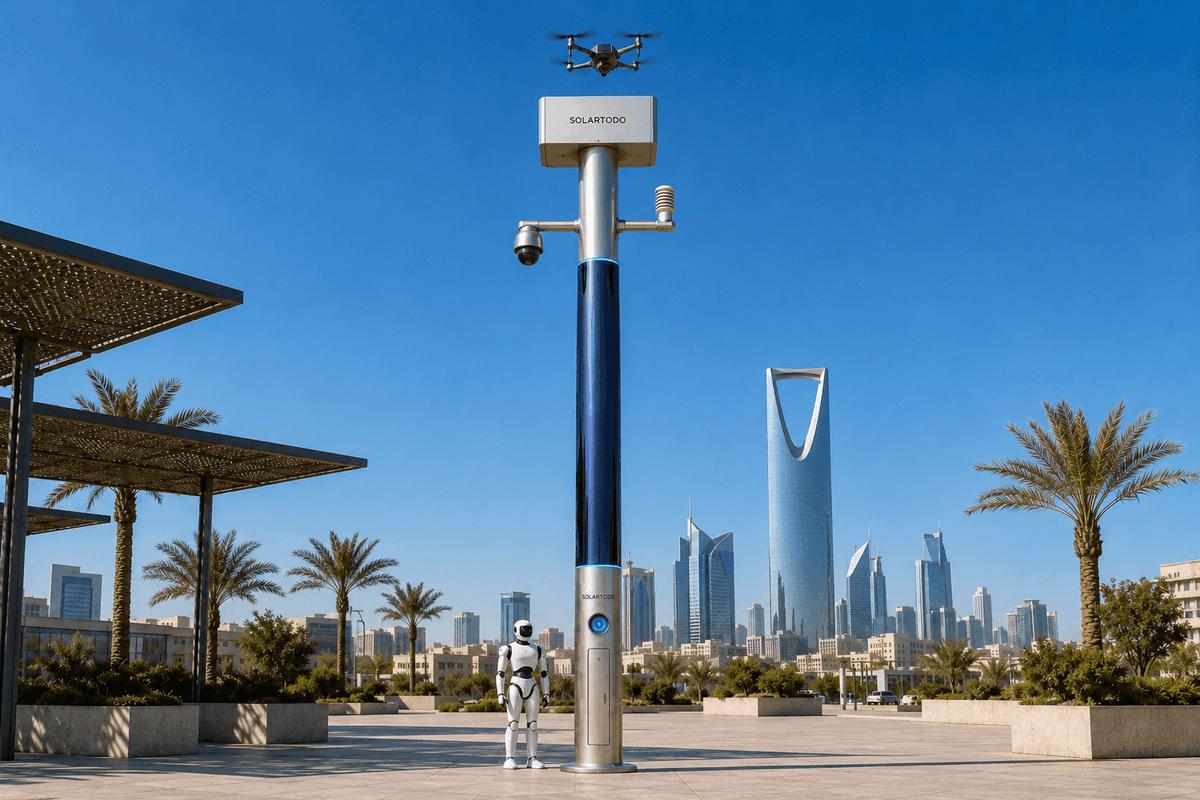
A City AI Pole is a non-illumination physical-AI edge node that hosts sensing, compute, energy storage, drone operations and ground robot coordination on one fully off-grid pole. In Manila, SOLARTODO Sentinel Sky Hub is proposed as a single-pilot old-town border-watch node for local anomaly detection, human-authorized response and availability-focused patrol continuity.
Incident Context: Old-Town Pressure During Holiday Movement
Manila’s old-town districts concentrate historic streets, transport edges, river corridors, churches, markets, schools, government facilities and tourism foot traffic into a dense operating environment. During long weekends and holiday periods, the city-management task changes from routine observation to continuous border-watch: watching district entrances, narrow service roads, informal gathering points, after-hours perimeter movement and queue spillover without turning every alert into a manual patrol dispatch. The pain point is not lack of cameras alone. It is slow manual patrol response across constrained streets where officers, field teams and command staff must decide which signal deserves attention. A proposed single-pilot Sky Hub deployment places one SOLARTODO Sentinel physical-AI edge-node pole at a selected old-town perimeter point, such as an access corridor between a heritage block, a public plaza edge and a logistics approach. The configuration is illustrative and subject to final engineering confirmation, site survey and local authority rules. Its purpose is to test whether one off-grid node can keep patrol availability higher during a holiday incident window by processing video and environmental signals locally, coordinating a drone sortie, managing automated battery exchange, and assigning a ground robot for closer inspection when authorized. The node is not a public lighting asset and is not positioned as urban decoration. It is a pure smart pole for sensing, compute, energy, drone and robot operations. The city stakeholder is the management office that must preserve situational awareness while keeping field teams focused on verified issues. The KPI framing is availability: whether the city can maintain patrol readiness, evidence continuity and redeployable air-ground assets when manual routes are delayed by crowd density, narrow roads or holiday traffic.
Deployment Shape: One Node, One Boundary, One Command Picture
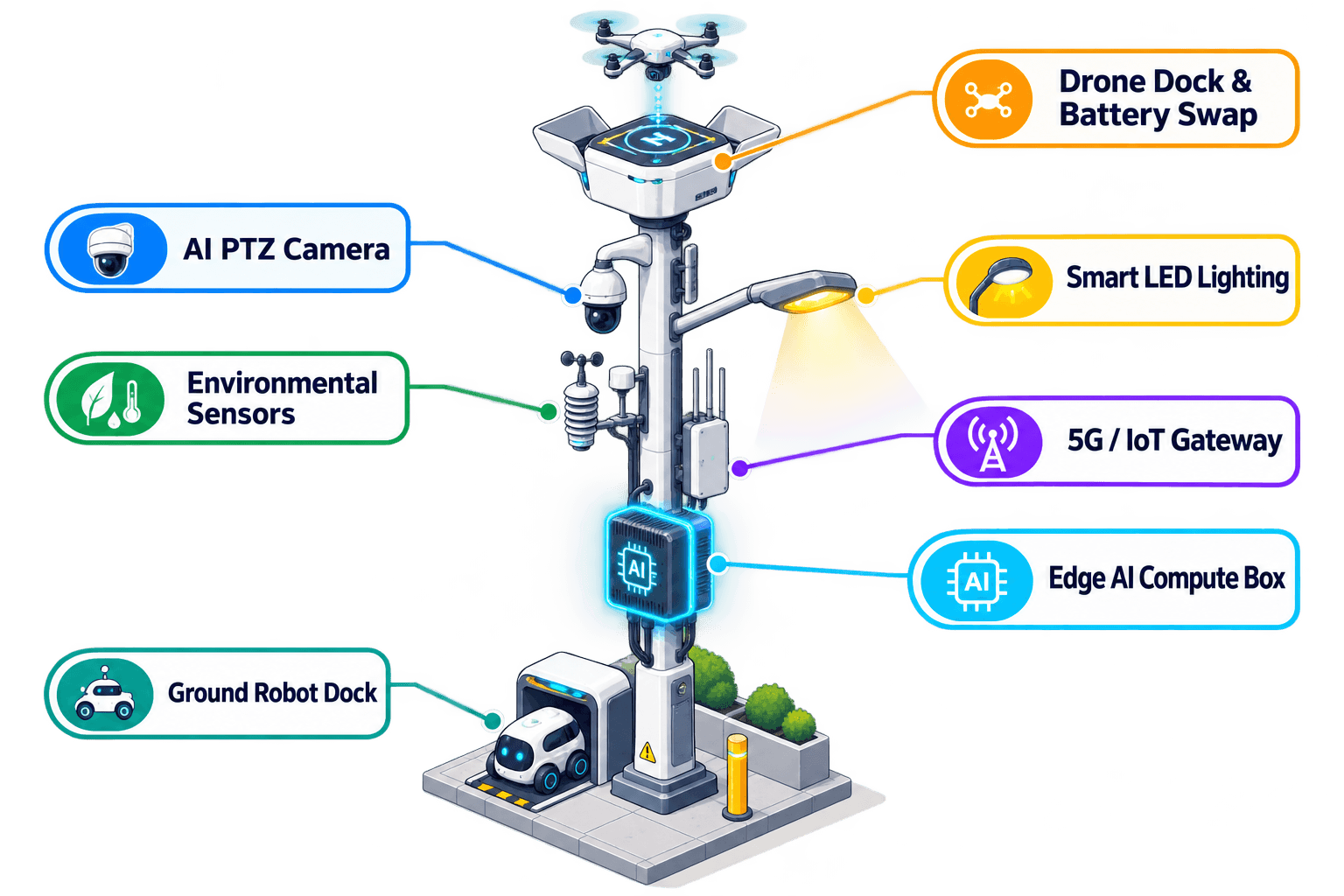
The proposed pilot uses Sky Hub as a fully off-grid micro-station. The pole body carries approximately 15 square meters of 360-degree wrapped flexible CIGS thin-film solar on a vertical cylindrical surface roughly 8 meters tall and 0.6 meters wide, paired with 5-20 kWh-class battery storage. The solar layer is a replenishment layer, not an unlimited self-sufficiency claim. Because a vertical cylinder collects direct sun mainly through its sun-facing projection, a high-irradiance region may see roughly 0.8-1.1 kW DC clear-sky peak and about 6-9 kWh per day, with production often peaking mid-morning and mid-afternoon rather than exactly at noon. Manila engineering should derate this further through local shading, monsoon cloud patterns, urban canyon effects, salt air exposure and duty-cycle requirements. The pole does not depend on grid, city or site power; high-power drone and robot activity is buffered by storage and scheduled by workload priority. The deployment mode is intentionally single-pilot. That keeps the evaluation focused on one operational boundary rather than a citywide claim. The command view presents a common operating picture for the loop often summarized as sensing, authorized assessment and response, edge-compute scheduling, and field operations and maintenance. A PTZ camera and local perception detect anonymous vehicle count changes, crowd density shifts, intrusion patterns and perimeter anomalies. Environmental sensors report wind speed, wind direction, temperature, humidity, atmospheric pressure, noise, PM10, PM2.5 and illuminance. The edge cabinet runs local inference and scheduling on a Jetson-class compute module. Raw video and raw sensor streams stay on the pole for local processing; only de-identified event and status metadata may leave the node for the city command view.
Battery-Swap Focus: Availability Instead of One-Time Flight
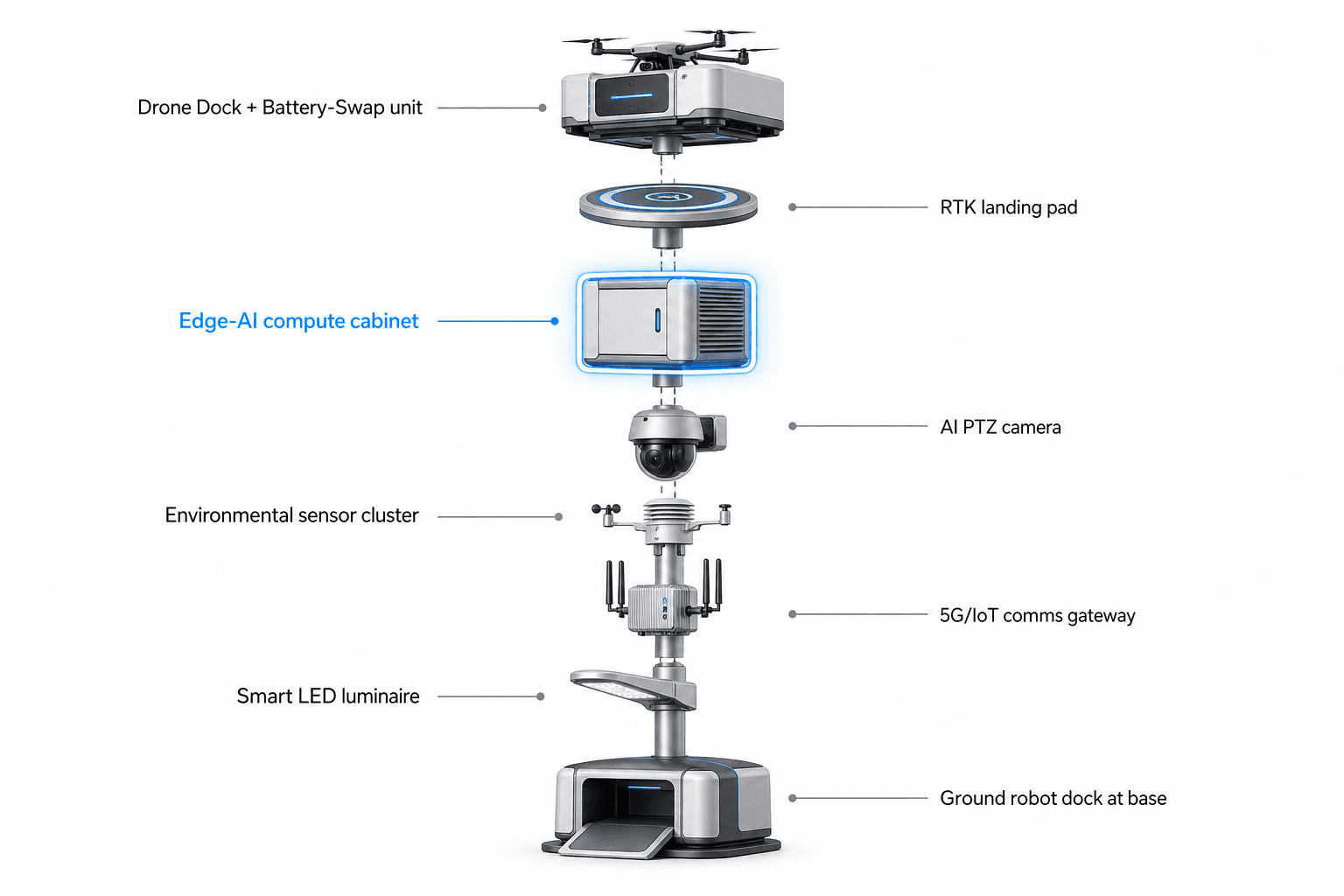
For Manila city management, the operational difference is not simply that a drone can launch. The useful capability is that the node can keep air coverage redeployable when a holiday incident stretches longer than a single battery cycle. Sky Hub’s drone bay supports autonomous launch, regional patrol, inspection, return and task redeployment without an operator standing at the pole. The module focus for this proposed case is the rear-service hot-swap magazine: when the friendly drone lands, the multi-bay battery system exchanges the depleted pack for a charged pack, verifies state, and returns the aircraft to the task queue when authorized. Multiple bays allow several consecutive sorties before a maintenance visit is required. This is important for old-town border-watch because many incidents are ambiguous at first. A crowd-density rise near a gate, a service vehicle stopped in the wrong lane, or repeated movement along a closed edge may not justify sending a patrol team immediately. The edge node can run a first classification locally, request operator review through the command view, and launch a drone inspection only when the human-in-the-loop approves the response. If the event persists, the swap mechanism supports follow-up sorties rather than forcing the city to choose between losing aerial visibility and assigning a manual team through congestion. Ground robot operations complete the availability story at street level. A humanoid or service robot can be tasked for autonomous patrol, alarm response, closer inspection, air-ground coordination and return-to-base wireless charging. The robot is not a substitute for city authority. It is a field asset that can approach an edge condition, confirm whether a gate is blocked or observe a restricted corridor while human staff retain authorization control. The KPI target is availability of patrol functions across the incident window: drone redeployment readiness, robot charging readiness, edge compute uptime, verified event records and reduced dependency on slow manual patrol loops.
Incident Review Workflow: Detect, Decide, Act, Record
A typical holiday incident begins with routine watch. The on-pole camera sees a crowd-density increase near an old-town perimeter gate while the environmental package confirms wind conditions suitable for flight. The edge AI classifies the event as a perimeter attention item, not an identity event. It does not perform face recognition or licence-plate recognition. The command view presents a de-identified incident card with location, time, sensor confidence, recommended response options, battery state and available drone and robot assets. City staff then authorize the next action. If aerial verification is selected, Sky Hub launches its friendly drone on a defined route over the boundary corridor. If the drone returns with the situation unresolved, the battery hot-swap state machine handles the exchange and places the aircraft back into redeployable status. If street-level confirmation is needed, the ground robot is assigned to inspect the approach, then returns to the pole base for wireless charging. If an unauthorized drone is detected and tracked by the node or by an optional partner-sensor input, the pole may command its own friendly drone for non-lethal C-UAS coordination, such as soft aerial net-capture or close-approach deterrence, only under human authorization and applicable rules. Radar is not built into the pole; it can only be treated as an optional external input where a partner sensor is approved. The review record contains event metadata, asset status, mission log, operator authorization, battery swap state, robot charging state and maintenance flags. This gives Manila city management an incident-review trail without exporting raw continuous video from the pole. The deployment remains PDPL-LGPD-oriented by design: local processing first, minimized external metadata, and auditable decision points rather than broad raw-data movement.
Evaluation Plan: Availability Metrics for a Single Pilot
The proposed evaluation avoids citywide numbers, coverage claims or asserted results. It asks whether one node can improve operational availability for a defined old-town boundary during a holiday window. Planning inputs should be recomputed after site survey, solar access review, roofline and canopy shading analysis, operating-hour policy, local drone rules, communications testing and maintenance access review. The most relevant availability metrics include percentage of incident window with edge compute online, number of authorized redeployable drone sorties supported by the battery magazine, robot ready-to-dispatch time, median time from local anomaly flag to command review, and completeness of incident logs. These are target evaluation metrics, not achieved results. The benefit to city management is qualitative but concrete: fewer blind intervals between patrol rounds, better triage before sending personnel into dense old-town streets, and a common operating picture that links sensing, authorization, asset dispatch and maintenance state. The proposed pilot should be treated as an operational configuration, not a product datasheet. It is subject to final engineering confirmation, local aviation and public-space approvals, data-governance review, safety case validation and acceptance tests defined by the city. The right conclusion after the pilot is not whether one pole replaces a city patrol force. The useful conclusion is whether a fully off-grid physical-AI edge node can keep an old-town border-watch function available longer, with clearer authorization records and faster asset redeployment, when manual patrol cycles slow down during holiday pressure.
System Configuration
| Parameter | Configuration |
|---|---|
| Deployment mode | Single Sky Hub pilot node for Manila old-town perimeter border-watch, subject to final engineering confirmation |
| Power architecture | Fully off-grid battery-backed micro-station with approximately 15 m2 wrapped flexible CIGS solar replenishment |
| Edge AI compute | On-pole Jetson-class inference and scheduling module; raw video and raw sensor data processed locally |
| Drone operations | Autonomous launch, patrol, inspection, return, mission logging and multi-bay rear-service battery hot-swap |
| Ground robot operations | Autonomous patrol and alarm-response robot coordination with return-to-base wireless charging at pole base |
| Security sensing | AI PTZ for anonymous vehicle count, crowd density, intrusion and perimeter awareness |
| Environmental package | Wind speed, wind direction, temperature, humidity, atmospheric pressure, noise, PM10, PM2.5 and illuminance |
How It Works
- On-pole PTZ and environmental sensors flag a perimeter anomaly near the old-town boundary.
- Edge AI classifies the event locally and generates a de-identified incident card for the COP command view.
- A city operator reviews the score, asset status and rules before authorizing drone or robot response.
- Sky Hub launches a friendly drone or assigns a ground robot, then records mission state and battery status.
- The drone returns for automated battery hot-swap when needed and can be redeployed for authorized follow-up.
- The node stores local evidence records and exports only de-identified event and status metadata.
Planning Assumptions (Indicative)
Illustrative planning inputs a buyer can recompute — target metrics, not achieved results. Subject to final engineering confirmation.
| Metric | Planning assumption | Indicative value |
|---|---|---|
| Patrol availability | manual perimeter checks are supplemented by scheduled drone and robot patrols during a holiday incident window | ~6-10 automated patrol tasks per day targeted |
| Drone redeployment | battery hot-swap magazine supports repeat sorties before field maintenance is required | ~3-6 consecutive authorized sorties targeted |
| Manual dispatch triage | edge-classified incident cards help operators decide before assigning a field team | ~30-50% of low-priority checks targeted for remote review first |
| Evidence continuity | local event metadata, mission logs and authorization records are retained for incident review | ~95% incident-card completeness targeted |
| Energy planning | solar replenishment offsets part of daily load while storage buffers high-power tasks by duty cycle | ~6-9 kWh/day replenishment reference in high-irradiance clear sky |
Deployed Equipment
- SOLARTODO Sentinel Sky Hub pure smart pole body
- 360-degree wrapped flexible CIGS thin-film solar replenishment layer
- 5-20 kWh-class battery storage and power management cabinet
- AI PTZ camera with local perception pipeline
- Nine-parameter environmental monitoring package
- Autonomous drone bay with multi-bay battery hot-swap magazine
- Ground robot wireless charging base interface
- OTATODO edge OS command and mission management runtime
Frequently Asked Questions
Is this a smart streetlight or public illumination project?
No. The Manila configuration is a pure smart pole and physical-AI edge node, not a public illumination asset. It hosts sensing, edge compute, off-grid energy storage, drone operations and ground robot coordination. It does not include a pole lighting system, and the case is framed around old-town border-watch operations rather than illumination service.
Does the pole need grid, city or site power?
No. Sky Hub is designed as a fully off-grid node using on-pole battery storage plus wrapped flexible CIGS thin-film solar replenishment. The solar layer is not presented as unlimited self-sufficiency. High-power drone and robot tasks are buffered by storage, scheduled by duty cycle and confirmed through final engineering analysis for the Manila site.
Why is battery hot-swap central to this Manila pilot?
Old-town holiday incidents can last longer than a single drone battery cycle, especially when manual patrols are delayed by crowds and narrow streets. The multi-bay rear-service battery magazine lets a landed friendly drone exchange to a charged pack and return to the task queue after authorization, improving redeployable patrol availability during the review window.
What data leaves the pole?
The intended data posture is local-first. Raw video and raw sensor data stay on the pole and are processed by the on-pole edge compute module. The command view may receive de-identified event cards, status metadata, mission logs and health summaries. This is PDPL-LGPD-oriented design language, not a claim of completed certification.
Does the system perform face or licence-plate recognition?
No active face recognition or licence-plate recognition is claimed for this proposed deployment. The security-sensing scope is anonymous vehicle count, crowd density, intrusion and perimeter awareness. That keeps the pilot focused on operational border-watch triage and local event classification rather than identity-based surveillance claims.
How does Counter-UAS coordination work in this case?
The pole may detect and track an unauthorized drone directly or through an approved optional partner-sensor input. Any response remains non-lethal and human-authorized only. Allowed actions include commanding the node’s own friendly drone for soft aerial net-capture or close-approach deterrence under applicable rules. Shoot-down, jamming and autonomous attack are outside the scope.
What should Manila city management evaluate after the pilot?
The evaluation should focus on availability, not asserted citywide outcomes. Useful target metrics include edge compute uptime during the incident window, drone redeployment readiness after hot-swap, robot ready-to-dispatch state, incident-card completeness and time from local anomaly flag to human review. All figures should be recalculated after site engineering and operational approval.
Explore Further
- City AI Pole / smart streetlight product line
- More smart-city deployment cases
- Talk to our engineering team
Planning a similar physical-AI deployment for streets, campuses or public spaces? Request an engineering consultation