Medellín Valley Airflow and Hill-Corridor Security: SOLARTODO Sentinel City AI Pole 77-Node Configuration Guide
Summary
Medellín’s 1,300-2,800 m valley terrain, 16.7-28.3 °C climate band and SECOP II procurement context favor approximately 77 off-grid SOLARTODO Sentinel City AI Pole nodes at 30 m spacing.
Key Takeaways
A 77-node Medellín configuration would cover roughly 2.31 km of corridor edge, using local processing and battery-buffered operation for dense urban terrain.
- Approximately 77 SOLARTODO Sentinel City AI Pole nodes at 30 m spacing would form a 2.31 km operational line for perimeter, campus, river-corridor or hill-access monitoring.
- Medellín sits in the Aburrá Valley, where Antioquia reports terrain from about 1,300 m to 2,800 m above sea level, creating steep access and foundation constraints.
- WMO climate normals for Medellín show monthly mean lows near 16.7-17.5 °C and highs near 26.9-28.3 °C, with October rainfall around 212 mm.
- The recommended energy architecture is fully off-grid: on-pole PV replenishment of roughly 1.0-1.3 kW DC peak and 5-20 kWh-class battery storage.
- The node should process raw video and sensor data on the pole; only de-identified event and status metadata should leave the site.
- Colombia’s RETIE was updated through Resolution 40117 of 2024, so electrical interfaces, batteries and PV-related components should be reviewed against Colombian conformity rules.
- SECOP II supports online public procurement workflows; Colombia Compra Eficiente reports more than 2,000 state entities use its buyer tools.
- Counter-UAS use must remain non-lethal and human-authorized: detection, tracking, command coordination and soft net-capture support, with no jamming or autonomous attack.
Market Context for Medellín
Medellín’s technical fit is shaped by 10-municipality metropolitan governance, a narrow inland valley and rain-driven maintenance cycles rather than coastal corrosion.
Medellín is Colombia’s second major urban economy and the core city of the Área Metropolitana del Valle de Aburrá. According to the Área Metropolitana del Valle de Aburrá (2021), the PIDM 2021-2032 covers 10 municipalities and coordinates development around quality of life, competitiveness, sustainability and public-private integration. That governance structure matters for SOLARTODO because a city AI pole program may be purchased by a municipality, a metropolitan agency, a campus authority, an industrial park or a public-services operator rather than a single street asset department.
The city is inland, not coastal, so salt-air hardening is less central than moisture, slope access and air-quality monitoring. According to the World Meteorological Organization using Colombian IDEAM climate data, Medellín’s monthly mean maximum temperature ranges from about 26.9 °C to 28.3 °C, while monthly mean minimum temperature stays near 16.7-17.5 °C. Rainfall is material: WMO lists about 212 mm in October and 199 mm in May, which makes sealed electronics, drainage, anti-condensation design and preventive inspection more important than desert dust assumptions.
Terrain is a Medellín-specific constraint. The Gobernación de Antioquia describes the Aburrá Valley as a natural basin in Colombia’s Central Andes, with heights ranging roughly from 1,300 m to 2,800 m above sea level. Steep laderas, river corridors and dense built-up areas create installation challenges: smaller staging areas, segmented deliveries, carefully sequenced foundations and maintenance routes that may need night or low-traffic access windows.
Air quality and microclimate also shape the product fit. The Alcaldía de Medellín states that the Aburrá Valley has “particularidades morfológicas, meteorológicas y de crecimiento urbano” that create air-pollution challenges, and notes the surrounding mountains can restrict wind circulation. For a SOLARTODO Sentinel City AI Pole program, that supports using environmental sensing for PM10, PM2.5, temperature, humidity, wind, noise and illuminance as operational data layers, not merely accessory readings.
Colombia’s national context favors edge-based autonomy, but not because Medellín lacks grid access. According to the World Bank (2023), Colombia’s urban electricity access indicator is tracked under SDG 7.1.1, while the IEA (2026) reports that Colombia’s electricity grid spanned over 750,000 km in 2024. The market issue is therefore not basic electrification; it is the cost, delay and disruption of pulling new power and data service to scattered security, mobility and inspection points.
Public procurement should also be treated as a technical constraint. Colombia Compra Eficiente defines SECOP II as a transactional platform for managing contracting processes online, and its buyer guidance covers more than 2,000 state entities. Colombia Compra Eficiente states, “SECOP II es la nueva versión del SECOP,” underscoring that suppliers should prepare technical datasheets, compliance matrices and acceptance protocols in a format suitable for online procurement review.
Recommended Technical Configuration
The recommended Medellín profile is a 77-node off-grid city-edge network, not a street lighting or grid-tied pole package.
A typical 77-unit deployment in this profile would consist of SOLARTODO Sentinel City AI Pole nodes placed at approximately 30 m spacing across a priority corridor, perimeter or district edge. At that spacing, the line length is about 2.31 km before route bends, setbacks, site obstacles and civil exclusions are applied. The configuration should be treated as project-based and subject to engineering confirmation, especially where foundations sit on slopes, retaining-wall edges, sidewalks or underground utility corridors.
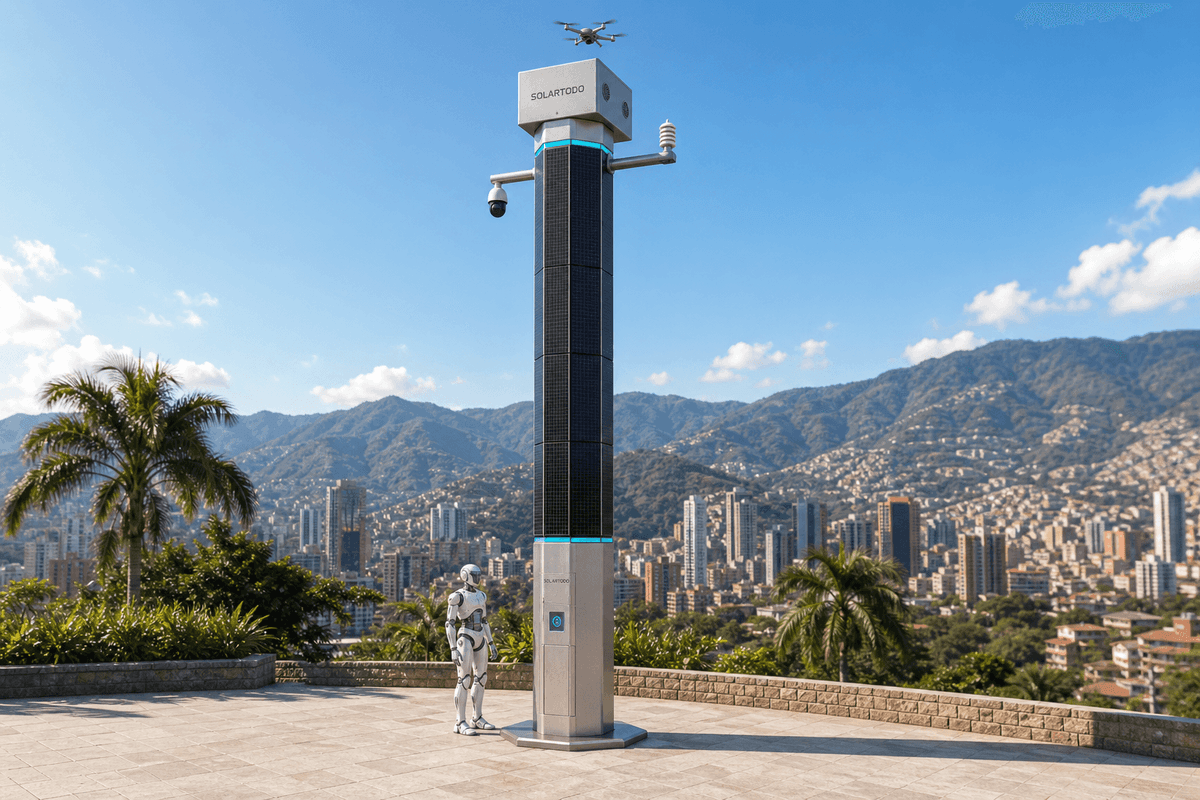
The correct product class is the SOLARTODO Sentinel physical-AI city edge node in Sky Hub pole form. It is a pure smart pole with no lighting system, designed to host sensing, local compute, drone operations, robot service workflows and battery-backed off-grid energy. It should not be specified as a smart streetlight, and it should not be justified through LED energy savings.
For Medellín, the recommended operating concept is corridor intelligence with local decision support. Each pole performs local perception for anonymous vehicle count, crowd density, intrusion and perimeter awareness. Raw video and sensor streams stay on the pole for processing; the central command view receives de-identified events, telemetry, health status, mission logs and operator-authorized response requests.
The 77-node configuration should group nodes into operational clusters rather than treating every pole as a standalone island. A practical structure is 7 clusters of 11 nodes, or a similar grouping aligned to terrain and security zones, with each cluster mapped to field maintenance access, mission scheduling and incident response coverage. This allows the command team to separate routine environmental monitoring from higher-priority perimeter alerts.
According to ITU (2024), about 5.5 billion people were online globally in 2024, but the same report notes persistent digital divides. ITU states, “An estimated 5.5 billion people are online in 2024.” In Medellín, where connectivity is relatively mature compared with rural regions, the design assumption should still be edge-first: intermittent backhaul should reduce visibility, not stop local sensing, logging or authorized field operations.
Technical Specifications
The Medellín specification centers on off-grid edge autonomy: 77 poles, 30 m spacing, 5-20 kWh storage and local AI processing.
- Product line: SOLARTODO Sentinel City AI Pole, city-ai-pole category, physical-AI urban edge node.
- Quantity for this guide: approximately 77 units, project-based custom configuration, subject to civil and electrical engineering confirmation.
- Spacing assumption: approximately 30 m between nodes, equivalent to about 2.31 km of linear corridor before route adjustments.
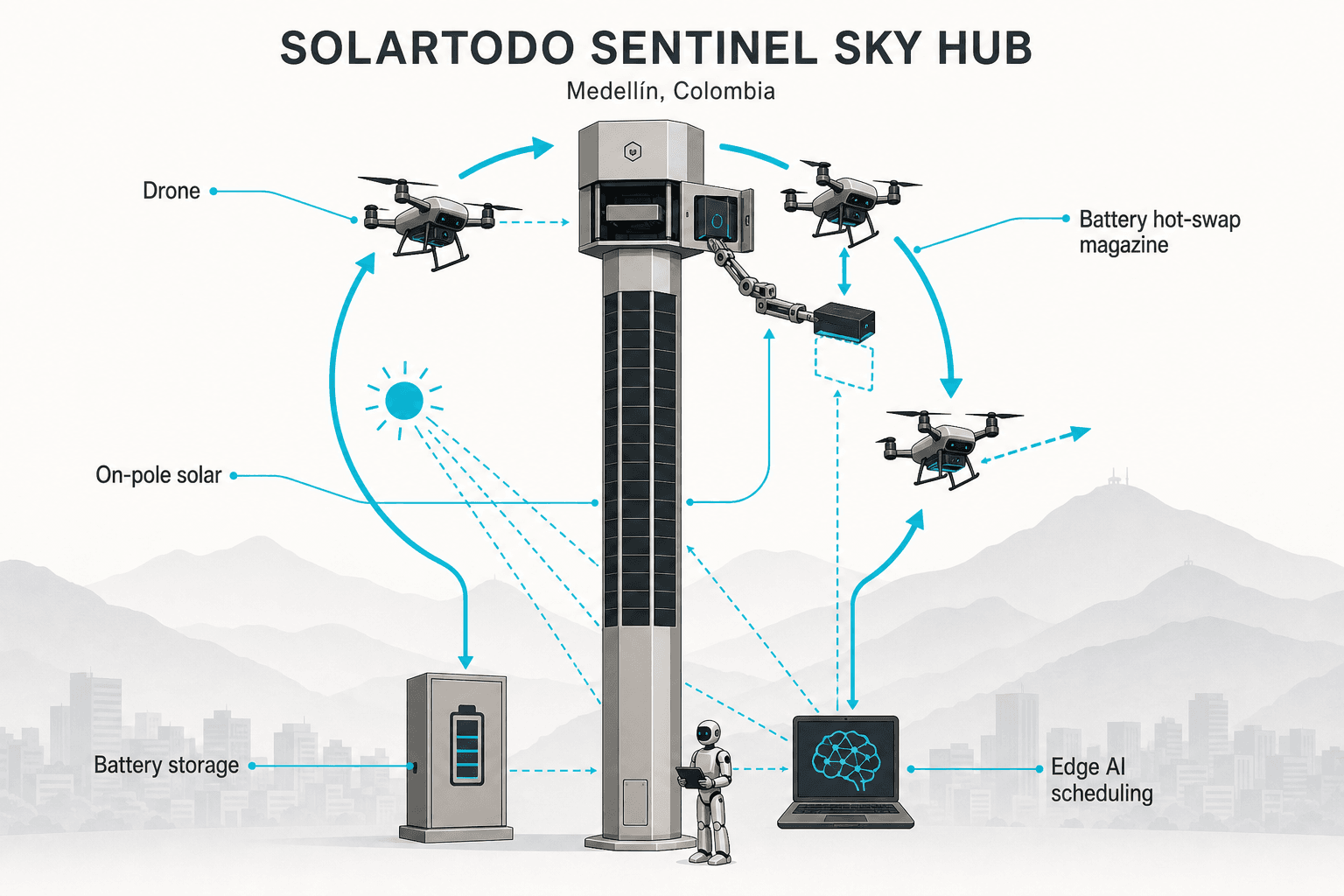
- Power architecture: fully off-grid, with battery storage and on-pole solar replenishment; no city, site or utility power dependency should be specified.
- Solar replenishment: roughly 1.0-1.3 kW DC clear-sky peak in high-irradiance conditions; Medellín yield must be adjusted for rainfall, cloud cover, shading and orientation.
- Daily replenishment benchmark: single-digit kWh/day in high-irradiance regions, used as supplemental charging rather than unlimited self-sufficiency.
- Storage class: 5-20 kWh battery buffer per node, selected by drone sortie frequency, robot duty cycle, sensor load and backhaul power budget.
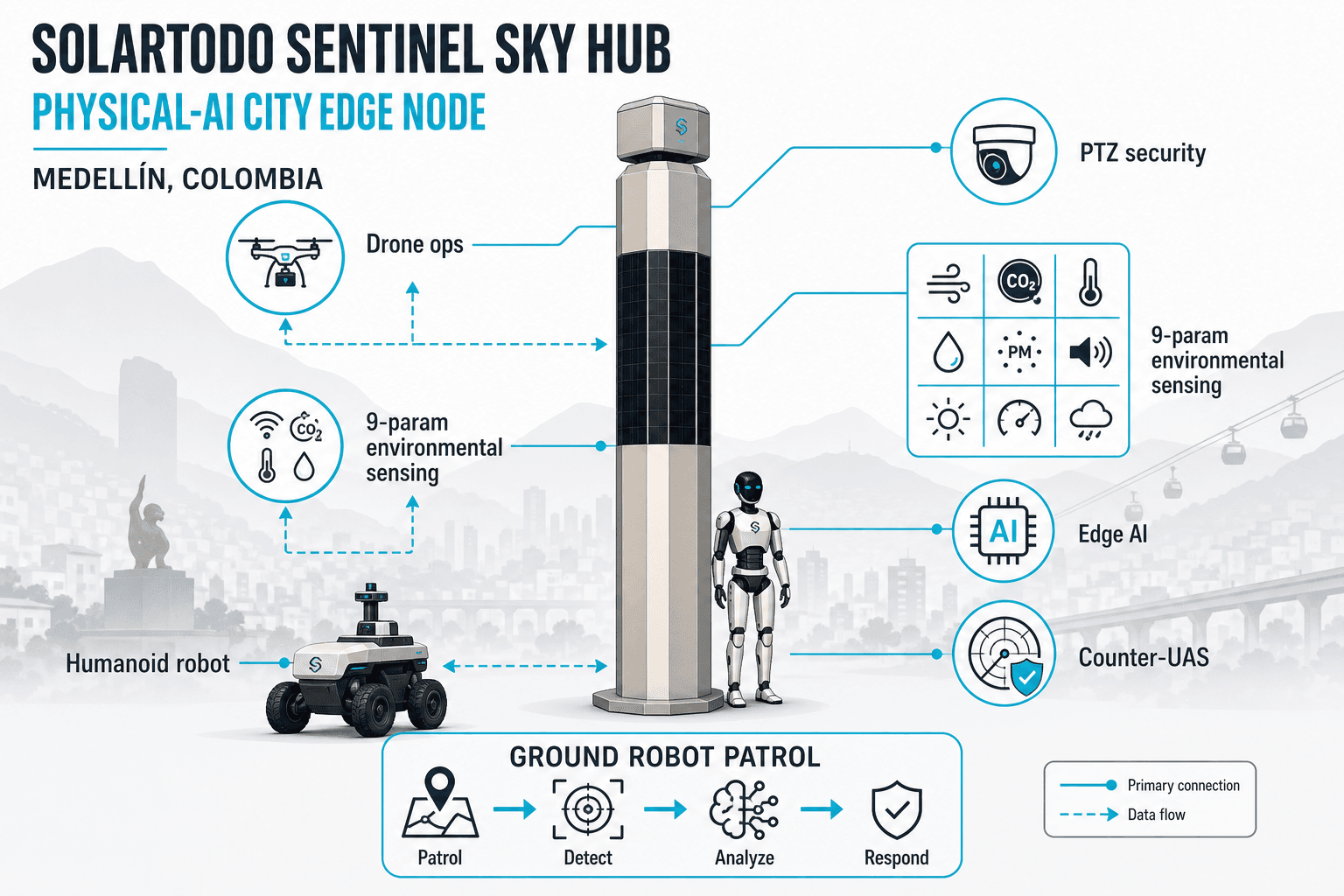
- Edge compute: Jetson-class module suitable for local inference, sensor fusion, task scheduling and health monitoring.
- Data handling: raw video and sensor data remain on the pole; only de-identified events, alarms, metadata and status packets leave the site.
- Drone operations: launch, patrol, inspection, return, automated battery exchange, mission queueing, health logging and task redeployment.
- Ground robot operations: autonomous patrol support, alarm response, inspection workflows, air-ground coordination and wireless charging at the pole base.
- Environmental sensing: wind speed, wind direction, temperature, humidity, atmospheric pressure, noise, PM10, PM2.5 and illuminance.
- Security sensing: PTZ camera with local analytics for anonymous vehicle count, crowd density, intrusion and perimeter awareness; no active face recognition or license-plate recognition is claimed.
- Counter-UAS coordination: detection, tracking, command coordination and human-authorized soft aerial net-capture or close-approach deterrence; no jamming, shoot-down or autonomous attack.
- Optional sensor integration: radar may be accepted only as an optional partner-sensor input, not as pole hardware.
- Colombian compliance review: RETIE, applicable NTC 2050-derived requirements and municipal civil works approvals should be checked during detailed engineering.
Implementation Approach
A Medellín rollout should be phased over 4 technical gates: route survey, procurement dossier, civil installation and edge commissioning.
The first phase is route and risk survey. Survey teams should verify the 30 m spacing model against sidewalks, public-space constraints, slopes, bridge approaches, tree canopy, drainage structures, existing ducts and line-of-sight limits. For Medellín, the survey should also classify rain exposure, vandalism risk, cellular backhaul strength and drone landing clearance by node.
The second phase is the procurement and compliance package. For a public buyer, the technical file should support SECOP II review with a bill of materials, acceptance tests, spare-parts plan, warranty terms, cybersecurity statement, local-data-processing description and RETIE applicability matrix. According to Colombia Compra Eficiente (2026), SECOP II is a platform for managing contracting processes online with accounts for entities and suppliers, so documentation clarity affects procurement speed.
The third phase is logistics and civil works. Medellín’s valley slopes and dense streets favor segmented delivery, local staging and foundation sequencing by cluster. Civil design should account for soil bearing, drainage, pedestrian protection, maintenance vehicle access and any underground utility conflicts. Where sites are in older dense corridors, shorter work windows and prefabricated foundation elements may reduce disruption.
The fourth phase is commissioning. Each SOLARTODO node should be tested for battery state, PV replenishment, sensor calibration, camera privacy masks, local inference, drone launch and return, battery exchange, robot charging, event metadata delivery and command authorization flow. The operations loop should remain human-in-the-loop: sensing, assessment, edge scheduling, field response and maintenance close-out are visible in a common operating picture.
Expected Performance & ROI
Expected value in Medellín comes from fewer truck rolls, faster inspection cycles and avoided trenching, with payback modeled over 5-8 years.
The primary ROI variable is avoided infrastructure work. Because the SOLARTODO Sentinel City AI Pole is fully off-grid, it can reduce the need for new power trenching, electrical service requests and energized tie-ins at remote or constrained urban points. That is especially relevant along Medellín’s slopes, river edges and secured campuses, where civil access can be more expensive than the pole hardware itself.
Operational value should be modeled around inspection frequency and response cost. A 77-node network can support recurring drone sorties, environmental readings and robot patrol workflows without assigning an operator to each location. Payback should be calculated through reduced manual patrol hours, faster incident verification, fewer emergency site visits, lower cabling work and improved uptime for perimeter monitoring.
Energy modeling should be conservative. The on-pole solar body is a replenishment layer, while the battery system buffers high-power workloads such as drone battery exchange, robotics and compute. Medellín’s rainfall profile means the system should use duty-cycle scheduling, weather-aware mission planning and reserve thresholds rather than assuming fixed solar yield every day.
According to the IEA (2026), hydropower represented around two-thirds of Colombia’s electricity generation over the past decade, but weather cycles can shift annual shares by about 10 percentage points. For city-edge systems, that supports resilient local energy buffers even in grid-served cities. The business case is not “free energy”; it is operational continuity, deployment flexibility and lower site-preparation risk.
Comparison Table
A 77-node SOLARTODO configuration differs from grid-tied CCTV poles by keeping raw data local and supporting drone and robot operations.
| Evaluation item | SOLARTODO Sentinel City AI Pole | Conventional grid-tied CCTV pole | Manual patrol-only model |
|---|---|---|---|
| Typical Medellín quantity in this guide | 77 nodes | 77 camera points | Variable patrol routes |
| Linear planning assumption | 30 m spacing, about 2.31 km | Often constrained by power/data access | No fixed digital coverage |
| Power model | Fully off-grid, 5-20 kWh storage | Grid or site power required | Vehicle or foot patrol energy |
| Solar role | 1.0-1.3 kW DC-class replenishment benchmark | Usually not integrated | Not applicable |
| Data handling | Raw data processed on-pole | Often streams raw video to VMS | Human observation logs |
| Drone workflow | Launch, return, hot-swap, task redeployment | Not native | Separate team or contractor |
| Robot workflow | Patrol, response, inspection, wireless charging | Not native | Human patrol only |
| C-UAS posture | Detection/tracking plus human-authorized soft response | Usually none | Visual reporting only |
| Privacy posture | De-identified event/status metadata off-pole | Depends on VMS design | Low sensor data, low automation |
| Best fit | Campuses, industrial parks, perimeters, critical zones | Static surveillance points | Low-density or temporary areas |
Pricing & Quotation
Pricing for Medellín should be quoted by 3 scopes: FOB equipment, CIF delivery or EPC turnkey with local installation assumptions.
SOLARTODO offers three pricing tiers for this product line: FOB Supply (equipment ex-works China), CIF Delivered (including ocean freight and insurance), and EPC Turnkey (fully installed, commissioned, with 1-year warranty). Volume discounts are available for large-scale deployments. Configure your system online for an instant estimate, or request a custom quotation from our engineering team at [email protected].
For Medellín, quotation inputs should include the 77-node count, route length, topographic class, foundation assumptions, drone sortie frequency, robot duty cycle, battery reserve policy, telecom backhaul option and acceptance-test protocol. Buyers comparing alternatives should evaluate installed lifecycle cost, not only pole supply cost. Technical teams can start from the city-ai-pole solution page at SOLARTODO solutions and then contact the engineering team through contact us.
Frequently Asked Questions
The following 10 FAQs cover the 77-node Medellín configuration, including technical scope, schedule, maintenance, ROI, pricing and installation.
Q1: Is the SOLARTODO Sentinel City AI Pole a smart streetlight? No. The SOLARTODO Sentinel City AI Pole is a pure smart pole and physical-AI edge node with no lighting system. It hosts sensing, local compute, battery-backed off-grid energy, drone operations and robot workflows. It should not be specified as a lamp, LED streetlight or lighting retrofit product.
Q2: Why is Medellín a specific fit for this configuration? Medellín combines dense urban corridors, steep valley terrain and rain-heavy months, with the Aburrá Valley ranging roughly from 1,300 m to 2,800 m elevation. A 77-node, 30 m-spacing layout suits constrained corridors where grid tie-ins, truck access and repeated manual inspection can be difficult.
Q3: What does a typical 77-unit deployment include? A typical 77-unit deployment would include 77 off-grid SOLARTODO Sentinel City AI Pole nodes, each with local AI compute, environmental sensors, PTZ-based anonymous analytics, battery storage, solar replenishment, drone service functions and robot charging support. Final configuration depends on route survey, duty cycle and civil engineering confirmation.
Q4: How long would implementation usually take? A realistic Medellín schedule should be phased rather than promised as one fixed duration. Route survey, compliance documentation and procurement may take several weeks, while civil installation and commissioning depend on foundation complexity, permits, traffic windows and cluster count. The 77-node scale is best commissioned in sections to reduce operational risk.
Q5: What ROI should buyers expect? ROI should be modeled from avoided trenching, fewer manual patrol hours, faster inspection cycles and reduced emergency site visits. For Medellín, a 5-8 year lifecycle model is more defensible than a short payback claim because rain, slope access, maintenance intervals and mission frequency strongly affect operating cost.
Q6: How is the system maintained in Medellín’s rainy climate? Maintenance should focus on seals, drainage paths, battery health, solar replenishment performance, sensor calibration, drone battery magazine checks and robot charging alignment. WMO data shows high-rain months such as October at about 212 mm, so inspection intervals should tighten during wet seasons and after major storms.
Q7: Does raw video leave the pole? No. The recommended SOLARTODO architecture processes raw video and sensor streams locally on the pole. Only de-identified event metadata, status data, alarms, health logs and operator-relevant summaries should leave the site. This supports a PDPL-LGPD-oriented privacy posture without claiming formal certification.
Q8: Can the pole perform counter-UAS operations? Yes, within strict limits. The pole can support detection, tracking, command coordination and human-authorized soft aerial net-capture or close-approach deterrence using friendly drone workflows. It must not be described as a weapon system, jammer, shoot-down device or autonomous attack platform.
Q9: How does EPC pricing work for Colombia? SOLARTODO structures commercial offers as FOB Supply, CIF Delivered or EPC Turnkey. For Colombia, EPC scope should clarify import responsibilities, civil foundations, installation labor, commissioning, training, warranty boundaries and local permits. Numerical prices should be quoted after engineering review, not inferred from the 77-node count alone.
Q10: What standards or agencies matter for installation? RETIE is the main Colombian electrical safety regulation to review for applicable interfaces, batteries and PV-related components. Public projects may also require SECOP II procurement documents, municipal public-space approvals and coordination with agencies such as the Alcaldía, Área Metropolitana del Valle de Aburrá or relevant site authorities.
References
These 7 references support the Medellín-specific market analysis, Colombia public context, climate assumptions and technical compliance framing.
- World Meteorological Organization / IDEAM (2026): Medellín climate normals list monthly temperatures around 16.7-28.3 °C and rainfall up to about 212 mm in October; https://worldweather.wmo.int/en/city.html?cityId=159
- Área Metropolitana del Valle de Aburrá (2021): PIDM 2021-2032 coordinates strategic development across 10 Aburrá Valley municipalities; https://www.metropol.gov.co/area/Paginas/planeacion-estrategica/plan-integral-desarrollo-metropolitano.aspx
- Alcaldía de Medellín (2026): Aburrá Valley morphology, meteorology and urban growth contribute to air-quality management challenges; https://www.medellin.gov.co/es/secretaria-medio-ambiente/calidad-del-aire/aire-en-el-valle-de-aburra/
- Gobernación de Antioquia (2026): Aburrá Valley is an Andean basin with terrain ranging roughly from 1,300 m to 2,800 m above sea level; https://www.antioquia.gov.co/index.php/valle-de-aburra
- Ministerio de Minas y Energía de Colombia (2024): RETIE Resolution 40117 of 2024 updates Colombia’s electrical-installation regulation; https://www.minenergia.gov.co/es/misional/energia-electrica-2/reglamentos-tecnicos/reglamento-t%C3%A9cnico-de-instalaciones-el%C3%A9ctricas-retie/
- Colombia Compra Eficiente (2026): SECOP II is the transactional online platform for public contracting, with tools for entities and suppliers; https://www.colombiacompra.gov.co/secop/secop-ii
- International Energy Agency (2026): Colombia’s electricity grid exceeded 750,000 km in 2024, and hydropower provided around two-thirds of generation over the past decade; https://www.iea.org/reports/an-energy-sector-roadmap-to-net-zero-emissions-in-colombia/executive-summary
Equipment Deployed
- 77 SOLARTODO Sentinel City AI Pole edge nodes, approximately 30 m spacing, about 2.31 km linear planning coverage
- Fully off-grid battery-backed power package with 5-20 kWh-class storage per node
- On-pole solar replenishment layer, roughly 1.0-1.3 kW DC clear-sky peak benchmark in high-irradiance conditions
- Jetson-class edge compute module for local inference, sensor fusion and mission scheduling
- PTZ security sensing for anonymous vehicle count, crowd density, intrusion and perimeter awareness
- Nine-parameter environmental sensor package: wind speed, wind direction, temperature, humidity, pressure, noise, PM10, PM2.5 and illuminance
- Drone operations module for launch, patrol, inspection, return, battery hot-swap and mission logs
- Ground robot operations interface for patrol support, alarm response, inspection and wireless charging
- Human-authorized non-lethal C-UAS coordination for detection, tracking, soft net-capture support and close-approach deterrence