Summary
For a proposed Medellín SOLARTODO smart-traffic application, the buyer should require named inspection owners, selected-equipment documentation, independent reference comparisons, and documented defect closure before accepting detection inputs. Approval to use those inputs in adaptive control should follow a separate integration review.
Medellín remains a proposed site. The supplied evidence establishes equipment-family scope and FHWA methodological context, but no local deployment, selected model, operating conditions, interface compatibility, or measured performance. Obtain the missing configuration records before making a model-specific purchase decision.
Key Takeaways
- Name the maintenance owner, reference reviewer, integration verifier, and buyer acceptance authority before testing.
- Obtain the selected camera and radar documentation, including operating conditions and permitted maintenance procedures.
- Agree on required outputs and an independent comparison method before collecting acceptance observations.
- Specify how the evaluation will identify and handle missing, stale, duplicate, misassigned, or conflicting records.
- Assign each defect an owner and require documented correction, repeat inspection, and an acceptance decision.
- Approve control integration separately, including interface interpretation, unsuitable-data handling, recovery, and authorization for operational use.
Proposed Problem
The buyer must decide what evidence to require before accepting detection inputs for a proposed adaptive-control integration.
The supplied FHWA adaptive signal control FAQs state that reliable adaptive decisions depend on well-maintained detection. This supports including detector maintenance in the evaluation. It does not establish SOLARTODO equipment performance or compatibility with a Medellín controller.
Before defining tests, ask the supplier and integrator to identify the required outputs and document their meanings. If the proposal includes counts, presence indications, or movement assignments, obtain configuration-specific definitions and supporting documentation for each requested output. The supplied catalog does not establish that these outputs are available; leave unconfirmed outputs outside the acceptance scope.
FHWA materials provide United States methodological context. They do not establish Colombian requirements or local authorization.
Source-Backed Product Boundary
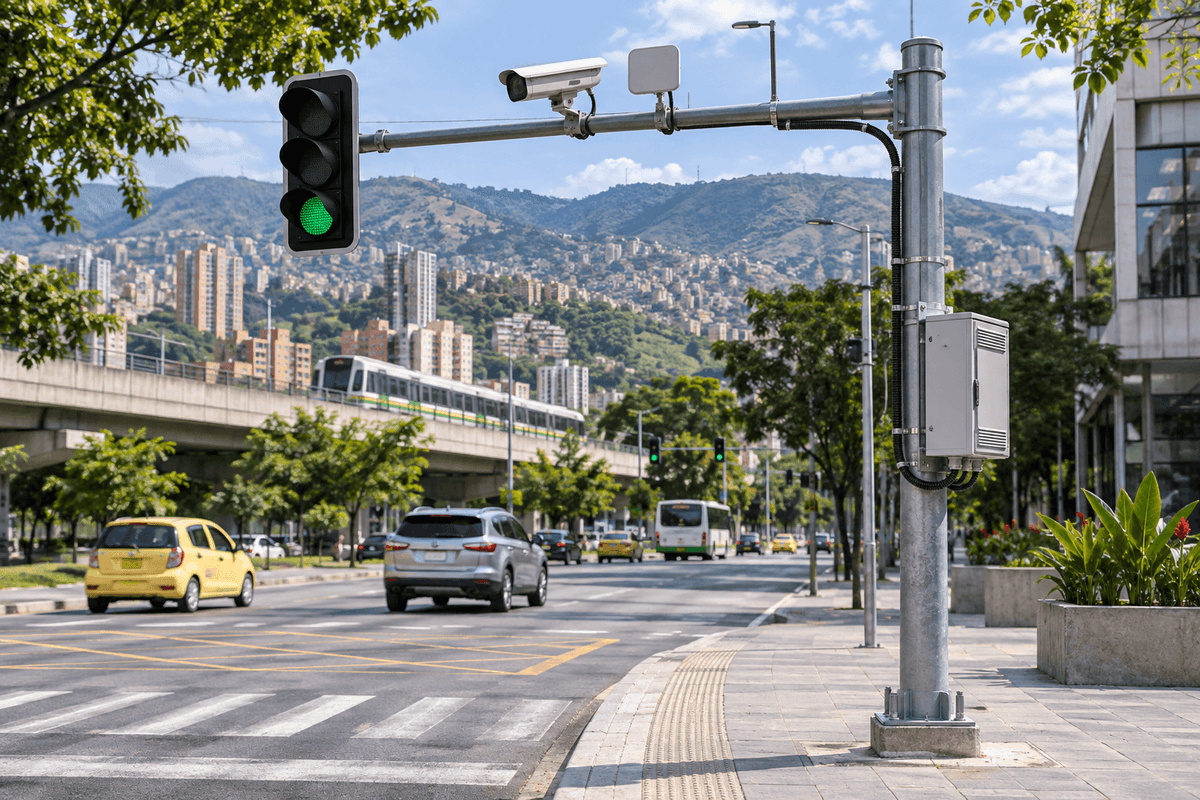
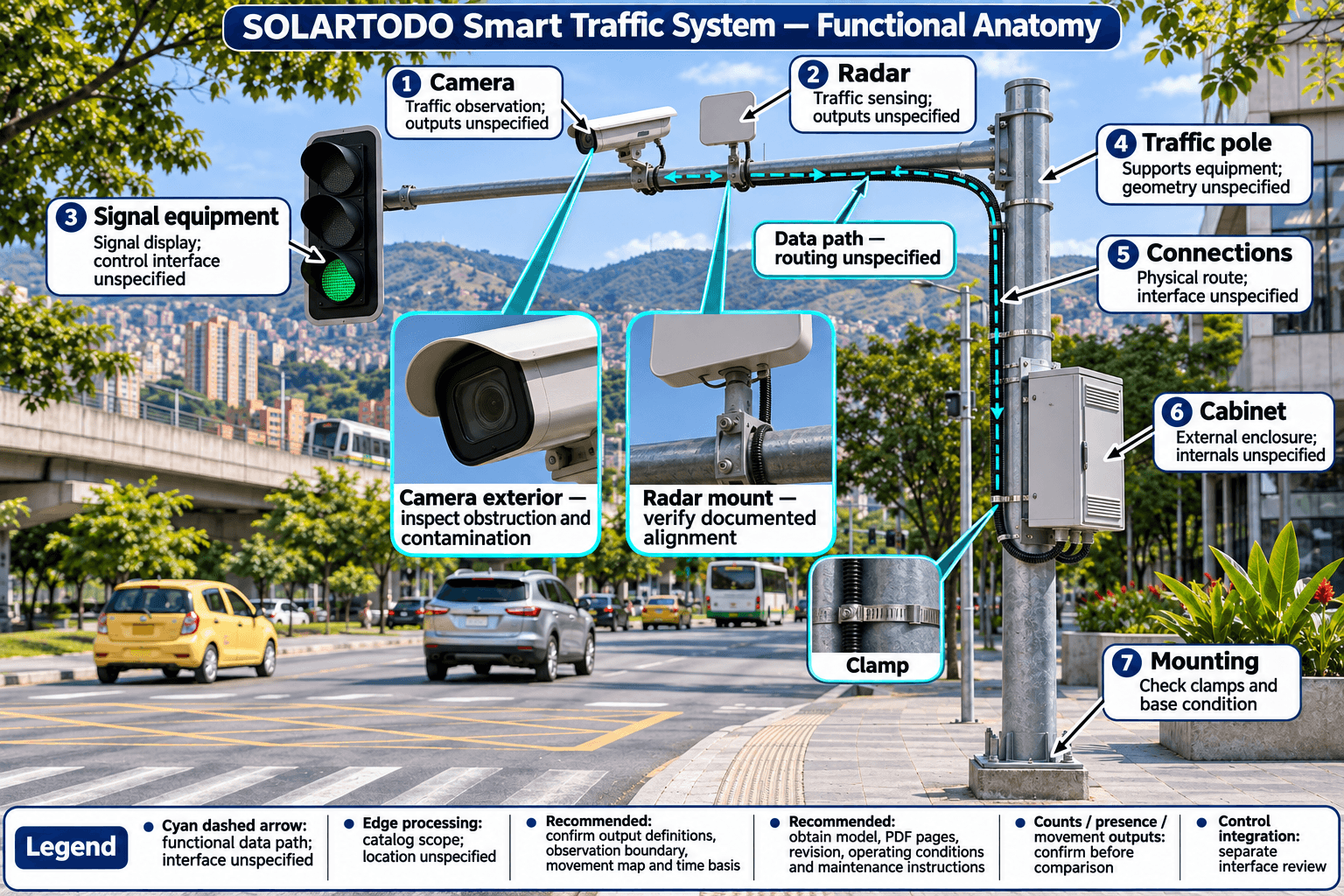
Catalog identity city-catalog-2026-11-01-v1 describes SOLARTODO smart traffic equipment as combining a traffic pole, camera, radar, signal equipment, and edge processing. The product route is SOLARTODO smart traffic, and the supplied public catalog URL is SOLARTODO smart-traffic equipment.
The supplied extraction establishes equipment-family scope only. It provides no selected sensor model, pole geometry, dimensions, operating conditions, signal-interface specification, certification, or measured performance. It does not establish an adaptive algorithm, output format, diagnostic function, data export, or controller interoperability.
No product PDF or PDF URL was supplied. Request the authoritative document and record the exact model, relevant pages, revision, operating conditions, and maintenance instructions. Resolve any conflict between that documentation and the proposed configuration before approval.
Proposed Design
Assign inspection and acceptance responsibilities
Use the following proposed allocation in the procurement scope:
- The maintenance owner keeps the equipment register, schedules inspections, records interventions, and identifies affected inputs.
- The installer records placement, proposed observation areas, configuration, and connections.
- The detector reviewer checks the proposed observation areas and movement map against the approved configuration.
- The reference reviewer reviews comparison observations and records unresolved events.
- The integrator checks how the receiving system interprets proposed inputs and handles unsuitable data.
- The buyer's acceptance authority records approval, restrictions, or rejection for each input and separately approves operational integration.
These are proposed contract responsibilities, not established SOLARTODO services. Name the accountable parties and their authority to approve changes.
Establish a maintenance baseline
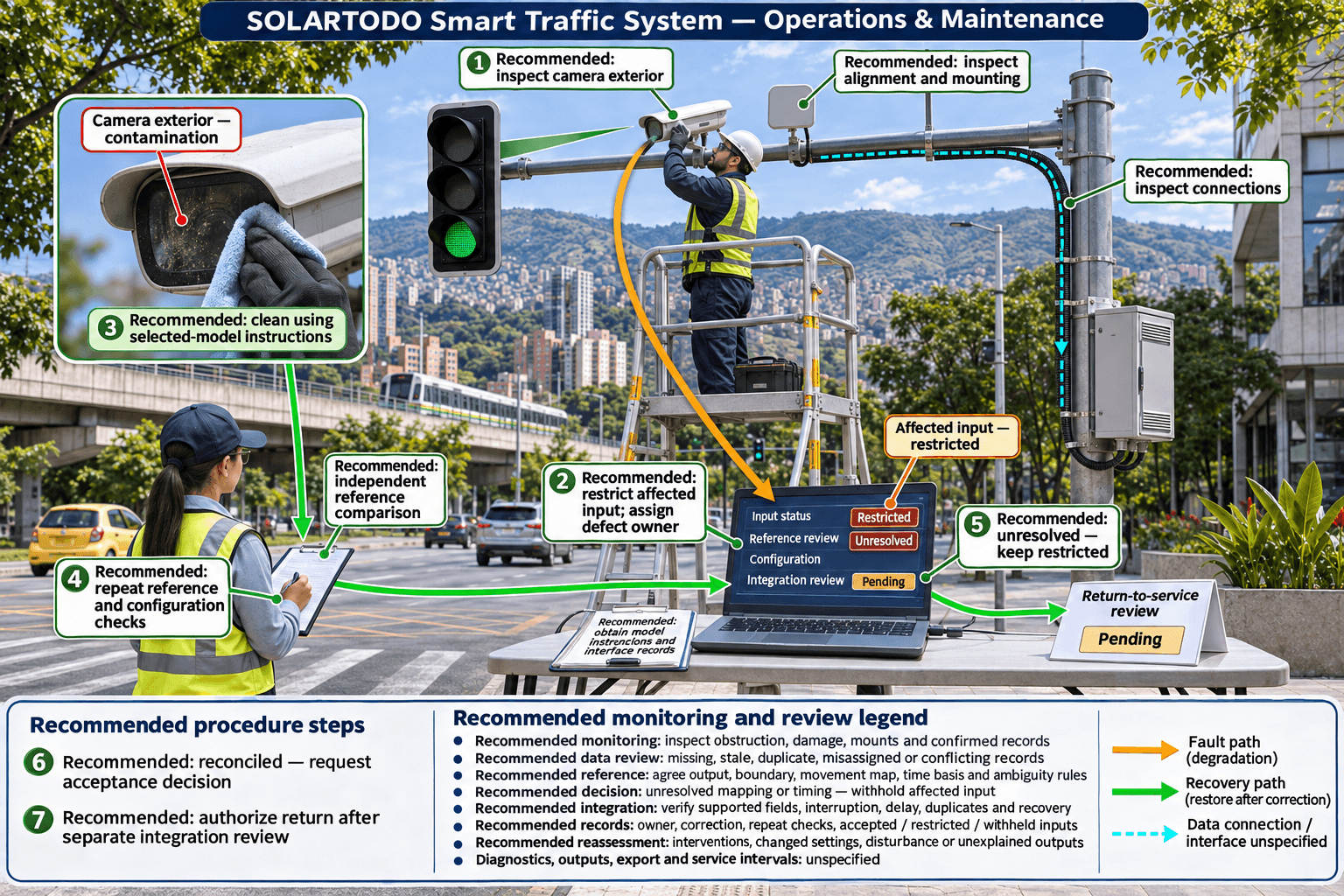
Require an inspection procedure based on the selected manufacturer's instructions. Proposed inspection subjects include obstruction, visible contamination, physical damage, mounting condition, radar alignment, connections, and consistency with the approved installation record. Include an item only where it applies to the selected configuration, and use documented inspection and adjustment methods.
Ask the supplier what continuity records, timestamps, configuration history, fault information, and diagnostic access are available. Plan evidence collection around confirmed access; the supplied catalog establishes no diagnostic or export capability.
Agree on inspection intervals after reviewing selected-model instructions and the proposed site survey. Also specify which interventions, configuration changes, physical disturbances, or unexplained output changes will trigger reassessment. The supplied evidence supports no universal inspection interval.
Define an independent reference comparison
Before observations begin, document the proposed output, observation boundary, movement identifiers, event definition, time basis, reference method, and ambiguity rules. Require the reference reviewer to explain how the chosen method will assess the requested output.
Where a count output is documented, a proposed comparison can record reference events alongside reported events and classify omissions, additional records, and movement-assignment discrepancies. Where a presence output is documented, agree on the reference definition and comparison intervals before testing. These are proposed test options, not catalog-confirmed capabilities.
Treat camera-radar agreement as a comparison item rather than the sole acceptance criterion. Require the reviewer to assess the proposed inputs against the agreed reference and retain unresolved observations in the record. Do not label an ambiguous observation as a successful match.
Separate data acceptance from control acceptance
Request an interface description covering field definitions, units where applicable, movement identifiers, timestamps, validity information, configuration identity, and unavailable-data behavior. Confirm which details the selected equipment actually supplies.
For the separate integration review, propose checks for interpretation of supported fields, interrupted input, delayed records, duplicates, recovery, and configuration mismatch. Agree on the receiving-system response, notification owner, and return-to-service authority before operational release. Do not silently substitute zero demand for unavailable observations unless the approved interface and receiving-system requirements explicitly call for that treatment.
The supplied FHWA validation guidance, Chapter 1 distinguishes verification of requested features from validation against operational objectives. Use separate acceptance records for detection-data checks, control integration, and any later evaluation of operational benefits.
Proposed Acceptance Criteria
Before testing, the buyer should approve a protocol that records:
- The selected configuration, required outputs, proposed movements, and documented operating conditions covered by the evaluation.
- The reference method, observation periods, reviewers, and treatment of unresolved observations.
- The discrepancy categories and acceptance limits for each confirmed output.
- The receiving system's documented input requirements and the proposed treatment of unavailable or unsuitable data.
- The evidence required to close a defect and the conditions requiring repeat evaluation.
No numerical accuracy threshold, freshness limit, sample quantity, or response deadline is established by the supplied product evidence. Request a documented basis for proposed values before adopting them. Do not present a buyer-selected threshold as a manufacturer specification.
Record any acceptance decision against its reviewed sample, configuration, and conditions. Keep claims about other conditions or traffic benefits outside that decision unless separately supported.
Survey/Acceptance Checklist
- Scope: Record the proposed location, equipment configuration, requested outputs, movement map, and excluded functions.
- Documentation: Obtain the authoritative product PDF; record model, pages, revision, operating conditions, maintenance instructions, and interface records.
- Inspection: Record applicable physical checks, findings, maintenance work, inspector, and procedure used.
- Configuration: Preserve the approved settings, observation boundaries, time basis, and available configuration identifier.
- Reference: Record the comparison method, observation periods, reviewer decisions, ambiguities, and limitations.
- Data review: Apply the agreed checks for omissions, additional records, misassignment, missing or stale records, duplicates, and conflicting observations where applicable.
- Corrective action: Assign the defect owner, affected input, restriction, corrective work, and repeat-test scope.
- Integration: Obtain separate evidence for supported-field interpretation, unsuitable-data handling, recovery, and authorized release.
- Decision: List accepted, restricted, and withheld inputs, their conditions of use, and reassessment triggers.
A proposed withholding rule is to exclude an affected input when its movement mapping remains unresolved, its timing cannot be reconciled with the reference, or its available records cannot support the agreed comparison. After correction, repeat the affected checks and ask the reviewer whether related inputs also require reassessment.
Keep unresolved defects visible in the final decision rather than closing them through an overall acceptance statement.
Limitations
The supplied catalog supports the listed equipment-family scope. FHWA supports the importance of maintained detection and the distinction between verification and operational validation. The detailed inspection roles, comparison procedures, and corrective-action gates above are buyer proposals for review, not procedures specified by those sources.
The pack contains no selected-model PDF, installation survey, interface specification, local operating authorization, or measured SOLARTODO detector results. It establishes no Medellín climate or traffic conditions, existing signal assets, customer deployment, detection accuracy, latency, certification, collision reduction, travel-time benefit, or interoperability outcome.
Benefits and field-study examples described by FHWA cannot establish results for this proposed application. Any operational evaluation should have its own agreed objectives, baseline, measurements, and integration evidence.
Procurement Questions
Ask the supplier to identify the exact camera and radar configuration and the authoritative PDF pages covering its operating conditions. Request documented outputs, maintenance procedures, available diagnostics, and access to records for independent comparison.
Ask the integrator to identify the proposed signal interface, receiving-system input requirements, and handling of unavailable or unsuitable data. Request configuration-specific evidence before approving integration.
Ask the maintenance provider to name inspection and correction owners. Have the buyer's acceptance authority approve the comparison protocol, defect-closure evidence, and reassessment triggers before testing.
Use contact to request the missing documentation and a configuration-specific response before committing on the basis of assumed capability or compatibility.
FAQ
Is Medellín an established SOLARTODO installation in this article?
No. Medellín is a proposed site; the supplied evidence establishes no local deployment or measured results.
Which equipment does the supplied catalog identify?
Catalog identity city-catalog-2026-11-01-v1 lists a traffic pole, camera, radar, signal equipment, and edge processing. It does not identify selected sensor models or interfaces.
Where are the product PDF, model, and operating conditions?
None were supplied. Request the authoritative PDF and record the selected model, relevant pages, revision, operating conditions, and maintenance instructions before model-specific approval.
Who should inspect and accept the detection inputs?
The proposed contract should name a maintenance owner, installer, detector reviewer, reference reviewer, integrator, and buyer acceptance authority, with responsibilities and approval powers recorded.
How should the buyer specify reference measurements?
First confirm the supported output. Then agree on its definition, observation boundary, movement identifiers, time basis, independent reference method, ambiguity rules, and acceptance limits before testing.
How often should inspections occur, and what closes a defect?
Agree on intervals using selected-model instructions and the site survey. Define reassessment triggers, and require documented correction, repeat checks, and an acceptance decision to close each defect.
What should happen to missing, stale, or conflicting records?
Identify them under the agreed protocol, record the affected inputs, and apply the approved receiving-system response. Require a separate decision before returning a restricted input to accepted use.
Does detection acceptance establish adaptive-control benefits or local approval?
No. Integration, operational benefits, and local authorization require separate evidence. FHWA materials provide United States methodological context, not Medellín requirements.
References
- SOLARTODO smart-traffic catalog: supplied catalog identity city-catalog-2026-11-01-v1; equipment-family scope only.
- FHWA, Measures of Effectiveness and Validation Guidance, Chapter 1: verification, validation, operational objectives, and measurement context.
- FHWA, Adaptive Signal Control FAQs: importance of maintained detection; the supplied page states a July 18, 2016 modification date.
- Authoritative product PDF: absent from the supplied evidence; no model, page, operating-condition citation, or PDF URL is available.
Proposed Equipment
- Traffic pole
- Camera
- Radar
- Signal equipment
- Edge processing