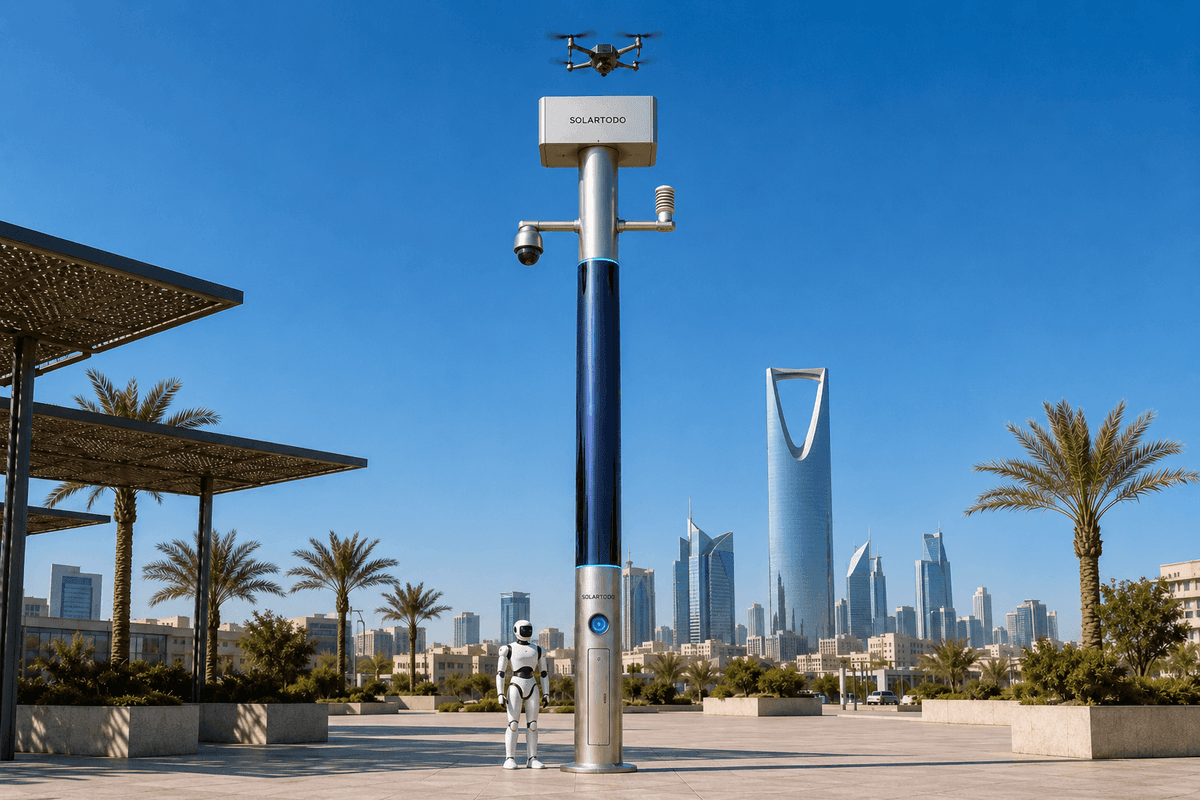
A City AI Pole is a non-lighting physical-AI edge node that combines off-grid energy, edge computing, sensing, drone operations and ground-robot support in one urban pole form. In this proposed Nairobi deployment, SOLARTODO Sentinel Sky Hub secures an industrial-park river-cross-section during a major sports-event period while keeping raw video and sensor data processed locally on the pole.
1. Deployment Context: A Sports-Event Security Surge at a Nairobi Industrial Park
This proposed pilot report is written for a Nairobi industrial-park operator preparing for a major sports-event period, when freight gates, contractor access, temporary parking, visitor movement and perimeter pressure can all rise at the same time. The operating site is assumed to include warehouses, service roads, drainage channels, pedestrian edges and a river-cross-section boundary where informal crossings, blind approaches and night-time movement create higher security workload than a standard gate-only model can handle. The goal is not to add public street infrastructure. It is to place SOLARTODO Sentinel Sky Hub poles as physical-AI urban edge nodes where the park’s security team needs sensing, local compute, drone tasking, robot patrol and off-grid resilience without depending on city, grid or site power.
The buyer in this case is the park operator, not a public lighting department. The operator’s KPI is opex: fewer repeated manual sweeps, fewer vehicle callouts for low-value checks, clearer evidence trails after alarms and better use of trained guards during peak-event windows. Nairobi’s practical challenge is that security routes can be interrupted by traffic, weather, temporary vendors, crowd spillover and river-edge access points. A fixed camera can see only what it sees. A manual patrol is expensive when it is repeated every hour. A drone can cover distance quickly, but endurance becomes the bottleneck when each flight requires a person on site to land, replace a pack and restart the mission. The Sky Hub deployment is therefore framed around drone-endurance relief, with the ground robot as the main module focus for persistent near-field response.
2. Proposed River-Cross-Section Layout and Operating Model
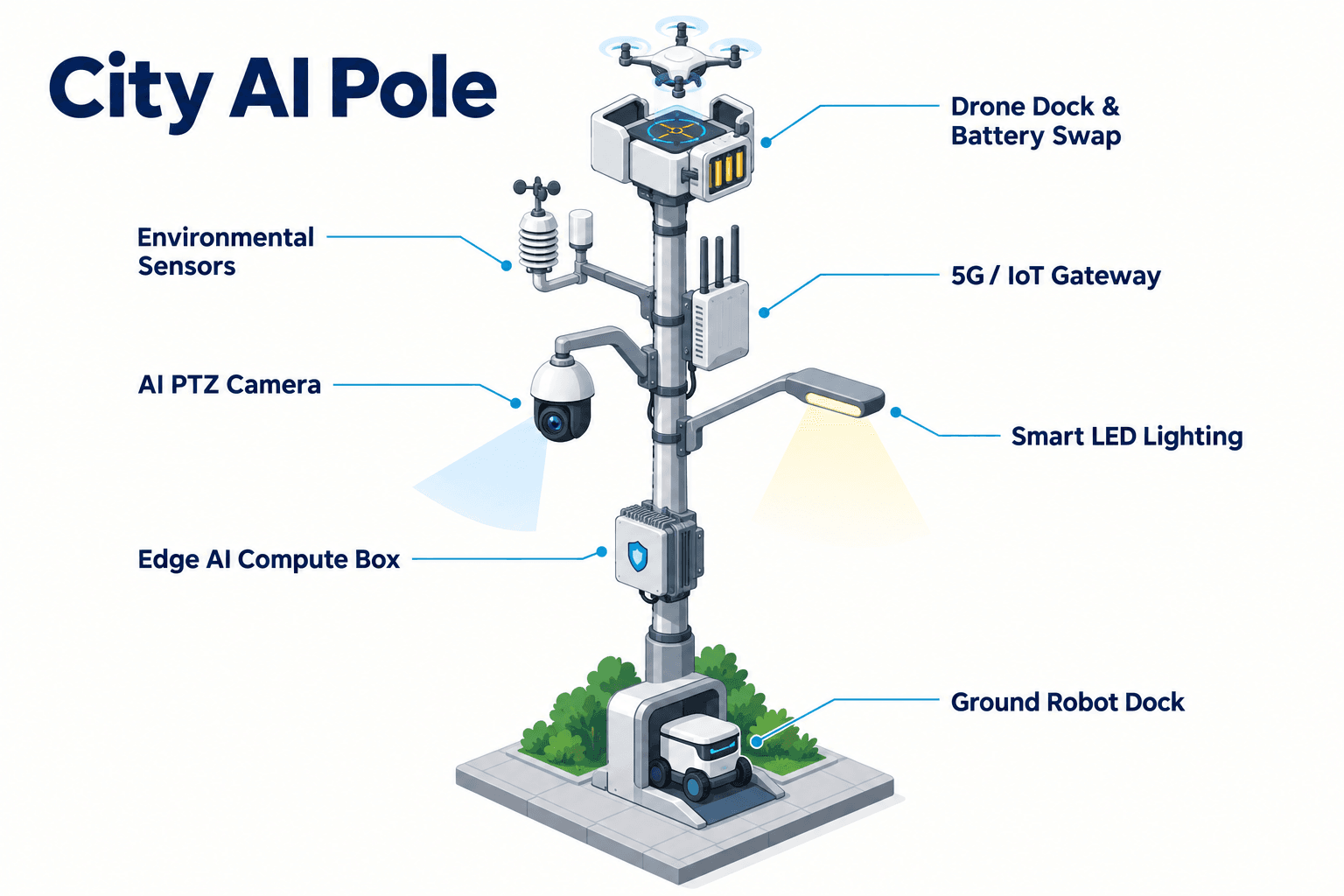
The proposed configuration places Sky Hub nodes along the industrial park’s river-cross-section, with each pole positioned to observe a defined slice of the perimeter, service road and access approach. Final pole count, spacing and patrol radius would be confirmed by site survey, radio assessment, aviation review, solar exposure and ground-robot route validation. The planning principle is simple: use the pole as a local operating cell, then combine multiple cells into a common-operating-picture command view. Each node performs local perception, stores raw sensor and video data on the pole, and transmits only de-identified event and status metadata to the command interface.
Sky Hub is a PURE smart pole with no lighting system. Its purpose is to host city-edge intelligence, not illumination. The pole carries battery storage and approximately 15 m2 of 360-degree wrapped flexible CIGS thin-film solar over a vertical cylindrical body around 8 m tall and 0.6 m wide, with about 2.4-2.7 kWp nameplate. For planning honesty, the wrap is not treated as if the full surface receives direct sun at once. In a high-irradiance region, realistic clear-sky production is roughly 0.8-1.1 kW DC peak, typically stronger in the morning and afternoon than at noon, and about 6-9 kWh/day. Nairobi engineering confirmation would adjust those figures for local shading, rainy-season duty cycles and site microclimate.
Because the solar layer is supplemental replenishment, mission continuity comes from energy scheduling and 5-20 kWh-class storage. During the sports-event window, the command team can assign higher drone and robot duty cycles to gates, river edges and temporary parking zones while reducing non-critical inspection frequency elsewhere.
3. Solving the Drone-Endurance Pain Point With Ground-Robot Continuity
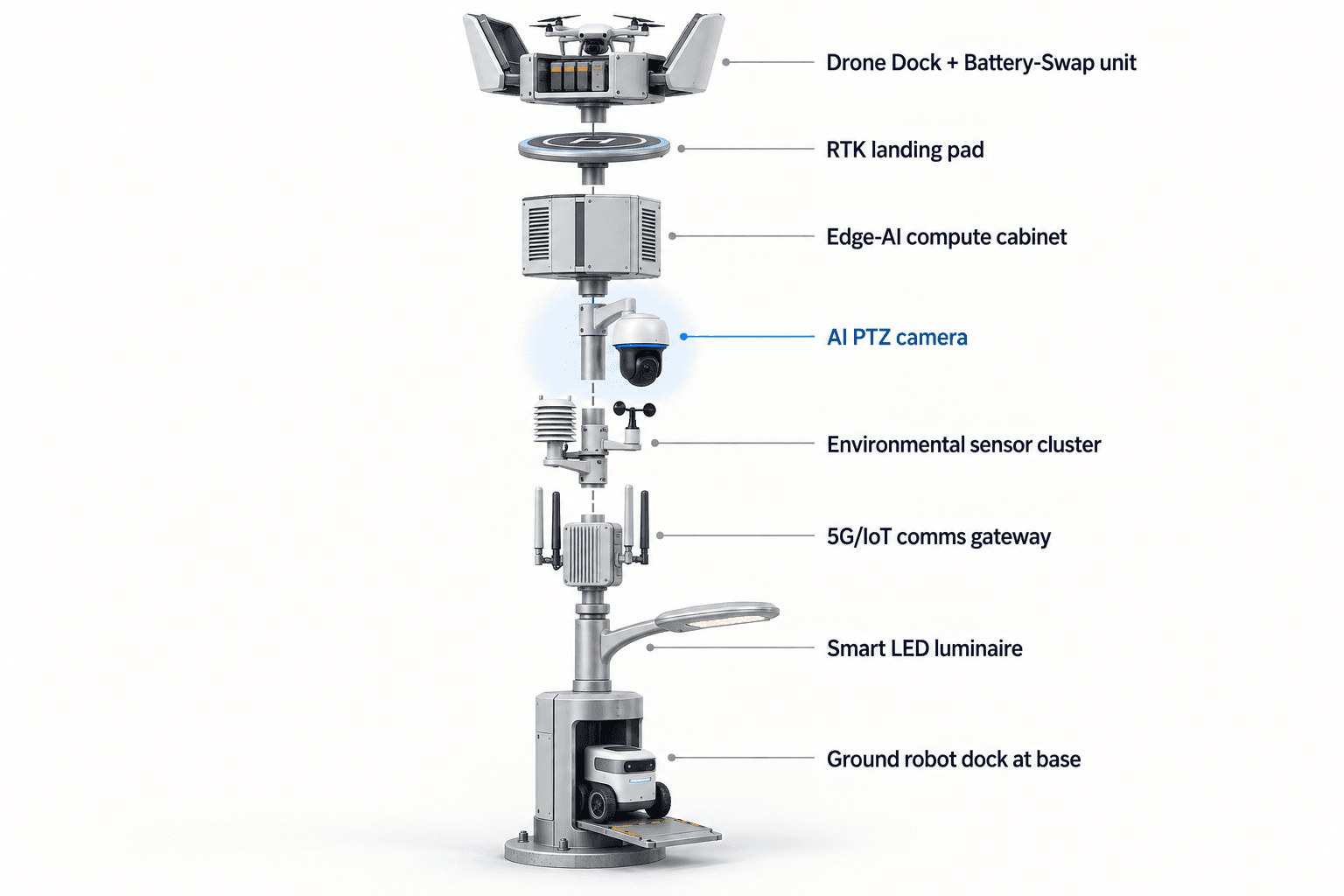
The core operating issue is drone endurance. Aerial patrol is valuable over a river boundary because it can cross line-of-sight gaps, inspect a suspected intrusion path, verify a parked vehicle cluster and check fence conditions faster than a walking patrol. But if every sortie requires a human operator at the pole, the opex case weakens. Sky Hub addresses this with autonomous launch, regional patrol, inspection, return and task redeployment, plus a multi-bay drone battery hot-swap magazine. After landing, the drone receives an automated rear-service battery exchange from a charged bay and can relaunch for another assigned sortie. Multiple bays support several consecutive missions, subject to weather, airspace authorization, storage state and operator policy.
The ground robot carries the continuity role. It patrols near the pole base, checks gate queues, inspects fence-line anomalies, approaches low-speed incidents, supports air-ground coordination and returns to the pole base for wireless charging. In a sports-event surge, this matters because many alerts are close-range and repetitive: a person lingering near a service culvert, a parked vehicle blocking a maintenance route, a crowd density increase near a contractor gate, or a perimeter alarm that needs a camera angle lower than the pole’s PTZ view. The robot reduces the need to send a guard vehicle for every first look.
The drone and robot are scheduled together. The drone provides a fast overhead view; the robot provides slower, persistent contact with the ground route. The pole’s drone operations management stack handles route planning, swap and charge state, task queueing, fleet health and mission logs. The result is not a claim of unlimited operation. It is a duty-cycle-managed security cell that uses battery buffering, local compute and autonomous field assets to reduce routine patrol load.
4. Edge-AI Security, Environmental Awareness and Human Authorization
Each Sky Hub node uses an AI PTZ camera with local perception for anonymous vehicle count, crowd density, intrusion and perimeter awareness. It does not rely on face recognition or licence-plate recognition as an active deployed capability in this proposed configuration. The environmental package supports nine-in-one monitoring: wind speed, wind direction, temperature, humidity, atmospheric pressure, noise, PM10, PM2.5 and illuminance. For a Nairobi industrial park, these readings help the operations team understand whether high winds should pause drone launch, whether dust or rain requires route adjustment, and whether noise or crowd-density changes align with the event traffic pattern.
The edge AI compute cabinet uses a Jetson-class module, either Orin- or Thor-class depending on confirmed workload and thermal design. Local inference runs on the pole. Workloads are scheduled on-pole so raw video and sensor streams stay on the node; only de-identified event records, health state, task status and selected operator-approved metadata leave the site boundary. The data-handling posture is PDPL-LGPD-oriented and designed for local processing. It should not be described as certified or already compliant without a separate legal and technical audit.
Counter-UAS coordination is included as a non-lethal, human-authorized workflow. If an unauthorized drone is detected and tracked by the pole’s own sensing or an optional partner-sensor input, the Sky Hub can command its own friendly drone to perform close-approach deterrence or soft aerial net-capture after authorization. Radar is not built into the pole; it can only be treated as an optional or partner-sensor input. The workflow excludes shoot-downs, jamming, autonomous attacks and other hard-force responses.
5. Opex Evaluation: What the Park Operator Should Measure
The proposed pilot should be evaluated as an operating model, not as a product demonstration. Before deployment, the park operator should define the baseline number of guard patrols, vehicle dispatches, manual fence checks, overnight incident reviews and event-day control-room escalations. During the sports-event operating period, the same categories should be measured against Sky Hub task logs, robot patrol records, drone sortie records, hot-swap cycles, environmental pauses and human authorization decisions. The most useful KPI is not a single headline number. It is the avoided repetition of low-value field checks while preserving human control over consequential actions.
A practical command view should show the operations loop as sensing, authorized assessment and response, edge-compute scheduling, then field operations and maintenance. In Chinese operating language this maps to the integrated idea of 运查打算协同: sense, inspect, act, calculate and coordinate maintenance through one common operating picture. For the Nairobi park operator, that means one screen for perimeter events, robot state, drone battery bays, current sorties, environmental constraints, pole health and mission evidence.
The right conclusion for a proposed pilot is conditional. If final engineering confirms solar exposure, storage sizing, safe drone operating envelopes, robot route quality, privacy review, security procedures and maintenance staffing, Sky Hub can be used as a mature physical-AI edge-node layer for high-pressure industrial-park security. The buyer should treat all KPI values as target planning inputs until measured on site. The business case is strongest where the river boundary creates repeated inspection work and where automated drone battery exchange removes the main endurance drag on event-period security operations.
System Configuration
| Parameter | Configuration |
|---|---|
| Pole form | SOLARTODO Sentinel Sky Hub PURE smart pole; non-lighting physical-AI edge node for sensing, compute, drone and robot operations |
| Energy system | Fully off-grid battery-backed micro-station with approximately 15 m2 360-degree wrapped flexible CIGS thin-film solar replenishment and 5-20 kWh-class storage |
| Edge AI compute | On-pole Jetson-class inference cabinet, Orin- or Thor-class depending on final workload and thermal engineering |
| Camera and sensing | AI PTZ security camera plus local perception for anonymous vehicle count, crowd density, intrusion and perimeter awareness |
| Environmental monitoring | Wind speed, wind direction, temperature, humidity, atmospheric pressure, noise, PM10, PM2.5 and illuminance |
| Drone operations | Autonomous launch, patrol, inspection, return, task redeployment and multi-bay rear-service battery hot-swap |
| Ground robot module | Autonomous patrol, alarm response, inspection, air-ground coordination and wireless charging at the pole base |
How It Works
- On-pole camera and sensors flag an anomaly at the river-cross-section perimeter.
- Edge AI classifies the event locally and sends de-identified metadata to the command view.
- A human operator authorizes drone inspection, robot response or watch-only escalation.
- The drone launches or relaunches after hot-swap while the ground robot moves to the nearest safe inspection point.
- Mission logs, battery state, environmental conditions and operator decisions are recorded for opex review.
Planning Assumptions (Indicative)
Illustrative planning inputs a buyer can recompute — target metrics, not achieved results. Subject to final engineering confirmation.
| Metric | Planning assumption | Indicative value |
|---|---|---|
| Inspection labor | Drone and robot patrols replace repeated low-value perimeter checks during event weeks | ~20-40 routine patrols/week automated |
| Vehicle dispatch | Robot first-look response reduces guard vehicle trips for non-critical alarms | ~30-50% of low-priority checks screened remotely |
| Drone continuity | Multi-bay hot-swap allows consecutive sorties without an on-site battery technician at each landing | ~3-6 back-to-back sorties per charged magazine cycle |
| Control-room review | Local event metadata and mission logs reduce manual review of uneventful raw footage | ~50-70% fewer routine review segments targeted for human screening |
| Maintenance planning | Battery state, solar replenishment, robot charge state and bay health are reviewed daily before peak event shifts | 1 planned operating check/day per active node cluster |
Deployed Equipment
- SOLARTODO Sentinel Sky Hub pole body with integrated off-grid energy cabinet
- 360-degree wrapped flexible CIGS thin-film solar replenishment layer
- 5-20 kWh-class battery storage system
- AI PTZ camera and environmental sensor suite
- Jetson-class edge AI compute module in on-pole cabinet
- Autonomous drone landing and multi-bay battery hot-swap assembly
- Ground robot wireless charging interface at pole base
- Common-operating-picture command view for mission and maintenance logs
Frequently Asked Questions
Is Sky Hub a smart streetlight or part of a lighting upgrade?
No. In this Nairobi industrial-park configuration, Sky Hub is specified as a PURE smart pole with no lighting system. Its role is to host off-grid energy storage, local compute, sensing, drone operations, ground-robot charging and security workflows. It is intended for perimeter, campus, park and critical-zone operations rather than public illumination projects.
Can the pole run fully off-grid during a major sports-event period?
The system is designed as a fully off-grid, battery-backed micro-station with on-pole CIGS solar replenishment. The solar wrap should be treated as a supplemental layer, not as unlimited pure-solar self-sufficiency. High-power drone and robot tasks are buffered by 5-20 kWh-class storage and scheduled by duty cycle, subject to final site engineering, weather and mission policy.
How does the deployment address drone-endurance limits?
The proposed operating model uses autonomous launch, return, task redeployment and a multi-bay drone battery hot-swap magazine. A landed drone can receive a charged pack through an automated rear-service exchange and relaunch without requiring a technician at the pole. The buyer should evaluate this as a target opex lever, then confirm sortie cadence under local weather, airspace and storage constraints.
What role does the ground robot play if drones are already available?
The ground robot is the continuity layer for close-range patrol and alarm response. It can inspect gates, fence approaches, service roads and river-edge access points where an overhead view is not enough. It also helps screen low-priority alarms before a guard vehicle is dispatched, then returns to the pole base for wireless charging after completing assigned tasks.
What data leaves the pole?
The intended data posture is local-first. Raw video and raw sensor data stay on the pole and are processed by the edge AI module. Only de-identified event metadata, task status, health state and mission records should leave the node for the common-operating-picture view. The design is PDPL-LGPD-oriented, but certification or formal compliance should be verified separately.
Does the system identify faces or licence plates?
No such active capability is claimed for this proposed Nairobi configuration. The PTZ camera and local perception are framed around anonymous vehicle count, crowd density, intrusion and perimeter awareness. This keeps the security workflow focused on operational risk signals while reducing exposure of personally identifiable surveillance functions that would require separate legal, policy and technical review.
How is counter-UAS handled around the industrial park?
Counter-UAS coordination is limited to detection, tracking and human-authorized non-lethal response. If an unauthorized drone is detected by on-pole sensing or an optional partner-sensor input, the node can command a friendly drone for close-approach deterrence or soft aerial net-capture after approval. The workflow excludes shoot-downs, jamming, denial actions and autonomous attack.
What should the park operator verify before procurement?
The operator should confirm pole placement, solar exposure, storage sizing, river-crossing visibility, robot route surfaces, drone operating permissions, weather constraints, maintenance access, data-governance requirements and control-room procedures. KPI values in this report are illustrative planning inputs only, so the final business case should be recalculated from measured patrol logs, incident workload and energy duty cycles.
Explore Further
- City AI Pole / smart streetlight product line
- More smart-city deployment cases
- Talk to our engineering team
Planning a similar physical-AI deployment for streets, campuses or public spaces? Request an engineering consultation