Summary
Panama City, Panama, is solely a proposed site for evaluating an integration built around SOLARTODO smart traffic equipment. Start procurement by requiring the integrator to declare whether the selected configuration uses a traffic model and whether its outputs can influence live signal timing. If a model is used, require reproducible comparisons against independent field observations, named responsibility for every adjustable parameter, and evidence that the approved configuration can be restored. If the integrator confirms that no traffic model is used, assess the supplied perception and control functions against their stated requirements. The evidence pack identifies the product family but supplies no product PDF, selected model identifier, or operating conditions. It supports an evaluation brief. Model-specific acceptance remains pending those records.
Key Takeaways
- Obtain a signed configuration declaration showing where a traffic model is used, what it consumes, and who or what can act on its outputs.
- Agree on the operating objective and observation protocol before the integrator collects calibration data.
- Reserve independent observations for validation and require comparisons by approach, movement, and agreed operating condition.
- Assign separate responsibility for proposing a parameter change, approving it, applying it, and checking the result.
- Require a commissioning packet with traceable observations, versioned settings, validation results, unresolved exceptions, and a witnessed restoration test.
- Define when an operator should investigate drift, who authorizes recalibration, and what evidence is required before revised settings return to service.
Proposed problem
The purchasing question is whether the candidate signal integration can be accepted and maintained when a traffic model informs its decisions. The first risk is ambiguous scope. Ask the integrator to specify whether the proposed integration uses a traffic model during design, during operation, or both, and to identify any role its outputs play in advising operators or changing signal timing. Each use calls for evidence about a different decision. An offline model needs evidence for the design decisions it informed. A live model also needs evidence linking its inputs and outputs to the decisions the integration makes during operation.
Ask the integrator to identify the traffic model, its version, its outputs, and the decisions that depend on them. Ask for the path from field observations through processing to the signal interface, including every point where a person can approve, modify, or reject an action. Have the integrator distinguish a traffic model that estimates or represents traffic behavior from any sensor-processing algorithms it may use. If model use remains unknown, record that as an open procurement issue before setting the acceptance scope. If the declaration confirms no traffic model, verify documented functions, interfaces, and controller behavior and validate them against the buyer's agreed operating objectives. The FHWA guidance distinguishes verification against requirements from validation against operating objectives. FHWA validation guidance, Chapter 1
Source-backed product boundary
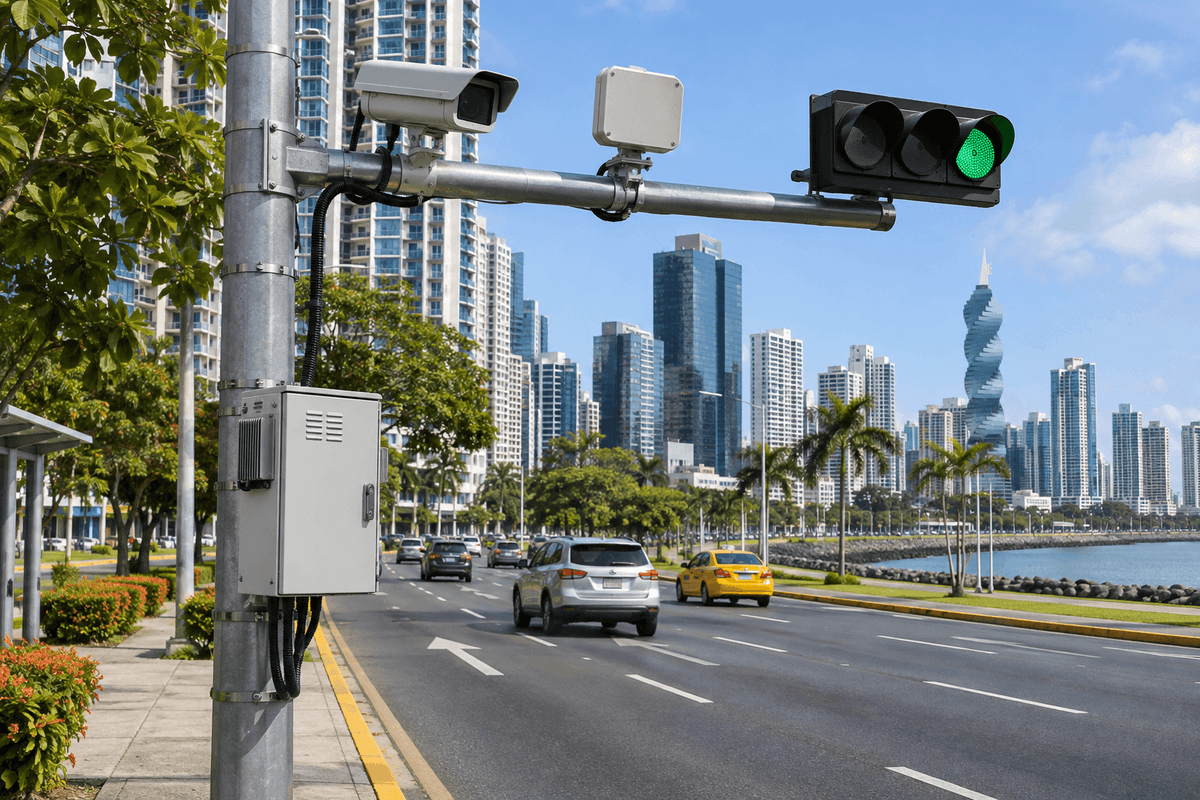
The SOLARTODO catalog record, city-catalog-2026-11-01-v1, identifies a smart traffic equipment family combining a traffic pole, camera, radar, signal equipment, and edge processing. That record supports the family-level description of traffic perception and control equipment. Pole geometry, dimensions, sensor selection, and signal interfaces depend on the selected configuration. Review the SOLARTODO smart traffic product page alongside the configuration submitted for the proposed evaluation. Public SOLARTODO catalog page
The evidence pack contains no product PDF or PDF URL, so there is no model-specific page to cite. Request the authoritative PDF and applicable page numbers, the offered model identifiers and revisions, and the operating conditions for each claim offered for acceptance. Resolve any discrepancy in favor of the applicable product PDF and record its page and configuration context in the procurement file. The catalog alone establishes no traffic model, adaptive control function, detection accuracy, latency, interoperability outcome, or measured field performance. The FHWA FAQs describe how some adaptive signal control systems use traffic models to evaluate performance and develop timing changes that the systems then implement. FHWA adaptive signal control FAQs
Proposed design
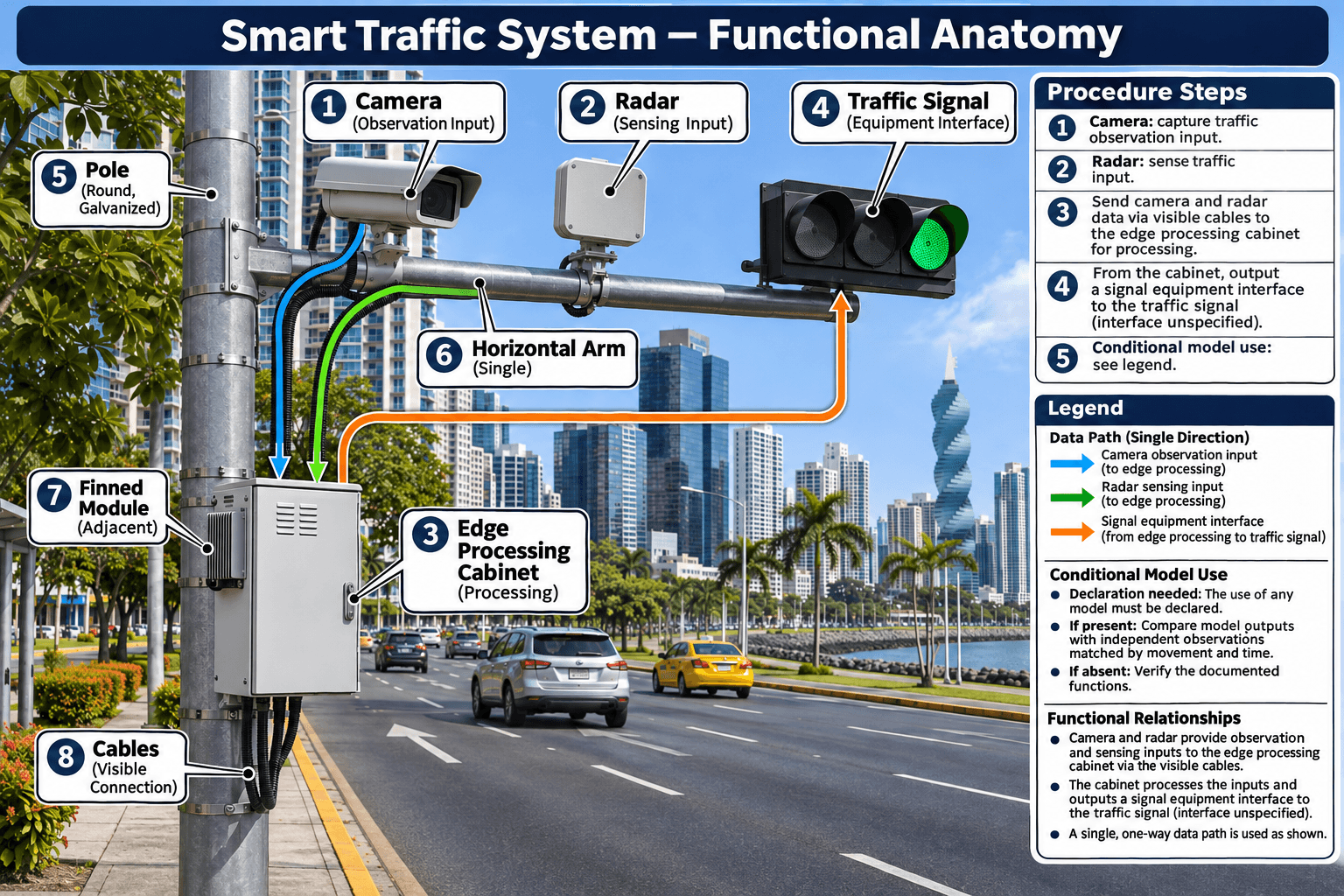
Begin with a jointly approved description of the control boundary. The integrator should mark which inputs come from field equipment, which values the model estimates, which outputs feed an operator or control process, and which component can write timing changes. Require a demonstration of the declared path with the offered configuration. For live operation, record how the operator can identify current settings, recognize a data or model fault, and invoke the approved fallback. Specify the expected behavior before the demonstration and capture what the controller actually applied.
Choose comparisons by tracing each output to the decision it supports. If the model estimates queues, compare predicted and observed queues for the same movement, timestamp, and queue definition. If it estimates arrivals, compare its arrival profile with independent counts on the same time base. If it emits route travel time, use observations that cover the same route endpoints and direction. For a timing recommendation, retain the recommendation, the controller's executed timing record, and the observations used to assess the operational objective. Identify values already fed into the model. The FHWA adaptive signal control FAQs describe model calibration as tuning the model to better match observed traffic behavior.
Define how reviewers will establish the reference record, including how they will document uncertain observations, missing intervals, and timestamp corrections. Agree on inclusion and exclusion rules before reviewing results. Keep calibration observations separate from the reserved validation observations. Version both data sets, preserve the mapping from raw records to comparison tables, and document the parameter changes made during fitting. Once settings are frozen, run validation against the reserved observations. If the team tunes settings after reviewing validation results, obtain a fresh independent set for the next acceptance decision. Report error direction, error magnitude, and usable sample coverage by agreed movement and operating condition so a pooled average cannot hide recurring disagreement.
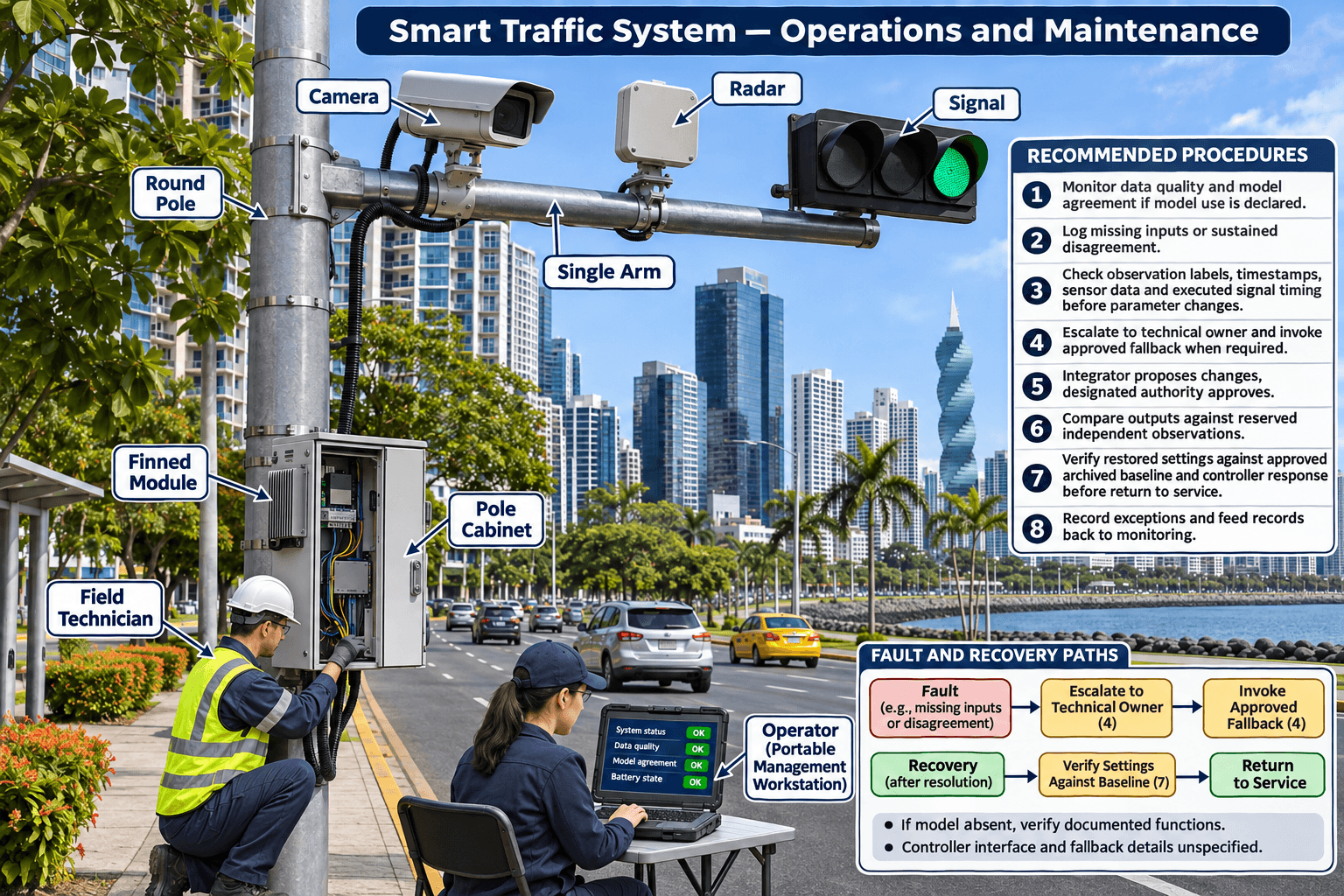
Assign the integrator responsibility for documenting parameter meaning, proposing initial settings, explaining changes, and reproducing the comparisons. Assign the buyer's designated traffic engineering authority responsibility for approving the observation protocol, permitted changes, the accepted baseline, and release to operation. Assign the designated operator responsibility for monitoring data quality and model agreement, recording anomalies, and following the approved escalation or fallback procedure. Ask the supplier to document which settings adjust automatically, which require expert intervention, and how changes can be identified and restored. FHWA describes both automatic and human-driven model adjustment in adaptive signal control. FHWA adaptive signal control FAQs
Explicitly hypothetical measurable evaluation assumptions
Use these example quantities to discuss test scope and reporting. The buyer should agree the observation protocol, the conditions covered, and the decision criteria before data collection. Apply each output-specific measure only when the candidate integration actually exposes that output and independent observations can support the comparison.
Hypothetical evaluation assumption: The validation schedule reserves four observation sessions separate from the sessions used for fitting.
Hypothetical evaluation assumption: Arrival counts are compared in five-minute intervals by approach and movement where arrival estimates are available.
Hypothetical evaluation assumption: Queue error is summarized by the median absolute difference in vehicles and the mean signed difference in vehicles for each evaluated movement where queue estimates are available.
Hypothetical evaluation assumption: A validation report flags any evaluated movement with more than ten percent unusable planned observation intervals for buyer review before acceptance.
Hypothetical evaluation assumption: The commissioning demonstration includes one witnessed restoration of the approved configuration and a comparison of restored settings against the archived baseline.
Survey and acceptance checklist
Before the survey. Confirm the offered equipment and integration revision, the intended operating objective, the control boundary, and the documentation needed to tie each test to the offered configuration. Identify the proposed movements, observation points, controller records, reference clock, and available observation methods. Ask who can access the records and who will label uncertain or unusable observations. Confirm that the proposed observation plan can independently check the outputs that matter to the decision.
During the survey and test. Record the field layout and the conditions actually observed. Check timestamp alignment, movement labels, consistency of observation boundaries, and completeness of controller records before fitting. Record any differences between the offered design and the tested configuration. Keep a log of unavailable data and explain how it affects coverage. When investigating disagreement, check observation labels, synchronization, sensor data quality, and executed signal timing before altering parameters.
Before commissioning. Require the signed model-use declaration, a versioned configuration and parameter register, the observation protocol, traceable calibration and validation records, and a comparison report with exceptions and reviewer decisions. Include evidence of what the controller executed, where applicable. For live control, witness the agreed failure response and restoration of the approved settings and record the outcome. Obtain a named acceptance decision that identifies the approved version, the evaluated conditions, and any open limits on use.
Before accepting recalibration. Investigate sustained disagreement, a change in field layout or signal configuration, a change in the observation or processing chain, or a software revision that affects decisions. The operator should log the trigger and route it to the designated technical owner. The change packet should show the reason, previous and proposed values, affected outputs, independent comparison results, and the restoration record or procedure. Require the designated approving authority to sign off before the revised settings return to service. Retain the original baseline and the change history so later reviewers can reproduce the decision.
Limitations
The evidence pack provides no selected configuration, site survey, local traffic measurements, approved operating objective, or actual integration test records. The proposed comparisons depend on which outputs the offered integration exposes and which observations the buyer can obtain. Document any gaps in movement or condition coverage as limits of the evaluation. Field agreement supports a finding about the tested output under the documented conditions. Evidence that a control function improves an operating objective requires a separately agreed comparison against an appropriate baseline. FHWA validation guidance, Chapter 1
Procurement questions
- Which exact configuration is offered, and which product PDF pages establish its model identifiers, interfaces, and operating conditions?
- Does a traffic model run during design, during operation, or both, and which decisions depend on it?
- Which inputs and outputs can reviewers export with timestamps, movement labels, quality flags, and configuration versions?
- Which settings are fixed, manually adjustable, or automatically updated, and who can view, change, approve, and restore them?
- How will the supplier demonstrate agreement with reserved independent observations and explain mismatches or unusable intervals?
- What does the live integration do when required inputs disappear, and how will the controller's response and the restoration of the approved settings be demonstrated?
- Who owns the evidence and change history after handover, and what will the supplier provide when a change triggers recalibration?
FAQ
Does the SOLARTODO catalog establish that a traffic model is used?
No. Require the integrator to declare model use and show where its outputs influence the selected integration.
What if the integration uses no traffic model?
Verify the documented perception and control functions and validate them against the buyer's agreed operating objectives.
What should reviewers compare with field observations?
Compare the outputs that inform decisions, using independent observations matched by movement, time, and measurement definition.
Can the same observations be used for fitting and acceptance?
Reserve independent observations for acceptance. If the team tunes settings after seeing those results, use fresh independent observations for the next decision.
Who should approve parameter adjustments?
The integrator should propose and document changes. The designated traffic engineering authority should approve them, and the operator should monitor the approved configuration and escalate anomalies.
What should be available before commissioning?
Require the model-use declaration, the approved version and parameter register, traceable validation results, documented exceptions, and evidence of fallback and restoration for live control.
What should trigger a recalibration review?
Investigate sustained disagreement or relevant changes to field layout, signal configuration, the data chain, or software. Require independent evidence and approval before revised settings return to service.
Can the buyer accept a model-specific product claim from the supplied pack?
The pack supports the catalog family scope. Obtain the authoritative product PDF with the applicable model, page, and operating conditions before accepting a model-specific claim.
References
- SOLARTODO smart traffic equipment. Catalog identity
city-catalog-2026-11-01-v1supports the family-level scope. The supplied pack contains no product PDF URL, model identifier, applicable PDF page, or model-specific operating conditions. SOLARTODO smart traffic catalog - FHWA, Measures of Effectiveness and Validation Guidance for Adaptive Signal Control Technologies, Chapter 1. U.S. methodological context for connecting operational objectives, measures, and data sources. FHWA validation guidance
- FHWA, Adaptive Signal Control FAQs. U.S. technical context for traffic model use, calibration, and automatic or human-driven parameter adjustment. FHWA adaptive signal control FAQs
Proposed Equipment
- Traffic pole
- Camera
- Radar
- Signal equipment
- Edge processing