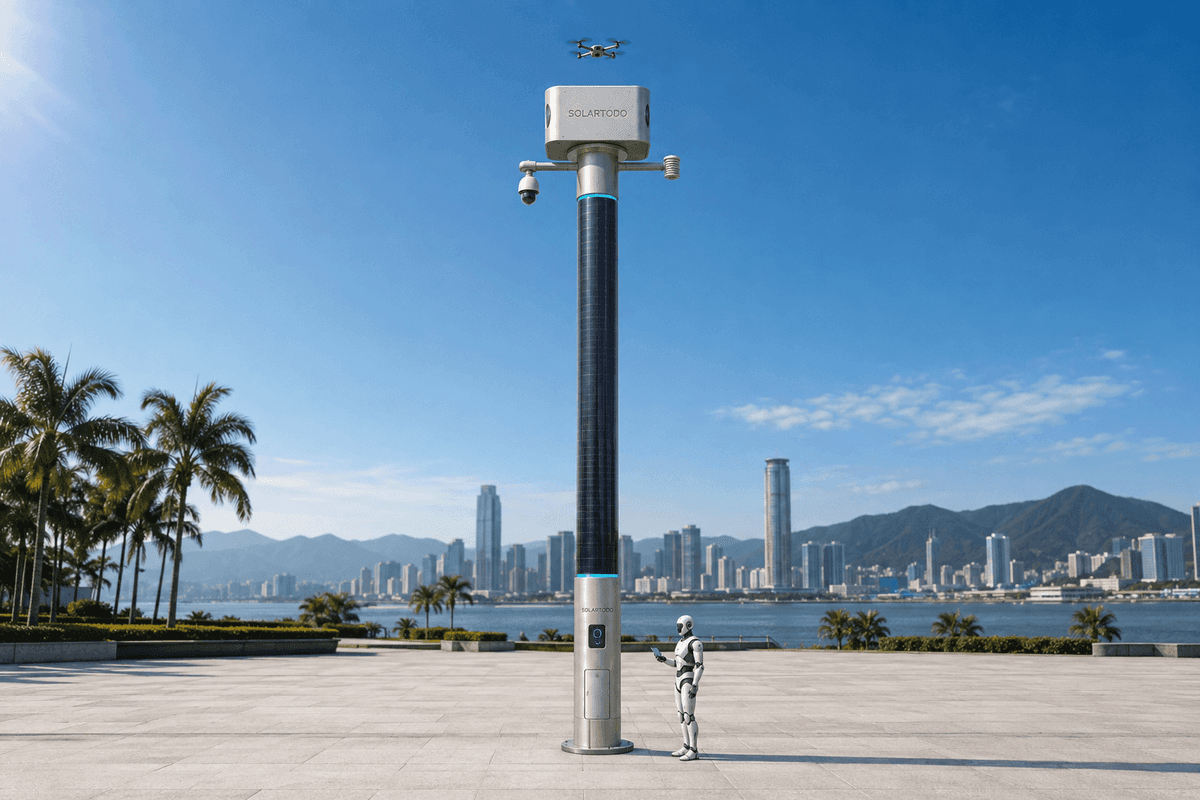
Penang coastal perimeter resilience: SOLARTODO Sentinel City AI Pole configuration for 115 off-grid edge nodes
Summary
Penang’s 1.8 million population, 4,748 people/km² in Timur Laut, and Malacca Strait exposure make approximately 115 off-grid SOLARTODO Sentinel City AI Pole nodes a practical edge-AI configuration for coastal, campus, port-adjacent and dense old-town zones.
Key Takeaways
- A typical Penang configuration would use approximately 115 SOLARTODO Sentinel City AI Pole nodes at about 30 m spacing, subject to survey confirmation.
- Each Sky Hub pole form carries about 15 m² of wrapped flexible CIGS with realistic clear-sky output of roughly 0.8-1.1 kW DC peak.
- The energy architecture should pair solar replenishment with 5-20 kWh-class storage, because drone and robot tasks draw burst power.
- Penang’s Timur Laut district reached 4,748 people/km² in 2025, so edge processing should avoid exporting raw video.
- Malaysia’s TNB distribution context includes 33 kV, 11 kV and 400/230 V classes, but this pole remains fully off-grid.
- Environmental monitoring should cover 9 channels: wind speed, wind direction, temperature, humidity, pressure, noise, PM10, PM2.5 and illuminance.
- Recommended data governance is PDPL-oriented local inference: raw video and sensor data stay on-pole, while only de-identified metadata leaves.
Market Context for Penang
Penang’s city-AI pole demand is shaped by 5.41°N coastal humidity, 1.8 million residents, dense districts and sea-lane risk rather than generic municipal lighting replacement. According to the Department of Statistics Malaysia (2025), Timur Laut, Pulau Pinang recorded 4,748 persons per square kilometre, one of Malaysia’s highest district densities. OpenDOSM’s Pulau Pinang dashboard also reports state-level population data as of 2026, reinforcing that planning should treat Penang as a compact, high-activity state rather than a low-density corridor.
Penang is both island and mainland. George Town, Bayan Lepas, Butterworth and Seberang Perai create different installation constraints: UNESCO-era streets can limit foundation work windows, industrial parks need perimeter automation, and waterfront assets face salt-laden air. According to Penang Infra (2026), the Penang Transport Master Plan covers land and sea systems including LRT, BRT, tram, ferry and water taxi, with a target public:private transport modal share of 40:60. That makes multi-site edge awareness valuable around interchanges, depots, coastal approaches and operational yards.
The sea context is not cosmetic. The Maritime Institute of Malaysia states, “Straits of Malacca connects the Indian Ocean to the Pacific Ocean,” and it reports 37% growth in merchant vessels over 300 GRT between 2000 and 2010. MIMA also notes that almost 50% of global energy shipments pass through the Straits annually. For Penang, that means port-adjacent situational awareness, drone inspection readiness and non-lethal C-UAS coordination should be specified as infrastructure functions, not optional add-ons.
Malaysia’s grid context matters even though the SOLARTODO Sentinel City AI Pole is fully off-grid. According to Tenaga Nasional Berhad (2026), Peninsular Malaysia transmission networks include 500 kV, 275 kV and 132 kV, while distribution voltages include 33 kV, 11 kV and 400/230 V at 50 Hz ±1%. TNB also references MS IEC 60364 for electrical installation practices. For Sentinel, these figures guide nearby electrical safety coordination, grounding interfaces and permitting conversations, but the pole does not require city, grid or site power.
Recommended Technical Configuration
A typical 115-unit Penang deployment should prioritize off-grid edge autonomy, coastal hardening, local inference and human-authorized response over grid-tied pole equipment. The recommended SOLARTODO configuration is the Sentinel physical-AI city edge node in Sky Hub pole form, positioned for smart districts, campuses, industrial parks, ports, city perimeters and critical-infrastructure zones. At about 30 m spacing, 115 nodes cover roughly 3.45 km of linear perimeter or distributed high-value corridors before allowances for gates, junctions, vegetation and right-of-way offsets.
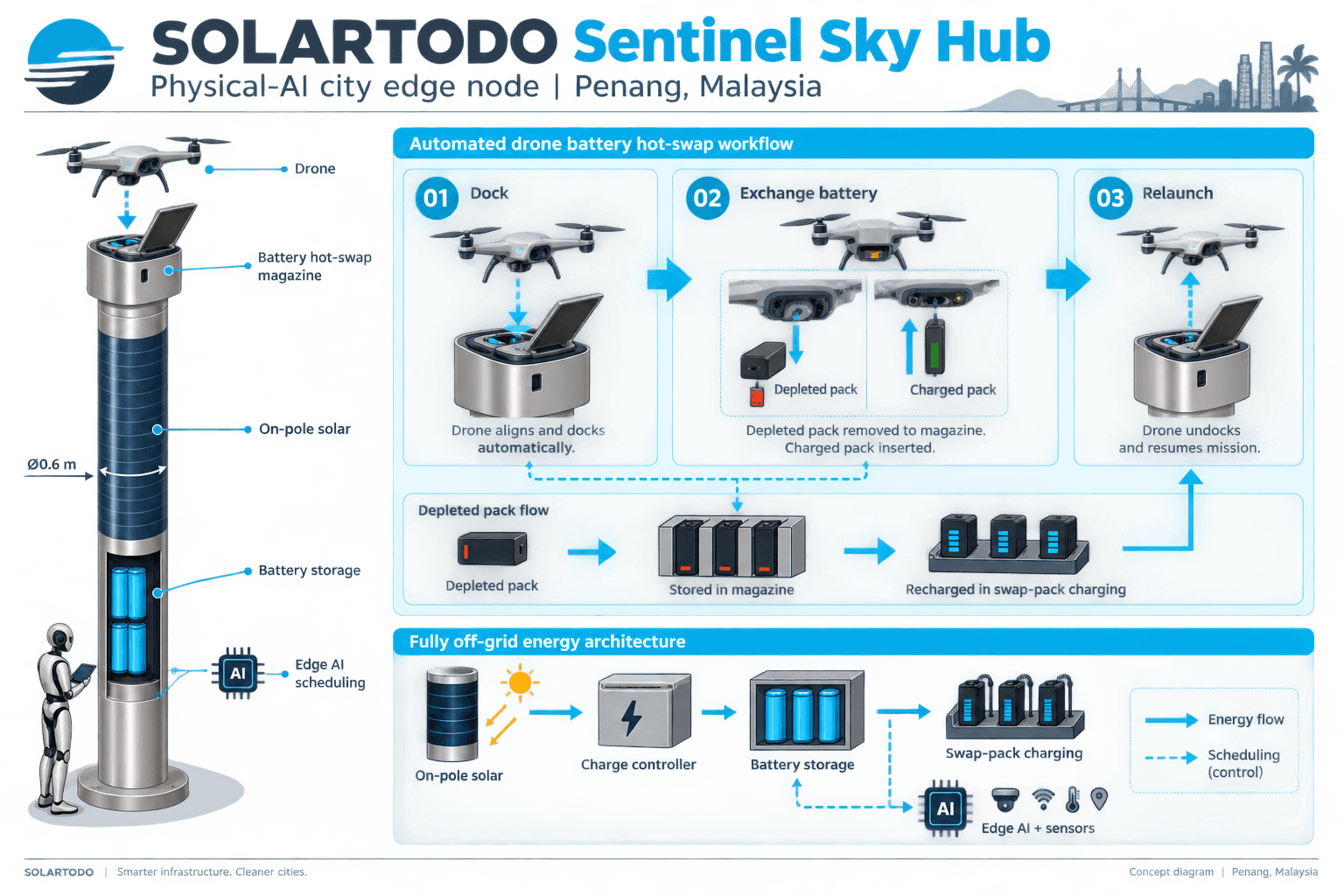
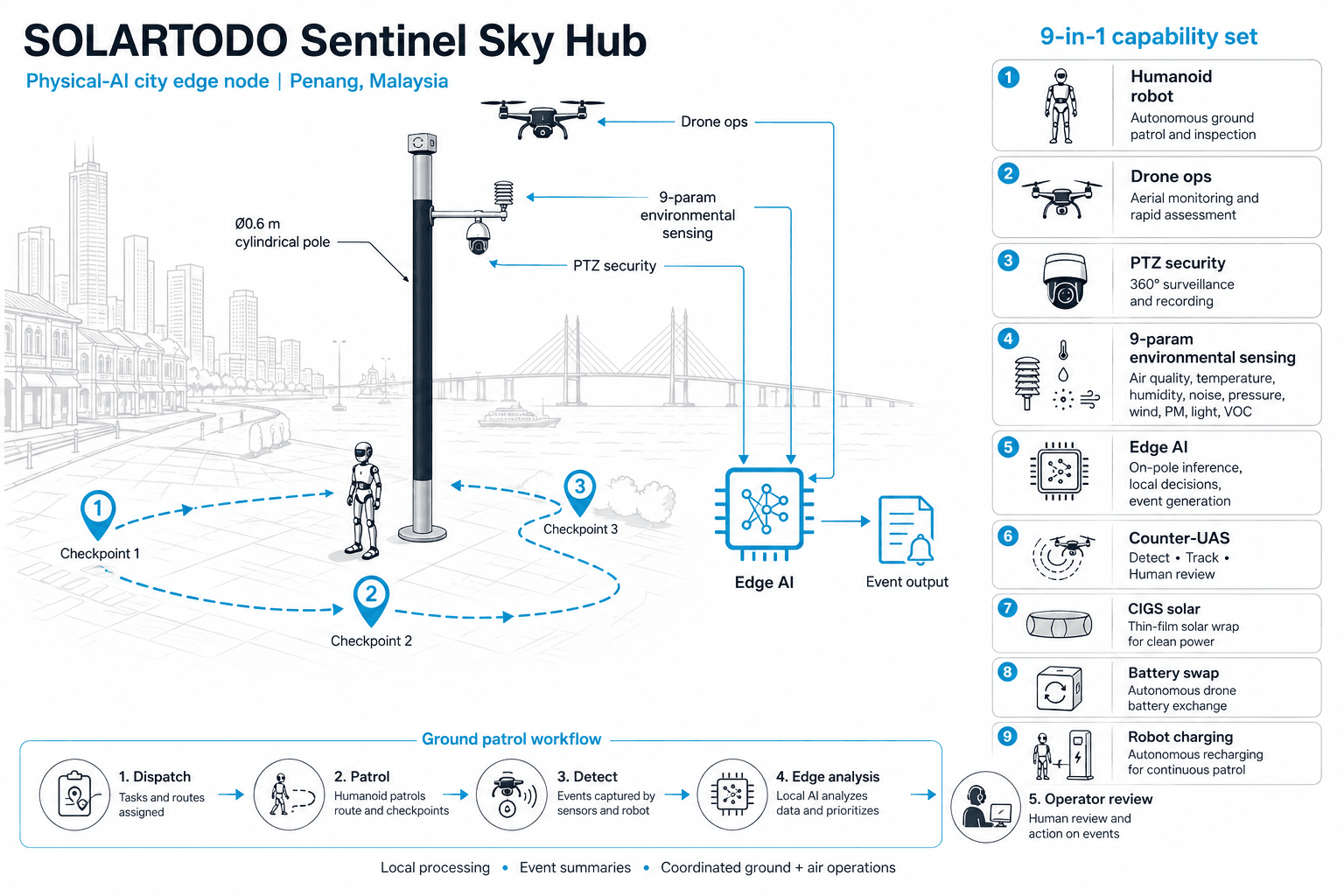
Each node should be treated as a micro-station with sensing, compute, drone service, robot service, storage and communications in one pole architecture. Drone operations should include task queueing, route execution, return management, battery state handling and automated battery exchange through a multi-bay service magazine. Ground robot operations should support patrol, inspection, alarm response and return-to-base wireless charging at the pole base.
For Penang, the recommended software posture is local-first. According to World Bank data (2024), 98% of Malaysia’s population used the internet, which supports connected command workflows, but dense public spaces still require data minimization. The Personal Data Protection Commissioner states, “The main objective of this law is to regulate the processing of personal data in commercial transactions.” Sentinel should therefore process video and sensor streams locally, transmit de-identified event/status metadata only, and avoid face or licence-plate recognition claims.
Counter-UAS coordination should remain non-lethal and human-authorized. The pole may detect and track an unauthorized drone and coordinate a friendly drone for soft aerial net-capture or close-approach deterrence after operator approval. Radar should be specified only as an optional partner-sensor input, not as built-in pole hardware.
Technical Specifications
The 115-node Penang configuration should use 15 m² solar replenishment, 5-20 kWh storage and Jetson-class edge compute per pole.
- Product: SOLARTODO Sentinel City AI Pole, Sky Hub pole-form physical-AI edge node.
- Quantity basis: approximately 115 units at about 30 m spacing, project-based and subject to engineering confirmation.
- Power model: fully off-grid, using on-pole solar replenishment plus battery storage; no grid, city or site power dependency.
- Solar layer: about 15 m² of flexible CIGS on a vertical cylindrical pole body, about 2.4-2.7 kWp nameplate.
- Realistic clear-sky output: about 0.8-1.1 kW DC peak and about 6-9 kWh/day in high-irradiance regions; Penang yield requires site-specific solar modelling.
- Storage: 5-20 kWh-class battery buffer, sized by drone sortie frequency, robot patrol duty cycle and communications uptime target.
- Compute: Jetson-class edge module for on-pole inference, workload scheduling and event filtering.
- Sensing: PTZ camera with local analytics for anonymous vehicle count, crowd density, intrusion and perimeter awareness.
- Environmental channels: wind speed, wind direction, temperature, humidity, atmospheric pressure, noise, PM10, PM2.5 and illuminance.
- Drone service: autonomous launch, patrol, inspection, return, task redeployment and automated battery hot-swap.
- Robot service: autonomous patrol, inspection, alarm response, air-ground coordination and return-to-base wireless charging.
- Data handling: raw video and sensor data stay on the pole; only de-identified event and system metadata may leave the pole.
- Standards alignment: IEC 60529 for enclosure IP classification, IEC 62305 for lightning protection principles, MS IEC 60364 context for Malaysian installation interfaces.
According to IEC (2013), IEC 60529 classifies enclosure protection for electrical equipment up to 72.5 kV. According to IEC (2024), IEC 62305-1 provides general principles for lightning protection of structures and persons. In Penang’s salt-air and thunderstorm environment, engineering review should include enclosure sealing, cable gland selection, bonding, surge protection and maintenance access before procurement release.
Implementation Approach
A 115-node Penang program would typically move through 6 phases: survey, authority coordination, configuration freeze, CKD logistics, installation and commissioning. The first phase should map right-of-way limits, waterfront corrosion exposure, flood-prone pockets, drone flight constraints, mobile backhaul strength and robot patrol paths. In George Town and other dense areas, civil work sequencing should account for narrow streets, business-hour access restrictions and underground utility congestion.
The procurement phase should separate standard pole assemblies from project-specific engineering packs. CKD shipping can reduce logistics complexity, but coastal storage in Penang should protect electronics, seals and battery modules from humidity before installation. Foundations should be verified against soil conditions, flood levels and wind exposure; port-adjacent and reclaimed-land sites may need additional geotechnical checks.
Commissioning should be staged by clusters rather than all 115 nodes at once. Each cluster should validate solar replenishment, battery reserve, local inference, event metadata transmission, drone landing and battery exchange, robot charging, environmental sensor calibration and command-view authorization workflows. The C-UAS workflow should be tested as detection, tracking and operator-approved coordination only; no jamming, destructive action or autonomous attack mode should be specified.
Expected Performance & ROI
Expected value comes from 24/7 local awareness, reduced manual patrol burden and faster inspection cycles, not from selling electricity or replacing luminaires. According to the World Bank (2023), Malaysia had 100% access to electricity, so the business case is resilience and deployment flexibility rather than basic electrification. Off-grid architecture avoids trenching for power in coastal, port-adjacent or heritage-constrained locations, which can materially reduce civil disruption.
For ROI modelling, buyers should compare Sentinel against separate camera poles, drone docks, robot chargers, weather stations, communications cabinets and patrol labor. A typical 115-node deployment can consolidate 9 environmental channels, local video analytics, drone service and robot service into one managed edge network. Payback depends on patrol staffing model, incident cost, inspection frequency and civil-work avoidance; a conservative municipal or industrial model should evaluate 5- to 10-year total cost of ownership.
According to NREL (2025), PVWatts estimates photovoltaic production using location, design parameters and system economics. That methodology is useful for engineering checks, but vertical wrapped CIGS should not be modelled like a conventional fixed flat array. SOLARTODO therefore recommends a duty-cycle study: reserve high-power drone/robot missions for battery-buffered windows, use solar as replenishment, and keep command, sensing and metadata functions available within the storage envelope.
Comparison Table
A 115-node Sentinel layout compares best against fragmented equipment stacks, with 9-in-1 functions and off-grid storage as the main differentiator.
| Evaluation point | SOLARTODO Sentinel City AI Pole | Conventional separate systems | Penang technical implication |
|---|---|---|---|
| Node count basis | Approximately 115 nodes | Multiple device counts by subsystem | One coordinated deployment plan |
| Spacing assumption | About 30 m | Varies by camera, dock and sensor | Survey gates and sightlines carefully |
| Power model | Fully off-grid, battery-backed | Usually grid-fed or mixed | Less trenching in dense/coastal zones |
| Solar replenishment | 0.8-1.1 kW DC clear-sky peak class | Usually absent or separate | Duty-cycle planning required |
| Storage | 5-20 kWh-class per node | Separate UPS or cabinet | Buffers drone and robot peak loads |
| Data handling | Raw data stays on pole | Often centralized recording | Stronger PDPL-oriented posture |
| Drone operations | Launch, return, tasking, hot-swap | Separate dock workflow | Better for port and perimeter patrols |
| C-UAS posture | Human-authorized, non-lethal coordination | Often detection-only or manual | Avoids prohibited hard-kill or jamming claims |
Pricing & Quotation
Pricing for a 115-node Penang configuration should be quoted after site survey, duty-cycle modelling and logistics review.
SOLARTODO offers three pricing tiers for this product line: FOB Supply (equipment ex-works China), CIF Delivered (including ocean freight and insurance), and EPC Turnkey (fully installed, commissioned, with 1-year warranty). Volume discounts are available for large-scale deployments. Configure your system online for an instant estimate, or request a custom quotation from our engineering team at [email protected].
For early design, buyers can review SOLARTODO physical-AI infrastructure options on the solutions page and then use contact us for a Penang-specific bill of quantities. Final quotation should confirm foundation assumptions, drone operating envelope, local permits, communications plan, spare battery quantity, warranty scope and commissioning acceptance tests. No pricing should be treated as final before engineering confirmation.
Frequently Asked Questions
This FAQ answers 10 Penang buyer questions on specifications, installation, ROI, maintenance, quotation, warranty and comparison.
Q1: Is the SOLARTODO Sentinel City AI Pole a smart streetlight? No. It is a pure smart pole with no lighting system. The Penang configuration is for edge sensing, local AI inference, drone operations, robot operations, environmental monitoring and human-authorized non-lethal C-UAS coordination. It should be specified for smart districts, campuses, ports, city perimeters and critical-infrastructure zones, not as a lighting asset.
Q2: Why is approximately 115 units the recommended Penang planning basis? The supplied deployment context is approximately 115 edge-node poles at about 30 m spacing. That represents roughly 3.45 km of linear coverage before site allowances. In Penang, the final count should be adjusted for gates, bridges, port approaches, dense George Town streets, flood-prone pockets, wireless backhaul strength and drone landing constraints.
Q3: Does the pole need TNB grid power? No. The SOLARTODO Sentinel City AI Pole is designed as a fully off-grid, battery-backed micro-station. Malaysia’s TNB voltage classes, including 33 kV, 11 kV and 400/230 V, are useful for nearby safety coordination and permit language, but the pole itself should not be designed around city, site or grid power.
Q4: What storage and solar configuration is appropriate for Penang? Each pole should use 5-20 kWh-class battery storage with on-pole CIGS solar replenishment. The solar layer is about 15 m² and has about 2.4-2.7 kWp nameplate, but realistic clear-sky peak output is about 0.8-1.1 kW DC. Penang’s cloud, monsoon rainfall and salt air require local yield modelling.
Q5: What is a realistic deployment timeline? A 115-node project would usually proceed in phases: survey, authority coordination, engineering freeze, CKD logistics, foundations, pole erection, commissioning and acceptance. Actual duration depends on right-of-way access, heritage-area work limits, coastal foundations, drone permissions and customs timing. Cluster commissioning is recommended so early nodes validate energy, communications and workflows before full rollout.
Q6: How should ROI or payback be evaluated? ROI should be calculated against avoided trenching, reduced manual patrol hours, faster inspection cycles, consolidated environmental sensing and fewer separate cabinets or docks. It should not be justified by energy export. For Penang, a 5- to 10-year total cost model should include corrosion maintenance, battery replacement assumptions, telecom fees, service response and incident-value reduction.
Q7: What maintenance does a coastal Penang installation require? Maintenance should emphasize salt-air inspection, enclosure seals, cable glands, solar surface cleaning, battery health, drone battery magazine checks, robot charging alignment and sensor calibration. Flood-prone or reclaimed-land sites may need more frequent foundation and corrosion inspections. Environmental sensor calibration should be scheduled, because humidity and marine aerosols can affect long-term measurement quality.
Q8: How does Sentinel compare with separate camera, drone and weather systems? A separate stack can work, but it usually requires more cabinets, power feeds, integration points and maintenance contracts. Sentinel consolidates local inference, drone service, robot service, environmental sensing and metadata transmission in one pole. For Penang’s dense and coastal sites, the main advantage is deployment simplicity plus local data handling, not a single isolated feature.
Q9: Can the system include counter-UAS functions? Yes, but only within strict limits. The pole can detect and track unauthorized drones and coordinate an approved response using a friendly drone for soft net-capture or close-approach deterrence. Human authorization is required. The configuration must exclude jamming, destructive hard-kill action, autonomous attack language and any claim that radar is built into the pole.
Q10: What should EPC pricing include? An EPC quotation should include pole assemblies, storage, drone and robot service interfaces, environmental sensors, communications, foundations, installation, commissioning, training and 1-year warranty scope. For Penang, the quotation should separately state coastal hardening, logistics, site access constraints, local authority coordination and acceptance tests. Buyers can request FOB, CIF or EPC formats from SOLARTODO.
References
These 7 references support Penang density, maritime exposure, Malaysia voltage classes, privacy posture, climate context and technical standards.
- Department of Statistics Malaysia (2025): Current Population Estimates by Administrative District, including Timur Laut density of 4,748 persons/km² and Pulau Pinang district data.
- OpenDOSM (2026): Pulau Pinang population dashboard, updated 31 July 2026, covering state-level demographic trends.
- Penang Infra (2026): Penang Transport Master Plan overview, including land and sea transport modes and 40:60 public-private modal share target.
- Maritime Institute of Malaysia (2025): Straits of Malacca context, including 37% growth in merchant vessels over 300 GRT from 2000 to 2010 and almost 50% of global energy shipments.
- Tenaga Nasional Berhad (2026): Electricity system and ESAH guidance listing 500 kV, 275 kV, 132 kV, 33 kV, 11 kV and 400/230 V classes, with 50 Hz ±1% supply frequency.
- World Bank (2024): Malaysia data, including 100% access to electricity in 2023 and 98% internet use in 2024.
- IEC (2013, 2024): IEC 60529 enclosure protection classification and IEC 62305-1 lightning protection general principles.
Equipment Deployed
- Approximately 115 SOLARTODO Sentinel City AI Pole Sky Hub edge nodes at about 30 m spacing
- Fully off-grid battery-backed micro-station per pole with 5-20 kWh-class storage
- About 15 m² wrapped flexible CIGS solar replenishment, 2.4-2.7 kWp nameplate, 0.8-1.1 kW DC realistic clear-sky peak class
- Jetson-class edge AI compute module for local inference and workload scheduling
- PTZ camera analytics for anonymous vehicle count, crowd density, intrusion and perimeter awareness
- Nine-channel environmental monitoring: wind speed, wind direction, temperature, humidity, pressure, noise, PM10, PM2.5 and illuminance
- Autonomous drone operations with tasking, return, mission logs and automated battery hot-swap
- Ground robot service interface with patrol, alarm response, inspection and wireless charging
- PDPL-oriented local processing architecture: raw video and sensor data stay on-pole
- Human-authorized, non-lethal C-UAS coordination with optional partner-sensor inputs