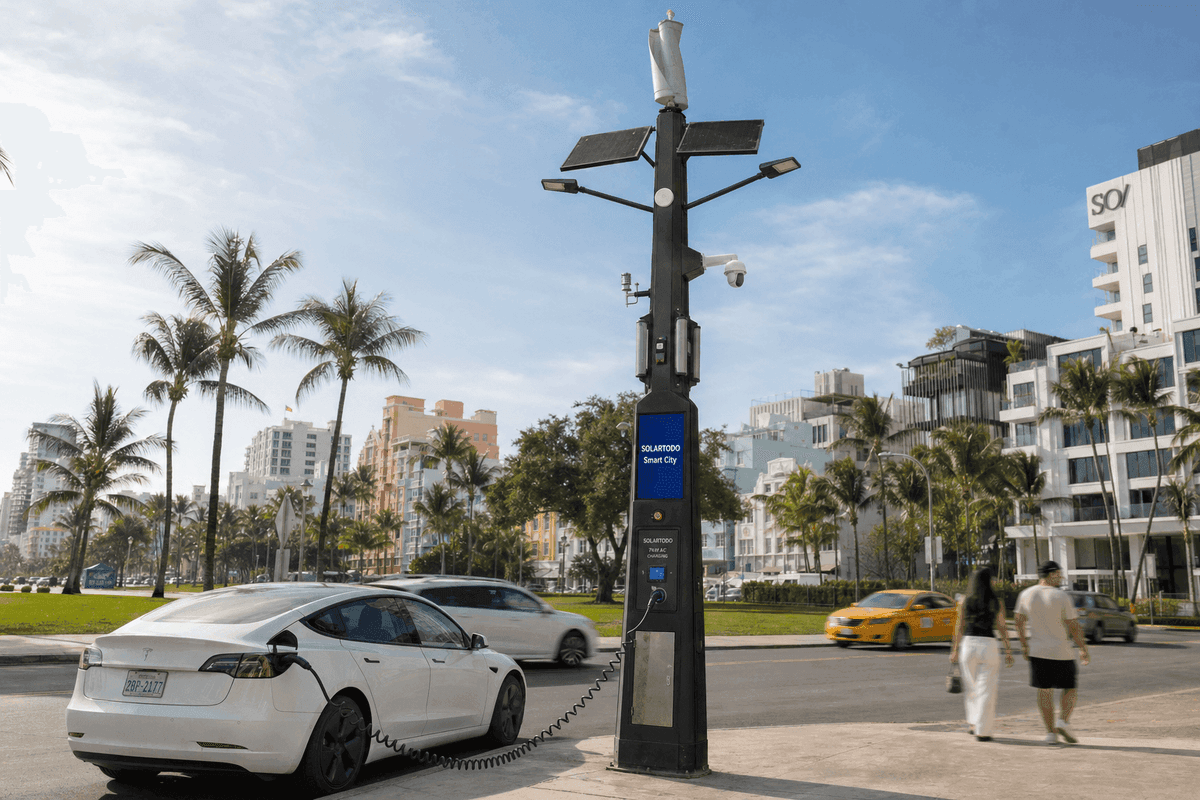
Phnom Penh Flood-Heat Corridor Lighting: Smart Streetlight Hybrid 11m Configuration Guide
Summary
Phnom Penh needs flood-resilient 11m Smart Streetlight design: WMO records 252.9mm September rainfall, World Bank cites 25 heatwave days, and a typical 176-unit corridor at 30m spacing covers about 5.3km.
Key Takeaways
- A typical 176-unit deployment at 30m spacing would cover approximately 5.28km of urban corridor, suitable for boulevard, bus-priority, and mixed-use commercial streets.
- Phnom Penh’s wettest month reaches 252.9mm mean rainfall, so IP-rated cabinets, raised foundations, and corrosion-resistant finishes matter more than decorative pole forms.
- The recommended SOLARTODO Smart Streetlight size class is an 11m octagonal tapered steel pole, base Ø45cm to top Ø15cm, not a highway mast or garden light.
- Each pole would use 2×80W LED luminaires at 4000K and 150 lm/W, giving 160W installed LED capacity per pole before adaptive dimming.
- Hybrid self-power combines a 300W Savonius VAWT, 2×200W monocrystalline panels, 5kWh LFP storage, MPPT control, and grid backup.
- The lower 2.2m is the integrated 7kW dual-gun AC EV charger cabinet, welded into the pole as one continuous steel structure.
- Communications should combine WiFi 6, 5G gateway, GbE uplink, and LoRaWAN control because Cambodia reached 68.5% internet use in 2024.
- Compliance should reference IEC 60598 for luminaires, GB/T 37024 for smart streetlight systems, and IEC 62196-2 for Type 2 AC charging interfaces.
Market Context for Phnom Penh
Phnom Penh’s smart lighting requirement is shaped by 2-million-person urban density, monsoon flooding, 95% national electricity access, and fast-growing digital public services.
Phnom Penh is inland at the Mekong, Bassac, and Tonle Sap river confluence, so the streetlight problem is not coastal salt spray; it is heat, intense monsoon rainfall, flood-prone streets, dense commercial frontage, and road corridors carrying people, logistics, and public transport. According to the World Bank (2017), Phnom Penh had close to 2 million residents and is Cambodia’s largest and fastest-growing city. According to the World Bank (2024), Cambodia’s urban population reached 7,209,455 people, confirming that capital-city public infrastructure is no longer a small municipal-lighting category.
Climate is a hard design constraint. According to the World Meteorological Organization (2026), Phnom Penh-Pochentong records mean daily maximum temperatures above 30°C in every month, with September mean rainfall of 252.9mm and 29 rain days. According to the World Bank (2025), Phnom Penh now experiences up to 25 heatwave days annually, and central urban temperatures are 1.16°C higher than the outskirts. For a SOLARTODO Smart Streetlight, this means battery ventilation, IP protection, anti-condensation design, and camera thermal stability are procurement requirements, not optional upgrades.
Grid and road context also favors a hybrid pole. According to the World Bank (2023), 95% of Cambodia’s population had access to electricity in 2023, which supports grid backup and OCPP charging, but not always uninterrupted feeder availability during drainage works, road reconstruction, or flood events. According to the Asian Development Bank (2016), Electricité du Cambodge is the state utility responsible for electricity delivery, with documented Cambodian networks using 230kV transmission and 22kV medium-voltage distribution. Phnom Penh streetlight tenders therefore commonly need coordination among municipal agencies, EDC service connection procedures, telecom operators, and road-right-of-way owners.
Public procurement is moving toward smart mobility and energy efficiency. According to Cambodia’s Ministry of Mines and Energy (2022), the National Energy Efficiency Policy includes street lighting modernization, smart controls, and harmonization with international standards. The World Bank states, “Phnom Penh faces an important opportunity to positively shape its future,” which is directly relevant to city-scale lighting because poles can also host public address, SOS, camera, air-sensing, WiFi, and EV charging functions. The World Bank also states, “Well-planned cities allow the socio-economic benefits of urbanization to be fully harnessed,” making integrated pole infrastructure preferable to multiple separate roadside cabinets.
Recommended Technical Configuration
A Phnom Penh 176-unit smart corridor would fit an 11m hybrid octagonal pole with 30m spacing, integrated EV charging, and raised flood-tolerant foundations.
The recommended size class is the SOLARTODO hybrid 12m family adapted to an 11m octagonal tapered steel pole, because Phnom Penh’s urban streets need high mounting height without moving into highway-scale mast infrastructure. A typical 176-unit deployment in this profile would consist of approximately 176 units spaced at 30m, covering about 5.28km of road edge or median alignment depending on road reserve. This is appropriate for urban street lighting and smart city equipment density, which generally falls within 25-50m spacing and 30-50 poles per km.
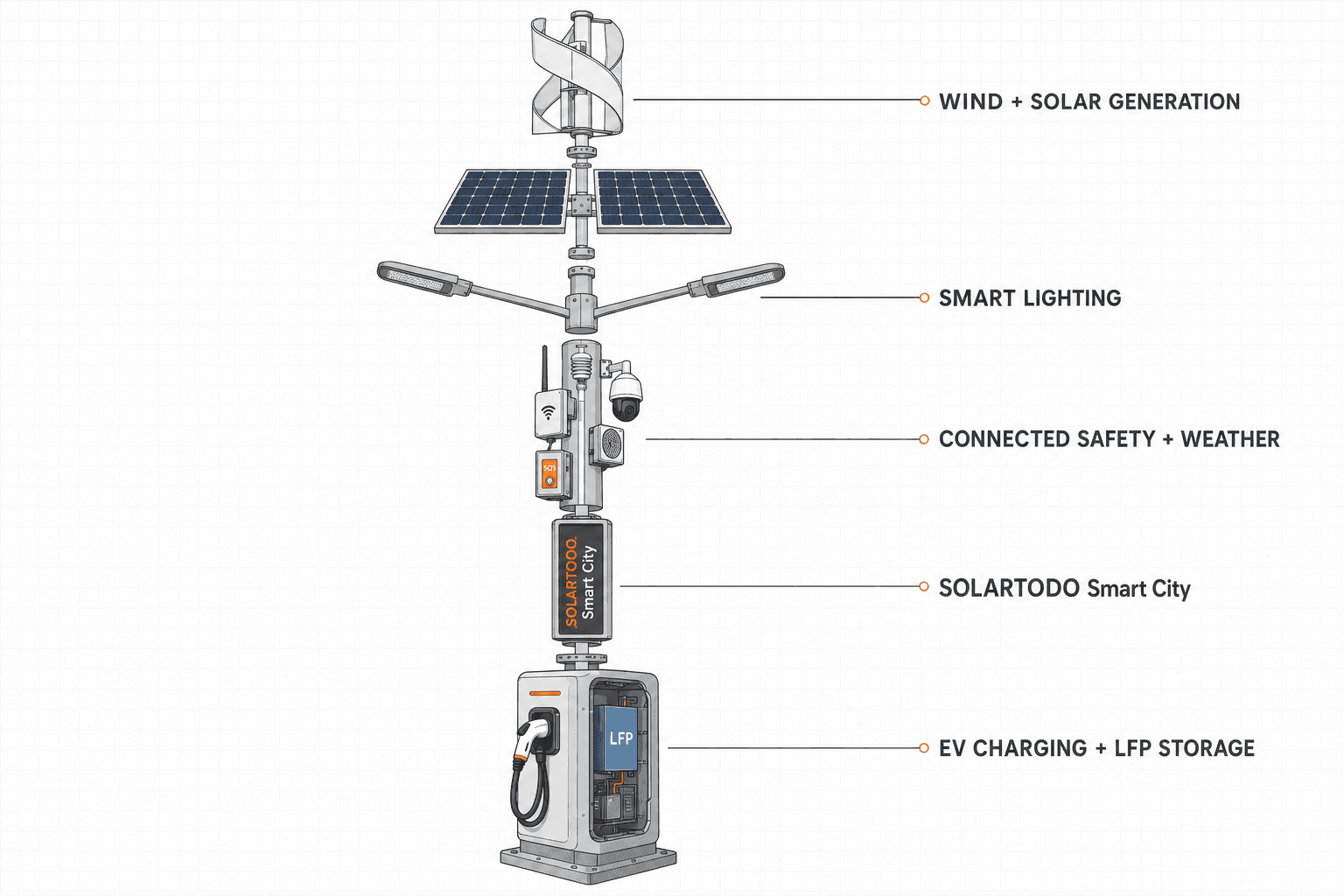
The exact configuration should use black RAL9005 powder-coated steel, a base diameter of Ø45cm, and a top diameter of Ø15cm. The lower 2.2m of each pole is the EV charging cabinet itself, seamlessly welded as one continuous steel structure rather than placed as a separate roadside pillar. That configuration matters in Phnom Penh because narrow footpaths, drainage channels, utility trenches, and shopfront access leave limited room for extra cabinets.
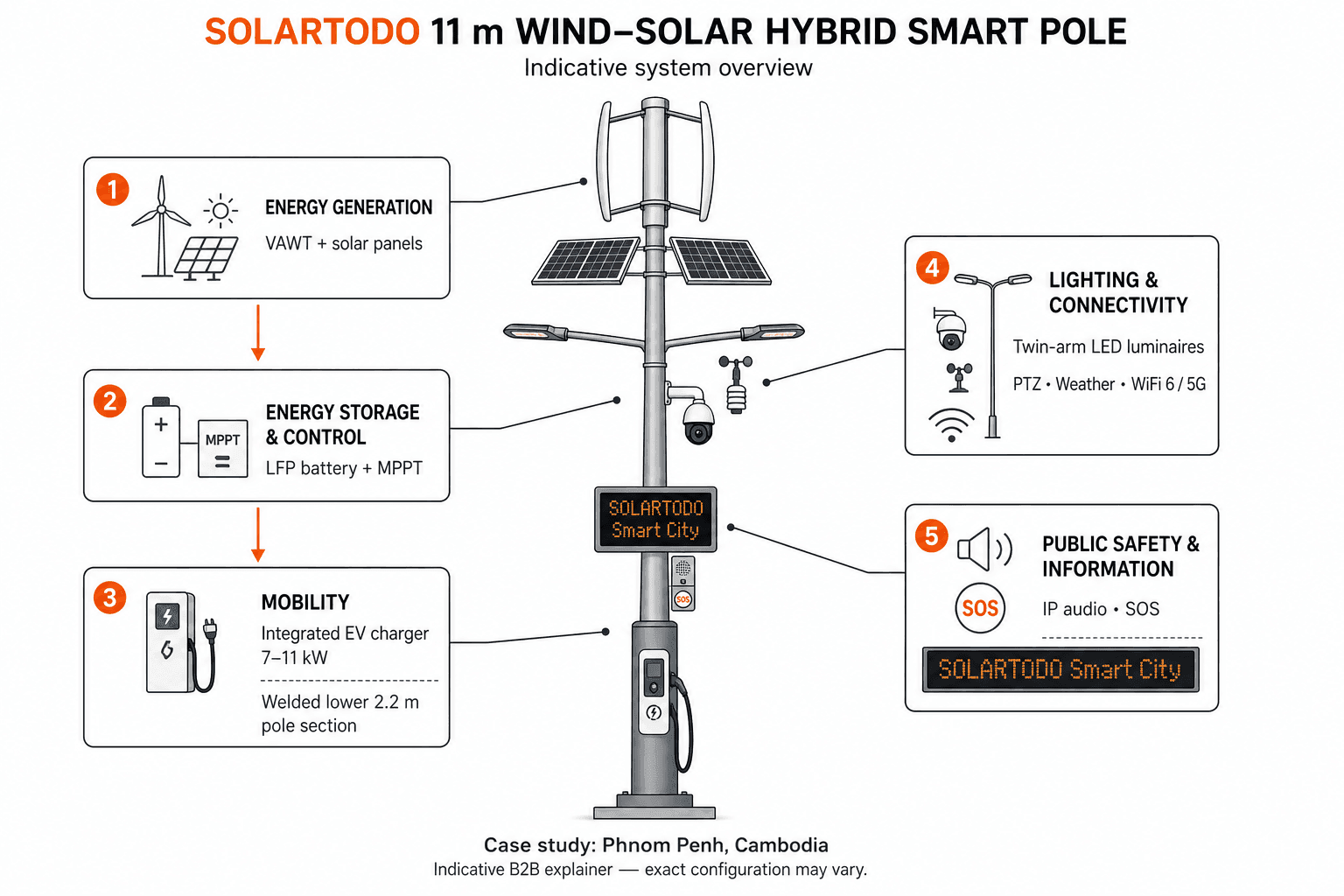
Hybrid self-power is recommended because Phnom Penh has strong sun exposure, seasonal storms, and urban feeder constraints. Each unit should combine a 300W Savonius bucket VAWT with 2 curved scoops, two 200W deep-black monocrystalline panels on symmetric east-west A-frame brackets at 15° tilt, a 5kWh LFP battery inside the base, MPPT control, and a backup grid tie. SOLARTODO should position this as a resilience configuration for municipal corridors, not as an off-grid-only solar streetlight.
Technical Specifications
The recommended Phnom Penh pole package uses 176 units, 11m height, 160W LED load, 400W solar input, 300W wind input, and 5kWh storage per pole.
- Structure: 11m octagonal tapered steel smart pole, base Ø45cm to top Ø15cm, black RAL9005 powder coat.
- Integrated design: lower 2.2m of the pole is the EV charging cabinet, welded into one continuous steel structure, not a separate pillar.
- Wind: Savonius bucket VAWT, 2 curved scoops, Ø60×90cm, 300W, red aviation LED.
- Solar: 2×200W monocrystalline deep-black panels, A-frame brackets, 15° tilt, symmetric east-west pair.
- Battery and control: 5kWh LFP battery in pole base with MPPT controller and backup grid tie.
- Lighting: twin symmetric 1.5m arms with +8° upward tilt, 2×80W LED, 150 lm/W, 4000K.
- Camera: 22cm white PTZ dome camera, 360° rotation, 25x zoom, IR 150m, mounted on 50cm L-bracket outrigger.
- Sensor: top 4-param environmental sensor for temperature, humidity, wind speed, and noise.
- Public address: 1× IP audio column, Ø10×50cm, 30W/93dB, TCP/IP networked vertical perforated aluminum tube, flush against pole face.
- Emergency: one-press SOS button with camera linkage for public-space incident escalation.
- EV charging: integrated 7kW dual-gun AC charger, 2× Type 2, OCPP 1.6J, 5m coiled cable, touchscreen, E-stop, and maintenance door.
- LED display: P5 portrait screen, 1280×2560mm, >5000 cd/m², content restricted to “SOLARTODO Smart City” in white sans-serif on deep blue.
- Communications: dual-mode WiFi 6 plus 5G gateway, GbE uplink, LoRaWAN, flush housing at 8.7m with continuous color-matched finish.
- User extras: Qi wireless phone charging pad plus USB-A charging port.
- Standards: IEC 60598, GB/T 37024, and IEC 62196-2.
Implementation Approach
A Phnom Penh rollout should be phased across 4 workstreams: survey, procurement, civil-electrical works, and commissioning with municipal acceptance testing.
The first phase is corridor survey and authority alignment. Engineering teams would map road width, drainage inlets, underground utilities, EDC service points, telecom backhaul availability, sidewalk clear width, camera sightlines, and flood marks. For old-town streets near dense shopfronts, the foundation detail should avoid blocking pedestrian movement and should raise service doors above nuisance-flood levels.
The second phase is procurement and factory acceptance. Pole bodies, integrated charger cabinets, LED arms, wind-solar kits, batteries, cameras, screens, and communication modules should be checked as matched assemblies before shipment. For Cambodia import logistics, CKD or semi-assembled shipping via sea freight and onward road movement from Sihanoukville to Phnom Penh is usually practical, but the packaging plan should protect powder-coated surfaces and LED screens from humidity and road vibration.
The third phase is civil and electrical installation. Foundations should be designed for 11m pole overturning moment, wet-season soil behavior, cable entry sealing, and maintenance door access. Electrical work should separate lighting, EV charging, communications, and low-voltage controls while preserving one integrated outer enclosure. Commissioning should include illuminance checks, OCPP 1.6J charger tests, PTZ camera coverage, PA audio intelligibility, WiFi/5G signal quality, LoRaWAN controller pairing, and cloud platform onboarding.
Expected Performance & ROI
A 176-unit Phnom Penh corridor could install 28.16kW of LED load, 70.4kW of solar panels, 52.8kW of wind capacity, and 880kWh of LFP storage.
The base energy case is straightforward: 176 poles × 2×80W equals 28.16kW of LED capacity before dimming. With adaptive scheduling, motion-aware profiles, and remote fault monitoring, municipalities typically reduce lighting energy and truck-roll costs compared with conventional manual streetlight operations. According to the International Energy Agency (2023), Cambodia’s NEEP is in force and supported by USD 77 million of 2022-2024 energy-efficiency investment, which strengthens the public-sector case for LED and smart-control procurement.
ROI should be evaluated as a multi-service infrastructure calculation, not lighting energy alone. Each SOLARTODO pole can support lighting, public safety video, environmental sensing, public address, emergency SOS, WiFi 6 access, 5G gateway readiness, LED information display, and 7kW AC EV charging. For a corridor near bus routes, markets, government buildings, or commercial frontage, the investment case can include avoided separate CCTV poles, avoided charger bollards, reduced maintenance visits, advertising-screen operating value, and improved response visibility.
A conservative payback model would compare the lifecycle cost of one integrated pole against separate LED lighting, CCTV mast, EV charger cabinet, communication enclosure, PA speaker, and signage. In Phnom Penh, space value and flood risk make this integration material: every eliminated roadside cabinet reduces obstruction, cable trenching, water ingress points, and maintenance inventory. SOLARTODO should quote ROI as a scenario range after site survey, feeder review, usage assumptions for 7kW charging, and local electricity tariff confirmation through contact us.
Comparison Table
For Phnom Penh, the 11m hybrid integrated charger pole offers more resilience than grid-only lighting and less sidewalk clutter than separate smart-city cabinets.
| Configuration option | Phnom Penh fit | Typical height | Power architecture | EV charging | Key limitation |
|---|---|---|---|---|---|
| Conventional LED pole | Basic lighting only | 8-10m | Grid only | None | No camera, SOS, WiFi, display, or charging integration |
| Separate smart pole plus charger pillar | Moderate | 10-12m | Grid or hybrid | 7kW cabinet beside pole | Uses more sidewalk width and adds flood-prone cabinet seams |
| SOLARTODO hybrid integrated Smart Streetlight | High | 11m | 300W wind + 400W solar + 5kWh LFP + grid backup | Integrated 7kW dual-gun Type 2 | Requires coordinated civil, electrical, telecom, and OCPP commissioning |
| Highway traffic pole | Low for urban streets | 12m+ | Grid only | Optional separate cabinet | Oversized for dense mixed-use corridors and not optimized for pedestrian services |
Pricing & Quotation
SOLARTODO provides 3 quotation paths for Phnom Penh buyers: FOB Supply, CIF Delivered, and EPC Turnkey, with scope driven by site survey.
SOLARTODO offers three pricing tiers for this product line: FOB Supply (equipment ex-works China), CIF Delivered (including ocean freight and insurance), and EPC Turnkey (fully installed, commissioned, with 1-year warranty). Volume discounts are available for large-scale deployments. Configure your system online for an instant estimate, or request a custom quotation from our engineering team at [email protected].
Frequently Asked Questions
A Phnom Penh Smart Streetlight program should specify 8 core items: pole structure, hybrid power, LED optics, EV charging, sensors, communications, foundations, and warranty.
Q1: What Smart Streetlight configuration is recommended for Phnom Penh? The recommended configuration is approximately 176 units of 11m octagonal tapered steel hybrid poles at 30m spacing. Each unit includes 2×80W LED luminaires, a 300W Savonius VAWT, 2×200W solar panels, 5kWh LFP battery, PTZ camera, SOS, WiFi 6, 5G gateway, LED display, and integrated 7kW dual-gun AC charging.
Q2: Why use a hybrid wind-solar pole instead of grid-only lighting? Hybrid power gives Phnom Penh resilience during drainage works, feeder interruptions, and monsoon disruptions while still retaining grid backup. The recommended system combines 400W solar, 300W wind, MPPT control, and 5kWh LFP storage per pole. It is not proposed as a pure off-grid solar streetlight; it is a multi-service urban infrastructure node.
Q3: How long would deployment typically take? A 176-unit corridor typically needs staged planning rather than a single installation event. Site survey, authority coordination, and engineering review may take several weeks; manufacturing, factory testing, shipping, foundations, erection, and commissioning follow. Actual timing depends on foundation design, road occupancy permits, EDC connection review, telecom integration, and rainy-season access constraints.
Q4: What is the expected ROI or payback period? ROI should be modeled after site survey because electricity tariffs, EV use, advertising-screen policy, maintenance costs, and camera-network value vary by corridor. The strongest Phnom Penh business case comes from combining 160W LED lighting, CCTV, PA, SOS, WiFi, display, and 7kW charging in one pole, reducing separate cabinets, trenching, and maintenance visits.
Q5: How should maintenance be planned in Phnom Penh’s rainy climate? Maintenance should prioritize water ingress checks, battery health, charger insulation testing, screen brightness, camera cleaning, and communication uptime. Because WMO records September mean rainfall of 252.9mm, service doors and cable entries should be sealed and accessible above nuisance-flood levels. Remote monitoring should reduce routine truck rolls and flag faults before corridor-wide outages.
Q6: How does this compare with a standard LED streetlight? A standard LED streetlight mainly provides illumination, while the SOLARTODO Smart Streetlight adds hybrid energy, PTZ video, environmental sensing, IP audio, SOS, WiFi 6, 5G gateway readiness, LED display, and 7kW EV charging. For Phnom Penh corridors where sidewalk space is limited, integration can be more valuable than adding separate poles and cabinets.
Q7: What pricing information can an EPC contractor request? An EPC contractor can request FOB Supply, CIF Delivered, or EPC Turnkey quotation scopes. The quotation should define 176-unit quantity assumptions, 11m pole structure, 30m spacing, foundation responsibilities, grid connection boundary, OCPP backend, telecom scope, commissioning tests, spares, warranty terms, and documentation. Prices should be issued only after technical and logistics review.
Q8: What standards should be referenced in procurement documents? Procurement documents should reference IEC 60598 for luminaires, GB/T 37024 for smart streetlight system requirements, and IEC 62196-2 for Type 2 AC charging interfaces. Local electrical approval should also align with Cambodian Ministry of Mines and Energy rules, EDC connection requirements, and municipal right-of-way conditions for Phnom Penh streets.
Q9: Is the integrated EV charger a separate roadside cabinet? No. In this configuration, the lower 2.2m of the pole is the EV charging cabinet itself, welded into one continuous steel structure. The 7kW dual-gun Type 2 AC charger includes OCPP 1.6J, 5m coiled cable, touchscreen, E-stop, and maintenance door within the pole-as-charger body.
Q10: Where should these poles be installed first? Priority corridors would include flood-resilient boulevards, bus-priority roads, commercial frontages, government districts, and mixed-use streets where lighting, safety monitoring, public address, WiFi, and EV charging can share one asset. Old-town narrow streets require extra sidewalk-clearance review, while highways should use separate 12m+ traffic pole designs instead.
References
- World Bank (2017): Urban Development in Phnom Penh; documents close to 2 million residents and infrastructure challenges including drainage, wastewater, public transport, and solid waste. https://www.worldbank.org/en/country/cambodia/publication/urban-development-in-phnom-penh
- World Bank (2025): From Floods to Resilience; cites Phnom Penh flood exposure, 25 annual heatwave days, 1.16°C urban heat island effect, and city climate planning. https://www.worldbank.org/en/news/feature/2025/09/02/how-the-gap-fund-is-helping-cambodia-build-greener-cities
- World Meteorological Organization (2026): Phnom Penh-Pochentong climatology; records monthly temperature and rainfall averages, including 252.9mm September rainfall. https://worldweather.wmo.int/en/city.html?cityId=348
- World Bank (2024): Cambodia data profile; reports 95% access to electricity in 2023 and 68% internet use in 2024. https://data.worldbank.org/country/cambodia
- International Telecommunication Union (2024): Individuals using the Internet; Cambodia recorded 68.5% internet use in 2024. https://datahub.itu.int/data/?i=11624
- Cambodia Ministry of Mines and Energy (2022): National Energy Efficiency Policy 2022-2030 listing; includes street lighting modernization and smart controls policy direction. https://mme.gov.kh/strategic-sectors/energy/recent-legislations-and-regulations
- Asian Development Bank (2016): Cambodia Second Power Transmission and Distribution Project; describes EDC delivery role, 230kV transmission, and 22kV distribution network context. https://www.adb.org/documents/cambodia-second-power-transmission-and-distribution-project
- IEC (2020): IEC 60598 luminaire safety standard and IEC 62196-2 AC charging interface standard for Type 2 connectors. https://www.iec.ch/
Equipment Deployed
- 176 units × 11m octagonal tapered steel smart pole, base Ø45cm to top Ø15cm, black RAL9005 powder coat
- Integrated lower 2.2m pole-as-EV-charging cabinet, welded as one continuous steel structure
- 300W Savonius bucket VAWT, 2 curved scoops, Ø60×90cm, red aviation LED
- 2×200W monocrystalline deep-black solar panels on 15° A-frame east-west brackets
- 5kWh LFP battery in pole base with MPPT controller and backup grid tie
- Twin 1.5m symmetric arms with +8° tilt and 2×80W LED, 150 lm/W, 4000K
- 22cm white PTZ dome camera, 360° rotation, 25x zoom, IR 150m, 50cm L-bracket
- 4-param environmental sensor for temperature, humidity, wind speed, and noise
- IP audio column Ø10×50cm, 30W/93dB, TCP/IP, flush color-matched housing
- Integrated 7kW dual-gun AC charger, 2× Type 2, OCPP 1.6J, 5m coiled cable
- P5 vertical LED screen, 1280×2560mm, >5000 cd/m², SOLARTODO Smart City content only
- Dual-mode WiFi 6 + 5G gateway with GbE uplink and LoRaWAN at 8.7m
- Qi wireless charging pad and USB-A user charging interface