Summary
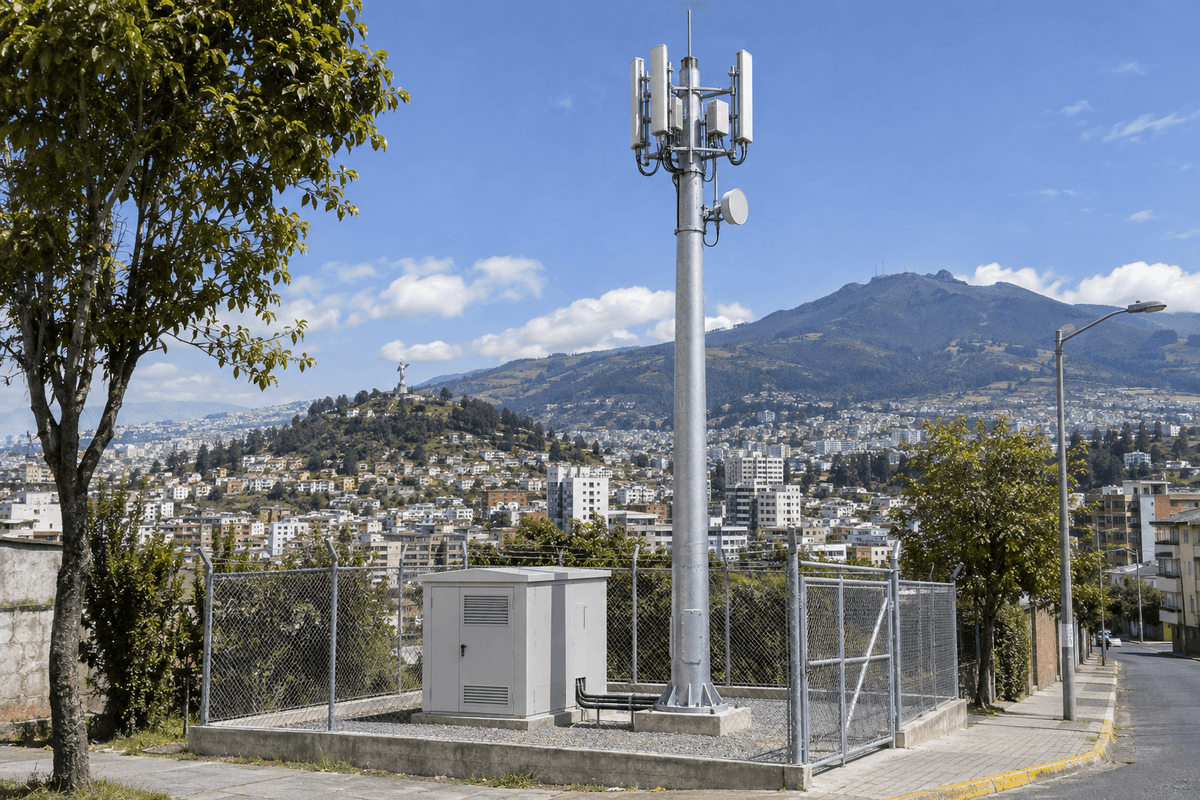
Advance the proposed SOLARTODO steel monopole in Quito to parcel survey and authority consultation. Hold final height approval, fabrication release, and any purchase of obstruction marking or lighting until the competent authority confirms the applicable review path and the project has documented the disposition and conditions for the exact design under review. Quito, Ecuador, is solely a proposed site for this evaluation. The evidence pack supplies the telecom tower catalog, an FAA process example, and GSMA policy context. It contains no product PDF or Quito-specific determination, so a model, PDF page, operating conditions, approved height, and hardware specification remain unverified.
Key Takeaways
- Survey the proposed tower position and document the coordinate and elevation reference systems before submitting a height proposal.
- Show the highest permanent point on a revision-controlled drawing, including the highest proposed attachment, and ask how temporary erection equipment should be handled.
- Ask the competent authority to confirm the filing route, acceptable closeout evidence, and any marking or lighting conditions for the submitted design.
- Carry open aviation hardware items as conditional scope in bids and tie purchase release to the applicable documented conditions.
- Reconcile the authority record with the survey, structural submission, and supplier drawing before releasing fabrication.
- Compare the installed configuration with the reviewed design and close any applicable inspection, testing, or notification obligations before owner acceptance.
Proposed Problem
The buyer needs to decide whether a particular steel monopole design can proceed at a candidate parcel in Quito, and what evidence would justify buying obstruction marking or lighting for it. The answer depends on both the location and the complete proposed height envelope. A nominal steel shaft height alone leaves open whether an antenna or another attachment is the highest point and whether the reviewer and supplier are using the same ground elevation and reference system.
The project should first identify the authority competent to make or confirm the aviation determination for the parcel. Ask which office handles the submission, whether other bodies must be consulted, which documents and reference systems it accepts, and what record closes the review. Obtain the required determination or the accepted record that a formal study is unnecessary for the submitted configuration. If a filing receipt is issued, retain it with the submitted design revision. For procurement, the buyer needs the applicable disposition, its conditions, and a way to tie them to the design revision being priced.
Source-Backed Product Boundary
The SOLARTODO telecom tower catalog, identified in the pack as city-catalog-2026-11-01-v1, supports steel monopole, lattice, guyed, and rooftop forms. This evaluation selects the tubular steel monopole form. Antennas, radios, and backhaul equipment are configuration items. The supplier should state which items the quote includes and provide the project-specific inputs that affect the proposed height, equipment arrangement, and loading.
The catalog calls for project-specific verification of height, wind loading, antenna loading, foundation, corrosion protection, and aviation or planning requirements. It establishes no universal weight per metre, load capacity, or coverage radius. The evidence pack also supplies no product PDF, PDF URL, model designation, page reference, or model-specific operating conditions. Obtain the applicable PDF and verify its model, pages, and operating conditions against the offer before approving a model-specific specification. The supplied city-catalog-2026-11-01-v1 extraction lists the steel monopole as a selectable form in the SOLARTODO telecom tower product family. Site-specific engineering and the authority record govern the proposed configuration.
Proposed Design and Approval Gate
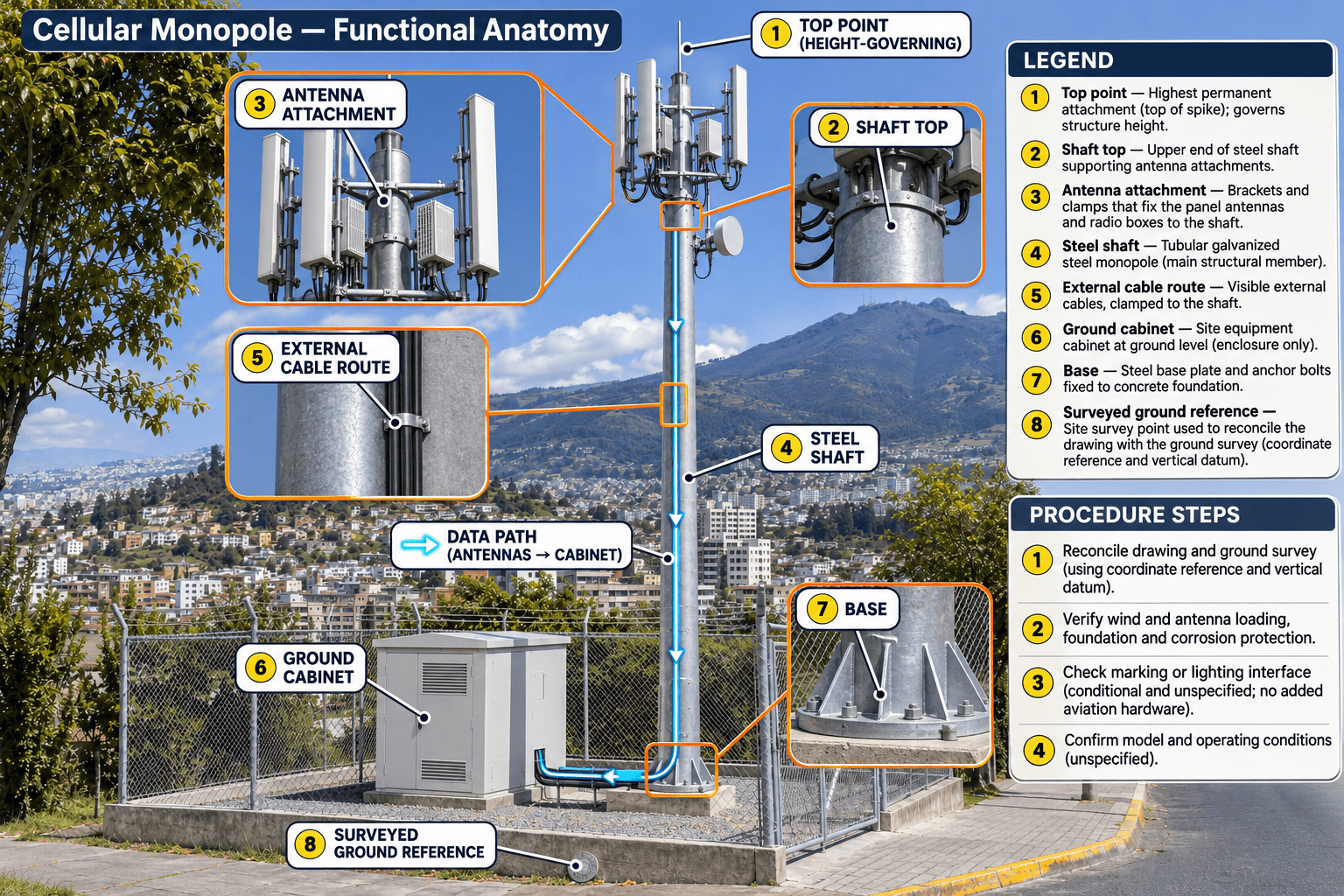
Start with a concept drawing for a single tubular steel monopole at a surveyed candidate position. Have the network designer identify the attachment arrangement needed for the proposed service objective. Ask the supplier to show the shaft top, each attachment that could govern the top elevation, and any conditional marking or lighting interface. Record dimensions from a defined reference point and show how the submitted top elevation relates to the surveyed ground elevation. When the site team proposes a design change, update the height calculation and drawing together.
Give the authority a consistent review package. Identify the parcel and candidate tower position, survey date, coordinate reference system, vertical datum, ground elevation, proposed height above ground, and corresponding top elevation. Attach the revision-controlled drawing that defines the highest point. Ask what details are needed for temporary erection equipment and later alterations. Preserve the submitted package, receipt, correspondence, decision, and conditions together so the buyer can trace which design each document covers.
Use the documented outcome to settle the hardware scope. If marking or lighting applies, request the applicable specification or an accepted design basis and translate it into a supplier schedule. Capture the required marking or lighting details, placement, operating conditions, and any applicable power, monitoring, maintenance, or notification provisions. Assign responsibility for supplying, installing, testing, and maintaining each applicable item. If the authority finds that neither marking nor lighting applies to the reviewed configuration, retain the applicable record with the procurement file.
The FAA's Obstruction Evaluation Overview provides an external example of screening for notice requirements, conducting aeronautical studies, and posting determinations. The overview also lists guidance on obstruction marking and lighting and points to related FAQs. Its value here is the sequence and the traceable record between submission and decision. The Quito project should obtain its filing criteria, forms, technical requirements, and acceptance path directly from the competent authority. FAA Obstruction Evaluation Overview
Explicitly Hypothetical Measurable Evaluation Assumptions
Use the following as proposed buyer-side checks. The checks evaluate the completeness and consistency of the review package. The actual submission criteria and technical tolerances come from the applicable project documents and authority requirements.
Hypothetical evaluation assumption: The file passes the survey traceability check when the reviewer can trace the submitted coordinates, ground elevation, and reference systems to a signed survey record.
Hypothetical evaluation assumption: The file passes the height reconciliation check when the survey elevation and drawing dimensions reproduce the submitted highest-point elevation within the documented survey and rounding tolerances.
Hypothetical evaluation assumption: The file passes the procurement release check when every applicable aviation hardware condition maps to a supplier deliverable, an assigned owner, and an inspection or test record to be collected.
Hypothetical evaluation assumption: The file passes the installed configuration check when the as-built survey and inspection records demonstrate conformity with the reviewed position, height envelope, and each applicable marking or lighting condition.
Survey and Acceptance Checklist
- Parcel and survey. Identify the proposed tower point within the parcel and record the field source for its coordinates and ground elevation. Label the reference systems and units on both the survey and the drawing. Confirm the required submission precision with the authority and resolve discrepancies before filing.
- Height and attachments. Identify the highest permanent point in the proposed configuration. Ask how the authority handles temporary erection equipment. Give the structural reviewer the antenna and attachment loading inputs for the same revision used in the aviation package.
- Authority closeout. File the applicable determination or accepted screening record alongside the submitted drawing. Capture the scope, referenced design, applicable conditions, and any follow-up. Assign a project owner to track outstanding conditions and record closure.
- Engineering coordination. Check the selected configuration against the project-specific wind and antenna loads, foundation design, and corrosion protection. Reconcile any changes that affect position, elevation, or attachments with the aviation review before fabrication release.
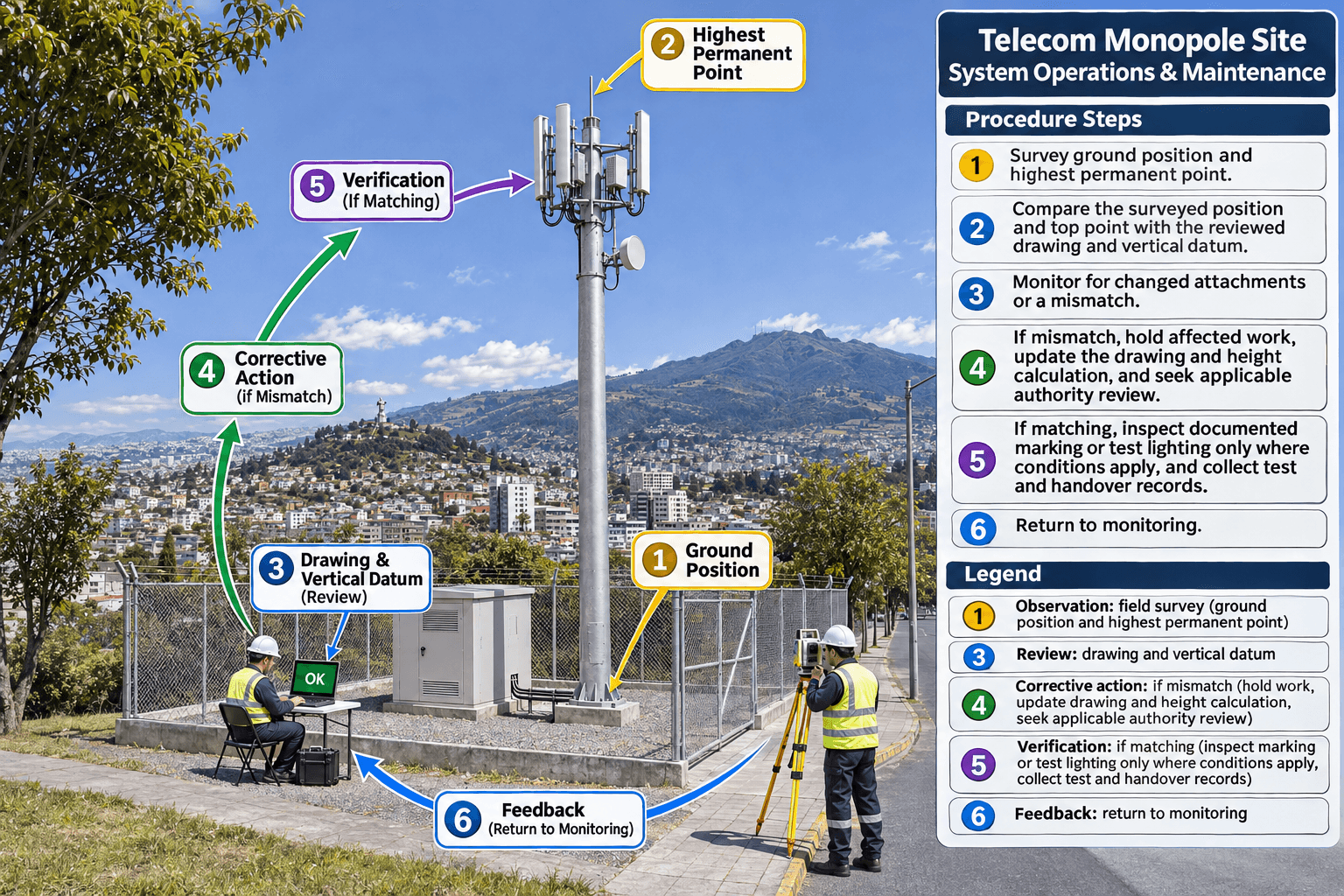
- Hardware acceptance. Where marking applies, inspect the documented pattern and placement against the applicable condition. Where lighting applies, check the supplied equipment and installed positions and exercise the specified operating and monitoring functions under the documented test conditions. Collect the corresponding records for the owner.
- As-built closeout. Compare the surveyed position and final highest point with the reviewed revision. Reconcile differences through the applicable review path and retain any required completion notice, test evidence, and maintenance handover records.
Limitations
The source pack provides enough evidence to define a buyer-side decision gate. It does not identify the competent authority, the applicable local filing criteria, the reviewed parcel, the accepted height envelope, or a lighting or marking requirement for Quito. Those items remain open until the project has a surveyed location and the relevant authority has confirmed the review path for the submitted design. The evidence also does not establish any site wind input, foundation design, selected catalog model, or verified network performance.
Keep aviation disposition and the other project sign-offs visible in the release record. An aviation outcome resolves the questions within its stated scope. Planning, structural, and network design decisions each need their own supporting records. The GSMA handbook provides sector context on passive tower infrastructure and planning oversight. Its general policy discussion supplies no parcel-level evidence for the proposed monopole. GSMA Mobile Policy Handbook — Business Environment
Procurement Questions
- To the permitting lead. Which authority will confirm the review path, what record will close it, and how will we establish that the record covers the drawing we intend to release?
- To the surveyor. Can the reviewer reproduce the top elevation from the ground survey and design drawing, and are the horizontal and vertical references clear across the package?
- To the tower supplier. What model and product PDF support the quote, which PDF pages define the offered configuration and operating conditions, and which antennas, radios, and backhaul items are included or excluded?
- To the engineering lead. Which wind and attachment loads, foundation inputs, and corrosion protection details still require verification, and who reconciles changes with the aviation submission?
- To the installer. How will applicable marking or lighting conditions be converted into installation checks and test records, and who owns any operating or maintenance obligations after handover?
- To the buyer. Which commercial commitments can remain conditional while review is open, and who can release fabrication or hardware procurement once the supporting records are in place?
FAQ
Does this evaluation describe an existing tower in Quito?
No. Quito is solely a proposed site for evaluating a tubular steel monopole. The review begins with a surveyed candidate parcel and a defined design revision.
What evidence should gate final tower-height approval?
Use the surveyed parcel and tower position, the revision-controlled highest-point drawing, and the competent authority's applicable determination or accepted screening record for that configuration.
How should the highest point be documented?
Show the shaft and height-governing attachments, give the height above the surveyed ground reference, and state the corresponding top elevation and vertical datum.
Who decides whether obstruction marking or lighting applies?
Confirm which office, if any, is responsible for deciding whether obstruction marking or lighting applies to the proposed Quito design. Carry aviation hardware as conditional scope until the applicable outcome is documented.
Can the FAA process establish the filing rules for Quito?
No. It illustrates how an external authority screens proposals, studies obstructions, and issues determinations. Obtain the applicable filing rules and technical conditions from the competent authority for the proposed site.
What happens if a later attachment changes the highest point?
Revise the height drawing and calculation, then ask the competent authority whether the change requires an updated submission or determination before releasing the affected work.
Can the catalog establish an exact model and operating conditions?
The supplied catalog establishes the product family and the selectable steel monopole form. Obtain the applicable product PDF to verify the model, referenced pages, and operating conditions before approving a model-specific specification.
What evidence should the buyer collect after installation?
Collect the as-built position and highest-point survey, the applicable marking inspection or lighting test records, and any completion or handover records called for by the disposition and contract.
References
- SOLARTODO telecom tower product catalog. The supplied
city-catalog-2026-11-01-v1extraction establishes the product family and configuration scope. A product PDF link, model, page, and operating conditions were absent from the evidence pack. SOLARTODO telecom tower catalog - U.S. FAA obstruction evaluation overview. External example of notice screening, aeronautical studies, and posted determinations. The overview also lists marking and lighting resources. FAA Obstruction Evaluation Overview
- GSMA policy handbook. General sector context on passive infrastructure and planning oversight. GSMA Mobile Policy Handbook — Business Environment
Proposed Equipment
- SOLARTODO tubular steel monopole from the telecom tower product family
- Antenna equipment, subject to project configuration
- Radio equipment, subject to project configuration
- Backhaul equipment, subject to project configuration