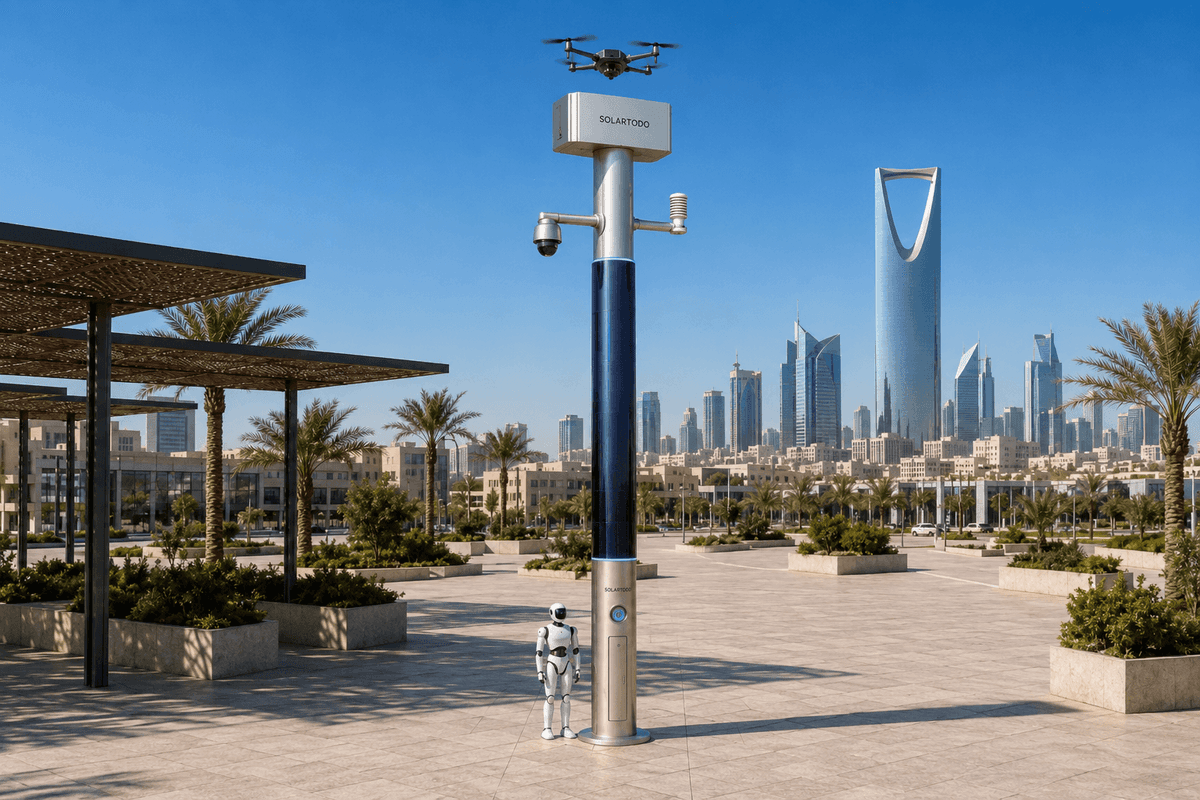
City AI Pole / Sentinel physical-AI edge-node is a non-lighting, fully off-grid urban edge node that combines local compute, sensing, battery-backed solar replenishment, drone operations, robot operations, environmental monitoring and human-authorized security response. In Riyadh, the proposed Sky Hub grid-mesh deployment supports industrial-park incident review by keeping raw data on-pole and sharing only de-identified event metadata.
Incident Context
Riyadh’s industrial districts carry a security load that changes sharply during major sports-event season. Logistics yards extend operating hours, service roads receive temporary traffic surges, contractor vehicles move outside normal windows, and perimeter teams are expected to document incidents without slowing legitimate work. For a city-management stakeholder, the problem is not only detection. The harder task is evidence collection: knowing what happened, where it happened, which field asset responded, whether a patrol was dispatched, and whether the operational record can be reviewed without exporting raw site data.
This proposed case study frames SOLARTODO Sentinel Sky Hub as a grid-mesh deployment across an industrial-park perimeter and internal service corridors in Riyadh, subject to final engineering confirmation. Each Sky Hub is a pure smart pole: a non-lighting intelligent pole hosting sensing, edge compute, energy storage, drone operations and ground robot operations. It is not a utility power accessory. It is designed as a fully off-grid micro-station, with on-pole battery storage and 360-degree wrapped flexible CIGS thin-film solar replenishment. The intent is to place security nodes where city power or site power should not be assumed, including temporary logistics gates, construction-edge perimeters, laydown areas and critical-service access points.
The incident-review structure starts with a practical city task: keep security availability high while generating usable evidence for low-altitude inspection events. A PTZ camera provides the primary security lens, supported by local perception for anonymous vehicle count, crowd density, intrusion and perimeter awareness. When the pole sees an anomaly, the local OTATODO edge OS processes it on-pole, scores it, schedules the next workload and presents the event in a common-operating-picture command view for human review. Raw video and raw sensor streams remain on the pole by default; only de-identified event and status metadata may leave the node.
Grid-Mesh Layout
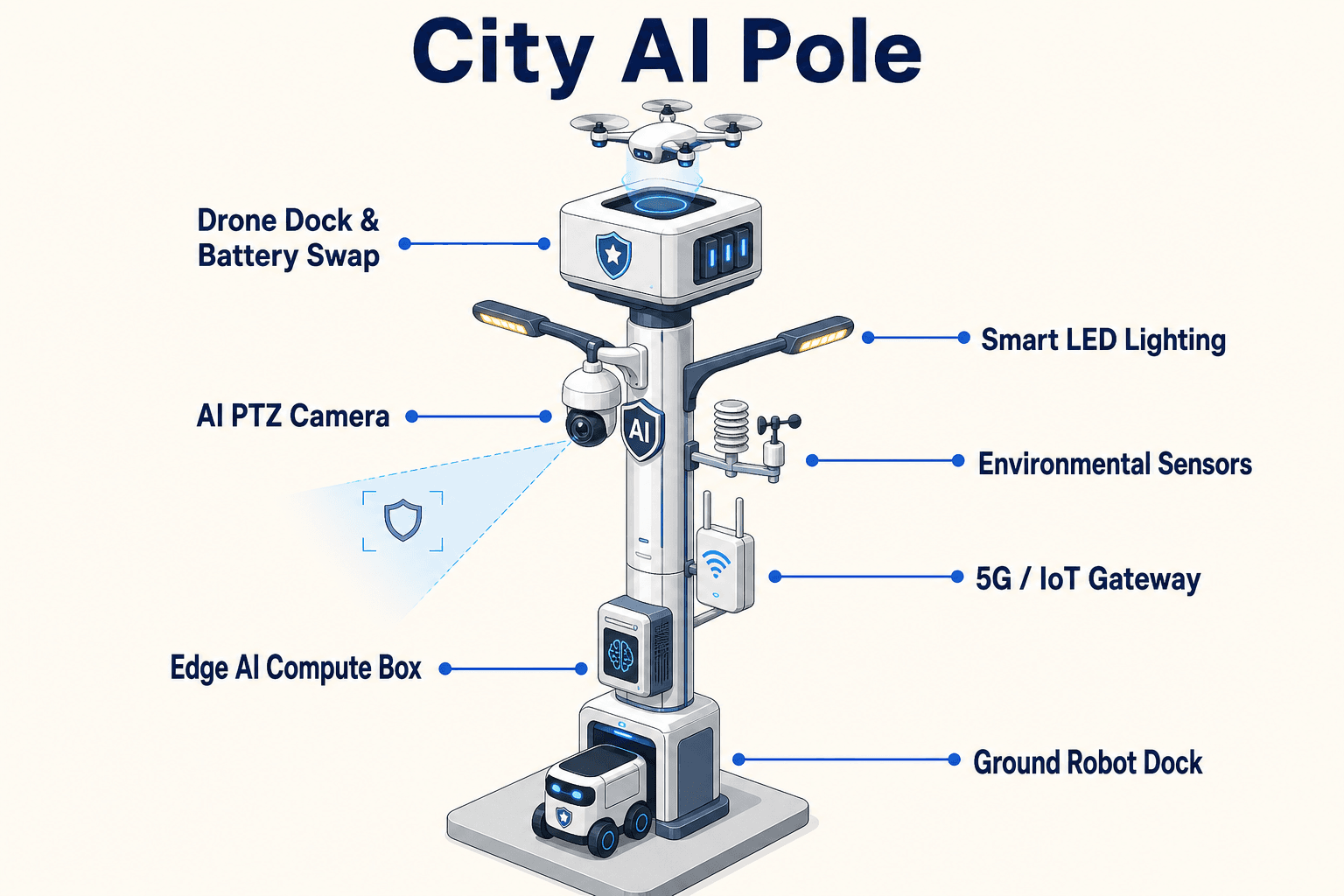
The proposed Riyadh deployment uses a grid-mesh pattern rather than a single showcase pole. A city-management team can place Sky Hubs at perimeter corners, logistics choke points, internal road bends, high-value storage edges and temporary sports-event staging zones. The value of the mesh is operational continuity: if one node is busy with a drone swap, a local patrol task, or battery-conservation scheduling, neighboring nodes continue sensing and sharing de-identified status metadata in the COP. This supports the availability KPI without claiming a specific achieved uptime number.
Sky Hub’s vertical body carries about 15 square meters of 360-degree wrapped flexible CIGS thin-film over an approximately 8-meter-tall, 0.6-meter-wide cylindrical surface. In Riyadh’s high-irradiance conditions, the important planning point is honesty: a vertical cylinder does not collect direct sun across the full wrap at once. The sun-facing projection drives practical output. Clear-sky output is therefore planned at roughly 0.8 to 1.1 kW DC peak, typically peaking in the mid-morning or afternoon rather than at noon, with about 6 to 9 kWh per day of solar replenishment. That solar layer supplements a battery-backed micro-station; it is not a promise of unlimited pure solar self-sufficiency.
For the industrial-park scenario, storage is planned in the 5 to 20 kWh class so higher-power drone and robot tasks can be buffered and scheduled by duty cycle. The grid-mesh operating model lets the COP see which nodes have energy headroom, which drone battery magazines are ready, which robots are docked, and which PTZ views are available for review. The city-management team can then prioritize coverage during event-night vehicle peaks, dust events, loading-yard turnover, and late contractor access windows.
Low-Altitude Inspection Loop
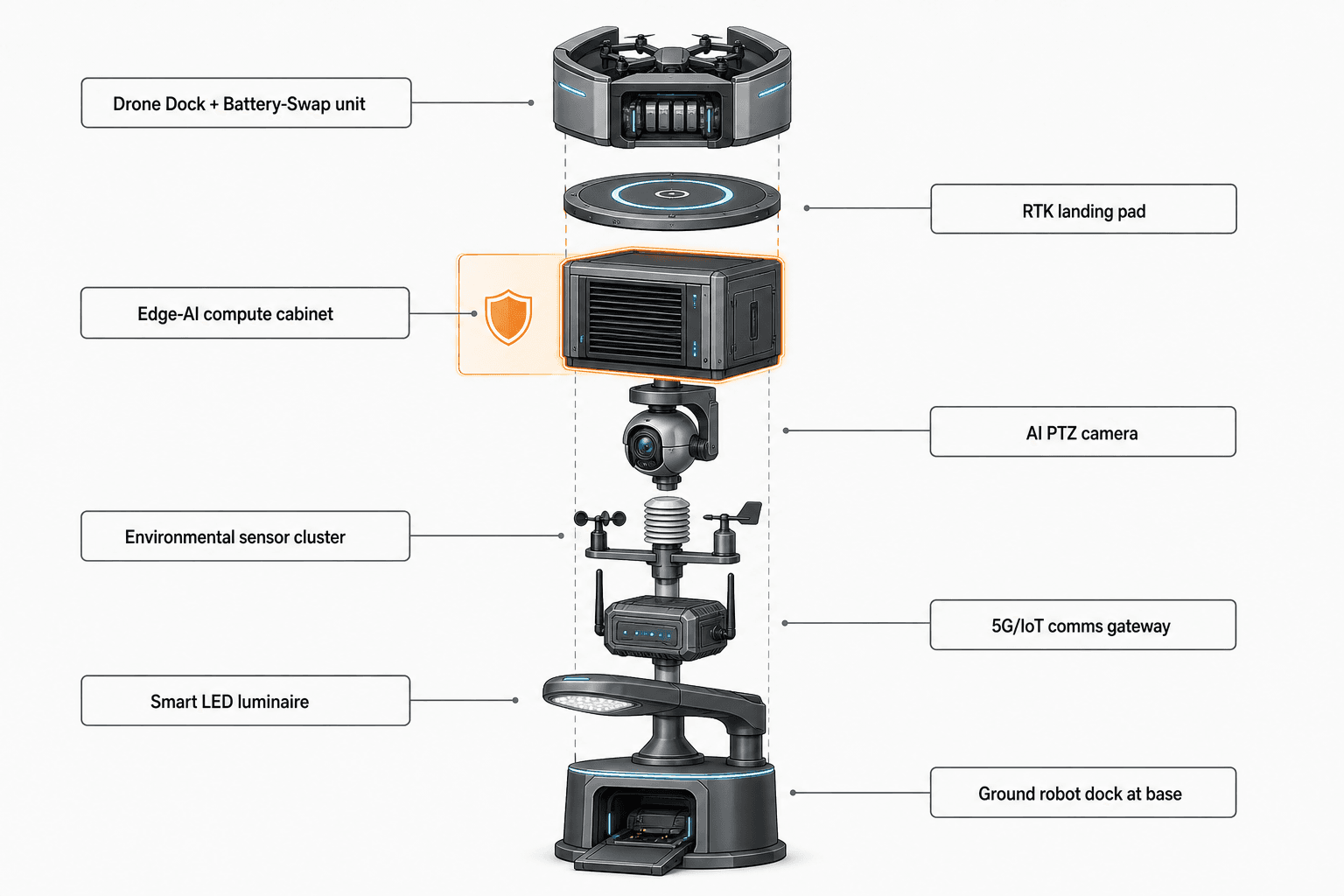
The operational scenario is low-altitude inspection after a security anomaly. A PTZ camera on the nearest Sky Hub performs the first review pass, using local perception to distinguish anonymous vehicle movement, unusual crowd density, perimeter approach or intrusion indicators. The pole does not need to upload raw video for first-stage assessment. OTATODO runs the inference and workload scheduling at the edge, then publishes an event card in the COP with time, node, confidence band, asset status and recommended response options.
If a human operator authorizes aerial review, the node commands its friendly drone to launch, follow a defined route, inspect the low-altitude corridor, and return to the pole. When it lands, a multi-bay battery magazine performs an automated rear-service battery exchange, giving the drone a charged pack and enabling consecutive sorties where the duty cycle and storage budget allow. The same operations-management layer tracks route planning, charge and swap state, task queueing, fleet health and mission logs. No operator needs to stand at the pole during the exchange.
Ground robot operations extend the same incident loop at surface level. A humanoid or service robot can patrol a gate line, approach an alarm location, inspect parked equipment, coordinate with the aerial view and return to the pole base for wireless charging. The robot and drone are operational tools under the COP, not independent enforcement actors. For suspected unauthorized drones, Sky Hub may detect and track the low-altitude object and coordinate a friendly drone for human-authorized, non-kinetic mitigation such as soft aerial net-capture or close-approach deterrence. Radar, if used, is treated only as an optional partner-sensor input, not built-in pole hardware.
Evidence and Data Handling
Evidence collection is the central pain point for this Riyadh case. In a conventional incident review, teams often discover too late that the best camera view was remote, disconnected, overwritten, or buried in a central archive that requires manual correlation with patrol logs. Sky Hub changes the workflow by keeping event formation close to the scene. The PTZ camera, environmental sensors, drone logs, robot task records, battery state and edge-compute decisions are organized as a local incident chain before metadata is shared with the command view.
The operations loop follows the principle of sensing, authorized assessment and response, edge-compute scheduling, then field operations and maintenance. In the COP, that becomes a single incident timeline: the PTZ flagged the anomaly, OTATODO classified it locally, a human authorized a response, the drone or robot performed the inspection, and the node recorded the mission state. This is designed for PDPL-LGPD-oriented local processing, not stated as a certification claim. Raw video and raw sensor data stay on the pole by default; shared records are de-identified event or status metadata suitable for review, escalation and maintenance planning.
Environmental monitoring also supports evidence quality. Wind speed and direction help explain drone launch decisions. Temperature and humidity inform battery and electronics load. Atmospheric pressure, noise, PM10, PM2.5 and illuminance add context for field conditions in a dusty, hot industrial zone. When an incident is reviewed, the city-management team can separate a security event from operational constraints such as wind thresholds, battery conservation, poor visibility, scheduled maintenance or node-to-node workload balancing.
KPI Evaluation
The primary KPI frame is availability: whether the grid-mesh can keep evidence collection, low-altitude inspection and response coordination available during high-demand windows. This case study does not claim achieved availability, coverage area, detection rate, latency or rollout scale. Those values should be established through a site survey, energy simulation, radio planning, privacy review, acceptance testing and final engineering confirmation. The practical evaluation is whether the proposed configuration gives the city-management team a recomputable operating model.
Availability should be tested across three layers. First, sensing availability: PTZ patrol paths, blind spots, local event classification and incident-card generation. Second, field-operation availability: drone launch readiness, battery hot-swap readiness, robot dock readiness, route assignment and return-to-base behavior. Third, energy and compute availability: storage state, solar replenishment forecast, workload scheduling, thermal derating assumptions and node-to-node task handover inside the grid-mesh. A mature deployment plan treats the pole as a physical-AI edge node with an operating budget, not as a fixed camera on a post.
For Riyadh industrial parks, the seasonal sports-event trigger makes the evaluation sharper. Temporary increases in contractors, delivery traffic and perimeter attention can be loaded into the task queue before the event period begins. City-management teams can predefine patrol windows, response authorizations, evidence-retention rules, drone sortie caps and robot patrol cycles. The result is an incident-review workflow that is locally processed, off-grid by design, and oriented around de-identified operational evidence rather than raw-data centralization.
System Configuration
| Parameter | Configuration |
|---|---|
| Pole form | Sky Hub pure smart pole, non-lighting cylindrical physical-AI edge node for industrial-park security operations |
| Energy system | ~15 m² 360° wrapped flexible CIGS thin-film, ~2.4–2.7 kWp nameplate, ~0.8–1.1 kW DC clear-sky practical peak, battery-backed off-grid operation |
| Storage class | 5–20 kWh-class on-pole battery storage, scheduled by duty cycle for sensing, compute, drone and robot workloads |
| Camera | AI PTZ camera for patrol views, anonymous vehicle count, crowd density, intrusion and perimeter awareness |
| Edge AI compute | Jetson-class on-pole inference module, Orin- or Thor-class configuration, local workload scheduling and metadata export control |
| Drone operations | Autonomous launch, patrol, inspection, return, task redeployment and multi-bay rear-service battery hot-swap magazine |
| Robot operations | Ground service or humanoid robot patrol, alarm response, inspection, air-ground coordination and wireless charging at pole base |
How It Works
- On-pole PTZ camera flags a perimeter anomaly and stores raw evidence locally.
- Edge AI classifies the event, scores urgency and creates de-identified metadata for the COP.
- A human operator reviews the incident card and authorizes drone, robot or watch-only response.
- The Sky Hub schedules the field task, checks energy state and launches the approved inspection workflow.
- The node records mission logs, asset state, environmental context and response outcome for incident review.
Planning Assumptions (Indicative)
Illustrative planning inputs a buyer can recompute — target metrics, not achieved results. Subject to final engineering confirmation.
| Metric | Planning assumption | Indicative value |
|---|---|---|
| Inspection labor | Night and event-period low-altitude patrol routes are assigned to drone sorties instead of manual perimeter walks where authorized | ~10–20 patrol routes/week automated as a target planning input |
| Evidence review time | Incident packages combine PTZ event metadata, mission logs, asset status and environmental context before operator review | ~30–50% reduction target for manual correlation effort |
| Availability reserve | Grid-mesh handover lets adjacent nodes continue sensing while one node is charging, swapping drone batteries or conserving power | N+1 local coverage pattern for priority gates |
| Energy scheduling | High-power drone and robot tasks are queued against battery state, solar forecast and event-night duty cycle | 5–20 kWh storage budget per node, recomputed per site |
| False dispatch control | Human-in-the-loop authorization gates drone, robot and C-UAS coordination after local event scoring | 100% of mitigation actions require authorized review |
Deployed Equipment
- Sky Hub non-lighting physical-AI edge-node pole
- 360° wrapped flexible CIGS thin-film solar replenishment layer
- 5–20 kWh-class battery storage and power-management cabinet
- AI PTZ camera with local perception
- Jetson-class on-pole edge compute cabinet
- Autonomous drone bay with multi-bay battery hot-swap magazine
- Ground robot wireless charging dock at pole base
- Nine-parameter environmental monitoring sensor set
Frequently Asked Questions
Is Sky Hub a smart streetlight or a lighting product?
No. Sky Hub is positioned as a pure smart pole and physical-AI urban edge node, not a lighting product. The Riyadh configuration described here focuses on sensing, edge computing, battery-backed off-grid operation, drone operations, robot operations, environmental monitoring and security evidence collection for industrial-park management.
Can the pole run without city power or site power?
The proposed configuration is designed as fully off-grid, using on-pole battery storage plus 360-degree wrapped flexible CIGS thin-film solar replenishment. The solar layer is a supplemental replenishment source, not an unlimited self-sufficiency claim. High-power drone and robot work must be scheduled against storage, weather and duty cycle.
What security evidence leaves the pole?
By default, raw video and raw sensor streams stay on the pole and are processed locally by OTATODO. The command view receives de-identified event and status metadata, such as event type, time, node identity, asset state and mission log references. This supports PDPL-LGPD-oriented local processing without claiming certification.
How does the PTZ camera support the incident-review workflow?
The PTZ camera is the primary evidence-collection module in this Riyadh scenario. It patrols priority views, flags anomalies locally, supports anonymous vehicle count, crowd density, intrusion and perimeter awareness, and anchors the event timeline before drone or robot inspection is authorized by a human operator.
How are drone operations handled during repeated inspections?
A landed drone can receive an automated rear-service battery exchange from a multi-bay magazine, allowing several consecutive sorties when energy budget and operational policy allow. Route planning, charge and swap state, task queueing, fleet health and mission logs are managed through the on-pole operations layer and COP.
What is allowed for Counter-UAS coordination?
The pole may detect and track an unauthorized drone and coordinate its own friendly drone for human-authorized, non-kinetic actions such as soft aerial net-capture or close-approach deterrence. It is not described as using weapons, autonomous attack, shoot-down behavior, RF denial or GNSS denial. Radar is only optional partner input.
Which KPIs should a Riyadh city-management buyer evaluate?
Availability is the main KPI frame for this case: sensing availability, drone and robot readiness, edge-compute scheduling, battery reserve, solar replenishment and node-to-node handover in the grid-mesh. Any final KPI target should be calculated after site survey, radio planning, energy modeling and acceptance testing.
Explore Further
- City AI Pole / smart streetlight product line
- More smart-city deployment cases
- Talk to our engineering team
Planning a similar physical-AI deployment for streets, campuses or public spaces? Request an engineering consultation